Modified Artificial Bee Colony Algorithm with
Multilevel Threshold Segmentation and Boundaries
Evaluation for Shadow Detection
Madhu Shandilya, Rakesh Kumar Das
Abstract- The appearance of shadows typically causes severe problems in pc vision. There are various methods have already put forward but scope in this field is open. In this article Shadow Detection and Removal Using Modified artificial bee colony (MABC) Algorithm with Multilevel Threshold segmentation is proposed. The proposed method uses three threshold and corresponding boundaries, associated curvature, edge response, gradient, and MABC algorithm. First data pre-processing is applied to find the correlation between the pixels then three threshold and corresponding boundaries evaluated to accurately differentiate pixels as foreground. The edge response, curvature, gradient are applied to find the boundaries. Finally, MABC has been applied for detecting the shadow. The results show improvement in comparison with other existing methods. Index Terms -shadow detection, artificial bee colony, curvature, gradient, edge response, boundary value.
I. INTRODUCTION
Shadow free image is required in many situations. In the current scenario, Shadow detection from the image is a challenging assignment and removal of shadow from the image is the latest trend in the PC vision applications like object recognition, image segmentation, and scene interpretation. The published works in this area reflect the large impact [1−4]. Identifying shadow and object tracking are the major shortcoming in the detection method [5-6]. Therefore, there is the need of effective techniques which should take care of boundary values so that exterior and interior regions should be classified. Most shadow detection and removal strategies are supported many assumptions like : (i) shadow area are dark as compare to the background; (ii) shadow always occurs neighbouring to the moving objects (iii) illumination direction of the source and strength must be known. Various color-based [7], edge-based [8], change in texture-based [9], and other methodology have successfully brought the desired objectives. In 2016, Su et al [10] discussed the shadow detection in case of satellite images. They have considered bimodal histogram which depends on the pixel density of shadow. They have used the mean value of the two peaks for thresholding in the histogram function. In 2017, Mostafa et al [11] discussed SDI (shadow detector index) to find a shadow in remote sensing images.They have considered RGB color band to identify the shadow pixel intensity then automatic threshold applied in the histogram. In 2017, He et al [12] describe a methodology that used 3D surface modeling.
Revised Manuscript Received on September 03, 2019
MadhuShandilya, Professor in electronics and communication engineering department, Maulana Azad National Institute of Technology, Bhopal, India.
Rakesh Kumar Das, received the BE degree in Electronics and communication engineering from RGPV University and the M.Tech in digital communication from MANIT Bhopal, India.
They suggested that the surface intensity of the shadow region may be obtained by considering the same texture in the area of non-shadow region. They have used technology that is image decomposition in which edge-preserving filter is registered to extract the details of the texture in the shadow region. In 2018, Tomas F. Yago et al [13] discussed the leave one-out error. They have used eight kernel values, the kernel weights (wL, wa, wb,wt) and the scaling factors (σL, σa, σb, σt). They have defined eight grids and each grid has a close similarity to a kernel value. The distinct values for σt make a set of mean distance. They have proposed the least square support vector machine LS-SVM to find the shadow probability in the image region. In 2018, Xudong Kang et al [14] discussed a method based on the collection of training sample to get a detection map. They have integrated the shadow pixels and correlations among adjacent pixels. They have also proposed a high resolution shadow detection methodology based on random walker approach. They have used Otsu for the threshold value detection and support vector machine as the classifier for the pixel classification. Then random walker model has been used for the refinement in the initial classification map to improve shadow detection accuracy in satellite images. In 2019, Das and shandilya [15] discussed the efficient artificial bee colony (ABC) with boundary value segmentation. In this method, the hybridization of association rules, Otsu approach, gradient segmentation, and ABC algorithm are used. First the data pre-processing has been applied for adjoin and adjacent matrix. Then association rules have been applied for adjoin and associated pixels and joint correlations have been formed. The Otsu’s approach and gradient segmentation have been applied. It is beneficial in threshold value estimation in case of intra class variations also. Finally, the ABC algorithm has been applied for the final object detection and tracking.
II. METHODS
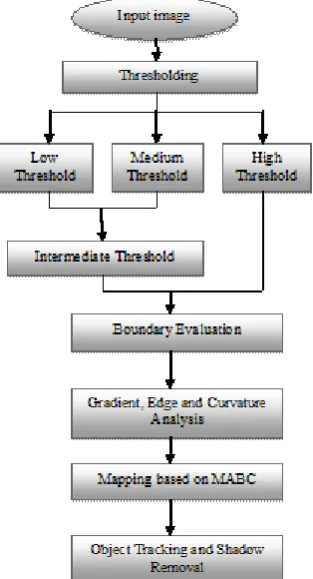
Our approach uses three thresholds to distinguish pixels as foreground after getting three thresholds we calculate corresponding boundaries and MABC algorithm is used for final shadow detection as the classifier. The approach is divided into four categories: 1) Image pre -processing 2) thresholds selection and corresponding boundaries 3) Curvature, edge response and gradient analysis 4) MABC algorithm. First the image pre-processing has been performed to find the correlation matrix and the adjacent neighbour matrix. Based on correlation three thresholds are adaptively determined which is used to generate
corresponding boundaries.
After getting the
analysis is performed to find in which direction and what rate the value of pixels change. The edge response and curvature evaluation are used for complete mapping and smoothness of the curve. The algorithm 1 shows our approach. Figure 1 shows the proposed architecture. Algorithm 1: Modified Artificial bee colony with three thresholds and corresponding boundaries Step 1: Image as input
Step2:Apply triangle methods on histogram function that is a line drawn between peak and largest nonzero value then the distance between the line and histogram is calculated at the right angle, the maximum distance is taken as the threshold,
T(j)=
where j=L,M,H corresponding to low, medium and high threshold.N1 represent the number of pixels in P1 and N2 represents the number of pixels in P2. P1 is the false positive pixels and P2 is the true positive pixels.C1 and C2 is the modes of P1 and P2.
[image:2.595.90.247.333.623.2]Step 3: Based on thresholds and corresponding boundaries population of the solution is calculated.
Figure 1: Proposed architecture for shadow detection and removal.
vij = xij +(1-φ)( xkj- xij)+ φ(bestj- xij)
where k (1,2,…..m) and j (,2,…..D) , Φ is a random number between [0,1]. And bestj is the current population which leads to improve the searching performance of ABC.
Step 7: Minimize the problems
Let the fitness gain as Fv and σi is objective function then two possibilities occur:
Case 1: σi ≥0 Fvi =
Case 2: Otherwise Fvi = 1 +
Step 8: Repeat the search process that is step 6 till condition is satisfied.
Step 9: Finally tracking the object for shadow detection.
III. RESULTS AND DISCUSSION
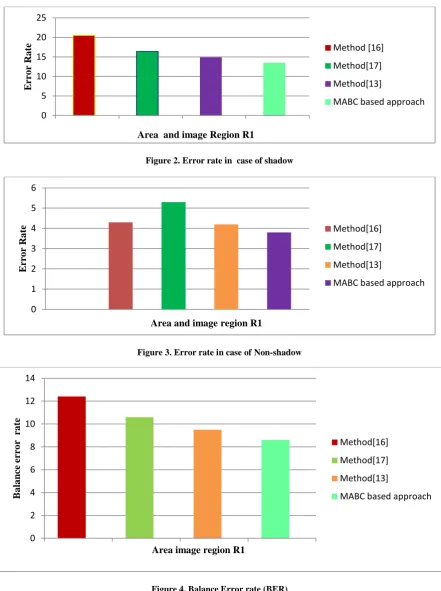
For experiment image of IKONOS is considered. The parameters considered to evaluate the shadow detection performances are overall accuracy (OA), Error Rate(ER) and Balance Error Rate (BER).
Overall Accuracy (OA)
Error Rate (ER)
*100%
Balance Error Rate (BER)
[image:3.595.75.517.69.310.2]
Figure 2. Error rate in case of shadow
Figure 3. Error rate in case of Non-shadow
Figure 4. Balance Error rate (BER) 0
5 10 15 20 25
E
rr
o
r
Ra
te
Area and image Region R1
Method [16]
Method[17]
Method[13]
MABC based approach
0 1 2 3 4 5 6
E
rr
o
r
Ra
te
Area and image region R1
Method[16]
Method[17]
Method[13]
MABC based approach
0 2 4 6 8 10 12 14
B
a
la
n
ce
erro
r
r
a
te
Area image region R1
Method[16]
Method[17]
Method[13]
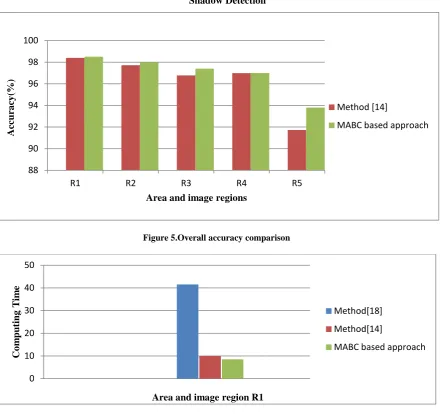
[image:3.595.74.518.416.624.2]Figure 5.Overall accuracy comparison
Figure 6.Computing time (in seconds) for processing an imag e
IV. CONCLUSION
In this paper, we propose a modified artificial bee colony method MABC using three-level of thresholds and boundary evaluation has been proposed, the concept of a gradient, curvature evaluation, and edge response help to enhance the accuracy. MABC is used to optimize the search process and to find the segmented and associated pixels for shadow detection. The accuracy, error rate, balance error rate and computing time compare well with the existing approach the result shows that the proposed method better than the previous one and other existing change detection methods.
REFERENCES
1. Bai T, Shiquan, D. Multi-scale hierarchical sampling change detection using Random Forest for high-resolution satellite imagery. International Journal of Remote Sensing , 2018, 39: 1–24.
6. Weidong Min ,Qing Han.A New Approach to Track Multiple Vehicle With the Combination of Robust Detection and Two Classifiers.IEEE Tansactions on intelligent transportation systems, no.1,vol. 19(pp174-186) january 2018.
7. Huerta. I, Gonzlez .J. Chromatic shadow detection and tracking for moving foreground segmentaion segmentation, Image and Vision Computing.Vol. 41, 2015:42-53
8. 8. Wang.J. ,Song.M. Moving cast shadow detection using online sub-scene shadow modeling and object inner-edges analysis. Journal of Visual Communication and Image Representation, Vol. 25, No. 5, (pp.978-993), 2014.
9. 9. B. N. Subudhi, Ghosh.A .Integration of fuzzy markov random field and local information for separation of moving objects and shadows.Information Sciences, Vol. 331, 2016:15-31
10. 10. N. Su,Miao.X. Shadow Detection and Removal for Occluded Object Information Recovery in Urban High-Resolution Panchromatic Satellite Images, IEEE journal on geoscience and remote sensing, no. 6, vol 9, June 2016.
11. 11. Mostafa Y, Abdelhafiz A. Accurate shadow detection from high-resolution satellite images. IEEE Geoscience and Remote Sensing Letters. 2017 Feb;14(4):494-8.
12. 12. He et al. Single Image Shadow Removal Using 3D Intensity 88
90 92 94 96 98 100
R1 R2 R3 R4 R5
Acc
ura
cy
(%)
Method [14]
MABC based approach
Area and image regions
0 10 20 30 40 50
Co
m
pu
ting
T
im
e
Area and image region R1
Method[18]
Method[14]
14. 14. Xudong Kang,Yufan Huang et al .Extended Random Walker for Shadow Detection in Very High Resolution Remote Sensing Images.IEEE Transaction on Geoscience and remote sensing,vol 56,no2,pp.867-876,Feb 2018.
15. 15. Rakesh.Das,M.Shandilya,”An efficient artificial bee colony with boundary value segmentation for shadow Detection”, Inter. J. Engg. and Advanced Tech.(IJEAT), ISSN:2249-8958 ,Volume 8,Issue-5,PP 1963-1967 June 2019.
16. 16. T. F. Yago,D. Samaras et al.Single image shadow detection using multiple cues in a supermodular MRF. in Proc.. Vis. Conf.,( pp. 126.1–126.12),2013.
17. 17. S. H. Khan.et al. Automatic feature learning for robust shadow detection.in Proc. IEEE Conf. Comput. Vis. Pattern Recognit., 2014:1939-46.
18. 18. H. Li, Shen.H. An adaptive nonlocal regularized shadow removal method for aerial remote sensing images, IEEE Transactions. Geoscience and Remote Sensing ,vol. 52, no. 1,( pp. 106–120), Jan. 2014.
AUTHORS PROFILE
MadhuShandilya received the B.E(electronics),M.Tech(Digita l-communication) and Ph.D degree. She is currently a Professor in electronics and communication engineering department, Maulana Azad
National Institute of
Technology, Bhopal, India. She co-authored more than fifty research papers and published
Rakesh Kumar Das was born in Araria, Bihar, India. He received the BE degree in Electronics and communication
engineering from RGPV
University and the M.Tech in digital communication from MANIT Bhopal,India, in 2013. He is presently pursuing the Ph.D. degree from MANIT Bhopal on the topic “Shadow detection and removal from high resolution images”.
in various national, international journals and conferences on image processing. Her main interests include image and video processing and digital geometry processing.