International Journal of Innovative Technology and Exploring Engineering (IJITEE) ISSN: 2278-3075, Volume-8 Issue-9, July 2019
Abstract: Digital signal processing is most widely used to process the signal. In digital signal processing filters are used to remove some unwanted constituents from aspired signal. Windowing is a scheme of finite impulse response filters. Present paper proposes a new versatile window function. It has two variable parameters first one is window span N and another changeable parameter is r. when the value of variable parameter r increases width of major lobe of window also increases with better side lobe reduction and vice versa. Gaussian window and Kaiser window are the well-known variable windows. This paper shows that the proposed window has more desirable results in comparison of Gaussian and Kaiser window with low power loss and better side lobe reduction. To achieve minimum power loss peak side lobe level should have to minimum. Proposed window has low peak side lobe level (-17.681dB) in comparison of Gaussian (-11.836dB) and Kaiser window (-6.9704dB). Proposed work shows that the proposed window has finer spectral characteristic then Gaussian and Kaiser window.
FIR filter formed by applying proposed window has narrow -3dB bandwidth (2π×0.320 rad/sample) corresponding to FIR filter formed by using Gaussian and Kaiser window. Ripple ratio of FIR filter plotted by applying proposed window (-144.321dB) is less corresponding to FIR filter delineated by using Gaussian and Kaiser which indicates that the proposed window will give better side lobe rejection and reduce the aliasing problem. In the biomedical field noise present in ECG signal can also reduce by using proposed window.
Index Terms: FIR filter, Gaussian window, Kaiser window, spectral characteristics of window function.
I. INTRODUCTION
To
remove some unwanted components from a signal, filters should be used. Digital signal processing is a type of signal processing that most widely used to process a signal. Digital filters possess much superiority over analog filters which make them superior over analog filters. Finite impulse response (FIR) and Infinite impulse response (IIR) digital filters are the types of digital filter. As the name of filters define that the FIR filter shows impulse response in finite span and impulse response of IIR filter continue to infinitely with internal feedback.FIR filters possess ascendency over IIR filters because; i. They shows Unconditional stability
ii. They have Linear phase response iii. They are reliable
iv. They shows Finite duration response
Revised Manuscript Received on July 05, 2019.
Poonam Parmar, Department of Electronics Engineering, Madhav Institute Of Technology and Science, Gwalior, India.
Rahul Dubey, Department of Electronics Engineering, Madhav Institute Of Technology and Science, Gwalior, India.
Karuna Markam, Department of Electronics Engineering, Madhav
FIR filters response settle to zero in finite duration. Causal FIR filter can simply derives from Non-causal FIR filter because of their reliability.
A. FIR filter design
There are mainly three methods to design a filter; a. The frequency sampling method
b. The window method c. The optimal method
Windowing is most widely used designing method of FIR filters. It has very low complexity which makes it very popular.
In the window design procedure, first derive the ideal IIR filter then multiply it with window function which has finite window length. Its outcome will be a FIR filter. Response in frequency domain of this finite impulse response filter is improved from that of the IIR filter. This paper proposed a new variable window function and compares it with the well-known Gaussian and Kaiser window.
[image:1.595.309.546.485.694.2]II. PARAMETERSOFWINDOWFUNCTION There are some parameters of a window function. On the basis of these parameters finer results of window can be shown. Those parameters are given as;
Figure 1: parameters of window function
Proposing a new variable window for better side
lobe reduction
Major lobe width:
The major lobe width of a window should be as narrow as possible to achieve better resolution.
Ripple ratio:
Ripple ratio is the ratio of peak side lobe value and amplitude of main lobe. It should be minimum for getting good results. In decibels it defines as;
Ripple ratio = peak side lobe level(in dB) – major lobe peak value(in dB) = B – A
Side-lobe fall off ratio:
To neglect the far end interference side lobe fall off ratio should be high. It is the ratio between the peak side lobe level and minimum side lobe level. In decibels it defines as; Side lobe fall off ratio = peak side lobe value(in dB) – minimum value of side lobe level(in dB) = B – C
Peak value of side lobe :
To reduce the power lose first side lobe peak value should be low.
III. SOMEORDINARYVARIABLEWINDOW Gaussian window: Gaussian window is a variable window with the variable parameter α. Gaussian function is given as:
w(n) = (1)
α is proportional to inverse of σ . Here, σ ≤ 0.5
Response of Gaussian window can be change by varying the value of α. There are some results shown for different value of α.
[image:2.595.314.550.51.247.2]“Fig.2” clearly indicates that when value of α increases, response becomes narrow and vice versa. Hence it can be seen that by varying value of α window can be adjusted.
Figure 2: Time domain response of Gaussian window for distinct value of α
[image:2.595.53.289.500.722.2].
Figure 3: Frequency domain response of Gaussian window for distinct value of α
Similarly, in “Fig.3” with higher value of α Gaussian window shows better side lobe rejection but main lobe width increases which is not good for better response. Hence α=2.4 will be the value for this paper to compare with proposed window.
Kaiser window: It is another variable window function with the variable parameter β and it is given as;
w(n) = where, 0 ≤ n ≤ N (2)
Where I0 = Zero order Bessel function and β = πα.
Leakage factor of Kaiser window can be minimize by increasing the value of β. For β=0.5, leakage factor is 8.36% and as the value of β increases leakage factor reduces for example when β=10 leakage factor will be 0% but main lobe width also increases with increasing value of β. Hence in this paper Kaiser window is compared with proposed window for variable value β=5.
[image:2.595.313.541.518.692.2]International Journal of Innovative Technology and Exploring Engineering (IJITEE) ISSN: 2278-3075, Volume-8 Issue-9, July 2019 “Fig.4”, represents a time domain results of Kaiser window
[image:3.595.315.550.52.278.2]for distinct value of β. As the value of β increases window becomes narrow with zero percent leakage factor.
Figure 5: Frequency response of Kaiser window for distinct value of β
In “fig.5” frequency domain response of Kaiser window shows that, with the decreasing value of β main lobe width is also decreases but ripple ratio will achieve higher value.
IV. PROPOSED WINDOW For designing a more efficient window function;
a) reduce the height of the side lobe which causes the ripple
b) reduce Gibb’s phenomena
c) width of major lobe should be narrow
It is known that, with reduction of main lobe width, height of side-lobe will increase and vice versa. These two are contradictory conditions so this paper presents a window which doesn’t have too large main lobe width with higher side lobe reduction.
The proposed window is a fusion of two cosine series and another proposed window [1]
p(n) = 0.591 – 0.664cos ) – 0.085cos (3)
(4)
p2(n) = 0.42 – 0.5cos( ) + 0.08cos( ) (5)
p3(n) = 0.5 – 0.5cos (6)
The proposed window function is;
w(n) = [{p1(n)*p2(n)}*p3(n)]
r (7)
Where, n = 0 to (N-1)
[image:3.595.47.284.91.316.2]N represents the length of window and r is a changeable parameter. Proposed window depends on two variables, a)length of window N b) changeable parameter r. In this paper window length is N=64.
Figure 6: Proposed window response for distinct value of variable r in time domain
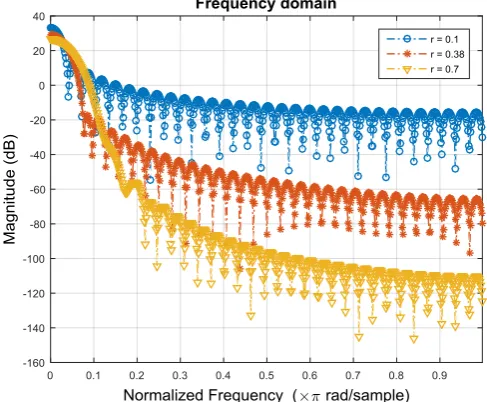
In “fig.6”, when value of r increases the window becomes narrow. For higher value of r leakage factor is 0%. In this paper value of r taken as 0.38 which gives 0% leakage factor and finer side lobe rejection with not too wide main lobe width.
In “fig.7”, with increasing value of r width of major lobe increases and shows superior side lobe rejection. Wider main lobe width is not a good property. Hence r=0.38 is the value that gives finer side lobe rejection with not too wide main lobe width.
[image:3.595.306.550.443.644.2]V. COMPARISON OF PROPOSED WINDOW
To compare proposed adjustable window with Kaiser and Gaussian window, value of variable r is 0.38. Fix the value of variable parameter α, β and r so that the difference between the main lobe widths of these windows is not too high and then compare the side lobe rejection parameters. It can simply show the better response of proposed window.
[image:4.595.308.545.55.257.2]A. Gaussian window and proposed window
Figure 8: Gaussian and proposed window response in time domain
[image:4.595.48.284.148.353.2]“Fig.8” shows that the Gaussian window has leakage factor 0.02% whereas the proposed window gives 0% leakage factor. Proposed window is narrower than Gaussian window. Similarly in “Fig.9”, major lobe width of proposed window (2π×0.0761 rad/sample) is narrow in comparison of Gaussian window (2π×0.0996 rad/sample). Peak side lobe of Gaussian window is -11.836dB and proposed window has side lobe peak value -17.681dB. It is clear that the Gaussian window has more power loss in comparison of proposed window.
Figure 9: Gaussian and proposed window response in frequency domain
[image:4.595.306.550.500.711.2]B. Kaiser window and proposed window
Figure 10: Kaiser and proposed window time domain response
In “Fig.10”, proposed window has narrow bandwidth than Kaiser window with 0% leakage factor. Kaiser window has leakage factor 0.02%. Power loss in proposed window is less in comparison of Kaiser window.
According to “fig.11”, Kaiser window gives major lobe width 2π×0.0605 rad/sample whereas the major lobe width of proposed window is 2π×0.0761 rad/sample. Peak side lobe level of Kaiser window is -6.9704dB and proposed window gives peak side lobe level -17.681dB. Here, it can be said that the Kaiser window has higher power loss in comparison of proposed window. Ripple ratio and fall off ratio of proposed window are -46.768dB and 47.886 whereas Kaiser window gives ripple ratio -37.690dB and side lobe fall off ratio -11.836dB. On the basis of these parameters value it can be said that the proposed window gives superior results in comparison of Kaiser window.
[image:4.595.48.292.511.741.2]International Journal of Innovative Technology and Exploring Engineering (IJITEE) ISSN: 2278-3075, Volume-8 Issue-9, July 2019
Table I: Comparison of proposed window parameters with Gaussian and Kaiser window
window Main-lobe
width (rad/sample) Peak side lobe level (in dB) Ripple Ratio (in dB) Side lobe fall off ratio (in dB) Proposed window (r=0.38)
2π×0.0761 -17.681 -46.768 47.886
Gaussian window (α=2.4)
2π×0.0996 -11.836 -42.044 14.186
Kaiser window (β=5)
2π×0.0605 -6.9704 -37.690 23.810
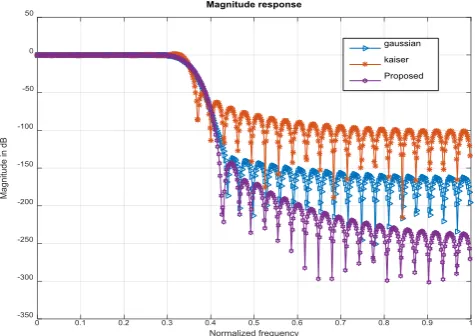
VI. PERFORMANCEANALYSISOFTHEFILTER FIR filter can be formed by applying the window function. It is an application of window function. Here a low pass FIR filter formed by applying Gaussian, Kaiser and proposed window. Spectral parameters of windows show that the proposed window has superior results than Gaussian and Kaiser window.
“Fig.12”, shows the spectral characteristic of low pass filter formed by using Gaussian, Kaiser and proposed window. It can be clearly shown that the FIR filter formed by using proposed window gives superior side lobe rejection than FIR filter formed by using Gaussian and Kaiser window.
[image:5.595.47.292.671.793.2]Figure 12: spectral analysis of FIR low pass filter design by using Gaussian, Kaiser and proposed window Table II: spectral parameter of Low pass FIR filter design by using Gaussian, Kaiser and proposed window
window -3dB
Main-lobe width (rad/sample)
Ripple Ratio (in dB)
Side lobe fall off ratio (in
dB)
Proposed window (r=0.38)
2π×0.320 -144.321 94.401
Gaussian window (α=2.4)
2π×0.324 -136.038 27.038
Kaiser window
(β=5)
2π×0.335 -50.462 50.327
VII. CONCLUSION
There are some well-known variable windows as Gaussian window and Kaiser window. Present paper proposed a new adaptable variable window which is a function of cosine series and another proposed window[1]. Compare the proposed window with Gaussian and Kaiser window on the basis of spectral parameter of window function by fixed the variable value of proposed window r=0.38. Spectral characteristics show that the proposed window has finer results in correspondence of Gaussian and Kaiser window. Proposed window gives the response with decreasing side lobes which reduces the aliasing problem. After that the low pass FIR filter formed by using the proposed, Gaussian and Kaiser window. FIR filter formed by using proposed window has -3dB bandwidth value 2π×0.320 rad/sample which is less than Gaussian (2π×0.324 rad/sample) and Kaiser (2π×0.335 rad/sample) and ripple ratio of low pass filter formed by using proposed window is -144.321 which is better in comparison of Gaussian(-136.038dB) and Kaiser (-50.462dB). Side lobe fall off ratio of low pass FIR filter formed by applying proposed window function (94.401dB) is large in comparison of designed by applying Gaussian (27.038dB) and Kaiser (50.327dB) window which results the better side lobe rejection and reduce the far end interference. Proposed window also have application in biomedical field. By using the proposed window function noise present in ECG signal can rectified.
REFERENCES
1. An Adjustable Cotangent Based Window Function for Designing an FIR Filter by Mitun Shil1, Talat Mahmud Osman Goni, Chandan Nath and Hrishi Rakshit. 2017 IEEE International Conference on Smart Technologies and Management for Computing, Communication, Controls, Energy and Materials (ICSTM), Veltech Dr.RR & Dr.SR University, Chennai, T.N., India. 2 - 4 August 2017. pp.344-348. 2. Aman Gupta and U. M. Chaskar “Hardware implementation and
reduction of Artifacts from ECG signal” 2015 International Conference on Information Processing (ICIP) Vishwakarma Institute of Technology. Dec 16-19, 2015
3. “An Adjustable Window-Based FIR Filter and Its Application in Audio Signal De Noising”, Md Altab Hossin Mitun Shil2, Vu Thanh Ngo Tung Son 4. 2018 3rd International Conference on Robotics and Automation Engineering
4. International Conference on Energy, Communication, Data Analytics and Soft Computing (ICECDS-2017). “A Hybrid Window Function to Design Finite Impulse Response Low Pass Filter with an Improved Frequency Response”, Dr.T.Kalpalatha Reddy, D .Kalaiyarasi. 5. Proakis and D. G. Manolakis, Digital Signal Processing fourth edition,
Prentice-Hall, 2007.
6. Andreas Antonious, “Digital Signal Processing : Signal, System and Filters”, TataMcGraw-Hill Education, ISBN: 0071454241, 2006. 7. “A New Adjustable Window Function to Design FIR Filter and Its
AUTHORS PROFILE
Poonam Parmar, PG Scholar in Madhav Institute of Technology and Science, Gwalior, M.P., India. E-mail: [email protected]
Dr. Karuna Markam, Currently she is working as assistant professor in MITS Gwalior, India. She completed her PhD from Barkatullah University, Bhopal. Her area of interest is Communication System.
E-Mail: [email protected]
Dr. Rahul Dubey, Currently he is working as assistant professor in MITS Gwalior, India. He did PhD from MANIT Bhopal. His area of interest is Digital Signal Processing.