The process of self-identification of foreign students at the Technical
University
Venera Zaylalova*, and Ildus Zaylalov
Ufa State Petroleum Technological University, Branch of the University in the City of Oktyabrsky, 54a, Devonskaya St., Oktyabrsky, Republic of Bashkortostan, 452607, Russia
Abstract. In this article we present the empirical base of the study, which consists of data obtained from social surveys of students of the branch of the Ufa State Oil Technical University in Oktyabrsky. The nationality of the respondents was stated according to self-identification of representatives of different nationalities living in the territory of different countries of the near and far abroad. The study involved 114 respondents aged from 17 to 21. The study applied a wide range of methods for collecting and processing empirical information. The authors applied some diagnostic techniques and methods of information collection used in the works of Russian researchers. The questionnaire (social survey) was used to study general demographic information, as well as to study the affective component of the national consciousness of foreign students – a sense of national identity and related emotional experiences.
1 Introduction
In the first decades of the twenty-first century many countries became interested in expanding economic, political and cultural ties. In this regard, the demand for training foreign students to interact professionally at the international level has increased. Russia is no exception. But foreign students face the challenge of entering a new socio-cultural environment (different languages, cultural traditions, another system of education in universities, living conditions, etc.). And since students are mainly represented by young people, the above-mentioned causes certain difficulties and especially self-identification. Self-identification is a complex process of individual socialization, which includes transition to a completely different level of life, interaction with new people, a different culture, the tight time frame of the education process, an attempt to get involved in this process as quickly as possible.
2 Materials and methods
To draw up the questionnaire questions we used the developed questionnaires tested in the studies by A.A. Kozhanov, T.A. Titova, S.V. Ryzhov, A.P. Okoneshnikova, Z.V. Sikevich, V.IU. Khotinets. The questions of the questionnaire were grouped into several blocks for foreign students of the USPTU branch in Oktyabrsky, which make up the largest number of all students: 1. Representatives from Arab countries (Iraq, Yemen, Syria, Egypt). 2. Representatives from African countries (Angola, Mozambique, Congo) 3. Representatives from the CIS (Uzbekistan, Tajikistan,
Kazakhstan). The questions covered the following aspects: a) the language of communication; b) cultural interests; c) material culture; d) ethnic orientation; e) psychological orientation.
To determine the socio-psychological level in the structure of national identity we took into account the ethno-affiliative attitudes (by S.V. Ryzhova and G.U. Soldatov) [1] and processed the responses of respondents. This revealed certain patterns of foreign students' needs in national identity itself. So the following statements were included in the questionnaire: "I never forget that I am a representative of my people", in the alternative - "My nationality and nationality of others does not matter for me." The reaction to this statement was also combined with the statement: "Is it necessary for a modern person to feel truly part of a certain nationality?».
3 Results and discussions
The option "I never forget that I am a representative of my people" was chosen by 81% of students from Arab countries, 90.5% of students from African countries, 72% of students from the near abroad, 49% of representatives from the Russian Federation to compare with the total number of students surveyed. The alternative option "My nationality and nationality of others does not matter for me" was shared by 19% of the Arab students, 9.5% of African students, 18% of students from the near abroad, 51% of students from the Russian Federation.
ethnicity is most expressed among Arab and African students, less expressed among students from the near abroad and the Russian Federation. A pronounced ethno-affiliative attitude complex among students from foreign countries is, in our opinion, a certain reflection of a positive image of "We".
This conclusion is confirmed by the answers to the question of whether it is necessary for a modern person to feel truly part of a certain nationality. 91% of students from far abroad, 87% from neighboring countries and 52% of students from the Russian Federation agree with the statement that "a person needs to feel truly part of their national group". The alternative statement "Modern people do not have to feel truly part of a certain nationality" is supported by 9% of students from the far abroad, 13% from the near abroad, 48% from Russia. At the same time, Arab students demonstrated a higher level of national dominance (97%) than those of other ethnic groups. Among the respondents, ethnic interests are defended by 87% of African students, 72% of the near abroad students, 68% of Russian students.
The study revealed rather low indicators of indifference to national problems: a small number of respondents identified themselves as people who "never take interethnic problems seriously."
A questionnaire on the ethnic identity level was also composed based on J. Finney [2], which allows determining the sense of belonging to one's ethnic group, cognitive and affective components of ethnic identity
.
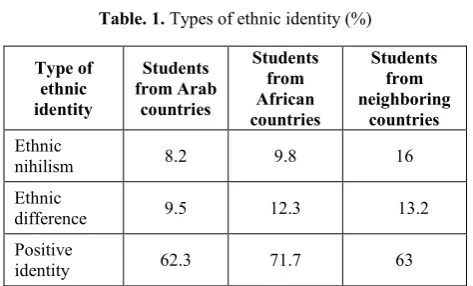
The data presented in table 1 indicate that ethnic nihilism is characteristic to a greater extent of respondents identifying themselves with the Russian people, although ethnic nihilism is the least severe attitude in general among the compared groups. It is considered that ethnic nihilism is expressed in the students' unwillingness to support their own ethnic and cultural values, a sense of ethnic inferiority, exclusion, shame for members of their ethnic group, and sometimes negative attitude towards them. This type of identity is considered a special case of the general defense mechanism of negation. In our opinion, this type of identity is more typical for representatives of ethnic groups with limited experience of clashes with people of a different ethnic group, so they usually have a limited, stereotypical set of ideas about the "others". It is believed that representatives of ethnic minorities are less inclined to "deny" their orientation compared with representatives of the dominant ethnic groups, which is confirmed by our data. As can be seen from the table, the representatives of dominant ethnic groups have the lowest percentage arranged by the type of identity "ethnic nihilism" among the studied ethnic groups.
[image:2.595.306.543.87.230.2]Ethnic indifference is largely superior to ethnic nihilism in all the studied samples; however, this type of ethnic identity was most pronounced in the group of respondents from the Russian Federation. We understand ethnic indifference as an indifferent attitude of a person to the problems of interethnic relations, to the values of his/her and other peoples.
Table. 1. Types of ethnic identity (%)
Type of ethnic identity
Students from Arab
countries
Students from African countries
Students from neighboring
countries
Ethnic
nihilism 8.2 9.8 16
Ethnic
difference 9.5 12.3 13.2
Positive
identity 62.3 71.7 63
Ethnic indifference leads to the fact that a person's behavior is not influenced by his or her ethnicity or the ethnicity of other people. Our findings are consistent with the results of studies (table 1) which emphasize that the importance of personal ethnicity is not relevant for the group of the national majority (e.g. the representatives from the Russian Federation), especially in a peaceful national environment. At the same time, these studies confirm that representatives of national minorities, as a rule, distinguish their ethnicity because it is the most stable side of their self-consciousness and allows them to emphasize the obvious ethno-cultural specificity of their group. The comparison of this type of ethnic identity led to the recognition of similar characteristics of ethnic indifference, which place ethnic differences in a leveling context. The respondents were familiar with the neighboring cultures and recognized their differences (values, beliefs, communication style, etc.). However, understanding of different cultures was based on comparison with own culture and on own cultural prospect. Respondents are aware of differences in cultural patterns but ignore their significance. For representatives of the dominant ethnic groups, the focus on cultural differences can cover understanding their own superiority and lead to underestimation of intercultural significance. Members of ethnic minorities perceive cultural differences in other ways. They are generally aware of the structure of privileges of the dominant ethnic groups. They use this orientation as the way to achieve their goal within the dominant ethnic groups. This is expressed in imitation and concentration on common features in order to distract attention from differences.
Regional policy of ignoring cultural differences can improve the relationship between representatives of different nationalities, however, it is not able to take into account the specifics of dominant ethnic groups, depending on their location.
commonality in the system of inter-ethnic relations, awareness of identity, uniqueness of own culture. This orientation is correlated, in our opinion, with the awareness of the people as one of many equal peoples in the region.
The results of the study showed that the respondents have adapted to the new circumstances, associate themselves with new social and cultural conditions, and try to meet them. Non-dominant peoples, having confidence in their own security and a weak need for national recognition, often experience a sense of dissatisfaction with interpersonal communication, the ability to navigate in social situations, in insufficiency of their social achievements. Experiencing the expressed need for constant social contacts which cause a sense of belonging to a social group and their own importance, representatives of non-dominant peoples express their desire to learn and join the culture of another people quite sincerely. However, the problem is to resolve understanding cultural differences and the possibility not to abandon one's own cultural values and principles [3].
Indicators of ethnic isolationism and ethnic egoism as the basis of tolerance are quite pronounced in two groups of respondents (Arab and African students). As we know, ethnic isolationism is "the belief in the superiority of their own ethnic group over others; extreme forms demonstrate recognition of the need to "purify" national culture and a negative attitude to interethnic marriages" [4]. The interaction within one's own ethnic group is perceived as superior to that of another group, while alien cultural patterns are perceived as hostile and threatening, or as an obstacle, while one's own cultural patterns are perceived as "right". But there is also a reverse side of polarization - "reversion" [5] when a foreign culture is perceived as superior. It is characterized by great friendliness towards other cultures. But, since "reversion" is based on newly acquired stereotypes (Americanization), it cannot be a characteristic of inter-ethnic relations, but rather an idealizing attitude to other cultures.
At the same time, we found that many respondents (83%) of the represented peoples are inclined to establish sensual relations with the opposite sex, and only a part of them (17%) see these relations as legalized in marriage. No one refused the opportunity to build relationships despite national differences, but due to the specifics of the regions represented, where cultural traditions are really strong, most of them refused marginal marriages. And this tendency is only increasing.
The studies lead us to the source of the national consciousness of respondents in the modern multi-ethnic environment. Here the need to approach the ideal model of self-identification is due to the desire of the individual to find integrity, i.e. to coordinate the objective and subjective in the multi-ethnic space. Thus, the greater the degree of approximation to the ideal is, the more harmonious individual self-identification is in the space of multiethnicity. The more a person is aware of the remoteness of the ideal, the less expressed his/her desire to recreate or reconstruct his/her place in a multi-ethnic environment is. Pursuing the ideal contributes to the emergence of an ethnic-modeled self-identification,
where the specific type of social identification rules the way the image of their ethnic group is built and recognized. This is manifested in clearer characteristics of the identity image and its place in the multiethnic region. A group of respondents from the Russian Federation demonstrate a weaker value attitude to national identity. Indicators of expressing national attitudes in this group show a low degree of orientation of the individual to the cultural ideal, indifferent attitude to their own identity, the "periphery" attitude to the issues of self-identification.
An indirect indicator of social identity includes ethnic consolidating attributes of identity, i.e. those elements of ethnic life which keep one ethnophor with other ethnophors.
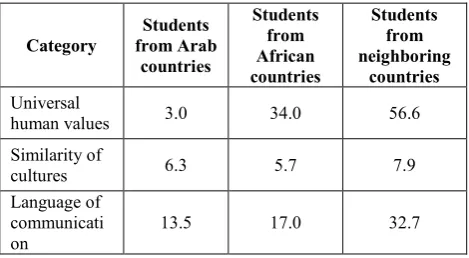
[image:3.595.307.542.304.433.2]To identify these indicators we asked the following question: "What do you think brings You closer to people of other nations?"(table 2).
Table 2. Ethnoconsolidating attributes of ethnicity (%)
Category from Arab Students countries
Students from African countries
Students from neighboring
countries
Universal
human values 3.0 34.0 56.6
Similarity of
cultures 6.3 5.7 7.9
Language of communicati
on 13.5 17.0 32.7
Thus, in all studied groups the first place among consolidating features is occupied by universal values. This corresponds to the traditional view on the definition of "self-identification" within the world community (as opposed to self-identity). The orientation to the most superficial and obvious level of ethnocultural identity represented by language (which occupies the second place among ethnic consolidating features) is also clearly expressed. It should be noted that almost all respondents speak Russian at a simple level. And this is understandable because Russian is the state language within the Russian Federation and is the main language for paperwork.
To a certain extent, self-identification brings together-the common historical past, common culture, religion, i.e. the cultural layer of self-consciousness.
It should also be noted that many people find anthropological characteristics important: more than 60% of respondents believe that they can recognize the appearance of representatives of other races and nationalities.
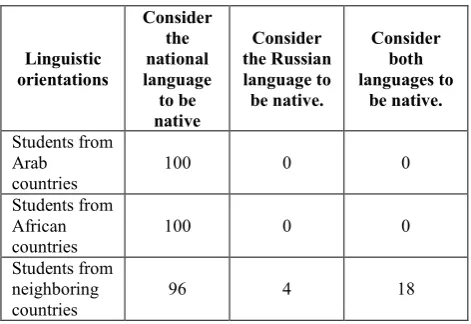
We have obtained the following data on the issues (table 3).
Table 3. Language orientations among the studied ethnic groups (%)
Linguistic orientations
Consider the national language to be native
Consider the Russian language to be native.
Consider both languages to
be native.
Students from Arab
countries 100 0 0
Students from African
countries 100 0 0
Students from neighboring
countries 96 4 18
Thus, the data show that the vast majority of respondents consider their national language to be their native one.
The linguistic behaviour of respondents reflects the expressed national solidarity. This is confirmed by the fact that the most popular answer to the question of the reasons to be aware of one or another language as a native one was the following: "This is the language of my people."
The respondents quite often chose the following options: "It's my mother's language," "It's my father's language." This is due to the fact that the family is the cell of primary socialization.
It should be noted that among the studied groups there is a large number of respondents focused on preservation of their native language for their children. The question "Do you want your children to speak your native language?" was answered affirmatively by 82% of Arab students, 87% of African students, 71% of students from the near abroad and 63% of students from Russia. However, less than 50% of respondents intend to take certain steps in this direction as they feel difficulty in naming the specific actions, they would take to ensure that their children can speak the national language.
At the same time, they are ready to take the following steps in this direction. 100% of representatives from the near and far abroad and 77% of representatives from the Russian Federation prefer communication in the national language at home. 73% of representatives from Arab countries, 61% from Africans, 58% of representatives from the neighboring countries, 51% of representatives from Russia maintain contacts with the "homeland". 73% of Arab students, 84% of African students, 54% of students from the near abroad, 47.6% of students from Russia read national literature, listen and watch national TV and radio programs.
The ranking of indicators showed that the guidelines for the social identification of students of four nationalities are primarily associated with their native language, culture, and parents. These are the guidelines that students most often follow to achieve self-identity. In social identification, students rely mainly on
professional self-realization, where corporate culture, of course, levels ethnicity. The basis is the interests of production and productive forces, and everything connected with them [6, 7].
3 Conclusions
Awareness of belonging to a certain nation and realization of nationality do not provide the individual with any real practical benefits in self-identification. It is rather a spiritual and psychological education contributing only to the involvement in the spiritual world, spiritual wealth and values of other people. Social and professional activity inevitably leads to socialization and social self-identification of the individual in a multi-ethnic society, such as modern Russia.
Self-identification as a special object of research in the life of Polytechnic University students actualizes the problem of determining their professional status, which in turn contributes to their uniting into professional associations.
Multi-ethnic associations are "historically established, stable multi-generational groups of people with not only common features but also relatively stable activities" [6]. The living environment within the multi-ethnic community is determined mainly by national interests, which has a serious impact on the professional qualities of students at Polytechnic University. Socialization of foreign students in the educational space serves to streamline the experience and regulate the behavior of members of a particular ethnic group in the process of self-identification. The specificity of polytechnic education for foreign students is that the cultural foundations of their life were formed on the basis of other behavior types and practices necessary to create new values in their professional activities. In this regard, the space-time factor of polytechnic education is a system-forming factor in the process of self-identification undergone by foreign students in their professional activities. An important characteristic of professional activity development is the fact that each member of the multi-ethnic community is strictly focused on preservation of ethnic balance which means developing new cultural values and simultaneous preserving traditional ones [8, 9].
Thus, self-identification of foreign students is understood as a spatial and temporal organization of their social life, when interethnic relations are carried out on the basis of certain types of professional activity, taking into account the social, cultural and interethnic experience of the host country (here, the Russian Federation). The educational process considers the level of ethnic identity of foreign students, on the one hand, and the maximum preservation of interpersonal communication in a multi-ethnic environment, on the other hand.
process leading to the gradual leveling of ethnic specificity, making it more universal.
Modern ethnic groups in a globalizing society cannot be represented in a "pure" form even in traditional countries: "One of the main features of this generation of students is a focus on development and self-realization. This is manifested in the desire of today's young people to find an interesting job. The main criterion for choosing is mainly not the level of wages but the opportunity to grow and develop, learn new things and realize their own potential" [10-12].
That is why understanding the conventionality of using the term "self-identification" in the situation of the global world, we can rely on a slightly different concept – the coexistence of individuals in the space of another culture based on social and professional activities, cross-cultural interactions and mutual tolerance [13].
References
1. G.U. Soldatova, Psychology of inter-ethnic tension (Moscow: Smysl, 1998) 389 p.
2. J.S. Phinney, Ethnic Identity in Adolescents and Adults: Rev. of Res., Psychol. Bull., 108, 499–514 (1990)
3. A.K. Abdina, H.S. Abdildina, A.G. Gappasova, D.N. Valerievich, T.M. Sadykova, Foreign students’ social adaptation to the education environment of a higher educational institution: By the example of S.Seifullin Kazakh Agro-Technical University, Mediterranean J. of Social Sci., 6(5), 184–194 (2015)
4. I.I. Zaylalov, A.Ya. Zaripov, Spiritual culture of ethnic groups and ethnicity: axiological interpretation of the identity of the subject, The Problems of Oriental Studies, 3(69), 18–21 (2015) 5. A.Ya. Zaripov, I.I. Zaylalov, The search for identity
in the postmodern era: axiological paradoxes of ethnic identity (Ufa: USPTU, 2017) 67 p.
6. R.N. Yusupov, Resource of Russian religious and philosophical tradition in a constructive relationship with the West, European Proceedings of Social and Behavioural Sciences (RPTSS 2018 – Int. Conf. on res. paradigms transformation in social sci.), 50, pp. 1402–1408 (2018). DOI: 10.15405/epsbs.2018.12.171 7. V.A. Dolgopolov, L.A. Yasyukova, The role of the ethnic factor in the adaptation of students in Saint Petersburg, Theory and practice of physical culture, 7, 45–47 (2014)
8. E.L. Guseinova, Organizational and pedagogical conditions for the development of professional competencies in the technical students' individual work through the example of studying the discipline “Hydraulics and fluid mechanics”, European J. of Contemporary Ed., 7(1), 118–126 (2018). DOI: 10.13187/ejced.2018.1.118
9. N.V. Ippolitova, S.K. Mukhametgaliyeva, A.E. Rodionova, K.N. Yagafarova, L.N. Ikonnikova, Lifelong professional education in the Russian
Federation: Personal aspect, Int. J. of Environmental and Sci. Ed., 11(16), 9426–9436 (2016)
10. E.A. Mukhtasarova, F.G. Safin, State of modern Russian youth tolerance, European Proc. of Social and Behavioural Sci. (RPTSS 2018 – Int. Conf. on res. paradigms transformation in social sci.), 50, pp. 206–213 (2018). DOI: 10.15405/epsbs.2018.12.26 11. R.M. Shaidullina, A.F. Amirov, V.S. Muhametshin,
K.T. Tyncherov, Designing Economic Socialization System in the Educational Process of Technological University European J. of Contemporary Ed., 6(1), 149–158 (2017). DOI: 10.13187/ejced.2017.1.149. 12. G.I. Simonova, A.V. Konysheva, N.V. Kotryahov,
Peculiarities of reflexive position formation in students within the educational process at the university by information and communication technologies, Perspectives of Sci. and Ed., 36(6), 65–73 (2018)