Abstract: Wireless sensor network are known for its numerous application and such variety demands improvement of the currently available protocols and its parameter. Certain specific parameter is energy consumption for routing which plays a key role in every application. Genetic algorithm is one of the optimization methods to improve its efficiency for large scale application. Over observation shows that while no of algorithm try to select the best cluster head based some metric, the process normally introduces over heads in communication which in term leads to more energy dissipation. The primary approach in cluster based routing protocols are to maintain network- cluster lifetime because node displacement and network failure (node energy level). Due to the cluster lifetime maximization, in order to cover the target, sensor node placement is playing the main role to cover maximum target and minimum node connectivity with limited nodes. The simulation work is performed primarily to generate genetic algorithm based sensor position with different population. The work has been compared with random deployment, genetic algorithm.
Index Terms: Wireless Sensor Networks, Cluster lifetime, genetic algorithm and optimization
I. INTRODUCTION
The sensor node which are consist of mobile and stationary that can be sensing, monitoring processing [37] data through spatially distributed environment is have highly attention in the recent years. WSN has some intended application for sensing process is used in monitoring conditions in environment [38] and physical such as high temperature, humidity, noise, pressure etc. Some of its applications include area monitoring, air pollution monitoring, disaster management, security surveillance, healthcare monitoring, industrial monitoring, forest fire monitoring, landslide monitoring etc. The topology of network changes dynamically due to mobility in sensor nodes. The main problem for functioning of these sensor nodes battery sources of the individual nodes for keep on sending signals to others. In this case the network failure occurs on the nodes because of the coverage area [36] of the network range and delay also wide for moment of nodes.
In last few years many researchers has done lot of works related to this issues and identified to organize these nodes into cluster [46, 48].
Revised Manuscript Received on June 05, 2019
T.Ganesan, Assistant Professor, Department of CSE, Koneru
Lakshmaiah Education Foundation, Guntur, AP, India
Pothuraju Rajarajeswari, Professor, Department of CSE, Koneru
Lakshmaiah Education Foundation, Guntur, AP, India
The reason for applying cluster in WSN to improve the scalability, signal quality, increase the maximum lifetime of the topology or network. To organize the nodes in cluster have different variety of nodes are there, cluster head (CH), Associate cluster head (ACH), and cluster members (CMs). The cluster head (CH) task for aggregate data from the cluster members (CMs) and Associate cluster Head (ACH), sending to base station (BS) and limits the transmission of within the cluster range.
The cluster head energy consumption, data transmission and increasing network lifetime is based on the cluster strategy: uniform cluster (UC) and non-uniform cluster (NUC). The imbalanced energy consumption between the nodes and node displacement is the main factor affecting cluster lifetime. The energy consumption among the nodes is depends on the cluster types. In order to balance the energy in uniform clustering the entire cluster’s had the approximate number of node and moreover same coverage area. So, that energy consumption between cluster head and members are to be less. Finally prolong the network lifetime because of the uniform distribution and cluster size.
While applying non uniform node distribution in cluster it always question for the network lifetime. Because of energy consumption is not balanced among the cluster heads. In this study, we are going to analysis cluster-based routing protocol [46, 48] for wireless sensor networks with uniform and non-uniform node distribution and energy-aware genetic algorithm (GA) based optimization methods [13, 14]. So, that genetic algorithm (GA) is a metaheuristic[32, 34] process of natural selection of larger networks, it continuously modify the network topology to provide high quality optimized solution for constrained and unconstrained networks [40, 41]. While applying genetic algorithm, it can called individual nodes for selection, crossover and mutation process and finally produce optimized solution for node fitness in the topology lifetime.
The sensors are deployed in the monitoring field in two ways [17, 19]. One is well defined or preplanned manual deployment is used for easy accessible region. This kind of manual deployment is very deterministic sensor placement; it brings better network management and saves sensor energy. Because this well planned method has been applying only less number of sensor to cover maximum of target area.
But inaccessible region is utilizing only random placement of sensors. The random deployment for formulating sensor
Genetic Algorithm Based Optimization to
Improve the Cluster Lifetime by Optimal Sensor
Placement in WSN’s
coordinates to apply the deployment but coverage and connectivity of sensors are very less with maximum number of sensor are required [17].
The coverage and connectivity is one of the critical issues for sensor deployment why because the lifetime of the whole WSNs is directly proportional to the number of groups.
The rest of the paper to be discussed follows. Section II discuss in the form related wok for different kind of cluster head selection methods and target coverage problems. Section III is deal with problem formulation for deterministic node placement, Section IV deal with implementation of GA with simulation work, performance measures. Sections V have ends with conclusion.
II. RELATEDWORK
To represent wireless sensor network (WSN), suppose that nodes are deployed in environment it continuously monitoring environment data and sent to a sink node or destination. In this sensor data to be decomposed and it can be represent two dimensional sparsity matrixes for sparsifying sensor data. The random ID to be initialized each sensor devices like 1 to N and sensor devices with ID (1≤ni≤N) is represent by n= {n1,n2,n3…..ni…nN}. The column vector of sensor devices are reading data like r= {r1,r2,r3…..ri,….rN}, where ri is data reading of niand residual energy of nodes R={R1,R2,R3….Ri..RN}.To form a cluster in sensor node has homo-hetero node property, node displacement, new node placement in homo-hetero cluster, node failure due to low level energy, cluster capacity and long distance between nodes to base station cause a minimum lifetime of WSN. We extend our analysis with various lifetime maximization approach followed by genetic algorithm (GA).
In the past few years, so many researchers have applied evolutionary algorithm [2] and genetic algorithm approaches to solve energy problem and lifetime maximization in WSN. As our proposed work carried out different kind genetic algorithm based lifetime maximization techniques with node placement, coverage and connectivity [35], we discussed here the previous work done by researchers.
To forming cluster [45] is consider k-coverage (NP hard optimization) [39, 42, 44] to encoding the individual sensor node by binary chromosome within the field. After, genetic algorithm (GA) to be applied in base station to elect very less number of cover heads to cover all cluster members (CMs) and destination points. Finally the entire chromosome is to be evaluated for, whether it covers all the target points or not and produce expected consumed energy of individual node is determine for upcoming routine which one is active.
Total expenditure of energy to be calculated from nodes to base station is T. Where Eni,BTis represent total energy consumed by each sensor node ni to base station B. Thus, the author conclude their result using experimental analysis of square area 100m and 200m with initial each node energy 0.5J and idle energy level 50nJ/rounds. Each round authors produced first and last target uncovered (FTU & LTU) achieved in the range of 26% to 41.3%.
In [33] discussed about k-coverage [42, 43] and m-connectivity from each target to base station based on GA. The author’s applied two different scenarios for grid [14, 18, 20, 21, 50]and random node placement with potential points to cover targets. Initially the environment to be formed for set of target points and potential points where as tp=
{t1,t2,t3,….tN} and pp= {p1,p2,p3,….pN} respectively. The communication range and sensing range of sensor nodes are Rc and Rs, distance between ti and ni is d(ti,ni) within target points the set of sensor nodes covered by C(ti) , in reverse, set of target points covered by sensor nodes is TC(ni).C(ti)={nj| d(ti,nj)≤ Rs,1≤j≤M},TC(ni)={tj| d(ti,ni)≤ Rs,1≤j≤N.
And communication range of set of sensor nodes is Com(ni)= {nj| d(ni,nj)≤ Rc,1≤j≤M}. Let be consider three Boolean variable bij,dcij and qi is defined as (bij,dcij, qi)=1 if ti covered by nj, ni directly connected to nj, and pi elected for node placement (1≤i≤K) respectively or 0 for otherwise. After that LPP (Linear Programming Problem) [12] can be formed, then bij is is covered at least k sensor nodes, dcij ensure that all sensor nodes is directly connected at least m. Thus, author’s proposed GA consists of chromosome representation, initial population, and fitness of each sensor nodes followed by crossover and mutation. For the construction of fitness function have multi-objective[2, 3, 7, 8] where each objective having different weight value Wi. Fitness=W1*(1.0-F1)+W2*F2+W3+F3 achieved to be maximum values F1=M/K, F2=( )/(N*k) and F3=(( )/(M*m)
Finally the authors are conclude their result compared with normal GA with K-coverage, m-connectivity [35] and achieved less time complexity and observed that if k, m value is increased the number of potential position of nodes to selected is improved.
Recently [47] proposed a method in GA in between cluster head (CH) and base station relay node [24, 29]to use as intermediate. The proposed method initially all the nodes are produced binary values like chromosome analysis and some nodes are elected itself as a cluster head (CH). If the binary bit is zero, node is already CH and its residual energy is drained very quickly. Suppose binary value is one, it have chance become a CH.
While forming a cluster, the CH is selected for initial population and then fitness operation to evaluate based on remaining residual energy and distance between BS and CH as well as ACH.
F(n1,nN)={(0.3*(R(n1,nN)/RCH))+(0.35*(D(CH->CMs) / NCH))+(0.35*(D(BS->CMs) / TCH))},
Where R-Residual energy on nodes, D-Distance between nodes CH to all nodes, N-number of node and T-Total number of CH. Each and every routine new fitness operation is calculated and before that crossover, mutation to be initiated for new CH selection. Based on shortest distance between BS to relay nodes [30] GA is evaluated and CH also selected because data aggregation is very easy, conclude GA-Distance Aware routing is better compared with different routing protocol like LEACH, LEACH-E etc.
Proposed a multi-objective[3, 8] variable length[1, 22] GA and Decision support system (Mo-VLGA and DSS) is applied real time surveillance maritime problem. If new node is going to add in existing topology node placement and network is optimizing communication coverage region based on ad-hoc sensor network technology. The coverage area to be maximized for using large number of quality measure service test points (STP) is communication nodes signal strength is always greater than required threshold value in receiver side.
In order to minimize network cost reduce the number of intermediate communication nodes. If we reduce the bandwidth in the entire boundary nodes to be achieved minimum bandwidth between all the active nodes. Any node is communicated by more than one hop node the noise levels of the network considerably increase. These Mo-VL to be associated with GA and DSS to be applied for better way to place new node in existing network to establish a connectivity between new infrastructure.
Whereas [25] discussed heterogeneity property in cluster network because it cause energy depletion of topology very fast. Mainly the authors focused on each rounds calculate balance energy level, expected energy for next rounds, environment, and base station distance. This works carried out two main things, initially estimate consumed and balance energy level for each round and future respectively. And then GA will be applied with different aspect of heterogeneity WSN and fitness function[28].
The authors [49] addressed that chromosome encoding used variable length[1] instead of fixed length[13, 15, 17], node placement (homogeneous and heterogeneous) and two different problem while placing nodes in cluster. Node placement consider five column, one is, where we are going to place a node (area of placement), which is consider dense and sparse points in any location (position=2D coordinates x, y (≥ 0) in geometric line). Characteristic of node is represent UML class diagram for generalization and specialization property like each node having its own property (homo-hetero) based on that node can be placed. And number of nodes in certain region, constraints and some objectives like no of targets covers, noise reduction and node connectivity. Finally the authors inherit flexible GA with two crossover constraints 1.locations of crossover area, 2.sizes of crossover area. These fGA algorithm applied real time problem in RFID [9]network planning and wind turbine farm layouts[10, 16].
In article [9] shows that two tired sensor networks used relay node as cluster head to achieved maximum network
lifetime. The relay node is directly communicated to base station and form a network with self. The load of relay node is increase in which all the sensor nodes transmit data to their respective cluster head. If the relay node acts as cluster head the energy level is decreased gradually and difficult to send node data to base station or destination. Usually communication takes place either single hop [24,25] or multi hop [29,31,47] to base station. In normal routing data is splitting [18,31,38] into different route to reach destination, which may increase the no of nodes, communication cost and time. So that, without splitting the data is transmit sensor nodes to cluster head (relay node) takes multi hop data transmission with consider minimum transmission energy model and minimum hop selection model. Initially non splitting models used integer linear program (ILP) [5] which is not suitable for larger networks. In this paper consider genetic algorithm (GA) to determine best routing for relay node networks to improve the lifetime for small and larger networks.
Singh et al [11] proposed column generation [15,18] based lifetime maximization in directional sensor [9] networks. Larger number of variable and less number of conditions are there in ILP (Integer Linear program), it can be decomposed into master problem and auxiliary problem while using Dantzig-Wolfe decomposition method [19,21]. Above mentioned two problems are to be solved by column generation approaches to find the optimum solution. The number of variable will be reduced in master problem and additional variable is to be created by auxiliary problem and added into main master problem for further improvement of optimal solution. GA and ILP will be applied to solve the auxiliary problem. Initially GA will be applied to find optimum one, if it fails again GA will be used. Even though it fails, ILP approaches to be used find even one head. If ILP also fails, the master problem solution is the last and column generation approaches is over.
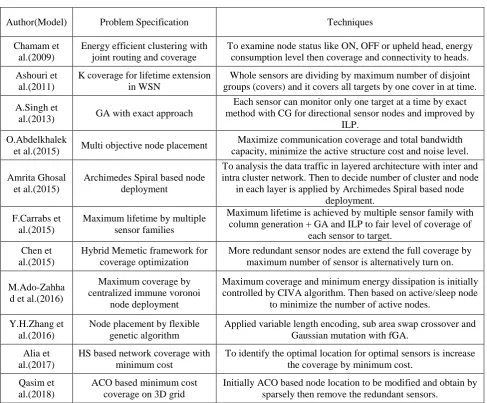
Table. 1 Maximum coverage by optimal node placement
The column generation (CG) approach solved master and separation problem (SP) and also having some drawbacks for NP-hard optimization problems. It can be identified and solved genetic algorithm (GA) by using binary chromosome fitness function, crossover and mutation.
In [14] authors proposed a hop selection for increasing lifetime of WSN is depends on cooperative transmission [19] to achieve the minimum energy consumption per bit only.
To improve the lifetime it can achieve by using MAC (Medium Access Control) [19] and transceiver optimization techniques for multiple hop selection. If we select efficient hop in cluster network to reduces the least energy consumption per bits and improve the network lifetime.
Recent attention to WSN the researchers have proposed different kind of lifetime maximization with GA. Our literature work summarize few techniques inherit with GA based maximum lifetime. K-coverage model [45] which extends the network lifetime and measure target covers (FTU and LTU. [33] Are mainly focused K-coverage and m-connected node placement with linear programming [11, 12]with GA and achieved better fitness of node for cluster head (CH). Below table: 1 represents efficient coverage done by optimal node placement.
If the node operates unwanted environment and autonomously energy level degreased recently. This problem identified by [47] and proposed distance aware routing to overcome energy depletion by introducing relay node in between CH and BS. These relay nodes [30] are reducing communication distance between CH and sink node access. Always heterogeneity of node leads some problems for next generation network (NGN), while using GA chromosome analysis variable length[1, 22] to be used for binary evaluation (VL-GA). These VL-GA integrate with DSS (Decision support system) to overcome the heterogeneity of node in NGN demand. [19] Have achieved the minimum noise and network cost for communication and maximum coverage area followed by minimum bandwidth used nodes. To optimize heterogeneous sensor nodes in before forming cluster to estimate initial energy state and required energy state for future [25] are states that to measure significantly energy level staring and upcoming rounds. Prediction of energy states only useful for fitness cluster head (CH) optimized GA. Consider location [49] of node placement, node type, coverage region with some conditions.
Author(Model) Problem Specification Techniques
Chamam et al.(2009)
Energy efficient clustering with joint routing and coverage
To examine node status like ON, OFF or upheld head, energy consumption level then coverage and connectivity to heads.
Ashouri et al.(2011)
K coverage for lifetime extension in WSN
Whole sensors are dividing by maximum number of disjoint groups (covers) and it covers all targets by one cover in at time.
A.Singh et
al.(2013) GA with exact approach
Each sensor can monitor only one target at a time by exact method with CG for directional sensor nodes and improved by
ILP.
O.Abdelkhalek
et al.(2015) Multi objective node placement
Maximize communication coverage and total bandwidth capacity, minimize the active structure cost and noise level.
Amrita Ghosal et al.(2015)
Archimedes Spiral based node deployment
To analysis the data traffic in layered architecture with inter and intra cluster network. Then to decide number of cluster and node
in each layer is applied by Archimedes Spiral based node deployment.
F.Carrabs et al.(2015)
Maximum lifetime by multiple sensor families
Maximum lifetime is achieved by multiple sensor family with column generation + GA and ILP to fair level of coverage of
each sensor to target.
Chen et al.(2015)
Hybrid Memetic framework for coverage optimization
More redundant sensor nodes are extend the full coverage by maximum number of sensor is alternatively turn on.
M.Ado-Zahha d et al.(2016)
Maximum coverage by centralized immune voronoi
node deployment
Maximum coverage and minimum energy dissipation is initially controlled by CIVA algorithm. Then based on active/sleep node
to minimize the number of active nodes.
Y.H.Zhang et al.(2016)
Node placement by flexible genetic algorithm
Applied variable length encoding, sub area swap crossover and Gaussian mutation with fGA.
Alia et al.(2017)
HS based network coverage with minimum cost
To identify the optimal location for optimal sensors is increase the coverage by minimum cost.
Qasim et al.(2018)
ACO based minimum cost coverage on 3D grid
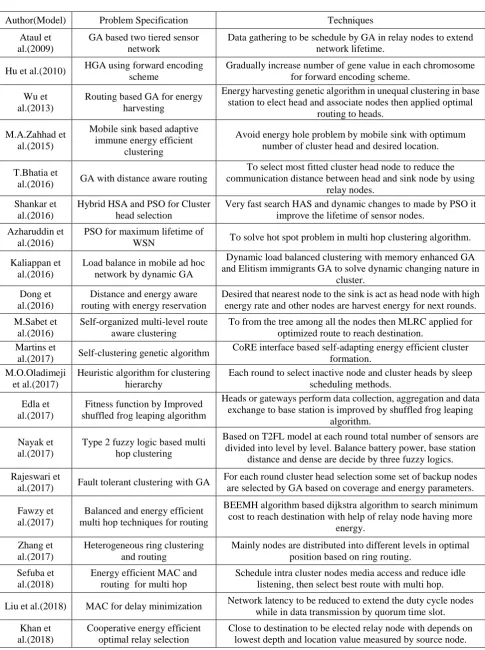
Table. 2 Energy efficient clustering methods
Author(Model) Problem Specification Techniques
Ataul et al.(2009)
GA based two tiered sensor network
Data gathering to be schedule by GA in relay nodes to extend network lifetime.
Hu et al.(2010) HGA using forward encoding scheme
Gradually increase number of gene value in each chromosome for forward encoding scheme.
Wu et al.(2013)
Routing based GA for energy harvesting
Energy harvesting genetic algorithm in unequal clustering in base station to elect head and associate nodes then applied optimal
routing to heads.
M.A.Zahhad et al.(2015)
Mobile sink based adaptive immune energy efficient
clustering
Avoid energy hole problem by mobile sink with optimum number of cluster head and desired location.
T.Bhatia et
al.(2016) GA with distance aware routing
To select most fitted cluster head node to reduce the communication distance between head and sink node by using
relay nodes. Shankar et
al.(2016)
Hybrid HSA and PSO for Cluster head selection
Very fast search HAS and dynamic changes to made by PSO it improve the lifetime of sensor nodes.
Azharuddin et al.(2016)
PSO for maximum lifetime of
WSN To solve hot spot problem in multi hop clustering algorithm.
Kaliappan et al.(2016)
Load balance in mobile ad hoc network by dynamic GA
Dynamic load balanced clustering with memory enhanced GA and Elitism immigrants GA to solve dynamic changing nature in
cluster. Dong et
al.(2016)
Distance and energy aware routing with energy reservation
Desired that nearest node to the sink is act as head node with high energy rate and other nodes are harvest energy for next rounds.
M.Sabet et al.(2016)
Self-organized multi-level route aware clustering
To from the tree among all the nodes then MLRC applied for optimized route to reach destination.
Martins et
al.(2017) Self-clustering genetic algorithm
CoRE interface based self-adapting energy efficient cluster formation.
M.O.Oladimeji et al.(2017)
Heuristic algorithm for clustering hierarchy
Each round to select inactive node and cluster heads by sleep scheduling methods.
Edla et al.(2017)
Fitness function by Improved shuffled frog leaping algorithm
Heads or gateways perform data collection, aggregation and data exchange to base station is improved by shuffled frog leaping
algorithm.
Nayak et al.(2017)
Type 2 fuzzy logic based multi hop clustering
Based on T2FL model at each round total number of sensors are divided into level by level. Balance battery power, base station
distance and dense are decide by three fuzzy logics.
Rajeswari et
al.(2017) Fault tolerant clustering with GA
For each round cluster head selection some set of backup nodes are selected by GA based on coverage and energy parameters.
Fawzy et al.(2017)
Balanced and energy efficient multi hop techniques for routing
BEEMH algorithm based dijkstra algorithm to search minimum cost to reach destination with help of relay node having more
energy.
Zhang et al.(2017)
Heterogeneous ring clustering and routing
Mainly nodes are distributed into different levels in optimal position based on ring routing.
Sefuba et al.(2018)
Energy efficient MAC and routing for multi hop
Schedule intra cluster nodes media access and reduce idle listening, then select best route with multi hop.
Liu et al.(2018) MAC for delay minimization Network latency to be reduced to extend the duty cycle nodes while in data transmission by quorum time slot.
Khan et al.(2018)
Cooperative energy efficient optimal relay selection
III. PROBLEMFORMULATION
The random ID to be initialized each available number of sensor devices like 1 to n and sensor devices with is represent by S= {S1, S2, S3…Sn}. The set of k targets T= {T1, T2, T3 ...Tk} to be monitored by set of n sensors placed in random position. In addition to the coverage the sensor nodes is to maintain the connectivity between the nodes as ability to reach data sink because data collection is very easy for node connectivity. To maintain the coverage and connectivity of the nodes have two different parameter sensing range and communication range. Total number of sensors is less than the total number of targets where n<k depends on the sensing range Sri and connectivity of each sensors is depends only the communication range of sensor Cr. Our aim is to cover maximum target Tk by available sensor nodes Sn and improve the connectivity of nodes each other’s by deployed sensors
(2)
(3)
The quality of coverage and connectivity is representing deployed sensor nodes to be defined by QC and percentage of QC (%).
(4)
(5)
Genetic algorithm is one of the evolutionary algorithms, which solves the optimization problem. The main idea in GA is to change the initial solution by using crossover, mutation and local enhancement for identifying the optimal position [13, 14]. Initial population is generated randomly by GA and modified by crossover and mutation. The frame work of proposed algorithm for sensor placement is given below. i) Representation: Chromosomes are represented in the form of nXn matrix, where n (Lets n=8) is the number of sensor. To place the sensor in random in the region of A, whereas each chromosome is the position of sensor and entry is start from 0 to AxA.
ii) Initial Population: There are more than 100 initial population generated randomly for optimal sensor placement. The given sample population is generated randomly; the matrix contains four rows and four columns, which is based
on available sensors. Each entry of matrix is to assign random value in between 0 to 10000, which is AxA.
iii) Fitness function: Entry of chromosome is converted into the position of sensor coordinates by using given fitness function. By using equation (6) the pop1 is converted into sensor coordinates.
(6)
iv) Crossover: Exchanging genes between the chromosomes is known as crossover. GA randomly selects a value between 1 to n. Let’s take a randomly the crossover point is 2. Therefore, the offspring (os1) and offspring (os2) is obtained from first 2 column of pop1 and last 2 columns of pop2, first 2 column of pop2 and last 2 column of pop1.
v) Mutation: Changing of some genes in chromosome for obtaining the optimal solution. GA randomly generated mutation point as 2 and 3 for os1 and os2 respectively. Therefore, the 2 column of os1 and 3 column of os2 are regenerated.
IV. SIMULATIONWORK
To analysis the performance of the proposed genetic algorithm different kind of population matrices demonstrated by using MATLAB. Different number of sensors (m) and its varied from 2 to 500 and sensing range is 100, target numbers are 10 to 100 in the same region size 100. Randomly generated initial populations are 10 to 100 with different crossover and mutation point. The main aim is to cover maximum number of target with maximum number of node connectivity to maintain network lifetime.
[image:6.595.312.546.529.696.2]In order to find the optimal position the QC, it can provide the quality population matrix and maximum cover percentage. Quality of sensor is fully depends only the target potential position, so that QC is also depends on that. The quality of proposed work was compared with random deployment and Genetic algorithm based node displacement. In this simulation is to evaluate three different ranges of population matrices with different range of sensors and target numbers.
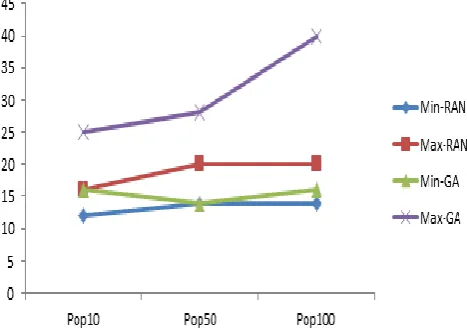
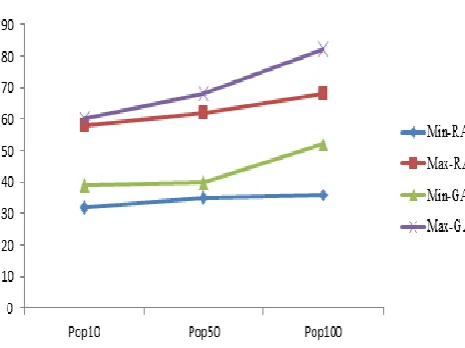
Fig. 2 16 sensors with 100 targets (RANDOM and GA)
Fig. 3 64 sensors with 100 targets (RANDOM and GA) To validate the performance of proposed algorithm compared with random deployment of sensor and GA based sensor deployment of sensor (Fig1, Fig2, and Fig3) in the environment for Fig 3: compare no of sensor is 64 with population 100 the target will be covered by using Random is 70% and GA is achieved 88%. In Fig 2, total no of senor is 16 and target is 100, with population 100 for Random is 70% and to compare GA is 90%. And Fig 1, the total no of sensor is 4 and target is 100 is achieved Random deployment is 25% and GA is more than 55%.
V. CONCLUSIONANDFUTUREENHANCEMENT
This work carries multi-dimensional open area for future research. The main challenge in WSN is maintain the cluster with as long as possible. Different approaches in this survey are reveal few optimized algorithm based on GA with different kind of factors. In this paper we have suggested a new GA to identify the optimal position for sensor placement to cover maximum possible no of target with less sensor ratio is compared with random deployment. In future WSN is going to play main role in green communication, IoT, heath care and smart devices etc. So, that to support rapid development of WSN we must provide efficient, less time and space complexity based algorithm to support. In future optimization techniques, we would like to implement genetic algorithm with second generation wavelets transform for improve the local search operation without skipping resultant data.
REFERENCES
1. C.K. Ting, C.N. Lee, H.C. Chang, J.S. Wu, “Wireless heterogeneous transmitter placement using multi objective variable-length genetic algorithm”, IEEE Trans.Syst. Man Cybern. B 39 (4) (2009) 945–958. 2. O. Castillo, G. Huesca, F. Valdez, “Evolutionary computing for
topology optimization of type-2 fuzzy controllers”, Stud. Fuzz. Soft Comput. 208 (2007) 163–178.
3. A.Sombra, F. Valdez, P. Melin, O. Castillo, “A new gravitational search algorithm using fuzzy logic to parameter adaptation”, in: IEEE Congress on EvolutionaryComputation CEC 2013, Art. No. 6557685, 2013, pp. 1068–1074.
4. H. Masri, O. Abdelkhalek, S. Krichen, “A comparison of multiple objective evolutionary algorithms for solving the multi-objective node placement problem”,in: 2014 International Conference on Control Decision and Information Tech-nologies (CoDIT), 2014, pp. 152–157. 5. O. Abdelkhalek, H. Masri, S. Krichen, “An adaptive variable
neighborhood searchfor solving the multi-objective node placement problem”, Electron. Notes Dis-cret. Math. 47 (2015) 189–196. 6. O. Abdelkhalek, S. Krichen, A. Guitouni, S Mitrovic-Minic, “A genetic
algorithmfor a multi-objective nodes placement problem in heterogeneous network infrastructure for surveillance applications”, in: IEEE Proc: 4th Joint IFIP/IEEEWireless and Mobile Networking Conference, 2011, pp. 1–9.
7. F. Valdez, P. Melin, O. Castillo, “Evolutionary method combining particle swarm optimization and genetic algorithms using fuzzy logic for decision making”, in:IEEE International Conference on Fuzzy Systems, Art. No. 5277165, 2009, pp.2114–2119.
8. F. Valdez, P. Melin, O. Castillo, “A survey on nature-inspired optimization algo-rithms with fuzzy logic for dynamic parameter adaptation”, Expert Syst. Appl.41 (14) (2014) 6459–6466.
9. Q. Guan, Y. Liu, Y. Yang, W. Yu, “Genetic approach for network planning in the RFID systems, in: Sixth International Conference on Intelligent Systems Design and Applications”, 2006. ISDA’06, vol. 2, IEEE, 2006, pp. 567–572.
10. M.Samorani, “The wind farm layout optimization problem, in: Handbook of Wind Power Systems”, Springer, 2013, pp. 21–38. 11. K. Chakrabarty, S.S. Iyengar, H. Qi, E. Cho, “Grid coverage for
surveillance and target location in distributed sensor networks”, IEEE Trans. Comput. 51 (2002)1448–1453.
12. J. Wang, N. Zhong, “Efficient point coverage in wireless sensor networks”, J.Comb. Optim. 11 (2006) 291–304.
13. B. Saavedra-Moreno, S. Salcedo-Sanz, A. Paniagua-Tineo, L. Prieto, A.Portilla-Figueras, “Seeding evolutionary algorithms with heuristics for optimal wind turbines positioning in wind farms”, Renew. Energy 36 (2011)2838–2844.
14. C. Elkinton, J. Manwell, J. McGowan, “Algorithms for offshore wind farm layout optimization”, Wind Eng. 32 (2008) 67–84.
15. H. Chen, Y. Zhu, K. Hu, T. Ku, “RFID network planning using a multi-swarm optimizer”, J. Netw. Comput. Appl. 34 (2011) 888–901. 16. ARISTIDIS,P.MARIA,L.CHRISTOS,“PARTICLE SWARM OPTIMIZATION
(PSO) ALGORITHMFOR WIND FARM OPTIMAL DESIGN”,INT.J.MANAG. SCI.ENG.MANAG.5(2010)53–58.
17. M. Wagner, K. Veeramachaneni, F. Neumann, U.-M. OReilly, “optimizing the layout of 1000 wind turbines”, European Wind Energy Association Annual Event (2011) 205–209.
18. Bhattacharya, U.K. Roy, “Optimal placement of readers in an RFID network using particle swarm optimization”, Int. J. Comput. Netw. Commun. 2 (2010)225–234.
19. O. Abdelkhalek, S. Krichen and A. Guitouni , “A genetic algorithm based decision support system for the multi objective node placement problem in next wireless generation network”, Journal of applied soft computing, pp. 278-291, 2015.
20. Y. Chen, H. Li, K. Jin, Q. Song, “Wind farm layout optimization using genetic algorithm with different hub height wind turbines”, Energy Convers. Manag.70 (2013) 56–65.
[image:7.595.52.285.231.405.2]22. R. Srikanth, R. George, N. Warsi, D. Prabhu, F.E. Petry, B.P. Buckles, “Avariable-length genetic algorithm for clustering and classification”, Pattern Recognit. Lett. 16 (1995) 789–800.
23. E.L. Lloyd, G. Xue, “Relay node placement in wireless sensor networks”, IEEETrans. Comput. 56 (2007) 134–138.
24. J. Tang, B. Hao, A. Sen, “Relay node placement in large scale wireless sensor networks”, Comput. Commun. 29 (2006) 490–501.
25. M. Elhoseny, X.Yuan et al, “Balancing energy consumption in heterogeneous wireless sensor networks using genetic algorithm”, IEEE Commun., vol.19.no.12 2015.
26. N.Javaid et al., “HEER: Hybrid energy efficient reactive protocol for wireless sensor network,” in Saudi Int. Electron. Commun. Photon. Conf., Riyadh, Saudi Arabia , Apr,2013, PP.1-4.
27. A.Behzadan, A.Anpalagan , and B.Ma, “Prolonging network lifetime via nodal energy balancing in heterogeneous wireless sensor network”, in IEEE Int. Conf. Commun.,2011,pp.1-5.
28. X.Du, Y.Xiao and F.Dai, “Increasing network lifetime by balanciong node energy consumption in heteroge-neous sensor network, wireless communication and mobile computing,”Wirelesscommun. Mobile. Comput., vol.8,no.5,pp.645-659, Jan.2008.
29. Gupta SK, Kuila P, Jana PK . “Genetic algorithm for k connected relay node placement in wireless sensor networks”. In: Proceedings of the second international conference on computer and communication technologies. Springer; 2015 p.721–9.
30. Misra S, Majd NE, Huang H. “Constrained relay node placement in energy harvesting wireless sensor networks”. In: 2011 IEEE 8th international conference on mobile ad hoc and sensor systems (MASS). IEEE;2011.p.25–34.
31. Lanza-Gutierrez JM, Gomez-Pulido JA. “Assuming multi objective metaheuristics to solve a three-objective optimization problem for relay node deployment in wireless sensor networks”. Appl Soft Comput 2015;30:675–87.
32. Kuila P, Jana PK. “A novel differential evolution based clustering algorithm for wireless sensor networks”. Appl Soft Comput 2014 b;25:414–25.
33. S.K.Gupta, P. Kuila, P.K. Jana, “Genetic algorithm approach for k-coverage and m-connected node placement in target based wireless sensor networks”, Journal of Computers and Electrical Engineering,pp.1-13, 2015.
34. Rebai M, Leberre M, Snoussi H, Hnaien F, Khoukhi L. “Sensor deployment optimization methods to achieve both coverage and connectivity in wireless sensor networks”. ComputOper Res 2015;59:11–21.
35. Sengupta S, Das S, Nasir M, Panigrahi BK. “Multi-objective node deployment in WSNS: in search of an optimal trade-off among coverage, lifetime, energy consumption, and connectivity”. EngApplArtifIntell 2013; 26(1):405–16.
36. Yoon Y, Kim Y-H. “An efficient genetic algorithm for maximum coverage deployment in wireless sensor networks”. IEEE Trans Cybern 2013; 43(5):1473–83.
37. N. Alvi, S. Bouk, S. H. Ahmed, N. Javaid, D. Kim, “Enhanced TDMA based MAC protocol for adaptive data control in wireless sensor networks”, Int. J. Commun. Netw., vol. 17, no. 3, pp. 247-255, Jun. 2015.
38. K. P. Ferentinos, N. Katsoulas, A. Tzounis, T. Bartzanas, C. Kittas, “Wireless sensor networks for greenhouse climate and plant condition assessment”, Biosyst. Eng., vol. 153, pp. 70-81, 2017.
39. M. Elhoseny, A. Farouk, N. Zhou, M.-M. Wang, S. Abdalla, J. Batle, “Dynamic multi-hop clustering in a wireless sensor network: Performance improvement”, Wireless Pers. Commun., pp. 1-21, Mar. 2017, [online] Available: http://dx.doi.org/10.1007/s11277-017-4023-8. 40. N. Metawa, M. Kabir Hassan, M. Elhoseny, “Genetic algorithm based model for optimizing bank lending decisions”, Expert Syst. Appl., vol. 80, pp. 75-82, 2017.
41. M. Elhoseny, X. Yuan, Z. Yu, C. Mao, H. El-Minir, A. Mohamed Riad, “Balancing energy consumption in heterogeneous wireless sensor networks using genetic algorithm”, IEEE Commun. Lett., vol. 19, no. 12, pp. 2194-2197, Dec. 2015.
42. N. Ebrahimian, G. Y. Sheramin, A. H. Navin, Z. Foruzandeh, “A novel approach for efficient k-coverage in wireless sensor networks by using genetic algorithm”, Proc. Int. Conf. Comput. Intell. Commun. Netw., pp. 372-376, 2010.
43. S. Mnasri, A. Thaljaoui, N. Nasri, T. Val, “A genetic algorithm-based approach to optimize the coverage and the localization in the wireless audio-sensors networks”, Proc. Int. Symp. Netw. Comput. Commun., pp. 1-6, 2015.
44. Q. Yang, S. He, J. Li, J. Chen, Y. Sun, “Energy-efficient probabilistic area coverage in wireless sensor networks”, IEEE Trans. Veh. Technol., vol. 64, no. 1, pp. 367-377, Jan. 2015.
45. M. Elhoseny, A. Tharwat, A. Farouk et al, “K-Coverage model based on genetic algorithm to extend WSN lifetime”, IEEE sensor council 2017, vol.1.no 4.
46. Abbasi, A. A., &Younis, M. (2007). “A survey on clustering algorithms for wireless sensor networks”. Computer Communications, 30(14), 2826–2841.
47. T. Bhatia, S. Kansal et al, “A genetic algorithm based distance aware routing protocol for wireless sensor networks”, Journal of Computers and Electrical Engineering.,pp.1-15,2016.
48. Afsar, M. M., &Tayarani-N, M. (2014). “Clustering in sensor networks: A literature survey”. Journal of Network and Computer Applications, 46, 198–226.
49. Y.H. Zhang, Y.J. Gong et al, “Flexible genetic algorithm: A simple and generic approach to node placement problems”, Journal of Applied soft computing” 2016.
50. W.-C. Ke, B.-H. Liu, M.-J. Tsai, “Constructing a wireless sensor network to fully cover critical grids by deploying minimum sensors on grid points is NP-complete”, IEEE Trans. Comput. 56 (2007) 710–715. 51. Ataul Bari, Shamsul Wazed et al, “A genetic algorithm based approach
for energy efficient routing in two-tiered sensor networks”, Ad Hoc Networks Volume 7, Issue 4, June 2009, Pages 665-676.
52. Aloksingh et al, “A genetic algorithm based exact approach for lifetime maximization of directional sensor networks” Ad Hoc Networks Volume 11, Issue 3, May 2013, Pages 1006-1021.
53. F.Carrabs et al, “Maximizing lifetime in wireless sensor networks with multiple sensor families”, Computers & Operations Research Volume 60, August 2015, Pages 121-137.
54. M.A.Zahhad et al, “A centralized immune-Voronoi deployment algorithm for coverage maximization and energy conservation in mobile wireless sensor networks”,Information Fusion Volume 30, July 2016, Pages 36-51.
55. T.Shankar et al, “Hybrid HSA and PSO algorithm for energy efficient cluster head selection in wireless sensor networks”, Swarm and Evolutionary Computation Volume 30, October 2016, Pages 1-10. 56. Md.Azharuddin et al, “Particle swarm optimization for maximizing
lifetime of wireless sensor networks”,Computers & Electrical Engineering Volume 51, April 2016, Pages 26-42.
57. M.Kaliappan et al, “Enhancing energy efficiency and load balancing in mobile ad hoc network using dynamic genetic algorithms”, Journal of Network and Computer Applications Volume 73, September 2016, Pages 35-43.
58. M.Sabet et al, “An energy efficient multi-level route-aware clustering algorithm for wireless sensor networks: A self-organized approach”,Computers & Electrical Engineering Volume 56, November 2016, Pages 399-417.
59. M.O.Oladimeji et al, “HACH: Heuristic Algorithm for Clustering Hierarchy protocol in wireless sensor networks”,Applied Soft Computing Volume 55, June 2017, Pages 452-461.
60. T.Bhatia et al, “A genetic algorithm based distance-aware routing protocol for wireless sensor networks”, Computers & Electrical Engineering Volume 56, November 2016, Pages 441-455.
61. Y.H.Zhang et al, “Flexible genetic algorithm: A simple and generic approach to node placement problems”,Applied Soft Computing Volume 52, March 2017, Pages 457-470.
62. A.Chamam et al, “On the planning of wireless sensor networks: Energy-efficient clustering under the joint routing and coverage constraint”,IEEE Transactions on Mobile Computing, 2009.
63. A.Khan et al, “Co-EEORS: Cooperative Energy Efficient Optimal Relay Selection Protocol for Underwater Wireless Sensor Networks”,IEEE Access, 2018.
64. Y.Liu et al, “QTSAC: An energy-efficient mac protocol for delay minimization in wireless sensor networks”,IEEE Access, 2018. 65. M.Sefuba et al, “Energy-efficient medium access control and routing
protocol for multihop wireless sensor networks”,IET Wireless Sensor Systems, 2018.
67. T.Qasim et al, “An ant colony optimization based approach for minimum cost coverage on 3-D grid in wireless sensor networks”, IEEE Comm, 2018.
68. A.E.Fawzy et al, “Balanced and energy-efficient multi-hop techniques for routing in wireless sensor networks”,IET Networks, 2017. 69. O.M.alia et al, “Maximizing wireless sensor network coverage with
minimum cost using harmony search algorithm”,IEEE Sensors Journal, 2017.
70. D.R.Edla et al, “An efficient load balancing of gateways using improved shuffled frog leaping algorithm and novel fitness function for WSNs”, IEEE Sensors Journal, 2017.
71. P.Nayak et al, “Energy efficient clustering algorithm for multi-hop wireless sensor network using type-2 fuzzy logic”,IEEE Sensors Journal, 2017.
72. K.Rajeswari et al, “Genetic algorithm based fault tolerant clustering in wireless sensor network”,IET Communications, 2017.
73. J.A.Martins et al, “Gacn: Self-clustering genetic algorithm for constrained networks”, IEEE Comm, 2017.
74. Y.Dong et al,”DEARER: A distance-and-energy-aware routing with energy reservation for energy harvesting wireless sensor networks”,IEEE Journal on Selected, 2016.
75. C.P.Chan et al, “A hybrid memetic framework for coverage optimization in wireless sensor networks”,IEEE transactions, 2015. 76. M.A.Zahhad et al, “Mobile sink-based adaptive immune
energy-efficient clustering protocol for improving the lifetime and stability period of wireless sensor networks”, IEEE Sensors, 2015. 77. A.Ghosal et al, “Lifetime maximizing clustering structure
using archimedes' spiral based deployment in WSNs”,IEEE Systems Journal, 2015.
78. Y.Wu et al, “Routing protocol based on genetic algorithm for energy harvesting-wireless sensor networks”,IET Wireless Sensor Systems, 2013.
79. X.M.hu et al, “Hybrid genetic algorithm using a forward encoding scheme for lifetime maximization of wireless sensor networks”,IEEE transactions, 2010.