International Journal of Innovative Technology and Exploring Engineering (IJITEE) ISSN: 2278-3075, Volume-8 Issue-8, June 2019
Abstract: In the medical field, the WBBSNs is employed to monitor physiological signs of patients such as Electro Eencephal Ggram (EEG), Electro Cardio Gram (ECG), Heartbeat, Blood Pressure (BP), Temperature, etc. In WBBSNs consists of smart battery operated bio-sensors are deployed in/on-body of patients. The main constraint on these networks is the energy consumption and network lifetime. To address this we proposed Reliable Energy Aware Medium Access Control (REA-MAC) protocol for Wireless Body Bio-Sensor Networks (WBBSNs). This protocol employs Time Division Multiple Access (TDMA) approach for channel access with synchronization approach. To avoid idle listening and overhearing all bio-sensors remain in sleep mode until the time slot assigned by sink node. The proposed protocol performances are compared in terms of energy and reliability and simulation results shows that performance of overall network is improved by 20% as compared with in IEEE 802.15.4 protocol.
Index Terms: TDMA, MAC, REA-MAC, WBBSNs, superframe.
I. INTRODUCTION
A Wireless Sensor Networks (WSN) uses air medium to accomplish distributed sensing tasks by interconnection of the several sensor nodes [1]. Advancements in wireless and storage technologies from last decade, number of smart bio-sensors are proficient of real-time health monitoring at the hospitals or remote places. WBBSNs allow us to use tiny bio-sensor nodes for real-time health monitoring. These tiny energy constrained bio-sensors monitor physiological signs of patient body and send to external monitoring station for analyze or treatment from a doctor. This streaming of data from patient to monitoring station employing wireless channel is energy consuming process. To prolong lifespan of these smart sensing devices and overall network energy efficient communication requires signal processing device equipped with low power. IEEE 802.15.4 describes a designation for Data Link and Physical Layers in Low-Rate Wireless Personal Area Networks [2].In [3], the WBAN is compatible to communicate with existing wireless technologies like Bluetooth, Wi-Fi, ZigBee, WLANs, WSNs, WPANs and the internet. Figure 1 shows the architecture of WBAN with 3 communication-tiers. In [4], communication Tier-1 is an Intra-WBAN which monitors the patient body
Revised Manuscript Received on June 07, 2019.
Ch.Rajendra Prasad, Research Scholar, Koneru Lakshmaiah Education Foundation (KLEF), Guntur, India.
Assistant Professor, Department of ECE, S R Engineering College, Warangal, India.([email protected])
Polaiah Bojja, Professor, Department of ECE, Koneru Lakshmaiah Education Foundation (KLEF), Guntur, India.
[image:1.595.310.548.319.435.2]through body sensors and collects the vital information like temperature, heartbeat, blood pressure etc, and send to the coordinator node using Bluetooth or Wi-Fi technology. Communication Tier- 2 is an Inter-WBAN, which comprises of a body coordinator that consolidated the data and transmits to the sink node. Tier-1 to Tier-3 data can be transferred through this gateway. In [5], the communication tier-3 is an extra WBAN where the sink transmits the gathered information to the remote medical centre and doctor through internet.
Fig. 1. WBBSNs communication architecturefor medical applications[6]
The main problem that arises in WBBSN topology is battery recharging cycle and not feasible to detach batteries from body parts for charging them from time to time. Since each bio- sensor node continuously transmits their information to central device which is done at the cost of their energy consumption. Which result in stability of network and network lifetime is reduced, hence, energy distribution among the nodes is major factor for designing the WBBSNs [6,7]. Energy awareness is the vital specification for good MAC protocol in WBBSNs [8]. By concentrating on this above mentioned factors in mind, we proposed a new MAC protocol for WBBSNs. In this proposed topology, we adopted fixed mode communication and TDMA approach for channel access with a novel scheme of synchronization. To avoid inactive listening and excess hearing all bio-sensors remain in sleep mode until the time slot assigned by sink node. An adaptive guard band technique is employed to prevent collision due to clock drift of bio- sensor nodes. It minimizes the energy of bio-sensor nodes and stability of network is enhanced.
Reliable Energy Aware MAC Protocol for
Wireless Body Bio-Sensor Networks
II. MACPROTOCOLSFORWBBSNS
This section describes a few existing MAC protocols which are recommended for WBBSNs. This description concentrates on the in perspective of reduction of energy and utilization of resources for the MAC protocols. The subsequent subsections specify the working of these protocols by highlighting consumption of energy. In addition we discuss how MAC protocols for WBBSNS improve energy efficiency by handling energy consumption of the resources such as idle listening, collision, excess hearing and overhead of control packet (CP).
A. IEEE 802.15.4 MAC
[image:2.595.306.552.302.428.2]For wireless applications low data rate IEEE 802.15.4 is designed with three operating frequency bands: 868, 915 and 2.4 GHz. Further these bands are splitted into 27 sub-bands i.e., one sub-channel in 868 MHz band, 915 MHz band into 9 sub-bands and 2.4 GHz band is splitted into 16 sub-bands. This protocol is working in 2 modes: beacon enabled mode (BEM) and non beacon enabled mode (Non-BEM).In BEM, central node uses periodic beacons device for synchronization, association and data streaming. This mode employs a super frame. Every super frame contains active and idle periods. The super frame in active period is splitted into 3 time slots: Contention Access Period (CAP) using slotted CSMA/CA, beacon and a Contention Free Period (CFP). Possibly 7 Guaranteed Time Slots (GTS) are allocated for bio-sensor nodes to have room for real-time in CFP. Due to its asymmetric nature of transmission, BEM of operation of IEEE 802.15.4 is not appropriate for WBBSNs.Non-BEM of IEEE 802.15.4 employs un-slotted CSMA/CA. In [2] authors, investigated slotted and un-slotted CSMA/CA and presented simulation results as shown in figure 2. The un-slotted technique is very sound in terms of utilization of bandwidth and energy.
Fig. 2.CAP sensors Vs Normalized throughput B. Battery-aware TDMA MAC
In [10], authors presented this MAC protocol to maximize the network life using cross-layer design. For medium access, this protocol concentrates on three factors: time-varying wireless fading channel, queuing characteristics of the pocket and electrochemical properties of battery. This protocol works similar to BEM in IEEE 802.15.4, where the modes pay attention once in a while to beacons from controller node. The time frame is spitted into three time
slots; beacon, active time and idle time period as shown in the Figure 3.
C. Priority Guaranteed TDMA MAC
In [11], authors presented this protocol, which employs a novel super frame format as illustrated in figure 4. This protocol active period is splitted into 5 parts; a beacon, Time Slot Reserved for Periodic (TSRP) traffic Control Channel (AC1), Control Channel (AC2). AC1 is employed for uplink management of real-time health application where as AC2 is employed for uplink management of Consumer Electronics. This MAC is employs TDMA technique to allocate GTS within information slots TSRP and TSRB. Control channels assigns GTS based on their priority order. The simulation results of this protocol are improved in terms of consumption of energy as contrast with the IEEE 802.15.4 protocol. However, the major disadvantages of this protocol are super frame structure is complex and is not adaptable for emergency traffic.
Fig. 3. Frame stucure of TDMA
Fig. 4. Priority gaurantieed superframe stucure of MAC D. Energy-Efficient Low Duty Cycle MAC
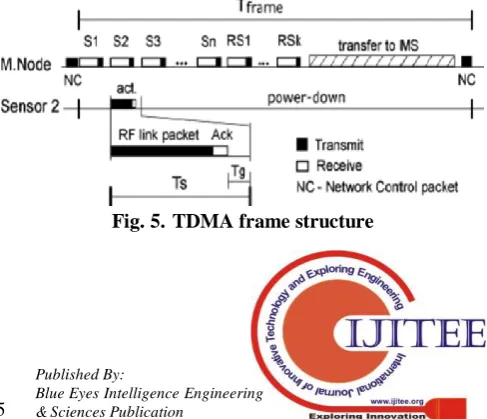
In [5] authors presented this protocol to support the static topology of BAN [5]. For streaming huge amount of data TDMA technique is used. The TDMA and Static topology are being used efficiently to exploit the stability and reliability of the network. In this network a Master Node gathers information from on- body bio-sensor nodes and transfers to the Monitoring Station. The gathered information is analyzed by monitoring station while the on-body management of the network and harmonization is being done by master node. As shown in Figure 5, the total frame is spitted into several time slots(TSs). The TS1 - TSn
are assigned to sensor nodes where as time slots RS1 - RSk are
[image:2.595.47.292.511.651.2]reserved which arebeing provided when demanded.
[image:2.595.305.549.621.830.2]International Journal of Innovative Technology and Exploring Engineering (IJITEE) ISSN: 2278-3075, Volume-8 Issue-8, June 2019
III. PROPOSEDMACPROTOCOL
The proposed REA-MAC protocol is employs TDMA method to decrease consumption of energy in the network. This protocol allocates GTS to every bio-sensor node for communication based on their necessities. To minimize excess hearing and inactive listening, proposed network employs sporadic sleep and awaken depending on necessities of the bio- sensor node. This protocol considered homogeneous topology; a central node gathers information from all bio-sensor nodes directly or indirectly via an Access Point (AP) and transmits to monitoring station.Central node is usually have superior computational power, transceivers (one or two) and equipped with larger batteries. The total time frame TF is assigned in case of 2 transceivers, for
efficient communication through all bio-sensor nodes. Where as in case of single transceiver the TF is splitted into 3
parts: Contention Free Period (CFP) for communication with bio-sensors, Contention Access Period (CAP) to on-demand traffic or accommodate emergency and Time Management System TMS for communicating sensor nodes’ information to monitoring station.
A. Channel Selection
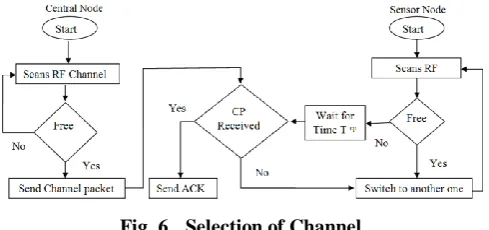
[image:3.595.307.548.189.289.2]In the beginning, the central node starts searching for accessible free Radio Frequency (RF) channels. In case of current RF Channel is already in use, then the central node switches to actuate RF Channel. Once Central node gets a free RF channel for communication it transmits the Channel Packet (CP), channel information with its address to bio-sensor nodes. On the other side, the bio-sensor nodes scan RF channels for CP from central node. If it is free it switches to alternate RF channel. Else it waits for time TCP to listen CP. If bio-sensor node does not receive the CP, it switches over to subsequent channel. By successful arrival of CP, the bio-sensor node initiates communication and transmits an acknowledgment packet to central node, as shown in fig. 6.
Fig. 6. Selection of Channel
Once bio-sensor node chooses a suitable RF Channel after receiving CP from central node, the bio-sensor node transmits a Time Slot Request (TSR) packet to central node. The TSR packet contains necessary time slot information and bio-sensor node’s transmission baud. In [12,13] authors, presented fixed length time slot (TS) s using fixed guard time. On-body and implanted bio-senor nodes have different bauds and sampling intervals by dissimilar clock drifts. Allocation of time slots for fixed span and unequal necessities is expenditure of resources. REA-MAC employs a
reliable method for TS and guard band time. Based on traffic model of nodes, central node allocates TS and transmits Time Slot Request Reply (TSRR). These TSs are of variable span depending on the necessities of bio-sensor nodes. Allocated TS can simply contain the transmission data pocket, ACK, reception data pocket and adequate delay, based on the network topology. A guard band time TGB is placed in between the two consecutive TSs to prevent the interference caused by clock drift of bio-sensor node and central node are illustrated in Fig. 7.
Fig. 7. TSs Assignment with GBT
Assignment of TSs with Guard-band Time Value of TGB depending on time span of the consecutive TSs and is computed by using eq. (1), eq. (2) and eq. (3). Adaptive guard band prevents probability of collision and interference caused by clock drift.
, 1
0.5
1
100
GBn n n n
F
T
TS
TS
(1)1 1
100
GB
F TS
T
(2)
100
GB n
n
F TS
T
(3)where F is factor of guard band, which is function of average drift period. Conversely, the TGB1 is placed before TS1 and
similarly TGBn is placed after TSn. On successful TS
assignment, bio-sensor nodes go to sleep mode and only awaken to transmit information to central node in assigned TSs. This sporadic sleep mode minimizes energy consumption due to inactive listening and excess hearing. Allotted TSs in CFP are absolutely collision free which minimizes the consumption of energy and provide reliable communication.
B. Synchronization
[image:3.595.48.293.534.649.2]This DV is send to bio-sensor node through the acknowledgment to re-adjust TS for next transmission. But, DV depends upon D and F. If the deference greater than D, central node transmits DV within Synchronization Acknowledgment packet for next harmonization to bio-sensor nodes or else, central node transmits simple acknowledgment packet for received data packet. Bio-sensor nodes adjust it’s awaken time by employing DV for future communication. In this synchronization scheme a bio-sensor node can enters to sleep mode within synchronization for total number of cycles (N). The Acceptable delay D is the function of TS1, TS2,..TSn and the guard band factor F as
under:
1, 2
(
,...
)
100
nF
D
Min TS TS
TS
(5),
0,
T
if
T
D
DV
if
T
D
(6)where
T Expected Arrival Time Current Arrival Time
The choice of transmitting DV to end bio- sensor nodes is based on T for further synchronization.
C. Analysis of Energy consumption
To model energy consumption analysis of the overall network, we presented the energy consumption in terms of the transceiver. In this analysis, the energy consumption of processing and sensing devices are assumed to be invariable. We presume sporadic traffic pattern, i.e., bio-sensor nodes transmit sporadic data to central node in allocated TSs. Bio-sensor nodes stay in sleep mode most of the period. During allotted TSs, they wake up to transmit the information. The energy consumption for N number of cycles for total network is computed using eq. (7).
1 1
k k
N N
Total Active Sleep
k k
E
E
E
(7)The total energy consumption is a sum of total time of the frame and the total current drawn from voltage source for a particular action. In sleep mode also bio-sensor nodes consumes the energy and is given in eq. (8). The sleep mode time is computed from length of the total time frame and active mode time period and is given in eq. (7).
Sleep Frame Active
T
T
T
(8)Sleep Sleep Sleep
E
T
V T
(9)ISleep is the sleep mode current, which is drawn from voltage
source(V). The bio-sensor nodes transmit, receive as well as wait for acknowledgment during TActive period. For switching
between sleep to active also consumes the energy. The EActive
is considered as energy consumption of fore mentioned actions during TActive period and it is given in eq. (10)
(2
)
Active S TX RX TO
E
E
E
E
E
(10)where,
ES=Switching energy
ETX=Transmission energy
ETX=Reception energy
ETo=Time-Out energy
IV. RESULTS
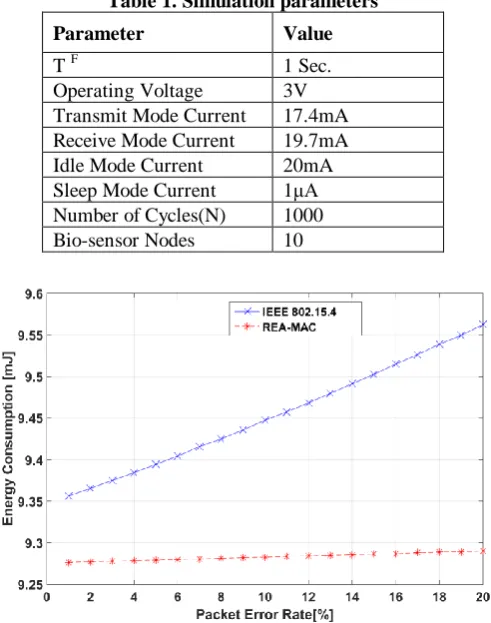
To evaluate and validate the proposed protocol we compared the energy efficiency with that of IEEE 802.15.4 protocol by deploying network with 10 bio-sensor nodes. To analyze the energy consumption of REA- MAC we employed Crossbow MICAZ transceiver features as simulation parameters are mentioned in Table I. We employed priority guaranteed superframe structure for MAC packet format as given in Fig.4. Time frame size used in simulations is TFrame = 1
[image:4.595.305.551.252.564.2]Second with drop rate of 1 to 2 percent. Fig. 8 shows the performance comparison of IEEE 802.15.4 and proposed protocol in terms of energy (mJ) and Pocket Error Rate (PER) (%).
Table 1. Simulation parameters
Parameter Value
T F 1 Sec.
Operating Voltage 3V
Transmit Mode Current 17.4mA
Receive Mode Current 19.7mA
Idle Mode Current 20mA
Sleep Mode Current 1μA
Number of Cycles(N) 1000
Bio-sensor Nodes 10
Fig. 8. Performance comparision of IEEE 802.15.4 Vs proposed protocol for N = 1000
International Journal of Innovative Technology and Exploring Engineering (IJITEE) ISSN: 2278-3075, Volume-8 Issue-8, June 2019
V. CONCLUSION
A new MAC protocol for WBBSNs is presented in this paper i.e., REE-MAC. This protocol allocates guaranteed time slots in adaptive manner and provides reliable communication by introducing adaptive guard band to avoid collisions. Synchronization is attained by introducing a smart mechanism to balance the drift of bio-sensor nodes clock. From the simulation results, the performance of REE-MAC improved as compared with that of IEEE 802.15.4 in terms of energy consumption by 20 percent. Simulation results show superior performance.
ACKNOWLEDGMENT
This work was supported by S R Engineering College, Warangal, India and Koneru Lakshmaiah Education Foundation (KLEF), Guntur, India.
REFERENCES
1. Ch. Rajendra Prasad and Polaiah Bojja, (2018), “A Review on Bio-Inspired Algorithms for Routing and Localization of WSNs”,
JARDCS, Vol. 9(18), pp. 1366-1374.
http://jardcs.org/backissues/abstract.php? archiveid=2324)
2. IEEE Std.802.15.4, Wireless MAC and physical layer specifications for low data rate WPANs. IEEE: Piscataway, USA, 2006
3. N.Chhabra, "Comparative Analysis of Different Wireless Technologies", Int. Jr. of Scientific Research in Network Security & Comm., Vol.1, Issue.5, PP. 3-4, 2013.
4. S. Singla, K. Sharma, “A Review Paper on WBANs for Health Care Applications”, Int. Jr. of Computer Science and Mobile Computing, Vol.5, Issue.10, pp. 1-10, 2016.
5. J.I. Bangash, A.H. Abdullah, M.H. Anisi and A.W. Khan, “A survey of routing protocols in WBSNs”, Sensors, Vol.14, Issue.1, pp. 1322-1357, 2014.
6. Ch. Rajendra Prasad and Polaiah Bojja, (2019) "A Reliable, Energy Aware and Stable Topology for Bio-sensors in Health-care Applications," Journal of Communications, vol. 14(5), pp. 390-395, Doi: 10.12720/jcm.14.5.390-395.
7. Ch. Rajendra Prasad and Polaiah Bojja, (2018), “A survey on routing protocols in WBANs for medical applications”, JARDCS, Vol. 10(10),
pp.92-97. http://jardcs.org/backissues/abstract.php?archiveid=4550) 8. A. Rahim, N. Javaid, “A Comprehensive Survey of MAC Protocols for
WBANs” 7th Int. Conf. on Broadband, Wireless Computing, Comm. and Applications, IEEE Computer society, pp. 434-439.2012.
9. Changle, L., Huan-Bang, L., and Kohno, R., “Performance evaluation of IEEE 802.15.4 for WBAN,” in the Proc. of IEEE ICC Workshops 2009, pp. 1-5, 2009.
10.Su, H., and Zhang, X., “Battery-dynamics driven TDMA MAC protocols for WBANs in healthcare applications,” IEEE J. Sel. Areas Comm. 27(4):424-434, 2009.
11.Zhang, Y., and Dolmans, G., “A new priority-guaranteed MAC protocol for emerging BANs,” in the Proc. of 5th ICWMC 2009, pp.140-145, 2009. 12.Kwak, K. S., Ullah, S., Kwak, D. H., Lee, C. H., and Lee., H. S., “A power efficient MAC protocol for WBAN,” Jr. of Korean Institute of Intelligent Transport Systems 8(6):131140, 2009.
13.O. Omeni, A and C. Toumazou, “Energy efficient MAC for wireless medical BANs,” IEEE Trans. on Biomedical Circuits and Systems. vol. 2, no. 4, pp. 251-259, Dec. 2008.
14.Huaming L., and Jindong T., “Heartbeat-Driven MAC for BSNs,” IEEE Trans. On IT in Bio-madicine, VOL. 14, NO. 1, JANUARY 2010 15.K. Suriyakrishnaan · D. Sridharan “Reliable Packet Delivery in WBANs
Using TCDMA Algorithm for e‑Health Monitoring system” Wireless Personal Communications, 2018.
https://doi.org/10.1007/s11277-018-5998-5
16.J.Ravichandar, et. al, “Localization of cooperative WSN using distributed PSO Algorithm with optimum references” IJECE, vol. 6, no. 6, pp. 3094-3102, Sept. 2016.
17.J.Ravichandar, et. al, “Enhancement of Indoor Localization in WSN using PSO tuned EKF” I.J. Intelligent Systems and Applications, vol. 9, no. 2, pp. 3094-3102, Feb.- 2017.
AUTHORSPROFILE
Ch.Rajendra Prasad Asst. Professor Dept. of ECE, S R Engineering College, Warangal, Telangana, India. He is pursuing Ph.D. from KLEF, Guntur, Andhra Pradesh, India. He published 20 international journals and attended the 6 International Conferences. He is working as Co-investigator for DST project titled “Development of Adhesive Tactile Walking Surface Indicator for Elderly and Visually Impaired People”. He has ISTE and IETE Life Member ships. His areas of interests are embedded systems, Wireless sensor networks and signal processing.
Polaiah Bojja, Professor, Department of Electronics & Communication Engineering, Koneru Lakshmaiah Education Foundation, Guntur, Andhra Pradesh, India He is having more than 12 years of 3experience in teaching and Research from prestigious Institutes like NBKRIST, Vidyanagar, ASCET, Gudur, SVEC, Tirupati., He published 30 papers in reputed with highest index, SCI and Scopus journals and presented the 36 papers in International and National Conferences. He also completed one AICTE Project as Chief Investigator and having experience with reputed Govt. R&D departments as a consultant or developer as part of the prestigious projects.”
![Fig. 1. WBBSNs communication architecture for medical applications[6]](https://thumb-us.123doks.com/thumbv2/123dok_us/8201239.260909/1.595.310.548.319.435/fig-wbbsns-communication-architecture-medical-applications.webp)