Perception of students on performance of dual-mode education: Information quality perspective
Latif Al-Hakim Faculty of Business
University of Southern queensland Toowoomba, Queensland 4350, Australia
Email: [email protected]
Abstract. In recent years, there have been radical developments in higher education in China. The most significant of these has been the aspiration of Chinese universities to form partnerships with overseas universities that allow their students to have the advantages of dual-mode enrolment, that is, to get the advantages of courses developed by other universities via distance education in addition to their University’s on-campus courses. The current literature investigating general perceptions of service quality by distance education students has so far barely examined perceptions of dual-mode students. This preliminary research attempts to fill this gap. It ascertains the relevance of
information quality (IQ) dimensions for delivery evaluation of various education modes. This paper employs a qualitative methodology and uses importance-performance analysis to investigate information quality dimensions affecting student satisfaction of dual-mode education. The case considered is a newly established Chinese University that has a partnership with an Australian University. The results show significant gaps in the
performance of accessibility, amount of information, coherency, relevancy and timeliness.
Keywords: Information quality, distance education dual-mode, gap analysis.
Biographical notes: Latif Al-Hakim lectures in Management in the Faculty of Business at the University of Southern Queensland, Australia. His experience spans industry, research and development and academic institutions. He was awarded his Undergraduate Degree in 1968. His Masters (1978) and PhD (1983) were awarded from University of Wales, UK. He has published extensively in information management and systems modelling. Dr Al-Hakim is the author and editor of six books, several chapters in books and more than 60 papers in various journals and conference proceedings. He has also consulted to a number of major industrial organisations in Australia.
1. Introduction
Traditionally, distance education is characterised by the students being physically separated from their teachers and classroom (Rumble 1986) for all or substantial portion of the formal, organised training or education program (Berge 2002). The first formal distance education program dates back to the nineteenth century (McIssac and
The growth of distance education has been rapid. For instance, it is reported that by 1910 the number of distance education students enrolled in international correspondence schools in the USA approached 184,000 students (Glatter and Wedell 1971). Distance education progress is associated with advances in information and communication technology (ICT). In the 1920s almost 10,000 schools in the United Kingdom had used BBC radio to broadcast courses and support classroom teachers (Demiray and Isman 2000). The State University of Iowa (USA) began transmitting instruction courses as early as 1932 and had broadcast about 400 teaching program by 1939 (Moore and Kearsley 1996). Australia began its first correspondence system from the University of Queensland in 1911 (Millington 2006). Television was used for broadcasting courses after the Second World War. In the mid 1970s, satellites were used for broadcasting as well as teleconferences for distance education (Williams et al 2005). Nowadays, virtually all institutions committed to distance education are using the Internet and Wide World Web (www) facilities to increase the effectiveness of distance education.
1.1 The five Distance Education Generations
Taylor (2001) identifies four generations or models for distance education based on the adoption of ICT. First is the correspondence model based on print technology; second is the multi-media model based on audio and video technologies; third is the telelearning model based on telecommunication technologies; fourth is the flexible learning model based on online delivery via Internet. Taylor (2001) claims a fifth generation of distance education has emerged from the fourth generation. The new generation aims to capitalise on the features of the Internet and Web. However, practice tells us that, even with on-campus study, Internet and Web facilities are used to communicate with on-on-campus or internal students, access educational material, communicate with lecturers and submit assignments. Simonson et al (2003, p.28) characterised current distance education in terms of four components; institution, separation of learner from teacher, interactive telecommunication and sharing of learning experience. Simonson et al states that if any of these components are not included, then it is not distance education.
1.2 Contrast with Formal Education
courses, (each course contains an interactive CD and a homepage). The study indicates that students agreed that the course CD had assisted their performance in the course.
Williams (2002) illustrates that students and academics may differ in their perception and evaluation of the ICT system that is used for distance education. Williams (2002) finds that the positive perception of students is not always mirrored by academics. Academics feel online material gives them extra work and may affect their academic duties.
Thurmond et al. (2002) evaluate students’ satisfaction with web-based distance education and accepts the argument of Billings et al. (2001) that students are more satisfied “with web-based courses because of their computer skills or high level of knowledge” rather than the contents of the web-based course. In other words, technology-related knowledge rather than course-related knowledge is rated as more important (Williams et al 2006).
1.3 Obstacles to Distance Education
There are a variety of obstacles to distance education. Berge (2002) describes 64 obstacles to distance education that can be classified into eight groups: Situational,
epistemological; philosophical; psychological; pedagogical; technical; social; and cultural. The study surveyed respondents employed by corporate organisations and concludes that technical expertise and organisational changes are the main barriers. Low level of interactivity resulting from technical barriers has also been identified by other research works (Comeaux 1995; Howard 2002). These barriers directly affect service quality of distance education as well as traditional education.
1.4 Education and Information Quality
Information is defined as “data that have been organised in a manner that gives them meaning for the recipient” (Turban et al. 2005). The definition is broadened by Copeland and Simpson (2004) to include “any communication or representation of knowledge such as facts or data, in any medium or form”. Organisations, including educational
institutions, have become so critically dependent on information that information quality (IQ) problems must be identified and treated as quickly as possible (Al-Hakim, 2007). A key target of modern education, including distance as well as traditional education, is to improve information flow between the instructors and the students. Information flow is associated with various dimensions of information quality such as accessibility, amount of information, coherency, etc.
1.5 Gap in Literature
Much of the research into student perceptions and attitudes towards distance education do not compare distance education to traditional face-to-face education (Williams et al 2006). Furthermore, virtually no research specifically examines perceptions regarding dual-mode enrolment, that is, to get the advantages of courses offered by other
quality of the dual-mode education from the information quality perspective which forms an important aspect of service quality.
2. Research Methodology
In recent years, there have been radical developments in Chinese higher education . The most significant of these has been the aspiration of Chinese universities to form
partnerships with overseas universities that allow their students to have the advantages of dual-mode enrolment. Usually the testamur is endorsed by both partners. The partnership considered in this paper is a newly established Chinese University (University A) that has partnership with an Australian University (University B). University A has selected a wide range of courses offered by University B in distance education mode as part of University A management programs. This research deals with only one course offered by University B, entitled, Supply Chain Analysis. The selected course is a core course for the undergraduate management program of University A. The survey questionnaire was distributed among University A on-campus students who enrolled in distance education mode for the course offered by University B. The students are required to attend weekly on-campus tutorial sessions offered by University A. The tutor receives regular
instructions from the Australian course leader. The assignments are marked by the tutor and are moderated by the University B course leader. Sometimes, the Australian course leader travels to China to provide eight intensive lectures over three days to University A students. The examination and final results are totally governed by University B. The course has a course Webpage which in turn has a discussion board that allows students to communicate with each others and with their course leader. The research refers to this course as a dual-mode course.
To compare the performance of courses offered via dual-mode and courses offered via traditional mode, another management course offered by only University A was selected. The study material was written in Chinese language, and the lectures, tutorials,
assessment and examination were governed by University A. This course is referred to as a traditional course.
2.1 Initial Discussion
Initially, the Australian academic divided the students into seven groups. Each group selected a coordinator. The seven coordinators then formed a focused group. The academic discussed the questionnaire with the coordinators and then provided a session to all students to explain the purpose from the survey and the elements of the
questionnaire. It is required from the coordinators to collect comments from their team members regarding the performance of dual-mode and traditional courses.
2.2 The Questionnaire
performance-distance and performance-traditional. For the importance field, the students are asked to rate the expectation about how critical or important each dimension was to their study. The performance fields consider the students’ perception of the performance of the dimension. The first performance field consider the students’ perception about the dual-mode course and the second field deals with the students’ performance of the traditional course offered by University A. If a dimension is not applicable to their study, the respondents are asked to tick N/A. For both importance and performance a 7-point Likert scale is utilised.
2.3 Gap Analysis
The gap between the importance and performance of each dimension was calculated. Dimensions with high important rate (ie., critical dimensions) and significant importance-performance gaps are selected. These dimensions are referred to as decisive dimensions (Al-Hakim, 2006). The justification is that when a dimension is critical and performed very well, that is, the performance gap is insignificant, the dimension does not require decisions to further improve its performance. The research identifies three gaps;
Gap 1: This gap refers to the difference between importance and performance measures for the dual mode course.
Gap 2: This gap refers to the difference between importance and performance measures for the traditional course.
Gap 3: This gap determines the difference between the performances of dual-mode and traditional courses.
3. Information Quality
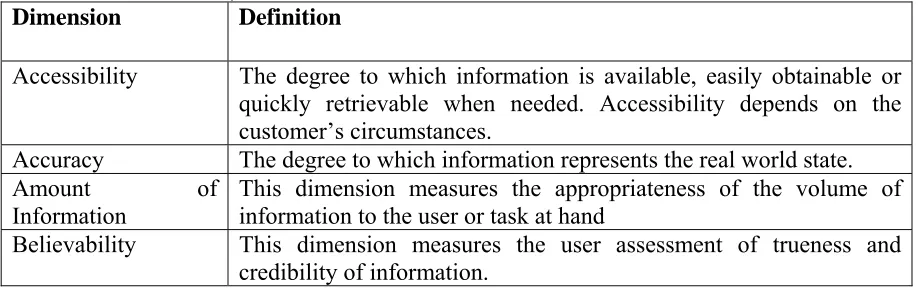
[image:5.612.84.543.568.713.2]IQ is multidimensional. This means that an educational institution must use multiple dimensions to evaluate the quality of their information or data. Several researchers have attempted to identify the IQ dimensions (Wand and Wang 1996; Wang, Storey, and Fifth 1995; Wang and Strong, 1996). Table 1 defines the common IQ dimensions. For the purpose of this research, the term user or customer in Table 1 is a reference to a distance education student.
Table 1. Definitions of the common IQ dimensions used in literature. (Adapted from several research works).
Dimension Definition
Accessibility The degree to which information is available, easily obtainable or quickly retrievable when needed. Accessibility depends on the customer’s circumstances.
Accuracy The degree to which information represents the real world state. Amount of
Information
This dimension measures the appropriateness of the volume of information to the user or task at hand
Coherency This measures how information “hangs together” and provides one meaning to different users.
Compatibility The level to which information can be combined with other information to form certain knowledge.
Completeness The degree to which information is sufficient enough to depict every state of the task at hand or the represented system, that is, assesses the degree of missing information.
Conciseness of representation
The compactness of information representation.
Consistency of
representation The degree of similarity and compatibility of formats used to represent information by different systems/users. Ease of manipulation The applicability of information to different tasks.
Ease of understanding
The degree of user’s comprehension of information.
Free-of-error The degree to which information is correct. This dimension measures the number, percent or ratio of incorrect or unreliable information.
Interpretability The appropriateness and clarity of information, language and symbols to the user.
Objectivity This dimension measures the information impartiality including whether information is unbiased and unprejudiced.
Relevancy Relevancy indicates whether information addresses the customer’s needs. It reflects the level of appropriateness of information to the task under consideration.
Reputation The degree of respect and admiration for both information source and information content.
Security The level of either restriction on access to information or appropriateness of information back-up - protecting information from disasters.
Timeliness This dimension measures how up-to-date information is with respect to customer’s needs or the task at hand. It reflects also how fast the information system is updated.
4. Results and Discussion
As a result of the discussion with the group coordinators, three dimensions were found irrelevant for the purpose of the study and can not be answered by the student at this stage. These dimensions are accuracy, believability and reputation. These three dimensions were dropped from the questionnaire.
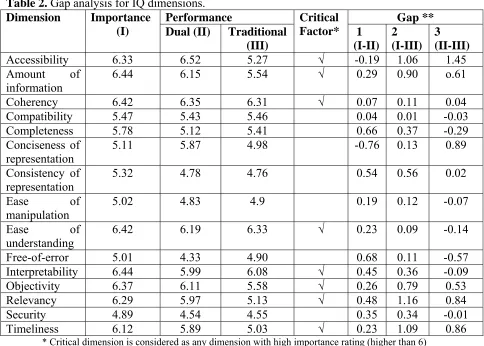
Table 2. Gap analysis for IQ dimensions.
Performance Gap **
Dimension Importance
(I) Dual (II) Traditional (III)
Critical Factor* 1
(I-II) 2 (I-III)
3 (II-III)
Accessibility 6.33 6.52 5.27 √ -0.19 1.06 1.45
Amount of
information 6.44 6.15 5.54 √ 0.29 0.90 o.61
Coherency 6.42 6.35 6.31 √ 0.07 0.11 0.04
Compatibility 5.47 5.43 5.46 0.04 0.01 -0.03
Completeness 5.78 5.12 5.41 0.66 0.37 -0.29
Conciseness of representation
5.11 5.87 4.98 -0.76 0.13 0.89
Consistency of representation
5.32 4.78 4.76 0.54 0.56 0.02
Ease of manipulation
5.02 4.83 4.9 0.19 0.12 -0.07
Ease of
understanding 6.42 6.19 6.33 √ 0.23 0.09 -0.14
Free-of-error 5.01 4.33 4.90 0.68 0.11 -0.57
Interpretability 6.44 5.99 6.08 √ 0.45 0.36 -0.09
Objectivity 6.37 6.11 5.58 √ 0.26 0.79 0.53
Relevancy 6.29 5.97 5.13 √ 0.48 1.16 0.84
Security 4.89 4.54 4.55 0.35 0.34 -0.01
Timeliness 6.12 5.89 5.03 √ 0.23 1.09 0.86
* Critical dimension is considered as any dimension with high importance rating (higher than 6) ** Gap 1 refers to the difference between importance and performance for the dual-mode course). Gap 2 refers to the difference between importance and performance for the traditional course. Gap 3 refers to differences between performances (dual-mode - traditional).
Table 2 shows the following results:
1. Eight dimensions have been rated with importance rating higher than 6 on the 7-points that are marked with symbol ‘√’ in Table 2. These dimensions are
accessibility, amount of information, coherency, ease of understanding, objectivity, relevancy and timeliness. Four of these eight dimensions have importance rating higher than 6.40. These dimensions are amount of information, coherency, ease of understanding and interpretability.
2. The performance of the dual-mode course is considered higher than that for the traditional course in six of these eight dimensions rated as high in importance. The traditional course has higher performance rating for ease of understanding and interpretability.
requirement to improve their own English Language. However, the performance rating for dual-mode course is higher for interpretability. This is because the study material of the dual-mode course contains material in form of figures, pictures, and PowerPoint slides which do not require the same high skill of English language.
4. Performance of the accessibility dimension for dual-mode course was the highest performance rating and exceeds its importance rating. The high performance rating for accessibility reflects the fact that the students can use this feature efficiently to access materials, including, refereed journal papers for the assignments of not only the dual-mode course but also the traditional courses.
The following qualitative comments were recorded:
a. Students were familiar with how to use their own University’s database to access specific material (mainly in Chinese language) but lack the information to use these databases to access other material, specifically international referred journal papers. Enrolment in dual-mode courses provides them with access to material required for the course assignments. In addition, such access allows students to download material directly relevant to their assignments for traditional courses.
b. The traditional course provides students a face-to-face opportunity. The traditional course leader prefers appointments for answering students’ queries rather than the use of emails. Having an appointment may take several days. In contrast, emails to dual-mode course leader can be posted at any time. Students may experience at certain times some delays. However, the timeliness (how fast they receive answers to their queries) is better for the dual-mode course.
c. Most of queries are posted via discussion group board of the dual-mode course Webpage. All students have opportunity to access the Webpage and discuss further the course leader comments or provide further explanation. Usually, the dual-mode course leader provides comments when students become involved in off-topic discussions.
A paired t-statistics test was undertaken to test whether a significant gaps existed. Only IQ dimensions with high importance rating (rating grater than or equal to 6) were selected. The calculated t value is compared with the t critical value, tc, obtained from the
appropriate table. If t < tc, the gap is not significant. Otherwise, for t ≥ tc the gap is greater than is statistically likely to occur, ie., the gap is significant (Tabachnick & Fidell 2007). Table 3 shows the calculations of t value for the eight IQ dimensions marked in Table 2. The calculation is based on p = 0.05 and degree of freedom equal to (n-1) = 48. The t critical for is about 2.01.
1. University B can enhance the performance of its dual-mode course by improving the performance of critical dimensions with significant gap 1. Table 3 indicates that there are two decisive dimensions associated with gap 1. These dimensions are ‘ease of understanding’ and ‘interpretability’.
2. University A can enhance the performance of its traditional course by improving the performance of critical dimensions with significant gap 2. The paired t-statistics test (Table 3) indicates that there are five critical IQ dimensions associated with gap 2 that have t value above tc = 2.01. These dimensions are ‘accessibility’, ‘amount of
information’, ‘coherency’, ‘relevancy’ and ‘timeliness’.
3. University A can enhance the performance of its traditional course relative to the performance of dual-mode course by improving the performance of critical
dimensions with significant gap 3. Table 3 indicates that there are only three decisive dimensions associated with gap 3. These dimensions are ‘accessibility’, ‘amount of information’, and ‘timeliness’.
5. Conclusion
Distance education has become one of the preferred methods of teaching by many universities worldwide. Technologies such as the Internet and World Wide Web (www) considerably facilitate distance education and bring with them ubiquitous connectivity, real-time access and overwhelming volumes of literature and study materials. The
research deals with dual-mode education in which students can enrol in traditional as well as distance education courses. The research employs case study methodology and selects a Chinese University as a case. It specifies the information quality dimensions that directly relate to education and employs importance-performance analysis to determine critical and decisive information quality dimensions that are affecting dual-mode education. The research identifies eight critical dimensions; ‘accessibility’, ‘amount of information’, ‘coherency’, ‘ease of understanding’, ‘interpretability’, ‘objectivity’, ‘relevancy’ and ‘timeliness’. Except for ‘interpretability’ and ‘ease of understanding’, results indicate that dual-mode education performs better. The lower rating of
‘interpretability’ and ‘ease of understanding’ performance reflects the needs to improve the English Language capability of students. The research uses paired t-statistics test to identify critical dimensions with significant gaps. Results indicate that the performance of dual-mode course requires improvement in two IQ dimensions; ‘ease of
Table 3. T-statistics for IQ critical dimensions. Accessibility Amount of
information
Coherency Ease of
understanding
Interpretability Objectivity Relevancy Timeliness
Gap 1 -0.19 0.29 0.07 0.33 0.45 0.26 0.48 0.23
Mean -0.490 0.265 0.265 0.492 0.571 0.299 0.27 0.242
Std Dev. 0.83 0.995 1.033 0.957 1.020 1.110 0.974 0.893
Error 0.118 0.142 0.148 0.137 0.146 0.159 0.139 0.128
t-Statistics
-4.15 1.866 1.791 3.59 * 3.91* 1.880 1.940 1.890
Gap 2 1.06 0.90 0.11 0.09 0.36 0.79 1.16 1.09
Mean 0.932 0.579 0.401 0.242 0.571 0.301 0.571 0.521
Std Dev. 0.982 1.110 1.101 0.974 0.995 1.110 1.300 0.957
Error 0.141 0.159 0.157 0.139 0.142 0.159 1.85 0.137
t-Statistics
6.60* 3.64* 2.55* 1.74 1.704 1.89 3.08* 3.80*
Gap 3 1.25 0.61 0.04 -0.24 -0.09 0.53 0.84 0.86
Mean 0.492 0.322 0.265 -0.492 -0.290 0.27 0.301 0.492
Std Dev. 0.957 0.830 1.020 0.995 0.957 1.000 .1.110 0.995
Error 0.137 0.118 0.146 0.142 0.137 0.143 0.157 0.142
t-Statistics
4.16 * 2.72* 1.81 -3.46 -2.11 1.888 1.917 3.46*
[image:10.612.78.722.114.406.2]6. Reference
Al-Hakim, L. (2006). Information Mapping: a case of operating theatre list management process. In Proceedings, 2006 Information resources Management Association International Conference, Washington DC, pp. 799-803..
Al-Hakim, L. (2007). Information quality factors affecting innovation process. International Journal of Information Quality, Vol. 1, No. 2. To be Appear.
Allen, M., Bourhis, J., Burrell, N. and Mabry, E. (2002). Comparing student satisfaction with distance education to traditional classrooms in higher education: a meta-analysis. American Journal of Distance Education, Vol. 16 No. 2, pp. 83-97.
Berge, Z.L. (2002). Obstacle to distance training and education in corporate organisations. Journal of Workplace Learning, Vol. 14, No. 5, pp. 182-189.
Billings, D.M., Connors, H.R. and Skiba, D.J. (2001). Benchmarking best practices in web-based nursing courses. Advances in Nursing Science, Vol. 23 No. 3, pp. 41-52.
Birch, D. and Gardiner, M. (2005). Students’ perception of technology-based marketing courses. Australian and New Zealand Marketing Academy Conference Proceedings: Broadening the Boundaries, University of Western Australia, pp. 16-22.
Demiray, U. and Isman, A. (2000). History of Distance Education. chapter of Winds of Changing, in e-book in TOJET, Adapazari, Turkey. See also
http://www.herdsa.org.au/conference2004/Contributions/NRPapers/A051-jt.pdf
Cohen, P.A., Eleling, B.J. and Kulik, J.A. (1981). A meta-analysis of outcome studies of visual-based instruction. Educational Communication and Technology Journal, Vol. 29 No. 1, pp. 29-36.
Comeaux, P. (1995). The impact of an interactive distance learning network on classroom communication. Communication Education, Vol. 44 No. 4, pp. 353-61.
Glatter, R., and Wedell, E.G. (1971). Study by Correspondence . Longman, London.
Howard, D. (2002). Enhanced by Technology, not Diminished: A Practical Guide to Effective, Distance Communication. McGraw-Hill, New York, NY.
Machtmes, K. and Asher, W. (2000), “A meta-analysis of the effectiveness of telecourses in distance education. American Journal of Distance Education, Vol. 14 No. 1, pp. 27-46.
Millington, C. (2006). From Colonies of Learning to Commonwealth of Learning: Some Thoughts on the Significance of Distance Education from the Preindependence Era. Accessed on 2 June 2007, from http://pcf4.dec.uwi.edu/viewpaper.php?id=177
Rumble, G. (1986). The Planning and Management of Distance Education. Croom helm, London.
Tabachnick, B. G, and Fidell, L. S. (2007) Using Multivariate Statistics. 5th edition, Person Education, Inc.: Boston.
Taylor, JC. (2001). Fifth generation distance education. E-Journal of Instructional Science and Technology, Vol. 4, No. 1, pp. 1-14.
Turban, E., Aronson, J.E., and Liang T-P. (2005). Decision support systems and intelligent systems (7rd ed.). Upper Saddle River, Prentice-Hall, Inc. NJ.
Wand, Y. and Wang, R. Y. (1996) ‘Anchoring data quality dimensions in ontological foundations’. Communications of ACM, Vol. 39, No. 11, pp. 86-95.
Wang, R. Y., Storey, V. C. and Firth, C. P. (1995) ‘A framework for analysis of data quality research’ IEEE Transactions Knowledge and Data Engineering, Vol. 7, No. 4, pp. 623-640.
Wang, R. C. and Strong, D. M. (1996) ‘Beyond accuracy: What data quality means to data consumers’. Journal of Management Information Systems, Vol. 12, No. 4, pp. 5-34.
Williams, P. (2002). The learning web: the development, implementation and evaluation of internet-based undergraduate materials for the teaching of key skills. Action for Learning in Higher Education, Vol. 3 No. 1, pp. 40-53.
Williams, P., Nicholas, D. and Gunter, B. (2005). E-learning: what the literature tells us about distance education - An overview. Aslib Proceedings: New Information
Perspectives, Vol. 57, No. 2, pp. 109-122.