Photocopying permitted by license only a member of the Old City Publishing Group
Noise as a Computational Resource
Srinandan Dasmahapatra1, J¨orn Werner2 and
Klaus-Peter Zauner1
1School of Electronics and Computer Science,
University of Southampton, UK.
2School of Biological Sciences,
University of Southampton, UK. E-mail: [email protected]
Received: January 11, 2006. In Final Form: March 17, 2006.
In systems far from equilibrium, such as cellular biomolecular assemblies, energetic input is converted into systematic execution of function. The functional machinery comprises transport and interconversion of matter, as well as signalling systems and the regulation of other functional components. Within the microscopic dimensions of the cell, these processes are carried out by discrete co-ordinated interactions among molecules in a noisy environment. We take the position that given the pronounced effects noise can have in such small volumes having low copy numbers of molecular species, cells have harnessed evolutionary pressures into making productive use of noise. Correspondingly, given the drive towards miniaturisation in future computational hardware, we can view the attendant concerns about “taming” the noise inherent to this regime as an opportunity to learn from the way cells fulfil their transport and information processing needs. In particular, we shall look at how molecular ratchets exploit thermal noise, how signalling processes may exploit fluctuations in the number of enzymes, and how the ability to read out from conformational substates of enzymes can enable targeted low-pass filtering to guide computational steps through a suitably mapped state space.
Keywords: molecular computing, molecular motors, molecular ratchets
1 INTRODUCTION
How can information reliably be processed with components that act in a stochastic fashion? This question occupied computer science from its onset [24]. The question was motivated by both the practical difficulty
of implementing high-precision components and the manifestly reliable operation of the nervous system assumed to be based on sloppy components [9]. The typical approach to the problem resembled Shannon’s information theory [22] by trading reliability against redundancy either in input signals or functional modules in order to overcome noise [25].
The dual motivation for the present paper is similar to what started the aforementioned line of inquiry half a century ago. Progress in engineering is pushing towards nano-level structures, but fabricating nano-components that rigidly follow imposed rules is typically uneconomical and often physically infeasible. Yet, from an increasingly detailed understanding of how organisms process information on the molecular level, it is also evident that reliable information processing can be implemented on the nano-scale. All information processors, being part of the physical universe, operate within the constraints provided by the laws of physics. They need to be shielded from entropy production and heat dissipation for them to extract useful work from their energy sources [16]. Biological systems, too, operate within the same set of constraints, yet their spontaneous ordered states and the precision of their genetic information transfer at nano-scales is maintained in an environment where thermal motion and stochastic fluctuation is a prominent feature [21]. The possibility that the ambient noise may be exploited by biological systems to enhance signal-to noise-ratio through stochastic resonance has been considered on macroscopic and molecular level [13]. It appears plausible that nature’s molecular computers not only subdue noise but press it to the services of cells and organisms. Accordingly our interest here is information processing concepts that make use of noise.
1.1 Biased Selection
Similarly, the operation of molecular motors, to be explained in more detail below, may be viewed as funnelling of random fluctuations into a preferred direction [17]. The broad applicability of biased selection principle from random possibilities points to the question what role it may play in intracellular information processing. Moreover, information processing in general can be regarded as the selective discarding of information, although in the established paradigm the selection is deterministic [16]. Conceivably an alternate form of computation could be based on the biased selection principle.
1.2 Computing with Molecules
Molecular level interactions are implicated in all forms of biological information processing. Single cells provide the most prominent example. Devoid of higher level structures or organs such as a nervous system or a brain, cells have to process information on the molecular and supramolecular scale. A seed, for example, has to process complex, ambiguous information from multiple sensors to arrive at a crucial 1-bit output:to grow or not to grow. Similarly, bacteria fuse the information of a variety of specialised sensors to control their run-and-tumble movements. Whether these natural molecular information processors function despite noise or actually exploit noise is an open question.
Artificial molecular computing schemes that implement computation as transformations of frequency distributions of molecules have been devised [2, 27]. These schemes average over a sufficiently large number of reactions to overcome the noise inherent in the stochastic nature of molecular interactions. Within cells, and in particular within sub-compartments of cells, however, the number of molecules present may not be large enough to reduce noise by averaging [6]. In particular, given the small numbers of mRNA in a cell, the processes of transcription, followed by translation is inherently noisy, and it is quite likely that organisms have evolved to exploit this indeterminacy of available components, such as proteins or RNA in order to maintain function.
appear that this asymmetry could prevent motion in one direction, while allowing the integration of momentum from molecular collisions, effectively rectifying thermal motion. Such a hypothetical device can’t work in practice; at thermal equilibrium the fluctuations in the ratchet mechanism would nullify any rectification. The principle of eliciting directed motion from random fluctuations does work, however, if the potential function of the system is suitably modulated by a driving mechanism. When molecules experience an asymmetry repeated along some generalised co-ordinate, but in a time-dependent, non-equilibrium fashion, they can generate a drift velocity by averaging over thermal noise [4, 19]. The result is a Brownian molecular motor, i.e. a molecular machine that harvests thermally activated state-transitions to perform useful work. This mechanism has been used to explain the sophisticated operation of the molecular machines that transcribe genetic information [5] and supramolecular machines acting as Brownian motors have been demonstrated using chemically synthesised molecules [3]. Artifical molecular information processing devices (c.f. [26]) face the same noisy environment as their natural counterparts. Selecting the course of computation from random fluctuations by modulation of free-energy landscapes may be a viable approach to tackling noise in a constructive way.
2 ENZYMES EXPLOIT THERMAL NOISE FOR TRANSPORT AND TRANSCRIPTION
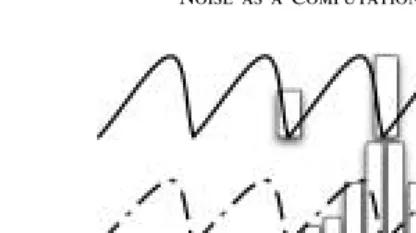
FIGURE 1
The potential is shown to be asymmetric in the horizontal direction in the page, whereas the vertical direction denotes the switching between this and a flat potential in which a particle is free to diffuse in a random fashion. The dotted lines indicate that the potential is set to zero. This switching between two potentials neither of which has a net directional bias gives rise to a biased random walk of a particle localised at the bottom of the potential well in the lowest figure. The location is tracked by the histograms in the figure. Time progresses from bottom to top.
It is important to point out why such a combination of determinism and stochasticity is a relevant system to consider as a potential source of computational inspiration. In a conventional computer, resources are consumed in carrying instructions to the central processing unit as well as in executing the algorithm. In the machinery of the cell, the genetic apparatus is responsible for transcription and translation of proteins which undertake much of the cellular activities. While some signalling is performed without any net transport of matter, there is substantial bulk transportation undertaken in the cell which exploits the cytoskeleton. The ratchet principle has been used to explain, with varying degrees of consensus, the different motions required for transport as well as for the transcription from DNA via the enzymatic motor RNA polymerase. Not only is there evidence that the cell seems to make use of the noise and non-inertial dissipative effects of the cellular environment, the diffusive “backtracking” of RNA polymerase in the Brownian ratchet phase of its transcription elongation steps [5, 1] is tied into the repair of transcription errors.
In the Figure 1 below, the lowest sketch shows a particle localised at one of the minima of the asymmetric potential (for anyV(−x)=V(x+a)∀a∈R, wherex denotes spatial location anda is a fixed arbitrary offset). In the next depicted time step, this potential is switched off (dotted sketch of the potential) and the particle is then free to diffuse and the histogram shows the likelihood of the distance travelled by the particle until the asymmetric potential is switched back on, whereby the particle slides down the potential gradient to the nearest local minimum.
walk by suitably rectifying thermal fluctuations. Since the Kelvin-Planck formulation of the second law of thermodynamics explicitly forbids the conversion of heat into work for an engine operating in a cycle, this system must operate away from equilibrium. In Appendix A we show, following [18] that in order to have a non-zero average velocity in the absence of a net potential difference, there needs to be (a) an asymmetric periodic potential and (b) energetic input into the switching of states experiencing the different potentials as in Figure 1 to drive the system out of equilibrium. In cellular environments, such a ratchet-like behaviour would exploit the presence of ATP as an energy source to enable directed motion. There is ongoing debate regarding the applications of this principle to explain the motion of kinesin on microtubules or myosin on actin. In contrast to the isothermal (flashing) ratchet depicted above, which has a loose coupling between chemical energy burning (from ATP hydrolysis) and motion (the diffusive step), a tightly coupled mechanochemical cycle has been proposed where there is no diffusive slippage. Instead of switching between a sculpted potential and a flat one, more finely tuned switching schemes have been proposed where transitions take place between asymmetric potentials like the one depicted which are shifted with respect to each other so that the particles are switched about to always go downhill, thus making that motion more efficient. The hand-over-hand motion of kinesin can be viewed simplistically in this fashion.
The biological motor families such as kinesin and myosin are enzymes which facilitate the conversion of one chemical species (substrate) into another (product) by lowering the energy barrier separating the species’ energetic states. In this case, the enzyme performs hydrolysis of ATP to release energy for motion, which results in a series of conformational changes of the enzyme resulting in its net movement. In the case of the creation of RNA transcript from DNA by RNA polymerase, experimental data has identified a base-pair by base-pair transcription elongation as the enzyme is translocated along the DNA polymer. However, the data also favours a loosely coupled step in the process of elongation, whereby prior to NTP binding to the active site (the catalytic core) the enzyme executes Brownian motion, flipping between the pre- and post-translocation states, much like the Brownian ratchet we have considered.
the appropriate biomolecular states labelled by its conformation or by some suitably coarse-grained summary of its microscopic quantum mechanical description. While the interaction between the kinesin macromolecule and theαandβ tubulin units of the microtubule accounted for the asymmetric potential which was periodic in space, for a computation to be enacted, differences in free energy could be confined to trajectories laid out in terms of chemical potentials of the biochemical system. The task would then be to sculpt the chemical potential landscape which would retain the periodicity of the microtubule or actin filaments. A simple candidate for such a periodicity would arise in the case of an enzyme sequentially converting substrate molecules into products, thus revisiting the same chemical potential differences periodically, modulo the lowering of substrate and raising of product number by one unit at each step.
In the case of molecular motors, a conformational change of the enzyme accompanying the chemical reaction (the strain of “induced fit” or some other allosteric change) could render the enzyme to be weakly coupled to the cytoskeletal substrate whereby it can explore by diffusion the surface of the cyloskeletal filament. In the presence of fluctuations in numbers of substrates and products a similar reduction in directed “downhill” motion down the chemical potential gradient is fostered. In other words, the chemical reaction can go either way along a generalised reaction co-ordiinate, the analog of the diffusive step. This could realise a ratchet-like motion whereby a reversible computation could be executed, depending on the nature of the rectifying switching. The reversibility reflects the ability to generate directional bias even in its absence in the underlying chemical potential surface, which also permits “uphill” trajectories even when the overall chemical potential requires downhill paths. This leads us to consider the noise in biomolecular processes that originate in number fluctuations in reactants in the next section.
3 NOISEIN SIGNALLING—-ALTERING THESTATESPACE
FIGURE 2
The basic phosphorylation-dephosphorylation cycle. KinaseE+ attaches to the protein and hydrolyses ATP to covalently modify protein X by attaching a phosphoryl group to it, releasing ADP in the process. The native concentrations of ATP and ADP ensure that this runs far from equilibrium. A phosphatase E− reverses this by releasing inorganic phosphate to the cytoplasm.
with respect to system-specific time scales is often the task at hand. These long-lived dynamical behaviours of specific biochemical species are often identified theoretically as the steady states of the biochemical network. Instead of identifying conformational states of individual enzymes as the carriers of computational states, it is also possible to view steady states of networks in the same vein. We shall find, following [20] that bistability, a feature thought to require feedback in networks (see for instance[10]) can also be obtained if there is noise present in a non-linear reaction scheme. Here we review a phenomenon demonstrated theoretically in the simplest signalling network which is ubiquitous in biological systems, namely, the phosphorylation-dephosphorylation cycle which are two independent processes driven by enzymes belonging to the kinase and phosphatase families respectively.
In a phosphorylation-dephosphorylation (“futile”) cycle, an enzyme (kinase) converts a substrate proteinX to its phosphorylated (often active) form X∗ with the phosphoryl group coming from hydrolysis of ATP (the relative concentrations of ATP and ADP help drive the system away from equilibrium). Similarly, a phosphatase converts X∗ back into X again involving an irreversible step, when the inorganic phosphate is released to the cytosol. In Appendix B eq. 10 we outline the basic rate equations for conversion of substrate to product using Michaelis-Menten (hyperbolic) kinetics for each of the two reactions. Combining these two competing effects, and given the conserved numbers of protein ([X](t)+[X∗](t) is
t-independent), we have
d[X]
dt = − d[X∗]
dt = k+
2[E+]0[X] K+
M+[X] − k−
2[E−]0[X∗] K−
M+[X∗]
In reference[12] the steady state equations (obtained by setting (d[X]/dt)=0) yielded a quadratic equation in [X] (or [X∗]) which admits one stable fixed point. In ref. [20] the kinases E+ are introduced via a discrete chemical process which introduces a non-zero variance in kinase concentration. In the Appendix we outline how instead of kinetic rate equations, this can be modelled as an equation for the probability density of the concentrations, a Fokker-Planck equation. An intuitive Langevin picture can be seen easily by replacing [E+] in the equation 1 by [E+]0+σξt whereξt is a white
noise process. The steady state is now given by the stationary probability distribution, which turns out to be quartic in [X] thus qualitatively changing the stability characteristics of the system. In particular, [20] show the bistability of the response ([X] or [X∗]) upon changing the input [E+], a phenomenon absent in the noise-free case.
The appearance of a multiple steady states due to noise also allows for temporal signatures of switching between them, providing a more varied repertoire for the cell for signal analysis. Since intracellular noise in terms of molecular number fluctuations is ubiquitous in cells, the attendant spectrum of temporal fluctuations is likely to have been “interpreted” by the organism. In the previous section we have isolated a particular enzyme as an inspiration for providing a computational principle by following its trajectory along its chemical potential. In contrast, in this section we focus instead on a biochemical (sub)-network as a computational substrate, viewing its steady states as computational states. By extension, trajectories between multiple steady states which become accessible to the system, albeit on a longer time scale, provide additional inputs for downstream processes. Steady state behaviours, and in particular the outcome of stable switching modes have been interpreted as the signals for key events in the life history of a cell. Examples include the MAPK cascade which is believed to instantiate the ultrasensitive switch driving oocyte maturation in frogs [10]. For the purpose of this position paper, we view the multistability as the basis for instantiating computational states, where temporal signatures of noise-driven switching in response to modulation in enzymatic concentrations can be decoded by a suitable readout interface.
4 REMARKS
computational tools, particularly at nano-scales where rule based control of device components is technically challenging, and often beset with the difficulties of coping with noise.
From the above survey of potential contributions of noise to the functioning of molecular mechanisms the basis for a speculative extrapolation emerges: Noise induced change in structure of steady states give rise to transitions between quasi-steady states. These transition patterns are signatures of system states that could be acted upon by biased selection. Perhaps noise endows biomolecular organisations with additional signals open to interpretation and hence manipulation.
It is too early to know the extend to which noise exploiting mechanisms play a role in intracellular computation, but what is known indicates that the utilisation of noise in natural and artificial architectures warrants more in-depth investigation.
A. CONDITIONS FOR MACROSCOPIC DRIFT
In this section we show, following [18] that in order to have a non-zero average velocity in the absence of no potential difference, there needs to be (a) an asymmetric periodic potential and (b) energy input into the switching of states experiencing the different potentials as in Figure 1. Here we use a generalised Fokker-Planck description of the enzyme in conformational state i in which it is subject to a potential Vi(x). The probability distribution of the enzyme in state i Pi(x, t) is then given by
∂tPi(x, t)+∂xJi(x, t)=
j=i
πi←j(x)Pj(x, t)−πj←i(x)Pi(x, t), (2)
whereπa←b(x) denotes the rate of switching from stateb to state a. The current Ji(x, t) is given by
Ji(x, t)=η−1[Pi(x, t) (∂xVi(x)+Fext)+kBT ∂xPi(x, t)] (3)
where we have set the friction terms η to be the same in all states for simplicity. The current contains the drift (involving the gradient of the potential) and diffusion (involving the Boltzmann constant kB times the temperature T) terms, and the right hand side of 2 denotes the rates of probability transfer into and out of statei. Introducing the total probability
P(x, t)=iPi(x, t), the fractional probabilitiesλi(x, t)=Pi(x, t)/P(x, t) in each state and the total current J =iJi(x, t), we can introduce an effective Fokker-Planck equation [23] for the total probability P(x, t):
where
J(x, t)=η−1[P(x, t) (∂xVeff(x)+Fext)+kBT ∂xP(x, t)], (5) and
Veff(x)=
i
x
d xλ
i(x)∂xVi(x). (6)
If the periodicity of the potential is L, we can now make a few observations from equation 6. Upon integrating over the length of a period, the effective energy difference over a period is
Veff(L
2)−Veff(
−L
2 )=
i
L/2
−L/2 d xλ
i(x)∂xVi(x). (7)
If the potentials Vi(x) are symmetric with respect to x→ −x, the prob-abilities inherit the same symmetry and the equation 7 vanishes. Also, if the detailed balance condition is satisfied for the steady state probability distribution, then
πi←j(x)
πj←i(x) =e
Vj(x)−Vi(x)
Upon settingPiss∼exp(−Vi(x)), the equilibrium distribution, the average velocity across a period in steady state:
v =
L/2
−L/2
1
η
i Pss
i (x)(Fext−∂xVi)dx
= 1
ηFext
L/2
−L/2 dx
i Pss
i (x)+
1
η
L/2
−L/2 dx
i
∂xe−Vi(x)
= 1
ηFext,
the last step again follows from the periodicity of the potentials and the normalisation of the total probability distribution. Thus, spatial asymmetry and non-equilibrium are both required for the ratchet motion to be possible in the absence of an external force.
B. NOISECHANGES THEFIXED POINT STRUCTUREOF THE FUTILECYCLE
framework from which the Michaelis-Menten rate laws for conversion of substrate to product is derived. The typical chemical reaction mechanism with first order rate constants ki takes the form:
E+S$%k1 k−1
ES−→k2 E+S (8)
where the catalytic conversion at ratek2is assumed to be energy driven, so its reverse reaction occurs with vanishing probability. Introducing kinetic rate equations valid for concentrations [X] of large numbers of molecules of species X in a well-stirred regime, the coupled set of equations is usually solved in the quasi-steady state approximation where d[ES]/dt≈0. Since the total concentration of enzyme is constant ([E]0=[E](t)+[ES](t)), we
can take the concentration of available enzyme to be [E](t)=[E]0−[ES](t)
so that at steady state concentrations of [ES],
0≈ d[ES]
dt =k1[S](t) ( [E]0−[ES](t) )−(k−1+k2)[ES](t) (9)
from which we deduce:
[ES]= [E]0[S]
k−1+k2
k1
+[S] =⇒
d[P]
dt =
k2[E]0[S] KM +[S]
(10)
where we have set KM =(k−1+k2)/k1, called the Michaelis constant.
In a phosphorylation-dephosphorylation (“futile”) cycle, an enzyme (kinase) converts a substrate proteinX to its phosphorylated (often active) form X∗ with the phosphoryl group coming from hydrolysis of ATP (the relative concentrations of ATP and ADP help drive the system away from equilibrium). Similarly, a phosphatase converts X∗ back into X again involving an irreversible step, when the inorganic phosphate is released to the cytosol. Combining these two competing effects, and given the conserved numbers of protein ([X](t)+[X∗](t) ist-independent), we have
d[X]
dt = − d[X∗]
dt = k+
2[E+]0[X] K+
M+[X] − k−
2[E−]0([X]T −[X]) K−
M+([X]T−[X]) , (11)
where [X]T =[X]+[X∗]. In reference [12] the steady state equations (obtained by setting (d[X]/dt)=0) were analysed in the saturated limit (KM± <<1). At saturation, the kinetics is “zero order” and there is not much resistance to conversion of X to X∗ if the catalytic rate k+2 > k2− or the converse, and in a macroscopic system, there is a steep or “ultrasensitive” switch (faster than the hyperbolic Michaelis-Menten rate) of X/(X+X∗) from 0 to 1 as k2+/k−2 crosses unity.
whereξt is a white noise process,
ξt =0, ξtξt =δ(t−t), (12)
to [E+]0 in eq. 11 we end up with a Langevin equation [20], where a
fluctuating term of the form
k+
2σ[X] K+
M+[X]ξt.
(13)
is added to the right hand side of eq. 11. This leads to a Fokker-Planck equation for the probability distribution of the concentrations [X] (see [23]):
∂tP([X], t)=∂[X]
−a([X])P([X], t)+1
2∂[X](D([X])P([X], t)) , (14)
with “drift term”a([X]) given by the kinetic rate terms in eq. 11 and an effective “diffusion constant” (obtained via a fluctuation-dissipation relation calculated fromd[X]td[X]t) given by
D([X])=
k+
2σ[X] KM++[X]
2
. (15)
At steady state, the probability distribution is obtained by multiplying with the integrating factor for the first order differential equation which follows from the stationarity condition ∂tP([X], t)=0:
−a([X])Ps([X])+1
2∂[X](D([X])Ps([X]))=constant
For the “zero current” case, the constant on the right hand side is 0, and
Ps([X])∝ 1
D([X])exp
+2
[X] a([X]) D([X])d[X]
We omit the details here, referring the reader to ([23]). Setting the derivative of the stationary distribution to 0 gives the equation for the isocline:
a([X])−1
2∂[X]D([X])=0.
Upon inserting fora([X]) andD([X]) the expressions in eq. 11 and eq. 15, we get
−k+E+[X] K+
M +[X] +
k+E−([X]T −[X])
K−
M+([X]T−[X])− K+
Mk+2σ2[X]
(KM++[X])2 =0,
REFERENCES
[1] Abbondanzieri, E. A., Greenleaf, W. J., Shaevitz, J. W., Landick, R. and Block. S. M., (2005). Direct observation of base-pair stepping by RNA polymerase. Nature, 438: 460–465.
[2] Adar, R., Benenson, Y., Linshiz, G., Rosner, A., Tishby, N. and Shapiro, E., (2004). Stochastic computing with biomolecular automata. Proc. Natl. Acad. Sci. USA, 101, (27):9960–9965.
[3] Astumian, D., (2005). Chemical peristalsis. Proc. Natl. Acad. Sci. USA, 102, (6): 1843–1847.
[4] Astumian, R. D., (1997). Thermodynamics and kinetics of a browinian motor. Science, 276:917–922.
[5] Bar-Nahum, G., Epshtein, V., Ruckenstein, A. E., Rafikov, R., Mustaev, A. and Nudler, E., (2005). A ratchet mechanism of transcription elongation and its control. Cell, 120:183–193.
[6] Bhalla, U. S., (2004). Signalling in small subcellular volumes. i. & ii. Biophysical
J., 87:733–744, 745–753.
[7] Bosshard, H. R., (2001). Molecular recognition by induced fit:How fit is the concept?
News Physiol. Sci., 16:171–173.
[8] Eisenmesser, E. Z., Millet, O., Labeikovsky, W., Korzhnev, D. M., Wolf-Watz, M., Bosco, D. A., Skalicky, J. J., Kay, L. E. and Kern, D., (2005). Intrinsic dynamics of an enzyme underlies catalysis. Nature, 438:117–121.
[9] Elias, P., (1958). Computation in the presence of noise. IBM Journal, 346–353. [10] Ferrell, J. E. and Machleder, E. M., (1998). The biochemical basis of an all-or-none
cell fate switch in xenopus oocytes. Science, 280:895–898.
[11] Feynman, R. P., Leighton, R. B. and Sands, M., (1963). The Feynman Lecutres on
Physics, 1, 46,1–9. Addison-Wesley, Reading MA.
[12] Goldbeter, A. and Koshland, D. E., (1981). An amplified sensitivity arising from covalent modification in biological systems. Proc. Natl. Acad. Sci. USA., 78:6840–6844. [13] H¨anggi, P., (2002). Stochastic resonance in biology. ChemPhysChem, 3,(3):285–290. [14] Jerne, N. K., (1967). Antibody and learning:Selection versus instruction. In Quarton, G. C. Melnechuk, T. and Schmitt, F. O., editors, The Neurosciences, 200–205. Rockefeller University Press, New York.
[15] Koshland, D. E., (1967). The catalytic and regulatory properties of enzymes. Annu.
Rev. Biochem., 37:359–410.
[16] Landauer, R., (1976). Fundamental limitations in the computational process. Berichte
der Bunsen-Gesellschaft, 80,(11):1048–1059.
[17] Oster, G., (2002). Darwin’s motors. Nature, 417:25.
[18] Prost, J., Chauwin, J.-F., Peliti, L. and Ajdari, A., (1994). Asymmetric pumping of particles. Physical Review Letters, 72:2652–2655.
[19] Reimann, P., (2002). Brownian motors:noisy transport far from equilibrium. Physics
Reports, 361,(2–4):57–265.
[20] Samoilov, M., Plyasunov, S. and Arkin, A. P., (2005). Stochastic amplification and signaling in enzymatic futile cycles through noise-induced bistability with oscillations.
PNAS, 102:2310–2315.
[21] Schr¨odinger, E., (1945). What is Life? Cambridge University Press, Cambridge. [Reprint 1992.].
[23] van Kampen, N. G., (1992). Stochastic Processes in Physics and Chemistry. North Holland, Amsterdam.
[24] von Neumann, J., (1956). Probabilistic logics and the synthesis of reliable organisms from unreliable components. In Shannon, C. E. and McCarthy, J. editors, Automata
Studies, 43–98. Princeton University Press.
[25] Winograd, S. and Cowan, J. D., (1963). Reliable Computation in the Presence of
Noise, 4, 22–33. MIT Press, Cambridge, MA.
[26] Zauner, K. -P., (2005). Molecular information technology. Critical Reviews in Solid
State and Material Sciences, 30,(1):33–69.
[27] Zhang, B. -T. and Jang, H. -Y., (2005). Molecular learning of wDNF formulae. In