Behavioural Specification of Grid Services with the KAoS Policy Language
Luc Moreau
1Jeff Bradshaw
2Maggie Breedy
2Larry Bunch
2Pat Hayes
2Matt Johnson
2Shri Kulkarni
2James Lott
2Niranjan Suri
2Andrzej Uszok
2(1) Electronics and Computer Science, University of Southampton
(2) Institute for Human and Machine Cognition (IHMC)
[email protected],[email protected],[email protected],[email protected],[email protected]
[email protected],[email protected],[email protected],[email protected],[email protected]
Abstract
Complex services in Service-Oriented Architectures such as the Grid typically require to be configured in multiple ways that cannot be anticipated by service designers; we il-lustrate this requirement by studying the myGrid registry, a Grid Registry capable of supporting annotations of service descriptions by third-party users. Instead, services have to be conceived so that they can be configured at deployment and run time. We argue that KAOS is a powerful and
flexi-ble language that can help define such configurations. Us-ing our registry case study, we examine the requirements that the definition of such complex configurations brings on policy languages and explain how they can be satisfied. Specifically, we use role-value maps to express constraints between property values; we introduce a notion of PolicySet with associated parameters that support constraints within a well defined scope; finally, we define a notion of Context that allows us to refer to property values that were extant in past execution environments. Essentially, these concepts allow us to add constraints to values in policy definitions, to organise policies in coherent and structure blocks, and to refer to the execution history. The paper discusses these concepts and how they are implemented in a binding of the
KAOS policy language to the myGrid Registry.
1
Introduction
Complex services in Service-Oriented Architectures such as the Grid typically require to be configured in mul-tiple ways that cannot be anticipated by service designers. Consider the myGrid registry [17], which is capable of host-ing service descriptions and third-party annotations; anno-tations include semantic descriptions of services, trust or ac-curacy information about them, their usage policies or sim-ply general statistics about their use. Such Grid registries may be deployed in many different ways: e.g., they may be
federated or replicated, they may hold annotations to be cu-rated by experts, their access control may be role based. As registries operate semi-autonomously, some additional ex-ternal constraints may be set by institutions that host them: e.g., about the computing resources they use or about the domains of services being registered.
The variety of service configurations is such that service designers cannot anticipate them all. It is therefore a re-quirement that such services be provided with the means to specify their configurations, hence giving them the flex-ibility that is desired at deployment or run time. We argue that policy languages, such as KAOS [22], Ponder [5], or Rei [14] can be utilised for configuring complex grid ser-vices. In particular, the KAOS language, which has been used for grid security [13, 23] or mobile agents, is an inter-esting candidate since it is conceived to constrain behaviour of (semi-)autonomous entities through the use of enforce-ment mechanisms [4]. Another benefit that is relevant to this context is that KAOS is based on the ontology language
OWL[1] and thereforeOWL-based reasoning can be applied to policies for enforcing them or for detecting conflicts they may entail.
We therefore undertook to use the policy language KAOS to specify configurations of the myGrid registry [17], which had already been designed to be modularly or-ganised around a set components [18]. Three different us-ages of KAOS policies have been adopted in our endeavour. Policies are used to (i) to express the behavioural specifi-cation of components; (ii) to define components instances and aggregate them in meaningful compositions; and, (iii) to characterise overarching constraints over registries.
Doing so, we have encountered an interesting set of new requirements, which we have addressed by providing ex-tensions to KAOS. These extensions will be discussed in this paper: (i) We made extensive use of role-value maps
[20] to add constraints to property values in concept defi-nitions, which would otherwise be not expressible inOWL.
extended with properties and can be referenced by policies belonging to these sets. (iii) Finally, we recognise that a
policy language, in particular one that contains obligation policies, has an underlying computational model; we make past execution history explicit through anOWL-concept of
context.
This paper is organised as follows. We provide further motivation for this work, by detailing a flexible Grid Reg-istry, whose behaviour needs to be specified and constrained at deployment- and run- times (Section 2). We summarise key concepts of the policy language KAOS, which we see as a powerful fit for such an application (Section 3). We then discuss how policies can contribute to the configura-tion of such a Grid Registry (Secconfigura-tion 4). This is followed by an analysis of the requirements that this application in-troduces on a policy language and the KAOS solutions to address them (Section 5), and an overview of our on-going implementation (Section 6). Finally, we conclude the paper by a discussion and a summary.
2
Background Motivation: a Flexible Grid
Registry
The Grid is a large scale computer system that is capable of coordinating resources that are not subject to centralised control, whilst using standard, open, general-purpose pro-tocols and interfaces, and delivering non-trivial qualities of service [10]. As part of the endeavour to define the Grid, a service-oriented approach has been adopted, by which com-putational resources, storage resources, networks, programs and databases are all represented by services [11]. In this context, a service is a network-enabled entity capable of en-capsulating diverse implementations behind a common in-terface. A service-oriented view is powerful since it allows the composition of services to form more sophisticated ser-vices.
Service discovery is a difficult task in large-scale open distributed systems such as the Grid and Web, due to the potentially large number of services advertised. In order to filter out the most suitable services for the task at hand, many have advocated the use of semantic descriptions that qualify functional and non-functional characteristics of ser-vices in a manner that is amenable to automatic processing [2, 7, 24].
As part of the myGrid project (www.mygrid.org.uk), a service directory was designed for hosting semantic de-scriptions of services, including their functionality and their semantic inputs and outputs [15]. Semantic descriptions are currently expressed in an OWL ontology [24]. A key characteristics of our approach is that semantic descriptions need not be published by service providers, but can be made available by third party users [15]; such an approach sup-ports collaborative practices, since users can utilise services
because others found them useful or efficient to perform specific tasks.
We have identified different ways of deploying a Grid registry; the following use cases illustrate configurations that are deemed desirable in different circumstances. (i)
First, a Grid registry can be deployed as a standalone ser-vice, presenting the set of interfaces required by its de-ployer, and whose availability to clients is prescribed by its security policy. (ii) Second, users could deploy it as
a “proxy” to a publicly available registry for which they do not have write access [15]; the proxy would typically tun-nel queries to the public registry, but would hold locally any metadata information about registered services, and would therefore act as a personalised registry. (iii) Alternatively, the service could also federate entries from multiple reg-istries. Such configurations, and many others, cannot be frozen at design time, but they need to be decided at de-ployment time according to the deployer’s needs, or possi-bly at run time according to the users’ needs. Therefore, the architecture of such a registry must be designed to al-low easy configuration or re-configuration at deployment and run time, respectively.
Against this background, the myGrid registry implemen-tation adopts a message-passing metaphore, in which mes-sages are handled by components we refer to as handlers [18]. Handlers are typically designed to process messages of a same category, such as the messages of theUDDI pub-lish interface, of theUDDIinquiry interface, or messages re-lated to metadata; handlers in fact contain the business logic implementing some ports of the registry’sWSDLinterface.
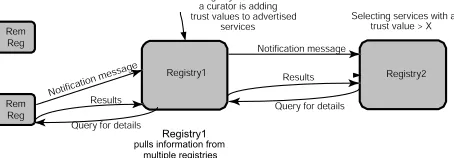
To focus the discussion, we consider a typical distributed deployment of the registry, supporting some myGrid use cases. Figure 1 illustrates the scenario in which an expert scientist in an organisation has a personalised registry (Reg-istry 1) that copies the service adverts published in one or more public remote registries. The expert then adds a trust value as metadata to each service advert, indicating how re-liable they have found the service. A novice in the same organisation owns a personalised registry (Registry 2) that subscribes to notifications of changes in Registry 1, and copies new entries from Registry 1, if the trust value of such an entry is higher than a particular defined constant. The novice is the only user allowed to edit the metadata in Registry 2. As a result, all services discovered by the novice have been judged to be trustable by the expert.
configura-Registry2 Notification message
Registry1 pulls information from
multiple registries
The information in Registry1 is curated: a curator is adding trust values to advertised
services
Query for details Results
Selecting services with a trust value > X
Query for details Results
Notifica tion messa
ge Registry1
Rem Reg
[image:3.612.58.285.32.111.2]Rem Reg
Figure 1. A Deployment Scenario
tions. Hence, we believe that a policy-based mechanism to specify configurations of such services would be very valu-able. In Section 4, we discuss the different use of policies that we foresee in this context, but beforehand we introduce the KAOS policy language and its terminology.
3
KAoS Policy Language Overview
We refer the reader to previous KAOS publications such as [4, 22, 13] for a detailed presentation of the KAOS lan-guage and its associated graphical interfaceKPAT. In this section, we introduce the concepts of KAOS that we use in this paper.
KAOS key entity is the policy that can express autho-rization (i.e., constraints that permit or forbid some action) or obligation (i.e., constraints that require some action to be performed, or else serve to waive such a requirement) for some type of action performed by one or more actors in some situation. A policy is represented as an ontology sub-class of one of the four types of policy sub-classes: positive or negative authorization, and positive or negative obligation. An important property value is the name of a controlled
ac-tion class, which is used to determine the actual meaning of
the policy. Authorization policies use it to specify the action being authorized or forbidden, whereas obligation policies use it to specify the action being obliged or waived. An-other property value is the trigger which identifes an action that will trigger the enactment of a policy. Finally, policies are bundled together into named policy sets.
Figure 2 illustrates the syntactic notation that we use in this paper and is shown by the KPAT editing interface. It contains the specification of a positive obligation policyp that mandates actors of classX to perform a
Communi-cationAction, which is a predefined concept in the KAOS ontology. The communication action is to send messages of class Bar to recipients of classY; such a communication action is referred to as the “controlled action” of the policy, or control for short. In Figure 2, the trigger of the policy is itself another communication action that must take place to enable the obligation. The trigger requires an obligation’s incumbent of classX to be the recipient of a message of class Foo. Informally, the policy requires any X to send
a message of class Bar to someY, whenever it receives a message of class Foo. For instance, such an obligation pol-icy could be instantiated to record incoming messages into a logging service. Concepts Foo and Bar must themselves be defined in an ontology; in our case study, they will denote messages that are used by the registry implementation.
Policyp:
Xis obligated to perform
CommunicationAction with properties hasDestination is subset ofY
carriesMessage is subset of Bar
whenXperforms
CommunicationAction with properties hasDestination is subset ofX
carriesMessage is subset of Foo
Figure 2. KAoS Obligation Policy
4
Multiple Levels of Policy Usage
In this Section, we analyse how policy languages can help specify the behaviour of services, and in particular grid registries. As an illustration, we consider the deployment scenario introduced in Section 2, and specifically, the con-figuration of Registry 2 for the novice. Figure 3 shows the expert registry and the contents of the novice registry. A notification message, in transit from the expert registry to the novice registry, is meant to indicate that some metadata has been updated in the expert registry. Such a notification message is received by the event handler in the novice reg-istry, which needs to be configured so as to behave accord-ing to the scenario described previously. We now introduce different types of policy usage in the context of the registry, namely inside components, registry level and external to the registry.
Inside component Upon receiving a MetadataChanged notification message, the EventHandler in the novice reg-istry needs to query the expert regreg-istry to obtain the details of the metadata that has changed. If such a metadata per-tains to the trust given to a service, than the service detail (and all its metadata) should be retrieved from the expert registry and saved into the novice registry. Such a behaviour can be characterised by five obligation policies: (i) obtain
trust metadata from expert registry and check it is greater than threshold; (ii) obtain service detail from expert reg-istry; (iii) save service detail in novice registry using the
EVENT HANDLER
METADATA HANDLER
UDDI PUBLISH HANDLER
METADATA HANDLER
UDDI PUBLISH HANDLER
EXPERT REGISTRY
MetadataChanged Notification
PolicySet specifying the behaviour of the EventHandler component parametrised by the remote registry, the Event Handler interface, the Metadata and UDDI Publish Handler Interfaces and external parameters
PolicySet specifying which component instances have to be deployed, how they should be connected, what parameter values should be adopted, and which interface should be exposed externally in order to provide a personalised Registry.
param1 param2 param3
[image:4.612.49.288.20.222.2]NOVICE REGISTRY
Figure 3. Policies in Novice Registry
Registry Level Given a set of components, either pro-grammed directly or specified by policies, a given deploy-ment of the registry will identify how such components need to be connected. Again, such configuration cannot be hard-coded by registry implementers but must be speci-fiable by deployers. In our case, the policy will identify three component instances (as depicted in Figure 3), a set of parameters for example read from a configuration file, and how each of these components will be connected.
Single and Distributed Registries Overarching Con-straints Registries may have to conform to the rules set by the institution in which they are deployed. Examples of such rules are: (i) A registry may be authorised to
repli-cate data only from a trusted remote registry, and it is at the institutional level that such a notion of trusted registry is specified. (ii) A collection of registries may be authorised to replicate data from each other, but a policy may force them to avoid circularity in data being replicated. (iii)
An institution may set constraints on the set of resources a registry can use (such as processor or disk space). (iv)
Likewise, an institution may require services in a given reg-istry to be located within some administrative domain (e.g., Southampton services), or to be related to a given applica-tion domain (e.g., bioinformatics).
5
Policy Language Features
We now illustrate how specific application requirements can be expressed with KAOS policy language.
5.1
Action Must Refer to Trigger Properties
There is a type of constraints that is very common in practical policy definitions, as illustrated by the following examples: given a message from an entityX, the obliga-tion is to send an acknowledgement back toX; or given a message with valuev, the obligation is to send a message with valuev+ 1. In such cases, the trigger of an obligation policy identifies a value, and the action of this policy is to perform an action that is parameterised by such a value.
Such constraints could naturally be expressed using a no-tion of variable: the trigger declares a variable, which is computationally bound to a value when the trigger of the policy is verified to be satisfied; the value the variable refers to is itself used when the variable is referenced in the action. KAOS policy language is based on OWL which does not offer variables directly; instead, KAOS relies on a mech-anism, called role value maps [20], to express such con-straints. Figure 4 illustrates how role value maps have been put into practice in an example obligation policy. Using the notation:
GetBusinessServiceMetadata→hasMetadataKey
equals
Trigger→carriesMessage→hasMetadataKey,
the set of values of the hasMetadataKey property of
Get-BusinessServiceMetadata messsages in the policy control
is prescribed to be equal to the values of the property
has-MetadataKey of the messages that are values of the
prop-erty carriesMessage, for the obligation trigger. Likewise, the following notation:
MetadataChanged→hasMetadataKey equals
Control→carriesMessage→hasMetadataKey.
requires the values of the property hasMetadataKey to be equal to values of the same property for messages in the Control. Within a policy specification, the reserverd words
Control and Trigger refer to the terms respectively denoting
the control and trigger of the current policy being defined.
5.2
Policy Set Context
EventHandler is obligated to perform CommunicationAction with properties
hasDestination is subset of Registry carriesMessage is subset of
GetBusinessServiceMetadata hasMetadataKey equals
Trigger→carriesMessage →hasMetadataKey
when EventHandler performs
CommunicationAction with properties hasDestination is subset of EventHandler carriesMessage is subset of
MetadataChanged hasMetadataKey equals
Control→carriesMessage →hasMetadataKey
Figure 4. Role Value Maps in Obligation Policy
Programming languages have a similar analogy. Con-sider that a component behavioural specification is im-plemented by a Java class, with a constructor initialising some private instance variables; each policy could be im-plemented by a method (or possibly inner class); policies would be entitled to refer to instance variables. Java scop-ing rules would ensure that private instance variables re-main visible to the current block, i.e. the component. Com-ponents instances can be created by instantiating the class: instance variables would then be entitled to be bound to dif-ferent values in difdif-ferent component instances. The role-value maps introduced in Section 5.1 can be used to express such a notion. Figure 5 provides us with an illustration.
Using role value maps and a keyword PolicySet, we can express contraints between concept properties and Policy-Set properties. In Figure 5, we set a constraint to the concept
MetadataChanged by requiring the values of its hasTrust
property to be greater than the values of the hasThreshold property of the PolicySet the policy belongs to.
hasTrust greaterThan PolicySet→hasThreshold
In Figure 5, we show how a component behaviour can be specified by a set of policies, includingp1we have just defined. Such a behaviour can be instantiated into two dif-ferent concrete componentsc1andc2, which are each given a specific threshold value (0.5forc1and0.8forc2). Within componentc1, policyp1will be instantiated: its constraint will refer to threshold0.5. Likewise, the instance ofp1in c2will refer to threshold value0.8. We note that policyp1 could also be used in a different policy set, which would be instantiated to form other component instances, referring to different threshold values.
Policyp1:
EventHandler is obligated to perform CommunicationAction with properties . . .
when EventHandler performs
CommunicationAction with properties hasDestination is subset of EventHandler carriesMessage is subset of
MetadataChanged hasMetadataKey equals
Control→carriesMessage →hasMetadataKey hasTrust greaterThan
PolicySet→hasThreshold
PolicySet ComponentBehaviour hasPolicy [p1, p2, . . .]
hasThreshold [Integer] hasOtherParameter [Class]
Instancec1of ComponentBehaviour
hasThreshold 0.5
Instancec2of ComponentBehaviour hasThreshold 0.8
Figure 5. PolicySet Properties
5.3
Execution Context
An obligation policy such asp1 may initiate an event, whose completion may trigger another obligation policyp2. In other words, the succession of events and triggerings of policies result in the sequenced execution of obligation poli-cies. In some cases, a given event may trigger several obli-gation policies, which potentially could be executed in par-allel. Hence, the computing model underlying the KAOS policy language naturally supports sequentiality and paral-lelism. In a policyp2that is executed afterp1, it is frequent that we have to refer to property values that were extant in the trigger ofp1.
Hence, KAOS provides us with a notion of execution
context, through which we can refer to properties that held
during the enactment of a previous policy. Since parallel execution may take place, it is understood that multiple ex-ecution contexts may coexist, so that each “thread of execu-tion” is entitled to its own context.
Policyp1:
EventHandler is obligated to perform CommunicationAction with properties
(see Figure 5)
with context: extends Context with properties
hasTrust equals Trigger→carriesMessage→hasTrust
when EventHandler performs
CommunicationAction with properties hasDestination is subset of EventHandler carriesMessage is subset of
MetadataChanged hasMetadataKey equals
Control→carriesMessage→hasMetadataKey hasTrust greaterThan
PolicySet→hasThreshold
Policyp2:
EventHandler is obligated to perform SaveAction with properties
hasValue Pair
hasLeft equals Trigger→carriesMessage →returns, hasRight equals Context→hasTrust
when EventHandler performs
CommunicationAction with properties hasDestination is subset of EventHandler carriesMessage is subset of
GetBusinessServiceMetadata returns equals
Control→hasValue→hasLeft
Figure 6. Execution Level Context
existing context with a property hasTrust that is equal to a property accessible from the trigger.
We note that the keywords PolicySet and Context have different purposes: the former refers to the static structure of policies, whereas the latter refers to execution. From a semantic viewpoint, we allow contexts to be “extended” by adding a new property to an existing context; if the prop-erty already existed, the new propprop-erty overrides the previous one. Such a non-mutable semantics of contexts provides a precise behaviour when multiple policies can be triggered in parallel and they share a same execution context1.
5.4
Overarching Constraint
Finally, we now show an example of an overarching con-straint set by the institution in which a registry is deployed. In Figure 7, we present a negative authorization policy that prevents a Registry from communicating with remote reg-istries located outside its administrative domain. Such a policy ensures that services advertised in the Registry are
1Specifically, the notion of context that we have introduced here
corre-sponds to the notion of environment usually used in denotational semantics of programming language as opposed to the notion of store.
not propagated to other institutions, and that the Registry’s content is not directly changed by updates coming from other domains.
Policyp:
Registry is not authorized to perform CommunicationAction with properties
hasDestination is subset of RemoteRegistry
hasDomain not equal Registry→hasDomain
Figure 7. Overarching Constraint
6
Implementation
The myGrid registry adopts a message passing metaphor, according to which a set of components only communi-cate by message passing [18]; each component is imple-mented as a handler of messages of a given type. From an implementation viewpoint, messages are specified in the registry’s WSDL interface and converted into Java classes (using the Axis wsdl2java converter). In order to structure the code, messages implement the visitor pattern; handlers are expressed as visitors for sets of messages. Such a code design insures proper compile-time type checking and pro-motes compositionality of components.
In order to bind the KAOS run time system to the my-Grid registry, we have defined new message visitors that are capable of converting messages and their contents into communication actions understood by KAOS. KAOS of-fers an API that allows the construction of “Action Instance
Descriptions” asOWLconcepts with their associated prop-erties. A querying interface allows us to identify the obliga-tions that are triggered by a given action; to this end, KAOS uses OWL-based reasoning to find the obligations, whose triggers match the current action, and obtain the resulting controls, instantiated for the given trigger. Such actions now need to be converted back to Java messages that can be han-dled by the myGrid registry; they are then dispatched to the appropriate handlers, as specified by the triggered obliga-tion. As far as authorization policies are concerned, they can be enforced using a similar technique to [13], in which an access control modules decides, usingOWL-based rea-soning, whether a request can be appropriately delegated to a component, or whether it should be rejected.
7
Discussion and Related Work
services and agents that cannot always be trusted to regu-late their own behaviour appropriately, because poorly de-signed, buggy or malicious [4]. Specifically, policy lan-guages, such as KAOS [4] or Ponder [6], allow system de-signers to externally adjust the bound of autonomous be-haviour, in order to ensure safety and effectiveness of their system: policy languages and associated mechanisms to en-force them allow the dynamic regulation of the system com-ponents behaviour without changing their code, nor requir-ing the cooperation of the components berequir-ing governed. Pol-icy languages have also been adopted by the Web Services community, in particular, in the context of security: for in-stance, WS-Policy is a framework for indicating a service’s requirements and policies [3].
WS-Policy introduces a simple grammar for expressing the capabilities, requirements, and general characteristics of Web Services and their clients. Policy expressions al-low for domain-specific declarative and conditional asser-tions. WS-Policy defines a policy to be a collection of one or more policy assertions. WS-Policy, in compari-son to KAOS, takes a different view on policy semantics since it defines policy from the perspective of capabilities or behaviour required to access particular service. Thus, the WS-Policy policies, in essence, provide lists of possi-ble values for properties defining capabilities. As previ-ously described, KAOS policy semantics is concentrated around authorizations and obligations, which can also be used to obtain lists of allowed values for a given service request. However, KAOS declarative definitions based on
ontology allow for greater flexible computing of these lists based on the current context. In general, the fact that KAOS
is using ontology both as a base of its policy vocabulary and as its policy constructs allows us to build much more complex policy definitions then WS-Policy and more im-portantly allows for reasoning of policy applicability and relations. Recent work by Parsia et al. [19] provides map-pings of WS-Policy into OWL that allows them to reason about policy containment, i.e., whether the requirements for supporting one policy are a subset of the requirements for another. WS-SecurityPolicy defines extensions for security properties for Web Services [8]; SAML [12], the Security Assertion Markup Language, is a framework for exchang-ing authentication and authorization information.
Among the plethora of policy languages, KAOS adopts the original approach of expressing policy specifications in the ontology languageOWL [1], which gives it a number of significant advantages. First, most policy specifications need to refer to domain specific concepts, which are typ-ically formalised in an ontology; therefore, by expressing both policies and concepts inOWL, policy specifications are able to refer to concepts easily. Second, reasoning over pol-icy specifications can decide if a set of policies subsumes another, or if a set of policies results in conflicts; thus, we
naturally benefit fromOWL’s underlying reasoning mech-anism by expressing polices in OWL. Third, the policy language is not constructed in an ad-hoc manner for spe-cific application domains, but it draws its vocabulary from a well-understood, clearly specified set ofOWLterms.
This paper introduces a new kind of use of the KAOS language since it applies KAOS to the behavioural specifi-cation of Grid registries. Miles et al. [16] is a first attempt of using policies for specifying the behaviour of Grid reg-istries. Their approach differs from ours in two different ways. First, it adopts an ad-hoc policy language to describe the configuration of a system; such a language does not of-fer the systematism ofOWL-based KAOS, nor its reasoning capababilities; on the other hand, since it was purposely de-signed for the task, it is more concise. Second, in order to enforce management policy in a registry, Miles et al. create an agent that processes the goals of the policy and the op-erations performed on the registry using the belief-desire-intention model and its specific instantiations as the pro-cedural reasoning system (PRS) and the distributed multi-agent reasoning system (dMARS) [9]. As far as enforce-ment (i.e., execution) is concerned, both approaches have strong theoretical underpinning, respectively OWL-based reasoning and belief-desire-intention model. The KAOS approach offers the additional advantage that reasoning can be applied statically over policies, to detect conflicts or to perform subsumption reasoning, a facility that is not avail-able in Miles’ approach. From a performance viewpoint, reasoning is also used to decide if a policy applies to an incoming message; in the simplest case, pattern matching suffices to match an incoming message against applicable policies; in the most complex case, ontological reasoning is required which trigger is semmantically satisfied; our focus is on optimising such a process, by maximising the amount of offline reasoning, so as to reduce the amount of reasoning requied at run time.
8
Conclusion
9
Acknowledgements
This research is funded in part by the Overseas Travel Scheme of the Royal Academy of Engineering and EP-SRC project (reference GR/S75758/01). The case study presented here is the myGrid registry (EPSRC Grant GR/R67743/01) which is being refactored as part of the OMII Grimoires project (EPSRC Grant GR/S90843/01).
References
[1] S. Bechhofer, F. van Harmelen, J. Hendler, I. Hor-rocks, D. L. McGuinness, P. F. Patel-Schneider, and L. A. Stein. OWL Web Ontology Language Reference. http://www.w3.org/TR/2004/REC-owl-ref-20040210/, Feb. 2004.
[2] T. Berners-Lee, J. Hendler, and O. Lassila. The Semantic Web. Scientific American, 284(5):34–43, 2001.
[3] D. Box, F. Curbera, M. Hondo, C. Kaler, D. Langworthy, A. Nadalin, N. Nagaratnam, M. Nottingham, C. von Riegen, and J. Shewchuk. Web services policy framework (ws-policy). May 2003.
[4] J. M. Bradshaw, P. Beautement, M. Breedy, L. Bunch, S. V. Drakunov, P. J. Feltovich, R. R. Hoffman, R. Jeffers, M. Johnson, S. Kulkarni, J. Lott, A. Raj, N. Suri, and A. Us-zok. Making agents acceptable to people. In N. Zhong and J. Liu, editors, Intelligent Technologies for Information Analysis: Advances in Agents, Data Mining, and Statistical Learning, pages 361–400. Springer, 2004.
[5] N. Damianou, N. Dulay, E. Lupu, and M. Sloman. The pon-der policy specification language. In Workshop on Policies for Distributed Systems and Networks (POLICY 2001), vol-ume 1995 of Lecture Notes in Computer Science. Springer-Verlag, 2001.
[6] N. Damianou, N. Dulay, E. C. Lupu, and M. Sloman. Pon-der: a language for specifying security and management policies for distributed systems. Imperial College Research Report DoC 2000/1, 2000.
[7] DAML-S Coalition:, A. Ankolekar, M. Burstein, J. Hobbs, O. Lassila, D. McDermott, D. Martin, S. McIlraith, S. Narayanan, M. Paolucci, T. Payne, and K. Sycara. DAML-S: Web Service Description for the Semantic Web. In First International Semantic Web Conference (ISWC) Proceedings, pages 348–363, 2002.
[8] G. Della-Libera, P. Hallam-Baker, M. Hondo, T. Janczuk, C. Kaler, H. Maruyama, N. Nagaratnam, A. Nash, R. Philpott, H. Prafullchandra, J. Shewchuk, E. Waingold, and R. Zolfonoon. Web services security policy (ws-securitypolicy). Dec. 2002.
[9] M. dInverno, M. Luck, M. Georgeff, D. Kinny, , and M. Wooldridge. The dmars architecture: A specification of the distributed multi-agent reasoning system. Autonomous Agents and Multi-Agent Systems, 2004.
[10] I. Foster. What is the grid? a three point check-list. http://www-fp.mcs.anl.gov/˜foster/, July 2002.
[11] I. Foster, C. Kesselman, J. M. Nick, and S. Tuecke. The Physiology of the Grid — An Open Grid Services Architec-ture for Distributed Systems Integration. Technical report, Argonne National Laboratory, 2002.
[12] J. Hughes and E. Maler. Security assertion markup language (saml) 2.0, technical overview, working draft 03. Feb. 2005. [13] M. Johnson, P. Chang, R. Jeffers, J. Bradshaw, M. Breedy, L. Bunch, S. Kulkarni, J. Lott, N. Suri, A. Uszok, and V.-W. Soo. Kaos semantic policy and domain services: An appli-cation of daml to web services-based grid architectures. In AAMAS Workshop on Web-Services and Agent-based Engi-neering, Merlbourne, Australia, 2003.
[14] L. Kagal, T. Finin, and A. Joshi. A policy based approach to security for the semantic web. In Second International Semantic Web Conference (ISWC2003), Sanibel Island FL, Oct. 2003.
[15] S. Miles, J. Papay, V. Dialani, M. Luck, K. Decker, T. Payne, and L. Moreau. Personalised grid service discovery. IEE Proceedings Software: Special Issue on Performance Engi-neering, 150(4):252–256, Aug. 2003.
[16] S. Miles, J. Papay, M. Luck, and L. Moreau. Implementing policy management through bdi. In The Twenty-third SGAI International Conference on Innovative Techniques and Ap-plications of Artificial Intelligence, Dec. 2004.
[17] S. Miles, J. Papay, T. Payne, K. Decker, and L. Moreau. To-wards a protocol for the attachment of semantic descriptions to grid services. In The Second European across Grids Con-ference, volume 3165 of Lecture Notes in Computer Science, pages 230–239, Nicosia, Cyprus, Jan. 2004.
[18] J. Papay, S. Miles, M. Luck, L. Moreau, and T. Payne. Prin-ciples of personalisation of service discovery. In Proceed-ings of the UK OST e-Science second All Hands Meeting 2004 (AHM’04), Nottingham, UK, Sept. 2004.
[19] B. Parsia, V. Kolovski, and J. Hendler. Expressing ws-policies in owl. In Submitted to Policy Man-agement for the Web Workshop, 14th International World Wide Web Conference, Chiba, Japan, May 2005. http://www.mindswap.org/papers/2005/WSPolicyInOWL.pdf. [20] M. Schmidt-Schauss. Subsumption in kl-one is
undecid-able. In R. J. Brachman, H. J. Levesque, and R. Reiter, ed-itors, Proc. of the 1st Int. Conf. on the Principles of Knowl-edge Representation and Reasoning (KR’89), pages 421– 431, Los Altos, 1989. Morgan Kaufmann.
[21] Universal Description, Discovery and Integration of Busi-ness of the Web.www.uddi.org, 2001.
[22] A. Uszok, J. M. Bradshaw, and R. Jeffers. Kaos: A pol-icy and domain services framework for grid computing and semantic web services. In C. Jensen, S. Poslad, and T. Dim-itrakos, editors, Trust Management: Second International Conference (iTrust 2004) Proceedings, volume 2995 of Lec-ture Notes in Computer Science, pages 16–26, Oxford, UK, Mar. 2004. Springer.
[23] A. Uszok, J. M. Bradshaw, M. Johnson, R. Jeffers, A. Tate, J. Dalton, S. Aitken. KAoS policy management for semantic web services. IEEE Intelligent Systems, July/August, 19(4), pages 32-41, 2004.