Gait Verification Using Probabilistic Methods
Alex I. Bazin Mark S. Nixon
School of Electronics and Computer Science
University of Southampton, UK
[aib02r|msn]@ecs.soton.ac.uk
Abstract
In this paper we describe a novel method for gait based identity verification based on Bayesian classification. The verification task is reduced to a two class problem (Client or Impostor) with logistic functions constructed to provide probability estimates of intra-class (Client) and inter-class (Impostor) likelihoods. These likelihoods are combined using Bayes rule and thresholded to provide a decision boundary. Since the outputs of the classifier are probabilities they are particularly well suited for use without modification in classifier fusion schemes. On tests using 1664 examples from 100 clients and 100 impostors the Bayesian method achieved an equal error rate of 7.3%. The improvement over a Euclidean distance classifier was shown to be statistically significant at the 5% level using McNemar’s test.
1. Introduction
Gait recognition is defined as the identification of a person through the pattern produced by walking. This field has produced significant interest over recent years, and through this work it has been shown that a subject’s gait pattern is sufficiently unique for identification [1]. Gait has particular advantages over other biometrics: it can be used at a distance, uses no addition skills on the part of the subject, and may be performed without the subject’s awareness or active participation. All of these advantages make it particularly valuable in surveillance or security systems.
Recognition methods can be broadly divided into two groups, silhouette based techniques and model based techniques. Silhouette based techniques [2, 3] tend to offer speed and simplicity, but are only indirectly linked to gait and are difficult to normalise for noise or variations such as clothing. Model based
techniques [4, 5, 6] use the shape and dynamics of gait to guide the extraction of a feature vector. Static and dynamic measurements can be extracted directly whilst the constraints of the model ensure that only plausible human shape and motion is permitted. The constraints of the model also dramatically reduce the effects of variance due to clothing or noise. In this paper we employ a model based method proposed by Wagg and Nixon [7] due to its good performance coupled with low dimensionality.
With most of the techniques cited above (and the majority of other gait techniques in the literature), recognition relies on distance metrics, typically Euclidean distance, i.e. a form of nearest neighbour classifier. Between two vectors; one of a known subject, iC, and one of an unidentified subject, iN, a classification decision can be made based on the distance between the two vectors,d= iN −iC . This technique has a number of weaknesses; principle amongst them is that it fails to exploit any knowledge of variation within the data, particularly which variation is due to changes between recordings of the same subject (intra-class variations) and which variation is due to changes between subjects (inter-class variations). The second important weakness of this technique is the uncertainty about the range or distribution of scores that will be produced. This is an important factor in the verification problem and in data fusion.
Data fusion attempts to combine metrics from various techniques to build one single identification score [8, 9, 10, 11, 12]. These methods struggle when using distance based metrics since the scale and distribution of scores across multiple techniques are unlikely to be similar. To compensate for this, score transformation is often used to approximate the posterior probability [13, 14]; however it is not clear whether these are good approximations of the posterior probability. In this paper we describe a method which we feel would be more suitable, where the posterior probabilities are calculated directly.
One solution for all of the problems described above would be to use the Bayesian classifier [15] to provide a probabilistic measure for the verification (or classification) decision. A well designed Bayesian classifier will take into account intra and inter-class variation, as well as providing well scaled (guaranteed between zero and one) and well distributed outputs.
This paper describes a Bayesian based probabilistic method for verification of subjects based on their gait. We will show a technique for the accurate estimation of intra and interclass likelihoods and how these may be combined using Bayes’ rule. We will test our technique against the Euclidean distance technique described earlier and present the results of this experiment. Our conclusion discusses the performance of our technique and future applications for our work.
2. Theory
2.1. Gait Signature Extraction
Following the methods described by Wagg and Nixon [7, 16] we extract a seventy-three dimensional measurement vector, i, using model based estimation. This signature derives from bulk motion and shape characteristics of the subject, articulated motion estimation using an adaptive model and motion estimation using deformable contours; examples of all of these processes can be seen in Figure 1.
Shape Estimation
Period Estimation
Adaptive Model
Deformable Contours Figure 1 – Gait parameter extraction
After pre-processing to remove noise and background the sequence is edge detected with a Sobel operator. A motion compensated temporal accumulation algorithm [17] is used to extract the bulk motion of the subject in the horizontal plane. This is then filtered using template matching, leaving only motion due to the subject. Shape estimation is then performed using a more accurate model of the subject’s shape.
Articulated motion is estimated as sinusoidal models of hip, knee, ankle and pelvic rotation. These provide a starting point for model adaptation of the subject’s limb movements. An adaptive process for joint location is then applied to the sequence to form a more accurate and robust model of limb movement. This adaptive process is based on an iterative gradient descent model repeated until no changes occur over the entire sequence.
By feature selection, the processes described in [7] yield 45 parameters based on are joint rotation models for the hip, knee and ankle and 18 parameters describing the subject’s speed, gait frequency and body proportions. A further 10 parameters are extracted from the processes described in [16]. All of these parameters are normalised to make them size invariant.
2.2. Intra and Inter-Class Variation
Decisions in traditional gait recognition are made in terms of the Euclidean distance between a known and unknown vector,d= iN −iC . We have expressed a desire to exploit our knowledge of the variation within d to provide a probabilistic measure of whether iC and iN belong to the same subject. Specifically we wish to describe the variation in two ways, the variation that arises from differences in measurements from the same subject (intra-class variation) and that variation that is the result of differences between the measurements of different subjects (inter-class variance).
D d d N N i i 1 1 ∈ ∀ =
∑
= µ (1)(
)
∑
= − ∀ ∈ = N ii d D
d N 1 2 2 1 µ σ (2)
This process is undertaken for both the intra and inter-class training sets to give, µC, µI, σ2C, and σ2I. We justify the use of the variance rather than the covariance following Liu and Wechsler’s work in face recognition [18] where they make the assumption that the covariance matrices are diagonal:
} ,..., ,
{ 22 2
2
1 m
diagσ σ σ
=
Σ (3)
Initial experiments performed on our data show that the covariance matrices are indeed sparse except on the diagonal and we concur with Liu and Wechsler’s experiments showing no loss of performance using variance rather than covariance.
2.3. Likelihood Estimation
We wish to describe a new sequence’s similarity to a stored sequence of a known subject in a probabilistic manner using the information on the mean and variance obtained in (1) and (2). To achieve this we must calculate the likelihoods of obtaining the distance d given either intra-class variation, P(d|C), or an inter-class variation, P(d|I), i.e that the subject is either a client or an impostor.
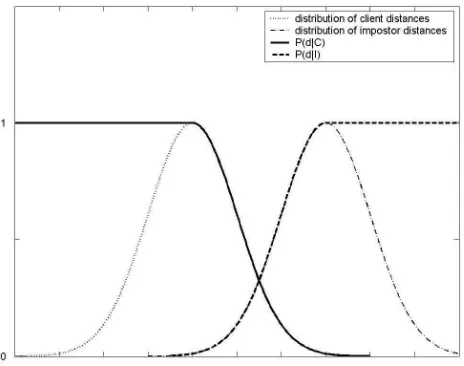
[image:3.612.109.266.73.140.2]It is desirable to model these two distributions such that P(d|C) tends to one with d less than µC, tending to zero as d increases beyond µC; conversely P(d|I) should tend to zero with d less than µI and tend to one as d increases beyond µI. If the distributions of d from clients and impostors are slightly overlapping then the functions for P(d|C) and P(d|I) should appear as in Figure 2.
To achieve this distribution we have chosen to model P(d|C) and P(d|I) as logistic functions [19] such that: C C b d e C d
P −µ
+ = 1 1 ) | ( (4) ( ) I I b d e I d
P − −µ
+ = 1 1 ) | ( (5) where: 2 2 3 π σ = b (6)
[image:3.612.314.546.199.382.2]These two functions conform to our requirements set out above that they take into account knowledge of the variations of d, that they are well distributed and guaranteed to produce outputs between zero and one.
Figure 2 – Intra and inter-class distribution and likelihoods
2.4. Bayesian Classification
From our estimates of the posterior the probability of a subject being a client, P(C|d), can be calculated directly. To achieve this we use Bayes’ rule (7), with the assumption that the prior probabilities of a client or an impostor are equal, (8), and calculating P(d) using (9): ) ( ) ( ) | ( ) | ( d P C P C d P d C
P = (7)
) ( )
(C P I
P = (8)
) | ( ) ( ) | ( ) ( )
(d P C P d C P I Pd I
P = + (9)
Equation (7) then simplifies to:
Having calculated the posterior probability, a suitable decision threshold, t, can be implemented for the verification task. Hence if P(C|d) is greater than t we accept the assertion that the subject is a client, otherwise we reject them as an impostor. The value of t may be adjusted to achieve the desired trade-off between false accept and false reject rates.
3. Methodology
The performance of our verification method was evaluated on the Southampton HiD database [20]. Each subject is filmed in controlled laboratory conditions from a fronto-parellel viewpoint. The database is encoded in Digital Video at a resolution of 720x576 pixels, with a frame rate of 25fps; each sequence is approximately 90 frames in length. The sequences are then reduced to a 73 dimensional vector using the technique described in section 2.1.
The database consists of 1,079 sequences from 115 subjects walking to the left. From this database we constructed four datasets:
• 145 sequences from 15 subjects were used to form a training set in order to estimate intra and inter-class mean and variance;
• One sequence for each of the remaining 100 subjects was used to form a gallery;
• A number of sequences were selected to match each subject in the gallery forming a client set of 834 sequences;
[image:4.612.346.501.371.518.2]• A number of sequences were selected so that the subject in the sequence and gallery did not match, these 834 sequences formed the impostor test set.
Figure 3 – Example image from the gait sequence
Following the procedure described in section 2.2 each vector from the training set was subtracted from all other vectors of the same subject to form the
intra-class training set of 1,322 vectors; we also subtracted every vector from every other vector where the subjects are not identical, to form an inter-class training set of 19,558 vectors.
Using (4), (5) and (6) intra and interclass likelihoods were calculated for each vector in the client and impostor sets. These likelihoods were then combined using (10) to calculate posterior probabilities for each vector. We then performed thresholding on our intra and inter-class likelihoods and posterior probabilities at various values of t between zero and one. This provides us with false accept and false reject rates for our results. For comparison we used the Euclidean distance, d, as described in section 1 and again performed thresholding to calculate false accept and false reject rates.
4. Results
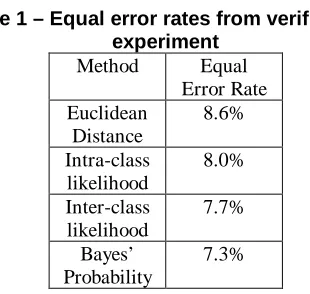
Using the results obtained in section 3, equal error rates were calculated for the intra-class likelihoods, inter-class likelihoods, Bayes’ probability and Euclidean distance (Table 1).
Table 1 – Equal error rates from verification experiment
Method Equal Error Rate Euclidean
Distance
8.6%
Intra-class likelihood
8.0%
Inter-class likelihood
7.7%
Bayes’ Probability
7.3%
Our experiments showed that by using likelihood estimates alone we can achieve a small decrease in error rates over the previous Euclidean distance method; however these improvements are not statistically significant. When we combine the likelihood estimates using Bayes’ rule we gain an additional improvement in error rates. The improvement in error rates between the Bayesian method and the Euclidean distance method is statistically significant at the 5% level using McNemar’s test [21].
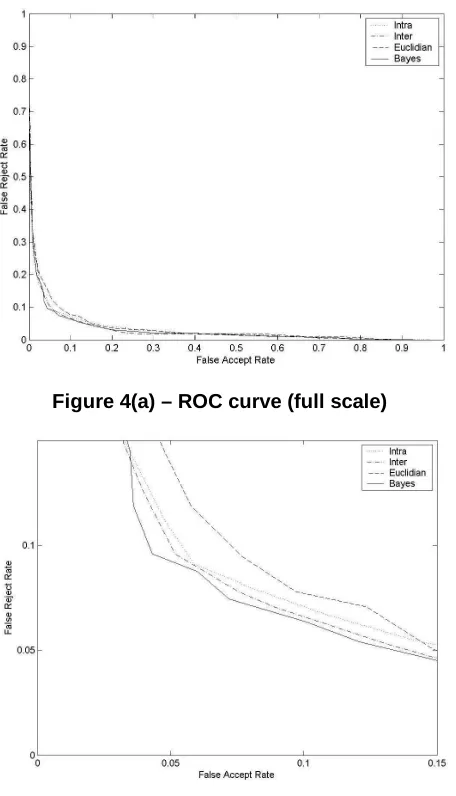
[image:4.612.67.300.497.614.2]scale and the region about the equal error rates. In each plot we can clearly see the improvement of the probabilistic techniques over the Euclidean distance method. Whilst the difference is small in absolute terms we should remember that we are dealing with error rates that are already fairly low.
Figure 4(a) – ROC curve (full scale)
Figure 4(b) – ROC curve (region of interest)
[image:5.612.320.545.69.250.2]It is also of interest to examine the distribution of the posterior probabilities to see if they meet our criteria stated in section 1, that the outputs should be well distributed and well scaled between zero and one. By inspection of Figure 5 we can see that the output from Bayes’ rule is indeed well distributed and well scaled, it also appears that the overlap between client and impostor sets is small.
Figure 5 – Distribution of posterior probabilities for the test sets
5. Conclusions
In this paper we have described a novel method for verification of subjects based on their gait. We seek to improve over the more standard Euclidean distance methods by exploiting the intra and inter-class variation in subjects’ measurements. Using this variation we aim to both improve the recognition rate over the Euclidean distance method, and provide well distributed and well scaled outputs that are directly useable for data fusion without score transformation.
We use an established dynamic method to extract gait parameters. We then use training data to find intra and inter-class variation within the parameter space. Using our estimates of variation we are able to implement logistic functions to find intra and interclass likelihoods which are then combined using Bayes’ rule.
In tests using 1,664 sequences of clients and impostors from a large publicly available database we achieve an equal error rate of 7.3%. This result is a statistically significant improvement over the Euclidean distance method when tested using a McNemar’s test at the 5% level. We also observe that the outputs of our method are well scaled and well distributed which will allow them to be used directly with data fusion algorithms.
[image:5.612.75.303.152.550.2]Acknowledgements
The authors gratefully acknowledge partial support by the Defence Technology Centre 8-10 supported by General Dynamics, the Engineering and Physical Sciences Research Council, UK and Neuciences. The authors also thank David Wagg for his assistance in processing the gait sequences.
References
[1] M. S. Nixon, J. N. Carter, M. G. Grant, L. Gordon, and J. B. Hayfron-Acquah, "Automatic recognition by gait", Sensor Review, vol. 23, 2003, pp. 323-331.
[2] J. B. Hayfron-Acquah, M. S. Nixon, and J. N. Carter, "Automatic gait recognition by symmetry analysis", Pattern Recognition Letters, vol. 24, 2003, pp. 2175-2183.
[3] R. T. Collins, R. Gross, and J. Shi, "Silhouette-based human identification from body shape and gait", Proc. 5th IEEE Int'l Conf. Automatic Face Gesture Recognition, Washington, DC, USA, 2002, pp. 366-71.
[4] H. Ning, L. Wang, W. Hu, and T. Tan, "Articulated model based people tracking using motion models", Proc. 4th IEEE Int'l Conf. Multimodal Interfaces, Pittsburgh, PA, USA, 2002, pp. 383-8.
[5] D. Meyer, J. Posl, and H. Niemann, "Gait classification with HMMs for trajectories of body parts extracted by mixture densities", Proc. British Machine Vision Conf. (BMVC 98), Southampton, UK, 1998, pp. 459-68. [6] D. Cunado, M. S. Nixon, and J. N. Carter,
"Automatic extraction and description of human gait models for recognition purposes", Computer Vision and Image Understanding, 2003, pp. 1-41. [7] D. K. Wagg and M. S. Nixon, "On automated
model-based extraction and analysis of gait", Proc. 6th IEEE Int'l Conf. Automatic Face and Gesture Recognition., 2004, pp. 11-16.
[8] S. Ben-Yacoub, Y. Abdeljaoued, and E. Mayoraz, "Fusion of face and speech data for person identity verification", IEEE Transactions on Neural Networks, vol. 10, 1999, pp. 1065-1074. [9] J. Kittler, M. Hatef, R. P. W. Duin, and J. Matas,
"On combining classifiers", IEEE Transactions on Pattern Analysis and Machine Intelligence, vol. 20, 1998, pp. 226-239.
[10] R. Brunelli and D. Falavigna, "Person identification using multiple cues", IEEE Transactions on Pattern Analysis and Machine Intelligence, vol. 17, 1995, pp. 955-966.
[11] A. Ross and A. Jain, "Information fusion in biometrics", Pattern Recognition Letters, vol. 24, 2003, pp. 2115-2125.
[12] R. De Luis-Garcia, C. Alberola-Lopez, O. Aghzout, and J. Ruiz-Alzola, "Biometric identification systems", Signal Processing, vol. 83, 2003, pp. 2539-2557.
[13] L. Wang, H. Ning, T. Tan, and W. Hu, "Fusion of static and dynamic body biometrics for gait recognition", IEEE Transactions on Circuits and Systems for Video Technology, vol. 14, 2004, pp. 149-158.
[14] G. Shakhnarovich and T. Darrell, "On
probabilistic combination of face and gait cues for identification", Proc. 5th IEEE Int'l Conf. Automatic Face and Gesture Recognition, Washington, USA, 2002, pp. 169-174.
[15] P. Langley, W. Iba, and K. Thompson, "Analysis of Bayesian classifiers", National Conf. Artificial Intelligence, San Jose, USA, 1992, pp. 223-228. [16] D. K. Wagg and M. S. Nixon, "Automated
markerless extraction of walking people using deformable contour models", Computer Animation and Virtual Worlds, vol. 15, 2004, pp. 399-406. [17] D. K. Wagg and M. S. Nixon, "Model-Based Gait
Enrolment in Real-World Imagery", Proc. Multimodal User Authentication, 2003, pp. 189-195.
[18] C. Liu and H. Wechsler, "Probabilistic reasoning models for face recognition", Proc. IEEE Computer Society Conf. Computer Vision and Pattern Recognition, Santa Barbara, USA, 1998, pp. 827-32.
[19] D. von Seggern, "CRC Standard Curves and Surfaces," CRC Press, 1992, pp. 250.
[20] J. D. Shutler, M. G. Grant, M. S. Nixon, and J. N. Carter, "On a Large Sequence-based Human Gait Database", Proc. Recent Advances in Soft Computing, 2002, pp. 66-71.
[21] J. R. Beveridge, B. A. Draper, K. She, and G. H. Givens, "Parametric and nonparametric methods for the statistical evaluation of human id