Submitted to Construction and Building Materials
PROBABILISTIC-BASED CHARACTERISATION OF THE MECHANICAL
1
PROPERTIES OF CFRP LAMINATES
2
S. Gomes1, D. Dias-da-Costa*,2, L.A.C. Neves3, S.A. Hadigheh2, P. Fernandes4, E. Júlio5 3
*corresponding author (Email: [email protected])
4
1ISISE, Department of Civil Engineering, University of Coimbra, Rua Luís Reis Santos, 3030–788
5
Coimbra, Portugal. 6
2School of Civil Engineering, The University of Sydney, Sydney, NSW 2006, Australia.
7
3Centre for Risk and Reliability Engineering, University of Nottingham, Faculty of Engineering,
8
University Park, United Kingdom. 9
4Civil Engineering Department, Instituto Politécnico de Leiria, Portugal.
10
5CEris-ICIST, DECivil, Instituto Superior Técnico, Universidade de Lisboa, Av. Rovisco Pais,
11
1049-001 Lisboa, Portugal 12
Abstract
13
Fibre reinforced polymer (FRP) composites have been increasingly used worldwide in the 14
strengthening of civil engineering structures. As FRP becomes more common in structural 15
strengthening, the development of probability-based limit state design codes will require accurate 16
models for the prediction of the mechanical properties of the FRPs. Existing models, however, are 17
based on small sample sizes and ignore the importance of the tail region for analyses and design. 18
Addressing these limitations, this paper presents a probabilistic-based characterisation of the 19
mechanical properties of carbon FRP (CFRP) laminates using a large batch of tension tests. The 20
analysed specimens were pre-cured laminates of carbon fibres embedded in epoxy matrices, which 21
is the most commonly used laminate for the strengthening concrete beams and slabs. Based on the 22
existing data, probabilistic models and correlations were established for the Young's modulus, 23
ultimate strain and tensile strength. Analyses demonstrate the suitability of the Weibull distribution 24
for the estimation of CFRP properties. Results also show that the statistical characterisation of the 25
mechanical properties should be performed with a focus on the tail region. The proposed 26
distributions constitute a set of validated probabilistic models that can be used for performing 27
reliability analyses of structures strengthened with CFRP laminates. 28
29
Keywords: CFRP laminates; strengthening of structures; Mechanical properties; Probabilistic
30
models. 31
*Revised Manuscript
2
1. Introduction
32
During the last decades, externally bonded reinforcement (EBR) of fibre-reinforced polymers 33
(FRP) has become a common technique to strengthen and upgrade civil engineering structures. FRP 34
is usually used in the form of wet lay-up sheets or pre-fabricated laminates due to their simplicity 35
and lower capital cost. The former system is based on the direct application of fibre sheets saturated 36
with resin, whereas the second uses pre-fabricated cured strips. There are also automated techniques 37
using vacuum (e.g. resin infusion techniques) or vacuum and heat (e.g. heated vacuum bag only) for 38
impregnation of fibres [1-3]. The characteristics of the FRP, namely its lightweight, high durability 39
in aggressive environments, ease of installation and cost effectiveness, are quite competitive for 40
strengthening purposes and constitute a good alternative to more traditional methods and materials, 41
such as EBR using steel plates or concrete jacketing [1]. There are several examples where FRPs 42
were used to increase the flexural, shear or axial capacity of structural members, such as beams, 43
slabs, columns, or joints [4-8]. 44
The growing interest in FRP composites resulted in the development of several design guidelines 45
(e.g. CEB-FIB [9], TR-55 [10], CNR [11] and ACI 440.2R-08 [12]). These, however, are not 46
presently at a level of development comparable to those used in structural concrete and steel design. 47
Considering the uncertainties present in FRP applications, new guidelines are required to develop 48
probability-based limit state design codes and to support the acceptance of FRP materials in civil 49
engineering [13, 14]. Despite previous reliability studies (e.g. Ellingwood [13], Plevris, 50
Triantafillou [15], Okeil, El-Tawil [16], Monti and Santini [17], Atadero, Lee [18], Atadero and 51
Karbhari [19], Okeil, Belarbi [20], and Ali, Bigaud [21]) having addressed some of these 52
uncertainties, the statistical information is still limited in the development of more accurate 53
probabilistic models. 54
A variety of factors affect the properties of FRP after manufacturing which create a degree of 55
3
Weibull and Gamma distributions to analyse the probabilistic properties of field-manufactured wet 57
lay-up carbon and glass composites. Six sets, composed by one, three or four subsets resulting in 58
903 samples, were considered to assess the tensile strength, the Young's modulus and the laminate 59
thickness. Despite the large number of samples used, the need to divide them in smaller subsets of 60
different properties and manufacturing processes led to a significant reduction in the sample size 61
available for the statistical analysis. From this study, the Weibull distribution was proposed to 62
model the tensile strength, whereas the Young's modulus and the laminate thickness were modelled 63
using a log-normal distribution. Zureick, Bennett [24] performed statistical analysis on over 600 64
samples of pultruded composite materials fabricated from E-glass fibres and polyester or vinylester 65
matrices. However, due to the differences in the properties of the specimens, each subset contained 66
no more than 30 samples. Zureick, Bennett [24] investigated the longitudinal tensile and 67
compressive strengths, the longitudinal tensile and compressive modulus, the shear strength and 68
modulus. The Weibull distribution was proposed to model the strength and stiffness properties. 69
Further studies on the probabilistic properties of composites can be found in Jeong and Shenoi [25] 70
or Lekou and Philippidis [26]. 71
2. Research Significance
72
The main limitations in previous studies are mainly related with the small size of the samples that 73
makes it difficult to accurately characterise probabilistic distributions. Previous models focused on 74
the entire sample distribution and ignored the importance of the tail region for probabilistic 75
analysis. It is also difficult to obtain suitable probability distribution functions without sufficient 76
number of samples and to output accurate estimates for the tail region. As such, discrepancy 77
between existing models and experimental data could reach several orders of magnitude [27]. To 78
address these limitations, the main aim of this work is to validate and propose probabilistic models 79
4
strain and tensile strength) and to highlight the importance of the tail of the sample distribution. All 81
statistical analyses are performed on a large and homogeneous batch of samples. 82
3. Experimental Tests
83
The data used in the present study concerns pultruded laminates produced from the same 84
manufacturer. The CFRP had a density of 1.4g/cm3 and a fibre content above 68% in volume, with 85
a tensile design stress of 1000 MPa and 1300 MPa, respectively for 0.6% and 0.8% elongation. As 86
part of the quality process of the manufacturer, the mechanical properties of the CFRP were 87
consistently assessed in the fibre direction. In total, a large set of 1368 coupon samples were 88
obtained for this process, collected from specimens with various cross sections (60-168 mm2) – see 89
appendix A for complete sample characterisation. 90
The coupon configuration for tensile testing was based on the EN ISO 527-5 [28] standard 91
(Table 1), with all the tensile tests being carried out according to same standard on a Zwick Z100 92
universal testing machine (Figure 1a). As part of the experimental procedure, a pre-load of 0.1 kN 93
was applied to avoid any misalignment within the system. Then, each coupon sample was loaded at 94
a constant displacement rate of 2 mm/min until failure. Both loading and CFRP strain were directly 95
[image:4.595.179.415.566.750.2]measured using a load cell and a strain gauge, respectively (Figure 1b). 96
Table 1. Details of the tensile samples based on EN ISO 527-5 [28]. 97
Detail Values (mm)
FRP length 250
FRP width 15 (±0.5)
FRP thickness 1.0 (±0.2) Tab extension > 50
Tab thickness 0.5-2
Grip extension ≥ 7
Gauge length 50 (±1)
Bevel angle 90
5
99
(a) (b)
[image:5.595.139.469.54.248.2]100
Figure 1. Experimental test set-up: (a) testing machine (courtesy of S&P Clever Reinforcement 101
Ibérica); (b) instrumentation. 102
It should be denoted that the pre-load was considered in the analyses described in the following 103
sections. Furthermore, the data for statistical analysis was carefully selected to exclude invalid 104
results arising from: (i) tab region failure; (ii) broken fibres in contact with the strain gauge; 105
(iii) slippage of specimens from the jaws; and (iv) failure of specimens at or close to the jaws. The 106
stress versus strain curves were plotted, and the tensile strength, modulus of elasticity, and ultimate 107
strain of the FRP were calculated. Figure 2 illustrates typical raw stress-strain diagrams for coupon 108
samples tested where the linear elastic behaviour can be observed nearly up to failure. 109
110
Figure 2. Raw stress-strain diagrams for five tested coupon samples. 111
jaws
CFRP specimen
strain gauges
tabs
jaws
CFRP specimen
strain gauges
tabs
0 0.5 1.0 1.5 2.0
0 1000 2000 3000
Strain (%)
St
re
ss
(M
P
[image:5.595.206.407.516.658.2]6
4. Statistical Models
112
Three statistical distributions were considered to model the CFRP properties: (i) normal; (ii) log-113
normal; and (iii) Weibull. The probability density function (PDF) and the cumulative distribution 114
function (CDF) for each distribution were obtained from the following relationships. 115
- Normal distribution
116
2
1 2
1
PDF: ( | , ) , 0, ,
2
x
f x e x , (1)
117
2
1 2
1
CDF: ( | , )
2
t x
F x e dt, (2)
118
where is the mean and is the standard deviation, and t is a real variable.
119
- Log-normal distribution
120
2 2
ln
2 0
1
, 0,
PDF: ( | , ) ,
2
x
f e
x x
x , (3)
121
2
1 ln 2 0
1 1
CDF: ( | , ) .
2
t x
F x e dt
t (4)
122
- Weibull distribution
123
Since previous studies [29] showed that the statistical characterisation of the CFRP does not 124
improve using a three-parameter Weibull distribution, a two-parameter approach was adopted here. 125
This is defined by the following expressions: 126
1
PDF: ( | , ) , , 0,0
x x
f x e x , (5)
127
CDF: ( | , ) 1 ,
x
F x e (6)
128
7
The best-fit distributions were found following the censored maximum likelihood estimation 130
(MLE) [30]. This method allows estimating parameters of a statistical distribution for a sample, 131
considering the following: 132
1 2
1
ˆ ˆ ˆ ˆ
( | , , , )n n X( | ),i
i
L x x x f x (7)
133
in which L(.) is the likelihood that the parameters 1, , ,2 n properly describe the sample
134
1 2 ˆ ˆ ˆ, , ,ˆn
x x x x , and fX is the joint PDF of a sample. The maximum likelihood estimators are
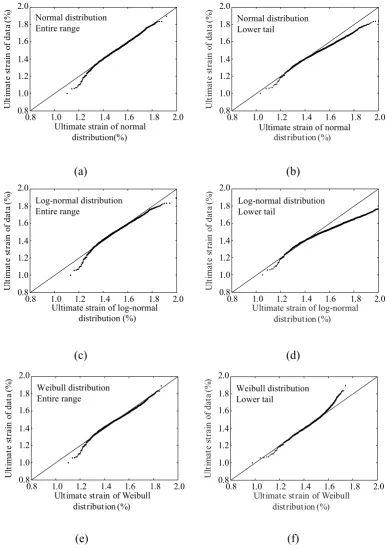
135
computed from the set of parameters that maximise the likelihood function by considering all 136
possible cases of . 137
Since the tail region is critical for structural reliability analysis and prediction, especial attention 138
is given to this region in the statistical analysis of the tensile tests. The adopted technique considers 139
explicitly the values of the lower tail that are smaller than a predefined bound, whereas the 140
remaining values are used implicitly [31]. The censored MLE can be defined as follows: 141
1 2
L L L , (8)
142
with 143
1
1 ( | )
j
i i
L f x , (9)
144
2 ( | )n j
G
L P X x , (10)
145
( G| ) 1 ( G| )
P X x F x , (11)
146
where 1L is the likelihood associated with the j observations of values equal or lower than the 147
bound value xG. 2L is the likelihood associated with the observations of values higher than the 148
bound value xG. F x( G| ) is the CDF of xG given the PDF , n is the total number of
8
observations and n j is the total number of observations exceeding the bound value xG. The best 150
fit can be computed iteratively through the optimisation problem of maximising L. 151
For each property, the distributions families were adjusted for the entire sample and the lower 152
percentiles of: 20th, 25th, 30th, 35th and 40th. The 20th percentile is considered to be a reasonable 153
choice for reliability studies in this research, since it includes the region of interest without 154
decreasing the sample size to statistically meaningless values. 155
The goodness of fit for all distributions was examined using the Anderson-Darling test for the: 156
(i) entire samples; and (ii) samples with right-censored data. The Anderson-Darling test was 157
adopted since it provides adequate comparison tools for tail regions [32]. The statistic for the right-158
censored data and entire data can be obtained respectively by [33]: 159
2
( ) ( 1 )
1
1 r (2 1) ln ln(1 )) ,
i n i
i
A i Z Z n
n (12)
160
2 2 2 2
, ( ) ( ) ( ) ( ) ( ) ( )
1 1
1 1
(2 1) ln ln{1 } 2 ln{1 } ( ) ln{1 } ln ,
r r
r n i i i r r r
i i
A i Z Z Z r n Z r Z n
n n
161
(13) 162
where r is the uncensored observation, n is the total number of observations and Z denotes the 163
CDF of the probability distribution. The statistic values ( 2
A ) were then compared with the critical 164
values (CV) presented by Stephens and D'Agostino [33]. The null hypothesis (H0) of the data 165
following the distribution tests was not rejected if the statistic value was lower than the critical 166
value. The critical values for different percentiles are given in Table 2. To minimise Type I errors, 167
which occur when H0 was wrongly rejected, or Type II errors, in which H0 was wrongly accepted,
168
the significance level ( ) was set at 10%. 169
Table 2. Critical values for different percentiles. 170
Percentile 20% 25% 30% 35% 40% 100%
9
4.1. Young's modulus
171
The Young's modulus is one of the significant parameters related with the structural safety of the 172
FRP for rehabilitation of structures, particularly in situations where failure is expected to occur at 173
tensile stresses significantly lower than the ultimate strength of the FRP. This type of failure usually 174
occurs when debonding of the CFRP or concrete crushing are the dominant failure mechanisms [9]. 175
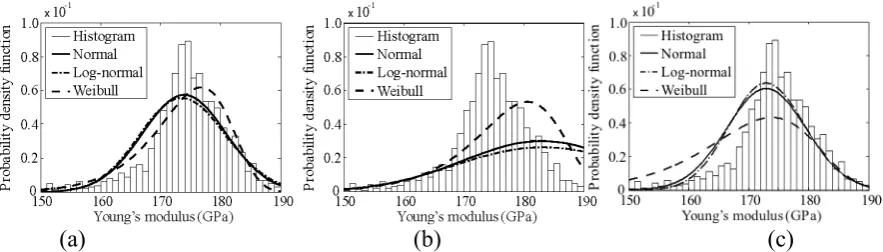
The best fit for each PDF for the Young's modulus is illustrated in Figure 3. As it can be seen in 176
Figure 3a, when the distributions were fitted to the entire sample, significant differences existed in 177
the range of the lower and upper values. Considering the importance of the tail regions in safety 178
assessment, clear improvements were achieved by applying the approach described above firstly to 179
the lower 20th percentile region – see Figure 3b. Both normal and log-normal distributions provided 180
similar results, whereas the Weibull distribution showed the closest fit to the data. For more clarity, 181
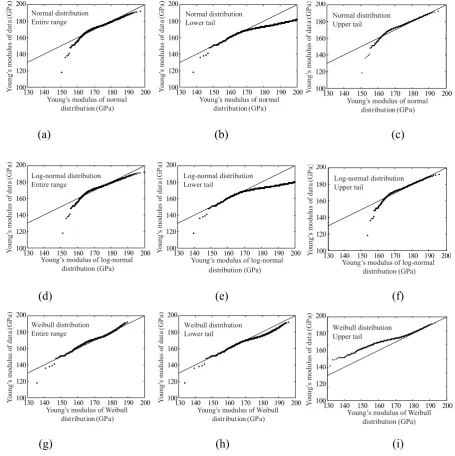
the Q-Q curves were plotted for three distributions in Figure 4. The Weibull distribution was able to 182
approximate the experimental data with high precision in both 20th percentile lower tail and entire 183
range regions (Figure 4e and Figure 4f). 184
185
(a) (b) (c)
[image:9.595.84.526.453.579.2]186
Figure 3. PDF for the Young's modulus of: (a) the entire data fit, (b) the 20th percentile lower tail 187
fit; and (c) the 20th percentile upper tail fit. 188
10 190
(a) (b) (c)
191 192
193
(d) (e) (f)
194
195
(g) (h) (i)
[image:10.595.76.532.57.514.2]196
Figure 4. Q-Q plot of the Young's modulus based on: normal distribution adjusted to (a) the 197
entire range, and (b) the 20th lower and (c) 20th upper percentile; log-normal distribution adjusted to 198
(d) the entire range, and (e) the 20th lower and (f) 20th upper percentile; and Weibull distribution 199
adjusted to (g) the entire range, and (h) the 20th lower and (i) 20th upper percentile. 200
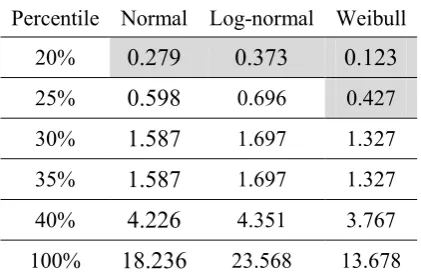
The statistic values for the Anderson-Darling goodness of fit test are presented in Table 3. In this 201
table, the shaded cells refer to tests where the distributions were not rejected. The results showed 202
that the Weibull was the only distribution where the null hypothesis was not rejected for the highest 203
percentile (in this case the 25th). Additionally, this distribution presented the smallest statistical 204
130 140 150 160 170 180 190 200
100 120 140 160 200 180 Y ou ng ’ s m od ul us of da ta (G P a) distribution (GPa)
Young’s modulus of normal 130 140 150 160 170 180 190 200
100 120 140 160 180 200 Y ou ng ’ s m od ul us of da ta (G P a) distribution (GPa) Young’s modulus of normal Normal distribution
Entire range Normal distributionLower tail
130 140 150 160 170 180 190 200
100 120 140 160 200 180 Y ou ng ’ s m od ul us of da ta (G P a) distribution (GPa)
Young’s modulus of normal 130 140 150 160 170 180 190 200
100 120 140 160 180 200 Y ou ng ’ s m od ul us of da ta (G P a) distribution (GPa) Young’s modulus of normal Normal distribution
Entire range Normal distributionLower tail
Y ou ng ’ s m od ul us of da ta (G P a) distribution (GPa) Young’s modulus of normal
Y ou ng ’ s m od ul us of da ta (G P a)
Young’s modulus of log-normal distribution (GPa)
(a) (b)
130 140 150 160 170 180 190 200
100 120 140 160 200 180
130 140 150 160 170 180 190 200 100 120 140 160 180 200 Y ou ng ’ s m od ul us of da ta (G P a)
Young’s modulus of Weibull distribution (GPa)
130 140 150 160 170 180 190 200
100 120 140 160 200 180 (c) Normal distribution Upper tail Weibull distribution Upper tail Weibull distribution Upper tail
130 140 150 160 170 180 190 200
100 120 140 160 200 180 Y ou ng ’ s m od ul us of da ta (G P a)
Young’s modulus of log-normal distribution (GPa)
130 140 150 160 170 180 190 200 100 120 140 160 180 200 Y ou ng ’ s m od ul us of da ta (G P a)
Young’s modulus of log-normal distribution (GPa) Log-normal distribution
Entire range
Log-normal distribution Lower tail
130 140 150 160 170 180 190 200
100 120 140 160 200 180 Y ou ng ’ s m od ul us of da ta (G P a)
Young’s modulus of log-normal distribution (GPa)
130 140 150 160 170 180 190 200 100 120 140 160 180 200 Y ou ng ’ s m od ul us of da ta (G P a)
Young’s modulus of log-normal distribution (GPa) Log-normal distribution Entire range Log-normal distribution Lower tail Y ou ng ’ s m od ul us of da ta (G P a) distribution (GPa) Young’s modulus of normal
Y ou ng ’ s m od ul us of da ta (G P a)
Young’s modulus of log-normal distribution (GPa)
(a) (b)
130 140 150 160 170 180 190 200
100 120 140 160 200 180
130 140 150 160 170 180 190 200 100 120 140 160 180 200 Y ou ng ’ s m od ul us of da ta (G P a)
Young’s modulus of Weibull distribution (GPa)
130 140 150 160 170 180 190 200
100 120 140 160 200 180 (c) Weibull distribution Upper tail Log-normal distribution Upper tail Weibull distribution Upper tail
130 140 150 160 170 180 190 200 100 120 140 160 180 200 Y ou ng ’ s m od ul us of da ta (G P a) distribution (GPa)
Young’s modulus of Weibull 130 140 150 160 170 180 190 200
100 120 140 160 180 200 Y ou ng ’ s m od ul us of da ta (G P a) distribution (GPa) Young’s modulus of Weibull Weibull distribution
Entire range
Weibull distribution Lower tail
130 140 150 160 170 180 190 200 100 120 140 160 180 200 Y ou ng ’ s m od ul us of da ta (G P a) distribution (GPa)
Young’s modulus of Weibull 130 140 150 160 170 180 190 200
100 120 140 160 180 200 Y ou ng ’ s m od ul us of da ta (G P a) distribution (GPa) Young’s modulus of Weibull Weibull distribution Entire range Weibull distribution Lower tail Y ou ng ’ s m od ul us of da ta (G P a) distribution (GPa) Young’s modulus of normal
Y ou ng ’ s m od ul us of da ta (G P a)
Young’s modulus of log-normal distribution (GPa)
(a) (b)
130 140 150 160 170 180 190 200 100 120 140 160 200 180
130 140 150 160 170 180 190 200 100 120 140 160 180 200 Y ou ng ’ s m od ul us of da ta (G P a)
Young’s modulus of Weibull distribution (GPa)
11
values, meaning that the average squared distance between the data and the fitted distribution was 205
[image:11.595.193.404.180.319.2]also the lowest. 206
Table 3. Statistical values for the Anderson-Darling goodness of fit test for each percentile and 207
distribution. 208
Percentile Normal Log-normal Weibull
20% 0.279 0.373 0.123
25% 0.598 0.696 0.427
30% 1.587 1.697 1.327
35% 1.587 1.697 1.327
40% 4.226 4.351 3.767
100% 18.236 23.568 13.678
209
Based on the statistical analysis of the experimental data, the following shape and scale 210
parameters were proposed to model the Young’s modulus based on the Weibull distribution 211
adjusted to the 20th percentile: 212
~ W(26.2,180.9) GPa. f
E (14)
213
Depending on the design situation, the upper percentile of the Young’s modulus might also be 214
required. For example, in situations of debonding failure, an higher value for this material 215
parameter can provide more conservative estimates on the capacity of the structural member. For 216
this reason, the study described in this section was similarly applied to obtain the best fit 217
distribution for the 20th upper percentile. Results are shown in Figs. 3 and 4, whereas the Weibull 218
distribution adjusted to the upper tail region was given by the following equation: 219
~ W(20.4,174.4) GPa. f
E (15)
220
Using the distributions shown in Eqs. (14) and (15), the characteristic values for the Young's 221
modulus were determined as 161.5 GPa and 184.0GPa, respectively corresponding to the 5th and 222
12
value provided by the manufacturer (165 GPa). Results also showed that the coefficient of variation 224
was reduced, i.e., 0.04. 225
4.2. Ultimate strain
226
The ultimate strain of the FRP is another important parameter in structural safety since the 227
material typically exhibits elastic behaviour until failure. The same procedure described above was 228
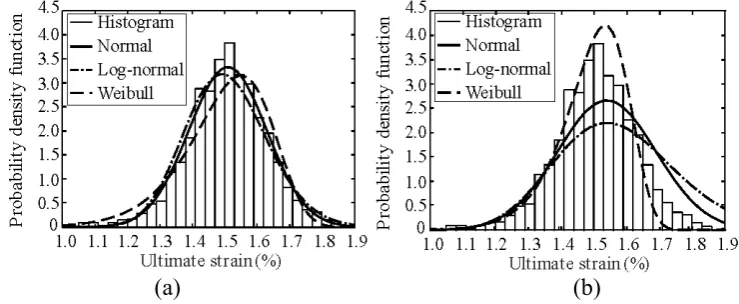
followed to analyse this material parameter from the tensile tests. Conversely to what was observed 229
for the Young’s modulus, the statistical analysis showed that (Figure 5a) none of the selected 230
distributions could fit well the lower tail when using the entire sample. Figure 5b shows the ultimate 231
strain probability density functions adjusted to the lower tail, where the Weibull distribution was the 232
one that provided the best results. The same trend could be seen in the corresponding Q-Q plots 233
illustrated in Figure 6. 234
235
(a) (b)
[image:12.595.110.480.390.542.2]236
Figure 5. PDF for the ultimate strain of the entire data fit (a) and 20th percentile lower tail fit (b). 237
The Anderson-Darling goodness of fit test presented in Table 4 shows that the Weibull was the 238
only distribution not rejected for the highest percentile (in this case the 40th), whereas the null 239
hypothesis was rejected for all the distributions adjusted to the entire sample. Based on these 240
results, the Weibull distribution adjusted to the 20th percentile was proposed to model the ultimate 241
strain with a coefficient of variation of 0.06, and the following parameters: 242
~ W(17.1,1.5) %.
fu (16)
13 244
(a) (b)
245
246
(c) (d)
247
248
(e) (f)
[image:13.595.110.498.56.607.2]249
Figure 6. Q-Q plot of the ultimate strain based on: normal distribution adjusted to (a) the entire 250
range and (b) the lower tail; log-normal distribution adjusted to (c) the entire range and (d) the 20th 251
lower percentile; and Weibull distribution adjusted to (e) the entire range and (f) the 20th lower 252
percentile. 253
254
1.0
0.8 1.2 1.4 1.6 1.8 2.0
1.0 0.8 1.2 1.4 1.6 1.8 2.0 distribution(%) U lt im at e st ra in of da ta (% )
Ultimate strain of normal 0.8 1.0 1.2 1.4 1.6 1.8 2.0
1.0 0.8 1.2 1.4 1.6 1.8 2.0 distribution (%) U lt im at e st ra in of da ta (% )
Ultimate strain of normal Normal distribution
Entire range Normal distributionLower tail
1.0
0.8 1.2 1.4 1.6 1.8 2.0
1.0 0.8 1.2 1.4 1.6 1.8 2.0 distribution(%) U lt im at e st ra in of da ta (% )
Ultimate strain of normal 0.8 1.0 1.2 1.4 1.6 1.8 2.0
1.0 0.8 1.2 1.4 1.6 1.8 2.0 distribution (%) U lt im at e st ra in of da ta (% )
Ultimate strain of normal Normal distribution
Entire range Normal distributionLower tail
1.0
0.8 1.2 1.4 1.6 1.8 2.0
1.0 0.8 1.2 1.4 1.6 1.8 2.0
Ultimate strain of log-normal
U lt im at e st ra in of da ta (% ) distribution (%) 1.0
0.8 1.2 1.4 1.6 1.8 2.0
1.0 0.8 1.2 1.4 1.6 1.8 2.0 distribution (%) U lt im at e st ra in of da ta (% )
Ultimate strain of log-normal
Log-normal distribution Entire range
Log-normal distribution Lower tail
1.0
0.8 1.2 1.4 1.6 1.8 2.0
1.0 0.8 1.2 1.4 1.6 1.8 2.0
Ultimate strain of log-normal
U lt im at e st ra in of da ta (% ) distribution (%) 1.0
0.8 1.2 1.4 1.6 1.8 2.0
1.0 0.8 1.2 1.4 1.6 1.8 2.0 distribution (%) U lt im at e st ra in of da ta (% )
Ultimate strain of log-normal
Log-normal distribution Entire range
Log-normal distribution Lower tail
1.0
0.8 1.2 1.4 1.6 1.8 2.0
1.0 0.8 1.2 1.4 1.6 1.8 2.0 distribution (%) Ultimate strain of Weibull
U lt im at e st ra in of da ta (% ) 1.0
0.8 1.2 1.4 1.6 1.8 2.0
1.0 0.8 1.2 1.4 1.6 1.8 2.0 distribution (%) Ultimate strain of Weibull
U lt im at e st ra in of da ta (% ) Weibull distribution
Entire range Weibull distributionLower tail
1.0
0.8 1.2 1.4 1.6 1.8 2.0
1.0 0.8 1.2 1.4 1.6 1.8 2.0 distribution (%) Ultimate strain of Weibull
U lt im at e st ra in of da ta (% ) 1.0
0.8 1.2 1.4 1.6 1.8 2.0
1.0 0.8 1.2 1.4 1.6 1.8 2.0 distribution (%) Ultimate strain of Weibull
U lt im at e st ra in of da ta (% ) Weibull distribution
14
Table 4. Statistical values for the Anderson-Darling goodness of fit test for each percentile and 255
distribution. 256
Percentile Normal Log-normal Weibull
20% 0.206 0.351 0.050
25% 0.237 0.393 0.057
30% 0.433 0.656 0.101
35% 0.771 1.148 0.126
40% 1.371 2.056 0.136
100% 2.5453 5.485 8.9873
4.3. Tensile strength
257
The tensile strength of the FRP is important in situations where failure occurs within the 258
laminate. This can be particularly critical for prestressed FRP laminates, since the prestress loading 259
often represents a high percentage of the tensile strength [34, 35]. Preliminary results of the 260
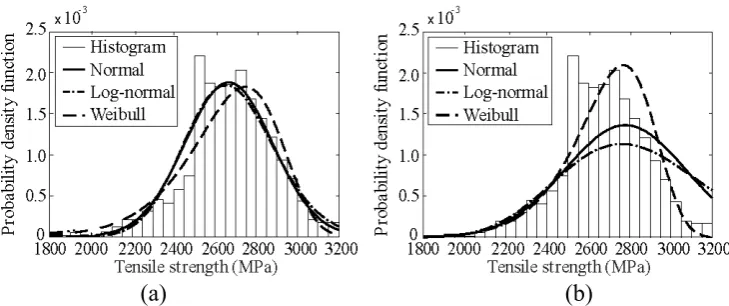
distributions adjusted to the entire sample showed that all selected distributions were unable to 261
provide a good fit in the lower tail, as illustrated in Figure 7a. An improvement could be obtained 262
when the procedure based on fitting the CDF to the lower tail is followed – see Figure 7b. The 263
Weibull distribution performed better in both cases. 264
265
(a) (b)
[image:14.595.114.479.507.660.2]266
Figure 7. PDF for the tensile strength of (a) the entire data fit (b) and the 20th percentile lower tail 267
fit. 268
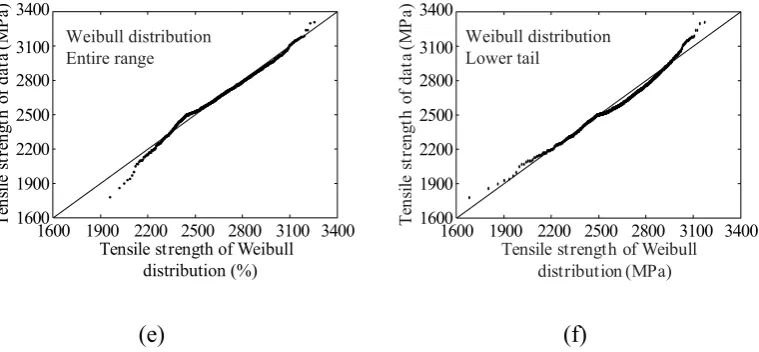
The Q-Q plots showed the similarity between normal and log-normal distributions – see 269
15
fit obtained with the Weibull distribution in this region can be noticed by comparing Figure 8e and 271
f. Despite these observations, the goodness of fit results for the lowest tail fit (Table 5) did not reject 272
any of the distributions for the 20th and 25th percentiles. However, since the Weibull presented a 273
better result than the other models overall, it was adopted here as the distribution model for the 274
tensile strength with the following parameters: 275
~ W(15.9, 2777.0) MPa. f
f (17)
276
The 5th characteristic value using the proposed distribution was 2304.2 MPa, which was only 277
0.3% higher than the experimental value (2299.0 MPa). The coefficient of variation was also very 278
small, i.e. 0.08. The selected distribution is in agreement with the works from Atadero [23] and 279
Zureick, Bennett [24] for prediction of the tensile strength based on the entire data fit. 280
281
(a) (b)
282
283
(c) (d)
284
1600 1900 2200 2500 2800 3100 3400 1600 1900 2200 2800 3100 2500 3400 distribution (MPa) Tensile strength of Normal
T en si le st re ng th of da ta (M P a)
1600 1900 2200 2500 2800 3100 3400 1600 1900 2200 2800 3100 2500 3400 distribution (MPa) Tensile strength of Normal
T en si le st re ng th of da ta (M P a) Normal distribution
Entire range Normal distributionLower tail
1600 1900 2200 2500 2800 3100 3400 1600 1900 2200 2800 3100 2500 3400 distribution (MPa) Tensile strength of Normal
T en si le st re ng th of da ta (M P a)
1600 1900 2200 2500 2800 3100 3400 1600 1900 2200 2800 3100 2500 3400 distribution (MPa) Tensile strength of Normal
T en si le st re ng th of da ta (M P a) Normal distribution
Entire range Normal distributionLower tail
1600 1900 2200 2500 2800 3100 3400 1600 1900 2200 2800 3100 2500 3400
Tensile strength of Log-normal
T en si le st re ng th of da ta (M P a) distribution (MPa)
1600 1900 2200 2500 2800 3100 3400 1600 1900 2200 2800 3100 2500 3400 T en si le st re ng th of da ta (M P a)
Tensile strength of Log-normal distribution (MPa) Log-normal distribution
Entire range
Log-normal distribution Lower tail
1600 1900 2200 2500 2800 3100 3400 1600 1900 2200 2800 3100 2500 3400
Tensile strength of Log-normal
T en si le st re ng th of da ta (M P a) distribution (MPa)
1600 1900 2200 2500 2800 3100 3400 1600 1900 2200 2800 3100 2500 3400 T en si le st re ng th of da ta (M P a)
Tensile strength of Log-normal distribution (MPa) Log-normal distribution
Entire range
16 285
(e) (f)
[image:16.595.116.496.63.239.2]286
Figure 8. Q-Q plot of the tensile strength based on: normal distribution adjusted to (a) the entire 287
range and (b) the lower tail; log-normal distribution adjusted to (c) the entire range and (d) the 20th 288
lower percentile; and Weibull distribution adjusted to (e) the entire range and (f) the 20th lower 289
percentile. 290
Table 5. Statistical values for the Anderson-Darling goodness of fit test for each percentile and 291
distribution. 292
Percentile Normal Log-normal Weibull
20% 0.050 0.068 0.064
25% 0.342 0.366 0.333
30% 0.894 0.941 0.817
35% 2.518 2.658 2.154
40% 4.160 4.429 3.404
100% 5.453 5.485 9.897
5. Correlation Analysis
293
This section presents a correlation analysis on the mechanical properties discussed in the 294
previous section. Within the linear elastic range, strain, stress and Young’s modulus are naturally
295
related with each other by the Hooke’s law. When approaching ultimate values – i.e. the material 296
strength – the standard relation may no longer hold and more suitable relationships may need to be 297
recommended for reliability analysis. The following pairs were considered: (i) tensile strength and 298
1600 1900 2200 2500 2800 3100 3400 1600
1900 2200 2800 3100
2500 3400
Tensile strength of Weibull
T
en
si
le
st
re
ng
th
of
da
ta
(M
P
a)
distribution (%)
1600 1900 2200 2500 2800 3100 3400 1600
1900 2200 2800 3100
2500 3400
T
en
si
le
st
re
ng
th
of
da
ta
(M
P
a)
distribution (MPa) Tensile strength of Weibull Weibull distribution
Entire range
Weibull distribution Lower tail
1600 1900 2200 2500 2800 3100 3400 1600
1900 2200 2800 3100
2500 3400
Tensile strength of Weibull
T
en
si
le
st
re
ng
th
of
da
ta
(M
P
a)
distribution (%)
1600 1900 2200 2500 2800 3100 3400 1600
1900 2200 2800 3100
2500 3400
T
en
si
le
st
re
ng
th
of
da
ta
(M
P
a)
distribution (MPa) Tensile strength of Weibull Weibull distribution
Entire range
[image:16.595.192.404.423.563.2]17
ultimate strain, (ii) tensile strength and Young's modulus, and (iii) Young's modulus and ultimate 299
strain. 300
A linear regression analysis was firstly performed between tensile strength and ultimate strain 301
without constraints. Results showed high correlation between these two properties (R2 = 0.75) as
302
illustrated in Figure 9a. Additionally, the residual standard deviation related with the uncertainty of 303
the proposed model was 0.062%, which means that a probabilistic model could indeed describe the 304
correlation between the two mechanical parameters. The corresponding model was defined as 305
follows: 306
0.17 0.0005014 0.0618 (%),
fu ff Z (18)
307
where ff is the tensile strength in MPa, fu is the ultimate strain and Z ~ (0,1)N . 308
Based on the results above, a second correlation analysis was performed by constraining the 309
linear relation to the origin. The results and observations were quite similar, as shown in Figure 9b. 310
The latter model had a standard deviation of 0.063% and was defined by the following expression: 311
0.0005646 0.0633 (%)
fu ff Z . (19)
312
The last expression can be recommended in practice to relate the two expressions, since it provides 313
good results and is relatively simple. It should be mentioned that such result shows that the ultimate 314
strain and tensile strength are highly correlated variables. However, since both are not deterministic, 315
the numerical value in the equation should not be directly compared with the inverse ratio of the 316
Young’s modulus – although both are similar given the linear nature of the correlation found. 317
It should be highlighted that from this study, the tensile strength and Young's modulus were 318
found to have a small correlation – see representation in Figure 10a. Similar observation was also 319
found between the Young's modulus and ultimate strain (Figure 10b). This suggests that the 320
18 322
(a) (b)
[image:18.595.116.480.54.246.2]323
Figure 9. Scatter diagram of tensile strength versus ultimate strain of (a) the regression without 324
constraints and (b) the regression across the origin. 325
326
(a) (b)
327
Figure 10. Scatter diagram of (a) tensile strength versus Young's modulus ( ff , Ef ) and (b) 328
Young's modulus versus ultimate strain (Ef , fu). 329
6. Conclusions
330
This manuscript presented a statistical analysis on mechanical properties of prefabricated CFRP 331
laminates obtained from a large set of tests. Results showed that the Weibull distribution can be 332
adopted to model the Young's modulus, the ultimate strain and the tensile strength of CFRP 333
[image:18.595.121.485.313.500.2]19
carried out giving particular attention to the tail region. In fact, although an overall good fit of any 335
selected distribution can be achieved in most cases, the approximation obtained in the tail region is 336
not acceptable. 337
A low variability in the mechanical properties was also observed in this study, which is most 338
significant in terms of structural safety. The lowest coefficient of variation is found for the Young's 339
modulus, with the characteristic values from experimental data and proposed distributions being 340
also very similar. 341
The correlation analysis between mechanical properties demonstrated that a probabilistic model 342
relating the tensile strength and ultimate strain can be proposed. However, despite the strain, stress 343
and Young’s modulus being related by the Hooke’s law in the linear elastic region, no probabilistic 344
model could be proposed between tensile strength or ultimate strain and Young's modulus. In fact, 345
these pairs of variables can be considered as independent. 346
As a final note, it should be mentioned that the distributions given in this paper can be used for 347
carrying out reliability analyses aimed at proposing partial safety factors for the future revision of 348
design codes. 349
Acknowledgements
350
The authors acknowledge the experimental tests data provided by S&P Clever Reinforcement 351
Ibérica. Sara Gomes would like to acknowledge the research grant from the Portuguese Science and 352
Technology Foundation (SFRH/BD/76345/2011) and D. Dias-da-Costa would like to acknowledge 353
the support from the Australian Research Council through its Discovery Early Career Researcher 354
Award (DE 150101703) and from the Faculty of Engineering and Information Technologies, The 355
20
Appendix A: sample distribution
357
Table A-1 provides the sample size and geometrical data for the 1368 coupon samples studied in 358
[image:20.595.216.378.170.326.2]this paper. 359
Table A-1. Details of coupon samples. 360
Cross-section
(mm2) (mmArea 2) Sample size (#)
50 1.2 60 85
50 1.4 70 422
60 1.4 8.4 54
80 1.2 96 110
80 1.4 112 122
90 1.4 126 41
100 1.2 120 144
100 1.4 140 192
120 1.2 144 43
120 1.4 168 155
References
361
[1] Leeming MB, Hollaway LC. Strengthening of reinforced concrete structures: Woodhead Publishing 362
Limited; 1999. 363
[2] Hadigheh SA, Gravina RJ, Setunge S. Influence of the processing techniques on the bond characteristics 364
in externally bonded joints- Experimental and analytical investigations. Composites for Construction. 365
2016;20:1-13. 366
[3] Hadigheh SA, Gravina RJ. Generalization of the interface law for different FRP processing techniques in 367
FRP-to-concrete bonded interfaces. Composites Part B: Engineering. 2016;91:399-407. 368
[4] Karbhari VM. Materials considerations in FRP rehabilitation of concrete structures. Journal of Materials 369
in Civil Engineering. 2001;13:90-7. 370
[5] Mirmiran A, Shahawy M, Samaan M, Echary HE, Mastrapa JC, Pico O. Effect of column parameters on 371
FRP-confined concrete. Journal of Composites for Construction. 1998;2:175-85. 372
[6] Khalifa A, Gold WJ, Nanni A, Abdel Aziz MI. Contribution of externally bonded FRP to shear capacity 373
of RC flexural members. Journal of Composites for Construction. 1998;2:195-202. 374
[7] Hadigheh SA, Gravina RJ, Setunge S. Prediction of the bond-slip law in externally laminated concrete 375
substrates by an analytical based nonlinear approach. Materials and Design. 2015;66:217-26. 376
[8] Smith ST, Zhang H, Wang Z. Influence of FRP anchors on the strength and ductility of FRP-strengthened 377
RC slabs. Constr Build Mater. 2013;49:998-1012. 378
[9] CEB-FIB. FIB-Bulletin 14- Externally bonded FRP reinforcement for RC structures. Geneva, 379
Switzerland: Fédération International du Béton (FIB); 2001. p. 130. 380
[10] TR-55. Design guidance for strenghening concrete structures using fibre composite materials. 381
SOCIETY, C.(ed.); 2000. 382
[11] CNR. Guide for the design and construction of externally bonded FRP systems for strengthening 383
existing structures. National Research Council, Advisory Committee on Technical Recommendations for 384
Constructuion2001. 385
[12] ACI 440.2R-08. Guide for the design and construction of externally bonded FRP system for 386
21
[13] Ellingwood BR. Toward load and resistance factor design for fiber-reinforced polymer composite 388
structures. Journal of Structural Engineering. 2003;129:449-58. 389
[14] Wang N, Ellingwood BR, Zureick AH. Reliability-based evaluation of flexural members strengthened 390
with externally bonded fiber-reinforced polymer composites. Journal of Structural Engineering. 391
2010;136:1151-60. 392
[15] Plevris N, Triantafillou TC, Veneziano D. Reliability of RC members strengthened with CFRP 393
laminates. Journal of Structural Engineering. 1995;121:1037-44. 394
[16] Okeil AM, El-Tawil S, Shahawy M. Flexural reliability of reinforced concrete bridge girders 395
strengthened with carbon fiber-reinforced polymer laminates. Journal of Bridge Engineering. 2002;7:290-9. 396
[17] Monti G, Santini S. Reliability-based calibration of partial safety coefficients for fiber-reinforced 397
plastic. Journal of Composites for Construction. 2002;6:162-7. 398
[18] Atadero R, Lee L, Karbhari VM. Consideration of material variability in reliability analysis of FRP 399
strengthened bridge decks. Composite Structures. 2005;70:430-43. 400
[19] Atadero RA, Karbhari VM. Calibration of resistance factors for reliability based design of externally-401
bonded FRP composites. Composites Part B: Engineering. 2008;39:665-79. 402
[20] Okeil AM, Belarbi A, Kuchma DA. Reliability assessment of FRP-strengthened concrete bridge girders 403
in shear. Journal of Composites for Construction. 2013;17:91-100. 404
[21] Ali O, Bigaud D, Ferrier E. Comparative durability analysis of CFRP-strengthened RC highway 405
bridges. Constr Build Mater. 2012;30:629-42. 406
[22] Atadero RA, Karbhari VM. Sources of uncertainty and design values for field-manufactured FRP. 407
Composite Structures. 2009;89:83-93. 408
[23] Atadero RA. Development of load and resistance factor design for FRP strengthening of reinforced 409
concrete structures: PhD Thesis, University of California; 2006. 410
[24] Zureick AH, Bennett RM, Ellingwood BR. Statistical characterization of fiber-reinforced polymer 411
composite material properties for structural design. Journal of Structural Engineering. 2006;132:1320-7. 412
[25] Jeong HK, Shenoi RA. Probabilistic strength analysis of rectangular FRP plates using Monte Carlo 413
simulation. Computers & Structures. 2000;76:219-35. 414
[26] Lekou DJ, Philippidis TP. Mechanical property variability in FRP laminates and its effect on failure 415
prediction. Composites Part B: Engineering. 2008;39:1247-56. 416
[27] Ellingwood BR. Acceptable risk bases for design of structures. Progress in Structural Engineering and 417
Materials. 2001;3:170-9. 418
[28] EN ISO 527-5. Plastics- Determination of tensile properties, Part 5: Test conditions for unidirectional 419
fibre-reinforced plastic composites. European Committee for Standardization; 2009. 420
[29] Alqam M, Bennett RM, Zureick AH. Three-parameter vs. two-parameter Weibull distribution for 421
pultruded composite material properties. Composite Structures. 2002;58:497-503. 422
[30] Lindley DV. Introduction to probability and statistics. Cambridge University Press1965. 423
[31] Havbro Faber M, Köhler J, Dalsgaard Sorensen J. Probabilistic modeling of graded timber material 424
properties. Structural Safety. 2004;26:295-309. 425
[32] Lawless JF. Statistical models and methods for lifetime data: Wiley; 1982. 426
[33] Stephens M, D'Agostino R. Goodness-of-fit techniques: Marcel Dekker; 1986. 427
[34] Quantrill RJ, Hollaway LC. The flexural rehabilitation of reinforced concrete beams by the use of 428
prestressed advanced composite plates. Composites Science and Technology. 1998;58:1259-75. 429
[35] Triantafillou TC, Deskovic N, Deuring M. Strengthening of concrete structures With prestressed fiber 430
reinforced plastic sheets. Structural Journal. 1992;89:235-44. 431
![Table 1. Details of the tensile samples based on EN ISO 527-5 [28].](https://thumb-us.123doks.com/thumbv2/123dok_us/8556436.364344/4.595.179.415.566.750/table-details-tensile-samples-based-en-iso.webp)