0022-538X/97/$04.0010
Copyrightq1997, American Society for Microbiology
Genetic Analysis of the Yellow Fever Virus NS1 Protein: Identification
of a Temperature-Sensitive Mutation Which Blocks
RNA Accumulation
ISABELLA R. MUYLAERT,1RICARDO GALLER,2ANDCHARLES M. RICE1*
Department of Molecular Microbiology, Washington University School of Medicine, St. Louis, Missouri 63110-1093,1
and Departamento de Bioquı´mica e Biologia Molecular, Fundac¸a˜o Oswaldo Cruz, Rio de Janeiro 21040, Brazil2
Received 2 August 1996/Accepted 27 September 1996
The flavivirus NS1 protein is a highly conserved nonstructural glycoprotein that is capable of eliciting protective immunity. NS1 homodimers are secreted from virus-infected mammalian cells, but the protein is also present at the plasma membrane and in the lumen of intracellular vesicles. Based on these properties, it has been speculated that NS1 may function in virus maturation or release. To gain further insight into NS1 function, we used clustered charged-amino-acid-to-alanine mutagenesis to create 28 clustered substitutions in the NS1 protein of yellow fever virus. To screen for conditional mutations, full-length RNAs containing each mutation were assayed for plaque formation at 32 and 39&C after RNA transfection. We found that 9 mutations were lethal, 18 allowed plaque formation at both temperatures, and 1,ts25, was strongly heat sensitive and was unable to form plaques at 39&C. Lethal mutations clustered in the amino-terminal half of NS1, whereas those leading to impaired replication relative to the parent were distributed throughout the protein. High-multi-plicity infections at 39&C demonstrated that ts25 was defective for RNA accumulation, leading to depressed viral protein synthesis and delayed virus production. Although ts25 secreted less NS1 than did the parent, temperature shift experiments failed to demonstrate any temperature-dependent differences in polyprotein processing, NS1 stability and secretion, or release of infectious virus. Thetslesion ofts25 was shown to be due to a single alanine substitution for Arg-299, a residue which is conserved among flaviviruses. These results argue that NS1 plays an essential but as yet undefined role in flavivirus RNA amplification.
Flaviviruses are small, enveloped, positive-strand RNA vi-ruses belonging to the family Flaviviridae (see references 3, 5, 31, 38, and 52 for reviews). Members of the Flavivirus genus are typically arthropod borne, being transmitted to vertebrates by infected mosquito or tick vectors; a number of them cause significant human morbidity and mortality worldwide (31). The genome RNA of yellow fever virus (YFV), the prototype mem-ber of this genus, is 10,862 bases long and contains a 59cap and a nonhomopolymeric 39-terminal stem-loop structure (40). The incoming genome RNA is translated as a large polypro-tein, which is cleaved by host and viral proteases to produce the mature structural and nonstructural (NS) proteins (5, 42). The protein order in the polyprotein is NH2
-C-prM(M)-E-NS1-NS2A-NS2B-NS3-NS4A-2K-NS4B-NS5-COOH, where C (capsid), prM(M) (membrane), and E (envelope) represent the structural proteins or their precursors and NS1 through NS5 are NS proteins (5, 26, 42).
Flavivirus RNA replication, a membrane-associated event, occurs in the cytoplasm via a negative-strand intermediate and is asymmetric, leading to the preferential accumulation of pos-itive-strand RNAs (5, 52). Several NS proteins have been im-plicated in this process. The NS2B-3 serine proteinase is re-quired for processing at multiple sites in the NS polyprotein; these cleavages are presumably important for assembly of functional replication complexes (8, 9, 33). NS3 also possesses RNA-stimulated nucleoside triphosphatase (49), RNA heli-case (11), and RNA triphosphatase activities (50). The N-terminal domain of NS5 contains sequence elements charac-teristic of methyltransferases (23), as well as a GDD motif, which is common to many viral RNA-dependent RNA
poly-merases (RDRP) (21). RDRP activity has been demonstrated for NS5 expressed in Escherichia coli (48), and recent work has shown that NS5 is phosphorylated on serine residues (22). Enzymatic functions for the remaining NS proteins have not been determined, but the smaller hydrophobic proteins NS2A, NS4A, and NS4B may play structural roles in replicase assem-bly or mediate interaction of other replicase components with host cell membranes (52).
The remaining NS protein, NS1, is a highly conserved gly-coprotein containing 12 invariant cysteine residues and two potential N-linked glycosylation sites (5). NS1 is inserted into the endoplasmic reticulum lumen via a signal sequence located near the C terminus of the E protein and produced by cleavage of a discrete NS1-2A precursor (6). Dimerization occurs short-ly after synthesis, and NS1 is present in intracellular, cell sur-face, and secreted forms (29, 53, 54). NS1 does not contain obvious membrane-spanning segments, and the mechanism by which it associates with cellular membranes is unknown. Inter-estingly, immunization with NS1 or passive transfer of NS1-specific antibodies can confer protective immunity against fla-vivirus infection (17, 19, 20, 44, 46, 47). Based on these properties, it was originally proposed that NS1 might play a role in viral assembly and/or maturation (29, 41). However, recent immunolocalization studies of dengue 2 virus (DEN2) NS1 (28), as well as our analysis of YFV NS1 glyco-sylation mutants (32), suggest the possible involvement of NS1 in viral RNA replication.
For many biological systems, conditional mutants have proven invaluable in studying protein function. For flavivi-ruses, temperature-sensitive (ts) mutants with defects in viral adsorption (15), RNA accumulation, and virulence have been isolated but only partially characterized (3). In this study, 28 YFV NS1 mutants were generated by clustered
charged-ami-* Corresponding author. Phone: (314) 2842. Fax: (314) 362-1232.
291
on November 9, 2019 by guest
http://jvi.asm.org/
no-acid-to-alanine scanning mutagenesis (12, 51) and one strongly ts mutant (ts25) was obtained. Phenotypic analysis of these mutants provides a preliminary genetic map of NS1 func-tional domains, and characterization of ts25 argues strongly that NS1 is required for efficient amplification of flavivirus RNA.
MATERIALS AND METHODS
Cell cultures, virus stocks, and plaque assay.SW-13 cells were propagated in alpha minimal essential medium (aMEM) supplemented with 10% fetal calf serum (FCS). To prepare high-titer virus stocks, subconfluent monolayers of SW-13 cells (in 150-mm dishes) were infected at a multiplicity of infection (MOI) of 0.01 PFU of the parental virus (YFiv5.2) or temperature-sensitive mutant ts25 (both recovered from RNA transfection supernatants [see below]) per cell. After incubation for 3 days at 328C inaMEM–2% FCS, culture supernatants were harvested, clarified at 3,0003g for 10 min, aliquoted, and stored at2808C. Titers of virus stocks were determined by plaque assay on SW-13 cells at 32 or 398C (32). Plaques were visualized after 4 or 5 days by staining with 0.02% neutral red in phosphate-buffered saline (PBS) and, after fixation of the cells with 7% formaldehyde, with 1.3% crystal violet in 20% ethanol.
Plasmid constructions and site-directed mutagenesis.DNA manipulations were performed by standard methods (1, 43). Clustered charged-amino-acid-to-alanine and single mutations (see Table 1) were made by oligonucleotide-di-rected mutagenesis with uridylated (24, 27) phagemid pH2J1-NS1/2A DNA (32). To facilitate the construction of full-length templates containing the NS1 muta-tions, the plasmid pYFM5.2/15 was created by digesting pYFM5.2 (39) with
AvrII and BglII, filling in the protruding ends, and religation. Mutagenized
sequences were subcloned into pYFM5.2/15 by replacing the corresponding
SstI-BamHI (for mutants A2 to A9, A30, and A31), SstI-MluI (for mutant A10), BamHI-MluI (for mutants A11 to A16), BamHI-KpnI (for mutant A17), MluI-KpnI (for mutants A18 to A22), and MluI-KpnI-PvuII (for mutants A23 to A29, A32
and A33) fragments. For all constructs, the sequence of the entire subcloned fragment was confirmed. Mutant pYFM5.2 derivatives were constructed by re-placement of the Sse8387I-AvrII fragment pYFM5.2 with the corresponding fragment from the mutant pYFM5.2/15 derivatives. Full-length YF 17D cDNA templates were constructed by in vitro ligation of restriction fragments from pYF5939IV and pYFM5.2 or its mutant derivatives (39).
In vitro transcription and RNA transfection.59-capped transcripts were syn-thesized in vitro from ligated cDNA templates by using SP6 RNA polymerase (39). Trace quantities of [3H]UTP were included in the transcription reaction mixtures to allow quantitation and gel analysis of the RNA transcripts. Incor-poration was measured by adsorption to DE81 (Whatman) filter paper (43). Subconfluent SW-13 monolayers (35-mm dishes) were used for RNA transfec-tion with Lipofectin (GIBCO-BRL) (39), and transfectransfec-tion was performed, si-multaneously, at 32 and 398C to allow the direct identification of ts mutants. Briefly, transfection mixtures were made by adding 200 ng of each RNA tran-script to 400ml of PBS containing 16ml of Lipofectin and incubating the mixture on ice for 10 min. Half this mixture was added to each of two cell culture dishes and incubated at room temperature for 10 min. Transfected monolayers were washed once withaMEM, and one set was incubated withaMEM–2% FCS for 3 days at 32 or 398C. Culture fluids were harvested, clarified by centrifugation at 3,0003g for 10 min, aliquoted, and stored at2808C. Viral titers were deter-mined by plaque assay at 32 or 398C, as described above. The parallel set of transfected plates was overlaid with agarose (32) and assayed directly for plaque formation at 32 or 398C.
Virus growth analyses.To measure virus production at constant temperatures, subconfluent monolayers of SW-13 cells (in 35-mm dishes) were infected at a MOI of 5 PFU of the parental virus or ts25 per cell inaMEM–2% FCS. After a 1-h incubation at 32 or 398C, the inoculum was removed and the monolayers were washed with prewarmedaMEM and incubated with 2 ml ofaMEM–2% FCS. Differential growth curves were generated by harvesting and replacing the culture supernatants at 12, 24, 48, or 72 h postinfection (p.i.). Aliquots were stored at2808C, and titers were determined by plaque assay on SW-13 mono-layers at 32 and 398C.
To measure virus release upon temperature shift-up, subconfluent monolayers of SW-13 were infected with the wild-type virus or ts25 at 328C, as described above. At 45 h p.i., the cells were washed with prewarmedaMEM, the medium was replaced with fresh medium, and incubation was continued at either 32 or 398C. After 3 h, culture supernatants were harvested and stored at2808C, and released viral titers were determined by plaque assay at 32 and 398C.
Analysis of viral proteins.SW-13 monolayers (in 35-mm dishes) were infected at a MOI of 5 PFU of the wild-type virus or ts25 per cell and incubated at 32 and 398C (both adsorption and incubation were done at these temperatures). At 36 h p.i., the cells were labeled at these temperatures for 6 h in methionine-free
aMEM–2% FCS containing 40mCi of Tran-35S label (ICN) per ml. For pulse-chase experiments, cells were infected as described above at 328C. At 35 h p.i., the cells were labeled for 1 h at either 32 or 398C in methionine-freeaMEM–2% FCS–100mCi of Tran-35S label per ml and either harvested immediately or incubated at 32 or 398C for an additional 6 h inaMEM–2% FCS containing 10 times the normal amount of unlabeled methionine. At the indicated times,
supernatants were collected and clarified by centrifugation at 3,0003g for 2 min
and monolayers were lysed in either sodium dodecyl sulfate (SDS)- or Triton X-100 containing lysis solution, as described previously (7). Triton X-100-treated proteins were immunoprecipitated with a YFV 17D-specific mouse hyperim-mune ascitic fluid, and SDS-treated viral proteins were immunoprecipitated with a combination of NS1-specific rabbit polyclonal antibody (6) and mouse mono-clonal antibodies 8G4 and 1A5 (45), as previously described (7). Immunopre-cipitates were collected with Staphylococcus aureus Cowan 1 (Calbiochem) and separated by SDS-polyacrylamide gel electrophoresis (PAGE) (7, 25). The gels were treated with 1 M sodium salicylate (pH 7.0) for fluorographic detection of radiolabeled proteins at2808C (4).
RNA analysis.To measure RNA accumulation during continuous incubation at 32 or 398C, SW-13 monolayers (in 35-mm dishes) were infected at these temperatures with a MOI of 5 PFU of the wild-type virus or ts25 per cell and incubated for 36 h. In shift-up analyses, SW-13 cells were infected and incubated at 328C for 18 h followed by an additional 18 h at either 32 or 398C. To harvest RNA, the cells were washed once with ice-cold PBS and total cellular RNA was isolated by the RNAzol method (TEL-TEST, Inc.). A one-cycle or two-cycle RNase protection assay (32, 34) was used for analysis of positive- and negative-strand YFV RNAs, respectively.32
P- or35
S-labeled positive- or negative-sense RNA probes, encompassing the region of the YFV genome between nucleotides (nt) 3839 and 4089, were produced by in vitro transcription. Probe and protected RNAs were 284 and 251 nt, respectively. Protected RNAs were analyzed by electrophoresis in a 5% polyacrylamide–urea gel (43), and the bands were quan-tified with a phosphorimaging system (Bio-Rad).
RESULTS
In a previous study, we showed that ablation of the first or both YFV NS1 N-glycosylation sites led to impaired RNA accumulation, slow virus production, and decreased mouse neurovirulence (32). Since these glycosylation mutations were not conditional, it was not possible to precisely define the step(s) in YFV replication affected by these NS1 defects. To con-tinue our genetic analysis of NS1 function, clustered charged-amino-acid-to-alanine mutagenesis (12, 51) was used to create a new panel of 28 YFV NS1 mutants (Table 1). For both yeast actin (51) and the poliovirus RDRP (12), this method has produced a number of useful conditional mutants. Clusters of two charged residues in a window of 5 amino acids in the NS1 coding region were replaced with alanine residues, as de-scribed by Wertman et al. (51). Since the sensitivity of NS1 to mutagenesis was unknown, both highly conserved and noncon-served charged residues were targeted.
Phenotypic characterization of clustered charged-amino-acid-to-alanine NS1 mutants.SW-13 monolayers were trans-fected with the parent or the clustered charged-amino-acid-to-alanine mutant RNAs followed by incubation at either 32 or 398C. These two temperatures were chosen based on prelimi-nary experiments examining plaque formation and virus yield at various temperatures (data not shown). Parallel samples were overlaid with agarose or incubated with medium to assay, respectively, for plaque formation and release of infectious virus. For the parent (YFiv5.2), transcript RNA specific infec-tivity and the titer of released virus titer (at 72 h) were approx-imately 2- and 10-fold lower, respectively, at 398C than at 328C. The lower yield of parental virus at 398C is probably due to the shorter growth cycle observed at this temperature (see below) and increased thermal inactivation of the virus at the higher temperature. In any case, 19 of the 28 mutant RNAs produced plaques at both temperatures with specific infectivities similar to those of the parental transcripts (Table 1). Five of them (A5, A10, A15, A18, and A29) were phenotypically similar to the parent in terms of plaque size and released-virus titers. Thir-teen mutants (A6, A8, A12, A16, A19, A20, A21, A22, A23, A24, A26, A27, and A28) exhibited smaller plaque phenotypes and/or reduced virus yields compared to the parent. A single mutant (A25) was strongly ts, exhibiting no plaque formation and limited virus production at 398C (Table 1; see below). No plaques were observed at either temperature for nine of the mutant RNAs (A2, A3, A4, A7, A9, A13, A17, A30, and A31).
on November 9, 2019 by guest
http://jvi.asm.org/
Since the principal goal of this work was to obtain and study conditional NS1 mutants, we focused on characterization of the strongly ts mutant A25 (designated ts25). For subsequent studies, high-titer ts25 stocks were obtained after one passage in SW-13 monolayers at 328C; no phenotypic reversion was observed as shown by the absence of plaque-forming virus at 398C (data not shown).
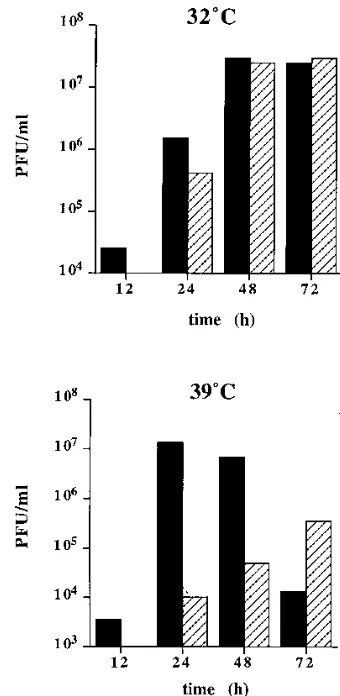
The growth ofts25 is severely restricted at 39&C.As an initial step toward characterizing the conditional defect(s) of ts25, we examined the production of infectious virus during constant-temperature infections at either 32 or 398C. SW-13 cells were infected at a high MOI with the parental virus or ts25, and titers of virus released during 0 to 12, 12 to 24, 24 to 48, and 48 to 72 h p.i. were determined by plaque assay at 328C (Fig. 1). At 328C, the permissive temperature, ts25 replicated to com-parable levels and induced similar cytopathic effects (CPE) as compared to the parental virus, although the growth was slightly delayed. However, at 398C, the nonpermissive temper-ature, ts25 growth was dramatically delayed as evidenced by severely reduced virus accumulation and little or no observable CPE, even after 72 h. In contrast, the parental virus produced
strong CPE and high virus yields, peaking at 24 to 48 h p.i. To assay for possible ts25 revertants, titers were also determined at 398C. No plaques were observed at 398C for ts25 produced at either temperature, indicating that progeny produced at 398C did not represent the emergence of wild-type revertants or pseudorevertants. These results suggest that the replication of ts25 is severely impaired at 398C. However, the defect ap-pears to be leaky, since low levels of virus are produced after prolonged incubation at the nonpermissive temperature.
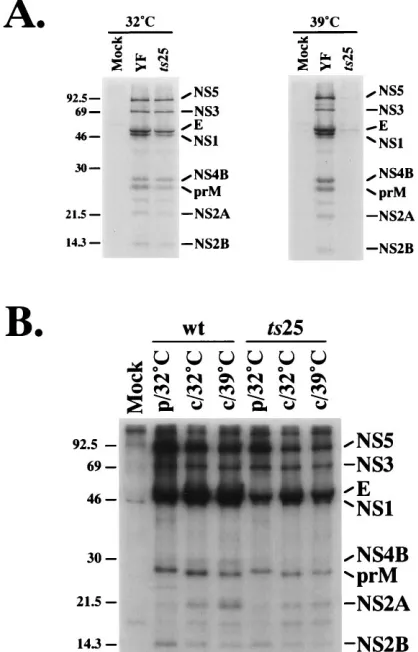
[image:3.612.60.297.91.426.2]Thets25 lesion leads to reduced accumulation of YFV-spe-cific proteins at 39&C.To investigate whether the block in virus production correlated with reduced viral protein synthesis, we examined protein accumulation during constant-temperature infections. SW-13 cells were infected at a high MOI with the parental virus or ts25 at 32 and 398C and were metabolically labeled, and YFV-specific proteins were immunoprecipitated and separated by SDS-PAGE (Fig. 2A). Except for reduced amounts of NS1, the level and profile of virus-specific proteins observed at 328C were similar for ts25 and the parental virus. However, at 398C, although the pattern was essentially the same for the parental virus, YFV-specific proteins were not detected in cells infected with ts25.
[image:3.612.345.515.318.666.2]FIG. 1. Growth of ts25 and the parental virus at 32 and 398C. SW-13 cells were infected at a MOI of 5 PFU of either the parental wild-type virus (solid bars) or ts25 (hatched bars) per cell at 328C (the permissive temperature) or 398C (the nonpermissive temperature). At 12 h p.i., the medium was harvested and replaced with fresh medium. This was repeated at 24, 48, and 72 h p.i. The titer of virus released during each time interval was determined by plaque assay on SW-13 cells at 328C.
TABLE 1. Summary of YFV NS1 mutations and mutant phenotypes
Virusa
NS1 amino acid residue(s)
changed to alanine
RNA spe-cific infec-tivitybat:
Virus titercat:
Plaque
morphol-ogydat:
328C 398C 328C 398C 328C 398C
wt None 55 25 8.03107 7.53106 L L
A2 K-14, D-17 0 0 #50 #50 — —
A3 R-23, D-24 0 0 #50 #50 — —
A4 D-27, K-31 0 0 #50 #50 — —
A5 D-38, K-41 52 26 3.03107 1.03107 L L
A6 E-51, E-52 53 29 1.53107
6.53106
S S
A7 D-61, E-64 0 0 #50 #50 — —
A8 R-69, R-71 26 10 2.03105
1.03105
S S
A9 E-83, D-85 0 0 #50 #50 — —
A10 D-92, K-94 70 31 5.03107
4.03106
L L
A12 K-116, K-120 30 17 1.53106 3.03106 M M
A13 R-128, K-129 0 0 #50 #50 — —
A15 K-141, E-142 55 31 6.43107 2.53106 L L
A16 E-156, E-157 30 15 1.53106
3.03106
M M
A17 R-166, D-170 0 0 #50 #50 — —
A18 D-178, D-180 51 25 3.03107
1.53106
L L
A19 K-191, K-192 13 7 1.13106 4.53106 M M
A20 E-217, D-220 31 19 7.03103
5.03102
S S
A21 E-223, E-225 30 17 3.53106 4.03106 M M
A22 E-238, E-240 33 19 1.53107
2.13107
M M
A23 E-274, K-276 50 33 4.83107 7.53106 M M
A24 D-288, D-292 45 17 2.53107
3.03106
M M
A25 K-296, R-299 50 0 1.03107 #50 S —
A26 D-303, K-306 50 20 1.33106
5.03106
S S
A27 E-310, R-314 52 32 4.53107 5.03106 M M
A28 E-334, R-336 48 21 4.53106
7.53105
S S
A29 K-339, E-342 45 24 5.53107 2.83106 L L
A30 D-73, E-74 0 0 #50 #50 — —
A31 E-80, E-81 0 0 #50 #50 — —
A32 K-296 56 31 6.53107
4.03106
L L
A33 R-299 52 0 1.33107 #50 S —
awt, parental virus.
bNumber of plaques obtained at 32 or 398C after transfection of SW-13
monolayers with 20 ng of transcript RNA (see Materials and Methods). Plaques were stained and counted at 4 or 5 days posttransfection.
cViral titer (PFU per milliliter) in the medium at 72 h posttransfection. After
transfection, SW-13 monolayers were incubated at either 32 or 398C. Plaque assay mixtures were incubated at the same temperature used to rescue the virus.
dRelative plaque size (L, large; M, medium; S, small) or no plaques detected
(—).
on November 9, 2019 by guest
http://jvi.asm.org/
ts25 exhibits an early defect in RNA accumulation. The simplest explanation for the lack of virus-specific protein syn-thesis in ts25-infected cells at 398C is that the lesion led to impaired RNA amplification and reduced levels of genome-length viral mRNA. To examine this possibility, SW-13 cells were infected at a high MOI with the parental virus or ts25 at 32 or 398C for 36 h and accumulation of positive- and negative-strand RNAs was analyzed by an RNase protection assay. At 328C, the permissive temperature, the levels of positive- and negative-strand RNAs in ts25-infected cells were approxi-mately twofold lower than those of the parental virus (Fig. 3A). In contrast, at 398C, ts25 RNA synthesis was not readily de-tected above background (Fig. 3A). Although a band of the expected size for a fragment protected by positive-strand RNA can be seen for ts25 at 398C, similar levels of this product were also observed when RNA from mock-infected cells was used.
Nature of thets25 RNA defect.We next examined the effect of a temperature shift on RNA accumulation. In this experi-ment, monolayers were infected at 328C, as described above, and at 18 h, incubations were either continued at 328C or shifted to 398C for an additional 18 h. RNA accumulation was again determined by an RNase protection assay (Fig. 3B) and quantified with a phosphorimager (data not shown). For the
parental virus, the levels of both positive- and negative-strand RNAs after the shift to 398C were approximately twofold higher when compared to those produced by continuous incu-bation at 328C (Fig. 3B). After 18 h, the molar ratio of positive-strand to negative-positive-strand RNA was approximately 10; by 36 h, this ratio was 40 (398C) or 50 (328C). These data suggest that the asymmetry in positive- and negative-strand RNA synthesis increases during the course of infection. For ts25, the level of negative-strand RNA at 18 h was similar to that of the parent but increased only twofold after the shift to 398C (in contrast to the eightfold increase observed at 328C). These data suggest a heat-sensitive defect in ts25 negative-strand RNA tion. Relative to the parent, positive-strand RNA accumula-tion was also reduced for ts25 at both 32 and 398C. After 18 h at 328C, the molar ratio of positive- to negative-strand RNA was only 3 (as compared to;10 for the parent). By 36 h at 328C, this ratio had increased to about 35 (as compared to;50 for the parent). In the shift-up experiment, a 10-fold increase in positive-strand RNA accumulation was observed for ts25, corresponding to a molar ratio of positive- to negative-strand RNA of 14. Thus, at 328C, ts25 replicates more slowly than the parent, accumulating lower levels of both negative- and posi-tive-strand RNAs. If the cells are shifted to 398C, the ts25 defect is more dramatic, resulting in little additional lation of negative-strand template RNA and reduced accumu-lation of positive-strand RNA. It is clear, however, that once infection is established at 328C, RNA synthesis can continue after the shift to the nonpermissive temperature. This
conclu-FIG. 3. Accumulation of YFV negative- and positive-strand RNAs. (A) SW-13 monolayers were mock infected or infected at a MOI of 5 PFU of either the wild-type virus (wt) or ts25 per cell and incubated at 32 or 398C for 36 h. Cytoplasmic RNAs were isolated, and the levels of positive- and negative-strand viral RNAs were determined by an RNase protection assay, as described in Materials and Methods. (B) As described for panel A, three sets of SW-13 monolayers were mock infected or infected and incubated at 328C. RNAs were harvested after 18 h at 328C or after an additional 18-h incubation at either 32 or 398C. The sizes of the probe and protected fragments are 284 and 251 nt, respectively. The experiment has been repeated four times with similar results. FIG. 2. Viral protein synthesis. (A) SW-13 cells were mock infected or
in-fected at a MOI of 5 PFU of either the wild-type parent (wt) or ts25 per cell, incubated at 32 or 398C for 36 h, and metabolically labeled at these temperatures for 6 h. (B) SW-13 cells were infected and incubated at 328C for 35 h, pulse-labeled for 1 h (p), and chased (c) for 6 h at either 32 or 398C. Cell extracts were immunoprecipitated with YFV-specific hyperimmune ascitic fluid and analyzed by SDS-PAGE (13% polyacrylamide). Molecular mass markers (in kilodaltons) are indicated on the left; YFV-specific proteins are indicated on the right.
on November 9, 2019 by guest
http://jvi.asm.org/
[image:4.612.73.282.73.399.2]sion has been verified by showing that [3H]uridine can be
incorporated into viral genomic RNA after the shift to the nonpermissive temperature (data not shown). Although fur-ther experiments are needed, the simplest interpretation of these data is that the ts25 lesion inhibits the formation of new RNA replication complexes synthesizing negative- and per-haps positive-strand RNAs (see Discussion).
Effects of thets25 lesion on polyprotein processing and NS1 secretion.The ts25 lesion might inhibit the formation or func-tion of YFV RNA replicafunc-tion complexes by affecting YFV polyprotein processing. An octapeptide sequence at the C ter-minus of NS1 (18) as well as NS2A (16) sequences appears to be important for proper processing at the NS1/2A cleavage site, implying the presence of a functional linkage between these two proteins, which are initially produced as a discrete NS1-2A precursor (6). Cleavages at the 2A/2B site (9) and at an internal cleavage in NS2A (6, 7, 33) are mediated by the flavivirus NS2B-3 serine proteinase. Thus, mutations in NS1 which affect its interaction with NS2A could, in theory, affect processing at downstream sites, which is important for the assembly of functional replicases (8, 9, 33). To examine poly-protein processing and stability in ts25-infected cells, infection was established at 328C and at 35 h p.i., cells were pulse-labeled for 1 h at 328C and either harvested immediately or incubated for an additional 6 h at 32 or 398C. YFV-specific proteins were immunoprecipitated and separated by SDS-PAGE. As shown in Fig. 2B, no obvious temperature-depen-dent defects in ts25 NS polyprotein processing or product sta-bility were observed, although it was difficult to distinguish between E and NS1 in this analysis.
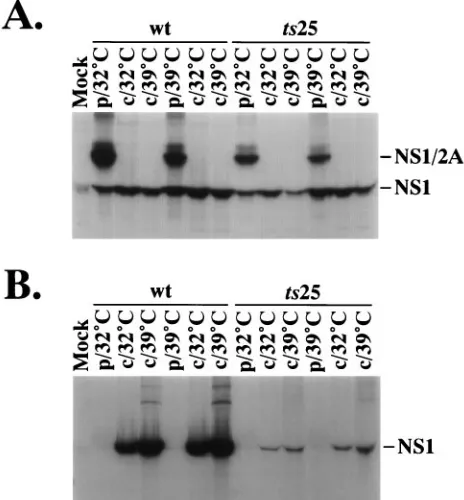
We therefore examined NS1 processing, stability, and secre-tion in more detail. Another pulse-chase experiment was con-ducted, in which pulse-labeling was performed at 32 or 398C, and equal portions of the cell lysates (Fig. 4A) or supernatants (Fig. 4B) were analyzed by immunoprecipitation with satu-rating amounts of a mixture of NS1-specific polyclonal and monoclonal antibodies. Overall, we did not observe any tem-perature-dependent differences in the processing, stability, or secretion of ts25 NS1. Examination of Fig. 4A suggests that while ts25 makes somewhat reduced levels of NS1-2A and NS1 relative to the parent, NS1-2A processing is unimpaired re-gardless of whether the proteins were synthesized at 32 or 398C. For both the parent and ts25, lower levels of cell-associ-ated NS1 were observed after chases at 398C compared to 328C, but this most probably reflects more efficient secretion of NS1 at the higher temperature. The most striking observation of the experiment was the markedly reduced levels of NS1 present in the supernatant of ts25-infected cells (Fig. 4B). Although this could be due to enhanced susceptibility of the mutant NS1 to degradation in the culture supernatant, it seems more likely that a substantial fraction of the NS1 made by ts25, at either temperature, is targeted for intracellular degradation and not secreted.
Effects of thets25 lesion on virus release.Since it had been suggested that NS1 might play a role in virus assembly, matu-ration, or release, we also examined the production of progeny virus in a temperature shift experiment. Since the primary ts25 defect is in RNA accumulation, it was again necessary to es-tablish infection at the permissive temperature. At 45 h p.i. at 328C, the cell cultures were washed extensively and incubated at either 32 or 398C for an additional 3 h. As shown in Table 2, the yields of parental virus upon the shift to 398C were similar to those obtained after continued incubation at 328C and the yields were less than twofold lower for ts25. These results suggest that the ts25 lesion does not have a dramatic inhibitory effect on virus release, at least when infection is established at the permissive temperature.
Substitution of Ala for Arg-299 is responsible for the ts
phenotype. Since ts25 contains two Ala substitutions, one at Lys-296 and a second at Arg-299, single substitutions were examined to determine whether one or both mutations were required for the ts phenotype. As summarized in Table 1, substitution of Lys-296 with Ala led to a virus (A32) which was indistinguishable from the parent, whereas substitution of Arg-299 with Ala resulted in a mutant (A33) with a ts phenotype.
DISCUSSION
[image:5.612.61.293.73.323.2]Characterization of the 28 clustered charged-amino-acid-to-alanine mutants created in this study provides a preliminary genetic map of NS1 functional domains (Fig. 5). Nine muta-tions which abrogated plaque formation at either temperature FIG. 4. Effects of temperature on NS1 accumulation, stability, and secretion.
SW-13 cells were mock infected or infected at a MOI of 5 PFU of either the wild-type virus (wt) or ts25 per cell. After 35 h at 328C, cells were pulse-labeled (p) for 1 h at either 32 or 398C and chased (c) for 6 h at either 32 or 398C. Equivalent portions of SDS-treated cell extracts (A) or culture supernatants (B) were immunoprecipitated with NS1-specific polyclonal and monoclonal antibod-ies and analyzed by SDS-PAGE (10% polyacrylamide). To allow better visual-ization of the low levels of NS1 secreted by ts25, the autoradiograph shown in panel B was exposed 2.5 times longer than that shown in panel A.
TABLE 2. Effects of temperature shift on virus releasea
Virus
Titer of infectious virus released
from 45 to 48 h p.i. (PFU/ml) at: Yield ratio (398C/328C) 328C 398C
wtb 1.33107 1.53107 1.1
ts25 7.53106 4.53106 0.6
aSW-13 cells were infected at 328C at a MOI of 5 PFU/ml. At 45 h p.i., the
cells were washed, prewarmed medium was added, and the incubation was continued for 3 h at either 328C or after a shift to 398C. Titers were determined by plaque assay on SW-13 cells.
bwt, parental virus.
on November 9, 2019 by guest
http://jvi.asm.org/
[image:5.612.317.557.624.686.2]were found to be localized in the N-terminal half of NS1. Previous work has shown that ablation of the first (Asn-130) but not the second (Asn-208) N-linked NS1 glycosylation site leads to defects in viral RNA replication, virus production, and pathogenicity (32, 36). Although further genetic, biochem-ical, and functional studies are needed to confirm this, the N-terminal portion of NS1 may form a separate functional domain. Other mutations, i.e., those leading to an “impaired” or “wild-type” phenotype relative to the parent, were dis-tributed throughout the protein. Substitution of conserved charged residues did not necessarily lead to a mutant pheno-type. For instance, the Lys-339 and Glu-342 residues substi-tuted in mutant A29 are conserved among flaviviruses, yet this mutant was similar to the parent in terms of plaque phenotype and growth at 32 and 398C. In contrast, Asp-27 and Lys-31 are not conserved yet substitution of Ala for these residues in mutant A4 was lethal. It should be pointed out, however, that we have examined plaque phenotype and virus growth at only two temperatures in only a single cell type (human adrenocor-tical carcinoma SW-13 cells). It will be of interest to conduct more detailed analyses with other cell types, with whole mos-quitoes, and with animal pathogenesis models. It is tempting to speculate that substitutions for highly conserved residues, which have minimal effects on RNA replication, may affect other aspects of NS1 function related to its cell surface or secreted forms.
Of the 28 mutants, only ts25 was strongly ts, and even this mutant was leaky at 398C, the nonpermissive temperature. Detailed analysis of the ts25 phenotype suggested that this lesion leads to an early defect in RNA accumulation which is
enhanced at 398C relative to 328C, leading to the heat-sensitive phenotype. At the nonpermissive temperature, RNA replica-tion was dramatically delayed relative to that of the parent, but it did occur, as evidenced by the eventual production of virus after prolonged incubation. The resulting progeny were still ts and were not likely to be the result of same-site or second-site reversion events. In shift-up experiments, where infection was established at the permissive temperature, negative-strand RNA accumulation was severely impaired whereas significant positive-strand RNA was synthesized, considering the low level of negative-strand template RNA. Although this analysis sug-gests that the ts25 lesion exerts a selective block at negative-versus positive-strand RNA replication complex formation or function, further experiments are needed to confirm this ob-servation. Shift-up experiments failed to provide evidence for a temperature-dependent difference in polyprotein processing or in NS1 stability or secretion. It was clear, however, that significantly less ts25 NS1 accumulated in the culture superna-tant at either temperature. Barring enhanced susceptibility to degradation in this extracellular compartment, these results suggest that a large fraction of ts25 NS1 may be targeted for intracellular degradation and is not secreted.
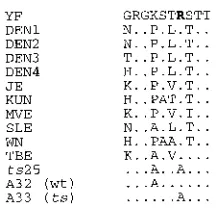
The temperature sensitivity of ts25 correlated with the Ala substitution at Arg-299, which is located in the C-terminal portion of the 352-residue NS1 protein. As shown in Fig. 6, this NS1 residue is conserved among flaviviruses. The second Ala substitution in ts25, at Lys-296, produced a mutant phenotyp-ically indistinguishable from the parent. This position is not highly conserved, and in fact, Ala is present at this position in TBE NS1. Although we cannot formally exclude the possibility FIG. 5. Summary of NS1 clustered charged-amino-acid-to-alanine mutants. Shown at the top is a schematic of the 352-residue NS1 protein (thick bar) highlighting the conserved Cys residues (C) and N-linked glycosylation sites (}). Diagrammed below are NS1 mutants grouped by phenotype: wild type (open circles), impaired (shaded circles), lethal (solid circles), or temperature sensitive (ts). Details can be found in Table 1 and the text. Vertical lines indicate the positions of charged residues; thicker vertical lines indicate the charged residue(s) mutated to alanine for individual mutants.
on November 9, 2019 by guest
http://jvi.asm.org/
that the nucleotide substitutions creating the Arg-299 substi-tution are exerting an effect at the RNA level, the simplest interpretation of our results is that substitution of Arg-299 impairs the ability of NS1 to function in some aspect of RNA replication. Other mutagenesis studies also implicate the C-terminal portion of the NS1 as an important functional do-main. Substitution mutations in the C-terminal eight residues can have dramatic effects on NS1-2A cleavage efficiency (18). In addition, Ala substitutions for the three conserved Cys res-idues near the C terminus of DEN2 NS1 resulted in destabi-lization of dimers and inhibition of secretion (37).
At present, the role which NS1 plays in RNA replication is not clear; several non-mutually exclusive models can be envi-sioned. NS1 could play a direct role in replicase function. It seems unlikely, however, that NS1 has an enzymatic activity required for RNA amplification, given its luminal localization. Rather, NS1 might be a structural component of RNA repli-cation complexes via direct interaction with other membrane-spanning or membrane-associated viral or host components. Alternatively, NS1 may not be present in functioning replicases but may be required for an early step in replication complex assembly. In this regard, RNA replication for positive-strand RNA viruses occurs in association with cellular membranes; significant proliferation and reorganization of membrane or-ganelles is often associated with virus infection. In poliovirus, such changes can be triggered by specific viral proteins (2, 10, 14). Furthermore, the inhibition of poliovirus RNA replication by brefeldin A suggests that some portion of the secretory apparatus is required for the assembly of functional replication complexes (13, 30). Given this precedent, NS1 might facilitate the formation of membrane organelles required for the assem-bly of functional flavivirus RNA replication complexes or tar-get replicase components to the proper subcellular compart-ment. The ts25 lesion could either directly interfere with NS1 function and/or lead to limiting quantities of functional NS1 via destabilization and turnover of the protein. Either model could explain the observed ts25 RNA phenotype. At 328C, lower levels of functional NS1 would lead to a slight delay in achieving saturating levels of negative- and positive-strand RNA replication complexes. At 398C, the NS1 defect is more severe, leading to extremely slow RNA replication complex formation and RNA accumulation, delayed virus production, minimal CPE, and no plaque formation. Shift-up experiments, which suggest a selective block in negative-strand RNA ac-cumulation, may indicate that NS1 is no longer required once
a functional positive-strand replication complex has been formed.
Although a role for NS1 in virion morphogenesis or release was previously proposed, no data have been obtained to sup-port this. In our study, shift-up experiments with ts25 did not demonstrate a significant defect in the release of infectious virus. Furthermore, at both 32 and 398C, the secretion of ts25 NS1 appeared to be severely impaired. Thus, in mammalian cells, successful transit of NS1 through the secretory pathway is not linked to virus release. This is also true for mosquito cells, which do not secrete NS1 but are highly permissive for flavi-virus RNA replication and production of infectious flavi-virus (29). These results, which implicate NS1 in flavivirus RNA replica-tion but not virion producreplica-tion, are consistent with a recent immunolocalization study (28). DEN2 NS1 was shown to be associated with intracellular membrane organelles and colocal-ized with other nonstructural replicase components including double-stranded RNA. NS1 did not colocalize with vesicles containing DEN2 structural proteins and intracellular virus particles.
In summary, our study provides strong evidence that NS1 is required for an early step in flavivirus RNA replication. Addi-tional work is needed to define its precise role in RNA repli-cation complex assembly and/or function. Further analysis of ts25 as well as the other clustered charged-amino-acid-to-ala-nine NS1 mutants may help to elucidate related or distinct functions for NS1 in flavivirus replication and pathogenesis.
ACKNOWLEDGMENTS
We thank Sean M. Amberg and Brett D. Lindenbach for critical reading of the manuscript and for helpful comments.
I.R.M. was supported by a fellowship from Capes/CNPq and PHS grant AI31501 to C.M.R. R.G. acknowledges support from the Rock-efeller Foundation (Biotechnology Career Program) and CNPq.
REFERENCES
1. Ausubel, F. M., R. Brent, R. E. Kingston, D. D. Moore, J. G. Seidman, J. A. Smith, and K. Struhl (ed.).1993. Current protocols in molecular biology. Greene Publishing Associates, New York, N.Y.
2. Barco, A., and L. Carrasco. 1995. A human virus protein, poliovirus protein 2BC, induces membrane proliferation and blocks the exocytic pathway in the yeast Saccharomyces cerevisiae. EMBO J. 14:3349–3364.
3. Brinton, M. A. 1986. Replication of flaviviruses, p. 327–365. In S. Schlesinger and M. J. Schlesinger (ed.), The Togaviridae and Flaviviridae. Plenum Press, New York, N.Y.
4. Chamberlain, J. P. 1979. Fluorographic detection of radioactivity in poly-acrylamide gels with the water-soluble fluor, sodium salicylate. Anal. Bio-chem. 98:132–135.
5. Chambers, T. J., C. S. Hahn, R. Galler, and C. M. Rice. 1990. Flavivirus genome organization, expression, and replication. Annu. Rev. Microbiol. 44:649–688.
6. Chambers, T. J., D. W. McCourt, and C. M. Rice. 1990. Production of yellow fever virus proteins in infected cells: identification of discrete polyprotein species and analysis of cleavage kinetics using region-specific polyclonal antisera. Virology 177:159–174.
7. Chambers, T. J., D. W. McCourt, and C. M. Rice. 1989. Yellow fever virus proteins NS2A, NS2B, and NS4B: identification and partial N-terminal amino acid sequence analysis. Virology 169:100–109.
8. Chambers, T. J., A. Nestorowicz, and C. M. Rice. 1995. Mutagenesis of the yellow fever virus NS2B/3 cleavage site: determinants of cleavage site spec-ificity and effects on polyprotein processing and viral replication. J. Virol. 69:1600–1605.
9. Chambers, T. J., R. C. Weir, A. Grakoui, D. W. McCourt, J. F. Bazan, R. J. Fletterick, and C. M. Rice.1990. Evidence that the N-terminal domain of nonstructural protein NS3 from yellow fever virus is a serine protease re-sponsible for site-specific cleavages in the viral polyprotein. Proc. Natl. Acad. Sci. USA 87:8898–8902.
10. Cho, M. W., N. Teterina, D. Egger, K. Bienz, and E. Ehrenfeld. 1994. Membrane rearrangement and vesicle induction by recombinant poliovirus 2C and 2BC in human cells. Virology 202:129–145.
11. Collett, M. S. Personal communication.
[image:7.612.124.233.68.173.2]12. Diamond, S. E., and K. Kirkegaard. 1994. Clustered charged-to-alanine mutagenesis of poliovirus RNA-dependent RNA polymerase yields multiple FIG. 6. Comparison of flavivirus NS1 sequences in the vicinity of the ts25
lesion. Shown is an alignment of NS1 residues 293 to 302 (YFV numbering) for 11 different flaviviruses, ts25, and single substitution mutants A32 and A33. Positions identical to the YFV sequence are indicated by dots, and the conserved Arg-299 residue is shown in boldface type. Abbreviations: YF, yellow fever virus; DEN1, dengue 1 virus; DEN2, dengue 2 virus; DEN3, dengue 3 virus; DEN4, dengue 4 virus; JE, Japanese encephalitis virus; KUN, Kunjin virus; MVE, Murray Valley encephalitis virus; SLE, St. Louis encephalitis virus; WN, West Nile virus; TBE, tick-borne encephalitis virus. Primary references for these flavivirus sequences can be found in references 5 and 35.
on November 9, 2019 by guest
http://jvi.asm.org/
temperature-sensitive mutants defective in RNA synthesis. J. Virol. 68:863– 876.
13. Doedens, J., L. A. Maynell, M. W. Klymkowsky, and K. Kirkegaard. 1994. Secretory pathway function, but not cytoskeletal integrity, is required in poliovirus infection. Arch. Virol. Suppl. 9:159–172.
14. Echeverri, A. C., and A. Dasgupta. 1995. Amino terminal regions of polio-virus 2C protein mediate membrane binding. Virology 208:540–553. 15. Eckels, K. H., P. L. Summers, and P. K. Russell. 1983.
Temperature-sensi-tive events during the replication of the attenuated S-1 clone of dengue type 2 virus. Infect. Immun. 39:750–754.
16. Falgout, B., R. Chanock, and C.-J. Lai. 1989. Proper processing of dengue virus nonstructural glycoprotein NS1 requires the N-terminal hydrophobic signal sequence and the downstream nonstructural protein NS2a. J. Virol. 63:1852–1860.
17. Gould, E. A., A. Buckley, A. D. T. Barrett, and N. Cammack. 1986. Neutral-izing (54K) and non-neutralNeutral-izing (54K and 48K) monoclonal antibodies against structural and nonstructural yellow fever virus proteins confer im-munity in mice. J. Gen. Virol. 67:591–595.
18. Hori, H., and C.-J. Lai. 1990. Cleavage of dengue virus NS1-NS2A requires an octapeptide sequence at the C terminus of NS1. J. Virol. 64:4573–4577. 19. Jacobs, S. C., J. R. Stephenson, and G. W. Wilkinson. 1992. High-level expression of the tick-borne encephalitis virus NS1 protein by using an adenovirus-based vector: protection elicited in a murine model. J. Virol. 66:2086–2095.
20. Jacobs, S. C., J. R. Stephenson, and G. W. Wilkinson. 1994. Protection elicited by a replication-defective adenovirus vector expressing the tick-borne encephalitis virus nonstructural glycoprotein NS1. J. Gen. Virol. 75: 2399–2402.
21. Kamer, G., and P. Argos. 1984. Primary structural comparison of RNA-dependent polymerases from plant, animal, and bacterial viruses. Nucleic Acids Res. 12:7269–7282.
22. Kapoor, M., L. Zhang, M. Ramachandra, J. Kusukawa, K. E. Ebner, and R. Padmanabhan.1995. Association between NS3 and NS5 proteins of dengue virus type 2 in the putative RNA replicase is linked to differential phosphor-ylation of NS5. J. Biol. Chem. 270:19100–19106.
23. Koonin, E. V. 1993. Computer-assisted identification of a putative methyl-transferase domain in NS5 protein of flaviviruses and lambda 2 protein of reovirus. J. Gen. Virol. 74:733–740.
24. Kunkel, T. A. 1985. Rapid and efficient site-specific mutagenesis without phenotypic selection. Proc. Natl. Acad. Sci. USA 82:488–492.
25. Laemmli, U. K. 1970. Cleavage of structural proteins during the assembly of the head of bacteriophage T4. Nature (London) 227:680–685.
26. Lin, C., S. M. Amberg, T. J. Chambers, and C. M. Rice. 1993. Cleavage at a novel site in the NS4A region by the yellow fever virus NS2B-3 proteinase is a prerequisite for processing at the downstream 4A/4B signalase site. J. Vi-rol. 67:2327–2335.
27. Lin, C., T. J. Chambers, and C. M. Rice. 1993. Mutagenesis of conserved residues at the yellow fever virus 3/4A and 4B/5 dibasic cleavage sites: effects on cleavage efficiency and polyprotein processing. Virology 192:596–604. 28. Mackenzie, J. M., M. K. Jones, and P. R. Young. 1996. Immunolocalization
of the dengue virus nonstructural glycoprotein NS1 suggests a role in viral RNA replication. Virology 220:232–240.
29. Mason, P. W. 1989. Maturation of Japanese encephalitis virus glycoproteins produced by infected mammalian and mosquito cells. Virology 169:354–364. 30. Maynell, L. A., K. Kirkegaard, and M. W. Klymkowsky. 1992. Inhibition of
poliovirus RNA synthesis by brefeldin A. J. Virol. 66:1985–1994. 31. Monath, T. P., and F. X. Heinz. 1996. Flaviviruses, p. 961–1034. In B. N.
Fields, D. M. Knipe, and P. M. Howley (ed.), Fields virology, 3rd ed. Raven Press, New York, N.Y.
32. Muylaert, I. R., R. G. Galler, and C. M. Rice. 1996. Mutagenesis of the N-linked glycosylation sites of the yellow fever virus NS1 protein: effects on virus replication and mouse neurovirulence. Virology, 222:159–168. 33. Nestorowicz, A., T. J. Chambers, and C. M. Rice. 1994. Mutagenesis of the
yellow fever virus NS2A/2B cleavage site: effects on proteolytic processing,
viral replication and evidence for alternative processing of the NS2A protein. Virology 199:114–123.
34. Novak, J. E., and K. Kirkegaard. 1991. Improved method for detecting poliovirus negative strands used to demonstrate specificity of positive-strand encapsidation and the ratio of positive to negative strands in infected cells. J. Virol. 65:3384–3387.
35. Osatomi, K., and H. Sumiyoshi. 1990. Complete nucleotide sequence of dengue type 3 virus genome RNA. Virology 176:643–647.
36. Pletnev, A. G., M. Bray, and C. J. Lai. 1993. Chimeric tick-borne encephalitis and dengue type 4 viruses: effects of mutations on neurovirulence in mice. J. Virol. 67:4956–4963.
37. Pryor, M. J., and P. J. Wright. 1993. The effects of site-directed mutagenesis on the dimerization and secretion of the NS1 protein specified by dengue virus. Virology 194:769–780.
38. Rice, C. M. 1996. Flaviviridae: the viruses and their replication, p. 931–960.
In B. N. Fields, D. M. Knipe, and P. M. Howley (ed.), Fields virology, 3rd ed.
Raven Press, New York, N.Y.
39. Rice, C. M., A. Grakoui, R. Galler, and T. J. Chambers. 1989. Transcription of infectious yellow fever virus RNA from full-length cDNA templates pro-duced by in vitro ligation. New Biol. 1:285–296.
40. Rice, C. M., E. M. Lenches, S. R. Eddy, S. J. Shin, R. L. Sheets, and J. H. Strauss.1985. Nucleotide sequence of yellow fever virus: implications for flavivirus gene expression and evolution. Science 229:726–733.
41. Rice, C. M., E. G. Strauss, and J. H. Strauss. 1986. Structure of the flavivirus genome, p. 279–326. In S. Schlesinger and M. J. Schlesinger (ed.), The Togaviridae and Flaviviridae. Plenum Press, New York, N.Y.
42. Rice, C. M., and J. H. Strauss. 1990. Production of flavivirus polypeptides by proteolytic processing. Semin. Virol. 1:357–367.
43. Sambrook, J., E. Fritsch, and T. Maniatis. 1989. Molecular cloning: a lab-oratory manual. Cold Spring Harbor Lablab-oratory, Cold Spring Harbor, N.Y. 44. Schlesinger, J. J., M. W. Brandriss, C. B. Cropp, and T. P. Monath. 1986. Protection against yellow fever in monkeys by immunization with yellow fever virus nonstructural protein NS1. J. Virol. 60:1153–1155.
45. Schlesinger, J. J., M. W. Brandriss, and T. P. Monath. 1983. Monoclonal antibodies distinguish between wild and vaccine strains of yellow fever virus by neutralization, hemagglutination inhibition, and immune precipitation of the virus envelope protein. Virology 125:8–17.
46. Schlesinger, J. J., M. W. Brandriss, and E. E. Walsh. 1985. Protection against 17D yellow fever encephalitis in mice by passive transfer of mono-clonal antibodies to the nonstructural glycoprotein gp48 and by active im-munization with gp48. J. Immunol. 135:2805–2809.
47. Schlesinger, J. J., M. Foltzer, and S. Chapman. 1993. The Fc portion of antibody to yellow fever virus NS1 is a determinant of protection against YF encephalitis in mice. Virology 192:132–141.
48. Tan, B.-T., J. Fu, R. J. Sugrue, E.-H. Yap, Y.-C. Chan, and Y. H. Tan. 1996. Recombinant dengue type 1 virus NS5 protein expressed in Escherichia coli exhibits RNA-dependent RNA polymerase activity. Virology 216:317–325. 49. Warrener, P., J. K. Tamura, and M. S. Collett. 1993. An RNA-stimulated
NTPase activity associated with yellow fever virus NS3 protein expressed in bacteria. J. Virol. 67:989–996.
50. Wengler, G., and G. Wengler. 1993. The NS 3 nonstructural protein of flaviviruses contains an RNA triphosphatase activity. Virology 197:265–273. 51. Wertman, K. F., D. G. Drubin, and D. Botstein. 1992. Systematic mutational
analysis of the yeast ACT1 gene. Genetics 132:337–350.
52. Westaway, E. G. 1987. Flavivirus replication strategy. Adv. Virus Res. 33: 45–90.
53. Winkler, G., S. E. Maxwell, C. Ruemmler, and V. Stollar. 1989. Newly synthesized dengue-2 virus nonstructural protein NS1 is a soluble protein but becomes partially hydrophobic and membrane-associated after dimerization. Virology 171:302–305.
54. Winkler, G., V. B. Randolph, G. R. Cleaves, T. E. Ryan, and V. Stollar. 1988. Evidence that the mature form of the flavivirus nonstructural protein NS1 is a dimer. Virology 162:187–196.