FORMULATION DEVELOPMENT AND EVALUATION OF TRANSDERMAL PATCH CONTAINING AMLODIPINE
BESYLATE
Dissertation submitted to
THE TAMILNADU Dr. M.G.R MEDICAL UNIVERSITY, CHENNAI in partial fulfillment of the requirements
for the award of the degree of
MASTER OF PHARMACY IN
PHARMACEUTICS
DEPARTMENT OF PHARMACEUTICS
PERIYAR COLLEGE OF PHARMACEUTICAL SCIENCES FOR GIRLS, TIRUCHIRAPPALLI -620 021.
March 2008
Prof.T.N.K.Suriyaprakash M.Pharm.,( Ph.D.) Head, Department of Pharmaceutics,
Periyar College of Pharmaceutical Sciences for Girls, Tiruchirapalli-620 021
Tamil Nadu, India.
CERTIFICATE
This is to Certify that this dissertation entitled “FORMULATION DEVELOPMENT AND EVALUATION OF TRANSDERMAL PATCH CONTAINING AMLODIPINE BESYLATE” :by Mr Shaikh Imran for the award of “Master Of Pharmacy” degree, comprises of the bonafide work done by him in the Department of Pharmaceutics, Periyar College of Pharmaceutical Sciences for Girls, Tiruchirapalli, under my supervision and guidance and to my full satisfaction.
Place: Tiruchirapalli
Dr. R.Senthamarai, M.Pharm., Ph.D., Principal,
Periyar College of Pharmaceutical Sciences for Girls, Tiruchirapalli-620 021
Tamil Nadu, India.
CERTIFICATE
This is to Certify that this dissertation entitled “FORMULATION DEVELOPMENT AND EVALUATION OF TRANSDERMAL PATCH CONTAINING AMLODIPINE BESYLATE”, by Mr Shaikh Imran for the award of “Master of Pharmacy” degree, comprises of the bonafide work done by him in the Department of Pharmaceutics, Periyar College of Pharmaceutical Sciences for Girls, Tiruchirapalli, his work was supervised by Prof.T.N.K.Suriyaprakash M.Pharm., (Ph.D.), Head, Department of Pharmaceutics, Periyar College of Pharmaceutical Sciences for Girls, Tiruchirapalli.
I recommend this research work for acceptance as project for the partial fulfillment of the degree of “Master of Pharmacy” of the Department of Pharmaceutics, Periyar College of Pharmaceutical Sciences for Girls, Tiruchirapalli, for the year March 2008.
Place : Tiruchirapalli
ACKNOWLEDGEMENT
Though words are seldom sufficient to express gratitude and feelings, it some how gives me an opportunity to thank those who helped me during the tenure of my study. The work of dissertation preparation was a daunting task and a fascinating experience.
I take this opportunity to express my deep sense of gratitude to my guide Prof.T.N.K.Suriyaprakash M.Pharm, (Ph.D.), Head, Department of Pharmaceutics, Periyar College of Pharmaceutical Sciences for Girls, Trichy-21, for his guidance, valuable suggestions and liberal encouragement to complete this work successfully entitled “FORMULATION DEVELOPMENT AND EVALUATION OF TRANSDERMAL PATCH CONTAINING AMLODIPINE BESYLATE”,
It’s my privilege and honor to thank Dr.R.Senthamarai M.Pharm, Ph.D., Principal, Periyar College of Pharmaceutical Sciences for Girls, Trichy-21, for providing all the necessary facilities to do this thesis work.
I extend my sincere thanks to our honorable chairman Man.K.Veeramani, MA.B.L., Chancellor, Periyar Maniyammai University and Mr.Gnana Sebastian Correspondent, Periyar College of Pharmaceutical Sciences for Girls, Trichy-21, for providing all the facilities.
Pharmaceutical Sciences for Girls, Trichy-21, for his valuable suggestion and help to complete thesis work.
I express my deep sense of gratitude to Prof.A.M.Ismail M.Pharm, (Ph.D) Dean(PG), Periyar College of Pharmaceutical Sciences for Girls, Trichy-21, for his suggestion to complete this work.
My sincere and heart felt thanks to Mrs.K.Reeta Vijaya Rani M.Pharm, (Ph.D), Mr.M.Sakthivel M.Pharm., Ms.N.Pavala Rani M.Pharm., and Mrs.R.Latha Eswari M.Pharm., Department of Pharmaceutics, Periyar College of Pharmaceutical Sciences for Girls, Trichy-21,for their valuable suggestion and help to complete thesis work.
Words are insufficient to express my feeling towards my classmates V.Narayanan, B.Senthilnathan, V.Dineshkumar, A.Sivakumar, Eugien Leo Prakash and other my friends who helped me directly and indirectly in the successful completion of this dissertation.
I convey my special thanks to Mr.K.A.S..Mohammed Shafique M.Pharm., for his constant help and suggestion which were of great importance to me to complete this thesis work.
Also express my heartfelt and sincere thanks to all teaching and non-teaching staff members for their timely help.
Last but not the least I am glad to express my warm gratitude to all my Teacher, Juniors, Friends, and well wishers for their kind co-operation encouragement and help rendered at various stages of this research work.
I express my heartfelt thanks to my parents, my sisters for their support and encouragement throughout my course of study.
S.No Contents Page No
1 Controlled Drug Delivery System
1.1 Introduction 1
1.2 Transdermal Drug Delivery System 5 1.3 Types of Transdermal Drug Delivery Systems 7 1.4 Novel Methods In Transdermal Drug Delivery
System
13 1.5 Skin as a site for Transdermal Drug Delivery System 19 1.6 Factors affecting Transdermal Permeability 26 1.7Polymer of Transdermal Drug Delivery System 30 1.8 Selection of Drug Candidate for Transdermal
Delivery
34
2 Literature Review 35
3 Aim and Objective 42
4 Plan of Work 43
5 Drug and Excipients Profile
5.1 Drug Profile 44
5.2 Excipients Profile 48
S.No
Contents
6
Materials and Methods
6.1 List of Instrument 50
6.2 List of reagents 50
6.3 Materials 50
6.4 Methods 51
6.5 Standard Curve for Amlodipine 54
6.6 Procedure For Fabrication of Transdermal Film 55 6 .7 Evaluation of Transdermal Drug Delivery System 57 6.8 Accelerated Stability Studies 60
7 Result and Discussion 63
8 Summary and Conclusion 92
9 Bibliography 94
1. Controlled drug delivery system
1. 1 Introduction
Over the past twenty-five years, as the expense and complication involved in marketing new drug entities have increased with concomitant recognition of the therapeutic advantage of controlled drug delivery system. There are several seasons for the attractiveness of these dosage forms. It is generally recognized that for many disease states, a substantial number of therapeutically effective compounds already exist. Side effects or the necessity to administer the compound in a clinical setting, however, often limits the effectiveness of this drugs.1
The goal in designing controlled drug delivery systems is to reduce the frequency of dosing and increase effectiveness of the drug by localization at the site of action .Reducing the dose required (or) providing uniform drug delivery.
Controlled release drug administration means not only prolonged release, but also implies predictability and reproducibility of drug release kinetics. Controlled drug delivery system is the one, which delivers the drug at a predetermined rate, systematically, for a specific period of time .2
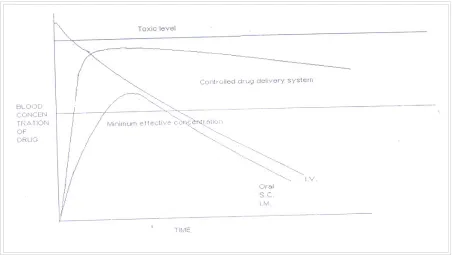
FIGURE 1 Theoretical Illustration Comparing Blood Drug Concentration profiles Of A Controlled-Release Drug Delivery System And Conventional Dosage Forms Via Various Routes Of Administration.
Figure 1 show comparative blood drug level profiles obtained from administration of conventional, controlled as well as prolonged release dosage forms. Thus, the conventional tablet or capsule provides only a single and transient burst of drug. As long as the amount of drug is above the minimum effective concentration, a pharmacological response is observed problems occur when the therapeutic range is very narrow or when the peak is greater than the upper limit of this of this range. Indeed, one of the main purposes of controlled release to improve safety and minimize side effects of the drug by reducing fluctuations in drug level.3
MERITS OF CONTROLLED DRUG DELIVERY SYSTEM4
1. The potential merit that a controlled release drug delivery system may bring to us can be appreciated by a consideration of prolonged and efficient delivery of therapeutically effective dosages, and localization of therapy.
2. The "peak and valley' pattern is more striking for drugs with biological half-life less than4hrs. Which can be over come by controlled release drug delivery system
3. It provides maximum utilization of drug enabling reduction in total amount of dose administered.
4. Improved patient convenience and compliance due to less frequent drug administration.
5. Reduction in fluctuation in steady state levels and therefore better control of disease condition and reduced intensity of local or systemic side effects.
6. Increased safety margin of high potency drugs due to better control of plasma levels.
DEMIRITS OF CONTROLLED DRUG DELIVERY SYSTEM5
1. Decreased systemic availability in comparison to immediate release conventional dosage forms; this may due to incomplete release, increased first pass metabolism, increased stability, insufficient residence time for complete release, site-specific action, pH-dependant solubility, etc.
2. Possibility of dose dumping due to food, physiologic or formulation variables or chewing or grinding of oral formulation by the patient and thus, increased risk of toxicity.
3. Retrieval of drug is difficult in case of toxicity, poisoning or hypersensitivity reaction.
4. Reduced potential for dosage adjustment of drugs normally administered in varying strengths.
1. 2 TRANSDERMAL DRUG DELIVERY SYSTEM
For many decades medication of acute disease as well as a chronic illness has been accomplished dosage forms. Like tablets, capsules, ointments, aerosol, injectables and suppositories, as carrier, recently a technical advancement have resulted in the development of new techniques of drug delivery which includes transdermal drug delivery system. Several transdermal drug delivery systems have been developed to achieve the objective of systemic medication through topical application on the skin surface 4.
The principle of transdermal drug delivery system is that they could provide controlled drug delivery (have constant drug concentration in plasma) over a prolonged period of time. It is anticipated that transdermal drug delivery system can be designed to input drugs at appropriate rates to maintain suitable plasma drug levels for therapeutic efficacy, without the periodic sojourns into plasma concentration that would accompany toxicity (or) lack of efficacy.
ADVANTAGES OF TRANSDERMAL DRUG DELIVERY SYSTEMS2
1. Avoids problems associated with gastro-intestinal absorption due to pH enzymatic activity, and drug food interactions.
2. It is a substitute for oral route.
3. Avoid the risks and inconveniences of I.V therapy. 4. Provides predictable extended duration of activity. 5. Extends the activity of drug with short half-life. 6. Multilayer therapy with single application. 7. Provides capacity to terminate.
8. Minimize inter and intra patient variation. 9. Provides suitability by self-administration.
10.Reduces daily dosing, thus improving patient compliance.
11.Enhance therapeutic efficacy, reduce side effects due to optimization of blood concentration –time profile and elimination of pure entity of drugs into systemic circulation.
LIMITATIONS OF TRANSDERMAL DRUG DELIVERY SYSTEMS8
1. Difficulty of permeation through human skin:
2. Skin Irritation:
• Skin irritation or contact dermatitis due to excipients and enhancers of the drug system used for increasing percutaneous absorption is another major limitation.
3. Clinical Need:
• It has to be examined carefully before developing a transdermal product.
1.3 TYPES OF TRANSDERMAL DRUG DELIVERY SYSTEMS
Several approaches can be effectively utilized to control the release of systematically active drugs for permeation at a programmed rate through the skin tissues. The successfully launched commercially available transdermal drug delivery systems may be classified into four types, depending on the technological approach9.
Membrane permeation controlled transdermal therapeutic system; (Drugs tried under this are: Scopolamine and Nitroglycerine).
Micro reservoir dissolution controlled transdermal system (Drug tried under this is Nitroglycerin
MICRORESERVOIR TRANSDERMAL DRUG DELIVERY SYSTEM
Figure No.2 Microreservoir Transdermal Drug Delivery System
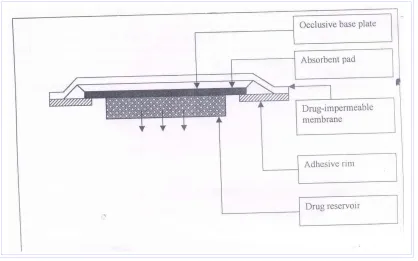
MATRIX DIFFUSION TRANSDERMAL DRUG DELIVERY SYSTEM
Here, the drug reservoir is formed by homogenously dispersing the drug solids in a hydrophilic or lipophilic polymer matrix, the medicated polymer is then molded into a medicated disc with a defined surface area and controlled thickness. This drug reservoir containing polymer disc is mounted to an occlusive base plate in a compartment fabricated from a drug impermeable plastic backing. The adhesive, in this is spread along with circumference of the patch to form an adhesive rim.
[image:17.612.82.500.363.624.2]
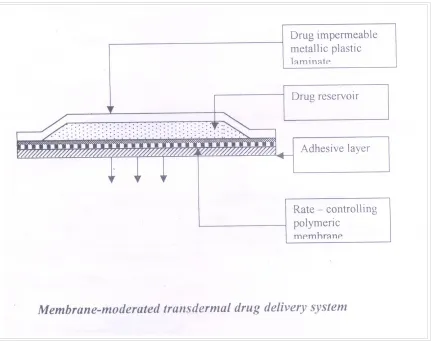
MEMBRANE MODERATED SYSTEM
[image:18.612.94.525.155.496.2]In membrane moderated systems the drug reservoir is totally encapsulated in a shallow compartment molded from a drug impermeable metallic plastic laminate and a rate controlling polymeric membrane.
Figure No.4 Membrane Moderated System
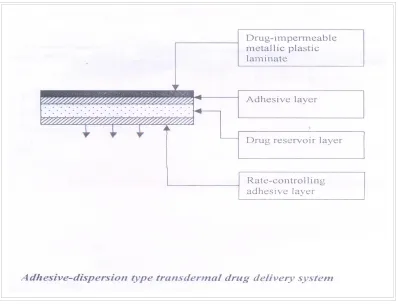
ADHESIVE DIFFUSION CONTROLLED SYSTEM:
[image:19.612.109.507.287.595.2]In this system the drug reservoir is formulated by directly dispersing the drug in an adhesive polymer on a flat sheet of drug impermeable backing to form a thin drug reservoir layer. On the top of the drug reservoir layer, layers of non-mediated rate controlling adhesive polymer of constant thickness are applied to produce an adhesive diffusion-controlled drug delivery system
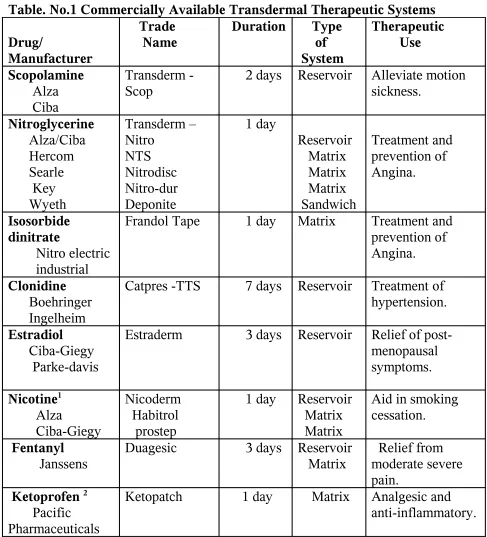
Table. No.1 Commercially Available Transdermal Therapeutic Systems Drug/ Manufacturer Trade Name
Duration Type of System Therapeutic Use Scopolamine Alza Ciba Transderm - Scop
2 days Reservoir Alleviate motion sickness. Nitroglycerine Alza/Ciba Hercom Searle Key Wyeth Transderm – Nitro NTS Nitrodisc Nitro-dur Deponite 1 day Reservoir Matrix Matrix Matrix Sandwich Treatment and prevention of Angina. Isosorbide dinitrate Nitro electric industrial
Frandol Tape 1 day Matrix Treatment and prevention of Angina.
Clonidine Boehringer Ingelheim
Catpres -TTS 7 days Reservoir Treatment of hypertension. Estradiol
Ciba-Giegy Parke-davis
Estraderm 3 days Reservoir Relief of post-menopausal symptoms. Nicotine1 Alza Ciba-Giegy Nicoderm Habitrol prostep
1 day Reservoir Matrix Matrix
Aid in smoking cessation.
Fentanyl
Janssens
Duagesic 3 days Reservoir Matrix
Relief from moderate severe pain.
Ketoprofen 2
Pacific Pharmaceuticals
Ketopatch 1 day Matrix Analgesic and anti-inflammatory.
1 The product available in India [Transderm – TTS; CIBA-GIEGY; Top nitro; FULFORD(India)].
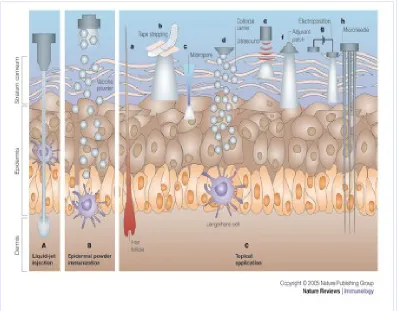
1.4 NOVEL METHODS IN TRANSDERMAL DRUG DELIVERY
Various Methods Have Been Attempted To Enhance Transport
1. Penetration enhancers 2. Iontophoresis
3. Electroporation 4. Sonophoresis
[image:21.612.104.503.326.637.2]5. Microfabricated microneedles and microchips.
PENETRATION ENCHANCERS APPROACH
An ideal enhancer should be pharmacologically, inactive, non-irritant and should not damage the skin irreversibly. The effects of an enhancer on the permeation of a drug usually depend upon the physico-chemical characteristics of the permeate as well as the enhancer molecule. The penetration of the enhancers into the stratum corneum is a basic requirement for their efficacy. It is possible to facilitate the penetration of the drug by appropriate pretreatment of the skin with penetration enhancer. The lipoprotein partitioning theory of Barry offers the most acceptable explanation for the skin with penetration enhancers and the stratum corneum. Accordingly, the main reason for enhancement includes:
Interactions with the intercellular lipids and intracellular keratin.
IONTOPHORESIS TECHNOLOGY
Iontophoresis is a process or technique involving the transport of ionic or charged molecules into a tissue by the passage of direct or periodic electric current through an electrolyte solution containing the ionic molecules to be delivered using an appropriate electrode polarity. The process involves the transfer of ions into the body by an electromotive force. Ions with positive charge are driven into the skin at the anode and those with the negative charge at the cathode. In the conventional topical treatment by iontophoresis, the drug is administrated through an electrode having the same charge as the drug and a return electrode opposite in charge to the drug is placed at a neutral site on the body surface. The operator then selects a current intensity below the pain threshold level of the patient and allows the current to flow for an appropriate period of time.
Iontophoresis was found to be widely used in several clinical situations; Iontophoretic delivery of ionizable drugs like, propranolol across excised human skin from rabbit, pig and humans has been reported. Iontophoretic delivery of a weakly basic analgesic, oxycodone across the excised skin from human and several animals was investigated using pulse current delivered from a newly developed transdermal iontotherapeutic system66 .
ELECTROPORATION TECHNOLOGY
Electroporation or electropermeabilization involves changes in membrane of cell due to application of transmembrane voltages. The change in the membrane involves; structural rearrangement and conductance leading to temporary loss of semipermeability of cell membranes. Suggesting formation of pores. The pulses are normally used on the unilamellar phospholipids bilayers of cell membranes. Approximately 100 multilammeller bilayer of the stratum corneum need about 100V pulses for electroporation or 1V per bilayer. Electroporation of skin takes place at high transdermal voltage (100V or more). There is considerable indirect evidence that high voltage pulses cause changes in the skin structure.
Besides, the modes compounds calcein, other drugs investigated for transdermal delivery by electroporation includes; metaprolol flurbiprofen, cyclosporine, heparin, fenanyl and oligonucleotides67.
SONOPHORESIS TECHNOLOGY68
Ultra sound has been used to treat a wide range of clinical condition and to transport drugs to deeper tissues. The movement of drugs through living perturbation is called Sonophoresis. Ultra sound was applied with a sonicator (VCX-400 sonics and materials) operating at a frequency of 20 KHz. The sonicator were operated in the duty-cycle; that is pulsed mode (0.1s on and 0.9s off or 1s on and 9s off or 5s on and 5s off).
Ultra sound may enhance transdermal drug delivery systems by affecting the skin structure (through which enhanced diffusion may occur), by inducing concection or by a combination of both effects. Because, skin conductivity is an excellent indicator of the skin barrier properties.
The ultra sound application has resulted in modest permeation of simple molecular. It was reported that, low frequency ultrasound could be used to deliver insulin across rabbit skin in vivo, resulting in increased plasma hormone levels and lowering of blood glucose.
Another method is aluminium foil measurement. In an attempt to quantify the potential of the sonicator to induce transient cavitations in aluminium foil paper. It was mounted onto the diffusion cell in a manner identical to that of the skin sonication was performed for 20s [0.1 on and0.9s off] and then aluminium foil was remove from the cell. The number of pits on the foil was determined by visual inspection. The pits represent physical evidence of the effects of cavitations bubble formation induced by ultrasound.
MICROFABRICATED MICRONEEDLES AND MICROCHIPS TECHNOLOGY18
The microprocessor and pump automatically inject the right dosage of the drug. The micro needles have extremely sharp tips with radius of curvature less than 1mm facilitating easy piercing into the skin.
1.5 SKIN AS A SITE FOR TRANSDERMAL DRUG DELIVERY SYSTEMS
STRUCTURE OF THE SKIN
The skin consists of different tissues that are joined to perform specific functions. The thickness of the skin cover most of the body is 1-2 mm thick.
Structurally the skin consists of two principal parts. The superficial, thinner portion which is composed of epithelial tissue is the epidermis. The deeper, thicker, connective tissue part is the dermis. Deep to the hypodermis and not part of the skin is the subcutaneous layer. The hypodermis layer consists of areolar and adipose tissues. The sub cutaneous layer serves as a storage depot for fat and contains large blood vessels that supply the skin. This region also contains nerve endings called lamellated corpuses that are sensitive to pressure.
Epidermis
The epidermis is keratinized stratified squamous epithelium. It
contains four principal types of cells, keratinocytes, melanocytes, langerhans cells and merkel-cells. About 90% of epidermal cells are keratinocytes
Epidermis consists of following layers: o Stratum basale,
[image:28.612.80.530.138.665.2]o Stratum spinosum, o Stratum granulosum, o Stratum lucidum, o Stratum Corneum.
Stratum Basale:
The deepest layer of the epidermis is the stratum basale, composed of a single row of cubical or columnar keratinocytes.
Superficial to the stratum basale is the stratum spinosum where 8-10 layers of polyhedral keratinocytes fit closely together.
Stratum Granulosum:
At the middle of the epidermis the stratum granulosum consists of three to five layers of flattened keratinocytes that are undergoing apoptosis. Stratum corneum:
The stratum corneum consists of 25-30 layers of dead,flat keratinocytes. The interior of the cells contains mostly densely packed intermediate filaments and keratohyalien. Between the cells are lipids from lamellar granules that help to make this layer water-repellent. These cells are continuously shed and replaced by cells from the deeper strata. The stratum corneum serves as an effective water-repellent barrier and also protects against injury and microbes. Constant exposure of skin to friction stimulates the formation of a callus an abnormal thickening of the epidermis21.
ROUTES OF PENETRATION
features arriving at a general conclusion27
Sebum and surface material
The layer of sebum mixed with sweat, bacteria, and dead cells is this (0.4 – 10 µm), irregular, and discontinuous: it hardly affects percutaneous absorption.
Skin appendages
Their fractional area available for absorption is small (about 0.1%) and this route usually cannot contribute appreciably to the steady state flux. However, the route may be important for ions and large polar molecules which cross-intact stratum corneum with difficulty. Diseases, which disturb the horny layer, such as eczema and exfoliate dermatitis, allow easy access. Skin appendages may act as shunts, important at short times prior to steady state diffusion, e.g. in bioassays which use pharmacological reactions. Thus minute concentrations of nicotinates or corticosteroids penetration rapidly down the shunt route may trigger erythema or blanching.
Epidermal route
penetrant is very lipophililc, it crosses the horny layer to meet an aqueous phase in which it is poorly soluble. The chemical potential immediately below the barrier may then become high, approaching that in the barrier. The potential gradient (stratum corneum to viable tissue) falls, together with the flux. The rate-determining step in percutaneous absorption the becomes barrier clearance not barrier penetration.
Within the stratum corneum, molecules penetrate either intercellular or transcellularly. Electron micrographs of intercellular material suggest a segregation of lipid between protein filaments. In hydrated tissues, these lipid and polar regions would provide parallel pathways for diffusion. Molecules would portion into and diffuse through, either network according to their polarities. The intercellular route is rich in neutral lipid and this pathway may be more important in percutaneous absorption than previously thought.
Topically applied agents such as steroids, hexachlorophane, griseofulvin, sodium fusidate and fusidic acid may form a depot or reservoir by binding within the stratum corneum.
MECHANISM OF SKIN PERMEATION
A systematically active drug that will reach a target tissue from the site of drug administration of the skin surface must posses some physicochemical properties that are capable of facilitating the absorption of drug through the stratum corneum the penetration of drug through viable epidermis and also uptake of the drug by capillary network in the dermal papillary layer. The sequence of transdermal permeation of drug is shown. The rate of the permeation, dq/dt across the skin tissues can be expressed mathematically by the following relationship.
dq/dt = Ps[Cd-Cr]. Where
Cd and Cr, respectively the concentration of a skin penetrant in the donor compartment (e.g. Body),
Ps is the overall permeability coefficient of the skin.
Ps = Ks Dss/hs. (1) Where
Ks is the partition-coefficient for the interfacial partitioning of a penetrant molecule from the solution of medium or a transdermal drug delivery system on to a stratum corneum;
penetrant molecule through a thickness of skin tissues.3
Analysis of (eq-1) suggests that to achieve a constant rate of drug permeation one needs to maintain the drug concentration on the surface of stratum corneum (Cd) consistency and substantially greater than the drug concentration in the body (Cr),
i.e.., Cd>Cr;
Under such a condition eq.1 can be reduced to dq/dt = PsCd
The rate of skin permeation dq/dt becomes a constant, if the magnitude of Cd remains fairly constant throughout the course of skin permeation to maintain Cd at a rate (Rd) that is either constant or always greater than the rate of skin update (Ra), i.e. Rd> Ra. By making Rd greater than Ra the drug concentration on the skin surface (Cd) is maintained at a level equal to or greater than the equilibrium (or saturation) solubility of the drug in the stratum corneum (Cse).ie., Cd.C>Cse and a maximum rate of skin permeation
(dq/dt)m = PsCse
Recent studies indicate the importance of appending in percutaneous absorption. The appendages route may be more significant for ions and large polar molecules, which slowly permeates across the bulk of the intact horny layer. The two potential micro pathways serve the stratum corneum through the transcellular and intercellular route.
The principal pathway taken by the penetrant is decided mainly by diffusant’s partition coefficient . Most of the diffusant’s permeate by both the routes. The intercellular pathway is considered to provide the principal route and the major barrier to the permeation of the drugs.
1.6 FACTORS AFFECTING TRANSDERMAL PERMEABILITY Physiological and pathological conditions of the skin .28
1. Skin condition:
2. Skin hydration:
• Hydration results from water diffusing from underlying epidermal layers or from perspiration accumulation after application of an occlusive vehicle or covering on the surface.
• Under occlusive conditions densely and closely packed cells of the skin are opened up and increase its porosity. Occlusion also reduces the “irreversible” binding capacity of stratum corneum. When the skin undergoes hydration, its resistance and capacitance may change. As the time of hydration increases the low frequency impedance of the excised skin decreases with time. A much less activation energy is required to diffuse through hydrated skin.
3. Skin Age:
• Fetal and infant skin appears more permeable than adult skin. The stratum corneum of preterm infants is not well developed and as such provides little barrier to the ingress of substances. So this route of delivery is possible for neonatal therapy, when difficulty is encountered in oral or
• Due to increased blood flow, a concentration gradient is established which will promote drug absorption.
5. Skin Temperature:
• Raising skin temperature results in an increase in the rate of skin permeation. This may be due to thermal energy required differently solubility of drug in skin tissues. Increased vasodilatation of skin vessels.
6.Regional skin sites:
Difference in the nature and thickness of the barrier layer of the skin causes variation in permeability.
7. Cutaneous drug metabolism:
Catabolic enzymes present in the viable epidermis may render a drug inactive by metabolism and thus affect the topical bioavailability of the drug.
8.Species variation:
Physicochemical properties of the penetrant molecules29.
I. Partition coefficient: A lipid/water partition coefficient of 1 or greater is generally required for optimal transdermal permeability. The partition coefficient of a drug molecule may be altered by chemical modification of its functional groups. Membrane partition coefficient increases exponentially as the length of the lipophillic alkyl chain increases.
II. pH conditions : Application of solutions whose pH values are very high or very low can be destructive to the skin. With moderate pH values, the flux of ionizable drugs can be affected by changes in pH that alter the ratio of charged to uncharged species and their transdermal permeability.
III. Drug concentration: The amount of drug percutaneously absorbed per unit surface area over time interval increase as the concentration of the drug in the vehicle is increased.
Physicochemical properties of drug delivery systems30.
I. Vehicle: Vehicles serve as drug carriers. Lipophillic solvents facilitate penetration. The absorption of water-soluble and lipid soluble substances from terpene and terpene derivatives was better than from alcoholic solutions. Solubility of drug in the vehicle determines the rate.
II. Composition of drug delivery systems: It affects not only the rate of drug release but also the permeability of stratum corneum by means of hydration mixing with skin lipids or other sorption promoting effects.
III. Enhancement of transdermal permeation: Transdermal permeation can be increased by including some penetrates, sorption promoters etc. Organic solvents like Dimethyl acetamide, dimethyl formamide, dimethyl sulfoxide, ethylene glycol, propylene glycol and polyethylene glycol.
1.7 POLYMERS OF TRANSDERMAL DELIVERY SYSTEM POLYMERS:
The polymer controls the release of the drug from the devices. The following criteria should be satisfied for a polymer to be used in a transdermal system..31
1. Drug solubility and diffusivity in the polymer.
2. The desired drug loading and its effect on polymer integrity.
3. Compatibility of the polymer with necessary excepients, such as solvents and skin permeation enhancer of the drug.
4. Skin compatibility: The effect of moisture occluded under the polymer formulation.
5. Mechanical properties: Softness, Flexibility Compatibility to skin and mechanical integrity.
6. Ease of fabrication.
7. Toxicity and purity i.e., compliance with safety requirements of the FDA.
8. Cost and availability.
employed to modify the polymer properties and thus drug release rates. Cross-linked polymers :
The higher the degree of cross-linking the more dense the polymer and slower the diffusion of drug molecule through the matrix cross-linking may be achieved chemically using cross-linking agent or by irradiation. This approached has been applied to the preparation of the Nitrodisc system.
Polymer blend:
The blended polymer combines the advantages of individual polymers. The potential advantages include easy fabrication of devices manipulation of drug loading and other device properties such as hydration, degradation and mechanical strength.
Plasticizers:
COMMONLY USED POLYMERS IN TRANSDERMAL FILM Poly-isobutylene
Poly-isobutylene (PIB) is a highly paraffinic, non-polar and amorphous hydrocarbon polymer composed of essentially straight chain macromolecules. Physical properties of PIB change gradually with increasing molecular weight, the lowest molecular weight polymers being viscous liquids. With increase in molecular weight the liquids are become more viscous, then change to balsam like sticky masses and finally form electrometric solids PIB is soluble in hydrocarbon solvents and insoluble in polar solvents, PIB exhibits excellent low-transition temperature flexibility and oxidative stability.
Polyvinylpyrolidone/Polyvinyl alcohol
Polyvinylpyrolidone (PVP) is a white, odorless and hygroscopic powder. It is available in different viscosity grades, identified by K value. It is soluble in water and in many organic solvents. Polyvinyl alcohol (PVA) is a cream coloured granular powder and is prepared from Polyvinyl acetates. PVA is available in different grades and the viscosity is directly proportional to its molecular weight. Both PVA&PVP are non-toxic to skin and incompatible with inorganic salts.
Ethylene vinyl acetate (EVA) copolymers
stable, non-toxic and biocompatible.
Vinyl chloride polymers and copolymers
Vinyl chloride, polymers and copolymers useful for drug/polymers matrix preparation include homopolymers vinyl chloride. CH2 = CH-Cl2 and copolymers having a high vinyl chloride content. PVC needs plasticization in order to form a soft and flexible film suitable for transdermal patch formulation. The commonly used plasticizers are dioctyl phthalate, epoxidized Soya bean oil and Citric acid esters.
Cellulose derivatives
Many cellulose derivatives are employed for transdermal drug delivery like ethyl cellulose, methylcellulose, cellulose acetate phthalate, cellulose acetate butyrate, hydroxyl propyl methyl cellulose, carboxyl methyl cellulose sodium they are mostly used in the combination with hydrophilic polymers like PVP, PEG etc.,.
1.8 SELECTION OF DRUG CANDIDATES FOR TRANSDERMAL DELIVERY
Physico-chemical properties of the drug:
1. The drug should have a molecular weight of less than 500 Daltons
2. The drug should possess balanced lipophilic, hydrophilic characteristics and also has reasonable solubility in both lipid and aqueous phases. The logP value should be in the range 1-3
3. The melting point should be less than 200 0 C
4. Saturated aqueous solutions of the drug should have pH value between 5 and 9.
5. Hydrogen bonding groups should be less than or equal to 2. Biological properties of drug
1. The biological half-life (t 1/2) should be less than 5-6 hours.
2. The drug should be potent with a daily systemic dose of less than 20mg.
2. Literature Review
• J.Y.Park et. al.,71 Studied comparative pharmacokinetic and
pharmacodynamic characteristics of amlodipine besylate and amlodiple nicotinate in healthy subject and the results shows mean ratio for AUC0-α and Cmax fell within the predetermined equivalent
range of 80-125% pharmacodynamics profiles including systolic and diastolic blood pressures and pulses rates exhibited no significant differences between the two formulations
• Paul W.Stott. et al.,72 Done mechanistic study into the enhanced
transdermal permeation of a model β-blocker, propranolol, by fatty acid: a melting point depression effect and found that the binary mixture of propranolol and fatty acid, the addition compounds are formed by interaction between the carbonyl group of the β-blocker, to form a salt. The oppositely charged species of the salt have been shown to permeate the human epidermal membrane by an ion – pair mechanism. This is in agreement with the work by Green and Hadgraft (1987) which suggested the formation of ion-pairs between propranolol and fatty acids. Where the process was driven by a pH gradient.
• D. Monti et.al.,73Conducted study on the comparison of the effect of
low-frequency US on skin permeation in vitro. The comparison of US and chemical enhancement indicates a slight superiority of the combination oleyl alcohol (OA) / propylene glycol (PG) over low – frequency US. Concerning morphine (MOR), significantly increased transdermal fluxes were produced by both low frequency US and by OA in combination with PG.
• Rajagopal K. et. al.,74 Formulate and evaluate a matrix type
transdermal patches of nimesulide by using different polymers alone or in combination, dibutyl phthalate as the plasticizer and aluminum foils as the backing membrane. The studies showed that (2.2) hydroxyl propyl methyl cellulose (HPMC) and ethyl cellulose (EC) combination may be the suitable polymer combination for the development of transdermal drug delivery system of nimesulide
• Jawahar N. et.al.,10 Prepare and evaluate verapamil hydrochloride
transdermal films and study the effect of different formulation variables. The drug diffusion through the films followed a pattern close to zero order type. The drug release profile was decreased with increased polymer concentration and film thickness.
• L.M.A. Nolan et.al.,75 Studies Iontophoretic and chemical
less efficient in the presence by buffer lons but with the iontophoretic delivery rates being enhanced by the presence of a fatty acid.
• M.B.Blanco.et.al.,76 Transdermal application of bupivacaine – loaded
poly (acrylamide (A)- CO- monomethyl itaconate ) hydrogels found the skin flux of the drug was between 90 ± 5 and 16 ± 7 mcg/ cm2 /h depending on the amount of bupivacaine included in the gel and the gel composition. Skin flux increases with the drug load of the gels. Furthermore as more MMI in the gel slower skin flux of the drug due to bupivacaine gel interactions.
• A.Nokhodchi. et. al.,77 Studies the enhancement effect of surfactants
on the penetration of lorazepam through rat skin. And concluded that the increase in flux at low enhancer concentrations is normally attributed to the ability of the surfactant molecules to penetrate the skin and increase its permeatility. Reduction in the rate of transport of the drug present in enhancer system beyond 1% w/w is attributed to the ability of the surfactant molecules to form micelles and us normally observed only if interaction between micelle & the drug occurs.
• Xiaohong Qi et.. al., 78 Studies convolution method to predict drug
predict in vivo drug absorption profiles following transdermal application.
• P.Rama Rao. et.al., 79 Provide comparative in-vivo evaluation of
propranolol hydrochloride after oral and transdermal administration in rabbits. The PK parameters such as maximum plasma concentration (Cmax), tmax, MRT Mean residence time) and AUC0-α were
significantly (P< 0.01) different following transdermal administration compared to oral administration. The t1/2 of transdermally delivered PPN was found to be similar to that following oral administration. But sustained activity was observed over a period of 24hrs after transdermal administration compared to oral. The relative bioavailability of PPN was increased about fivefold to six fold after transdermal compare to oral.
• Sandip B. Tiwari. et.al., 80 Done investigation into the potential of
• Michal A.Ashburn. et.al., 81 Work on pharmacokinetics of
transdermal Fentanyl delivered with and without controlled heat and there results suggest controlled heat might be used to significantly shorten the time needed to reach clinically important fentanyl concentrations, controlled heat might be useful to produce rapid increase in serum concentrations for the rapid treatment of breakthrough pain.
• Jagdish singh.et.al.,82 Done work on electronically facilitated
transdermal delivery of human parathyroid hormone (1-34) using porcine skin. The flux of hPTH (1-34) with the electroporation pulses of 100 and 300V followed by lontophoresis at 0.2mA/cm2 was 10 – and 5 –fold higher respectively, in comparison to the flux with corresponding pulses alone.
• Franziska Grafe,et.al.,83 Work on carrier mediated transport of
clonidine in human kerationocytes to characterize transport of clonidine into human keratinocytes to characterize transport of clonidine into human keratinocytes and conclude that clonidine us transported into keratinocytes in a pH – dependent manner by a saturable uptake system different from the keratinocyte choline transporter
• P.N.Kotiyan. et.al.,84 Studies electron bean irradiation; a novel
acid (AA) and solution irradiated on a backing membrane at different doses to get transdermal patches. The ISDN-EHA-AA system developed at an irradiation dose of 50KGY showed a higher skin permeation profile as compared to an internationally marketed transdermal matrix system of ISDN.
• Elvira Escribans. et. al., 85 Done assessment of diclofenaec
permeation with different formulation using human skin(0.4mm thick)from plastic surgery as a membrane. The results suggest that topical delivery of sodium diclofenac with an absorption enhancer such as a mixture of oleic acid and d-limonene may be an effective medication for both dermal and subdermal Injuries
• Jorg kreuter et.al.,86 Carry studies on crystallization of estradiol
containing TDDS determined by isothermal microcalorimetry X-ray diffraction and optical microscopy as it is still a problem to achieve a stable and prolonged constant drug release, to attain high permeation rates across the skin, the concentrations of the drug dissolved have to be high and often create supersaturated, thermodynamically metastable or unstable systems that possess a high tendency to crystallise.
• M.Jayne Lawrence et.al., 87Done work on formulation of electrically
(regardless of oil used). Which is due to inadequate level of water available for by hydration of the surfactant head group.
• Akirayamanoto et.al.,88 Enhanced transdermal delivery of
phenylalanyl-glycine by chemical modification with various fatty acids shows the results that the stability and permeability of Phe-Gly were improved by chemical modification with improved by chemical modification with fatty acids and this enchanced permeability of Phe-Gly by the acylation may be attributed to the protection of Phe –Phe-Gly from the enzymatic degradation in the skin and the increase in the partition of Phe-Gly to the stratum corneum.
• K.C. sung, et.al., 89assess the effect of electro oration on transdermal
permeation of nalbuphine (NA) and its prodrug. Study demonstrated that electroporation enhance and control transdermal permeation of NA and its prodrugs. The results also indicated that the physicochemical properties of prodrug has significant effects on kinetics as well as mechanisms of transdermal permeation by electroporation.
• Ramesh panchagnula et.al.,90 work on transdermal delivery of
3. Aim and Objective
Objective of this study
Cardiovascular drugs have relatively low therapeutic indices, which place responsibility on the dosage forms for maintaining the drug blood level within narrow limit .Conventional dosage forms suffer from variations in the absorption and thus leading to wide fluctuation in the plasma drug concentration.
Amlodipine Besylate, is an antihypertensive drug, having calcium channel blocking activity is therapeutically active even at very low doses. E.g.: 5-10mg/day which is one of the essential requirements of a drug candidate for use in transdermal delivery systems.
It also has other suitable properties which include. 1. Low molecular weight.
2. High lipid solubility
3. Extensive first pass metabolism etc.
Transdermal film prepared by various polymers can exhibit good controlled release properties. So, an attempt is done to formulate transdermal film containing Amlodipine Besylate for achieving following goals.
4. Plan of Work
1. Identification of drug by spectrophotometric method (IR and UV).
2. Determination of the, partition coefficient and melting point of Amlodipine.
3. Determination of the drug polymer interaction study between the drug (Amlodipine Besylate) and the polymer (HPMC) through differential Scanning calorimetry (DSC)
4. Study on the extent of in vitro permeation of Amlodipine from Transdermal device in the presence of penetration enhancers.
5. Study on the in vivo release pattern using rabbit.
6. To study the skin irritation of transdermal film using rabbit.
5. DRUG PROFILE OF AMILODIPINE BESYLATE 5.1 DRUG PROFILE
Drug Name - Amlodipine besylate
Classification - calcium channel blocker
Synonym - Amlodipine besylate
Chemical structure
Chemical Name - 3-Ethyl 5– Methyl (4R, S) -2- [(2-Amino Ethoxy) Methyl), 4-(2-Chlorophenyl)–6-Methyl–1,4–dihydropyridine–3,5
dicarboxylate benzene Sulphonate Molecular weight - 567.1
-Description
Colour - white crystalline powder
Partition coefficient(log P) -3.00
Dissociation Constant
(PKa) at 25 0C - 8.6
Odour - odourless
Solubility - slightly soluble in water
- Sparingly soluble in ethanol - Freely soluble in methanol
Melting point - 178 -179 0 C
Optical rotation - Racemic mixture
CLINICAL PHARMACOLOGY 12, 16
Amlodipine Besylate is a Dihydro pyridine derivative which is the most potent Ca2+ Channel Blockers. Bind to specific sites on the alpha1 subunit, all restricting Ca2+ entry
cAMP – phospho diesterase resulting in raised smooth muscle cAMP showing smooth muscle relaxant action.
Released endothelial nitrous oxide may exert anti atherosclerotic action.
Amlodipine produces vasodilatation resulting in a reduction of supine and standing blood pressure. Amlodipine does not change sinoatrial (SA) nodal function or atrioventricular (AV) conduction in intact animals or humans. The decrease in blood pressure is not accompanied by a significant change in heart rate or plasma catecholamine levels with chronic dosing. Vasodilatations also increase the oxygen available to the heart in patients with coronary artery spasm and blunt coronary vaso constriction.
PHARMACOKINETICS: Absorption/ Distribution:
Amlodipine is almost completely well absorbed following oral administration with no effect of food. Bioavailability range is 45 -60% Due to a significant degree of first pass metabolism. Following oral administration, . Time to peak plasma levels occur after 6 -12 hours.
Amlodipine, plasma protein binding is 97.5 % having volume of distribution around 20 L\ Kg. Time to steady state is 7 To 8 days. A normal serum level of Amlodipine may fall in the range 3-11 ng/ml. Amlodipine Crosses the Blood Brain Barrier, Placenta & is excreted in Breast Milk. Metabolism/ Excretion:
Dosage
Adults: 5 – 10mg once a day
Elderly patient should start with 2-5mg one day & the dose built up as required.
Therapeutic uses:
Amlodipine is used in the treatment for:
Stable and Prinzmetals angina,
Heart failure,
Hypertension. 5.2 Excipients profiles
Hydroxyl propyl methyl cellulose
Non-proprietary Name Hypromellose
Hydroxyl propyl methylcellulose Functional category Suspending agent
Coating agents Tablet binder Film former
Synonyms Methyl hydroxyl propyl cellulose Propylene glycol, ether cellulose Hydroxyl propyl methyl cellulose
ether.
Typical properties
Density 0.341 gm/cm3
Solubility Soluble in cold water forming viscous colloidal solution. Insoluble in alcohol, ether and
chloroform.
Grade HPMC K 100 M
HPMC K 4 M HPMC K 15M HPMC k100 LVP
Viscosity HPMC K 100 M - 8000 to 120 000 m pas HPMC K 4 M - 3000 to 5600 m pas
Application of HPMC in Pharmaceutical Formulation
6.MATERIALS AND METHODS 6.1 Equipments
UV- Visible spectro photometer Shimadzu – 1700 model.
Open tubular cell Magnetic stirrer PH meter
Differential scanning calorimeter : Perkin Elmer, DSC-7 Fourier Transform Infrared : Perkin Elmer. .
6.2 List of reagents
0.1 N Hydrochloric acid
8.5 ml of Concentrated Hydrochloric acid is dissolved in 1000 ml of distilled water.
6.3 Materials
Amlodipine Besylate BP- Standard drug Supplied by Orchid Pharmaceuticals Ltd, Chennai.
Methanol – (Analytical grade) supplied by Allied chemicals corporation, Vadodara.
Dimethyl sulphoxides (DMSO)
supplied by Suvidhinath Laboratories, Baroda.
6.4 Methods
Preformulation Studies
1. IR Determination
IR determination was carried out by Perkin Elmer Infra-Red Spectrophotometer using KBr Pellet technique 69,70
2. Melting point determination
Melting point of pure Amlodipine Besylate was carried out by open capillary tube method.
3. Differential scanning calorimetry DSC, 64 70
(s), appearance of new peaks (s), change in peak shape and its onset, peak temperature / melting point and relative peak area or enthalpy.
Method
The DSC analysis of each sample under the analogues conditions of temperature range ( 50 – 550C), heating rate (200 min-1), chart speed 1cm-1 under nitrogen atmosphere, with alumina as reference material, were carried out by using Perkin - Elmer DSC -7 analyser.
4. Determination of partition efficient (P) 51,57
Partition coefficient is the ratio of concentration of drug in n-octanol to the concentration of drug in water. The concentration determined by using UV-spectrophotometer.
The intrinsic partition coefficient (P1) may be more appropriate parameter to measure the partition coefficient of the non-ionized compound. So, P1 was calculated using formula.
P1 = P [antilog [Pk – PH] +1 6.5 Standard Curve for Amlodipine61
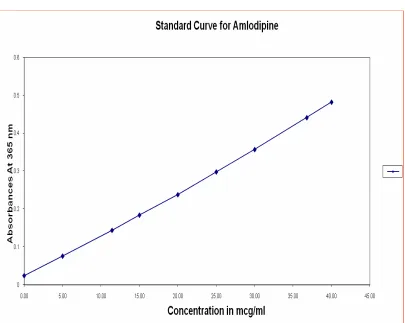
Standard curve of Amlodipine were drawn in 0.1NHCl using UV- Visible spectrophotometer.
Procedure for the Preparation of Standard
Table No.2 Standard Curve for Amlodipine
Concentration (mcg/ml) Absorbance (365nm)
5 0.076
10 0.150
15 0.179
20 0.258
25 0.289
30 0.353
35 0.425
40 0.468
r-0.9968 a-0.0244 b-0.0111
6.6 procedure for fabrication of transdermal film
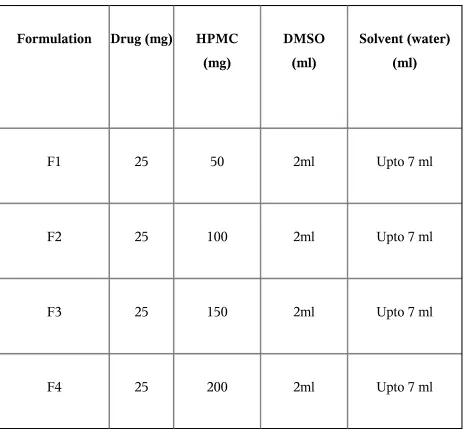
Table No.3 Formula for TDDS
Formulation Drug (mg) HPMC (mg)
DMSO (ml)
Solvent (water) (ml)
F1 25 50 2ml Upto 7 ml
F2 25 100 2ml Upto 7 ml
F3 25 150 2ml Upto 7 ml
6.7 EVALUATION OF TRANSDERMAL DRUG DELIVERY SYSTEM
Permeation Studies 10,49
The in vitro permeation studies were carried out using Dialysis membrane. The membrane was prepared using following procedure. The membrane is cut into appropriate size & socked in liquid glycerol for 24 hours for permeable characteristics.
The permeation study was conducted using open tubular cell in the static mode with an effective diffusion area 2.8cm2. The capacity of receptor compartment was 200ml and temperature was maintained at 370c+1 by means of temperature controller of magnetic stirrers. Drug concentration in donor compartment was 7.473mg/ml Receptor solution was 0.1mHCl which was continuously stirred at 100 rpm with a Teflon – coated bar movement placed inside the cell.
In vitro diffusion study10,62
The in vitro release profile of Amlodipine from a transdermal device was determined. An open tubular cell was used for the diffusion studies. The dialysis membrane was mounted between donor and receptor compartment of diffusion. The receptor compartment of the diffusion cell was filled with 0.1NHCl. The prepared matrix patch was placed over the membrane. The temperate of the receptor compartment was maintained at 37±10C. The receptor solution was stirred with Teflon coated magnet stirrer through out the experiment. Aliquots of receptor fluid were withdrawn at predetermined time intervals and replaced immediately with same volume of the fresh fluid, the samples were analyzed at 365 nm using spectrophotometrically.
In vivo release studies65
Skin irritation test
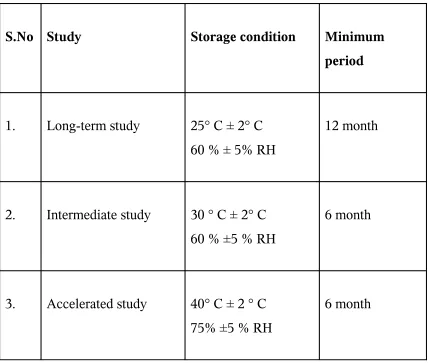
6.8 ACCELERATED STABILITY STUDIES 90
Stability
Stability is officially defined as the time lapse during which the drug product retains the same properties and characteristics that is possessed at the time of manufacture. This process begins at early devolvement phase.
Instability in modern formulation is often detectable only after considerable storage period under normal condition. To assess the stability of a formulated product its usual to expose it to high stress conditions to enhance its detoriation and therefore the time required for testing is reduce
common high stress like temperature and humidity. This will eliminate unsatisfactory formulation.
Strategy of stability testing
1. The study of drug decomposition kinetics 2. The development of stability dosage form.
3. Establishment of expiration date for commercially available drug product is some of the needs of stability testing.
4. Data form stability studies should be provided on atleast three primary batches of the drug product.
5. The batches should be manufactured to a minimum of pilot scale. 6. Important point of view of the safety of the patient, patient relieves a
Table No.4The Stability Storage condition
S.No Study Storage condition Minimum
period
1. Long-term study 25° C ± 2° C 60 % ± 5% RH
12 month
2. Intermediate study 30 ° C ± 2° C 60 % ±5 % RH
6 month
3. Accelerated study 40° C ± 2 ° C 75% ±5 % RH
6 month
ICH (International Conference on Harmonization) Guidelines Specification
1. 5% potency loss from initial assay of batch
2. Any specification degradation that exceed specification 3. Product failing out of pH limit
4. Dissolution out of specification for 12 minutes
Any one condition is observed then the stability of the batch is failed.
Procedure
7. Results and Discussion
Preformulation Studies
Drug Identification
[image:71.612.145.466.385.502.2]Method - Spectrophotometer method (UV)
Table No.5 UV- Absorbance of Amlodipine Besylate in 0.1 N HCl
S. No
Concentration in mcg/ml
Absorbance at 365nm
1 25 mcg/ml 0.281
Discussion
Infra-Red Spectrum
Table No.6 IR Spectrum of Amlodipine Besylate
S.No Frequency cm-1 Functional Group
1 3411 NH Stretching
2 2813 CH-aliphatic
3 1672 C=0 ester
4 561 C - C1 (C1 vibration)
5 1120 - C- 0 - ester
6 1382 – C - CH3
7 1593 - C = C - aromatic
8 756 Mono substituted aromatic
9 1208 C - 0 Stretching
10 1204 Phenolic Stretching
Discussion
Compatibility Studies
DSC Graph for Amlodipine Besylate Patch
Discussion
Figure No.10. DSC Graph for HPMC
In vitro Drug Release Profile
[image:79.612.100.523.191.458.2]Diffusion profile for Amlodipine Besylate in 0.1 N HCl Table No. 7 In vitro release profile F2 Formulation
S.No Time in hrs Absorbance in nm
Concentration in mcg/ml
Amount in mg
% Drug release
01 0 0 0 0 0
02 0.25 0.035 0.954 0.191 2.55
03 0.50 0.046 1.946 0.389 5.20
04 1.00 0.065 3.658 0.732 9.79
05 1.50 0.091 6.055 1.210 16.17
06 2.00 0.121 8.703 1.740 23.28
07 3.00 0.135 9.963 1.992 26.5
08 4.00 0.146 10.954 2.190 29.30
09 6.00 0.157 11.945 2.389 31.96
10 8.00 0.170 13.117 2.623 35.09
11 12.00 0.194 15.279 3.055 40.81
12 16.00 0.220 17.621 3.524 47.10
13 24.00 0.265 21.675 4.335 57.94
In vitro Drug Release
0 10 20 30 40 50 60 70
0 5 10 15 20 25 30
Time in hours
%
D
ru
g
R
e
la
s
e
Table No.8 In Vitro Release Profile F3 Formulation
S.No Time in hrs Absorbance in nm Concentration in mcg/ml Amount in mg % Drug release
01 0 - - -
-02 0.25 0.008 - -
-03 0.50 0.017 - -
-04 1.00 0.025 0.054 0.010 0.13
05 1.50 0.034 0.872 0.174 2.32
06 2.00 0.041 1.495 0.299 4.00
07 3.00 0.062 3.387 0.677 9.05
08 4.00 0.078 43828 0.965 12.91
09 6.00 0.095 6.360 1.272 17.02
10 8.00 0.118 8.432 1.686 22.56
11 12.00 0.147 11.045 2.209 29.55
12 16.00 0.179 13.927 2.785 37.26
[image:81.612.96.520.173.765.2]13 24.00 0.210 16.720 3.344 44.74
Figure No.13 In vitro Drug Release Profile for F3 Formulation In vitro Drug Release
Table No. 9 In Vitro Release Profile F4 Formulation
S.No Time in hrs Absorbance in nm Concentration in mcg/ml Amount in mg % Drug release
01 0 - - -
-02 0.25 0.008 - -
-03 0.50 0.012 - -
-04 1.00 0.024 - -
-05 1.50 0.030 0.504 0.100 1.33
06 2.00 0.041 1.495 0.288 4.00
07 3.00 0.055 2.756 0.551 7.37
08 4.00 0.069 4.018 0.803 10.74
09 6.00 0.080 5.009 1.001 13.39
10 8.00 0.097 6.540 1.308 17.50
11 12.00 0.120 8.612 1.722 23.04
12 16.00 0.154 11.675 2.335 31.24
13 24.00 0.171 13.207 2.641 35.34
Figure No.14 In vitro Drug Release Profile for F4 Formulation
In vitro Drug Release
[image:82.612.153.470.546.784.2]Figure No.15 Comparative In vitro Drug Release Profile
In vitro Drug Release Profile
0 10 20 30 40 50 60 70
0 5 10 15 20 25 30
Time in hours
%
D
ru
g
R
el
ea
se
In vivo Drug Release Profile
Table No.10 In Vivo Release Profile Control Formulation
∑ AUC = 2183.92
∑ AUMC = 53481.1849 Tim
e in hrs (t)
Absorban ce in nm
Plasma drug
concentrati on µg / ml
Amou nt of drug in mg % Drug releas e
C T [AUC]t 0
µghr/ml
[AUMC]t 0
µghr2/ml
0 0 - - - - 1.995 0.9976
0.50 0.113 7.981 0.798 7.98 3.990 6.918 5.9208
1.00 0.243 19.693 1.969 19.69 19.693 24.513 39.1765 2.00 0.350 29.333 2.933 29.33 58.666 65.062 201.582 4.00 0.421 35.729 3.572 35.72 142.916 76.143 385.4 6.00 0.473 40.414 4.041 40.41 242.484 83.531 587.42 8.00 0.503 43.117 4.311 43.11 344.936 184.9 1873.864 12.0
0
0.572 49.333 4.933 49.33 591.996 608.754 11058.12 24.0
0
0.603 52.126 5.212 52.12 1251.02 4
1132.104 39328.704 48.0
0
0.493 42.216 4.221 42.21 20.26.3 68
In vivo Drug Release 0 10 20 30 40 50 60
0 10 20 30 40 50 60
Time in hours
Table No: 11 Pharmacokinetic Parameter for Control
Pharmacokinetic Parameter Values
KE 0.0801 hr-1
t ½ 8.65 hrs
Cmax 52.126 mcg/ml
tmax 24 hrs
[AUMC] 48
0 85375.412 mcg hr2/ml
[AUC] 48
0 2711.62 mcg hr/ml
Table No.12 In Vivo Release Profile F2 Formulation
∑ AUC = 1687.0812 ∑ AUMC = 44405.0229 Time
in hrs
(t)
Absorbance at 365 nm
Plasma drug concentration
µg / ml
Amount of drug in mg % Drug releas e
C T [AUC]t 0
µghr/ml
[AUMC]t 0
µghr2/ml
0 0 - - - - 0.4187 0.2093
0.50 0.043 1.675 0.167 2.24 0.8375 1.2205 1.0111
1.00 0.060 3.207 0.320 4.29 3.207 4.153 6.7025
2.00 0.081 5.099 0.509 6.82 10.198 14.071 46.086
4.00 0.124 8.972 0.897 12.00 35.888 26.323 139.994 6.00 0.217 17.351 1.735 23.21 104.106 44.161 318.586 8.00 0.322 26.810 2.681 35.87 214.48 135.89 1416.2 12.0
0
0.481 41.135 4.113 55.04 493.62 509.292 9261.288 24.0
0
0.510 43.747 4.374 58.54 1049.92 8
951.552 33075.36 48.0
0
0.419 35.549 3.554 47.57 1706.35 2
Figure No.17 In vivo Drug Release Profile for F2 Formulation
In vivo Drug Release
0 5 10 15 20 25 30 35 40 45 50
0 10 20 30 40 50 60
Time in hours
Table No. 13 Pharmacokinetic Parameter for Formulation F2
Pharmacokinetic Parameter
Values
KE 0.1059 hr-1
t ½ 6.54 hrs
Cmax 43.747 mcg/ml
tmax 24 hrs
[AUMC] 48
0 63887.720 mcg hr2/ml
[AUC] 48
0 2022.765 mcg hr/ml