Contents lists available atScienceDirect
Global Ecology and Conservation
journal homepage:www.elsevier.com/locate/gecco
Original research article
Ecosystems and indigenous well-being: An integrated
framework
Kamaljit K. Sangha
a,∗, Andrew Le Brocque
a, Robert Costanza
b,
Yvonne Cadet-James
caSchool of Agricultural, Computational and Environmental Sciences, University of Southern Queensland, Toowoomba, Qld 4350,
Australia
bCrawford School of Public Policy, Australian National University, Canberra, ACT, Australia
cSchool of Indigenous Australian Studies, James Cook University, Townsville, Qld 4811, Australia
a r t i c l e i n f o
Article history:
Received 16 May 2015
Received in revised form 28 June 2015 Accepted 29 June 2015
Available online 10 July 2015
Keywords:
Ecosystem services Well-being Indigenous
Millennium Assessment
Socio-economic-ecological framework Ecosystems
a b s t r a c t
In Australia, role of natural resources in Indigenous well-being is completely ignored to date which further leads to inappropriate and ineffective well-being policies. This research addresses the need to develop an appropriate indigenous well-being approach that incor-porates indigenous values in relation to natural systems. It focuses on Indigenous people in Australia and examines the available well-being frameworks from global as well as from local (i.e. Australian and Indigenous), perspectives. It applies a holistic approach to assess the role of natural systems in indigenous well-being demonstrating how people’s social, economic and cultural worlds, and how people’s capabilities relate to their natural sys-tems. It integrates various social, economic and ecological values through the application of Capability Approach and the Millennium Assessment Approach. The study proposes an integrated framework that focuses on people’s belongingness to nature i.e. people’s values and capabilities that link to well-being. It emphasises the importance of each connection that people may have with their country in terms of people’s capabilities. The proposed framework can contribute to improved and better-informed policies on indigenous well-being as well as on the use, value and management of natural systems.
©2015 The Authors. Published by Elsevier B.V. This is an open access article under the CC BY-NC-ND license (http://creativecommons.org/licenses/by-nc-nd/4.0/).
1. Introduction
It is well known that many Indigenous people are well connected to their natural systems for various socio-cultural and economic values that benefit their well-being (Posey and Oxford Centre for the Environment, Ethics and Society, 1999;Maffi, 2001;Altman et al., 2011;Grieves, 2009and others). Despite this, current well-being measures fail to incorporate nature-related attributes when measuring indigenous well-being (Sangha et al., 2011). Even at global scale, our human development measures also neglect nature-related attributes (Costanza et al., 2014).
This paper provides a socio-economic-ecological perspective on indigenous well-being for incorporating nature related values, that may also apply to many of us. We review and analyse the basic concepts of human well-being, ecosystems and their ecosystem services (ES) from indigenous perspectives, and the available well-being frameworks on how to reflect and measure people’s connections with nature to appropriately reflect indigenous well-being. Indigenous communities in
∗Corresponding author. Tel.: +61 7 4631 5579.
E-mail address:[email protected](K.K. Sangha). http://dx.doi.org/10.1016/j.gecco.2015.06.008
Australia are the focus for this study given that several these communities largely depend on natural resources for various cultural, identity and spiritual values (Rose, 1995;Sangha et al., 2011and many others). The Australian Bureau of Statistics ABS(2009–2010) reported that 72% of Indigenous people have connections with their country or homeland. Based upon people’s values in relation to country (i.e. natural systems), this research proposes an integrated framework that could be applicable for broader human well-being. This paper also reports recent global initiatives where attempts have been made to develop economic welfare measures that incorporate ES (i.e. services and benefits that people receive from ecosystems). It further critically analyses such approaches, and suggest the advantages of indigenous approach for developing future human well-being measures.
Indigenous value systems can provide a fresh perspective on human well-being for an inclusive view of nature’s values in our living as Indigenous people’ socio-economic lives are well linked with nature (Altman et al.,2011;Sangha et al., 2011). Applying an indigenous perspective to evaluate links: ecosystems – indigenous values and capabilities – indigenous well-being, indeed provides much-needed in-depth knowledge to guide future policy decisions on well-being as well on use and management of natural resources. The proposed integrated framework can help comprehend the importance of ES/ecosystems (‘country’—a commonly used indigenous term for land/area) in indigenous well-being for future policy decisions both, on well-being and natural resource management. The main objectives for this study are:
•
To analyse the role of natural resources (and their ES) in indigenous well-being.•
To develop an integrated framework including socio-economic-ecological aspects of well-being.•
To provide a holistic perspective of well-being for the general public and policy decision-makers.This study, while integrating social–economic and natural resource sciences, provides a holistic perspective on wellbeing that is equally applicable to all human beings. This approach could benefit both, natural resource sciences for linking people’s values and capabilities to use and value of ecosystems, and socio-economic sciences to appropriately comprehend indigenous well-being for future policy decision-making.
Current global and local measures used to measure well-being, and indigenous values in relation to natural resources and their ecosystem services, are examined below and an integrated framework is proposed.
2. Methods
This study is based on thorough literature review (as analysed in various sections below), 10–15 years of research experience with Indigenous communities including numerous focus group meetings in north and south Queensland, apart from informal/formal interactions with the indigenous elders and professionals. We reviewed various natural resource management plans prepared/co-prepared/co-contributed by the Indigenous people, natural resource values and people’s well-being perspectives from local and regional resources, and various international initiatives on well-being perspectives using various resources (papers, reports etc.). This paper synthesises the ideas to present an integrated view of indigenous well-being by promoting understanding of ‘country’ from social, economic and natural resource sciences perspective. It minimises the gap between indigenous perspectives, socio-economics and ecological disciplines. For example, the common terms – country is equivalent to various ecosystems on land, ecological knowledge of bush food and medicine includes economic significance, caring for land involves social obligations – suggesting an overlap of various socio-economic-ecological values that are often missed in the related social, economic or socio-economic-ecological disciplines. We further apply the ES and the Capability approaches (discussed in the next section) to comprehend indigenous wellbeing. We extend the current indigenous values concept to people’s capabilities that are rather vital to live in indigenous ways for enhancing indigenous well-being.
3. Human well-being: basic concepts and current measures
Well-being literally means living happily or leading a satisfying life. The Australian Bureau of Statistics (ABS, 2001) defines well-being as ‘a state of health or sufficiency in all aspects of life’. Well-being is widely researched, mostly from social perspectives (Millennium Assessment(MA),2003;Prescott-Allen, 2001), giving rise to various definitions and conceptualisations of well-being (as reviewed byAlkire, 2002a). As OECD (Organisation for Economic Co-operation and Development, 2011) states, there is no single definition of human well-being because the term includes several facets with complex interactions and the respective importance of each aspect is difficult to identify. Despite this, there is a basic agreement that ‘‘well-being’’ includes the satisfaction of material needs, the experience of freedom, health, personal security, good social relations and healthy natural environment (Alkire,2002b;Sen,1993,1999a).
There are three main philosophical approaches to assess well-being according toDiener and Suh(1997):
•
Economics (choice utility) approach considers that people select things and activities that enhance their utility within the constraints of resources they possess (utilitarianism). This approach is based upon levels of satisfaction that a person achieves from consuming a good/service.•
Behaviour/Psychological Sciences (subjective experience) approach believes that different people have different value systems, so personal characteristics determine the type of attributes important to people. Hence the values of well-being will be different for different people.There are concerns with these approaches in terms of the choice of attributes, focus on subjective and/or objective attributes and for an overlap of concepts such as human welfare/quality of life/development (Busch et al., 2012). However, most of the work reported so far on human well-being by the socio-economic institutions focused on the utility based approach that primarily reflects economic well-being. Therefore, the attributes that are generally used to measure well-being are based on economic resources, and ignores any connections that Indigenous people may have with their natural systems.
We acknowledge that development is generally considered as a different concept than human well-being, nonetheless both these concepts have similar roots in ‘wellness’ of people. A few main development/economic welfare/sustainability related measures are briefly discussed here. Historically, GDP (Gross Domestic Product) and GNP (Gross National Product) are used to measure human development which is based upon income related measures. Recently, many ecological economists (Costanza et al., 2014;Daly, 2013and others) have promoted the idea of moving away from GDP to achieve sustainable growth. In the last 5–10 years, there have been significant advances on a global scale for including environment or sustainability related attributes into economic welfare measures, such as Environmental Net National Product (ENNP) or System of Environmental Economic Accounts (SEEA), Sustainable National Income (SNI), Index of Sustainable Economic Welfare (ISEW), Genuine Progress Indicator (GPI), Wealth measures or related indices. These measures have a strong focus on economic welfare with some degree of sustainability component and have been applied by some developed (OECD) countries (Costanza et al., 2007;Kubiszewski et al.,2013). In most of these sustainability indices, there is an attempt to adjust income as sustainable income by including pollution cost, depreciation/loss of natural capital or value of non-marketable services as the contributing factors towards environmental sustainability. Whereas, some other indices on human development such as Human Development Index (HDI) or Human Needs Assessment focus on human needs perspective, or the Quality of Life (QOL) indices mainly focus on subjective and objective well-being of people. The QOL index developed byThe Economist Intelligence Unit(2005) includes subjective and objective measures such as health, family/community life, material well-being (GDP/person), political stability and security, job security, etc., but fails to incorporate ecological attributes except for climate and geography. Similarly, the HDI (Human Development Report,1990, 2010,2011) focuses on three attributes of human development i.e. health, education and income, but nothing on human capabilities in relation to natural systems. Whereas, environment indices such as Environmental Sustainability Index (ESI)— a composite index of 21 attributes on environmental sustainability includes pollution levels, environmental management efforts, natural resource endowments, etc., excludes integration to human well-being.
Some studies have attempted to include natural systems as a capital such as National Well-being Index (NWI; byVemuri and Costanza, 2006) that includes built and human capital (as in HDI), social (as freedom of press) and natural capital (as the value of ES
/
km2). There are concerns with the NWI for estimating the value of ES on a national scale when there are often flaws in measuring the type and area of ecosystems, and the type of ES that ecosystems provide. Moreover, NWI ignores region-specific ES assessment on how people perceive value of their ecosystems in a particular area. None of these measures include natural systems or their services as a foundation of human well-being as claimed byDaly (1996,2005,2013)and others. It is still a challenge to develop an integrated measure of well-being that includes socio-economic and ecological perspectives.Another major issue in existing economic welfare or sustainability indices is the failure to incorporate many intangible services of natural systems that are particularly important for human well-being. To date, these intangible ES (e.g. cultural/spiritual/identity services) are often ignored in policy decisions mainly due to intangible nature, imperfect markets, or for considering these as ‘free’ of cost since these services were available in plenty in the past (Satz et al., 2013). Many spiritual benefits that people obtain from nature are often not valued appropriately, although these play a significant part in human well-being. Moreover, many spiritual benefits from nature are irreplaceable. At present, there is no conclusive answer to how to evaluate cultural/spiritual services given the diversity in cultural and natural landscapes. As a result, many such important cultural and spiritual benefits of nature are unaccounted. The sustainability and other indices (as mentioned above) may have included the value of tangible but not of intangible services that indeed play a vital role in human well-being.
socio-economic framework(2001) fails to incorporate indigenous people’s needs and aspirations in relation to natural systems, especially those that are vital for people’s capabilities.
In contrast to the abovementioned measures,Sen (1993,1999a,b)proposed a Capability Approach that emphasises on human capabilities. Capabilities are people’s abilities to do/achieve something (i.e. doings and beings) such as freedom, inequality and rights that are important in the well-being of an individual. This approach focuses on people’s ability to lead lives which are valuable for them. For example, health and knowledge are two capabilities that contribute to an individual’s well-being, and from 1990s onwards, these attributes were adopted by the United Nations Development Programme (UNDP) to calculate HDI worldwide. Sen’s Capability Approach is examined here for its application from indigenous perspectives.
According toSen(1999b) the basic objective for development is to create an enabling environment for people where people can enjoy their long, healthy and creative lives. Our argument is that given the access and security of basic necessities for living (i.e. income, health and education), then developing people’s capabilities such as improved traditional knowledge, land and fire management skills, and making use of those capabilities seems to be the main targets to enhance people’s well-being. From indigenous perspective, people’s capabilities require including connections with land, and spiritual or cultural knowledge that make Indigenous people feel well. Many Indigenous people possess nature related values that are beyond the materials or financial wealth but are an integral part of indigenous well-being, and are not accounted towards well-being measures (as discussed in the next section).
Another similar approach is the Millennium Ecosystem Assessment (MA) approach that emphasises to include ES into well-being, it is examined and applied from indigenous perspectives in this study (discussed later). Presently, there is a broader recognition that natural environment plays a vital role in human lives, especially since we started experiencing the impacts of climate change and environmental catastrophes. The United Nations commenced a MA programme in 2001 to highlight the role of natural systems in human well-being. TheMA(2003) defined human well-being as having ‘multiple constituents, including basic materials for a good life, freedom of choice, health, good social relations and security’ that relate to natural resources and their ES; thus, providing a different perspective compared to the earlier socio-economic concepts of well-being. The MA concept includes subjective measures for people’s values such as cultural services from ecosystems and proposed a first kind of framework that links people’s values and ecosystems in terms of people’ well-being. However, this framework does not suggest any methods to measure such links, and fails to include reciprocity between ES and well-being (that is rather well embedded in indigenous system as ‘duty of care’—discussed later).
In Australia, to date, there is no such available framework that could encompass the complexity of Indigenous people’s relationship to their natural systems and that is applicable at local or regional scales. An integrated framework that includes not just the socio-economic but also the nature related (i.e. ecological) attributes of well-being and that incorporates cultural and natural diversity, could appropriately address indigenous well-being. Thus, a combination of Sen’s Capability Approach and the MA concept, with modifications, is applied here to present a model on indigenous well-being.
4. Indigenous values in relation to natural systems and related well-being measures used in Australia
Worldwide, many Indigenous communities are directly connected to their surrounding ecosystems for their living, reflected by their knowledge of plants and animals (Posey and Oxford Centre for the Environment, Ethics and Society, 1999;Maffi,2001). In Australia, there is a significant literature suggesting people’s social, spiritual and cultural connections with nature (e.g. theAustralian Institute of Aboriginal and Torres Strait Islander Studies, 1994;Altman,1987,2004;Bunya Mountains Elders Council and Burnett Mary Regional Group plan, 2010; Dodson, 1997;Kaur,2006,2007;Keen, 2004; Queensland Murray Darling Committee(QMDC),2008–2011;Sangha et al., 2011; theWet Tropics Aboriginal Plan Project Team, 2005).Rose(1995) suggested that land defines identity for people and their future generations. Traditions, history and people’s relationship with sites are passed on from one generation to another, and are of paramount importance in the well-being of an indigenous society. These reports indicate that people’s traditional relationship to land is profoundly spiritual. Land provided people ceremonial objects, the sacred names, the kinship, and languages, demonstrating that diverse connections with land are central for well-being of Indigenous communities.
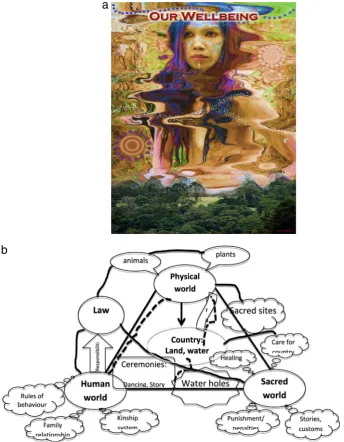
Indigenous ‘closeness’ with nature is clearly evident from the intricate relationships between people’s physical, spiritual and human worlds (Fig. 1) and from the values that people have about their traditional system for bush food, rituals, totems and the kinship system that involved responsibility to care about different components of nature (Altman, 2004; Bunya Mountains Elders Council and Burnett Mary Regional Group plan, 2010;Queensland Murray Darling Committee, 2008–2011).Fig. 1(a) painted by an Aboriginal artist (Charlie Waters) and its associated context (Fig. 1(b)) explains very well how indigenous well-being is embedded with country. From ecological perspective, many of these values represent the cultural and provisional ES that people obtain from their ecosystems.
Fig. 1. Indigenous well-being as reflected (a) by an Indigenous artist to suggest how nature’s elements (land, water, trees etc.) are embedded in people’ world and (b) from various connections between country and people’s well-being.
Source:(a) Aboriginal artist Charlie Waters. (b) authors’ interpretation adapted from Aboriginal Art by the Institute for Aboriginal Development.
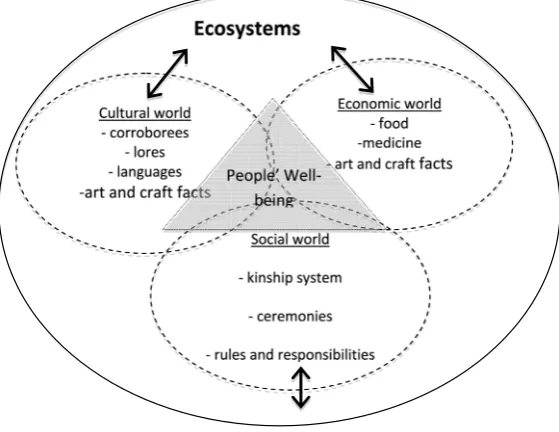
Fig. 2. An Integrated model of Indigenous Economy, Social world and Ecosystems. Each component has perforated boundaries to represent to and fro relationship with ecosystems (e.g. people obtain food from their country but also have responsibilities to look after).
We acknowledge that to date, some Indigenous people may not be fortunate to live on their land, but they are still connected with land for their traditions, culture and identity as evident from theABS report(2012a) and above-mentioned reports—about 72% indigenous population indicated cultural connections to country in the ABS surveys (ABS, 2009–2010). This is clearly expressed inQMDC(2008–2011) report as despite experiencing the benefits of the western lifestyle, people still desire to live on their country. One participant in one of our focus group meetings (May, 2014) said ‘there is nothing like being on my country, the kind of peace that I get from there is nowhere else’.
To address this, the ABS Indigenous Policy and Engagement Group (ABS, 2010b) developed a framework for Indigenous Australians that represented interactions of Indigenous people with their socio-cultural and economic environments. It focuses on social and cultural aspects to a greater extent compared to theABS(2001) socio-economic well-being framework, as an additional domain. However, in this framework (ABS, 2010b), there is no mention of the kind of connections between people and land or homeland (access/security) or related services that people derive from such connections. It only highlights that people identifies themselves with cultural groups, but it does not explain how people are connected to their homeland/country or other natural resources. Moreover, it has not been applied to the wider public.
TheAustralian Institute of Health and Welfare(2011) also reported a framework on links between health and natural environment, proposing that the global and natural ecosystems influence human health, one aspect of human well-being, as over compassing environments. On the contrary, we believe that Indigenous people have intricate connections with their ecosystems that represent the foundation of people’s well-being and form the basis (core) of other components of socio-economic well-being (as also suggested byDaly, 2005and others).
Apart from the abovementioned frameworks, the Australian Council for Educational Research (ACER, 2012) publishes a report on Overcoming Indigenous Disadvantages (OID) highlighting the performance of Australian governments in overcoming indigenous disadvantage. The OID report is intended to inform governments about whether or not their policies are improving outcomes for Indigenous people. The report is meant to help government in addressing Indigenous disadvantages. Conversely, if there is lack of understanding for what is valued by the Indigenous people, then the OID or similar government reports can lead to inappropriate policies, as has happened in the past. Hence, these policies have not proved fully effective to overcome indigenous disadvantages as evident from well-being levels of Indigenous Australians (ABS, 2012b), thus necessitates a new well-being approach that suits indigenous values.
5. A proposed well-being approach: mix of Capability and MA approaches to measure indigenous well-being
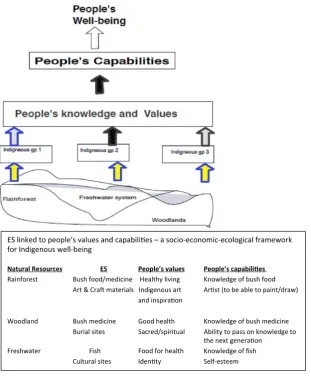
Fig. 3. A proposed conceptual framework including natural and cultural diversity in people’s values and capabilities in relation to ES from different ecosystems that are important for people’s well-being.
creative lives. Example:
Natural Resources
→
ES (e.g. Bush Food)→
Capabilities (e.g. Traditional Knowledge)→
Well-being (e.g. Good Health).To address these links, this study integrates both the MA and Capability Approaches (Fig. 3). The MA framework focused on the role of ES into well-being constituents (MA, 2003). However, it did not include the importance of natural systems in building people’s capabilities that is particularly relevant for Indigenous communities. This framework includes people’s capabilities in relation to natural systems, based onSen’s Capability Approach (1999a,b)suggesting that people’s capabilities should be the focus for welfare policy to enhance well-being.
To apply this framework (Fig. 3) requires identification of indicators at three levels, i.e. ES, people’s values and people’s capabilities. It also demands local scale studies to appropriately address natural and cultural diversity in a given landscape. The advantages of this framework are that it focuses on ES that are directly linked to people’s values and capabilities, and it could be easily applied by the ecologists, natural resource scientists and social scientists to evaluate their role in people’s well-being. By focusing on people’s capabilities, it can assist to appropriately reflect indigenous well-being for incorporating cultural, spiritual and social values that are not well perceived in the current well-being measures. It can help to close the gap between policy-decision-making, the natural resource scientists, and indigenous or local communities who depend on natural systems for their livelihoods. This framework could be further useful to develop policies that focus on enhancing people’s capabilities and sustainable use of natural resources.
6. Discussion and conclusion
due to human attitude to value a good or service only when there is a scarcity or a monetary tag attached to it (Satz et al., 2013;Costanza et al.,1997).
In Australia, the Measures of Progress (ABS,2005,2010a) and the State of Environment reports (State of the Environment Committee, 2011) are published every five years but without any integration of ecosystems or their ES with people’s well-being, as a result there is lack of understanding among the public and policy decision makers on how ecosystems contribute to people’s well-being (as demonstrated from the available well-being frameworks;ABS, 2001;ABS, 2010b).
To recognise the role of ES in human well-being, the MA concept was proposed in 2003. TheMA (2005a–c)and later the Sub-Global Assessment Network (SGA Network, 2014; a global initiative to extend the MA research) conducted about 70 case studies globally since 2003 applying this framework (de Groot et al., 2010on developing ES indicators;Kaur,2006,2007on ES and well-being of Indigenous communities in north Queensland;Smith et al., 2013on relating ES to domains of human well-being, and many others). It has been widely applied to assess the status of ecosystems or ES, but it fails to develop explicit link with people’s well-being and in suggesting specific tools/methods. We acknowledge that although ES concept itself includes the component of human benefits, but assessing the state of ecosystems or ES (as done in most MA studies) does not serve the purpose for policy-decision-making on welfare/well-being (ICSU-UNESCO-UNU, 2008). Over the past 10 years, there is a significant progress to understand the status of ecosystems but not much on how to integrate ecosystem with well-being of people (ICSU-UNESCO-UNU, 2008). This is the main reason that the Intergovernmental Platform on Biodiversity and Ecosystem Services (IPBES) was established in 2012, to focus mainly on bridging this gap and to incorporate indigenous and local systems. Undoubtedly, indigenous value systems could prove very useful in this regard.
Indigenous Australians can provide insights on various ES-well-being links. The proposed integrated approach in the present study (Fig. 3) focused on people’s capabilities in relation to natural systems that can help to develop appropri-ate well-being measures as well as policies in the future. We can analyse each world i.e. cultural, social and economic, in connection with country to evaluate the role of ES. So, there is need to develop indicators for each socio, cultural and economic link with the country that enables people to lead healthy and creative lives. Such indicators could involve di-rect (e.g. absolute terms) or indidi-rect measures (e.g. ordinal ranking) and requires trans-disciplinary approach—these to be discussed in the future studies. However, each value/link should be tested against people’s capabilities through con-ducting local/regional scale studies (e.g. focus group meetings, surveys etc.), to interpret/evaluate in terms of well-being. There is need to develop specific methods. Certainly, the indigenous oriented outcomes can guide the future policy to address the gaps on developing capabilities and on availability of resources that people think are important in their well-being.
Sen’s Capability Approach has been widely adopted in economics. However, it had rarely been attempted to assess the intangible values of natural systems that enhance indigenous capabilities, as presented in this study. Integrating Capability Approach with the MA approach provides a framework that suits indigenous values. Sangha et al.(2011) applied the modified MA framework in North Queensland to assess the links between various ES and well-being constituents. The MA framework helped to demonstrate the links but failed to reflect how people’s values on natural resources account towards their well-being. This study extends the earlier work by incorporating people’s capabilities that are vital for indigenous well-being and can only be achieved through connections to country. We acknowledge that the ES concept includes benefits that human derive from natural systems however, it mainly focuses on ecological systems and has limited application in economic studies given that the economists have not commonly used it.
Indigenous value systems view the ecosystems differently than as implied in the ES concept. The term ‘ES’ does not suit people’s value systems (as revealed by a number of participants in our focus group meetings during 2007–2014); unpublished and published results (Kaur,2006,2007;Sangha et al., 2011;QMDC, 2008–2011;Bunya Mountains Elders Council and Burnett Mary Regional Group plan, 2010). Indigenous worldview suggests that people are a part of mother nature, and that they belong to land/country that gives them fruit and other things to live so its people’s responsibility to look after their country (mother nature). Therefore, the notion of ‘deriving benefits’ from nature is not usually acceptable, however to avoid complexity (and in the absence of a suitable term in English), the term ES is used in this paper. This is the main reason for this research to demonstrate ES-well-being links from people’s values and capabilities perspectives. Nonetheless, we acknowledge that for Indigenous people, their connections with natural systems will depend on the status and type of the natural ecosystems as well as upon the values, rights and knowledge that people have for a particular ecosystem.
Furthermore, applying indigenous perspectives can provide significant solutions for:
•
Understanding ES-well-being links to develop a composite measure.•
Bridging the gap in social, economic and ecological disciplines.•
Evaluating each such links to include cultural as well as natural diversity.Firstly, Indigenous communities, especially those living in close contact with country, can help to develop a unique measure of ES-well-being interface that could be applicable to the wider public for effective policy-decision-making as well as for sustainable use and management of natural resources. There is a need to merge ES and well-being aspects as a common ‘integrated’ measure to assess the significance of ES in human well-being for policy-decision-makers. Integrating ES and people’s capabilities in the present study provides a way forward for developing such a common measure.
Secondly, indigenous knowledge can help bridge the current gap in social, economic and ecological disciplines. In modern times, many people are isolated from natural systems, and this undermines the value of our ecosystems. Whereas, from an ecological perspective, the ES (and ecosystem functions) are vital for people’s (sustainable) living, but regrettably these fail to account towards socio-economic well-being approaches. Indigenous value-system views these social–economic and ecological aspects as a ‘unified system’ (Altman,1987,2004), as also shown in the integrated model (Fig. 2) and thus, can prove useful for evaluating many ES in terms of well-being of people (Figs. 2and3).
Thirdly, indigenous perspectives could help to incorporate cultural and natural diversity that exists in any region to accurately assess the value of ES by conducting local scale studies. There is diversity in ecosystems as well as in Indigenous people’s values on how they value a particular ecosystem. It is very important to incorporate this cultural (i.e. clan) as well as natural (i.e. country) diversity to appropriately understand the role of ecosystems in people’s well-being. Most of the MA studies overlooked these connections as they were conducted at a regional scale, asDuraiappah(2011) suggested. In Ecuador, several ES-well-being connections were only revealed at the local scale MA study which were otherwise masked at a regional scale (Duraiappah, 2011). Scale is also a major issue in the current well-being or development measures discussed earlier in Section2, as most of the sustainability indices are applied at a national or global scale. Currently, there is lack of fine-scale ES data on the types of ecosystems that exist at a local scale. Moreover, there are different perceptions about the role of ES in people’s well-being depending upon the region, people’s state of knowledge and value system. When these different datasets (e.g. to calculate the indices at a national scale) are integrated, there is certainly exaggeration of values that could potentially mislead future policy decisions. For this reason, we emphasise the local scale indigenous studies that could provide detailed insights on ES-well-being links addressing cultural as well as natural diversity. However, we do believe that there is a scope for regional/national level execution once fine scale information is correctly investigated.
In conclusion, exploring connections between nature and Indigenous communities will help the broader global community to realise their dependence upon nature, and can lead to better policy-decision-making that enhances well-being of all people. Recently, the IPBES, established by the UN in April, 2012, has emphasised the need to include indigenous perspectives on ES related issues and to link ES with the policy-decision-making. Indigenous studies can add to this much-needed information by applying the proposed/similar framework.
TheMA(2005c) reported that the ecosystems have changed significantly over the past 50 years, and these changes can adversely affect human well-being. The results are alarming and suggest urgency to conserve the natural ecosystems. Learning from Indigenous societies can contribute to enhance our current knowledge of ecosystems, well-being, to embed our well-being with nature, and to develop integrated tools that can help modern societies to comprehend the value of natural systems in their living to better understand the meaning of being ‘well’ and to use our natural resources in a sustainable way that enhances human well-being for the present and future generations.
Acknowledgements
The authors are highly thankful to the Traditional Owners (TOs) who participated in various case studies i.e. the Bunya Mountains Elders group (organised by the Burnett Mary Regional Group, NRM body), Tim Knox and Traditional Owners from the Queensland Murray Darling Catchment (QMDC) (organised by the QMDC, NRM body) and the Mullunburra-Yidinji people (organised by Kamaljit K. Sangha and others), personal communications with the TOs during several FGMs, uncle Darby McCarthy, and Mr. Charlie Waters (an Aboriginal Artist) for beautifully painting his views on well-being, that has all helped us to develop an integrated framework.
References
ABS (The Australian Bureau of Statistics) 2001. Measuring Wellbeing, Frameworks for Australian Social Statistics, ABS catalogue no. 4160.0, Canberra. ABS 2005. Measures of Australia’s Progress: Summary Indicators, 2005, ABS catalogue no. 1383.0.55.001, Canberra.
ABS 2009–2010 Year Book 2009-10, in: Feature Article—Indigenous Disadvantage and Selected Measures of Wellbeing, ABS Catalogue no. 1301.0, Canberra. ABS 2010a, Measures of Australia’s progress, 2010- Is life in Australia getting better? ABS Catalogue no. 1370.0, Canberra.
ABS 2010b, Framework for Measuring Wellbeing: Aboriginal and Torres Strait Islander Peoples, 2010, ABS catalogue no. 4703.0, Canberra. ABS 2012a. Year Book Australia, 2012: Aboriginal and Torres Strait Islander People. Catalogue no. 1301.0, Canberra.
ABS 2012b. Aboriginal and Torres Strait Islander Wellbeing: A Focus on Children and Youth, April 2011, ABS catalogue 4725.0, Canberra. Alkire, S.,2002a. Dimensions of human development. World Dev. 30, 191–205.
Alkire, S.,2002b. Valuing Freedoms: Sen’s Capability Approach and Poverty Reduction. Oxford University Press, UK.
Altman, J.C.,2004. Economic development and Indigenous Australia: contestations over property, institutions and ideology. Aust. J. Agric. Res. Econ. 48, 513–534.
Altman, J., Kerins, S., Hunt, J., Ens, E., May, K., Russell, S., Fogarty, B., 2011. Indigenous Cultural and Natural Resource Management Futures. CAPER Topical Issue No. 9/2011, Australian National University, Canberra.
Australian Council for Educational Research,2012. Review of the Overcoming Indigenous Disadvantage: Key Indicators report for the Steering Committee for the Review of Government Service Provision. The Australian Council for Educational Research.
Australian Institute of Aboriginal and Torres Strait Islander Studies,1994. In: Edmunds, Mary (Ed.), Land, Rights, Laws: Issues of Native Title: Issue Paper no. 3. Australian Institute of Aboriginal and Torres Strait Islander Studies, ACT.
Australian Institute of Health and Welfare 2011, Health and the Environment: A Compilation of Evidence. Cat. no. PHE 136, Australian Institute of Health and Welfare, Canberra.
Bunya Mountains Elders Council and Burnett Mary Regional Group,2010. Bunya Mountains Aboriginal Aspirations and Caring for Country Plan. Burnett Mary Regional Group, Bundaberg, Qld.
Busch, M., La Notte, A., Laporte, V., Erhard, M.,2012. Potentials of quantitative and qualitative approaches to assessing ecosystem services. Ecol. Indic. 21, 89–103.
Costanza, R., d’ Arge, R., de Groot, R., Farber, S., Grasso, M., Hannon, B., Limburg, K., Naeem, S., O’Neill, R.V., Paruelo, J., Raskin, R.G., Sutton, P., van den Belt, M.,1997. The value of the world’s ecosystem services and natural capital. Nature 387, 253–260.
Costanza, R., Fisher, B., Ali, S., Beer, C., Bond, L., Boumans, R., Danigelis, N.L., Dickinson, J., Elliott, C., Farley, J., Gayer, D.E., Glenn, L.M., Hudspeth, T., Mahoney, D., McCahill, L., McIntosh, B., Reed, B., Rizvi, S.A.T., Rizzo, D.M., Simpatico, T., Snapp, R.,2007. Quality of life: An approach integrating opportunities, human needs, and subjective well-being. Ecol. Econ. 61, 267–276.
Costanza, R., Kubiszewski, I., Giovannini, E., Lovins, H., Mcglade, J., Pickett, K.E., Vala Ragnarsdóttir, K., Roberts, D., Vogli, R.D., Wilkinson, R.,2014. Development: Time To Leave GDP Behind’. Nature 505, 283–285.
Cummins, R.A., Eckersley, R., Pallant, J., van Vugt, J., Misajon, R.,2003. Developing a national index of subjective wellbeing: The Australian Unity Wellbeing Index. Soc. Indic. Res. 64, 159–190.
Daly, H.E.,1996. Beyond Growth: The Economics of Sustainable Development. Beacon Press, Boston. Daly, H.,2005. Economics in a full world. Sci. Am. 100–107.
Daly, H.,2013. A further critique of growth economics. Ecol. Econ. 88, 20–24.
de Groot, R.S., Alkemade, R., Braat, L., Hein, L., Willemen, L., 2010. Challenges in integrating the concept of ecosystem services and values in landscape planning, management and decision making. Ecol. Complex. 7 (3), 260–272.http://dx.doi.org/10.1016/j.ecocom.2009.10.006.
Diener, E., Suh, E.,1997. Measuring quality of life: economic, social, and subjective indicators. Soc. Indic. Res. 40, 189–216.
Dodson, M.,1997. Land rights and social justice. In: Yunupingu, G. (Ed.), Our Land Our Life; Land Rights—Past, Present and Future. University of Queensland Press, St Lucia, Qld.
Duraiappah, A.K.,2011. Ecosystem services and human well-being: do global findings make any sense? BioScience 61, 7–8.
Grieves, V., 2007. Indigenous Wellbeing: A Framework for Governments’ Aboriginal Cultural Heritage Activities Minimbah Consultants and Education Providers. Report for the NSW Department of Environment and Conservation.
Grieves, V., 2009. Aboriginal Spirituality: Aboriginal Philosophy—The Basis of Aboriginal Social and Emotional Wellbeing. Discussion paper no. 9. Cooperative Research Centre for Aboriginal Health, Casuarina, NT.
Human Development Report, 1990. The United Nations Development Programme Oxford University Press, UK.
Human Development Report,2010. The Real Wealth of Nations: Pathways to Human Development. The United Nations Development Progamme. Human Development Report,2011. Sustainability and Equity: A Better Future for All. The United Nations Development Programme.
ICSU-UNESCO-UNU,2008. Ecosystem Change and Human Well-being: Research and Monitoring Priorities Based on the Millennium Ecosystem Assessment. International Council for Science, Paris.
Kaur, K., 2006. The Role of Ecosystem Services from Tropical Savannas in the Well-being of Aboriginal People: A Scoping Study, A Report for the Tropical Savannas Cooperative Research Centre, Darwin, NT. p. 86.
Kaur, K.,2007. Linking ecosystem services to well-being: A case study of Aboriginal communities in north Australia. Aust. Aborig. Stud. 2, 145–147. Keen, I.,2004. Aboriginal Economy and Society. Oxford Press, UK.
Kubiszewski, I., Costanza, R., Franco, C., Lawn, P., Talberth, J., Jackson, T., Aylmer, C.,2013. Beyond GDP: Measuring and achieving global genuine progress. Ecol. Econ. 93, 57–68.
Maffi, L.,2001. On Biocultural Diversity: Linking Language, Knowledge, and the Environment. Simthsonian Institution, p. 578.
Millennium Ecosystem Assessment,2003. Ecosystems and Human Well-Being: A Framework for Assessment. Island Press, Washington, DC. Millennium Ecosystem Assessment,2005a. Ecosystems and Human Well-Being: Biodiversity Synthesis. Island press, Washington, DC.
Millennium Ecosystem Assessment,2005b. Ecosystems and Human Well-being: Current State and Trends, Vol. 1. In: Hussan, R., Scholes, R., Ash, N. (Eds.), Findings of the Conditions and Trends Working Group, Island Press, Washington, DC, p. 917.
Millennium Ecosystem Assessment,2005c. Ecosystems and Human Well-Being: Synthesis. Island press, Washington, DC. Organisation for Economic Co-operation and Development (OECD), 2011. How’s Life? Measuring Well-Being. OECD Publishing.
http://dx.doi.org/10.1787/9789264121164-en.
Posey, D., & Oxford Centre for the Environment, Ethics and Society,1999. Cultural and Spiritual Values of Biodiversity. Intermediate Technology Publications and UN Environment Programme, London, Nairobi.
Prescott-Allen, R.,2001. The Wellbeing of Nations: A Country by Country Index of Quality of Life and the Environment. Island Press, Washington, DC. Queensland Murray Darling Committee (QMDC),2008–2011. The Regional Caring for Country Plan. Aboriginal Program, Queensland Murray-Darling
Committee Inc., Toowoomba, Qld.
Rose, B.,1995. Land Management Issues: Attitudes and Perceptions Amongst Aboriginal People of Central Australia. Central Land Council, Alice Springs. Sangha, K., Butler, J., Delisle, A., Stanley, O.,2011. Identifying links between ecosystem services and Aboriginal well-being and livelihoods in north Australia:
applying the Millennium Ecosystem Assessment framework’. J. Environ. Sci. Eng. 5, 381–387.
Satz, D., Gould, R.K., Chan, K.M.A., Guerry, A., Norton, B., Satterfield, T., Halpern, B.S., Levine, J., Woodside, U., Hannahs, N., Basurto, X., Klain, S.,2013. The challenges of incorporating cultural ecosystem services into environmental assessment. Ambio 42 (6), 675–684.
Sen, A.,1993. Capability and wellbeing. In: Nussbaum, M., Sen, A. (Eds.), The Quality of Life. Clarendon Press, Oxford, UK. Sen, A.,1999a. Commodities and Capabilities. Oxford University Press, Oxford, UK.
Sen, A.,1999b. Development as Freedom. Oxford University Press, Oxford, UK. SGA Network, 2014:www.ecosystemassessments.net(accessed 21.05.14).
Smith, L.M., Case, J.L., Smith, H.M., Harwell, L.C., Summers, J.K.,2013. Relating ecoystem services to domains of human well-being: Foundation for a US index. Ecol. Indic. 28, 79–90.
State of the Environment Committee 2011. Australia State of the Environment 2011, Independent report to the Australian Government Minister for Sustainability, Environment, Water, Population and Communities, Canberra: DSEWPaC, 2011.
Taylor, J.,2008. Indigenous peoples and indicators of well-being: Australian perspectives on United Nations global framework. Soc. Indic. Res. 87, 111–126. The Economist Intelligence Unit,2005. Quality of Life Index—The World in 2005. The Economist Intelligence Unit, UK.
Vemuri, A.W., Costanza, R.,2006. The role of human, social, built, and natural capital in explaining life satisfaction at the country level: Toward a National Well-Being Index (NWI)’. Ecol. Econ. 58, 119–133.
Wet Tropics Aboriginal Plan Project Team,2005. Caring for Country and Culture—The Wet Tropics Aboriginal Cultural and Natural Resource Management Plan. Rainforest CRC and FNQ NRM Ltd., Cairns, Qld.
Further reading