This is a repository copy of
Effects of improper concrete curing on engineering
performance: a microstructural study
.
White Rose Research Online URL for this paper:
http://eprints.whiterose.ac.uk/120064/
Version: Publishers draft (with formatting)
Proceedings Paper:
Idowu, O and Black, L orcid.org/0000-0001-8531-4989 (2016) Effects of improper concrete
curing on engineering performance: a microstructural study. In: 36th Cement and Concrete
Science Conference. 36th Annual Cement and Concrete Science Conference, 05-06 Sep
2016, Cardiff, UK. Institute of Materials, Minerals and Mining .
[email protected] https://eprints.whiterose.ac.uk/
Reuse
Unless indicated otherwise, fulltext items are protected by copyright with all rights reserved. The copyright exception in section 29 of the Copyright, Designs and Patents Act 1988 allows the making of a single copy solely for the purpose of non-commercial research or private study within the limits of fair dealing. The publisher or other rights-holder may allow further reproduction and re-use of this version - refer to the White Rose Research Online record for this item. Where records identify the publisher as the copyright holder, users can verify any specific terms of use on the publisher’s website.
Takedown
If you consider content in White Rose Research Online to be in breach of UK law, please notify us by
1
36th Cement and Concrete Science Conference
Cardiff, 5th & 6th September 2016
Paper Number 028
Effects of improper concrete curing on engineering
performance: a microstructural study
Olusola Idowu and Leon Black
Department of Civil Engineering, University of Leeds, Leeds. LS2 9JT.
ABSTRACT
Ideally, the durability of concrete should not be a concern. Some degree of weathering should be expected, but improper concreting procedures can cause the deterioration to be earlier than expected. With increasing use of supplementary cementitious materials in order to reduce the embodied carbon dioxide of concrete, proper curing conditions become more important. Furthermore, since durability issues cannot be seen immediately, some assessment of the impact of improper concrete curing is needed.
This study has investigated the effects of improper curing on the strength and permeability of CEM I and II concretes. These results have been explained by considering the degree of hydration of the cementitious binder, as determined using SEM on paste samples of the same water cement ratio. Mix designs were adjusted to investigate the effects of; binder type (CEM I 52.5 N or using 30% PFA replacement), workability (10-30 and 60-180 mm slump) and target mean strength (20, 50 and 80 MPa). Samples were cured in a fog room at 200C or under ambient conditions 200C and 42% RH. The results shows that despite the increase in
strength with age for ambient cured concretes, proper curing of concretes cannot be compromised.
1. INTRODUCTION
Improper curing is one of the factors that have shortened the service life of many structures and have forced extensive repairs, with huge economic costs. Concrete is durable and flexible in it use thus the durability of concrete should not be a concern. Some degree of weathering should be expected, but improper concreting procedures can caused the deterioration to be earlier than expected. Long-term performance of concrete structures can be significantly changed by deterioration.
Recently there is increasing use of supplementary cementitious materials in order to reduce the embodied carbon dioxide of concrete. In such systems, proper curing conditions becomes more important. Furthermore, since durability issues cannot be seen immediately, some assessment of the impact of improper concrete curing is needed.
Fly ash is an important pozzolan, which has a number of advantages compared with regular Portland cement. FA is a finely divided residue that is a by-product from the combustion of powdered coal in power plants(Shi et al., 2012). FA has been used in concrete production for over 50 years in the world. It has been used in mass, conventional and high performance concrete to improve the workability, to reduce the heat of hydration and thermal cracking at early ages, and to improve the mechanical and durability properties especially at later ages.
The compressive strength of concrete plays a fundamental role in the design and construction of concrete structures. Concrete performance should be judged by strength and durability properties.
The pore structure is one of the most important properties that affected the durability of a concrete and this can be measured by sorptivity (Gopalan, 1996). Sorptivity is greatly influenced by the curing of concrete. Improper curing usually leads to very weak and porous materials near the surface of the concrete which is vulnerable to ingress of various harmful substances from the environment. This study investigates the effects of improper concrete curing on engineering performance, i.e. strength and durability. Engineering performance is then explained in terms of the degree of hydration.
2. Materials and Methods
Concrete specimens were cast using CEM I 52.5N. The PFA used was from Drax power station and complied with BS EN 450-1:2012 (British Standards Institution, 2012).The aggregates used meet the requirements for particle size distribution set out in BS EN 196-1: 2005(British Standards Institution, 2005). 10 mm diameter uncrushed coarse aggregate and quartz sand of diameter 150 µm to 5mm was used. The aggregates were oven dried before use. Potable mains water within the laboratory was used. Target strengths were 20, 50 and 80Mpa and target slumps of 10 to 30 and 60 to 180 mm, defined hereafter as “dry” and “wet” were used. Each mix was cured under two conditions, one in the fog room at 99% RH and the second one under ambient conditions at 200C, 42 % RH.
The compressive strength of concrete was determined at 28 days on 100 X 100 X 100 mm cubes cast in steel moulds. The specimens were covered with plastic sheets while in the moulds. After 24 hours specimens were stripped from their moulds and placed either in the fog room or under ambient conditions. For all tests, each value was the average of three specimens.
Permeability of the concretes was measured by using a gas permeability cell developed by Cabrera and Lynsdale. Concrete samples having 50mm diameter and 40mm height were cast and cured for 28 days. Following curing, the samples were put in the oven to dry at 40°C ±1°C until constant weight; this temperature was selected as it was deemed high enough to allow for pore water to be driven off in a reasonable time and not so high as to result in decomposition of the C-S-H or the ettringite. A bubble flow meter rate was used to measure the flow rate as the input pressures were varied between 0.5 and 2.5 bar. Nitrogen gas was used in
the test and the equation for calculating
permeability proposed by Grube and Lawrence was altered slightly to take account for the change in gas as shown in equation below.
Where: P1 is the absolute applied pressure (bar),
P2 is pressure at which the flow rate is measured in
bar and is 1.01325 bar, is measured in cm3/s,
and a measured in m and = dynamic viscosity of nitrogen at 20°C (g/cm/s).
Sorptivity tests were carried out on concrete cubes which had been cured for 28 days under the two different curing conditions and dried in an oven at 40°C to constant mass.
Paste samples were used for SEM and TG as the presence of quartz in concrete samples can affect the accuracy of the tests. Samples were prepared by using the same water / binder ratio as used for the concrete mixes. The pastes were prepared and cured for 28 days. The cured samples were cut using an isomet slow speed saw. After removal of the outer 1mm, a 2 mm thick layer was cut and hydration stopped by solvent exchange. The sliced cut samples were immersed in isopropyl alcohol (IPA) overnight using a solution-to-sample ratio of 100:1 followed by drying in a vacuum desiccator for another 12 hours.
The 2mm thick sample which had been cut and hydration stopped was resin impregnated and polished using silicon carbide paper and then diamond paste. The scanning electron microscope SEM of type Jeol 5900 LV fitted with a backscatter electron detector was used for imaging. Accelerating voltage of 15KeV and 10mm working distance was managed by the microscope. The degree of hydration was measured on 25 images obtained at 400X magnification(Scrivener, 2004). Image J was used for the analysis.
3. Results and Discussion
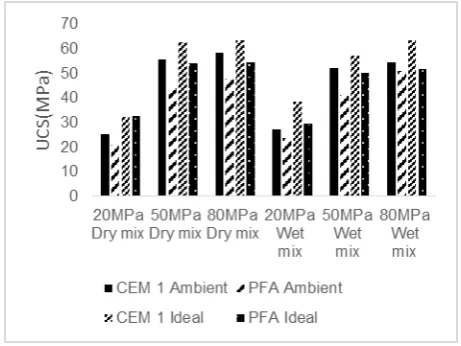
Unconfined compressive strength at 28 days for the concretes is shown in figure 1. In all the mixes ideally cured samples had higher strengths than the ambient-cured samples, though the 80MPa samples did not attain their desired strength and were only just stronger than the 50MPa samples. Also, for both the dry and wet mixes, the samples prepared with PFA showed lower strengths, irrespective of curing conditions.
Figure 1. Unconfined compressive strength of concretes at 28
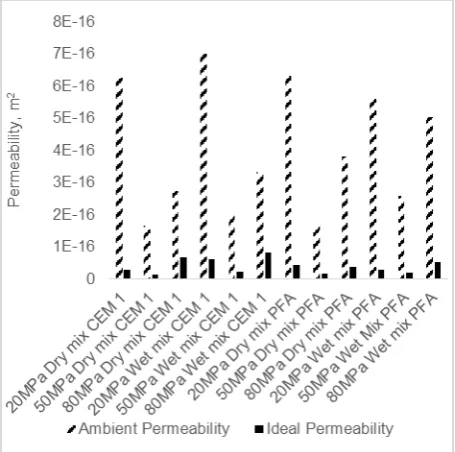
[image:3.595.310.541.571.744.2]3 The permeability of concrete samples in all the mixes shows that deviations from ideal curing led to more porous samples, with samples cured under ambient conditions all being more porous than those cured under ideal conditions. The deviation was greatest, at 25%, when the targeted strength was 80MPa, using CEM1 in a wet mix.
Figure 2. Permeability of CEM1 and PFA concretes at 28days.
[image:4.595.57.285.149.375.2]Figure 2 shows the permeability of ambient and ideal cured sample of CEM 1 and PFA concretes. In wet mix concretes the value of PFA concretes is lower than that of CEM1 meaning that PFA concretes reduces the permeability, likely due to more extensive hydration of the cementitious matrix. In dry mix 20 and 50MPa CEM 1 permeability values are lower than PFA concretes but in 80MPa PFA permeability value is reduced.
Table 1 shows the sorptivity values. In all the tested samples, concretes cured under ambient conditions had higher sorptivity values than concretes that were cured under ideal conditions. Comparing the CEM I mixes; the ideally cured wet mixes had higher sorptivities than the ideally cured dry mixes. (The same applies for the non-ideally cured samples). The same is true for the PFA blends. So, the increased water content of the mixes appears to lead to higher sorptivity. Effects of improper curing were more pronounced on PFA concretes than CEMI concretes.
An attempt was then made to try and explain the engineering performance by examining the microstructure. The degree of cement hydration was determined according to the method of Kocaba(Kocaba, 2009). The degree of cement hydration is shown in Figure 3. In all instances the degree of hydration was reduced in samples cured under non-ideal conditions. Secondly, PFA concretes all showed greater degrees of cement
hydration than CEM I mixes. This may seem counter-intuitive, but it should be noted that the degree of hydration is just that of the cement, not the binder as a whole. PFA is known to have a slight accelerating effect on cement hydration due to the filler effect and the provision of nucleation sites. No clear trends were seen regarding the effect of mix workability or strength on the degree of cement hydration.
Table 1. Sorptivity values
CEMI Dry sorptivity
(cm/s1/2)
CEMI wet sorptivity
(cm/s1/2)
PFA dry sorptivity
(cm/s1/2)
PFA wet sorptivity
(cm/s1/2)
20 Ideal 0.0074 0.0097 0.0072 0.0095
20 Amient
0.235 0.0244 0.0252 0.0244
50 Ideal 0.0067 0.0122 0.0088 0.0089
50 Amient 0.0122 0.0176 0.0152 0.0188
80 Ideal 0.0154 0.0244 0.0118 0.016
80 Amient 0.0256 0.0395 0.0188 0.0277
Figure3. Degree of cement hydration from SEM images.
As well as being used to determine the degree of cement hydration, SEM-BSE images were used to determine the porosity. The images in figure 4 show clearly how ambient cured samples exhibited a higher porosity than ideally cured samples, hence explaining the greater permeability.
[image:4.595.311.537.600.761.2]
Image B. 20MPa Ideal cured Stiff mix CEM1
Image C. 50MPa Ambient cured stiff mix CEM 1
Image D. 50MPa Ideal cured stiff mix CEM1
Figure 4. SEM BSE micrographs revealing the degree of
cement hydration in various mixes.
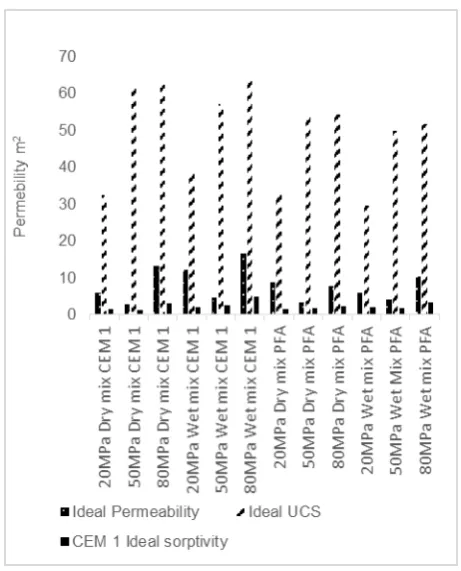
Permeability,sorptivity and unconfined compressive strength of ideal cured CEM1 and PFA concrete is shown in figure 5. The figure shows the high compressive strength and low values of permeability and sorptivivity in CEM1 and PFA concretes. Also Lower permeability and sorptivity values can be seen in PFA concretes.
4. Conclusions
In practice, the quality of concrete is usually determined by its compressive strength. Therefore, the relationship between compressive strength and durability-related properties is of particular interest. As the strength increases the permeability reduces both in CEM1 and PFA concretes and lower sorptivity values were obtained. Addition of PFA reduces sorptivity and permeability as ideal cured PFA samples have lower sorptivity and permeability values than ideal cured CEM I concrete.
Figure 5. Permeability, UCS and sorptivity of ideally cured
CEM1 and PFA concretes
References
A.M., N., 2011. Properties of concrete. Pearson Education Limited, England.
British Standards Institution, 2005. BS EN 196-1 Methods of testing cement — Part 1:
Determination of strength.
British Standards Institution, 2012. BS EN 450-1 Fly ash for concrete Part 1: Definition, specifications and conformity criteria.
Cabrera, J., Gowripalan, N., Wainwright, P., 1989. An assessment of concrete curing efficiency using gas permeability. Magazine of Concrete Research, 41(149): 193-198.
Cabrera, J., Lynsdale, C., 1988. A new gas permeameter for measuring the permeability of mortar and concrete. Magazine of Concrete Research, 40(144): 177-182.
Gopalan, M., 1996. Sorptivity of fly ash concretes. Cement and Concrete Research, 26(8): 1189-1197.
Kocaba, V., 2009. Development and evaluation of methods to follow microstructural development of cementitious systems including slags. Scrivener, K.L., 2004. Backscattered electron
imaging of cementitious microstructures: understanding and quantification. Cement and Concrete Composites, 26(8): 935-945. Shi, X., Xie, N., Fortune, K., Gong, J., 2012.
[image:5.595.57.278.49.513.2] [image:5.595.310.541.75.361.2]