This is a repository copy of
Practical and Secure Outsourcing of Discrete Log Group
Exponentiation to a Single Malicious Server
.
White Rose Research Online URL for this paper:
http://eprints.whiterose.ac.uk/151372/
Version: Accepted Version
Proceedings Paper:
Di Crescenzo, Giovanni, Khodjaeva, Matluba, Kahrobaei, Delaram
orcid.org/0000-0001-5467-7832 et al. (1 more author) (2017) Practical and Secure
Outsourcing of Discrete Log Group Exponentiation to a Single Malicious Server. In:
Practical and Secure Outsourcing of Discrete Log Group Exponentiation to a Single
Malicious Server. 2017 on Cloud Computing Security Workshop, 30 Oct 2017, Texas.
Association for Computing Machinery (ACM) , pp. 17-28.
https://doi.org/10.1145/3140649.3140657
[email protected]
https://eprints.whiterose.ac.uk/
Reuse
Items deposited in White Rose Research Online are protected by copyright, with all rights reserved unless
indicated otherwise. They may be downloaded and/or printed for private study, or other acts as permitted by
national copyright laws. The publisher or other rights holders may allow further reproduction and re-use of
the full text version. This is indicated by the licence information on the White Rose Research Online record
for the item.
Takedown
If you consider content in White Rose Research Online to be in breach of UK law, please notify us by
Practical and Secure Outsourcing of Discrete Log Group
Exponentiation to a Single Malicious Server
Giovanni Di Crescenzo
Vencore Labs
Basking Ridge, NJ, 07920, USA [email protected]
Matluba Khodjaeva
CUNY Graduate Center New York, NY, 10016, USA [email protected]
Delaram Kahrobaei
PhD Program in Computer Science CUNY Graduate Center New York, NY, 10016, USA
Vladimir Shpilrain
CUNY Graduate Center New York, NY, 10016, USA [email protected]
ABSTRACT
Group exponentiation is an important operation used in many public-key cryptosystems and, more generally, cryptographic pro-tocols. To expand the applicability of these solutions to computa-tionally weaker devices, it has been advocated that this operation is outsourced from a computationally weaker client to a compu-tationally stronger server, possibly implemented in a cloud-based architecture. While preliminary solutions to this problem consid-ered mostly honest servers, or multiple separated servers, some of which honest, solving this problem in the case of a single (logi-cal), possibly malicious, server, has remained open since a formal cryptographic model was introduced in [20]. Several later attempts either failed to achieve privacy or only bounded by a constant the (security) probability that a cheating server convinces a client of an incorrect result.
In this paper we solve this problem for a large class of cyclic groups, thus making our solutions applicable to many cryptosys-tems in the literature that are based on the hardness of the discrete logarithm problem or on related assumptions. Our main protocol satisies natural correctness, security, privacy and eiciency re-quirements, where the security probability is exponentially small. In our main protocol, with very limited oline computation and server computation, the client can delegate an exponentiation to an exponent of the same length as a group element by performing an exponentiation to an exponent of short length (i.e., the length of a statistical parameter). We also show an extension protocol that further reduces client computation by a constant factor, while increasing oline computation and server computation by about the same factor.
Permission to make digital or hard copies of all or part of this work for personal or classroom use is granted without fee provided that copies are not made or distributed for proit or commercial advantage and that copies bear this notice and the full citation on the irst page. Copyrights for components of this work owned by others than ACM must be honored. Abstracting with credit is permitted. To copy otherwise, or republish, to post on servers or to redistribute to lists, requires prior speciic permission and/or a fee. Request permissions from [email protected].
CCSW’17, November 3, 2017, Dallas, TX, USA © 2017 Association for Computing Machinery. ACM ISBN 978-1-4503-5204-8/17/11. . . $15.00 https://doi.org/10.1145/3140649.3140657
CCS CONCEPTS
·Security and privacy→Public key encryption;Mathematical foundations of cryptography;Privacy-preserving protocols;
KEYWORDS
Secure Outsourcing, Secure Delegation, Modular Exponentiations, Discrete Logarithms, Cryptography, Group Theory
1
INTRODUCTION
Server-aided cryptography is an active research direction address-ing the problem of clients delegataddress-ing or outsourcaddress-ing cryptographic computations to servers. Ideas related to this area have circulated in the literature already many years ago (see, e.g., [9], which intro-duced ‘wallets with observers' where a third party, such as a bank, installs hardware on a user's computer to facilitate its future compu-tations). Recently, this area is seeing an increased interest because of application scenario like cloud computing (where a client interacts with a much more powerful server), computations with low-power devices, such as wireless, RFIDs, etc (where a resource-constrained client interacts with a more powerful server).
The irst formal model for outsourcing of cryptographic opera-tions was introduced in [20], where the authors especially studied outsourcing of modular exponentiation, as this operation is a cor-nerstone of so many cryptographic protocols. In this model, we have a client, with an inputx, who outsources to one or more servers the computation of a functionF on the client's input, and the main challenges are:
(1) privacy: only minimal or no information aboutxshould be revealed to the servers;
(2) security: the servers should not be able, except possibly with very small probability, to convince the client to accept a result diferent thanF(x); and
(3) eiciency: the client's computation time should be much smaller than computingF(x)without outsourcing the com-putation.
original paper [20] and then reiterated in [25]. This is even the case in a model, as used in all previous work in the area, where relatively expensive oline computation can be performed and stored on the client's device. In many proposed protocols, the oline computation even involves the computation of modular exponentiations with random exponents, which are envisioned to be computed by an entity diferent than the client, or pre-computed by the client itself when additional time or computational power is available. The model also allows a client to perform in the online phase (a not large number of) less expensive operations like multiplications, an assumption that might be reasonable even in computationally challenged devices, in light of recent advances (see, for instance, [1], showing how to practically implement group multiplication, for a speciic group, and a related public-key cryptosystem, using RFID tags).
Previous results.As also mentioned in [20], a number of solutions had been proposed, even before their paper introduced a security model, and then broken in follow-up papers. The single-server solution from [20] assumes that the server is honest on almost all inputs.
Other solutions were proposed in more recent papers, but these solution either only consider a semi-honest server [11], or two non-colluding servers [10], or do not target input privacy [14], or only achieve constant security probability (of detecting a cheating server) [8, 23, 25]. The schemes proposed in [30, 31] do not satisfy our privacy requirement. Finally, the scheme proposed in [32] does not satisfy our security requirement.
All mentioned solutions for the outsourcing of exponentiation are based on pre-computed exponentiations of random exponents, which are somehow stored on the client machine in an oline phase. These exponentiations might be precomputed by another party and stored on the client's device, or might be computed by the client itself using a pseudo-random power generator. One such generator was proposed by combining the results in [6, 24], based on a hidden-subset-sum hardness assumption, although this assumption needs to be re-evaluated in light of the most recent attacks.
The literature of course contains several elegant general-purpose solutions, applicable to any polynomial-time computable function, and starting with [17], which uses garbled circuits [26] and fully-homomorphic encryption [18] to eiciently, privately and securely outsource any polynomial-time circuit to a single (semi-honest) server. Due to their generality, these solutions are only asymptoti-cally eicient, but not so in practical settings, and are thus out of scope in this paper.
Our Contributions.In this paper we irst of all provide rigorous deinitions, mainly based on [17] as well as [20], for the require-ments of correctness, privacy, security and eiciency for outsourced computation protocols in the single, malicious, server model, with an allowed of-line phase.
In this model, we construct protocols that provably satisfy these requirements while delegating, to asinglemalicious server, group exponentiation, for a large class of cyclic groups, including groups often used for cryptosystems with provable security under the Discrete Logarithm or related assumptions. All protocols satisfy security with probability exponentially small in a statistical secu-rity parameterλ(which can be set equal to, for instance, 128). Our
protocols' privacy and security properties do not rely on any ad-ditional complexity assumptions, as the adversary corrupting the server isnot limited to run in polynomial time. Our protocols dele-gate functionFexp,д,q(x)=дx(i.e., variable-exponent, ixed-base
exponentiation over an arbitrary cyclic groupG).
Our main protocol (in Section 3) delegates exponentiation in cyclic groups to a single, possibly malicious, server. The client delegates an exponentiation with an exponent as long as a group element (e.g., ofσ = 2048 bits), while only performing a single
exponentiation with a much smaller exponent (e.g., ofλ = 128
bits). Both the oline phase and the server in the online phase only require 2 exponentiations withσ-bit exponents. It is based on a 1-round probabilistic veriication of the server's computation, and satisies information-theoretic privacy, and security with exponen-tially small probability 2−λof the malicious server fooling the client. The main technical idea is simultaneously enforcing a probabilistic veriication equation (veriiable using less than 2λgroup multipli-cations), a deterministic inequality check and a group membership protocol (veriiable using no more than 1 group multiplication), given 2 correct exponentiations available to the client in an oline phase.
Our second protocol, presented in Section 4, extends the protocol in Section 3 to achieve the following (tunable) eiciency tradeof: it further reduces the number of the client's group multiplications, while increasing the number of group exponentiations of random exponents performed during the oline phase and the number of the server's group exponentiations. Here, the main technical idea consists of running multiple probabilistic veriication equations with smaller exponents at a performance cost for the client smaller than independently running each of the equations.
As in all previous work in the area, we consider a model with an oline phase, where a client can precompute exponentiations to random exponents, or another party can precompute them and store them on the client's device. Alternatively, if their hidden-subset-sum assumption holds when run with a low number of multiplications, the pseudo-random power generator from [6, 24] could be used.
2
NOTATIONS AND DEFINITIONS
In this section we formally deine outsourcing protocols, and their correctness, security, privacy and eiciency requirements, mainly building on the deinitional approach from [17], as well as the one from [20]. We also introduce group notations and deinitions that will be used in the rest of the paper. We start with some basic notations.
Basic notations.The expressiony←T denotes the probabilis-tic process of randomly and independently choosingyfrom set
T. The expressiony←A(x1,x2, . . .)denotes the (possibly
proba-bilistic) process of running algorithmAon inputx1,x2, . . .and any
necessary random coins, and obtainingyas output. The expres-sion(zA,zB) ← (A(x1,x2, . . .),B(y1,y2, . . .))denotes the (possibly
probabilistic) process of running an interactive protocol betweenA, taking as inputx1,x2, . . .and any necessary random coins, andB,
taking as inputy1,y2, . . .and any necessary random coins, where
zA,zBareAandB's inal outputs, respectively, at the end of this
System scenario, entities, and protocol.We consider a system with two types of parties: clients and servers, where a client's computational resources are expected to be more limited than a server's ones, and therefore clients are interested in delegating (or outsourcing) the computation of speciic functions to servers. In all our solutions, we consider a singleclient, denoted asC, and a singleserver, denoted asS. We assume that the communication link between each client andSis private or not subject to conidential-ity, integrconidential-ity, or replay attacks, and note that such attacks can be separately addressed using known techniques in cryptography and security. As in all previous work in the area, we consider a model with an oline phase, where exponentiations to random exponents can be precomputed and made somehow available to the client. This model has been justiied in several ways, all appealing to diferent application settings. In the presence of a trusted party (say, setting up the client's device), the trusted party can simply perform the precomputed exponentiations and store them on the client's device. If no trusted party is available, in the presence of a pre-processing phase where the client's device does not have signiicant compu-tation constraints, the client can itself perform the precomputed exponentiations and store them on its own device. Clients that always have signiicant computation constraints could spend more preprocessing time or use the pseudo-random power generator from [6, 24], which, based on a hidden-subset-sum assumption, only performs a relatively smaller number of group multiplications, to generate a new exponentiation for a pseudo-random exponent. Here, we note that this latter assumption needs to be re-evaluated in light of recent attacks. For simplicity of description, we will consider an Oline algorithm executed by either a trusted party or a client with no signiicant computation constraints, and remark any changes in our results when this algorithm is executed using a pseudo-random power generator.
Letσ denote the computational security parameter (i.e., the parameter derived from hardness considerations on the underlying computational problem), and letλdenote the statistical security parameter (i.e., a parameter such that evens with probability 2−λare extremely rare). Both parameters are expressed in unary notation (i.e., 1σ,1λ). When performing numerical performance analysis, we
useσ =2048 andλ=128, as these are currently the most often
recommended parameter settings in cryptographic protocols and applications.
LetF : Dom(F) → CoDom(F)be a function, whereDom(F)
denotesF's domain,CoDom(F)denotesF's co-domain, anddesc(F) denotesF's description. Assumingdesc(F)is known to bothCandS, and inputxis known only toC, we deine aclient-server protocol for the outsourced computation ofFin the presence of an oline phase as a 2-party, 2-phase, communication protocol betweenCandS, denoted as(C(1σ,1λ,desc(F),x),S(1σ,1λ,desc(F))), and consisting of the following steps:
(1) pp←Oline(1σ,1λ,desc(F)),
(2) (yC,yS) ← (C(1σ,1λ,desc(F),pp,x),S(1σ,1λ,desc(F)).
As discussed above, Step 1 is executed in anoline phase, when the inputxto the functionFis not yet available. Step 2 is executed in theonline phase, when the inputxto the functionFis available to
C. At the end of both phases,ClearnsyC(intended to be=y) andS
learnsyS(usually an empty string in this paper). We will often omit
desc(F),1σ,1λfor brevity of description. Executions of outsourced computation protocols can happen sequentially (each execution starting after the previous one is inished), or concurrently (Sruns at the same time one execution with each one of many clients). Correctness Requirement.Informally, the (natural) correctness requirement states that if both parties follow the protocol,Cobtains some output at the end of the protocol, and this output is, with high probability, equal to the value obtained by evaluating functionF
onC's input. A formal deinition follows.
Deinition 2.1. Letσ,λbe the security parameters, letF be a function, and let(C,S)be a client-server protocol for the outsourced computation ofF. We say that(C,S)satisiesδc-correctnessif for
anyxinF's domain, it holds that
Probhout ←CorrExpF(1σ,1λ) : out=1
i
≥δc,
for someδcclose to 1, where experiment CorrExp is detailed below:
CorrExpF(1σ,1λ) 1.pp←Oline(desc(F)) 2.(yC,yS) ← (C(pp,x),S)
3. ifyC =F(x)thenreturn:1 elsereturn:0
Security Requirement.Informally, the most basic security re-quirement would state the following: ifCfollows the protocol, a malicious adversary corruptingScannot convinceCto obtain, at the end of the protocol, some outputy′diferent from the value
yobtained by evaluating functionF onC's inputx. To deine a stronger and more realistic security requirement, we augment the adversary's power so that the adversary can even chooseC's input
x, before attempting to convinceCof an incorrect output. We also do not restrict the adversary to run in polynomial time. A formal deinition follows.
Deinition 2.2. Letσ,λbe the security parameters, letF be a function, and let(C,S)be a client-server protocol for the outsourced computation ofF. We say that(C,S)satisiesϵs-security against a
malicious adversaryif for any algorithmA, it holds that Probhout←SecExpF,A(1σ,1λ) :out=1
i
≤ϵs,
for someϵs close to 0, where experiment SecExp is detailed below:
SecExpF,A(1σ,1λ)
1.pp←Oline(desc(F)) 2.(x,aux) ←A(desc(F)) 3.(y′,aux) ← (C(pp,x),A(aux)) 4. ify′=⊥ory′=F(x)thenreturn:0
elsereturn:1.
Privacy Requirement.Informally, the privacy requirement should guarantee the following: ifCfollows the protocol, a malicious ad-versary corruptingScannot obtain any information aboutC's input
xfrom a protocol execution. This is formalized by extending the indistinguishability-based approach typically used in formal def-initions for encryption schemes. That is, the adversary can pick two inputsx0,x1, then one of these two inputs is chosen at random
for security, we do not restrict the adversary to run in polynomial time. A formal deinition follows.
Deinition 2.3. Letσ,λbe the security parameters, letF be a function, and let(C,S)be a client-server protocol for the outsourced computation ofF. We say that(C,S)satisiesϵp-privacy (in the
sense of indistinguishability) against a malicious adversaryif for any algorithmA, it holds that
Probhout←PrivExpF,A(1σ,1λ) : out=1
i
≤ϵp,
for someϵpclose to 0, where experiment PrivExp is detailed below:
PrivExpF,A(1σ,1λ)
1.pp←Oline(desc(F)) 2.(x0,x1,aux) ←A(desc(F))
3.b← {0,1}
4.(y′,d) ← (C(pp,xb),A(aux))
5. ifb=dthenreturn:1 elsereturn:0.
Eiciency Metrics and Requirements. Let(C,S) be a client-server protocol for the outsourced computation of functionF. We say that(C,S)haseiciency parameters(tF,tP,tC,tS,cc,mc), ifF
can be computed (without outsourcing) usingtF(σ,λ)atomic
op-erations,Ccan be run in the oline phase usingtP(σ,λ)atomic
operations and in the online phase usingtC(σ,λ)atomic operations,
Scan be run usingtS(σ,λ)atomic operations,CandSexchange
a total of at mostmcmessages, of total length at mostcc. In our analysis, we only consider the most expensive group operations as atomic operations (e.g., group multiplications and/or exponen-tiation), and neglect lower-order operations (e.g., equality testing, additions and subtractions between group elements). While we naturally try to minimize all these protocol eiciency metrics, our main goal is to design protocols where
(1) tC(σ,λ)<<tF(σ,λ), and
(2) tS(σ,λ)is not signiicantly larger thantF(σ,λ),
based on the underlying assumption, consistent with the state of the art in cryptographic implementations at least for many group types, that group multiplication requires signiicantly less computing resources than group exponentiation.
Group notations and deinitions.Let(G,×)be a group, letσbe its computational security parameter, and letLdenote the length of the binary representation of elements inG. Typically, in crypto-graphic applications we setLas about equal toσ.
We also assume that(G,×)iscyclic, has orderq, and denote asд
one of its generators. Byy=дxwe denote theexponentiation (inG)
ofдto thex-th power; i.e., the valuey∈Gsuch thatд× · · · ×д=y, where the multiplication operation×is appliedx−1 times. Let
Zq={0,1, . . . ,q−1}, and letFexp,д,q:Zq→Gdenote the
func-tion that maps everyx∈Zqto the exponentiation (inG) ofдto the
x-th power. Bydesc(Fexp,д,q)we denote a conventional
descrip-tion of the funcdescrip-tionFexp,д,qthat includes its semantic meaning as
well as generatorд, orderqand the eicient algorithms computing multiplication and inverses inG. Bytexp(ℓ)we denote a parameter
denoting the number of multiplications inGused to compute an exponentiation (inG) of a group value to an arbitraryℓ-bit expo-nent. Bytm,exp(ℓ)we denote a parameter denoting the number of
multiplications inGused to computemexponentiations (inG) of the same group value tomarbitraryℓ-bit exponents.
We deine aneiciently veriiable membership protocolforGas a one-message protocol, denoted as the pair (mProve,mVerify) of algorithms, satisfying
• completeness: for anyw ∈G, mVerify(w,mProve(w))=1; • soundness: for anyw<G, and any mProve′,
mVerify(w,mProve′(w))=0;
• eicient veriiability: the number of multiplicationstmVerify(σ)
inGexecuted by mVerify iso(texp);
• eicient provability: the number of multiplicationstmProve(σ)in
Gexecuted by mProve is not signiicantly larger thantexp.
We say that a group iseicientif its description is short (i.e., has length polynomial inσ), its associated operation×and the inverse operation are eicient (i.e., they can be executed in time polyno-mial inσ), and it has an eiciently veriiable membership protocol. Note that for essentially all cyclic groups frequently used in cryp-tography, the description is short and its associated×and inverse operations can be run in time polynomial inσ. The only non-trivial property to establish is whether the group has an eiciently verii-able membership protocol. In the rest of the paper we present our results for any arbitrary eicient cyclic group, of which we now show two examples that are often used in cryptography and that do have eiciently veriiable membership protocols.
Example 1:(G,×)=(Z∗
p,· modp), for a large primep. This group
was one of the most recommended for early foundational crypto-graphic schemes like the Blum-Micali pseudo-random generator [5], etc. Note that multiplication and inverses modulopcan be computed in time polynomial in logp, and an eiciently veriiable membership protocol goes as follows:
(1) on inputw, mProve does nothing;
(2) on inputw, mVerify returns 1 if 0<w <pand 0 otherwise. The completeness, soundness, eicient provability properties of this protocol are easily seen to hold. The eicient veriiability property follows by noting that mVerify runs in time linear in logp, which is strictly smaller than the time for exponentiation modp(in fact, even the time for multiplication modp).
Example 2:(G,×)=(Gq,· modp), for large primesp,qsuch that
p=2q+1, whereGqis theq-order subgroup ofZ∗p. This group is
one of the most recommended for cryptographic schemes like the Diie-Hellman protocol [15], El-Gamal encryption [16], Cramer-Shoup encryption [12], etc. It is known thatGq is cyclic and is
characterized as the set of quadratic residues modulop; i.e., the set ofz∈Z∗
pfor which there exists anr∈Zp∗such thatz=r2 modp.
Using results from [13] based on this characterization, an eiciently veriiable membership protocol can be built as follows:
(1) on inputw, mProve computesr = w(q+1)/2 modp and
returnsr;
(2) on inputw,r, mVerify returns 1 ifw = r2 modpand 0 otherwise.
3
OUTSOURCING EXPONENTIATION IN ANY
EFFICIENT CYCLIC GROUP
In this section we present our irst and main protocol for outsourc-ing exponentiation in cyclic groups. We irst formally state our re-sult, then informally and formally describe the protocol, and inally prove its correctness, security, privacy and eiciency properties. Formal theorem statement.We obtain the following
Theorem 3.1. Let(G,×)be an eicient cyclic group, letσbe its computational security parameter, and letλbe a statistical security parameter. There exists (constructively) a client-server protocol (C,S)for outsourcing the computation of functionFexp,д,q, which
satisies
1. δc-correctness, forδc=1;
2. ϵs-security, forϵs =2−λ;
3. ϵp-privacy, forϵp=0;
4. eiciency with parameters(tF,tS,tP,tC,cc,mc), where
• tF is =texp(σ);
• tSis = 2texp(σ)+2tmProve(σ);
• tP is = 2texp(σ), with random exponents fromZq;
• tCis≤texp(λ)+2tmVerify(σ)+2 multiplications inGand 1 multiplication inZq;
•cc=4 elements inGandmc=2.
The main takeaway from Theorem 3.1 is thatC outsources the computation of an exponentiation with aσ-bit exponent toSwhile
Conly performs an exponentiation with aλ-bit exponent, 2 group membership veriications inG, 2 multiplications inGand 1 modular multiplication inZq. Also remarkable are the running time ofS, who
only performs 2 exponentiations and 2 group membership proof generations inG, and of the oline phase, where only 2 known-base exponentiations with random exponents are needed. Finally, the protocol only requires 2 messages, which is clearly minimal in this model, and only requires the communication of 4 elements inG. Informal description of protocol(C,S).The main challenge in coming up with our desired protocol consists of allowingC to eiciently verify computations performed by the possibly malicious server. It should be noted that general conversion techniques are known in the cryptography literature to transform a protocol secure against a honest party into one secure against a malicious one. Typically, these techniques are based on zero-knowledge proofs of knowledge of secrets that certify the correctness of the computation [19]. In their most general version, these techniques do not perform well with respect to many eiciency metrics. Even considering their most simpliied version, basic proofs of knowledge of exponents in the literature (such as, e.g., [9]) require the veriier to perform group exponentiations, which is precisely what the client is trying to delegate. Accordingly, we need a substantially diferent protocol technique to allow the client's eicient veriication of the server's computations.
Our main idea consists of a probabilistic veriication equation which is veriiable using only a small number of modular multipli-cations. More speciically,Cinjects an additional random element in the inputs on whichSis asked to compute the value of function
F, so to satisfy the following properties: (a) ifS returns correct computations ofF, thenCcan use these random values to correctly
computey; (b) ifSreturns incorrect computations ofF, thenSeither does not meet some deterministic veriication equation or can only meetC's probabilistic veriication equation for one possible value of the random elements; (c)C's messages hide the values of the random element as well asC's input to the function. By choosing a large enough domain (i.e.,{1, . . . ,2λ}) from which this random value is chosen, the protocol achieves a very small security proba-bility (i.e., 2−λ). As this domain is much smaller thanG, this results
in a considerable eiciency gain onC's running time.
Our probabilistic veriication equation involves the answer from
S, a correct exponentiation available toC(and computed in an oline phase byCor another trusted party), and the potential func-tion output computed using the answer fromSand another correct exponentiation computed in the oline phase. Only one of these values is exponentiated byC, and to an exponent that is≤2λ, which
can be much smaller than|G|. In itself, this probabilistic test is not always successful, but we characterize the condition under which it fails, and this condition can be expressed as 2 computationally simple deterministic tests: a value distinctness test and a group membership test.
The value distinctness test can be eiciently veriied byCwith no exponentiation or multiplication inG, but it introduces a mi-nor case (i.e.,C's input is=0) where the probabilistic test is not
passed; however, in this case, to preserve the protocol's correct-ness,Ccalculates the functionFexp,д,qby himself (i.e., by setting
Fexp,д,q(0)=д0=1), and ignores all other veriications.
The group membership test is realized via the assumed eiciently veriiable group membership protocol. While we do not know of such a protocol for any arbitrary cyclic group, we showed in Sec-tion 2 that groups commonly used in cryptography have one. Formal description of protocol(C,S).LetGbe an eicient cyclic group, and let (mProve,mVerify) denote its eiciently veriiable membership protocol.
Input to S:1σ,1λ,desc(F exp,д,q)
Input to C:1σ,1λ,desc(Fexp,д,q),x ∈Zq
Oline phase instructions:
(1) Randomly chooseui ∈Zq, fori=0,1 (2) Setvi =дui and store(u
i,vi)onC, fori=0,1
Online phase instructions:
(1) Crandomly choosesb∈ {1, . . . ,2λ}
Csetsz0:=(x−u0) modq,z1:=(b·x+u1) modq
Csendsz0,z1toS
(2) Scomputeswi :=дzi andπ
i :=mProve(wi), fori=0,1
Ssendsw0,w1,π0,π1toC
(3) Ifx=0
Creturns:y=1 and the protocol halts
if mVerify(wi,πi)=0 for somei∈ {0,1}, then
Creturns:⊥and the protocol halts
Ccomputesy:=w0∗v0
Cchecks that
y,1, also called the ‘distinctness test'
w1=yb∗v1, also called the ‘probabilistic test'
mVerify(w0,π0)= mVerify(w1,π1)= 1,
if any one of these tests is not satisied then
Creturns:⊥and the protocol halts
Creturns:y
Properties of protocol(C,S):The eiciency propertiesare veriied by protocol inspection.
•Round complexity:the protocol only requires one round, con-sisting of one message fromCtoSfollowed by one message fromStoC.
•Communication complexity:the protocol requires the transfer of 2 elements inGand 2 proofs of group membership from
StoC, and 2 elements inZqfromCtoS.
•Runtime complexity:During the oline phase, 2 exponenti-ations in baseдand with randomσ-bit exponents are per-formed. Note that known-base exponentiations can be exe-cuted faster than unknown-base ones using pre-computation techniques (see, e.g.,[7, 22]). During the online phase,S com-putes 2 exponentiations toσ-bit exponents inGand 2 group membership proofs; andC veriies 2 group membership proofs and computes 2 multiplications inG, 1 modular mul-tiplication inZq, and 1 exponentiation inGto a random
exponent that is much smaller (≤2λ) than 2σ.
Thecorrectnessproperty follows by showing that ifC andS
follow the protocol,Calways outputsy=дx. First, assumex=0;
in this case,Creturnsy=1=д0at the beginning of step 3. Now, assumingx , 0, we show that the 3 tests performed byC are always passed. The membership test is always passed sincewiis
computed bySasдzi, fori
=0,1, andдis a generator of groupG;
the probabilistic test is always passed since
w1=дz1
=дbx+u1
=(дx)bдu1 =ybv1.
The distinctness test is always passed, since we assumex , 0, which implies that−u0,(x−u0) modq, which implies, using the
fact thatдis a generator and has thus orderq, thatv0−1=д−u0 ,
дx−u0
=дz0=w0, equivalently saying thaty=w0∗v0,1. This
implies thatCnever returns⊥, and thus returnsy. To see that this returned valueyis the correct output, note that
y=w0∗v0=дz0∗дu0=дx−u0∗дu0=дx.
Theprivacyproperty of the protocol against any arbitrary ma-liciousS follows by observing thatC's only message toS does not leak any information aboutx. This message is a pair(z0,z1)
wherez0 =(x −u0) modq,z1 =(bx+u1) modq, andz0and
z1are uniformly and independently distributed inZq, as so areu0
andu1. Then, no information is leaked byz0,z1aboutxas: (a) for
anyx ∈ Zq, there is exactly oneu0corresponding toz0; that is,
u0 =x−z0 modq; (b) for anyx ∈ Zq, for anyb ∈ {1, . . . ,2λ}
chosen byC, there is exactly oneu1corresponding toz1; that is,
u1=z1−bx modq. This implies that, sinceu0,u1are uniformly
and independently distributed inZq, the distribution ofx
condi-tioned onz0,z1is also uniform inZq. Moreover, by essentially the
same proof, protocol (C,S) satisies the following property: for any
x,z0andz1do not leak any information aboutb. We will use this
latter privacy property in the proof of the security property. To prove thesecurityproperty against any maliciousSwe need to compute an upper boundϵs on the security probability thatS
convincesC to output aysuch thaty,Fexp,д,q(x). Ifx =0,C
can calculateFexp,д,q(x)=д0=1 and it does not need to check
whetherSis honest or dishonest. Thusϵs =0 whenx =0. Now
assume thatx,0. We start by deining the following events with respect to a random execution of(C,S)whereCusesxas input:
•ey,,, deined as ‘Coutputsysuch thaty,Fexp,д,q(x)'
•e⊥, deined as ‘Coutputs⊥'
By inspection of(C,S), we directly obtain the following fact.
Fact 3.1.If eventey,,happens then event(¬e⊥)happens.
With respect to a random execution of(C,S)whereCusesx as input, we now deine the following events:
•e1,b, deined as ‘∃exactly onebsuch thatS's message(w0,w1)
satisiesw1=(w0∗v0)b∗v1'
•e>1,b, deined as ‘∃more than onebsuch thatS's message
(w0,w1)satisiesw1=(w0∗v0)b∗v1'.
By deinition, eventse1,b,e>1,bare each other's complement event.
In our proof of the privacy property of(C,S), we proved that for anyx,C's message(z0,z1)does not leak any information aboutb.
This implies that all values in{1, . . . ,2λ}are still equally likely even when conditioning over message(z0,z1). Then, if evente1,bis true,
the probability thatS's message(w0,w1)satisies the probabilistic
test, is 1 divided by the number 2λof values ofbthat are still equally likely even when conditioning over message(z0,z1). We obtain the
following
Fact 3.2.Prob
¬e⊥|e1,b
≤1/2λ
We now show the main technical claim, saying that ifS is ma-licious then it cannot produce in step 2 of the protocol values
w0′,w1′satisfying all ofC's 3 tests relatively to two distinct values
b1,b2∈ {1, . . . ,2λ}:
SinceScan be malicious, in step 2 it can send arbitrary values to
C. Diferently saying,Ccan sendwi′fori = 0,1 forwi′ =wi or
wi′,wi, wherewi =дzi. Since the groupGis cyclic,дis generator
ofGandCusesπ0,π1to check in step 3 thatwi′∈G, we can write
w0′=дu∗w0andw1′=дv∗w1for someu,v∈Zq
theny =w0′∗v0=дu∗w0∗v0 =дu∗дx. Now, recall that the
goal of a maliciousSis to passC's three veriication tests and force
C's output to bey ,дx; then, assume thatu ,0 modq. Now, consider the following equivalent rewritings ofC's probabilistic test, obtained by variable substitutions and simpliications:
w1′=yb∗v1
дv∗w1=(дu∗дx)b∗дu1
дv∗дz1
=дub∗дbx+u1
дv∗дbx+u1
=дub∗дbx+u1
дv=дub
v=ub modq.
Notice that ifu=0 modqthen the above calculation implies that
v =0 modq, and thusSis honest, from which we derive that
thatu,0 modq. We want to show thatbis unique in this case. If there exist two distinctb1andb2such that
ub1=v modqandub2=v modq
thenu(b1−b2)=0 modqthenb1−b2 =0 modq(i.eb1=b2)
becauseu,0 modq. This shows thatbis unique. We obtain the following fact.
Fact 3.3.Prob e>1,b
=0
The rest of the proof consists of computing an upper boundϵs on
the probability of eventey,,. We have the following
Prob ey,,
≤ Prob[ ¬e⊥] = Probe1,b
·Prob
¬e⊥|e1,b
+Probe>1,b·Prob¬e⊥|e>1,b
= Probe1,b
·Prob
¬e⊥|e1,b
≤ Prob e1,b
· 1 2λ
≤ 1 2λ,
where the irst inequality follows from Fact 3.1, the irst equality follows from the deinition of eventse1,b,e>1,band the
condition-ing rule, the second equality follows from Fact 3.3, and the second inequality follows from Fact 3.2.
We inally obtain thatϵs =Probey,,
=2−λ, which concludes
the proof for the security property for(C,S). □
Remark.Although we have only analyzed our protocol (C,S) with respect to a single execution, we note that the proofs of its proper-ties naturally extend to multiple sequential, parallel or concurrent executions of the same protocol (both oline and online phase).
4
OUTSOURCING EXPONENTIATION IN ANY
EFFICIENT CYCLIC GROUP WITH
TRADEOFF RUNTIME PERFORMANCE
In this section we present our second protocol for outsourcing exponentiation in cyclic groups. This protocol can be seen as an extension of the irst protocol, from Section 3, trying to further reduce the client's runtime, even at the cost of slightly increas-ing other computation metrics. The underlyincreas-ing motivation here is that in many applications slightly increasing a cloud server's time complexity may be worth to obtain further reduced client's time complexity. We irst formally state this subsection's result, then describe the protocol, and inally prove its correctness, security, privacy and eiciency properties.
Formal theorem statement.We actually show a class of proto-cols varying according to a parameterm ≥1, where in the case
m= 1 we have the same protocol as in Section 3. Formally, we
show the following
Theorem 4.1. Let(G,∗)be an eicient cyclic group, letσ be its computational security parameter, letλbe a statistical security parameters, let integermbe a protocol parameter, and letλ′ =
⌈λ/m⌉. There exists (constructively) a client-server protocol(C,S) for outsourced computation of functionFexp,д,qwhich satisies
1. δc-correctness, forδc =1;
2. ϵs-security, forϵs =2−λ;
3. ϵp-privacy, forϵp=0;
4. eiciency with parameters(tF,tS,tP,tC,cc,mc), where
•tF is =texp(σ);
•tSis =tm+1,exp(σ)+(m+1) ·tmProve(σ);
•tP is =tm+1,exp(σ);
•tCis =tm,exp(λ′)+(m+1)multiplications inG+m
mul-tiplications inZq+(m+1) ·tmVerify(σ);
•cc=m+1 elements inZq,m+1 elements and membership
proofs inG; •mc=2.
The main takeaway from Theorem 4.1 is thatCdelegates an ex-ponentiation with aσ-bit exponent toSwhileConly performsm
same-base exponentiations with aλ′-bit exponent,m+1
multipli-cations and group membership veriimultipli-cations inGandmmodular multiplications inZq. Here, note that exponentλ′is⌈λ/m⌉, and
thatmsame-base exponentiations can be performed faster than independently repeatingmtimes the same exponentiation algo-rithm, by using optimized algorithms. The protocol still requires only 2 messages, which is minimal in this model. On the other hand, the running time ofShas increased, in thatSnow performsm+1
exponentiations and generatesm+1 group membership proofs in
G. Similarly, the running time of the oline phase has increased, as nowm+1 known-base exponentiations with random exponents
are needed. The communication complexity also has increased to
m+1 elements inZqandm+1 elements inG. While these latter 3
metrics increase with respect to the protocol in Section 3, it should be noted that parametermcan be chosen by the system designer, to select the desired tradeof (as further discussed in Section 5). Informal description of protocol(C,S).In Section 3 we pre-sented a protocol which satisiesδc-correctness,ϵp-privacy and
ϵs-security, withδc=1,ϵp=0, andϵs =2−λ, with the following
running time parameters:tC ≤texp(λ)+2 group multiplications,
tS=2 group exponentiations, andtP =2 group exponentiations.
In this section we design protocols that further decrease the value oftCwhile keeping the same values forδc,ϵp,ϵs, and only slightly
increasingtS,tP.
The main idea in our new protocol is based on a detailed consider-ation of the role of the probabilistic veriicconsider-ation equconsider-ation ‘w=ybv'
in the protocol of Section 3. Speciically, it is possible to usem>1 such equations, each with the same baseyand an independent value of the random exponentb(i), while:
(1) the worst-case number ofC's multiplications increases by a factor strictly smaller thanm;
(2) the security analysis performed using a single probabilistic veriication equation can be extended to allmequations, thus reducing the security probability by an exponential factor ofm.
Then, since it suices to target a security probability of 2−λfor
the resulting protocol, we can choose a smaller, by a factor of
m, domain (i.e.,{1, . . . ,2⌈λ/m⌉ −1}) for the random exponents
group multiplication smaller thanmtimes those needed in a sin-gle probabilistic veriication. This is because any preprocessing techniques, including those described in [7, 27], can be run on-line and become efective if used to compute multiple same-base exponentiations. On the other hand, performingmprobabilistic veriication equations requiresm+1 oline exponentiations fromC
andm+1 exponentiations fromS(here, a directm-fold repetition of the protocol from Section 3 would actually incur a number of 2m ex-ponentiations but we reduce this number tom+1 by observing that
the security property continues to hold even when using the same
w0across allmequations). The actual eiciency tradeof achieved
by the resulting protocol (i.e., the reduction in the number ofC's group multiplications and the increase in the number of oline exponentiations to random exponents andS's exponentiations) will vary depending on the speciic algorithm used to computem same-base exponentiations. In what follows, we describe protocol (C,S) based on a generic multiple-exponentiation algorithm and prove its correctness, privacy and security properties. Later, in Section 5, we analyze the protocol's performance metrics based on speciic instantiations of this algorithm, and for diferent values ofm(which can be chosen by the system designer to calibrate the tradeof); in particular, we show thatm=5 minimizes the numbertC ofC's
group multiplications.
Formal description of protocol(C,S).
Let ManyExp(z,x(1), . . . ,x(s),β)denote an algorithm that, on in-putz ∈Gand exponentsx(1), . . . ,x(s) ∈ {1, . . . ,2β}, computes
exponentiationszx(1), . . . ,zx(s)inG. Algorithm ManyExp could be instantiated usingsexecutions of the textbook square-and-multiply algorithm, or using improved techniques based on precomputations (here perfomed in the online phase), such as those from [7, 22, 27]. Letmbe a protocol parameter that can be chosen by the system designer, and letλ′=⌈λ/m⌉.
Input to S:1σ,1λ,desc(Fexp,д,q), parameter 1m
Input to C:1σ,1λ,desc(Fexp,д,q),x∈Zq, parameter 1m
Oline phase instructions:
1. Uniformly chooseu0, . . . ,um∈Zq
2. Run algorithm ManyExp(д,u0,u1, . . . ,um,σ)
to compute(v0,v1, . . . ,vm)
3. Store(u0,v0),(u1,v1), . . . ,(um,vm)onC
Online phase instructions:
1. Csetsz0=(x−u0) modq
Fori=1, . . . ,m,
Cuniformly choosesb(i) ∈ {1, . . . ,2λ′}
Csetszi =(b(i) ·x+ui) modq
Csendsz0,z1, . . . ,zm toS
2. Sruns algorithm ManyExp(д,z0,z1, . . . ,zm,σ)
to compute(w0,w1, . . . ,wm)
Forj=0, . . . ,m,
Scomputesπj =mProve(wj)
Ssends(w0,π0),(w1,π1), . . . ,(wm,πm)toC
3. Ifx =0
Creturns:y=1 and the protocol halts
Ccomputesy=w0∗v0
Cchecks thaty,1, also called the ‘distinctness test'
Cchecks that mVerify(wi,πi)=1, fori=0,1, . . . ,m,
also called the ‘membership test'
Cruns ManyExp(y,b(1), . . . ,b(m),λ′) to computeyb(1), . . . ,yb(m)
Fori=1, . . . ,m,
Cchecks thatwi =yb(i)∗vi,
also called the ‘i-th probabilistic test' if any one of the above checks is not satisied then
Creturns:⊥and the protocol halts. 4. Creturns:y
Properties of protocol(C,S):The eiciency propertiesare veriied by protocol inspection.
• Round complexity.The protocol only requires one round, con-sisting of one message fromCtoSfollowed by one message fromStoC.
• Communication complexity.The protocol requires the trans-fer ofm+1 elements inGand membership proofs fromSto
Candm+1 elements inZqfromCtoS.
• Runtime complexity.Only≤m+1 exponentiations inGwith the same base and randomσ-bit exponents are performed during the oline phase. During the online phase,Scomputes
m+1 exponentiations inGwith the same base and random
σ-bit exponents, andm+1 membership proofs, whileC
performsmmultiplications inZq,m+1 multiplications in
G,m+1 membership proof veriications and computesm
exponentiations inGwith the same base and randomλ′-bit exponents.
The correctness propertyfollows by showing that ifCandSfollow the protocol,Calways outputsy=дx. This is proved for the case
x=0 exactly as done for the protocol in Section 3. Then, assume
x,0. We can prove thatCpasses theG-membership test and the distinctness test exactly as done for the protocol in Section 3. Even thei-th probabilistic test is passed, for alli=1, . . . ,m, since
wi =дzi
=дb(i)x+ui
=(дx)b(i)∗дui
=yb(i)∗vi.
This implies thatCnever returns⊥, and thus returnsy=Fexp,д,q(x),
since
y=w0∗v0=дz0∗дu0
=дx−u0∗дu0 =дx.
Theprivacyproperty of the protocol against a maliciousS fol-lows, similarly as for the protocol in Section 3. Note thatC's only message toSis a tuple(z0, . . . ,zm)wherez0 =(x−u0) modq
andzi = (b(i) ·x +ui) modq, fori = 1, . . . ,m. Here, values
u0,u(1), . . . ,u(m)are uniformly and independently distributed in Zq, and thus so arez0,z(1), . . . ,zm. This is the cases for anyx
and for anyb(1), . . . ,b(m) ∈ {1, . . . ,2λ′}. Thus, we obtain that the protocol satisies the following two properties for allj=0, . . . ,m: (1) for anyx,z0,z1, . . . ,zmare uniformly and independently
dis-tributed inZq; and (2) for anyxand anyb(1), . . . ,b(m) ∈ {1, . . . ,2λ′}, valuesz0,z1, . . . ,zmare uniformly and independently distributed
inZq. Property (1) implies thatC's message does not leak any
To prove thesecurityproperty against a maliciousS, we need to compute an upper boundϵs on the security probability thatS
convincesC to output aysuch thaty,Fexp,д,q(x). Ifx =0,C
can calculateFexp,д,q(x)=д0=1 and it does not need to check
whetherSis honest or dishonest. Thusϵs =0 whenx =0. Now,
assume thatx ,0. We start by deining the following events with respect to a random execution of(C,S)whereCusesxas input:
•ey,,, deined as ‘Coutputsysuch thaty,Fexp,д,q(x)'
•e⊥, deined as ‘Coutputs⊥'
•e⊥,i, deined as ‘The valuewisent bySdoes not satisfy the
i-th probabilistic check'
By inspection of(C,S), we directly obtain the following facts.
Fact 4.1.If eventey,,happens then event(¬e⊥)happens.
Fact 4.2.If event¬e⊥happens then event((¬e⊥,1) ∧. . .∧ (¬e⊥,m))
happens.
With respect to a random execution of(C,S)whereC usesxas input, we now deine the following events for alli=1, . . . ,m:
•e1,b(i), deined as ‘∃exactly oneb(i)such thatS's message
(w0, . . . ,wm)satisieswi =(w0∗v0)b(i)∗vi'
•e>1,b(i), deined as ‘∃ more than oneb(i)such thatS's
mes-sage(w0, . . . ,wm)satisieswi=(w0∗v0)b(i)∗vi'.
By deinition, eventse1,b(i),e>1,b(i)are each other's complement
event, for alli=1, . . . ,m.
In our proof of the privacy property of(C,S), we proved that for anyx,C's messagez0,z1, . . . ,zmdoes not leak any
informa-tion aboutb(1), . . . ,b(m). By recalling that valuesb(1), . . . ,b(m) are randomly and independently chosen byC, we obtain that all values in {1, . . . ,2λ′}are still equally likely for eachb(i) even when conditioning over message(z0,z1, . . . ,zm)and over values
b(1), . . . ,b(i−1). Then, for eachi=0,1, . . . ,m, if evente1,b(i)is
true, the probability that values(w0,w1, . . . ,wm)inS's message
satisfy thei-th probabilistic test, is 1 divided by the number 2λ′
of values ofb(i)that are still equally likely even after conditioning over message(z0,z1, . . . ,zm)and over valuesb(1), . . . ,b(i−1).
We obtain the following
Fact 4.3.For alli=1, . . . ,m, it holds that Prob[di|d1∧. . .∧di−1] ≤
2−λ′, wheredi denotes event¬e⊥,i∧e1,b(i).
By applying the rule of conditional probability, we can write Prob[d1∧. . .∧dm]=
m
Ö
i=1
Prob[di|d1∧. . .∧di−1].
By further using the result from Fact 4.3, and the expressionλ′=
⌈λ/m⌉, we obtain the following
Fact 4.4.It holds that Prob[d1∧. . .∧dm] ≤2−λ, wheredidenotes
event¬e⊥,i ∧e1,b(i), for alli=1, . . . ,m.
We continue with the main technical claim, saying that ifS is malicious then it cannot produce in step 2 of the protocol values
w0′, . . . ,wm′ satisfying all ofC's three tests relatively to two distinct
valuesb1(i),b2(i) ∈ {1, . . . ,2 λ
m
}for eachi=1, . . . ,m:
SinceScan be malicious, in step 2 it can send correct answer or
incorrect answer. Diferently saying, it can sendwj′wherew′j =wj
orwj′,wjwherewi =дzjfor eachj
=0, . . .m. Since the groupG
is cyclic,дis generator ofGandCchecks in step 3 thatwj′∈G, we can write
w′j=дαj∗w
jfor someαj ∈Zqforj =0, . . . ,m
theny=w0′∗v0=дα0∗w0∗v0=дα0∗дx. The goal of maliciousS
to pass all three checks andC's outputy,дxthenα0,0 modq.
Now, consider ‘probabilistic check' for eachi=1, . . . ,m:
wi′=yb(i)∗vi
дαi∗w
i =(дα0∗дx)b(i)∗дui
дαi ∗дzi
=дα0b(i)∗дb(i)x+ui
дαi∗дb(i)x+ui
=дα0b(i)∗дb(i)x+ui
дαi
=дα0b(i)
αi =α0·b(i) modq
Notice that ifα0=0 modqthenαi =0 modqfor alli=1, . . . ,m
from above calculation which implies thatSis honest then auto-maticallyϵs =0. Ifαi =0 modqthenα0=0 becauseb(i),0 for
i ∈ {1, . . . ,m}. Now, if there exist somej ∈ {1, . . . ,m}such that
αj ,0, in this case we want to show thatb(j)is unique. If there exist two distinctb1(j)andb2(j)such that
αjb1(j)=α0 modqandαjb2(j)=α0 modq
thenαj(b1(j) −b2(j))=0 modqthenb1(j) −b2(j)=0 modq(i.e
b1(j)=b2(j)) becauseαj ,0 modq. Which shows that eachb(i) is unique for alli=1, . . . ,m.
We obtain the following fact.
Fact 4.5.Prob e>1,b(i)
=0
The rest of the proof consists of computing an upper boundϵson
the probability of eventey,,. We have the following
Prob ey,,
≤Prob[ ¬e⊥]
=Prob¬e⊥∧ (e1,b(1)∧. . .∧e1,b(m))
+Prob¬e⊥∧ ¬(e1,b(1)∧. . .∧e1,b(m))
≤ Prob
(¬e⊥,1∧e1,b(1)) ∧. . .∧ (¬e⊥,m∧e1,b(m)) +Prob¬e⊥∧ (e>1,b(1)∨. . .∨ e>1,b(m))
=Prob(¬e⊥,1∧e1,b(1)) ∧. . .∧ (¬e⊥,m∧e1,b(m))
+Prob(¬e⊥∧e>1,b(1)) ∨. . .∨ (¬e⊥∧e>1,b(m)))
≤
m
Ö
i=1 2−λ′+
m
Õ
i=1 Prob
¬e⊥∧e>1,b(i)
=(2−λ′)m+
m
Õ
i=1
Prob e>1,b(i)
·Prob
¬e⊥|e>1,b(i)
=2−λ
using the deinition of eventse1,b(i),e>1,b(i). The second inequality
follows from Fact 4.2. The second equality is obtained by a distribu-tive rule. The third inequality follows from Fact 4.4 and a union bound. The third equality follows from the conditioning rule. The last equality follows from Fact 4.5 and by the deinition ofλ′.
We inally obtain thatϵs =Probey,,
≤2−λ, which concludes the proof of the security property for(C,S). □
5
PERFORMANCE ANALYSIS
In this section we describe parametric (as a function of parameters
σ,λ,m) and numeric performance evaluations of our protocols in Section 3, 4. We also compare these two protocols with the non-outsourced computation of the same function.
So far we have expressed the performance of our protocols in terms of group multiplications and two parameter functions:
texp(ℓ), the number of multiplications inGto compute one
expo-nentiation to an arbitraryℓ-bit exponent; andtm,exp(ℓ), the number
of multiplications inGto computemexponentiations of the same group value tomarbitraryℓ-bit exponents. A more concrete eval-uation of the performance of our protocols requires a (possibly optimized) instantiation of these two functions. As there can be dif-ferent algorithms for the computation of one exponentiation or of
mexponentiations of the same base tomarbitraryℓ-bit exponents, we opt for the following two representative istantiations:
(1) Basic setting:using the textbook square-and-multiply algo-rithm to evaluate group exponentiation, and computingm
exponentiations by simply independently applying this same algorithmmtimes, we can set
• texp(ℓ)=2ℓ
• tm,exp(ℓ)=2mℓ
(2) Improved setting: using improved algorithms from the lit-erature to evaluate group exponentiation, we can obtain even asymptotic improvements over the above expressions in the basic setting. In particular, we use the improved algo-rithms discussed in [27], which contains a detailed literature account and closed-form estimates for the number of multi-plications of the main discussed algorithms. We obtain that: • texp(ℓ)is aboutℓ(1+log1ℓ), using Brauer's 1939 algorithm,
as described in [27],
• tm,exp(ℓ)is aboutℓ(1+logmℓ), using Yao's 1976 algorithm, as described in [27].
We also refer the reader to [7, 22, 28, 29] for other algorithms claiming improvements, although note that these papers do not provide additional closed-form evaluations.
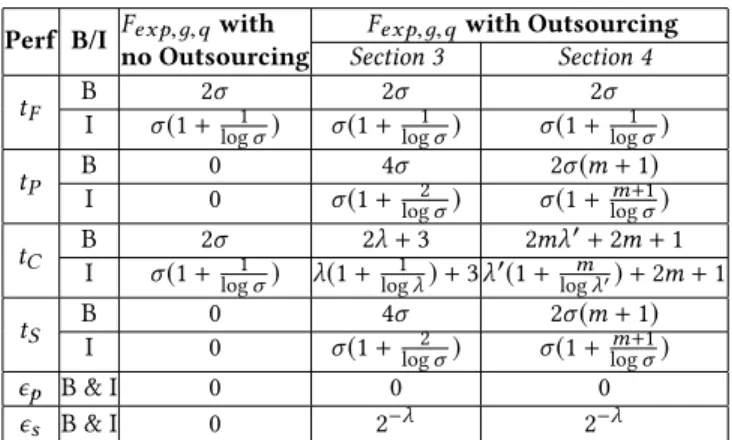
The table below compares the performance of our outsourc-ing protocols in Section 3 and Section 4 with a non-outsourced computation of the client under both basic (B) and improved (I) settings of functionstexp,tm,exp. The table reports expressions (as
a function ofσ,λ,m,λ′, for eiciency metricstF (the number of
multiplications to compute functionFexp,д,q),tP(the number of
multiplications used in the protocol's oline phase),tC(the
num-ber of multiplications byCin the protocol's online phase),tS(the
number of multiplications bySin the protocol's online phase),ϵp
(the probability parameter in the privacy deinition), andϵs (the
probability parameter in the security deinition).
For simplicity of description, we only consider the case when the group membership protocols do not add any multiplication (as shown in Example 1 of Section 2, whenG=Z∗
p).
Perf B/I Fexp,д,qwith no Outsourcing
Fexp,д,qwith Outsourcing
Section 3 Section 4
tF B 2σ 2σ 2σ
I σ(1+log1σ) σ(1+log1σ) σ(1+log1σ)
tP B 0 4σ 2σ(m+1)
I 0 σ(1+log2σ) σ(1+ m+1
logσ)
tC B 2σ 2λ+3 2mλ
′
+2m+1
I σ(1+log1σ) λ(1+log1λ)+3λ′(1+logmλ′)+2m+1
tS B 0 4σ 2σ(m+1)
I 0 σ(1+log2σ) σ(1+ m+1
logσ)
ϵp B & I 0 0 0
ϵs B & I 0 2−λ 2−λ
Table 1: Parametric performance of our protocols.
The analysis for Example 2, whenG=Gq⊆Z∗p, forp=2q+1 and
p,qprimes, is similarly obtained as it only addsm+1
exponentia-tions inGforSandm+1 multiplications inGforC.
We believe the main takeaways by analyzing the expressions in the above table are as follows:
• our protocol in Section 3 reducestCby a multiplicative factor
of aboutσ/λwith respect to non-outsourced computation, when using both basic and improved settings;
• the protocol in Section 4 reducestCby a multiplicative factor
of: (1) aboutσ/λwith respect to non-outsourced computa-tion, when using the basic parameter settings, and (2) about
σ/λ′with respect to non-outsourced computation, when us-ing the improved parameter settus-ings, whereλ′=⌈λ/m⌉by
deinition, andm≥1 can be chosen by the system designer; • the protocol in Section 4 reducestCby a multiplicative factor
of aboutλ/λ′with respect to the protocol in Section 3, how-ever by increasing parameterstPandtSby a multiplicative
factor of aboutmtimes, when using both basic and improved settings;
• the impact of using basic or improved settings for functions
texp,tm,expis only on lower-order terms of the performance
metricstF,tP,tC,tS.
As for the numeric analysis, in Figure 1 and 2, we show the perfor-mance of our protocols in Sections 3 (whenm=1) and Section 4
(for anym≥1). We setσ=2048 andλ=128, as these are the
cur-rently most recommended settings, and use the improved settings for functionstexp,tm,exp.
Figure 1 shows the number of multiplications by the client in the online phase (tC) asmincreases, both in the Example 1 case
G=Zp∗and in the Example 2 caseG=Gq. We notice that in both
casestCdecreases asmincreases up to 5, and then either keeps the
same value or increases for larger values ofm.
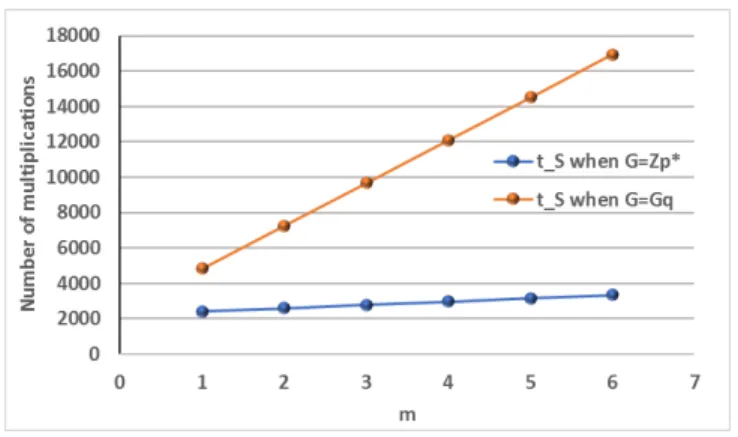
Figure 2 shows the server's number of multiplications in the online phase (tS) asmincreases, both in the Example 1 caseG=Zp∗
Figure 1: MetrictC as a function ofm
metric monotonically increases in both cases, exhibiting a much higher slope in the caseG =Gq than in the caseG =Z∗
p. This
is because whenG=Gq, the eiciently veriiable group
member-ship protocol requiresm+1 variable-base exponentiations fromS, which we cannot optimize using improved algorithms (working on multiple exponentiations on the same base).
As for metrictP, we note that in both Example 1 and Example 2
cases, it is equal to the (plotted) value oftSin the Example 1 case.
Interesting tradeof points, obtained by instantiating parameters in the improved setting, are the following:
(1) G=Z∗
p:m=1,tC=145,tP=tS=2,420, which minimizes
tSfor Example 1;
(2) G=Z∗
p:m=5,tC =65,tP =tS =3,165, which minimizes
tC for Example 1;
(3) G =Gq:m=1,tC =152,tP =2,420,tS =4,841, which minimizestSfor Example 2;
(4) G =Gq:m=5,tC =71,tP =3,165,tS =14,523, which minimizestCfor Example 2.
Finally, we considered benchmarks for modular multiplication and exponentiation modulo a 2048-bit prime executed using com-modity computing resources and extrapolated the running time of
tC whenm=5 andG=Z∗
pas just below 0.24ms and the running
time oftCwhenm=5 andG=Gqas just above 0.26ms.
6
CONCLUSIONS
We considered the problem of outsourcing group exponentiation to a single, possibly malicious, server, originally left open in [20]. We solved this problem by showing protocols that provably satisfy formal correctness, privacy, security and eiciency requirements, in a large class of cyclic groups; speciically, cyclic groups whose multiplication and inverse operations can be eiciently computed, and which admit an eiciently veriiable protocol to prove that an element is in the group. In the presented protocols, the prob-ability that a cheating server convinces the client of an incorrect computation result can be proved to be exponentially small. Pre-vious best results could only achieve a constant probability. The considered class of cyclic groups includes groups often discussed in cryptography literature, such as
Figure 2: MetrictSas a function ofm
• Z∗
p, for a large primep, and
•Gq ⊆Z∗p, for primesp,qsuch thatp=2q+1.
Our methods suggest that expensive operations in many crypto-graphic protocols (speciically, those basing their security on as-sumptions related to the discrete logarithm problem in frequently discussed groups) can be outsourced to a cloud server, with consid-erable savings on client computation (e.g., by performing about 70 group multiplications instead of 1 group exponentiation). Acknowledgement.Many thanks to Xiaowen Zhang for inter-esting discussions. Research by Delaram Kahrobaei and Vladimir Shpilrain was supported by the ONR (Oice of Naval Research) grant N000141210758.
REFERENCES
[1] A. Arbit and Y. Livne and Y. Oren and A. Wool,Implementing public-key cryptography on passive RFID tags is practical.In: Int. J. Inf. Sec. 14(1): 85-99, 2015.
[2] P. Barrett,Implementing the Rivest Shamir and Adleman public key encryption algorithm on a standard digital signal processor, In: Advances in Cryptology, CRYPTO 1986, LNCS263, 311-323, 1986.
[3] L. Batina and J. Guajardo and T. Kerins and N. Mentens and P. Tuyls and I. Verbauwhede,Public-Key Cryptography for RFID-Tags.In: Fifth Annual IEEE International Conference on Pervasive Computing and Communications -Workshops (PerCom -Workshops 2007), March 2007, White Plains, New York, USA, pp. 217-222, 2007.
[4] Bellare, Mihir and Garay, Juan A and Rabin, Tal,Fast batch veriication for modular exponentiation and digital signatures.In: Proceedings of Eurocrypt 1998: 236-250, Springer, 1998.
[5] Manuel Blum, Silvio Micali,How to Generate Cryptographically Strong Sequences of Pseudo-Random Bits. In SIAM Journal of Computing, 13(4): 850-864 (1984) [6] V. Boyko and M. Peinado and R. Venkatesan,Speeding up discrete log and
factoring based schemes via precomputations.In: Advances in Cryptology, EU-ROCRYPT'98, pp. 221-235, Springer, 1998.
[7] Brickell, Ernest F and Gordon, Daniel M and McCurley, Kevin S and Wilson, David B,Fast exponentiation with precomputation: algorithms and lower bounds, In: Proceedings of Eurocrypt '92, pp. 200-207, Springer.
[8] Cavallo, Bren and Di Crescenzo, Giovanni and Kahrobaei, Delaram and Shpil-rain, Vladimir,Eicient and secure delegation of group exponentiation to a single server, In: International Workshop on Radio Frequency Identiication: Security and Privacy Issues: 156-173, Springer, 2015.
[9] Chaum, David and Evertse, Jan-Hendrik and van de Graaf, Jeroen and Peralta, Renér,Demonstrating possession of a discrete logarithm without revealing it, In: Proceedings of CRYPTO 1986, pages 200-212, Springer, 1986.
[11] Chevalier, Céline and Laguillaumie, Fabien and Vergnaud, Damien,Privately outsourcing exponentiation to a single server: cryptanalysis and optimal construc-tions, In: European Symposium on Research in Computer Security: 261-278, Springer, 2016.
[12] Ronald Cramer, Victor Shoup,Design and Analysis of Practical Public-Key Encryption Schemes Secure against Adaptive Chosen Ciphertext Attack. In SIAM J. Comput. 33(1): 167-226 (2003)
[13] Di Crescenzo, Giovanni and Khodjaeva, Matluba and Kahrobaei, Delaram and Shpilrain, Vladimir,Computing Multiple Exponentiations in Discrete Log and RSA Groups: From Batch Veriication to Batch Delegation, In: Proc. of 3rd IEEE Workshop on Security and Privacy in the Cloud, IEEE, 2017.
[14] M. Dijk, D. Clarke, B. Gassend, G. Suh, and S. Devadas,Speeding Up Expo-nentiation using an Untrusted Computational Resource.In: Designs, Codes and Cryptography, 39 (2), pp. 253-273, 2006.
[15] Whitield Diie, Martin E. Hellman,New directions in cryptography. In IEEE Transactions on Information Theory 22(6): 644-654 (1976)
[16] Taher El Gamal,A public key cryptosystem and a signature scheme based on discrete logarithms. In IEEE Transactions on Information Theory 31(4): 469-472 (1985)
[17] R. Gennaro, C. Gentry, and B. Parno,Non-interactive veriiable computing: Outsourcing computation to untrusted workers,in: Advances in Cryptology, CRYPTO 2010, Lecture Notes Comp. Sc.6223, 465ś482, 2010.
[18] Craig Gentry:Fully homomorphic encryption using ideal lattices. In Proceedings of ACM STOC 2009, pages 169-178
[19] Goldreich, Oded and Micali, Silvio and Wigderson, Avi,Proofs that yield nothing but their validity or all languages in NP have zero-knowledge proof systems, In: Journal of the ACM (JACM), 38 (3): 690-728, ACM, 1991.
[20] S. Hohenberger and A. Lysyanskaya,How to securely outsource cryptographic computations.In: Proceedings of the Theory of Cryptography Conference 2005, pages 264-282, Springer, 2005.
[21] M. Jakobsson and S. Wetzel,Secure server-aided signature generation.In: Pro-ceedings of the Public Key Cryptography conference, pp. 383-401, Springer, 2001.
[22] Lim, Chae Hoon and Lee, Pil JoongMore lexible exponentiation with precom-putation, In: Proceedings of CRYPTO 1994, pages 95-107, Springer, 1994. [23] X. Ma and J. Li and F. Zhang,Outsourcing computation of modular
exponentia-tions in cloud computing.In: Cluster Computing (2013) 16:787-796 (also INCoS 2012).
[24] P. Q. Nguyen and I. E. Shparlinski and J. Stern,Distribution of modular sums and the security of the server aided exponentiation.In: Proceedings of Cryptography and Computational Number Theory, pp. 331-342, Springer, 2001.
[25] Y. Wang and Q. Wu and D. Wong and B. Qin and S. Chow and Z. Liu and X. Tao,Securely outsourcing exponentiations with single untrusted program for cloud storage.In: Proceedings of Computer Security-ESORICS 2014, pp.326-343, Springer, 2014.
[26] A. C. Yao,Protocols for secure computations.In: Proceedings of the 23rd Annual Symposium on Foundations of Computer Science, pp. 160-168, IEEE Computer Society, 1982.
[27] Bernstein, Daniel J,Pippenger’s Exponentiation Algorithm, Draft, In: Citeseer (2002)
[28] Möller, Bodo,Improved techniques for fast exponentiation, In: Proceedings of ICISC, (2587): pp.298-312, Springer (2002)
[29] Cubaleska, Biljana and Rieke, Andreas and Hermann, Thomas,Improving and extending the Lim/Lee exponentiation algorithm, In Proceedings of International Workshop on Selected Areas in Cryptography, pp.163-174, Springer (1999) [30] Ma, Xu and Li, Jin and Zhang, Fangguo,Outsourcing computation of modular
exponentiations in cloud computing, In: Cluster computing, 16 (4), pp.787-796, Springer (2013)
[31] Cai, Jianxing and Ren, Yanli and Jiang, Tiejin,Veriiable Outsourcing Computa-tion of Modular ExponentiaComputa-tions with Single Server, In: International Journal of Network Security, 19 (3), pp.449-457, (2017)