R E S E A R C H A R T I C L E
Open Access
Remote ischemic conditioning during
primary percutaneous coronary
intervention in patients with ST-segment
elevation myocardial infarction: a
systematic review and meta-analysis
Ren Gong and Yan-Qing Wu
*Abstract
Objective:This systematic review was designed to evaluate the efficacy of remote ischemic conditioning (RIC) with primary percutaneous coronary intervention (PCI) versus primary PCI alone for ST-segment elevation myocardial infarction (STEMI).
Search strategy:Computerized search for trials from PubMed, EMBASE, CENTRAL and Cochrane Database of Systematic Reviews databases.
Selection criteria:Trials investigating RIC plus primary PCI (group A) versus primary PCI alone (group B).
Outcome measures:Myocardial enzyme levels; left ventricular ejection fraction (LVEF); major adverse cardiac and cerebrovascular events (MACCEs); TIMI flow grade III; myocardial salvage index or infarct size per patients.
Results:In all, 14 studies involving 3165 subjects were included. There was a significant association of myocardial edema levels, myocardial salvage index and incidence of MACCEs in group A compared with group B (myocardial edema levels: SMD =−0.36, 95% CI (−0.59,−0.13); myocardial salvage index: MD = 0.06, 95% CI (0.02, 0.10); MACCE: OR = 0.70, 95% CI (0.57, 0.85)). With regard to infarct size, TIMI flow grade III and LVEF, group A appeared to be equivalent with group B (infarct size: MD =−1.67, 95% CI (−3.46, 0.11); TIMI flow grade III: OR = 1.04, 95% CI (0.71, 1. 52); LVEF: MD = 0.74, 95% CI (−0.80, 2.28)).
Conclusion:RIC was associated with lower myocardial edema levels, myocardial salvage index and incidence of MACCE, while non-significant beneficial effect on infarct size, TIMI flow grade III or LVEF. These findings suggest that RIC is a promising adjunctive treatment to PCI for the prevention of reperfusion injury in STEMI patients.
Keywords:Remote ischemic conditioning, Ischemic conditioning, Myocardial infarction, Percutaneous coronary intervention, Meta-analysis
* Correspondence:[email protected]
Department of Cardiovascular Medicine, The Second Affiliated Hospital of Nanchang University, No. 1 Minde Road, Nanchang 330006, Jiangxi, China
© The Author(s). 2019Open AccessThis article is distributed under the terms of the Creative Commons Attribution 4.0
International License (http://creativecommons.org/licenses/by/4.0/), which permits unrestricted use, distribution, and
Introduction
Percutaneous coronary intervention (PCI), with its full and lasting opening infarct-related artery, has become one of the most effective means for treating ST-segment elevation myocardial infarction (STEMI) [1]. However, ischemia-reperfusion injury can cause myocardial necro-sis or no reflux phenomenon and affect the short-term and long-term prognosis of patients [2, 3]. How to re-duce myocardial ischemia and reperfusion-inre-duced in-jury has become our focus.
Ischemic preconditioning refers to the application of a shorter, non-fatal, ischemia-reperfusion treatment before a longer ischemic injury to reduce long-term ischemic injury to tissues. A large number of experimental and clinical studies have confirmed the protective effect of ischemic preconditioning and considered it to be the strongest and most effective cardioprotective measure currently available [4, 5]. In 2005, Staat et al. first re-ported another endogenous cardioprotective mechanism [6]. During percutaneous transluminal coronary angio-plasty, balloon inflation and deflation were used to achieve interruption and recovery of blood flow. This method can reduce the myocardial infarct size, protect coronary artery endothelial function and reduce the is-chemic myocardium inflammatory response and other cardiac protection, similar to ischemic preconditioning, and this method is called ischemic postconditioning [7]. Although myocardial ischemic preconditioning and postconditioning can produce cardio-protective effects
and reduce myocardial ischemia-reperfusion injury, it is itself traumatic and presents a variety of potential risks, which reduces its clinical feasibility. The remote organ ischemic preconditioning and post-treatment have the characteristics of simple implementation, and less trauma, has and have certain clinical feasibility. Remote ischemic conditioning (RIC) is easy to operate and has few side effects. It protects important vital organs through ischemic preconditioning of organs. Therefore, it will be of great clinical value to conduct in-depth re-search on it. The purpose of this meta-analysis was to evaluate the effect of randomized controlled trials of RIC in STEMI patients undergoing elective PCI.
Materials and methods
This meta-analysis was performed according to the Cochrane Handbook for Systematic Reviews of Interven-tions [8] and presented based on the Preferred Reporting Items for Systematic Reviews and Meta-analyses guide-lines [9].
Search strategy
We conducted a systematic search of the PubMed, EMBASE, Cochrane Central Register of Clinical Trials (CENTRAL) and Cochrane Database of Systematic Reviews, using the MeSH terms and free key words “ischemic conditioning”, “remote conditioning”,
“re-mote ischemic conditioning”, “myocardial infarction”,
“STEMI” or “percutaneous coronary intervention”
from their dates of inception to March, 2018, and identified all potentially relevant articles. There was no language restriction. We also searched the refer-ence lists of the full-text papers and reviewed studies from all of the relevant publications to identify any omitted studies.
Inclusion criteria
Inclusion criteria were articles relating to: 1) STEMI pa-tients undergoing primary PCI;2) trials focused on com-paring RIC with no conditioning (control) group; 3) randomized controlled trials (RCTs). Articles with the fol-lowing exclusion criteria were eliminated:1) STEMI pa-tients undergoing thrombolysis; 2) unreported myocardial parameters or clinical outcomes; 3) case reports, or obser-vational studies; 4) duplicated previous literature.
Outcomes measures
Myocardial enzyme levels, including creatine kinase iso-enzyme MB (CK-MB) (peak or area under the curve), troponins (peak or area under the curve); left ventricular ejection fraction (LVEF%); major adverse cardiac and cerebrovascular events (MACCE); TIMI flow grade III; myocardial salvage index and infarct size. At least one of the outcome measures mentioned above must be re-ported in the included articles.
Risk-of-bias assessments
The risk of bias in each included study was evaluated based on Cochrane handbook version 5.1.0 for System-atic Reviews by Cochrane Collaboration. Study quality was evaluated including random sequence generation, allocation concealment, blinding of participants and personnel, blinding of outcome assessment, incomplete outcome data, selective reporting and other biases. Each entry was then classified as“low risk”,“unclear risk”and “high risk”.
Data selection and extraction
Trials identified through the search activities described above were each assigned to a review topic (or topics). Data extracted from the review were entered into Thom-son Research Software (EndNote X4), and checked for accuracy. When information regarding any of the above was unclear, original reports were examined for further details. “Included”, “pending”, “excluded (reason)” were indicated into the“notes”column, and“pending”reports were retraced from the references.
A self-designed data extraction form was used to inde-pendently extract contents by two researchers including lead author, year of publication, participant characteristics, RIC protocol, and outcome measures. Literature screen-ing, quality evaluation and data extraction were carried out by two reviewers. In case of disagreement, a third in-vestigator helped resolve the disagreement or through discussion.
Statistical analysis
Review Manager Software (RevMan5.3 offered by the Cochrane Collaboration) was used for statistical analysis. Mean difference (MD) and its 95% confidence interval
(CI) presented the result of meta-analysis for continuous outcomes. When different scales were used, the stan-dardized MD (SMD) was calculated. Odds ratios (OR) and its 95% CI were used for binary data meta-analysis of effect size. Chi-square test was used to assess signifi-cance of heterogeneity, and the degree of heterogeneity was then examined using the I2statistic. The fixed-effects model was used if the assessment of heterogeneity was not significant (p > 0.1,I2≤50%). If the source of hetero-geneity was uncertain, the random-effects model was used for analysis.
Results
Study selection
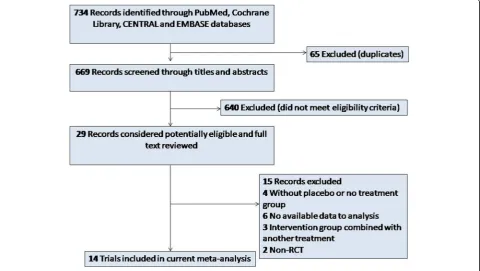
A total of 734 articles were retrieved. After 65 duplicate papers were removed, 640 irrelevant citations were ex-cluded based on review of titles and abstracts. Intensive full-text review of the 29 included articles further elimi-nated 15 articles. Finally, a total of 14 studies [10–23] published between 2010and 2018 were assessed for eligi-bility in the meta-analysis (Fig.1).
Quality assessment
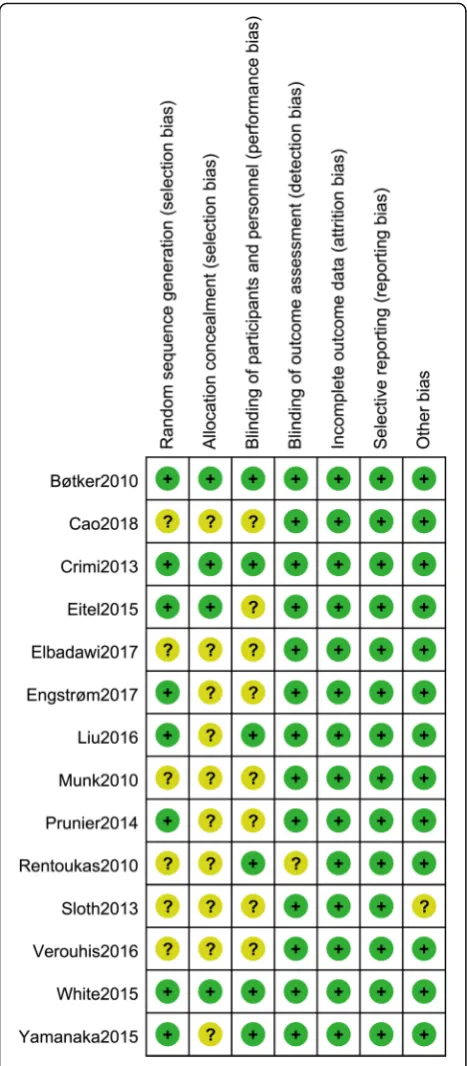
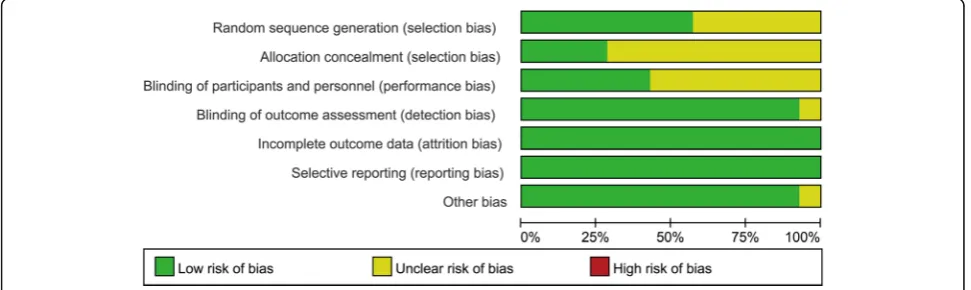
Eight studies [10,12,13,15,16,18,22,23] used random sequence generation by computer-generated random se-quence, while the remaining 6 studies were just reported as randomized trials and offered no description on randomization methods. Four trials [10, 12, 13,22] allo-cated patient concealment by sealed envelope. Blinding methods were used in 6 trials [10, 12, 16, 19, 22, 23]. Blinding of outcome assessment independent of treat-ment was used in most trials except 1 trial [19]. None of the included studies had incomplete report or selective report. Overall, 6 studies [10,12, 13, 16,22,23] were of high methodological quality, and the rest were of moder-ate quality. A summary of the quality assessment results for all of the trials is shown in Fig.2and Fig.3.
Characteristics of study selection
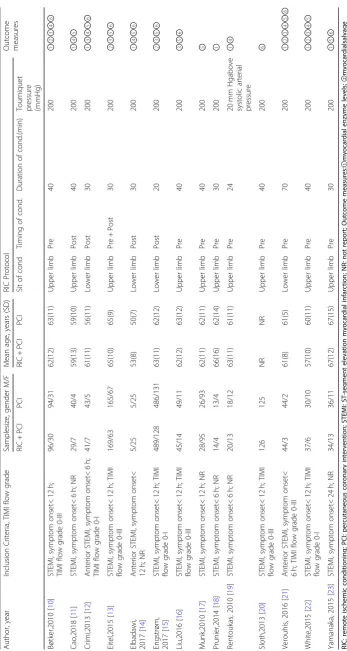
Totally, 3165 STEMI patients were included in this meta-analysis, 1585 receiving RIC plus primary PCI (group A), and 1580 receiving primary PCI alone (group B). Studies included STEMI patients with symptom on-set < 24 h, TIMI flow grade > I in 3 trials [12, 15, 22]. Their mean age ranged from 50 to 80 years, and the sample size ranged from 35 to 1234. RIC protocols were similar among most of the studies. The characteristics of the included studies are depicted in Table1.
Outcomes and synthesis of results
Myocardial enzyme levels
Nine studies [10–12,14,18,19,21–23]reported myocar-dial enzyme levels, including a total of 945 patients (474 patients in group A and 471 in group B). There was stat-istical between-study heterogeneity in SMD of studies (P= 0.003, I2= 65%); therefore, we used the random ef-fects model for merging. The pooled estimates of effect sizes showed that the difference of myocardial enzyme levels between the two groups was statistically significant
(SMD =−0.36, 95% CI (−0.59, −0.13), P= 0.002)
(Fig.4).
Myocardial salvage index
Five studies [10,13, 15, 21, 22] reported myocardial sal-vage index, including a total of 922 patients (463 in group A and 459 in group B). There was statistical between-study heterogeneity in SMD of studies (P= 0.07, I2= 54%); therefore, we used the random effects model for merging. The pooled estimates of effect sizes showed that the difference of myocardial salvage index between the two groups was statistically significant (MD = 0.06, 95% CI (0.02, 0.10),P= 0.008) (Fig.5).
Infarct size
Seven studies [10,12,13,15,16,21,22] reported infarct size, including a total of 1236 patients (614 in group A and 622 in group B). There was statistical between-study
heterogeneity in SMD of studies (P= 0.02, I2= 61%); therefore, we used the random effects model for mer-ging. The pooled estimates of effect sizes showed that the difference of infarct size between the two groups was not statistically significant (MD =−1.67, 95% CI (−3.46, 0.11), P= 0.07) (Fig.6).
TIMI flow grade III
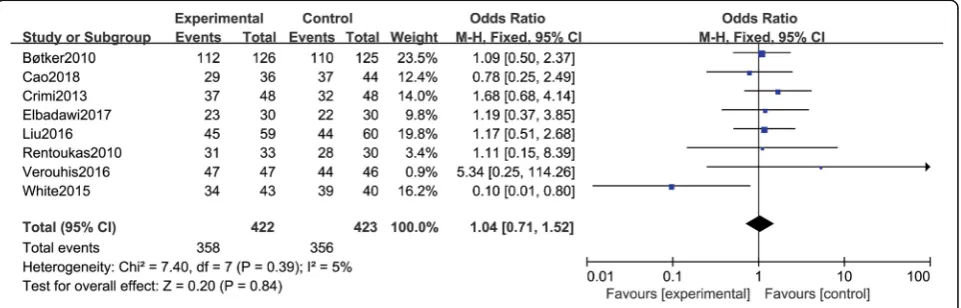
Eight studies [10–12, 14, 16, 19, 21, 22] reported TIMI flow grade III, including a total of 845 patients (422 in group A and 423 in group B). There was no statistical between-study heterogeneity in OR of studies (P= 0.39, I2= 5%); therefore, we used the fixed effects model for merging. The pooled estimates of effect sizes showed that the difference of TIMI flow grade III between the two groups was not statistically significant (OR = 1.04, 95% CI (0.71, 1.52),P= 0.84) (Fig.7).
LVEF
Ten studies [11–17, 21–23] reported LVEF, including a total of 1521 patients (746 in group A and 775 in group B). There was statistical between-study heterogeneity in SMD of studies (P= 0.002, I2= 66%); therefore, we used the random effects model for merging. The pooled esti-mates of effect sizes showed no statistically significant difference in LVEF between the two groups(MD = 0.74, 95% CI (−0.80, 2.28),P= 0.35) (Fig.8).
MACCE
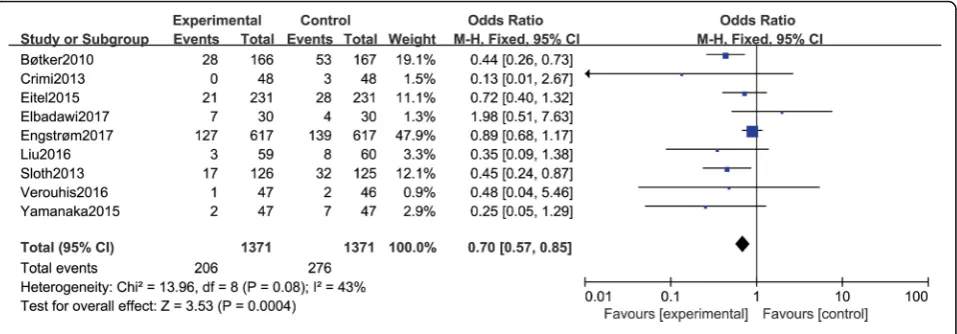
Nine studies [10, 12–16, 20, 21, 23] reported MACCE, including a total of 2742 patients (1371 in group A and 1371 in group B). There was no statistical between-study heterogeneity in OR of studies (P= 0.08, I2= 43%); there-fore, we used the fixed effects model for merging. The pooled estimates of effect sizes showed t statistically sig-nificant difference in MACCE between the two groups (OR = 0.70, 95% CI (0.57, 0.85),P= 0.0004) (Fig.9).
Discussion
The results of this meta-analysis showed that RIC in pa-tients undergoingPCI for STEMI was significantly asso-ciated with lower myocardial edema levels, myocardial salvage index and incidence of MACCEs. No benefit was demonstrable ininfarct size, TIMI flow grade III or left ventricular ejection fraction (LVEF).
PCI is the primary measure to treat acute STEMI clin-ically. Although acute restoration of myocardial blood flow is overall beneficial, the procedure in itself may jeopardize the myocardium. Patients receiving such treatment will risk sustaining reperfusion injury, which could potentially increase the final myocardial infarct size. Therefore, how to prevent and reduce reperfusion injury is important for myocardial protection and prognosis of patients. Remote ischemic pre- and post-conditioning, induced by repeated brief periods of limb ischemia before index ischemia, are recommended
Fig. 4Comparison of myocardial enzyme levels between group A and group B
therapy for cardioprotection and myocardial injury pre-vention. RIC can provide a variety of protections against ischemic myocardium by limiting the myocardial infarct size and edema, reducing reperfusion-induced apoptosis, improving ventricular function (increased left ventricular diastolic pressure and decreased right ventricular dia-stolic pressure), and regulating myocardial remodeling after infarction [24]. Despite its potential clinical signifi-cance, the exact mechanisms of RIC have not yet been elucidated. The humoral and neural signaling pathways, as well as the systemic inflammatory response, may work in combination [25,26].
Most included trials in this study chose a segment of the distal upper extremity or lower extremity prior to prolonged ischemia of the heart, and then inflate the cuff for 5 min (pressure reaches 200 mmHg) followed by 5 min. The deflation was performed continuously for 3 to 4 cycles as RIC protocol for ischemia treatment. Reperfusion profiles in STEMI depend on several patient-related factors. For example, age has a great influence on the regulatory ability of the cardiovascular system. Regardless of animal experiments or clinical trials, the protective effect of ische-mic preconditioning and post-conditioning on older age is significantly reduced [27]. Although some studies have speculated that the effective thresholds for ischemic
preconditioning and post-conditioning have increased for older cases, it is proposed to adopt higher intensity treat-ment measures to achieve effective cardio-protection, but some studies have shown that the intensified treatment measures still fail to overcome the decline in effectiveness. In addition, comorbidities also have an effect on the effects of RIC [27]. A variety of chronic diseases such as diabetes, obesity, hyperlipidemia, hypertension, and cardiac hyper-trophy, etc. have negative effects on ischemic precondition-ing and post-treatment [28, 29]. It is worth noting that sulphonyl urea anti-hyperglycemic agents impair the activa-tion of ATP-sensitive potassium channels and thus affect the effect of preconditioning. The above comorbidities are also important risk factors for STEMI. There are many cases of STEMI combined with the above chronic diseases, which largely limits the clinical application of RIC.
There is a certain degree of heterogeneity between the studies in this meta-analysis. The main cause of hetero-geneity may be the different limb ischemic conditioning schemes (e.g. number of times, ischemic duration, site of action, and pretreatment distance from PCI). The effect of ischemic treatment on the upper and lower extrem-ities can also vary with the number of muscles in the upper and lower limbs. Of course, the heterogeneity may also be due to the age of the patient and whether it is
Fig. 6Comparison of infarct size between group A and group B
due to chronic diseases such as diabetes and obesity sta-tus.What’s more, factors include time of ischemia, and TIMI flow grade at admission have been recognized as determinants of post-PCI myocardial injury. Initial cor-onary arteriography of the myocardial visible collateral circulation (TIMI flow grade > I) in STEMI patients is protective and may develop smaller infarct size, regard-less of protection strategy [30]. Evaluating myocardial blood flow in certain emergencies is challenging, so the protective effect of these patients by intervention should be ruled out. In this analysis, only 3 trials [12,15,22 ]ex-cluded patients with TIMI flow grade > I, and other trials included patients with TIMI flow grade II – III, which may influence the cardioprotective effect of RIC.
Several limitations of current analysis should be dis-cussed. First, the RIC protocol was not uniform. 9 trials were performed on ischemic preconditioning, 4 on is-chemic post-conditioning, and 1 on isis-chemic precondi-tioning and post-condiprecondi-tioning. Compared with ischemic preconditioning, ischemic post-conditioning is applied after ischemia has occurred and is more clinically operable. In view of the unpredictability of clinical
myocardial ischemic events, compared with precondi-tioning, ischemic post-conditioning is more clinically op-erable after the onset of ischemia, so its application prospects for target organ protection are the most promising. However, ischemic preconditioning provides intervention in the time window of ischemia, does not prolong treatment time, is ethically accepted by people, and has good clinical feasibility. Future clinical trials should further verify the clinical effects of these two methods. Four studies chose the lower limb for remote treatment, and 9 studies chose the upper limb. Kolbens-chlag et al. [31] conducted further studies on remote limb selection and found that the ischemic treatment of the upper and lower limbs can increase the blood flow of the skin, but the RIC of the upper limb can better trigger the protective effect. Second, the 14 trials in-cluded in this study are mostly small and / or single-center trials with varying quality. All RCTs in this meta-analysis used the different trial designs. Thus, this meta-analysis did not provide reliable results on the ef-fects of RIC added to PCI for prevention of reperfusion injury in STEMI patients. In the future, relevant research
Fig. 8Comparison of LVEF between group A and group B
needs to be further improved from the following aspects: increasing the sample size; proper random allocation and allocation of hidden programs; sufficient follow-up duration to observe the short-term and long-term ef-fects; stratified analysis of RIC protocol, TIMI flow grade, and more comprehensive evaluation of the effi-cacy of RIC. Thirdly, due to the retrospective nature of all the included studies, bias still exists, which may im-pact the comparison of clinical outcomes.
Conclusions
In this meta-analysis based on randomized clinical trials, RIC was associated with lower myocardial edema levels and myocardial salvage index and decreased the inci-dence of MACCE, while it had no significant beneficial effect on infarct size, TIMI flow grade III or LVEF. These findings suggest that RIC is a promising adjunctive treat-ment to PCI for theprevention of reperfusion injury in STEMI patients; however, multi-center, high-quality studies with a larger sample size, are required to verify its clinical efficacy.
Abbreviations
RIC:remote ischemic conditioning; PCI: percutaneous coronary intervention; STEMI: ST-segment elevation myocardial infarction; LVEF: left ventricular ejection fraction; MACCEs: major adverse cardiac and cerebrovascular events; CI: confidence interval; OR, odds ratio
Acknowledgements
None
Availability of data and material
The datasets generated and analyzed during the current study are available from the corresponding author on reasonable request.
Funding
This study was supported by the National Science Foundation of China (No. 8166020210).
Authors’contributions
All authors have made substantial contributions to conception and design of the study, literature searching, data extraction from the collected literature and data analysis; Ren Gong wrote the manuscript; Yan-Qing Wu revised the manuscript; All authors approved the final version of the manuscript.
Ethics approval and consent to participate
Not applicable.
Consent for publication
Not applicable.
Competing interests
There is no competing interest.
Publisher’s Note
Springer Nature remains neutral with regard to jurisdictional claims in published maps and institutional affiliations.
Received: 25 October 2018 Accepted: 8 January 2019
References
1. Windecker S, Kolh P, Alfonso F, et al. 2014 ESC/EACTS guidelines on myocardial revascularization: the task force on myocardial revascularization
of the European Society of Cardiology (ESC) and the European Association for Cardio-Thoracic Surgery (EACTS)developed with the special contribution of the European Association of Percutaneous Cardiovascular Interventions (EAPCI).Eur Heart J.2014;35(37)(1522-9645 (electronic)):2541-2619.
2. Lowenstein CJ. Myocardial reperfusion injury. N Engl J Med. 2007;357(23): 2409–10.
3. Gersh BJ, Stone GW, White HD, Jr HD. Pharmacological facilitation of primary percutaneous coronary intervention for acute myocardial infarction: is the slope of the curve the shape of the future? JAMA. 2005;293(8):979–86. 4. Heusch G, Bøtker HE, Przyklenk K, Redington A, Yellon D. Remote ischemic
conditioning. J Am Coll Cardiol. 2015;65(2):177.
5. Ovize M, Thibault H, Przyklenk K. Myocardial conditioning opportunities for clinical translation. Circ Res. 2013;113(4):439–50.
6. Staat P, Rioufol G, Piot C, et al. Postconditioning the human heart. Circulation. 2005;112(14):2143–8.
7. Zhao ZQ, Corvera JS, Halkos ME, et al. Inhibition of myocardial injury by ischemic postconditioning during reperfusion: comparison with ischemic preconditioning. American Journal of Physiology Heart & Circulatory Physiology. 2003;285(2):H579.
8. Higgins J. Green SR. The Cochrane Collaboration: Cochrane Handbook for Systematic Reviews of Interventions; 2011.
9. Liberati A, Altman D, Tetzlaff J, et al. The PRISMA statement for reporting systematic reviews and meta-analyses of studies that evaluate healthcare interventions: explanation and elaboration.Epidemiology Biostatistics & Public Health.2009;6(1756–1833 (Electronic)):e1-e34.
10. Bøtker HE, Kharbanda R, Schmidt MR, et al. Remote ischaemic conditioning before hospital admission, as a complement to angioplasty, and effect on myocardial salvage in patients with acute myocardial infarction: a randomised trial. Lancet. 2010;375(9716):727–34.
11. Cao B, Wang H, Zhang C, Xia M, Yang X. Remote ischemic Postconditioning (RIPC) of the upper arm results in protection from cardiac ischemia-reperfusion injury following primary percutaneous coronary intervention (PCI) for acute ST-segment elevation myocardial infarction (STEMI). Med Sci Monit. 2018;24:1017–26.
12. Gabriele C, Silvia P, Claudia R, et al. Remote ischemic post-conditioning of the lower limb during primary percutaneous coronary intervention safely reduces enzymatic infarct size in anterior myocardial infarction: a randomized controlled trial. Jacc Cardiovasc Interv. 2013;6(10):1055–63. 13. Eitel I, Stiermaier T, Rommel KP, et al. Cardioprotection by combined
intrahospital remote ischaemic perconditioning and postconditioning in ST-elevation myocardial infarction: the randomized LIPSIA CONDITIONING trial. Eur Heart J. 2015;36(44):3049–57.
14. Elbadawi A, Awad O, Raymond R, Badran H, Mostafa AE, Saad M. Impact of remote ischemic Postconditioning during primary percutaneous coronary intervention on left ventricular remodeling after Anterior Wall ST-segment elevation myocardial infarction: a single-center experience. Int J Angiol. 2017;26(04):241–8.
15. Engstrøm T, Kelbæk H, Helqvist S, et al. Effect of ischemic Postconditioning during primary percutaneous coronary intervention for patients with ST-segment elevation myocardial infarction: a randomized clinical trial. JAMA Cardiol. 2017;2(5):490.
16. Liu Z, Zhao L, Hong D, Gao J. Remote ischaemic preconditioning reduces myocardial ischaemic reperfusion injury in patients with ST-elevation myocardial infarction undergoing primary percutaneous coronary intervention. Acta Cardiol. 2016;71(5):596–603.
17. Munk K, Andersen N, Schmidt M, Nielsen S, Terkelsen C, Sloth E. Remote ischemic conditioning in patients with myocardial infarction treated with primary angioplasty: impact on left ventricular function assessed by comprehensive echocardiography and gated single-photon emission CT. Circ Cardiovasc Imaging. 2010;3:656–62.
18. Prunier F, Angoulvant D, Saint EC, et al. The RIPOST-MI study, assessing remote ischemic perconditioning alone or in combination with local ischemic postconditioning in ST-segment elevation myocardial infarction. Basic Res Cardiol. 2014;109(2):400.
19. Rentoukas I, Giannopoulos G, Kaoukis A, Kossyvakis C, Raisakis K, Driva M. Cardioprotective Role of Remote Ischemic Periconditioning in Primary Percutaneous Coronary Intervention.JACC: CARDIOVASCULAR INTERVENTIONS. 2010;3(1):49–55.
ischaemic conditioning as an adjunct to primary percutaneous coronary intervention. Eur Heart J. 2013;35(3):168.
21. Verouhis D, Sörensson P, Gourine A, et al. Effect of remote ischemic conditioning on infarct size in patients with anterior ST-elevation myocardial infarction. Am Heart J. 2016;181:66.
22. White SK, Frohlich GM, Sado DM, et al. Remote ischemic conditioning reduces myocardial infarct size and edema in patients with ST-segment elevation myocardial infarction. Jacc Cardiovasc Interv. 2015;8(1):178–88. 23. Yamanaka T, Kawai Y, Miyoshi T, Mima T, Takagaki K. Remote ischemic
preconditioning reduces contrast-induced acute kidney injury in patients with ST-elevation myocardial infarction: a randomized controlled trial. Int J Cardiol. 2015.
24. Rohailla S, Clarizia N, Sourour M, et al. Acute, delayed and chronic remote ischemic conditioning is associated with downregulation of mTOR and enhanced autophagy signaling. PLoS One. 2014;9(10):e111291.
25. Redington KL, Disenhouse T, Strantzas SC, et al. Remote cardioprotection by direct peripheral nerve stimulation and topical capsaicin is mediated by circulating humoral factors. Basic Res Cardiol. 2012;107(2):241. 26. Costa FL, Teixeira RK, Yamaki VN, et al. Remote ischemic conditioning
temporarily improves antioxidant defense. J Surg Res. 2015;200(1):105–9. 27. Lochner A, Marais E, Genade S, Huisamen B, Du TE, Moolman JA. Protection
of the ischaemic heart: investigations into the phenomenon of ischaemic preconditioning. Cardiovascular Journal of Africa. 2009;20(1):43–51. 28. Wider J, Przyklenk K. Ischemic conditioning: the challenge of protecting the
diabetic heart. Cardiovasc Diagn Ther. 2014;4(5):383–96. 29. Peart JN, Headrick JP. Clinical cardioprotection and the value of
conditioning responses. American Journal of Physiology Heart & Circulatory Physiology. 2009;296(6):H1705.
30. Chenghui Zho, Yuntai Ya, Zhe Zhen, Junsong Gon, Wan W. Stenting technique, gender, and age are associated with cardioprotection by ischaemic postconditioning in primary coronary intervention: a systematic review of 10 randomized trials.European Heart Journal.2012:2–9. 31. Kolbenschlag J, Sogorski A, Harati K, et al. Upper extremity ischemia is