On the logical strengths of partial solutions
to mathematical problems
Laurent Bienvenu, Ludovic Patey and Paul Shafer
Abstract
We use the framework of reverse mathematics to address the question of, given a mathematical problem, whether or not it is easier to find an infinite partial solution than it is to find a complete solution. Following Flood [‘Reverse mathematics and a Ramsey-type K¨onig’s lemma’,J. Symb. Log.77 (2012) 1272–1280], we say that aRamsey-typevariant of a problem is the problem with the same instances but whose solutions are the infinite partial solutions to the original problem. We study Ramsey-type variants of problems related to K¨onig’s lemma, such as restrictions of K¨onig’s lemma, Boolean satisfiability problems and graph coloring problems. We find that sometimes the Ramsey-type variant of a problem is strictly easier than the original problem (as Flood showed with weak K¨onig’s lemma) and that sometimes the Ramsey-type variant of a problem is equivalent to the original problem. We show that the Ramsey-type variant of weak K¨onig’s lemma isrobustin the sense of Montalb´an [‘Open questions in reverse mathematics’,
Bull. Symb. Log. 17 (2011) 431–454]: it is equivalent to several perturbations. We also clarify the relationship between Ramsey-type weak K¨onig’s lemma and algorithmic randomness by showing that Ramsey-type weak weak K¨onig’s lemma is equivalent to the problem of finding diagonally non-recursive functions and that these problems are strictly easier than Ramsey-type weak K¨onig’s lemma. This answers a question of Flood.
1. Introduction
This work presents a detailed study of the question given some mathematical problem, is it easier to find an infinite partial solution than it is to find a complete solution? that was implicitly raised by Flood in [9]. By ‘mathematical problem’, we simply mean any theorem from ordinary mathematics that can be easily formulated in the language of instances and solutions in the sense illustrated by the key example of K¨onig’s lemma. K¨onig’s lemma states that every infinite, finitely branching tree has an infinite path. The corresponding problem is thus that of finding an infinite path through a given infinite, finitely branching tree. The problem’s instances are the infinite, finitely branching trees T, and the solutions to a given instance T are the infinite paths throughT.
Formally, we consider Π12statements of the form
∀X(ϕ(X)→ ∃Y ψ(X, Y)).
Received 17 August 2015; revised 2 September 2016; published online 13 April 2017. 2010Mathematics Subject Classification03B30, 03F35, 05C15, 05D10, 03D32 (primary).
Laurent Bienvenu and Ludovic Patey are funded by the John Templeton Foundation (‘Structure and Randomness in the Theory of Computation’ project). The opinions expressed in this publication are those of the authors and do not necessarily reflect the views of the John Templeton Foundation. Laurent Bienvenu was also supported by theANRgrant RaCAF ANR-15-CE40-0016-01. Paul Shafer was an FWO Pegasus Long Postdoctoral Fellow at Ghent University. He was also supported by the Fondation Sciences Math´ematiques de Paris.
Ce2017 The Authors. The Transactions of the London Mathematical Society is copyright CeLondon Mathematical Society. This is an open access article under the terms of the Creative Commons Attribution
Every such statement corresponds to a problem whose instances are the setsXsuch thatϕ(X) and whose solutions to a given instance X are the setsY such thatψ(X, Y). In the example of K¨onig’s lemma,ϕ(X) expresses that X is an infinite, finitely branching tree, andψ(X, Y) expresses thatY is an infinite path throughX.
The problems we consider come with natural notions of infinite partial solutions. Again, consider K¨onig’s lemma, where we specify that an infinite, finitely branching tree means an infinite, finitely branching subtree of N<N. For such a tree T, a path through T, which we think of as a complete solution to the instance T, is a function f: N→N such that
∀n(f(0), f(1), . . . , f(n−1) ∈T). An infinite partial solution to the instance T is then a functiong:X →Nfor an infiniteX ⊆Nsuch that there is a function f:N→Nthat extends
g and is a path through T. Following Flood [9], we call the variant of a problem in which we ask not for complete solutions but for infinite partial solutions the Ramsey-type variant of the problem. Thus, for example, Ramsey-type K¨onig’s lemma is the problem of producing an infinite partial path (in the sense described above) through an infinite, finitely branching tree. The label ‘Ramsey-type’ comes from an analogy with the infinite versions of Ramsey’s theorem. Any infinite subset of an infinite homogenous set for some coloring is also an infinite homogeneous set for that coloring. The Ramsey-type variant of a problem has this same flavor: an infinite piece of a partial solution to some instance of the problem is also a partial solution to that same instance.
Thus, given a mathematical problem, we ask whether or not it can be solved using its Ramsey-type variant. If the answer is positive, then finding partial solutions to the problem is just as hard as finding complete solutions. If the answer is negative, then it is easier to find partial solutions than it is to find complete solutions. Reverse mathematics, a foundational program whose aim is to classify the theorems of ordinary (that is, non-set-theoretic) mathematics according to their provability strengths, provides an appropriate framework in which to analyze such questions. In reverse mathematics, theorems are formalized in the language of second-order arithmetic (which even suffices for theorems concerning the structure of the real line or analysis on complete separable metric spaces), and the implications among them are studied over a base theory called RCA0. Roughly speaking, the theorems provable inRCA0 are those that are computable in the sense illustrated by the example of the intermediate value theorem. Given a continuous real-valued function which is negative at 0 and positive at 1, one can compute an x∈(0,1) such thatf(x) = 0 essentially by using the usual interval-halving procedure. This argument can be formalized to a proof of the intermediate value theorem in RCA0(see [34, Theorem II.6.6]).
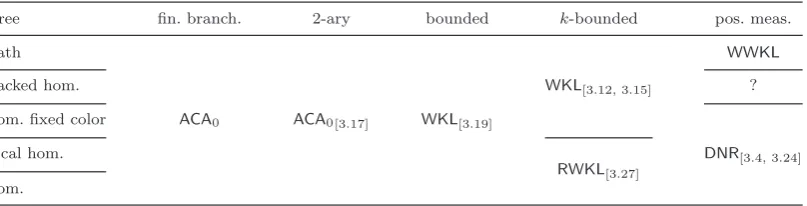
Implication over RCA0 provides a natural classification of logical strength. We think of a theorem ϕ as being at least as strong as a theorem ψ if ϕ→ψ can be proved in RCA0. Similarly, we think ofϕandψas having equivalent strength ifϕ↔ψcan be proved inRCA0. Thus we may, for example, formalize the question of whether or not it is easier to find partial paths through infinite, finitely branching trees than it is to find complete paths by asking whether or not the statement ‘for every infinite, finitely branching tree there exists an infinite partial path implies K¨onig’s lemma’ can be proved inRCA0. Flood [9] was the first to consider such questions and he showed (among other results) that the Ramsey-type variant of weak K¨onig’s lemma (which is K¨onig’s lemma restricted to infinite, binary branching trees) is indeed easier than weak K¨onig’s lemma. In contrast, we show that the forgoing example of K¨onig’s lemma for arbitrary infinite, finitely branching trees is equivalent to its Ramsey-type variant (Theorem 3.17). Thus for some problems it is easier to find infinite partial solutions and for other problems it is not.
(an important statement defined in Section 2.4), but he left as an open question whether or notRWKLis strictly stronger thanDNR. We answer Flood’s question by showing thatRWKL is indeed strictly stronger thanDNR(Corollary6.12), and we also show thatDNRis equivalent to the Ramsey-type variant of weak weak K¨onig’s lemma (which is K¨onig’s lemma restricted to binary branching trees of positive measure; Theorem3.4)†. ThusRWKLis distinct from every theorem previously studied in the context of reverse mathematics. This raises the question of whetherRWKLis a sort of logical artifact or whetherRWKLcharacterizes the logical strength of a fundamental mathematical idea. We propose that RWKL is indeed fundamental, in no small part because the basic question that inspires RWKL, that is, the question of whether or not it is easier to find an infinite partial solution to a problem than to find a complete solution, is so natural. In order to provide further support for RWKL, we prove a number of theorems which, together, suggest that RWKL is robust in the informal sense proposed by Montalb´an [26]. Theorem 3.27shows thatRWKL is equivalent to several small perturbations. Much more significantly, in Sections 4 and 5 we show that RWKL is equivalent to several quite large perturbations. In these sections, we consider statements that are equivalent to weak K¨onig’s lemma (compactness for propositional logic in Section 4 and graph coloring in Section 5) and show that their corresponding Ramsey-type variants are equivalent toRWKL.
RWKL is also of significant technical interest because it provides a sufficient amount of compactness for many separation results concerning Ramsey-type statements. For example, Seetapun’s theorem [33] (separating RT22 from ACA0), Wang’s separation of the free set and thin set theorems from ACA0 [36], and various recent separations of Patey [31, 32] can be streamlined by using models of RWKL in place of models of WKL. Many computability-theoretic properties are preserved by both RT22 and WKL, such as cone avoidance [33], hyperimmunity [29] and fairness [31]. Explicit use of models ofRWKLis helpful when proving that RT22 preserves a property which is not preserved by WKL, such as constant-bound-enumeration avoidance [24]. In particular, Liu’s theorems [23, 24], that RT22 does not imply WKL or WWKL, can be simplified by making explicit use of models of RWKL. In this sense, using of models of RWKL rather than of WKLis more general because it facilitates proving preservations of more computability-theoretic properties.
The paper is organized as follows. In the next section, we present the necessary reverse mathematics background. In Section3, we study several Ramsey-type variants of full, bounded, weak, and weak weak K¨onig’s lemma. The remainder of the paper focuses on Ramsey-type variants of theorems equivalent to weak K¨onig’s lemma. In Section 4, we study Ramsey-type variants of the compactness theorem for propositional logic. In Section5, we study Ramsey-type variants of graph coloring theorems. In Section6, we prove several non-implications concerning the Ramsey-type theorems, including thatDNRdoes not imply RWKL.
1.1. Basic notation
We follow the standard notation from computability theory. (Φe)e∈N is an effective list of all partial recursive functions.We= dom(Φe) is theeth r.e. set. These relativize to any oracleX, and we denote the corresponding lists by (ΦXe)e∈Nand (WeX)e∈N.
Identify eachk∈Nwith the set{0,1, . . . , k−1}. For k∈N∪ {N} ands∈N, ks is the set of strings of length sover k,k<s is the set of strings of length < s overk, k<N is the set of finite strings over k, andkN is the set of infinite strings overk. The length of a finite string
σ is denoted |σ|. For i∈N and σ a finite or infinite string, σ(i) is the (i+ 1)th value of σ. For finite or infinite strings σ and τ, σ is a prefix of τ (written στ) if dom(σ)⊆dom(τ) and (∀i∈dom(σ))(σ(i) =τ(i)). For ann∈Nand a string (finite or infinite)σof lengthn,
σn=σ(0), σ(1), . . . , σ(n−1)is the initial segment ofσof lengthn.
A tree is a set T ⊆N<N such that ∀σ∀τ(σ∈T∧τσ→τ∈T). If T is a tree and
s∈N, thenTs is the set of strings inT of length s. Anf ∈NNis a path through a tree T if (∀n∈N)(f n∈T). The set of paths throughT is denoted [T].
For k∈N∪ {N}, the space kN is topologized by viewing it as i∈Nk, giving each copy of
k the discrete topology, and giving the product the product topology. Basic open sets, also called cylinders, are sets of the formσ={f ∈kN:f σ}forσ∈k<N. Open sets are of the form σ∈Wσfor W ⊆k<N. If the setW is an r.e. subset ofk<N, thenσ∈Wσis said to be r.e.(oreffectively)open. We identify the space 2Nof infinite binary strings withP(N) by equating each subset ofNwith its characteristic string as usual. 2Nis compact, and its clopen sets are exactly the finite unions of cylinders. The uniform(or Lebesgue)measure μon 2N is the Borel probability measure for which (∀σ∈2<N)(μ(σ) = 2−|σ|).
It is a convention, when working in second-order arithmetic, to use the symbol ‘ω’ to refer to the standard natural numbers and to use the symbol ‘N’ to refer to the first-order part of a possibly non-standard model of some fragment of arithmetic. We follow this convention. For example, the definitions above use ‘N’ because they are intended to be interpreted in possibly non-standard models. We use ‘ω’ when we explicitly build a structure whose first-order part is standard.
2. Reverse mathematics background
Reverse mathematics is a foundational program, introduced by Friedman [12] and developed by Friedman and by Simpson, whose goal is to classify the theorems of ordinary mathematics according to their provability strengths. Simpson’s book [34] is the standard reference. A truly remarkable phenomenon is that five equivalence classes, called the Big Five (in order of increasing strength: RCA0, WKL0, ACA0, ATR0, and Π11−CA0), emerge and classify the majority of usual theorems. The Big Five classes also have satisfying interpretations as the ability to perform well-known computability-theoretic operations. For example, RCA0 corresponds to the ability to perform Turing reductions and Turing joins, whereas ACA0 corresponds to the ability to perform Turing reductions, Turing joins, and Turing jumps.
There is, however, a notable family of theorems which are not classified by the Big Five. These are what we call the Ramsey-typetheorems, perhaps the most famous of which is Ramsey’s theorem for pairs and two colors. Since the seminal paper of Cholak, Jockusch and Slaman [4], an abundant literature has developed surrounding the strength of Ramsey’s theorem for pairs and related theorems, such as chain-antichain, ascending or descending sequence and the Erd˝os– Moser theorem (see, for example, [15] and [22]). These Ramsey-type theorems do not typically have nice computability-theoretic characterizations of their equivalence classes.
We are primarily concerned with the logical relationships among combinatorial statements (specifically Ramsey-type statements) provable in the systemACA0. Thus we now summarize several of the subsystems of second-order arithmetic below ACA0and the relationships among them.
2.1. Recursive comprehension, weak K¨onig’s lemma and arithmetical comprehension
First we summarize the induction, bounding and comprehension schemes and three of the most basic subsystems of second-order arithmetic. Everything stated here is explained in full detail in [34].
Full second-order arithmetic consists of the basic axioms:
∀m(m+ 1= 0) ∀m∀n(m×(n+ 1) = (m×n) +m)
∀m∀n(m+ 1 =n+ 1→m=n) ∀m∀n(m < n+ 1↔(m < n∨m=n))
∀m(m+ 0 =m) ∀m¬(m <0)
theinduction axiom:
∀X((0∈X∧ ∀n(n∈X→n+ 1∈X))→ ∀n(n∈X));
and the comprehension scheme, which consists of the universal closures of all formulas of the form
∃X∀n(n∈X ↔ϕ(n)),
where ϕ is any formula in the language of second-order arithmetic in which X is not free. We obtain subsystems of second-order arithmetic by limiting induction and comprehension to predicates of a prescribed complexity.
For each n∈ω, the Σ0n (Π0n)induction scheme, denotedIΣ0n (IΠ0n), consists of the universal closures of all formulas of the form
[ϕ(0)∧ ∀n(ϕ(n)→ϕ(n+ 1))]→ ∀nϕ(n),
where ϕis Σ0
n (Π0n). The induction schemes are closely related to the bounding (also called collection) schemes. For each n∈ω, the Σ0
n (Π0n) bounding scheme, denoted BΣ0n (BΠ0n), consists of the universal closures of all formulas of the form
∀a[(∀n < a)(∃m)ϕ(n, m)→ ∃b(∀n < a)(∃m < b)ϕ(n, m)],
where ϕis Σ0 n (Π0n).
Thearithmetical comprehension schemeconsists of the universal closures of all formulas of the form
∃X∀n(n∈X ↔ϕ(n)),
whereϕis an arithmetical formula in whichXis not free. A further restriction of comprehension is the Δ0
1comprehension scheme, which consists of the universal closures of all formulas of the form
∀n(ϕ(n)↔ψ(n))→ ∃X∀n(n∈X ↔ϕ(n)),
where ϕis Σ0
1,ψis Π01, andX is not free inϕ.
RCA0 (for recursive comprehension axiom) encapsulates recursive mathematics and is the usual base system used when comparing the logical strengths of statements of second-order arithmetic. The axioms ofRCA0are the basic axioms,IΣ01, and the Δ01 comprehension scheme. RCA0 proves sufficient number-theoretic facts to implement the codings of finite sets and sequences that are typical in computability theory. Thus insideRCA0, we can fix an enumeration (Φe)e∈N of the partial recursive functions. We can also interpret the existence of the setN<N of all finite strings and give the usual definition of a tree as subset ofN<Nthat is closed under initial segments.
Weak K¨onig’s lemma (WKL) is the statement ‘every infinite subtree of 2<N has an infinite path’, andWKL0 is the subsystemRCA0+WKL.WKL0 captures compactness arguments, and it is strictly stronger than RCA0 (that is,RCA0WKL).
ACA0 (for arithmetical comprehension axiom) is the subsystem axiomatized by the basic axioms, the induction axiom, and the arithmetical comprehension scheme. It can also be obtained by adding the arithmetical comprehension scheme toRCA0.ACA0is strictly stronger thanWKL0, and all of the statements that we consider are provable inACA0.
2.2. Ramsey’s theorem and its consequences
Definition 2.1 (Ramsey’s theorem). Fix n, k∈Nwithn, k >0. A set H ishomogeneous
for a coloring f: [N]n →k (or f-homogeneous) if there is a color c < k such that f([H]n) =
{c}. A coloring f: [N]n→k is stable if for every σ∈[N]n−1 there is a color c such that (∃m)(∀s > m)(f(σ, s) =c). RTnk is the statement ‘for every coloring f: [N]n→k, there is an infinitef-homogeneous set’.SRTnk is the restriction of RTnk to stable colorings.
Definition 2.2(Cohesiveness). LetR = (Ri)i∈Nbe a sequence of subsets ofN. A setC⊆N
is called R-cohesive if C is infinite and ∀i(C⊆∗Ri∨C⊆∗Ri), where A⊆∗B means that
ABis finite.COHis the statement ‘for every sequence of setsR, there is anR-cohesive set’.
For every fixed n∈ω with n3, the statement (∀k2)RTnk is equivalent to ACA0 over RCA0. Indeed, the statement RT32 is already equivalent to ACA0 over RCA0 (see [34, Theorem III.7.6]). Much work was motivated by the desire to characterize the logical strength ofRT22. Among many results, Cholak, Jockusch and Slaman [4] (with a bug-fix in [25]) showed thatRT22splits intoCOHandSRT22overRCA0:RCA0RT22↔COH∧SRT22. By work of Chong, Slaman and Yang [5],SRT22 is strictly weaker thanRT22overRCA0. By work of Hirst [17] and Liu [23],RT22andSRT22are independent ofWKLoverRCA0.
Definition 2.3 (Chain-antichain). A partial order P = (P,P) consists of a set P ⊆N
together with a reflexive, antisymmetric, transitive, binary relationP onP. A chainin P is a set S⊆P such that (∀x, y∈S)(xP y∨yP x). An antichain in P is a setS ⊆P such that (∀x, y∈S)(x=y→x|Py) (where x|Py means that xP y∧yP x). A partial order (P,P) is stable if either (∀i∈P)(∃s)[(∀j > s)(j∈P →iP j)∨(∀j > s)(j∈P →i|P j)] or (∀i∈P)(∃s)[(∀j > s)(j∈P →iP j)∨(∀j > s)(j∈P →i|P j)]. CAC is the statement ‘every infinite partial order has an infinite chain or an infinite antichain’.SCACis the restriction ofCACto stable partial orders.
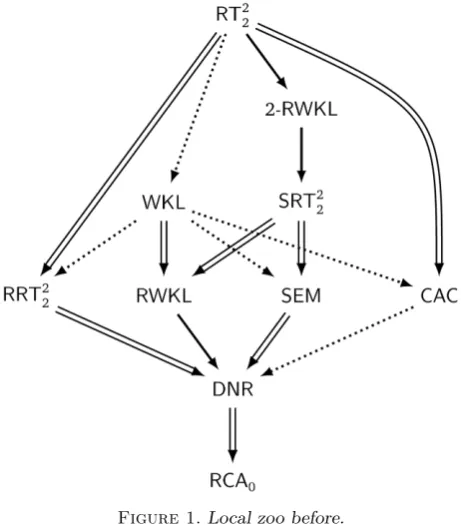
Hirschfeldt and Shore give a detailed study of CACandSCAC (and many other principles) in [15]. They show that RCA0CAC↔COH∧SCAC and that, over RCA0, SCAC is strictly weaker than CACandCACis strictly weaker thanRT22.
Definition 2.4 (The Erd˝os–Moser theorem). A tournament T = (D, T)† consists of a set D⊆N and an irreflexive binary relation on D such that for all x, y∈D with x=y, exactly one ofT(x, y) andT(y, x) holds. A tournamentT istransitiveif the relationT is transitive in the usual sense. A tournamentT isstableif (∀x∈D)(∃n)[(∀y > n)(y∈D→T(x, y))∨(∀y >
n)(y∈D→T(y, x))]. A sub-tournament of T is a tournament of the form (E, E2∩T) for an E⊆D. EM is the statement ‘for every infinite tournament there is an infinite transitive sub-tournament’.SEM is the restriction ofEMto stable tournaments.
It is easy to see that RCA0RT22→EM and that RCA0SRT22→SEM. Furthermore, SEM is strictly weaker than EM over RCA0. This can be deduced from the fact that RCA0EM→2-DNR(Joseph Miller, personal communication; see Section2.4for the definition of 2-DNR) and the fact that there is a (non-standard) model of RCA0+SRT22 (and hence of RCA0+SEM) that contains only low sets [5] (see [28] for a complete explanation). By work of Bovykin and Weiermann [3] and of Lerman, Solomon and Towsner [22], EM and SEM are strictly weaker than RT22 over RCA0 and are independent of CAC and SCAC over RCA0.
2.3. Weak weak K¨onig’s lemma and Martin-L¨of randomness
Let T ⊆2<N be a tree and let q∈Q. The measure of (the set of paths through) T is q
(written μ(T)q) if ∀s(2−s|Ts|q) (recall that Ts is the set of strings in T of length s). A tree T ⊆2<Nhaspositive measure, writtenμ(T)>0, if (∃q∈Q)(q >0∧μ(T)q). Weak weak K¨onig’s lemma (WWKL), introduced by Yu and Simpson [37], is the statement ‘every subtree of 2<Nwith positive measure has an infinite path’.WWKLis strictly weaker thanWKL overRCA0 [37]. It is well known that, overRCA0,WWKLis equivalent to 1-RAN, which is the statement ‘for every set X, there is a set Y that is Martin-L¨of random relative toX’ (see [2], for example).
Avigad, Dean and Rute [2] generalize WWKL to n-WWKL for each n∈ω with n1. Informally, n-WWKL asserts that if X is a set and T ⊆2<N is a tree of positive measure that is recursive in X(n−1), then T has an infinite path. Care must be taken to formalize
n-WWKLwithout implying the existence ofX(n−1)or ofT. Forn∈ωwithn1, lete∈X(n) abbreviate the formula
(Qxn−2). . .(∃x1)(∀x0)(∃σX)[Φσe(xn−2, . . . , x0,0)↓].
The quantifier ‘Q’ is ‘∀’ if n is even and is ‘∃’ if n is odd. In the case n= 1, the formula is simply (∃σX)[Φσe(0)↓]. LetσX(n)abbreviate the formulaσ∈2<N∧(∀e <|σ|)(σ(e) = 1↔e∈X(n)). Let ΦX(n)
e (x) =yabbreviate the formula (∃σX(n))(Φσe(x) =y). Ifϕ(σ) is a formula defining a subtree of 2<Nandq∈Q, then that the measure of this tree is qcan be expressed by a formula that states that for every n there is a sequence σ0, σ1, . . . , σk−1 of distinct strings in 2n such thatk2−n qand (∀i < k)ϕ(σi). Similarly, that the measure of the tree defined by ϕis positive can be expressed by a formula that says that there is a rational
q >0 such that the measure of the tree isq.
Definition 2.5. For n∈ω with n2, n-WWKL is the statement ‘for every X and e, if ΦXe(n−1) is the characteristic function of a subtree of 2<N with positive measure, then this tree has an infinite path’. (That is, there is a function f: N→2 such that
∀m[ΦXe(n−1)(f m) = 1].)
Avigad, Dean and Rute [2] also generalize 1-RAN to n-RAN, which is a formalization of the statement ‘for every X there is a Y that is n-random relative to X’, for all
n∈ω with n1. They prove that the correspondence between 1-WWKL and 1-RAN also generalizes to all nonce BΣ0n is added ton-RAN: for everyn∈ω with n1,n-WWKL and
n-RAN+BΣ0nare equivalent overRCA0. Note that this implies that for everyn∈ωwithn1, RCA0+n-WWKLBΣ0n.
2.4. Diagonally non-recursive functions
A functionf :N→Nisdiagonally non-recursive(DNR) if∀e(f(e)= Φe(e)) and isdiagonally non-recursive relative to a setX(DNR(X)) if∀e(f(e)= ΦXe (e)). An important characterization is that a set computes a DNR function if and only if it computes a fixed-point free function, that is, a functiong:N→Nsuch that∀e(Wg(e)=We).
Definition2.6. DNRis the statement ‘for everyXthere is a functionfsuch that∀e(f(e)=
ΦXe (e))’.
RCA0WWKL→DNR. By work of Ambos-Spies, Kjos-Hanssen, Lempp, and Slaman [1],DNR is strictly weaker thanWWKLoverRCA0.
As with weak weak K¨onig’s lemma and Martin-L¨of randomness, we can define a hierarchy of principles expressing the existence of diagonally non-recursive functions. For everyn∈ω with
n1, we generalize DNR to n-DNR, which is a formalization of the statement ‘for every X
there exists a function that is diagonally non-recursive relative toX(n−1)’.
Definition 2.7. n-DNR is the statement ‘for every X there is a function f such that ∀e(f(e)= Φ Xe(n−1)(e))’.
Of course, the ‘ΦXe(n−1)(e)’ in the above definition should be interpreted as it is in Section2.3. Again,RCA0n-WWKL→n-DNR. We prove this vian-RANto avoid the use of BΣ0n.
Theorem 2.8. RCA0n-RAN→n-DNR.
Proof. LetX be given, and, byn-RAN, letY ben-random relative toX. Definef:N→N by ∀e(f(e) = the number whose binary expansion isY e). We show that f is almost DNR relative to X(n−1). Consider the sequence (Ui)i∈N defined by
Ui=
Z: (∃e > i)(∃σ∈2e)
the binary expansion of ΦXe(n−1)(e) isσandσZ
.
(Ui)i∈N is a uniform sequence of strict (in the sense of [2]) Σ0,X
n sets, and ∀i(μ(Ui)2−i) because Ui contains at most one string of length e for each e > i. Thus (Ui)i∈N is a Σ0n,X -test. Therefore Y /∈Ui for some i∈N. Suppose for a moment that f(e) = ΦXe(n−1)(e) for an
e > i. This means that ΦXe(n−1)(e) is the number whose binary expansion is Y e and thus that Y e⊆Ui, a contradiction. Therefore f is DNR relative to X(n−1) at all e > i. For each ei, we can effectively find an index me> i such that ∀σ∀x(Φσme(x) = Φ
σ
e(e)). Thus
f(me)= ΦXm(ne−1)(me) = Φ
X(n−1)
e (e). So we may obtain a function that is DNR relative to
X(n−1) by changingf(e) tof(me) for all ei.
It follows thatRCA0n-WWKL→n-DNRbecauseRCA0n-WWKL→n-RAN. By work of Slaman [35],RCA0+ 2-RANBΣ20, so we may also conclude thatRCA0+ 2-DNRBΣ02.
2.5. Ramsey-type weak K¨onig’s lemma
In [9], Flood introduced the principle Ramsey-type weak K¨onig’s lemma, a simultaneous weakening of WKL and RT22. Informally, RWKL states that if T ⊆2<N is an infinite tree, then there is an infinite set X that is either a subset of a path through T or disjoint from a path through T (when thinking of the paths throughT as characteristic strings of subsets of
N). When formalizing RWKL, care must be taken to avoid implying the existence of a path throughT and hence implyingWKL.
Definition 2.9. A set H⊆N is homogeneous for a σ∈2<N if (∃c <2)(∀i∈H)(i < |σ| →σ(i) =c), and a set H ⊆N is homogeneous for an infinite tree T ⊆2<N if the tree
{σ∈T:H is homogeneous forσ}is infinite.RWKLis the statement ‘for every infinite subtree of 2<N, there is an infinite homogeneous set’.
Remark 2.10. Flood actually named his principleRKL, forRamsey-type K¨onig’s lemma.
below). The typical scheme is to view a combinatorial principle as a problem comprised of instances and solutions to these instances. For example, with WKL, an instance would be an infinite subtree of 2<N, and a solution to that instance would be a path through the tree. The Ramsey-type variation of a principle has the same class of instances, but instead of asking for a full solution in the problem’s original sense, we ask only for an infinite set consistent with being a solution.
Flood [9] proved that RCA0WKL→RWKL and that RCA0SRT22→RWKL. He also noted that RWKL is strictly weaker than both WKL and SRT22 over RCA0 because WKL and SRT22 are independent over RCA0. The result RCA0SRT22→RWKL can be improved to RCA0SEM→RWKL, which we show now.
Theorem 2.11. RCA0SEM→RWKL.†
Proof. LetT ⊆2<Nbe an infinite tree. For eachs∈N, letσsbe the leftmost element ofTs. We define a tournament R from the tree T. For x < s, if σs(x) = 1, then R(x, s) holds and
R(s, x) fails; otherwise, if σs(x) = 0, then R(x, s) fails and R(s, x) holds. This tournament
R is essentially the same as the coloring f(x, s) =σs(x) defined by Flood in his proof that RCA0SRT22→RWKL [9, Theorem 5], in which he showed that f is stable. By the same argument,R is stable.
Apply SEM to R to get an infinite transitive sub-tournament U. Say that a τ∈U<N
satisfies () if ran(τ) is not homogenous for T with color 1 and (∀k <|τ|)R(τ(k), τ(k+ 1)). Consider a hypothetical τ∈U<N satisfying (). There must be ak <|τ|such that R(s, τ(k)) for cofinitely many s. This is because otherwise there would be infinitely many s such that (∀k <|τ|)R(τ(k), s) and hence infinitely manys for which ran(τ) is homogeneous for σs with color 1, contradicting that ran(τ) is not homogeneous for T with color 1. From the facts that
R(s, τ(k)) for cofinitely manys, that (∀k <|τ|)R(τ(k), τ(k+ 1)), and thatU is transitive, we conclude thatR(s, τ(|τ| −1)) for cofinitely manys.
The proof now breaks into two cases. First, suppose that the τ(|τ| −1) for the τ∈U<N
satisfying () are unbounded. Then, because () is a Σ0
1property of U, there is an infinite set
X consisting of numbers of the form τ(|τ| −1) forτ ∈U<N satisfying (). As argued above, every x∈X satisfiesR(s, x) for cofinitely manys. Thus we can thin out X to an infinite set
H such that (∀x, y∈H)(x < y→R(y, x)). ThusH is homogeneous forT with color 0 because
H is homogeneous forσy with color 0 for everyy∈H.
Second, suppose that theτ(|τ| −1) for the τ∈U<N satisfying () are bounded, say bym. Then H=U{0,1, . . . , m} is homogeneous for T with color 1. To see this, suppose not. Then there is a finiteV ⊆H that is not homogeneous forT with color 1. Letτ∈V<Nbe the enumeration of V in the order given by R: (∀k <|τ|)R(τ(k), τ(k+ 1)). Then τ satisfies (), but τ(|τ| −1)> m. This is a contradiction.
Flood also proved thatRCA0RWKL→DNR, and this result prompted him to ask ifRCA0 DNR→RWKL. Corollary6.12shows that the answer to this question is negative.
3. Ramsey-type K¨onig’s lemma and its variants
We investigate the strengths of several variations ofRWKL. Our variations are obtained in one of two ways. First, we consider Ramsey-type K¨onig’s lemma principles applied to different classes of trees. We show that when we restrict to trees of positive measure, the resulting principle
is equivalent to DNR (Theorem 3.4); that when we allow subtrees of k<N (for a fixed k∈ω
withk2), the resulting principle is equivalent toRWKL(Theorem3.27); that when we allow bounded subtrees ofN<N, the resulting principle is equivalent toWKL(Theorem3.19); and that when we allow arbitrary finitely branching subtrees ofN<N, the resulting principle is equivalent toACA0(Theorem3.17). Second, we impose additional requirements on the homogeneous sets that RWKL asserts exist. If we require that homogeneous sets be homogeneous for color 0 (and restrict to trees that have no paths that are eventually 1), then the resulting principle is equivalent toWKL(Theorem3.12). If we impose a bound on the sparsity of the homogeneous sets, then the resulting principle is also equivalent toWKL(Theorem3.15). If we require that the homogeneous sets be subsets of some prescribed infinite set, then the resulting principle is equivalent to RWKL (Theorem3.27). It is interesting to note that each variation ofRWKL that we consider is either equivalent to RWKL itself or some other well-known statement. We also note that sometimes the Ramsey-type variant of a principle is equivalent to the original principle, as with K¨onig’s lemma for bounded trees and K¨onig’s lemma for arbitrary finitely branching trees; and that sometimes the Ramsey-type variant of a principle is strictly weaker than the original principle, as with weak K¨onig’s lemma and weak weak K¨onig’s lemma.
Several results in this section indicate robustness inRWKL. For example, we may generalize RWKLto subtrees ofk<N(for fixedk∈ωwithk2) without changing the principle’s strength. We explore the robustness of RWKL more fully in Sections4 and 5. This robustness we take as evidence thatRWKL is a natural principle.
3.1. DNR functions and subsets of paths through trees of positive measure
Just as WKLcan be weakened to WWKL by restricting to trees of positive measure, so can RWKL be weakened toRWWKLby restricting to trees of positive measure.
Definition3.1. RWWKLis the statement ‘for every subtree of 2<Nwith positive measure,
there is an infinite homogeneous set’.
Applying RWWKL to a tree in which every path is Martin-L¨of random yields an infinite subset of a Martin-L¨of random set, and every infinite subset of every Martin-L¨of random set computes a DNR function. In fact, computing an infinite subset of a Martin-L¨of random set is equivalent to computing aDNRfunction, as the following theorem states.
Theorem 3.2 (Kjos-Hanssen [20], Greenberg and Miller [13]). For every A∈2ω, A computes aDNRfunction if and only ifAcomputes an infinite subset of a Martin-L¨of random set.
Theorem3.2also relativizes: a setAcomputes a DNR(X) function if and only if it computes an infinite subset of a set that is Martin-L¨of random relative toX. Thus one reasonably expects thatDNRandRWWKLare equivalent overRCA0. This is indeed the case, as we show. The proof makes use of the following recursion-theoretic lemma, which reflects a classical fact concerning diagonally non-recursive functions.
Lemma 3.3. The statement ‘for every set X there is a function g: N3→N such that ∀e, k, n(g(e, k, n)> n∧(|WeX|< k→g(e, k, n)∈/WeX))’ is provable inRCA0+DNR.
Proof. Fix a sequence of functions (bk)k∈N such that, for each k∈N, bk maps N onto
Nk in such a way that b−1
enumerated in WeX if |WeX|i+ 1; and ΦXc(e,i,k)(x)↑ otherwise. Let f be diagonally non-recursive relative to X. Define g by letting g(e, k, n) be the least x > n such that bk(x) =
f(c(e,0, k)), f(c(e,1, k)), . . . , f(c(e, k−1, k)). Suppose for a contradiction that |WeX|< k but that g(e, k, n)∈WeX. Then g(e, k, n) is the (i+ 1)th number enumerated into WeX for some i+ 1< k. Hence ΦXc(e,i,k)(c(e, i, k)) =bk(g(e, k, n))(i). However, by the definition of g,
bk(g(e, k, n))(i) =f(c(e, i, k)). Thus f(c(e, i, k)) = ΦXc(e,i,k)(c(e, i, k)), contradicting that f is
DNR relative toX.
Note that in the statement of the above lemma,WeXneed not exist as a set. Thus ‘|WeX|< k’ should be interpreted as ‘∀s(|We,sX|< k)’, where (We,sX)s∈N is the standard enumeration of
WeX.
Theorem 3.4. RCA0DNR↔RWWKL.†
Proof. The direction RWWKL→DNR is implicit in Flood’s proof thatRCA0RWKL→ DNR([9] Theorem 8). Indeed, Flood’s proof uses the construction of a tree of positive measure due to Jockusch [19]. (For a similar construction proving a generalization ofRWWKL→DNR, see the proof of Lemma3.6.) The proof thatDNR→RWWKLis similar to the original proof of Theorem3.2. However, some adjustments are needed as the original argument uses techniques from measure theory and algorithmic randomness which can only be formalized withinWWKL. We instead use explicit combinatorial bounds.
Assume DNR, and consider a tree T of measure 2−c for some c, which we can assume to be 3 (the reason for this assumption will become clear). For a given set H ⊆N and a value v∈ {0,1}, let ΓHv ={σ∈2<N: (∀i∈H)(σ(i) =v)}, and abbreviate Γv{n} by Γvn. For a tree T and a constant c, let Bad(n, T, c) be the Σ0
1 predicate ‘μ(T∩Γ0n)<2−2c’. In the following claim, {n: Bad(n, T, c)} need not a priori exist as a set, so ‘|{n: Bad(n, T, c)}|<
2c’ should be interpreted in the same manner as ‘|WeX|< k’ in the statement of Lemma 3.3.
Claim. Ifc3 andμ(T)2−c,then|{n: Bad(n, T, c)}|<2c.
Proof. Suppose for a contradiction that |{n: Bad(n, T, c)}|2c, and letB be the first 2c
elements enumerated in{n: Bad(n, T, c)}. For eachn∈B, the treeT∩Γ0
nhas measure<2−2c, which implies that (∀n∈B)(∃i)(|Ti∩Γ0
n|<2i−2c) (recall thatTi is the set of strings inT of lengthi). ByBΣ01, letN0be such that (∀n∈B)(∃i < N0)(|Ti∩Γ0n|<2i−2c), and observe that (∀n∈B)(∀j > N0)(|Tj∩Γ0n|<2j−2c). LetN=N0+ max(B).
On the one hand,
TN ∩n∈BΓ0n
=|TN Γ1B||TN| − |Γ1B∩ {0,1}N|2N−c−2N−2c.
On the other hand,
TN ∩n∈BΓ0n =
n∈BTN ∩Γ0n
n∈B
|TN ∩
Γ0n|2c2N−2c.
Putting the two together, we get that 2N−c−2N−2c2c2N−2c, which is a contradiction for
c3.
Let g be as in Lemma 3.3 for X =T. Given a (canonical index for a) finite set F and a c, we can effectively produce an index e(F, c) such that ∀n(n∈WeT(F,c)↔Bad(n, T ∩
Γ0
F, c)). Recursively construct an increasing sequence h0< h1< h2<· · · of numbers by letting, for each s∈N, Hs={hi: i < s} andhs=g(e(Hs, c2s), c2s+1,max(Hs∪ {0})). Using IΠ01, we prove that ∀s(μ(T∩Γ0
Hs)2−
c2s). For s= 0, this is simply the assumption
μ(T)2−c. Assumingμ(T∩Γ0
Hs)2−
c2s, the claim implies that |WT
e(Hs,c2s)|< c2
s+1. Thus
hs=g(e(Hs, c2s), c2s+1,max(Hs∪ {0}))∈/We(Hs,c2s), and therefore ¬Bad(hs, T ∩Γ0Hs, c2
s).
This means that μ(T∩Γ0 Hs∩Γ
0 hs)2−
c2s+1, which is what we wanted because Γ0 Hs∩Γ
0 hs =
Γ0 Hs+1.
Let H ={hs:s∈N}, which exists by Δ01 comprehension because the sequenceh0< h1<
h2<· · · is increasing. We show that H is homogeneous for T. Suppose for a contradiction that H is not homogeneous for T. This means that there are only finitely many σ∈T
such that H is homogeneous for σ. Therefore at some level s, {σ∈Ts: (∀i∈H)(σ(i) = 0)}=∅. As H∩ {0,1, . . . , s} ⊆Hs, we in fact have that {σ∈Ts: (∀i∈Hs)(σ(i) = 0)}=∅. In other words, T∩Γ0
Hs=∅, which contradictsμ(T∩Γ
0
Hs)2−
c2s. Thus H is homogeneous
forT.
Fix n∈ω withn2. Just as with n-WWKL, it is possible to define n-RWWKL to be the generalization of RWWKL to X(n−1)-computable trees. The equivalence betweenn-DNR and
n-RWWKL persists in the presence of sufficient induction.
Definition 3.5. Forn∈ω with n2,n-RWWKL is the statement ‘for everyX and e, if
ΦXe(n−1) is the characteristic function of a subtree of 2<N with positive measure, then there is an infinite homogeneous set’. (That is, there is an infinite H ⊆Nthat is homogeneous for infinitely many σ∈2<Nsuch that ΦXe(n−1)(σ) = 1.)
Lemma3.6. For everyn∈ωwithn1,RCA0+BΣ0nn-RWWKL→n-DNR.
Proof. Fix a sequence of functions (bk)k∈N such that, for each k∈N, bk is a bijec-tion between N and N[k]. Let X be given. Let e be an index such that ΦX(n−1)
e (σ) = 1 if
(∀i <|σ|)
ΦXi,|(nσ|−1)(i)↓→bi+3
ΦXi,|(nσ|−1)(i)
is not homogeneous forσ
,
and ΦXe(n−1)(σ) = 0 otherwise. It is clear that ΦX
(n−1)
e is the characteristic function of a tree. We need to show that this tree has positive measure. Fix s∈N. By bounded Δ0
n comprehension, which is a consequence of BΣ0n (see, for example, [14, Lemma 2.19]),
Ts={σ∈2s: ΦeX(n−1)(σ) = 1}exists as a finite set. For eachi < s, the proportion of strings in 2smissing fromTson account of ΦXi (n−1) is at most 2−i−2. Therefore|Ts|2−si<s2−i−2 1/2, so the tree indeed has positive measure.
Byn-RWWKL, there is an infinite homogeneous setH for the tree described by ΦXe(n−1). For eachi∈N, letHi denote the set consisting of the i least elements ofH. Definef:N→Nby
f(i) =b−i+31(Hi+3). We finish the proof by showing thatf is DNR relative toX(n−1). Suppose for a contradiction that there is an i∈Nsuch thatf(i) = ΦiX(n−1)(i), and letsbe such that Φi,sX(n−1)(i)↓. By the definition off, we have thatbi−+31(Hi+3) =f(i) = ΦX
(n−1)
i,s (i). By applying the bijectionbi+3, we have thatbi+3(ΦX
(n−1)
i,s (i)) =Hi+3is homogeneous for the tree described by ΦXe(n−1). This is a contradiction because if bi+3(ΦX
(n−1)
i,s (i)) is homogeneous for aσ∈2<N with|σ|> s, then ΦXe(n−1)(σ) = 0.
Proof. Follow the proof thatRCA0DNR→RWWKL from Theorem3.4, but interpret T
as an X(n−1)-computable tree of positive measure in the sense of Section 2.3. The proof of Lemma 3.3 goes through in RCA0 when X is replaced by X(n−1) and DNR is replaced by
n-DNR. The predicate Bad(n, T, c) is now Σ0
n, and the proof of the claim goes through in RCA0+BΣ0n. The functiong exists by the generalization of Lemma3.3, and the functioneis the same as it was before. The set H is constructed from g ande as it was before. Use IΠ0n, a consequence of RCA0+IΣ0n, to prove the analog of∀s(μ(T∩Γ0Hs)2−c2
s
). The rest of the
proof is the same as it was before.
Theorem 3.8. For every n∈ω withn1,RCA0+IΣ0n n-DNR↔n-RWWKL.
Proof. The theorem follows from Lemma3.6and Lemma3.7.
We leave open the question of the exact amount of induction required to prove Lemma 3.6 and Lemma 3.7. It would be particularly interesting to determine whether or not 2-RWWKL impliesBΣ02.
Question3.9. DoesRCA0+ 2-RWWKLBΣ0
2?
In [9], Flood also studies what he calls RKL(1), which is RWKL for Σ01-definable infinite subtrees of 2<N. He notes that RKL(1) is equivalent to RWKL for Π0
2 trees, and thus it follows that RKL(1) is equivalent to RWKL for Δ0
2 trees, a statement which we would call 2-RWKLin the foregoing notation. Flood presents Yokoyama’s proof thatRCA02-RWKL→ SRT22, and Flood asks [9, Question 22] if the reverse implication holds. We show that it does not.
Theorem 3.10. RCA0+SRT2
22-RWKL.
Proof. Over RCA0+BΣ02, 2-RWKL implies 2-RWWKL and, by Lemma 3.6, 2-RWWKL in turn implies 2-DNR. However,SRT22does not imply 2-DNRoverRCA0+BΣ02because there are models of RCA0+BΣ02+SRT22 in which every set is low [5]. In particular, every set in such a structure is computable from 0, so such a structure is not a model of 2-DNR.
3.2. Changing homogeneity constraints
Note that the homogeneous set constructed in the proof of Theorem3.4is always homogeneous for color 0, and we could just as easily have constructed a set homogeneous for color 1. Thus no additional power is gleaned from RWWKLby prescribing the color of the homogeneous set ahead of time.
Corollary 3.11 (to the proof of Theorem 3.4). The following statements are equivalent overRCA0:
(i) DNR (ii) RWWKL
(iii) for every treeT ⊆2<Nof positive measure, there is an infinite set that is homogeneous forT with color0.
eventually 1. For the purposes of the next theorem, ‘T has no path that is eventually 1’ means
∀σ∃n(σ1n∈/T).
Theorem 3.12. The following statements are equivalent overRCA0:
(i) WKL
(ii) for every infinite treeT ⊆2<Nwith no path that is eventually1, there is an infinite set homogeneous for T with color0.
Proof. Clearly (i) →(ii). For (ii) → (i), let S⊆2<N be an infinite tree. We define a tree
T ⊆2<N whose paths have 0’s only at positions corresponding to codes of initial segments of paths throughS. Let (τi)i∈Nbe the enumeration of 2<Nin length-lexicographic order, and note that ∀i(|τi|i). Let
T ={σ∈2<N: (∃τ∈S|σ|)(∀i <|σ|)(σ(i) = 0↔τiτ)}.
T is a tree because ifσ∈T is witnessed byτ∈S andn <|σ|, thenτ n∈S witnesses that
σn∈T. Every string of lengthninS witnesses the existence of a string of lengthninT, so
T is infinite becauseS is infinite.
We show that T has no path that is eventually 1. Consider a σ∈2<N. Choose m and n
such that ∀i(|τi|=m→ |σ|< i <|σ|+n). Suppose for a contradiction that τ∈S witnesses that σ1n∈T. If i is such that τ
i=τm, then |σ|< i <|σ|+n. So, because τ witnesses that σ1n∈T, we have the contradiction (σ1n)(i) = 0. Thus T has no path that is eventually 1.
By (ii), let H be infinite and homogeneous for T with color 0. If i and j are in H with
ij, thenτi andτj are inS with τiτj. This can be seen by considering aσ∈T of length
j+ 1 for which H is homogeneous with color 0 and a τ∈S witnessing that σ∈T. Thus we can define an f ∈2Nbyf =i∈Hτi, and thisf is a path throughS becauseτi∈S for every
i∈H.
We now study a variant of RWKL where the homogeneous sets are required to not be too sparse, namely, everywhere-packed homogeneous sets. This notion is not to be confused with the notion of a packed homogeneous set introduced by Flood [10]. Flood studies the computability-theoretic content of Erd˝os and Galvin’s [8]packedvariants of Ramsey’s theorem. These theorems weaken homogeneity to a property calledsemi-homogeneity, but they require that these semi-homogeneous sets satisfy a certain density requirement. Flood shows that the packed variants of Ramsey’s theorem behave similarly to Ramsey’s theorem. We formulate an everywhere-packed variant of RWKL and prove that it is equivalent to WKL. For this formulation, we consider an alternate definition of homogeneity.
Definition 3.13. A partial function h: ⊆N→N is homogeneous for σ∈N<N if (∀n∈
dom(h))(n <|σ| →σ(n) =h(n)). IfT is an infinite, finitely branching tree, a partial function
h: ⊆N→NishomogeneousforT if the tree{σ∈T:his homogeneous forσ}is infinite.
In Definition 3.13, we always assume that dom(h) exists as a set. This is no real restriction because inRCA0 one can prove that every infinite Σ0
1-definable set has an infinite subset that actually exists as a set. Thus if his infinite, we may always restricthto an infinite subset of dom(h) that exists as a set.
terms of set-homogeneity or in terms of function-homogeneity. However, function-homogeneity lets us impose the density constraints we need for our everywhere-packed variant of RWKL. Function-homogeneity also lets us formulate Ramsey-type variants of full K¨onig’s lemma and of bounded K¨onig’s lemma.
Recall that an order functionis a non-decreasing unbounded functiong:N→N.
Definition3.14. Letgbe an order function. A partial functionh: ⊆N→Nis everywhere-packed forgif∀n(|dom(h)n|g(n)).
Our everywhere-packed variant ofRWKLis equivalent toWKLby an argument that replaces a tree with a version of that tree having sufficient redundancy.
Theorem 3.15. RCA0 proves that, for every order function g satisfying∀n(g(n)n), the following statements are equivalent:
(i) WKL
(ii) for every infinite tree T ⊆2<N, there is an infinite h that is homogeneous for T and everywhere-packed forg.
Proof. Fix an order functiong bounded by the identity.
The direction (i) →(ii) is trivial. If f is a path throughT, thenf is also homogeneous for
T and everywhere-packed forg.
Consider the direction (ii) →(i), and letT be an infinite subtree of 2<N. Define a sequence (un)n∈Nbyu0= 0 andun+1=μi(g(i)un+ 1). Let
S={σ∈2<N: (∃τ ∈T)[|τ|=μi(|σ|< ui)∧(∀i <|σ|)(∀j <|τ|)(i∈[uj, uj+1)→σ(i) =τ(j))]}.
The idea behind S is to ensure enough redundancy so that the domain of every infinite function that is homogeneous for S and everywhere-packed for g intersects each interval [ui, ui+1). For example, ifg(n) =n/2, thenu1= 2,u2= 6, u3= 14,u4= 30, and the string 10101 inT corresponds inS to
u1−u0
11
u2−u1
0000
u3−u2
11111111
u4−u3
0000000000000000
u4−u3
11111111111111111111111111111111.
It is easy to see that ifT is infinite, then so isS. To see thatS is a tree, consider aσ∈S, and let τ∈T witness σ’s membership in S. Given an n|σ|, leti=μi(n < ui) and verify that
τ iwitnesses that σnis inS. Lethbe an infinite function that is homogeneous forS and everywhere-packed forg.
First we show that (∀j)(dom(h)∩[uj, uj+1)=∅). To see this, observe that|dom(h)uj+1|
g(uj+1) because his everywhere-packed for g. By definition, g(uj+1)uj+ 1. Thus, by the finite pigeonhole principle, there must be an iin dom(h)uj+1 withiuj.
Now, for each j, let ij be the least element of dom(h)∩[uj, uj+1). Define a functionf by
f(j) =h(ij). Thisf is a path throughT. To see this, fixnand letσ∈Sun be such thathis homogeneous forσ. Let τ∈T witness that σ∈S, and note that|τ|=n+ 1. For eachj < n, we have that σ(ij) =τ(j) by the choice of ij and the definition of S, and we also have that
σ(ij) =f(j) by the choice of σ and the definition of f. Thus f n=τn, so f n∈T as
desired.
3.3. Ramsey-type K¨onig’s lemma for arbitrary finitely branching trees
equivalent to ACA0 (see [34, Theorem III.7.2]) and that bounded K¨onig’s lemma (that is, K¨onig’s lemma for infinite bounded subtrees of N<N) is equivalent to WKL (see [34, Lemma IV.1.4]). Interestingly, we find that the Ramsey-type variant of K¨onig’s lemma is equivalent toACA0and that the Ramsey-type variant of bounded K¨onig’s lemma is equivalent to WKL, notRWKL.
Definition 3.16. RKL is the statement ‘for every infinite, finitely branching subtree of N<N, there is an infinite homogeneous partial function’†.
Theorem 3.17. RCA0ACA0↔RKL.
Proof. Let KL2-branching denote KL restricted to trees T ⊆N<N in which every σ∈T has at most two immediate successors in T. We take advantage of the fact that ACA0, KL, and KL2-branching are pairwise equivalent over RCA0 (see [34, Theorem III.7.2]). Clearly RCA0 KL→RKL, so it suffices to show that RCA0RKL→KL2-branching. Thus letT ⊆N<N be an infinite, finitely branching tree in which everyσ∈T has at most two immediate successors in
T. Let (τi)i∈Nbe a one-to-one enumeration ofN<N. Define the treeS by
S ={σ∈N<N: (∀i, j <|σ|)[τσ(i)∈T∧ |τσ(i)|=i∧(ij →τσ(i)τσ(j))]}.
ClearlyS is a tree. Sis infinite becauseT is infinite and, given aτ inT, it is easy to produce a σ in S of the same length. Now consider aσ∈S. For σn to be inS, it must be that τn is an immediate successor of τσ(|σ|−1) on T (or that τn=∅ in the case that σ=∅). As the enumeration (τn)n∈Nis one-to-one and every string inT has at most two immediate successors in T, it is also the case that every string inS has at most two immediate successors inS. In particular, S is finitely branching.
By RKL, let h be infinite and homogeneous for S, and let Sh be the infinite tree {σ∈
S: his homogeneous forσ}. Note that Sh contains strings of arbitrary length because it is infinite and every string in Sh contains at most two immediate successors in Sh. Now, if i and j are in dom(h) withij, thenτh(i)andτh(j)are in T withτh(i)τh(j), which may be seen by considering a σ∈Sh of lengthj+ 1. Hence i∈dom(h)τh(i) is a path through T, as
desired.
In fact, the above proof shows that the restriction ofRKL to trees in which each string has at most two immediate successors is also equivalent to ACA0 overRCA0.
Recall that a tree T ⊆N<N is bounded if there is a function g: N→N such that (∀σ∈
T)(∀n <|σ|)(σ(n)< g(n)).
Definition 3.18. RbWKL is the statement ‘for every infinite, bounded subtree of N<N,
there is an infinite homogeneous partial function’.
Theorem 3.19. RCA0WKL↔RbWKL.‡
Proof. Over RCA0, WKL implies RbWKL because WKL implies bounded K¨onig’s lemma, which clearly implies RbWKL. Thus it suffices to show thatRbWKLimpliesWKLover RCA0. This can be done by following the proof of Theorem 3.17. Let T ⊆2<N be an infinite tree. Let (τi)i∈N be the enumeration of 2<N in length-lexicographic order, and let g: N→N be
†‘RKL’ was Flood’s original name forRWKL. We prefer to use ‘RKL’ for the Ramsey-type variant of K¨onig’s lemma and ‘RWKL’ for the Ramsey-type variant of weak K¨onig’s lemma (see Remark2.10).
a function such that ∀n, i(|τi|=n→i < g(n)). Define S from T as in Theorem 3.17. Then (∀σ∈S)(∀i <|σ|)(σ(i)< g(i)). Thus S is bounded by g. The rest of the proof is similar to
that of Theorem3.17.
We remark that it is not difficult to strengthen Theorem3.19by fixing the function bounding the tree in the Ramsey-type bounded K¨onig’s lemma instance to be an arbitrarily slow growing order function. Indeed, RCA0 proves the statement ‘for every order function g,WKL if and only if Ramsey-type K¨onig’s lemma holds for infinite subtrees of N<N bounded by g’. However, as we will see next, it is not possible to replace an order function by a constant function.
3.4. Locality andk-branching trees
We analyze a notion oflocalitytogether with Ramsey-type weak K¨onig’s lemma fork-branching trees. These notions aid our analysis of Ramsey-type analogs of other combinatorial principles. Consider a function f: [N]n→k. RTnk asserts the existence of an infinite homogeneous set
H ⊆N. However, for the purpose of some particular application, we may want the infinite homogeneous set H to be a subset of some pre-specified infinite set X⊆N. This is the idea behind locality, and in such a situation we say that the RTnk-instancef has beenlocalizedto
X. It is easy to see thatRTnk proves that everyRTnk-instance can be localized to every infinite
X ⊆N. The following proposition is well known and is often used implicitly, such as when provingRT23 fromRT22.
Proposition 3.20. The following statements are equivalent overRCA0:
(i) RTnk
(ii) for every f: [N]n→k and every infinite X ⊆N, there is an infinite H ⊆X that is homogeneous for f.
Proof. Clearly (ii) → (i), so it suffices to show that (i) → (ii). Let f and X be as in (ii). Let (xi)i∈N enumerateX in increasing order. Defineg: [N]n→k by g(i0, i1, . . . , in−1) =
f(xi0, xi1, . . . , xin−1) for increasing n-tuples (i0, i1, . . . , in−1). Apply RT
n
k to g to get an infinite H0⊆N that is homogeneous for g with some color c < k. Let H ={xi: i∈H0}. Then H ⊆X is infinite, and H is homogeneous for f with color c because if xi0 < xi1 < · · ·< xin−1 are in H, then i0< i1<· · ·< in−1 are in H0, hence f(xi0, xi1, . . . , xin−1) =
g(i0, i1, . . . , in−1) =c.
By analogy with Proposition3.20, we formulateLRWKL, a localized variant of Ramsey-type weak K¨onig’s lemma.
Definition3.21. LRWKLis the statement ‘for every infinite treeT ⊆2<Nand every infinite X ⊆N, there is an infiniteH ⊆X that is homogeneous forT’.
Lemma3.22. RCA0RWKL↔LRWKL.
Proof. Clearly RCA0LRWKL→RWKL, so it suffices to prove that RCA0RWKL→ LRWKL. LetT ⊆2<N be an infinite tree andX⊆Nbe an infinite set. Let (xi)i∈Nenumerate
X in increasing order. LetS⊆2<Nbe the set
S={σ∈2<N: (∃τ∈T)(|τ|=x|σ|∧(∀i <|σ|)(σ(i) =τ(xi)))}.
S exists by Δ0