RESEARCH
Double-negative (CD27
−
IgD
−
) B cells
are expanded in NSCLC and inversely correlate
with affinity-matured B cell populations
Sara M. Centuori
1, Cecil J. Gomes
2, Samuel S. Kim
3, Charles W. Putnam
1,3, Brandon T. Larsen
4, Linda L. Garland
1,5,
David W. Mount
6and Jesse D. Martinez
1,7*Abstract
Background: The presence of B cells in early stage non-small cell lung cancer (NSCLC) is associated with longer survival, however, the role these cells play in the generation and maintenance of anti-tumor immunity is unclear. B cells differentiate into a variety of subsets with differing characteristics and functions. To date, there is limited informa-tion on the specific B cell subsets found within NSCLC. To better understand the composiinforma-tion of the B cell populainforma-tions found in NSCLC we have begun characterizing B cells in lung tumors and have detected a population of B cells that are CD79A+CD27−IgD−. These CD27−IgD− (double-negative) B cells have previously been characterized as uncon-ventional memory B cells and have been detected in some autoimmune diseases and in the elderly population but have not been detected previously in tumor tissue.
Methods: A total of 15 fresh untreated NSCLC tumors and 15 matched adjacent lung control tissues were dissociated and analyzed by intracellular flow cytometry to detect the B cell-related markers CD79A, CD27 and IgD. All CD79A+ B cells subsets were classified as either naïve (CD27−IgD+), affinity-matured (CD27+IgD−), early memory/germinal center cells (CD27+IgD+) or double-negative B cells (CD27−IgD−). Association of double-negative B cells with clinical data including gender, age, smoking status, tumor diagnosis and pathologic differentiation status were also examined using the logistic regression analysis for age and student’s t-test for all other variables. Associations with other B cell subpopulations were examined using Spearman’s rank correlation.
Results: We observed that double-negative B cells were frequently abundant in lung tumors compared to normal adjacent controls (13 out of 15 cases), and in some cases made up a substantial proportion of the total B cell com-partment. The presence of double-negative cells was also found to be inversely related to the presence of affinity-matured B cells within the tumor, Spearman’s coefficient of − 0.76.
Conclusions: This study is the first to observe the presence of CD27−IgD− double-negative B cells in human NSCLC and that this population is inversely correlated with traditional affinity-matured B cell populations.
Keywords: TIL-Bs, B cells, CD27, NSCLC, Double-negative B cells, Lung cancer, Memory B cells
© The Author(s) 2018. This article is distributed under the terms of the Creative Commons Attribution 4.0 International License (http://creat iveco mmons .org/licen ses/by/4.0/), which permits unrestricted use, distribution, and reproduction in any medium, provided you give appropriate credit to the original author(s) and the source, provide a link to the Creative Commons license, and indicate if changes were made. The Creative Commons Public Domain Dedication waiver (http://creat iveco mmons .org/ publi cdoma in/zero/1.0/) applies to the data made available in this article, unless otherwise stated.
Background
The tumor microenvironment is a complex dynamic network of stromal components, fibroblasts, endothe-lial cells, stem cells, and infiltrating immune cells, all
of which play roles in tumor development and pro-gression, hence patient prognosis. Consistent with this paradigm, various sub-classes of tumor-infiltrating T cells exhibit strong associations with patient survival in a variety of human malignancies [1]. Tumors may also be densely infiltrated with B cells, yet their role in anti-tumor immunity is far less understood [2]. Several reports investigating the role of B cells in the context of non-small cell lung cancer (NSCLC) have shown an
Open Access
*Correspondence: [email protected]
1 University of Arizona Cancer Center, University of Arizona, 1515 N. Campbell Ave., Tucson, AZ 85724, USA
upregulation of B cell related genes [3], CD20+ B cell infiltration [4], and the presence of B cell-related ter-tiary lymphoid structures [5] to correlate with patient survival, suggesting that B cells may have influen-tial roles in lung tumor immunity. This supposition is however challenged by data suggesting that humoral immune responses may instead attenuate T cell medi-ated tumor immunity [6]. These seemingly contra-dictory observations reinforce the importance of dissecting the role of B cells in anti-tumor immunity. To that end, we sought to examine the functional states of B cells within NSCLC tumors, based upon their phe-notypic characteristics, i.e. their expression of cell sur-face markers.
In the course of our efforts to characterize the intra-tumoral B cell subsets in NSCLC, we detected a previously poorly-characterized population of CD79A+CD27−IgD− B cells (CD79A is a pan-B cell marker) [7, 8]. B cells lacking CD27 and IgD have recently been termed double-negative memory B cells (DN B cells). It has been demonstrated that these cells can be detected in heathy individuals at low levels within peripheral blood and tonsils [7, 9], but are expanded in peripheral blood of elderly patients [10], patients with Alzheimer’s disease [11], rheumatoid arthritis [12], sys-temic lupus erythematosus [7], HIV [13], and rotavirus [8].
It has been suggested that DN B cells, unlike memory B cells which are CD27+, are incapable of acting as anti-gen presenting cells (APCs) due to their low levels of CD80 and CD40, as well as lacking the stimulatory mol-ecule IL-6R [10] and display more inhibitory molecules (CD330a and FcRH4) [8, 10]. In addition, levels of hyper-mutation have also been evaluated and compared against traditional memory B cell phenotypes. Reports demon-strate that DN B cells display a degree of hypermutation that is significantly lower than that of their conventional CD27+ class-switched counterparts and similar to levels observed on CD27+IgD+ non-switched memory cells [7, 8, 14].
B cell maturation typically occurs in germinal centers within lymph nodes and other secondary lymphoid tis-sues where they undergo antibody affinity maturation and differentiation. Germinal center reactions produce highly specific plasma or memory B cells that have acquired affinity to a specific antigen [15]. IgD and IgM are the ear-liest immunoglobulins expressed by B cells and form the B cell receptor (BCR), which binds antigen [16]. Current models hold that the absence of IgD on B cells indicates that the cell has been class-switched, that is, activation and proliferation had been triggered by the antigen-BCR interaction [17]. This is true in most cases except for IgM only cells, a rare B cell subset that expresses high levels
of IgM but low or absent levels of IgD and are not class-switched. IgM only cells are also CD27 positive and therefore are considered memory B cells, typically repre-senting less than 5% of peripheral blood B cells [14]. The process of IgD downregulation is followed by an almost immediate upregulation of the CD27 molecule. CD27, a member of the TNF-R superfamily, forms part of the BCR complex that assists in the propagation of activa-tion signals [18]. CD27 is expressed globally on germinal center B cells and early memory B cells (CD27+IgD+/−) found in secondary lymphoid organs, 15–20% of periph-eral B cells in the blood (CD27+IgD+), as well as B cells that have undergone class switching (CD27+IgD−) [19– 21]. CD27 negative cells are considered naïve and there-fore are unswitched, maintaining their expression of IgD (CD27−IgD+). Loss of IgD expression on double-negative (CD27−IgD−) B cells indicates that they have undergone class switching, though they do not gain the expression of CD27. Little is known about what consequences the lack of CD27 has on the DN B cell population. Furthermore, even less is known about how this DN B cell population effects tumor immunity.
In this study we characterized the various B cell popu-lations in untreated NSCLC tumors and matched nor-mal controls. During our investigation we observed that these samples harbor, to varying degrees, DN B cells and in many cases these cells comprised a significant pro-portion of the total B cell population. Furthermore, we documented an inverse correlation of DN B cells with the affinity-matured B cell population.
Methods
Collection of human tissues
Fresh surgically resected human NSCLC tumor samples and normal adjacent lung tissues (matched normal con-trols) were obtained from the UACC TACMASR collec-tion service and biorepository. All samples were obtained from untreated patients in accordance with TACMASR IRB approval and patient consent. Tissue adjacent lung samples were collected and served as matched normal controls. Samples were de-identified in accordance with our IRB protocol.
Dissociation of human lung tissues
the reaction was neutralized using 5 ml/tube of FBS. The cell suspension was then passed through a 100 μM cell strainer to obtain single cell suspensions.
Intracellular flow cytometry
Single cell suspensions were washed with PBS and 1.0 × 10⁶ cells/tube were FC blocked (eBioscience) and stained extracellularly for 30 min at 4 °C. Cells were then washed and prepared for intracellular staining using the FoxP3 Intracellular Staining Kit (R and D systems). Intra-cellular staining was performed at 4 °C for 60 min. Anti-bodies CD79A-APC, CD27-FITC, IgD-PE, CD4-APC, CD45RO-PE, CD8-FITC, and CD3-APC were purchased from eBioscience.
Statistical analysis
Logarithm transformation was applied to normalize the percentage of DN B cells. Comparisons of the percentage of DN B cells between tumor and matched normal lung samples were made with the paired student’s t-test. To evaluate all other categorical variables unpaired student’s t-tests were performed. Logistic regression analysis was used to analyze the continuous variable age. Spearman’s rank correlation was performed to evaluate associations between various B cell populations.
Results
The double‑negative (CD79A+CD27−IgD−) B cell
population is expanded in NSCLC tumors
Previously it has been reported that the expression of B cell-related genes (2) and the presence of tumor infiltrating B cells (TIL-Bs) (4) correlate with early stage lung cancer survival. Accordingly, we char-acterized TIL-Bs in untreated NSCLC tumors and matched normal lung tissue to identify B cell subsets which might participate in anti-tumor immunity. To do so, tumors and adjacent normal lung tissue sam-ples were dissociated into single cells, stained with a panel of B cell-related antibodies and analyzed by flow cytometry. We consistently identified a population of CD79A+CD27−IgD− B cells, also known as double-negative B cells, a rare subset of B cells not previously characterized in malignant tumors [22].
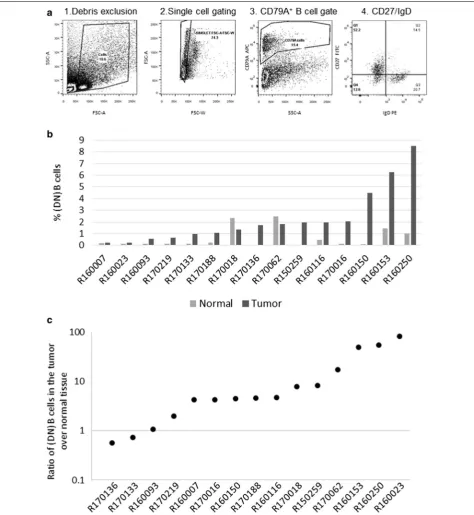
To quantify the DN B cell population, single cells were gated by the schema illustrated in Fig. 1a; additionally, accurate quadrant placement for each sample was veri-fied by back gating strategies allowing for the identifica-tion of true CD27 negative and IgD negative populaidentifica-tion locations. The DN B cell population was detectable in all 30 patient tissues examined (15 NSCLC tumors and 15 adjacent normal lung tissues). The proportion of DN B cells (of total live singlet cells analyzed) for each sample is shown in Fig. 1b; the values ranged between
0.2–8.5% in tumors and 0.02–2.5% in the normal lung tissues. Moreover, in 13 of the 15 patients, the ratio of DN B cells in the carcinoma compared to the adjacent normal lung sample was greater than one (Fig. 1c), sug-gesting the frequent expansion of the DN B subset in NSCLC tumors. This expansion was tested using the paired students t-test and was found to be significant (p value < 0.001).
Clinical parameters associated with the presence of DN B cells
We sought to correlate the extent of the DN B cell sub-set in tumors with the available clinical data, including gender, age, smoking status, tumor diagnosis and patho-logic differentiation status, as summarized in Table 1. The levels of DN B cells were significantly (p = 0.04) higher
in patients with moderately differentiated tumors versus those with poorly differentiated tumors; otherwise, no significant correlations with clinical attributes could be identified (Table 2). We also analyzed the relationship of DN B cells in the normal tissue samples in relation to smoking status (p = 0.923) and gender (p = 0.698),
but again no significant trends were observed (data not shown).
Because previous studies have shown that the double-negative subset is expanded in the peripheral blood of the elderly [8–10, 23, 24], a possible influence of age on the presence of DN B cells was explored using linear regres-sion analysis of data collected from either the NSCLC tumors or normal lung tissues. Consistent with published data from peripheral blood samples, there was a statisti-cally significant correlation (p = 0.002) between
increas-ing age and the proportion of DN B cells in normal lung tissue presenting with an estimate coefficient of 0.17 and a standard error of 0.04. Although elevated levels of DN B cells in older patients persisted in the NSCLC samples, this trend did not reach statistical significance (p = 0.06),
with an estimate coefficient of 0.08 and a standard error of 0.03.
The size of the DN B cell subset is inversely correlated with the affinity‑matured B cell population
Fig. 1 DN B cells are expanded in NSCLC tumors. Single cell suspensions of NSCLC tumors and matched normal lung tissue samples were stained with APC-CD79A, PE-IgD and FITC-CD27. a Schema for the enumeration of CD27−IgD− DN B cells by flow cytometry (1) debris is excluded
based on FCS-A, SSC-A, (2) single cells are selected based on FSC-W and FCS-A (3) then the total B cell population is gated based on APC-CD79A expression (4). Finally, the percentage of DN B cells were defined by the absence of PE-IgD and FITC-CD27 expression. b Shown is the percentage of CD79A+CD27−IgD− DN B cells present out of total live cell singlet population analyzed by flow cytometry of tumor versus normal lung for each
[image:4.595.61.536.87.603.2]confirmed an inverse relationship (Spearman’s rank cor-relation coefficient, − 0.76, p = 0.001) (Fig. 2b). Addi-tionally, we examined associations between the DN B cell population and all other B cell subsets and found no sig-nificant relationships (data not shown). These data sug-gest a possible etiologic relationship between the relative
numbers of DN and affinity-matured B cells within the tumor microenvironment.
Discussion
Here we provide data indicating the presence, in both NSCLC tumors and normal lung tissue, of CD27−IgD− (double-negative) B cells, a subset of B cells not previ-ously described in malignant tumors. We analyzed by flow cytometry 15 NSCLC tumors together with 15 adja-cent normal lung samples for the presence or absence of CD27 and IgD. In the normal lung samples, DN B cells ranged from 0.02 to 2.5% and were positively correlated with age, mirroring previous reports documenting simi-lar findings in the peripheral blood. Although the DN B cell population in tumor samples also appeared to cor-relate with age, this trend failed to reach statistical sig-nificance. More importantly, in all but two patients, the proportion of DN B cells in the tumor samples were significantly greater than in the corresponding nor-mal lung tissue, indicating expansion of this B cell sub-set in NSCLC tumors. This report is the first to reveal a tumor-specific expansion of this otherwise rare B cell population.
The percentages of DN B cells in the NSCLC tumors varied widely, between 0.2 and 8.5%. Other than the differentiation status of the tumor—moderately differ-entiated tumors exhibited higher concentrations of DN B cells than poorly differentiated ones—we could not identify associations with the other clinical parameters Table 1 Clinical information associated with NSCLC patient cohort
Smoking status was defined as smoker including the groups current and former smoker and non-smoker including the groups non-smoker and never smokers
SqCC squamous cell carcinoma, Adeno adenocarcinoma
Patient ID Diagnosis Age Smoking status Gender Stage Differentiation % DN cells out of total live singlets
[image:5.595.57.547.103.323.2]R160007 SqCC 70 Smoker Female Stage IB Poorly differentiated 0.204 R160023 Adeno 86 Non-Smoker Female Stage IIB Poorly differentiated 0.222 R160093 Sqcc 69 Smoker Male StageIB Moderately differentiated 0.536 R170219 Sqcc 69 Smoker Male Stage IIIA Poorly differentiated 0.643 R170133 Sqcc 62 Non-Smoker Female Stage IB Poorly differentiated 0.985 R170188 Adeno 72 Smoker Female Stage IA Poorly differentiated 1.088 R170018 Sqcc 74 Smoker Female Stage IIIA Poorly differentiated 1.341 R170136 Sqcc 60 Smoker Female Stage IIIA Moderately differentiated 1.721 R170062 Sqcc 83 Smoker Male Stage IB Moderately differentiated 1.830 R150259 Sqcc 75 Smoker Male Stage IB Poorly differentiated 1.943 R160116 Sqcc 73 Smoker Male Stage IIB Poorly differentiated 1.969 R170016 Adeno 71 Non-Smoker Female Stage IB Poorly differentiated 2.059 R160150 Adeno 71 Smoker Female Stage IB Moderately differentiated 4.471 R160153 Adeno 84 Non-Smoker Female Stage IB Moderately differentiated 6.269 R160250 Adeno 84 Non-Smoker Male Stage IIA Moderately differentiated 8.492
Table 2 Association between % (DN) B cells in NSCLC tumors and clinical parameters
* p < 0.05
n Mean (SE) p value
Diagnosis
SqCC 9 1.24 (0.68) 0.17
Adeno 6 3.76 (0.84)
Smoking status
Smoker 10 1.63 (0.77) 0.48
Non-smoker 5 3.60 (1.03)
Gender
Male 6 2.57 (1.02) 0.65
Female 9 2.16 (0.89)
Stage
I 9 2.28 (0.88) 0.94
II 3 3.56 (1.44)
IIIA 3 1.23 (1.43)
Differentiation
[image:5.595.56.290.399.615.2]examined. An analysis of survivorship in relationship to DN B cell status must of course await further long-term follow-up studies.
Perhaps our most striking finding is that of an inverse correlation between DN B cells and affinity-matured
B cells. In affinity-matured B cells, CD27 is upregu-lated while IgD is downreguupregu-lated; whereas in DN B cells the downregulation of IgD is accompanied by the absence of CD27. Lack of CD27 on a specific sub-set of exhausted B cells has recently been described in
Fig. 2 DN B cells are inversely correlated with the presence of affinity-matured B cells. a Tumor samples were first gated for single cells and then for APC-CD79A expression. The percentage of each subset within this population is defined by PE-IgD and FITC-CD27 expression as follows: CD27−IgD− (DN) B cells, CD27+IgD− Affinity-matured B cells, CD27−IgD+ Naïve (non-switched) B cells, and CD27+IgD+ Early memory/GC (germinal
center) B cells. The data are presented according to ascending amounts of DN B cells. b The percent of CD27−IgD− DN B cells (x-axis) and percent
of CD27+IgD− Affinity-matured B cells (y-axis) were defined as described above and plotted for each patient in ranked order. Spearman’s rank
[image:6.595.60.538.87.572.2]NSCLC [26]. Their presence has been associated with a reduction in the ability of TIL-B cells to present tumor antigen and positively correlated with the presence of regulatory T cells (Tregs); suggesting the lack of CD27 on TIL-B cells may hinder effective anti-tumor immu-nity. Although these studies on exhausted B cells did not examine the presence of IgD for class switching, it is possible that the CD27−IgD− double-negative cells in this study may have similar functional characteristics.
Unlike exhausted B cells, it remains unclear how DN B cells arise; at least four mechanisms have been sug-gested: (1) DN B cells are exhausted memory B cells that consequently exhibit downregulated CD27; (2) they are the product of a defective germinal center reaction in which CD27 fails to upregulate appropri-ately; (3) they represent precursor memory B cells that have yet to upregulate CD27; (4) they represent a unique B cell subset, possibly formed by a germi-nal center-independent process. Traditiogermi-nal CD27+ memory B cells initially express IgM and IgD and are then class-switched to express immunoglobulin iso-types IgG, IgA, or IgE. Previously, CD27 was consid-ered to be an all-encompassing memory B cell marker which accounted for all class-switched subsets [19, 27]. However, further research elucidated that between 10 and 20% of IgG+ class-switched memory B cells were CD27− [28]; leading to postulation of the existence of CD27− memory cells, i.e., DN B cells. In the same study, a large proportion of IgG+CD27− cells harbored BCL6 mutations indicative of germinal center deriva-tion. While origins of the collective DN B cell popula-tion remain uncertain, it is plausible that a fracpopula-tion of this population is derived from IgG+CD27+ germinal center memory B cells. In further support of this, some DN B cells from peripheral blood have been shown to share a high frequency of clonally related sequences with both traditional memory B cell subsets and mar-ginal zone B cells, leading to the supposition of a com-mon lineage [25]. Although our data demonstrating an inverse relationship between DN and affinity-matured B cells does not favor one hypothesis over another, it does suggest the possibility that the generation of DN B cells is at the expense of the affinity-matured B cell population, which are critical to the generation of an immune response.
Conclusions
This study revealed the presence of a CD27−IgD− B cell subset in untreated NSCLC and demonstrated that their presence inversely correlates with the presence of affin-ity-matured B cell populations from the same patient.
These findings are impactful and significantly contrib-ute to the field, since to date, double-negative B cells have not previously been described in the context of cancer. B cells are a positive predictive indicator in NSCLC as well as in other solid tumor, however, there is very lit-tle known about what specific subsets contribute to this effect. The observation that double-negative B cells exist in NSCLC tumors and make up a large proportion of the total B cell compartment provides preliminary evi-dence that their presence may influence tumor immunity. Furthermore, the fact that expansion of this population negatively correlated with the presence of other affinity-matured B cell populations provides further evidence that these cells should be taken into consideration when evaluating the immune landscape in cancer.
Abbreviations
APCs: antigen presenting cells; DN: double-negative; GC: germinal center; NSCLC: non-small cell lung cancer; TIL-Bs: tumor infiltrating B cells; Tregs: T regulatory cells.
Authors’ contributions
SC collected, analyzed and interpreted all data, and drafted the manuscript. CG assisted in data collection, data interpretation, figure generation and man-uscript editing. SK assisted in data collection and project design. CP assisted in project design and manuscript drafting. BL, LG and DM assisted in data interpretation and project design. JM oversaw all aspects of project design, data collection, and manuscript drafting. All authors read and approved the final manuscript.
Author details
1 University of Arizona Cancer Center, University of Arizona, 1515 N. Campbell Ave., Tucson, AZ 85724, USA. 2 Cancer Biology Graduate Interdisciplinary Pro-gram, University of Arizona, Tucson, AZ 85724, USA. 3 Department of Surgery, University of Arizona, Tucson, AZ 85724, USA. 4 Department of Laboratory Medicine and Pathology, Mayo Clinic, Scottsdale, AZ 85259, USA. 5 Depart-ment of Medicine, Division of Hematology/Oncology, University of Arizona, Tucson, AZ 85724, USA. 6 Department of Molecular and Cellular Biology, University of Arizona, Tucson, AZ 85724, USA. 7 Cell & Molecular Medicine, University of Arizona, Tucson, AZ 85724, USA.
Acknowledgements
Flow cytometry core, and TACMASR core facilities, specifically Betsy Dennison and Mark Curry, as well as, Dr. Haiyan Cui for her role in performing statistical analysis.
Competing interests
The authors declare that they have no competing interests.
Availability of data and materials
Data sharing is not applicable in this article as no datasets were generated or analyzed during the current study.
Consent for publication Not applicable.
Ethics approval and consent to participate
Human tissues were obtained from University of Arizona Cancer Center Biorepository under protocol approved by Biorepository Oversight committee chaired by Setsuko Chambers no reference number.
Funding
a Research Completion Award made possible through the Geographic Man-agement of Cancer Health Disparities Program (GMaP) Region 3, an initiative of the National Cancer Institute’s Center to Reduce Cancer Health Dispari-ties. The research in this manuscript was directly supported by the Tissue Acquisition and Molecular Analysis Shared Resource, Flow Cytometry Shared Resource, and the Biostatistics Shared resource at the University of Arizona Cancer Center all of which are funded by the National Cancer Institute Award P30CA023074.
Publisher’s Note
Springer Nature remains neutral with regard to jurisdictional claims in pub-lished maps and institutional affiliations.
Received: 21 December 2017 Accepted: 7 February 2018
References
1. Bremnes RM, Busund LT, Kilvaer TL, Andersen S, Richardsen E, Paulsen EE, et al. The role of tumor-infiltrating lymphocytes in development, progression, and prognosis of non-small cell lung cancer. J Thorac Oncol. 2016;11:789–800. http://www.ncbi.nlm.nih.gov/pubme d/26845 192. 2. Nelson BH. CD20+ B cells: the other tumor-infiltrating lymphocytes. J
Immunol. 2010;185:4977–82. http://www.ncbi.nlm.nih.gov/pubme d/20962 266.
3. Mount DW, Putnam CW, Centouri SM, Manziello AM, Pandey R, Garland LL, et al. Using logistic regression to improve the prognostic value of microarray gene expression data sets: application to early-stage squamous cell carcinoma of the lung and triple negative breast carcinoma. BMC Med Genomics. 7:33. http://www.ncbi.nlm.nih.gov/entre z/query .fcgi?cmd=Retri eve&db=PubMe d&dopt=Citat ion&list_uids=24916 928.
4. Al-Shibli KI, Donnem T, Al-Saad S, Persson M, Bremnes RM, Busund LT. Prog-nostic effect of epithelial and stromal lymphocyte infiltration in non-small cell lung cancer. Clin Cancer Res. 2008;14:5220–7. http://www.ncbi.nlm.nih. gov/pubme d/18698 040.
5. Germain C, Gnjatic S, Tamzalit F, Knockaert S, Remark R, Goc J, et al. Presence of B cells in tertiary lymphoid structures is associated with a protec-tive immunity in patients with lung cancer. Am J Respir Crit Care Med. 2014;189:832–44. http://www.ncbi.nlm.nih.gov/pubme d/24484 236. 6. Qin Z, Richter G, Schuler T, Ibe S, Cao X, Blankenstein T. B cells inhibit
induc-tion of T cell-dependent tumor immunity. Nat Med. 1998;4:627–30. http:// www.ncbi.nlm.nih.gov/entre z/query .fcgi?cmd=Retri eve&db=PubMe d&dopt=Citat ion&list_uids=95852 41.
7. Wei C, Anolik J, Cappione A, Zheng B, Pugh-Bernard A, Brooks J, et al. A new population of cells lacking expression of CD27 represents a notable compo-nent of the B cell memory compartment in systemic lupus erythematosus. J Immunol. 2007;178:6624–33. http://www.ncbi.nlm.nih.gov/pubme d/17475 894.
8. Wu YC, Kipling D, Dunn-Walters DK. The relationship between CD27 negative and positive B cell populations in human peripheral blood. Front Immunol. 2011;2:81. http://www.ncbi.nlm.nih.gov/pubme d/22566 870. 9. Colonna-Romano G, Aquino A, Bulati M, Di Lorenzo G, Listi F, Vitello S, et al.
Memory B cell subpopulations in the aged. Rejuvenation Res. 2006;9:149– 52. http://www.ncbi.nlm.nih.gov/pubme d/16608 412.
10. Colonna-Romano G, Bulati M, Aquino A, Pellicano M, Vitello S, Lio D, et al. A double-negative (IgD−CD27−) B cell population is increased in the periph-eral blood of elderly people. Mech Ageing Dev. 2009;130:681–90. http:// www.ncbi.nlm.nih.gov/pubme d/19698 733.
11. Bulati M, Buffa S, Martorana A, Gervasi F, Camarda C, Azzarello DM, et al. Double negative (IgG+IgD−CD27−) B cells are increased in a cohort of moderate-severe Alzheimer’s disease patients and show a pro-inflamma-tory trafficking receptor phenotype. J Alzheimers Dis. 2015;44:1241–51.
http://www.ncbi.nlm.nih.gov/pubme d/25408 215.
12. Mahmood Z, Muhammad K, Schmalzing M, Roll P, Dorner T, Tony HP. CD27−IgD− memory B cells are modulated by in vivo interleukin-6 receptor (IL-6R) blockade in rheumatoid arthritis. Arthritis Res Ther. 2015;17:61. http:// www.ncbi.nlm.nih.gov/pubme d/25888 920.
13. Bamford A, Hart M, Lyall H, Goldblatt D, Kelleher P, Kampmann B. The influ-ence of paediatric HIV infection on circulating B cell subsets and CXCR5(+) T helper cells. Clin Exp Immunol. 2015;181:110–7. http://www.ncbi.nlm.nih. gov/pubme d/25737 039.
14. Budeus B, Schweigle de Reynoso S, Przekopowitz M, Hoffmann D, Seifert M, Küppers R. Complexity of the human memory B-cell compartment is determined by the versatility of clonal diversification in germinal centers. Proc Natl Acad Sci USA. 2015;112:E5281–9. http://www.pnas.org/looku p/ doi/10.1073/pnas.15112 70112 .
15. De Silva NS, Klein U. Dynamics of B cells in germinal centres. Nat Rev Immu-nol. 2015;15:137–48. http://www.ncbi.nlm.nih.gov/pubme d/25656 706. 16. Geisberger R, Lamers M, Achatz G. The riddle of the dual expression of IgM
and IgD. Immunology. 2006;118:429–37. http://www.ncbi.nlm.nih.gov/ pubme d/16895 553.
17. Tangye SG, Ferguson A, Avery DT, Ma CS, Hodgkin PD. Isotype switching by human B cells is division-associated and regulated by cytokines. J Immunol. 2002;169:4298–306. http://www.ncbi.nlm.nih.gov/pubme d/12370 361. 18. Agematsu K, Hokibara S, Nagumo H, Komiyama A. CD27: a memory B-cell
marker. Immunol Today. 2000;21:204–6. http://www.ncbi.nlm.nih.gov/ pubme d/10782 048.
19. Victora GD, Dominguez-Sola D, Holmes AB, Deroubaix S, Dalla-Favera R, Nussenzweig MC. Identification of human germinal center light and dark zone cells and their relationship to human B-cell lymphomas. Blood. 2012;120:2240–8. http://www.blood journ al.org/cgi/doi/10.1182/blood -2012-03-41538 0.
20. Caron G, Le Gallou S, Lamy T, Tarte K, Fest T. CXCR4 Expression Functionally Discriminates Centroblasts versus Centrocytes within Human Germinal Center B Cells. J Immunol. 2009;182:7595–602. http://www.jimmu nol.org/ cgi/doi/10.4049/jimmu nol.08042 72.
21. Jung J, Choe J, Li L, Choi YS. Regulation of CD27 expression in the course of germinal center B cell differentiation: the pivotal role of IL-10. Eur J Immunol. 2000;30:2437–43. http://www.ncbi.nlm.nih.gov/pubme d/10940 936. 22. Kaminski DA, Wei C, Qian Y, Rosenberg AF, Sanz I. Advances in human B cell
phenotypic profiling. Front Immunol. 2012;3:302. http://www.ncbi.nlm.nih. gov/pubme d/23087 687.
23. Bulati M, Buffa S, Candore G, Caruso C, Dunn-Walters DK, Pellicano M, et al. B cells and immunosenescence: a focus on IgG+IgD−CD27− (DN) B cells in aged humans. Ageing Res Rev. 2011;10:274–84. http://www.ncbi.nlm.nih. gov/pubme d/21185 406.
24. Martorana A, Balistreri CR, Bulati M, Buffa S, Azzarello DM, Camarda C, et al. Double negative (CD19+IgG+IgD−CD27−) B lymphocytes: a new insight from telomerase in healthy elderly, in centenarian offspring and in Alzhei-mer’s disease patients. Immunol Lett. 2014;162:303–9. http://www.ncbi.nlm. nih.gov/pubme d/24951 896.
25. Bagnara D, Squillario M, Kipling D, Mora T, Walczak AM, Da Silva L, et al. A Reassessment of IgM Memory Subsets in Humans. J Immunol. 2015;195:3716–24. http://www.ncbi.nlm.nih.gov/pubme d/26355 154. 26. Bruno TC, Ebner PJ, Moore BL, Squalls OG, Waugh KA, Eruslanov EB, et al.
Antigen-Presenting Intratumoral B Cells Affect CD4(+) TIL Phenotypes in Non-Small Cell Lung Cancer Patients. Cancer Immunol Res. 2017;5:898–907.
http://www.ncbi.nlm.nih.gov/pubme d/28848 053.
27. Agematsu K, Nagumo H, Yang FC, Nakazawa T, Fukushima K, Ito S, et al. B cell subpopulations separated by CD27 and crucial collaboration of CD27+
B cells and helper T cells in immunoglobulin production. Eur J Immunol. 1997;27:2073–9. http://doi.wiley .com/10.1002/eji.18302 70835 .