Interference with a quantum dot single-photon source and a laser at telecom
wavelength
M. Felle, J. Huwer, R. M. Stevenson, J. Skiba-Szymanska, M. B. Ward, I. Farrer, R. V. Penty, D. A. Ritchie, and
A. J. Shields
Citation: Applied Physics Letters 107, 131106 (2015); doi: 10.1063/1.4931729
View online: http://dx.doi.org/10.1063/1.4931729
View Table of Contents: http://scitation.aip.org/content/aip/journal/apl/107/13?ver=pdfcov
Published by the AIP Publishing
Articles you may be interested in
Two-photon interference and coherent control of single InAs quantum dot emissions in an Ag-embedded structure
J. Appl. Phys. 116, 043103 (2014); 10.1063/1.4891224
Telecom-wavelength (1.5 μm) single-photon emission from InP-based quantum dots Appl. Phys. Lett. 103, 162101 (2013); 10.1063/1.4825106
Fast quantum dot single photon source triggered at telecommunications wavelength Appl. Phys. Lett. 98, 083105 (2011); 10.1063/1.3556644
Interference effects on bound-to-continuum quantum dot absorption J. Appl. Phys. 107, 083102 (2010); 10.1063/1.3385313
Interference with a quantum dot single-photon source and a laser at telecom
wavelength
M.Felle,1,2J.Huwer,1,a)R. M.Stevenson,1J.Skiba-Szymanska,1M. B.Ward,1I.Farrer,3,b)
R. V.Penty,2D. A.Ritchie,3and A. J.Shields1
1
Toshiba Research Europe Limited, Cambridge Research Laboratory, 208 Cambridge Science Park, Milton Road, Cambridge CB4 0GZ, United Kingdom
2
Centre for Advanced Photonics and Electronics, University of Cambridge, J.J. Thomson Avenue, Cambridge CB3 0FA, United Kingdom
3
Cavendish Laboratory, University of Cambridge, J.J. Thomson Avenue, Cambridge CB3 0HE, United Kingdom
(Received 10 July 2015; accepted 14 September 2015; published online 29 September 2015)
The interference of photons emitted by dissimilar sources is an essential requirement for a wide range of photonic quantum information applications. Many of these applications are in quantum communications and need to operate at standard telecommunication wavelengths to minimize the impact of photon losses and be compatible with existing infrastructure. Here, we demonstrate for the first time the quantum interference of telecom-wavelength photons from an InAs/GaAs quan-tum dot single-photon source and a laser; an important step towards such applications. The results are in good agreement with a theoretical model, indicating a high degree of indistinguishability for the interfering photons.VC 2015 AIP Publishing LLC. [http://dx.doi.org/10.1063/1.4931729]
Single-photon sources are essential components for many photonic quantum information technologies, ranging from linear-optics quantum computation1to teleportation of quantum bits2and large scale quantum networks.3The inter-ference of two independently generated photon states on a beam splitter is an important physical mechanism required for the realization of most of these schemes.
This quantum effect is manifested as a bunching of indistinguishable photons to either one of the two output modes of the beam splitter,4which is best observable when interfering non-classical light fields. The most common implementations thereby make use of two single photons.5–8 However, great potential lies in the interference of states with completely different statistical properties, such as a single-photon Fock state and a weak coherent state. It has been demonstrated that this provides a versatile tool to char-acterize the spectral9 and temporal10 density matrix of unknown single-photon states and finds application in quan-tum amplifier schemes.11
Of even greater immediate importance are applications related to quantum communication and quantum key distri-bution12,13(QKD), the most developed technology based on photonic quantum bits. The most widely implemented scheme for QKD makes use of weak coherent laser pulses.14 Interference of these states with single photons from an entangled pair to perform a Bell-state measurement thereby enables quantum teleportation. This opens up the route to de-velop a so-called quantum relay15 or all-photonic quantum repeater,16 indispensable to reduce noise and extend the transmission distances in future networks that are strongly limited by photon losses in optical fiber. More generally, recent theoretical studies17 have shown that, for limited
resources, the teleportation of continuous variable systems by using discrete single-photon entangled states is expected to have significant advantages over its continuous-variable counterpart. The interference between dissimilar photon sources is thereby of great interest both for fundamental sci-ence and a large number of technological applications.
Most experiments demonstrated so far have been per-formed with heralded single photon sources based on non-linear optical processes.9,10,18These sources obey Poissonian statistics, intrinsically deteriorating the single-photon charac-ter and making them non-desirable for certain applications. More recently, quantum dots (QDs) based on III-V semicon-ductor compounds have proven to be one of the most promis-ing sub-Poissonian sources, generatpromis-ing deterministic spromis-ingle photons as well as entangled photon pairs.19–22In the past, these systems have been successfully used to demonstrate in-terference of single photons with emission from a laser23and subsequently the teleportation of laser-generated qubits.24In both cases, the operating wavelength was below 1lm, mak-ing these sources unsuitable for quantum communication applications due to high photon absorption in optical fiber.
Operation of single photon sources in the standard O-band (1310 nm) and C-band (1550 nm) telecommunica-tion windows provides much lower losses and compatibility with existing optical-fiber-based communication infrastruc-tures.25,26 Over the past decade, progress has been made in increasing the emission wavelength of QD devices from the near infrared to standard telecom wavelengths,27–29including the direct generation of single entangled photon pairs in the telecom O-band.30To date, there is no reported interference measurement with this new class of quantum light emitter. In this letter, we demonstrate for the first time the quantum inter-ference between single photons generated at telecom wave-length from a QD with photons emitted from a laser.
The sample contains InAs/GaAs QDs in a quantum well, at the center of the intrinsic region of a p-i-n diode,
a)Electronic mail: [email protected]
b)Present address: Department of Electronic & Electrical Engineering,
University of Sheffield, Sheffield S1 3JD, United Kingdom.
surrounded by a weak planar distributed Bragg reflector cavity made from stacks of AlGaAs/GaAs, grown on a GaAs sub-strate.30 Applying a bias voltage across the diode tunes the emission properties of the device under optical excitation.
The device was operated at 10 K, and optically excited with continuous wave laser light at 785 nm. Unless otherwise stated in this paper, the applied bias voltage was set toþ1 V. Photons were collected with an aspheric lens (NA¼0.55) and coupled to a single-mode fiber, acting as a spatial filter and isolating the emission from a single QD. Photoluminescence spectra were measured with a grating spectrometer equipped with an InGaAs detector array.
Figure 1shows the spectrum of the single QD used in this work. The labelled lines were identified by a combina-tion of power-dependency measurements with the exciting laser and fine structure splitting (FSS) measurements based on the polarization properties of emitted photons. We deduce that the FSS is 8863leV for the X and XX line. The charged exciton line exhibits no measurable splitting and emits unpolarized photons. The QD was selected for its bright emission, with separated spectral lines, and good coherence properties.
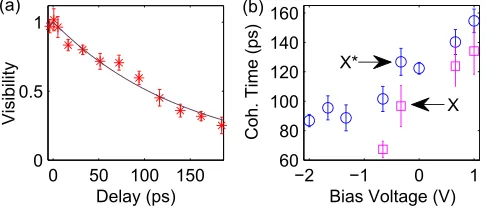
Two-photon interference experiments require long pho-ton coherence times to achieve highest visibilities in experi-mental setups with limited timing resolution. We used a fiber-based Mach-Zehnder interferometer to characterize the coherence properties of emitted photons from QDs in the sample. Figure2(a)shows the measured single-photon inter-ference visibility as a function of the delay in the interferom-eter, for photons emitted on the charged exciton line at
1306 nm. We derive a coherence time of sc¼15069 ps
from the exponential fit, for a bias voltage ofþ1 V applied to the device.
Embedding a QD in a verticalp-i-n diode19 provides a useful tool to control the emission properties by application of an electric field across the dot layer. This control ranges from tunability of the emission wavelength and FSS via the quantum confined Stark effect,31,32to the direct electrical ex-citation of QDs.33In addition, there is a significant influence on the coherence time of the dot emission. Figure2(b)shows a measurement of coherence times of the two brightest emis-sion lines from the QD at different bias voltages. We observe an almost two-fold increase in the coherence time when changing the bias voltage from 2 V to þ1 V, approaching the flat-band operation, which is expected around þ2.2 V.30 This effect is most probably caused by an effective relaxa-tion of the fluctuating charge environment surrounding the QD for an increasing flow of carriers injected into the device. The application of bias voltages greater than þ1 V resulted in a reduced brightness of the emission and no further exten-sion of the coherence time.
[image:3.612.58.293.55.171.2]We then used single photons emitted from the charged exciton to measure two-photon interference with photons generated by a laser. We implemented an all-fiber interfer-ence setup with an unbalanced beam splitter to keep the losses of QD photons low. Figure3gives an overview of the main components. The QD emission is sent through a linear polarizer (extinction ratio >105) and a spectral filter (band-width1 nm), providing photons with well-defined polariza-tion and frequency. The photons are overlapped with a strongly attenuated laser beam in a 96:4 single-mode fiber beam splitter (BS) made from standard telecom fiber (SMF-28). Autocorrelation measurements of the output mode carrying 96% of incident QD photons and 4% of incident laser photons are then performed with a Hanbury Brown and Twiss setup34 comprising a balanced 50:50 fiber BS, two superconducting nanowire single photon detectors (Single Quantum) and time-correlated single photon counting elec-tronics. The ratio between the rates of detected laser photons and detected QD photons is controlled by adjusting the laser intensity and is typically set to a value around 0.5. The sec-ond output mode of the unbalanced fiber BS is used to cali-brate the polarizations of the two interfering modes, which are controlled by electronic polarization controllers (EPCs). The polarization of QD photons is switched between the parallel and crossed case with respect to the laser polariza-tion, thereby enabling the measurement of interfering and non-interfering photons. Laser photons are generated from a
FIG. 1. Photoluminescence spectrum of QD when exciting with 785 nm laser light at 10 K for a bias voltage ofþ1 V. The shaded area denotes the part of the spectrum filtered for our experiment, centered around a bright and unpolarized charged exciton line (X*).
[image:3.612.54.297.611.715.2]FIG. 2. (a) Measurement of single photon coherence time for the charged exciton line at 1306 nm from Fig.1. The solid line is an exponential fit, cor-responding to a coherence time of 15069 ps. (b) Measured coherence time of the charged (X*) and neutral (X) exciton from the QD as a function of the applied bias voltage to the device.
FIG. 3. Diagram of the experimental setup used to measure two-photon interference. LP: linear polarizer, EPC: electronic polarization controller, and D1/D2: superconducting nanowire single photon detectors.
[image:3.612.320.554.644.733.2]commercial diode laser with a specified spectral bandwidth of2103leV, tunable across the telecom O-band with a precision of<1leV.
To observe perfect Hong-Ou-Mandel interference,4the photons must be indistinguishable in both their polarization and frequency. We tuned the laser wavelength to the QD emission by overlapping both spectral lines on the spectrom-eter. Gaussian fits were used to overcome the spectrometer resolution of 60leV, achieving a match of both energies with a precision of62leV. The measured coherence time of 150 ps for the QD emission corresponds to a spectral band-width of9leV, sufficiently large to provide good indistin-guishability of the two photon sources.
From agð2Þmeasurement of the QD emission, we derive a
gð2ÞQDð0Þvalue of 2164%, proving the sub-Poissonian
charac-ter of the source. This value is limited by detector dark counts, timing jitter of the electronics and background collected from neighboring QDs in the sample.
Previous interference experiments using dissimilar pho-ton sources23,24have shown that the measurements are well understood when using the wavepacket description devel-oped in Legeroet al.35 For the unbalanced interference cir-cuit described in Fig. 3, the theoretical second-order correlation function is
gð ÞTPI;2 /ð Þ ¼s 1þg
2 gð Þ2 QDð Þ s 1
þ2ga2ejsj=sccos2/
gþa2þb
ð Þ2 ; (1)
with g, a2, and b being proportional to the separate QD,
laser, and background photon intensities measured at detec-tors D1 and D2. The interference visibility is defined as
VðsÞ ¼ ½gð2Þk ðsÞ gð2Þ? ðsÞ=g ð2Þ
? ðsÞ, where the subscriptskand
? refer to co- and cross-polarized measurements of gð2ÞTPI
(/¼0 andp=2 in Eq. (1)). Taking the timing jitter and the previously determined single photon properties of the QD emission into account, we expect a maximum visibility of the interference for a laser to QD emission intensity ratio of a2=g’0:5.
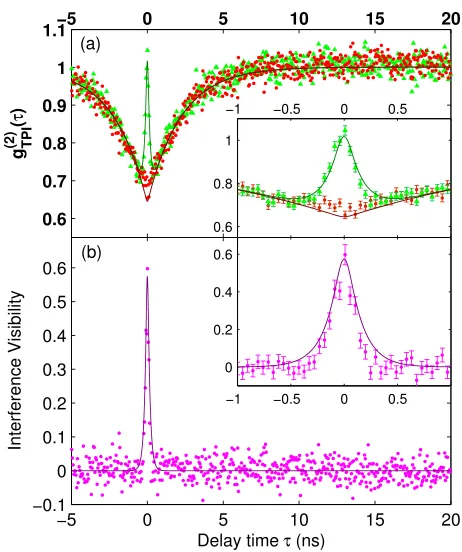
Figure 4(a) shows the measured normalized coinciden-ces, without background subtraction, after collecting data for co- and cross-polarized photons. For non-interfering
pho-tons, the second-order correlation functiongð2Þ? ðsÞshows an anti-bunching dip originating from the single-photon source, superposed on the uncorrelated laser-laser and dot-laser
pho-ton coincidences. For the interfering case,gð2Þk ðsÞexhibits a narrow and strong bunching peak ats¼0 due to the coales-cence of indistinguishable photons through the same output mode of the unbalanced BS. The lines show the theoretical fit from Eq. (1) convoluted with a Gaussian detector response, accounting for a measured timing jitter of 101.960.4 ps. The single-photon coherence time sc was
determined in an independent measurement, as shown in Fig. 2(a). We observe very good agreement between the model and the experimental data. The slight discrepancy for the non-interfering case can be explained by a deviation from perfectly crossed polarizations, caused by the limited extinc-tion ratio of the fiber components, used for calibraextinc-tion.
The interference visibility available directly from the raw data are displayed in Fig.4(b), with a maximum meas-ured value of 6066%. It has to be emphasized that this class of interference experiment between dissimilar sources is dominated by the Poissonian nature of the laser, limiting the visibility due to random laser-laser coincidences, depending on the laser intensity with respect to the QD emitter. By using Eq.(1)and the experimental intensity ra-tio ofa2=g¼0:6360:04, we calculate a theoretical
visibil-ity of 76.2%, assuming no timing jitter or detector dark counts and a perfect single-photon emitter. Therefore, the measured raw data visibility corresponds to 7968% of the maximal achievable value for the chosen intensity ratio of both sources.
To conclude, we have for the first time demonstrated the interference of single photons emitted by a semiconductor QD at the center of the telecom O-band with photons gener-ated by a laser. The resulting raw-data interference visibility of 60% compares well with raw-data visibilities achieved in other two-photon interference experiments between identical QD single-photon sources, operating at lower wavelength.22 The fact that we observe good agreement with our theoretical model is a strong indication of a high degree of indistin-guishability between the two independent photon sources. Assuming an overall fidelity of 85% for an entangled photon pair source, as recently demonstrated at telecom wave-lengths,30 the achieved visibility would be sufficient to implement quantum teleportation with fidelities above 80%, guaranteeing security for QKD applications.36The presented
[image:4.612.322.553.49.325.2]results are an important step towards a large number of pho-tonic quantum information applications at telecom wavelength. Most importantly, they pave the way for the implementation of a high fidelity quantum relay compatible with available tele-communication infrastructure.
The authors acknowledge partial financial support from the Engineering and Physical Sciences Research Council, and the EPSRC Quantum Technology Hub in Quantum Communications. M.F. acknowledges support from the EPSRC CDT in Photonic Systems Development. The data from this paper is available athttps://www.repository.cam.ac.uk/handle/ 1810/251122.
1E. Knill, R. Laflamme, and G. J. Milburn,Nature
409, 46 (2001). 2
C. H. Bennett, G. Brassard, C. Crepeau, R. Jozsa, A. Peres, and W. K. Wootters,Phys. Rev. Lett.70, 1895 (1993).
3
H. J. Kimble,Nature453, 1023 (2008). 4
C. K. Hong, Z. Y. Ou, and L. Mandel,Phys. Rev. Lett.59, 2044 (1987). 5
D. Bouwmeester, J.-W. Pan, K. Mattle, M. Eibl, H. Weinfurter, and A. Zeilinger,Nature390, 575 (1997).
6
C. Santori, D. Fattal, J. Vukovic, G. S. Solomon, and Y. Yamamoto, Nature419, 594 (2002).
7
H. D. Riedmatten, I. Marcikic, W. Tittel, H. Zbinden, and N. Gisin,Phys. Rev. A67, 022301 (2003).
8T. Legero, T. Wilk, M. Hennrich, G. Rempe, and A. Kuhn,Phys. Rev.
Lett.93, 070503 (2004).
9W. Wasilewski, P. Kolenderski, and R. Frankowski,Phys. Rev. Lett.99,
123601 (2007). 10
Z. Qin, A. S. Prasad, T. Brannan, A. MacRae, A. Lezama, and A. I. Lvovsky,Light: Sci. Appl.4, e298 (2015).
11
V. Josse, M. Sabuncu, N. J. Cerf, G. Leuchs, and U. L. Andersen,Phys. Rev. Lett.96, 163602 (2006).
12A. K. Ekert,Phys. Rev. Lett.
67, 661 (1991). 13
N. Gisin, G. Ribordy, W. Tittel, and H. Zbinden,Rev. Mod. Phys.74, 145 (2002).
14W.-Y. Hwang,Phys. Rev. Lett.
91, 057901 (2003).
15B. C. Jacobs, T. B. Pittman, and J. D. Franson,Phys. Rev. A
66, 052307 (2002).
16
K. Azuma, K. Tamaki, and H.-K. Lo,Nat. Commun.6, 6787 (2015). 17U. L. Andersen and T. C. Ralph,Phys. Rev. Lett.111, 050504 (2013). 18J. G. Rarity, P. R. Tapster, and R. Loudon,J. Opt. B
7, 171 (2005). 19
O. Benson, C. Santori, M. Pelton, and Y. Yamamoto,Phys. Rev. Lett.84, 2513 (2000).
20P. Michler, A. Kiraz, C. Becher, W. V. Schoenfeld, P. M. Petroff, L.
Zhang, E. Hu, and A. Imamoglu,Science290, 2282 (2000). 21
R. M. Stevenson, R. J. Young, P. Atkinson, K. Cooper, D. A. Ritchie, and A. J. Shields,Nature439, 179 (2006).
22M. M€uller, S. Bounouar, K. D. J€ons, M. Gl€assl, and P. Michler, Nat. Photonics8, 224 (2014).
23
A. J. Bennett, R. B. Patel, C. A. Nicoll, D. A. Ritchie, and A. J. Shields, Nat. Phys.5, 715 (2009).
24R. M. Stevenson, J. Nilsson, A. J. Bennett, J. Skiba-Szymanska, I. Farrer,
D. A. Ritchie, and A. J. Shields,Nat. Commun.4, 2859 (2013). 25
P. D. Townsend,Nature385, 47 (1997). 26
K. A. Patel, J. F. Dynes, I. Choi, A. W. Sharpe, A. R. Dixon, Z. L. Yuan, R. V. Penty, and A. J. Shields,Phys. Rev. X2, 041010 (2012).
27B. Alloing, C. Zinoni, V. Zwiller, L. H. Li, C. Monat, M. Gobet, G. Buchs,
A. Fiore, E. Pelucchi, and E. Kapon,Appl. Phys. Lett.86, 101908 (2005). 28
M. B. Ward, O. Z. Karimov, D. C. Unitt, Z. L. Yuan, P. See, D. G. Gevaux, A. J. Shields, P. Atkinson, and D. A. Ritchie,Appl. Phys. Lett.
86, 201111 (2005). 29
M. Benyoucef, M. Yacob, J. P. Reithmaier, J. Kettler, and P. Michler, Appl. Phys. Lett.103, 162101 (2013).
30M. B. Ward, M. C. Dean, R. M. Stevenson, A. J. Bennett, D. J. P. Ellis, K.
Cooper, I. Farrer, C. A. Nicoll, D. A. Ritchie, and A. J. Shields, Nat. Commun.5, 3316 (2014).
31
A. J. Bennett, M. A. Pooley, R. M. Stevenson, M. B. Ward, R. B. Patel, A. Boyer de la Giroday, N. Sk€old, I. Farrer, C. A. Nicoll, D. A. Ritchie, and A. J. Shields,Nat. Phys.6, 947 (2010).
32
S. Marcet, K. Ohtani, and H. Ohno,Appl. Phys. Lett.96, 101117 (2010). 33
Z. Yuan, B. E. Kardynal, R. M. Stevenson, A. J. Shields, C. J. Lobo, K. Cooper, N. S. Beattie, D. A. Ritchie, and M. Pepper,Science 295, 102 (2002).
34
R. H. Brown and R. Q. Twiss,Nature177, 27 (1956). 35
T. Legero, T. Wilk, A. Kuhn, and G. Rempe,Appl. Phys. B: Lasers Opt.
77, 797 (2003). 36H. F. Chau,Phys. Rev. A
66, 060302 (2002).