This is a repository copy of Inventory of current EU paediatric vision and hearing screening programmes.
White Rose Research Online URL for this paper: http://eprints.whiterose.ac.uk/96625/
Version: Published Version
Article:
Sloot, F., Hoeve, H.L.J., de Kroon, M.L.A. et al. (5 more authors) (2015) Inventory of current EU paediatric vision and hearing screening programmes. Journal of Medical Screening, 22 (2). pp. 55-64. ISSN 0969-1413
https://doi.org/10.1177/0969141315572403
[email protected] https://eprints.whiterose.ac.uk/
Reuse
Unless indicated otherwise, fulltext items are protected by copyright with all rights reserved. The copyright exception in section 29 of the Copyright, Designs and Patents Act 1988 allows the making of a single copy solely for the purpose of non-commercial research or private study within the limits of fair dealing. The publisher or other rights-holder may allow further reproduction and re-use of this version - refer to the White Rose Research Online record for this item. Where records identify the publisher as the copyright holder, users can verify any specific terms of use on the publisher’s website.
Takedown
If you consider content in White Rose Research Online to be in breach of UK law, please notify us by
Title: EU-wide inventory of current paediatric vision and
hearing screening programmes
Frea Sloot1, MD, Hans L.J. Hoeve2, MD, PhD, Marlou L.A. de Kroon3, MD, PhD, André Goedegebure2, PhD, MSc, Jill Carlton4, PhD, MMedSci, BMedSci, Helen J. Griffiths5, PhD, BSc (Hons), DBO, Huibert Jan Simonsz1, MD, PhD, for the EUS€REEN study group6
Affiliations: 1Department of Ophthalmology, Erasmus University Medical Center Rotterdam, the Netherlands; 2Department of Otorhinolaryngology, Erasmus University Medical Center Rotterdam, the Netherlands, 3Department of Public Health, Erasmus University Medical Center Rotterdam, the Netherlands, 4Health Economics and Decision Science (HEDS),
School of Health and Related Research (ScHARR), University of Sheffield, United Kingdom,
5
Academic Unit of Ophthalmology & Orthoptics, University of Sheffield, United Kingdom,
6Members of the EUS€
REEN study group are listed in Appendix A.
Address correspondence to: Frea Sloot, Department of Ophthalmology, Faculty Ee-1607
Erasmus MC, PO box 2040, 3000 CA Rotterdam, the Netherlands. Phone: +31 107043275. E-mail: [email protected]
Short title: EU vision and hearing screening inventory
Abbreviations: EU - European Union; VA - Visual acuity; OAE - otoacoustic emission;
ABR - auditory brainstem response; UNHS - Universal new-born hearing screening
Key words: screening, vision, hearing, EU, prevention, paediatric
Funding Source: No funding was secured for this study.
Financial Disclosure: None of the authors have financial relationships relevant to this article
to disclose.
Contributor’s Statement:
Frea Sloot conceptualized and designed the study, coordinated data collection, carried out the initial analyses, drafted the initial manuscript, revised the manuscript and approved the final manuscript as submitted.
Hans L.J. Hoeve conceptualized and designed the study, coordinated data collection, carried out the initial analyses, drafted the initial manuscript, revised the manuscript and approved the final manuscript as submitted.
Marlou de Kroon coordinated data collection, critically reviewed and revised the manuscript, and approved the final manuscript as submitted.
André Goedegebure designed the study, drafted the initial manuscript, critically reviewed and revised the manuscript and approved the final manuscript as submitted.
Jill Carlton coordinated data collection, critically reviewed and revised the manuscript, and approved the final manuscript as submitted.
Helen Griffiths coordinated data collection, critically reviewed and revised the manuscript, and approved the final manuscript as submitted.
Huibert Jan Simonsz conceptualized and designed the study, critically reviewed and revised the manuscript, and approved the final manuscript as submitted.
ABSTRACT
Background: We examined the diversity in paediatric vision and hearing screening
programmes in Europe.
Methods: Themes relevant for comparison of screening programmes were derived from
literature and used to compile three questionnaires on vision, hearing and public-health
screening. Tests used, professions involved, age and frequency of testing seem to influence
sensitivity, specificity and costs most. Questionnaires were sent to ophthalmologists,
orthoptists, otolaryngologists and audiologists involved in paediatric screening in all EU
full-member, candidate and associate states. Answers were cross-checked.
Results: Thirty-nine countries participated; 35 have a vision screening programme, 33 a
nation-wide neonatal hearing screening programme. Visual acuity (VA) is measured in 35
countries, in 71% more than once. First measurement of VA varies from three to seven years
of age, but is usually before the age of five. At age three and four picture charts, including Lea
Hyvarinen are used most, in children over four Tumbling-E and Snellen. As first hearing
screening test otoacoustic emission (OAE) is used most in healthy neonates, and auditory
brainstem response (ABR) in premature newborns. The majority of hearing testing
programmes are staged; children are referred after one to four abnormal tests. Vision
screening is performed mostly by paediatricians, ophthalmologists or nurses. Funding is
mostly by health insurance or state. Coverage was reported as >95% in half of countries, but
reporting was often not first-hand.
Conclusion: Largest differences were found in VA charts used (12), professions involved in
vision screening (10), number of hearing screening tests before referral (1-4) and funding
sources (8).
INTRODUCTION
The sensory functions of a child play a key role in intellectual and social development during
early childhood. Vision or hearing impairment therefore affects both personal and societal
health of children. There is robust evidence that earlier detection of a visual or hearing deficit
results in an improved outcome.1-4 Therefore, vision and hearing screening programmes have
been introduced world-wide. Although the programmes are based on the same general
principles, they still vary both within and across EU countries, regarding tests used, age of
testing, frequency of testing, professions involved in screening, referral procedure, funding
and coverage. These differences between screening programmes can result in health
inequities. No screening or screening with little population coverage can result in delayed
provision of the correct treatment and increased disease burden. Too abundant screening can
result in inappropriate interventions and increased costs for health care systems.
Vision screening and subsequent treatment has reduced the occurrence of insufficiently
detected and treated amblyopia.5 In the Netherlands, the age that amblyopia is detected is
nowadays more than two years earlier than in the seventies.6 Early screening for hearing
impairment has led to early intervention and improved outcome.2,7 Early detection of hearing
disorders and timely intervention such as cochlear implantation or hearing aid largely
prevents delayed language development,1 which also results in improved general
developmental outcome at 3 to 5 years of age.3
In spite of the increased consciousness world-wide that vision and hearing screening is
effective, there are differences in implementation between countries. Neugebauer et al. did a
survey of existing vision screening programmes in 190 countries via their ministries of health
and found that screening was often state funded, visual acuity (VA) was always tested and
in paediatric vision screening programmes through an e-mail survey to members of the
International Orthoptic Association (IOA). Ninety-eight percent of their 18 responsive
representatives indicated that a vision screening programme was in place in their country; in
44% this was a national programme. Screening was performed by a wide range of
professionals.9
Bubbico et al. reported an overview of implemented universal new-born hearing screening
(UNHS) programmes in 24 European countries dating from the period 2004-2006. In several
countries UNHS programmes were successfully introduced reaching more than 95% of all
neonates, but in many other countries programmes were recently introduced or were only
partially functioning.10 Reports on experiences with national neonatal hearing screening
programmes concern issues on implementation, test procedures, type of tests, coverage,
detected cases of hearing loss and costs.11-19
The cost-effectiveness of screening programmes has been the subject of several reports. In a
report by Carlton et al.,20 following the Health Technology Assessment (HTA) report by
Snowdon and Stewart-Brown,21 the cost-effectiveness of vision screening up to the age of 4-5
years was re-examined. They concluded that, based on the accepted value of a
Quality-adjusted life year (QALY), the cost-effectiveness of screening for amblyopia depends on the
long-term utility effects of unilateral vision loss and that there is currently no sustainable
evidence of utility loss that would render any form of screening likely to be cost-effective.20
Keren et al. concluded that universal new-born hearing screening (UNHS) in general has the
potential for long-term cost savings compared with selective hearing screening and no
screening.22 Burke et al found that the cost-effectiveness of hearing screening depended
mainly on the cost of the screening intervention per patient and on the prevalence of hearing
The purpose of this study was to make an inventory of population-based vision and hearing
screening programmes for children in Europe. It is known that differences exist, but to what
extent is unknown. It is necessary to gain more insight into these differences. This problem is
in particular relevant for EU countries that currently have no screening programme in place:
for new EU member states that want to implement vision and hearing screening, there is
uncertainty about which screening protocol to adapt. If large differences are found in
population-wide vision and hearing screening in children in all EU countries, further study on
METHODS
Items relevant for comparison of screening programmes were derived from literature, in
particular from five major cost-effectiveness analyses.20, 21,23-25 The following main domains
were used to formulate vision (Q1) and hearing (Q2) screening questionnaires:
- Type of tests, like visual acuity chart or hearing screening device (OAE, aABR) used
- Professions involved in screening, like nurses, orthoptists or doctors
- Funding, for example by state or health insurance
- Coverage, percentage of screened children
Questions were formulated in a focus group and asked in a multiple-choice format with room
for extra comments and multiple answers (Q1, Q2). All forms of screening for vision or
hearing problems were included (e.g. inspection of the eyes was also counted as form of
vision screening). To get a broader perspective of screening systems a short public-health
questionnaire (Q3) was developed through extrapolation of the vision and hearing
questionnaires. This very concise public-health questionnaire was only intended to provide
background information on screening and screening systems in all countries.
In all EU full member states (28), candidate states (5), potential candidate state Albania and
associated states Israel, Moldova, Norway and Switzerland a paediatric ophthalmologist,
orthoptist, otolaryngologist, audiologist and screening professional were approached to fill out
the questionnaires regarding screening in their own country. These representatives were
selected based on their involvement in paediatric vision and hearing screening. Existing
connections were used to find the most appropriate persons to fill out the questionnaires.
Where a representative could not be identified, new connections were asked to recommend
screening in their own country. Public-health representatives were found by approaching
Ministries of health and via recommendation of the vision and hearing representatives.
Firstly questions about screening tests, age and frequency of screening were included in our
questionnaire. Different tests can be used to screen for one disorder, but screening
programmes can also focus on more than one disorder. Two-stage or multiple-stage testing
improves the specificity of the screening, but makes the screening more expensive. The
higher specificity however can reduce costs in diagnostics during follow-up.23,26
Secondly questions about the choice of professions involved in screening were included
because this influences the quality and costs of screening. Screening tests with a higher
sensitivity and specificity might require higher educated personnel. This will lead to an
increase in costs of screening due to longer education and higher salary costs. This increase in
costs should be balanced with the increase in sensitivity and specificity.
Thirdly, funding is an important issue in screening. Funding can be provided by the state,
regions, municipalities, Health insurances, parents and/or charity. the choice of funding
agencies will influence the equity of screening, competitiveness, costs, coverage and
cost-effectiveness.
Finally questions about coverage were included because the participation frequency of a
screening programme is crucial for its effectiveness, and to make screening worthwhile from
a population point of view. Low coverage can lead to delayed provision of the correct
treatment and increased disease burden. If screening is free of charge or obligatory, coverage
will be higher. Acceptable participation frequencies can be reached by incorporating the
screening into an already existing system with a high participation rate, e.g. vaccination
Questionnaires were distributed via e-mail from December 2013 until April 2014. Clinicians
involved in population based screening were sought and their answers were cross-checked
with the answers given by the general screening professionals. In case of ambiguities the
questionnaires were returned to both the clinician and the screening professional and they
were asked to contact each other and send us the agreed corrections. Overviews of the
questionnaire answers were made and these were circulated three times to all representatives.
All representatives were asked to review and correct any errors in the overviews for their own
country and for neighbouring countries. The overviews were also presented to and checked by
RESULTS
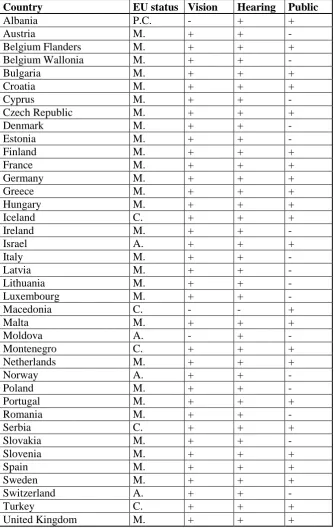
In all 39 countries (including 2 separate regions in Belgium), representatives were found.
Vision representatives were found in 36, hearing representatives in 38 and public-health
[image:11.595.68.403.215.745.2]representatives in 23 countries (Table 1).
Table 1. Eligible countries (EU status: A = associated state, C = Candidate, M = full member, P.C. = potential candidate).
Country EU status Vision Hearing Public
Albania P.C. - + +
Austria M. + + -
Belgium Flanders M. + + +
Belgium Wallonia M. + + -
Bulgaria M. + + +
Croatia M. + + +
Cyprus M. + + -
Czech Republic M. + + +
Denmark M. + + -
Estonia M. + + -
Finland M. + + +
France M. + + +
Germany M. + + +
Greece M. + + +
Hungary M. + + +
Iceland C. + + +
Ireland M. + + -
Israel A. + + +
Italy M. + + -
Latvia M. + + -
Lithuania M. + + -
Luxembourg M. + + -
Macedonia C. - - +
Malta M. + + +
Moldova A. - + -
Montenegro C. + + +
Netherlands M. + + +
Norway A. + + -
Poland M. + + -
Portugal M. + + +
Romania M. + + -
Serbia C. + + +
Slovakia M. + + -
Slovenia M. + + +
Spain M. + + +
Sweden M. + + +
Switzerland A. + + -
Turkey C. + + +
Vision
Information on vision screening programmes was obtained from 36 countries including two
regions in Belgium (Flanders and Wallonia). No information could be obtained from Albania,
Macedonia and Moldova. Thirty-five countries have a vision screening programme in place.
In Belgium, Bulgaria, Estonia, France, Romania, Spain and Switzerland this is a regional
programme. In several countries with a national vision screening programme in place,
regional differences in screening protocols do exist.
Tests infant and preverbal screening
Infant screening (age 0-4 months) included inspection, fixation, red reflex testing, Hirschberg
test, Bruckner test, Cover test, pupillary reflexes and motility. Most countries perform a
combination of two or more of these tests. In Bulgaria, Greece and Poland no screening is
performed at this age. In Germany only inspection of the eyes is performed. In Ireland,
Montenegro and Spain inspection of the eyes is combined with red reflex testing. In Cyprus,
Italy, Lithuania and Malta only red reflex testing is done. In Latvia this is combined with
motility testing. Preverbal screening (age 6-30 months) includes the same tests. At this age
screening is not performed in eight countries. In most other countries a combination of two or
more tests is performed.
Visual acuity measurements
In all countries visual acuity (VA) is tested, but the age of the first measurement varies
between three and seven years of age. In a third of countries VA is tested once, one third
twice and in one third more than two times. Thus in most countries VA measurements are
repeated at an older age. In children age four years and younger the most common used VA
charts are picture charts and the Lea Hyvarinen chart, above four years Tumbling E and
Personnel and referral
Screening is mostly performed by paediatricians, ophthalmologist and/or nurses. In all
countries children are referred to the ophthalmologist for further examination, except for
Latvia, where children are referred to the General Practitioner (GP), the UK where children
may also be referred to joint orthoptic and optometry clinics or optometrists, Malta where
children are referred to either the orthoptist or optometrist and the Netherlands where children
are mostly referred via the GP to an orthoptist or ophthalmologist, but sometimes directly to
an orthoptist, ophthalmologist, optometrist or optician.
Funding
In most countries vision screening is free of charge for parents, except for the Czech
Republic, Malta, Switzerland and Turkey. Funding is in 33% (partially) provided by the
Health Insurance and in 53% (partially) by the State. Parents and charity pay (part of the)
screening in the Czech Republic, Latvia, Romania, Slovakia, Spain and Turkey.
Coverage
Coverage varied from just starting (Estonia, Portugal, Turkey) to more than 95% in Austria,
Czech Republic, Denmark, Finland, Flanders, Germany, Hungary, Iceland, Luxembourg, the
Netherlands, Norway, Serbia, Slovenia, Sweden and parts of the UK. Coverage of different
testing moments varied within countries: the number of children screened varied, dependent
on the age that the screening test was carried out. The highest coverage percentage was
regarded as coverage for each particular country.
Country Scope Personnel 0-4mo
6-30mo Pres. Chart and age Auto. Also Funding Cov. (%)
Austria nat Ophth, ped,
school + + + Lea 3; 4; 5; 6 - stereo insur,
state >95 Belgium (Fl) YHC, nurse + + + Pict 3½, HOTV 4½ + both region >95 Belgium (W) nat Orth, ped, other + + + Snel 3½; 6 + - region >40
Bulgaria loc GP - + - Pict, E 7 - colour insur
Croatia nat Ophth, ped,
school + + + Pict, Lea 4, E 6; 6½ - -
insur,
state >90 Cyprus nat School + - - Snel 6½; 7 - - state >80
Czech rep nat
Ophth, orth, ped, YHC, optom, other
+ + + Pict; Lea 3, E 5, Snel 7; 9; 11; 13;
15 Loc. colour
insur, par region >95
Denmark nat Nurse, school,
GP + + + Pict 3; 4; 5; 6 - - region >95 Estonia loc Ophth, ped + + + Lea 3, Lea; Snellen 6 - - insur start
Finland nat Nurse, school,
GP + + + Lea 3; 4; 5½ - -
state,
munic >95
France loc Orth, ped,
nurse, school + + + Pict 4 - -
insur,
region >80 Germany nat Ped + + + Lea; HOTV 3 - - insur >95 Greece nat Ophth - - + Snel 5½ - both state >60
Hungary nat Ped, nurse,
school + + + Pict 6 Loc. both
insur,
state >95 Iceland nat Ped, nurse + + + Lea; HOTV 4, HOTV; Snel 6 - stereo state >95
Ireland nat School + + - Snel 5½ - - state >80
Israel nat Ped, nurse + + + Pict 3; 6 - - state >80
Italy nat Ped + - + Snel (3); 6 - - region >80
Latvia nat Ophth, ped + + + Cardiff 1, Pict; E 3, E; numbers
6½ - stereo state, par >60 Lithuania nat Ophth, ped + + + Pict; E; Snel 6; 6½; 7 + - state
Luxembourg nat Orth, ped,
nurse + + + Pict; E 3½, 4½, 5½, 6½ + both
insur,
state >95
Malta nat Orth, nurse,
optom, school + + - Snel 3, Sher 5½ - stereo state >80 Montenegro nat Ped, nurse + + + Snel 5½ - - state Netherlands nat YHC, nurse + + + Pict 3, Lea; C 4 - - munic >95
Norway nat Nurse, GP,
school + + + Lea 4, Sher 6 - - munic >95 Poland nat Ped, GP - + + Pict 4, Snel 6 - - state >80 Portugal nat GP + - + Sher 4, E 5; E; C 5½; 6 - - state start
Romania loc Ophth + - + Pict 3, Snel 4; 5 Loc. - state,
charity >80 Serbia nat Ophth, ped + + + Snel 6½ - both state >95
Slovakia nat Ophth, orth,
ped + + + Pict 3, Lea; E; C; Snel, 5; 6 - both par, insur >90 Slovenia nat Ped, school + + + Pict 3; 5 Snel 6; 7 - - insur >95
Spain loc Ped, ophth,
optom + - + Pict 4, Snel 4½; 5 - stereo par, state Sweden nat Nurse + - - HOTV 4, KM 6 - - region >95
Switzerland loc
Ophth, orth, ped, nurse, optic, school, GP
+ + + Pict 4, Lea; E 4½; 5, 5½ - stereo insur >80
Turkey start Ophth + + - E 5 - - par start
UK nat Orth, nurse,
Hearing
Information on neonatal hearing screening (NHS) programmes was obtained from 38
countries including two regions: Flanders and Wallonia in Belgium. No information could be
obtained from Macedonia.
Nation-wide universal NHS programmes are present in 33 out of 38 countries. Malta has a
nation-wide selective screening programme only for infants from neonatal and paediatric IC
units. In Bulgaria, Moldova and Serbia local selective screening programmes for risk groups
(premature new-borns) exist. Albania had for a few years a pilot nation-wide universal
screening programme, which was discontinued due to lack of funds.
Tests
The most widely used audiometric test is otoacoustic emission (OAE). Flanders has used
automated auditory brainstem response (aABR) in all neonates, but in 2013 measurement of
aABR plus auditory steady state responses (ASSR) were introduced. Some regions in
Denmark, Estonia, France, Germany, Spain and Sweden use aABR, OAE or both in the same
infant as first test in well babies. In nearly all programmes both ears are tested. Exceptions are
Finland and Switzerland where one or two ears are tested depending on the institution or the
presence of risk factors. Testing is not staged in five countries, two-staged in 13 countries,
three-staged in 19 countries and 4-staged in one country. aABR is used as final stage in the
majority of countries. In risk groups such as premature new-borns, most programmes use
aABR or a combination of OAE and aABR, but in eight countries OAE only is used. In
Wallonia (Belgium) all premature infants undergo full ABR.
A hearing test in pre-school or early school age children is in less than half of the countries a
Referral
Neonates who do not pass the test are in most countries referred to a combined audiology /
ear, nose, throat (ENT) institution, in some countries to an audiologist and in a few countries
to an ENT specialist.
Funding
In most countries the government or health insurance finances the neonatal hearing screening
programme. Other reported funding includes hospital, parents and private funds.
Coverage
Universal NHS programmes have a coverage of an estimated 10-50% in Romania, 50-95% in
nine countries, and more than 95% in 23 other countries. Malta has a nation-wide selective
screening programme with a good coverage, whereas Bulgaria, Moldova and Serbia have
local selective screening programmes, with a low coverage. Albania had for a few years a
pilot nation-wide universal screening programme with a low coverage.
Data is presented in more detail in table 3 and Map 2.
Table 3. Overview of neonatal hearing screening programmes in 38 European countries.
Scope = scope of hearing screening programme (nat = nation-wide, loc = local, past = pilot
Country Scope Strat Test St Last test Ears Test risk
group Refer Funding
Cov
(%) Child
Albania past all OAE 3 full ABR 2 OAE ENT private <10 - Austria nat all OAE 3 aABR 2 OAE audio state >95 -
Belgium (Fl) nat all aABR+
ASSR 2 aABR 2
aABR +
ASSR audio state >95 Belgium
(W) nat all OAE 2 full ABR 2 full ABR both par, state 90 -
Bulgaria loc select OAE 2 aABR 2 aABR both private,
hosp 25
Croatia nat all OAE 3 aABR 2 aABR both insur >95 - Cyprus nat all OAE 3 aABR 2 aABR audio NGO >95 +
Czech rep nat all OAE 1 2 OAE ENT insur >50
Denmark nat all OAE or
aABR 2 aABR 2 OAE+aABR audio state >95 +
Estonia nat all OAE or
aABR 3 aABR 2 OAE both insur >95 +
Finland nat all OAE 2 OAE 1/2 aABR both state >95 +
France nat all OAE or
aABR 3
aABR or
full ABR 2 aABR both state >50 +
Germany nat all OAE or
aABR 2 aABR 2 aABR both insur >95 +
Greece nat all OAE 1 2 aABR both par >50 +
Hungary nat all OAE 2 OAE 2 aABR both insur, state >50 + Iceland nat all OAE 3 aABR 2 OAE both state >50 - Ireland nat all OAE 2 aABR 2 OAE+aABR audio state >95 - Israel nat all OAE 3 aABR 2 OAE+aABR audio state >95 + Italy nat all OAE 3 aABR 2 OAE+aABR both hosp 70
Latvia nat all OAE 3 ABR 2 aABR and/or
other both state >95 +
Lithuania nat all OAE 3 aABR 2 OAE+aABR both insur
50-90 - Luxembourg nat all OAE 2 OAE 2 aABR ENT state >95 +
Malta nat select OAE 1 2 aABR both state >95
Moldova loc select OAE 2 aABR 2 OAE both int. project >50 - Montenegro nat all OAE 4 aABR 2 aABR both state >95 - Netherlands nat all OAE 3 aABR 2 aABR audio state >95 +
Norway nat all OAE 3 aABR or
full ABR 2 aABR both state >95
Poland nat all OAE 2 OAE 2 OAE both insur >95 -
Portugal nat all OAE 3 aABR 2 aABR both hosp >95 - Romania nat all OAE 2 aABR 2 OAE+aABR both state >10 -
Serbia loc select OAE 1 2 OAE both hosp 25 +
Slovenia nat all OAE 3 aABR 2 aABR both insur >95 - Slovakia nat all OAE 2 OAE 2 aABR both insur, state >95
Spain nat all OAE or
OAE+aABR 3 aABR 2
aABR or
OAE+aABR audio state >95 -
Sweden nat all OAE or
aABR 3
aABR or full ABR 2
OAE+aABR
or aABR both state >95 +
Switzerland nat all OAE 1 1/2 OAE or
aABR both hosp >95 +
Turkey nat all OAE 3 aABR 2 aABR both state 90
Public-health
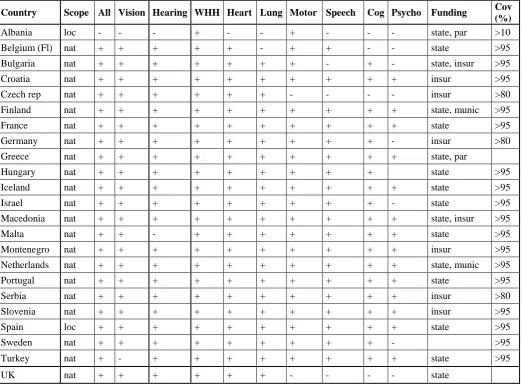
Extra information on public-health screening programmes was obtained from 23 countries
including one region in Belgium (Flanders).
All 23 countries have a public health screening programme in place, but in Albania, Belgium
and Spain this is a regional programme. In the Netherlands and Sweden there is a combination
of national and regional programmes in place. Almost all countries have a programme for all
children, except for Albania where there is only selective screening available. Screening is not
free of charge in Albania, Bulgaria and Czech Republic and is obligatory in Bulgaria,
Flanders, Greece, Hungary and Turkey.
Tests
Weight, height and head circumference are measured in all countries, cardiac function in all
but Albania, lung function in all but Albania and Flanders, vision in all but Albania and
Turkey, hearing in all but Albania and Malta, motor skills in all but Czech Republic and the
UK, speech and language development in all but Albania, Bulgaria, Czech Republic and the
UK, cognitive development in all but Albania, Czech Republic, Flanders and the UK and
psychosocial development is screened in all countries but Albania, Bulgaria, Czech Republic,
Flanders, Germany, Israel, Sweden and the UK.
Referral, funding and coverage
Referral is most often to a specialist. Funding is provided mostly by the government or health
insurance. Coverage is above 80% in all countries, except Albania.
Table 4. Public health screening programmes in 23 European countries. Scope = public-health screening programme (nat = nation-wide, loc = local), All = screening programme for all children, WHH = weight, height and head circumference, Cog = cognitive development,
Psycho = psychosocial aspects, Funding (insur = Health Insurance, par = parents, munic =
Municipalities) Cov = Coverage)
Country Scope All Vision Hearing WHH Heart Lung Motor Speech Cog Psycho Funding Cov (%)
Albania loc - - - + - - + - - - state, par >10
Belgium (Fl) nat + + + + + - + + - - state >95
Bulgaria nat + + + + + + + - + - state, insur >95
Croatia nat + + + + + + + + + + insur >95
Czech rep nat + + + + + + - - - - insur >80
Finland nat + + + + + + + + + + state, munic >95
France nat + + + + + + + + + + state >95
Germany nat + + + + + + + + + - insur >80
Greece nat + + + + + + + + + + state, par
Hungary nat + + + + + + + + + state >95
Iceland nat + + + + + + + + + + state >95
Israel nat + + + + + + + + + - state >95
Macedonia nat + + + + + + + + + + state, insur >95
Malta nat + + - + + + + + + + state >95
Montenegro nat + + + + + + + + + + insur >95
Netherlands nat + + + + + + + + + + state, munic >95
Portugal nat + + + + + + + + + + state >95
Serbia nat + + + + + + + + + + insur >80
Slovenia nat + + + + + + + + + + insur >95
Spain loc + + + + + + + + + + state >95
Sweden nat + + + + + + + + + - >95
Turkey nat + - + + + + + + + + state >95
Questionnaire answer check
Several changes were made based on the first round of questionnaire answers. The following
changes in hearing screening data were made: for Belgium (Flanders) the ASSR was added as
test for neonates at risk. For Finland “testing one ear” was changed to “testing one ear or both
ears”. For France “testing one ear and testing both ears” was changed to “always testing both
ears”. For Italy coverage of “> 95%” was changed to “70%”. For Malta selective screening,
and not population-wide screening, was confirmed. For Poland “non-staged screening” was
changed in “staged screening”. For Israel, Italy, Lithuania and Switzerland “only aABR
testing” for neonates at risk was corrected to “OAE and/or aABR”.
Vision screening data was revised: for Austria funding was changed from “health insurance”
to “health insurance and state”. For Belgium (Flanders) personnel was changed from “nurse”
to “nurse and youth health care physician”, testing of stereopsis and colour vision was added
and VA chart was changed from “Landolt C” to “Pictures and HOTV”. For Croatia VA chart
was changed from “only Tumbling E” to “Pictures, Lea and Tubling E”. For Czech Republic
Pictures and Lea chart were added. For Denmark the “Snellen chart” was changed to
“Pictures” and coverage was changed from “>80%” to “>95%”. For Iceland Snellen chart was
added. For Israel coverage was changed from “>95%” to “>80%”. For Italy funding was
changed from “state” to “regions”. For Latvia “Picture chart and Tumbling E” was corrected
to “Cardiff, Pictures, Tumbling E and numbers”. For Norway the Sheridan Gardiner chart was
added. For Slovenia autorefraction was corrected as in Slovenia autorefraction is only
performed in ophthalmology clinics for referred children and not for screening. For Sweden
the Konstantin Moutakis chart was added. For the UK funding was corrected from “state” to
“regions”, and personnel were changed from “orthoptist, optician and optometrist” to
DISCUSSION
This study assessed population-based vision and hearing screening programmes in all EU
countries. We showed that large differences exist in paediatric population-based vision and
hearing screening programmes throughout the EU. Large differences were found in tests used,
age and frequency of testing. First measurement of VA varies from three to seven years of
age, but in most countries it is measured before the age of five. In children age three and four
picture charts, including Lea Hyvarinen are used most, in children over four Tumbling E and
Snellen. Vision screening is performed mostly by paediatricians, ophthalmologists or nurses.
As first hearing screening test, otoacoustic emission (OAE) is used most in healthy neonates
and auditory brainstem response (ABR) in premature newborns. The majority of hearing
testing programmes are staged. Children are referred after one, two, three or four abnormal
tests. Funding is by health insurance, state, regions, municipalities, charity, hospital, parents
or private funding. A high coverage is reached in most countries for both vision and hearing
screening.
Our study was limited by the difficulty in obtaining referenced or first-hand data sources from
respondents. We have where possible tried to maintain the quality of our data by involving
clinicians who were involved in population based screening, and cross-checking their answers
with the answers given by the general screening professionals. It was most difficult to get
accurate information on funding and coverage, while information on tests, personnel and age
was easier to obtain. The percentage of coverage may have been overestimated by the country
Screening of vision and hearing deficits has similarities, but also differences. An essential
difference between vision and hearing screening is that objective tests are available for
hearing screening at a very early age, enabling screening directly after birth. This probably is
the reason for the more uniform approach and higher coverage that was reported for hearing
screening as compared to vision screening. As we assumed that the personnel operating the
screening apparatus at the hospital or during home visits would be a technician, we did not
ask the profession explicitly. There are only two tests for hearing screening available; OAE
and aABR. The major difference in hearing screening is primarily the number of screening
stages before referral. Multiple stage screening is more expensive, but results in a larger
specificity, which reduces the number of false referrals to specialized and expensive
audiological care centres.23,26 Two or three stages of screening before referral is most
frequently used, with mostly OAE as first test and aABR as last test. Boshuizen et al.
calculated that three stages is preferable in terms of cost-effectiveness, but this is not based on
combined use of OAE and aABR.26 A hearing test in pre-school or early school-age children
has the potential to discover hearing loss acquired during the years after birth, which occurs
more rarely. These tests have been abolished in many countries in Europe.
In our opinion the large diversity in screening programmes may have resulted from the fact
that these programmes arose piecemeal prior to the reporting of any robust evidence on
effectiveness and cost-effectiveness to guide protocol design or implementation. Another
reason could be that in addition most of the preventive health care programmes are
government funded and, therefore, competition is lower than in curative health-care. Careful
assessment is needed of the influence of the kind of funding (e.g. state, health insurance or
The large differences found in population-wide vision and hearing screening in children in all
EU countries necessitate further study on the relative costs and effectiveness of the different
approaches to screening. For instance 12 different VA charts are used, 10 professions are
involved in vision screening, one to four hearing screening tests take place before referral and
eight funding sources are involved. The large number of screening tests used in vision
screening should be compared. Efficiency of screening (i.e. sensitivity and specificity per
euro) should be calculated for screening performed by different screening professions.
We plan to extend the questionnaire and include data sources in a much larger and more
detailed questionnaire. The EUS€REEN study group, an EU-wide consortium (appendix), is
currently preparing a Europe-wide study to compare and optimise the cost-effectiveness of
vision and hearing screening and give country-specific advice in all candidate, associate and
APPENDIX A
EUS€REEN consortium: EU vision:
Austria: Langmann A; Lindner S; Gaugl H (Medical University Graz), Belgium Flanders: ten Tusscher M (University Clinic Brussel), Guérin C; Hoppenbrouwers K, van Lammeren M ( University Leuven), Boelaert K (Kind en gezin, Brussel), Godts D (University Hospital Antwerp), Belgium Wallonia: Paris V (CHU de Liège), Bauwens A (Bastogne), Bulgaria: Stateva D (Medical University Pleven), Croatia: Petrinovic-Doresic J; Bjelos M (University Eye Clinic University Hospital "Sveti Duh", Zagreb), Novak-Stroligo M (Clinical Hospital Rijeka), Alpeza-Dunato Z (Rijeka University Hospital Center), Cyprus: Gavrielides
Michaeloudes M, Czech Republic: Dostálek M (Center of Paediatric Ophthalmology, BINOCULAR s.r.o. Litomysl & Masaryk's University, Brno), Zobanova A (Prague),
Jerabkova A, Denmark: Hesgaard H, Welinder LG (Aalborg University Hospital), Sandfeld L (University of Copenhagen, Roskilde Hospital), Larsen S (Squinting Eyes, Copenhagen), Estonia: Levin M (Ida-Tallinn Central Hospital), Klett A; Somma K (Tallinn), Ismagilova S, Finland: Hyvärinen L (Developmental Neuropsychology, University of Helsinki), France: Thouvenin D (Purpan University Hospital, Toulouse), Coursager K, Germany: Elflein H; Pitz S (University Hospital, Johannes Gutenberg-University, Mainz), Lenk-Schaefer M
(Nürnberg), Van-Waveren M (Tübingen), Greece: Ziakas NG (Aristotle University Thessaloniki), Polychroniadis Scouros S (Hygeia Hospital Athens), Hungary: Knezy K; Nemeth J (Semmelweis University, Budapest), Soproni A (Anna Soproni’s Private Eye Clinic Budapest), Facskó A; Berkes S (University of Szeged), Iceland: Gudmundsdottir E
(Landspitalinn, University of Iceland, Reykjavik), Ireland: McCreery K (Blackrock Clinic, Dublin), Israel: Morad Y (Assaf Harofeh Medical Center, Tel Aviv University, Zrifin), Ancri O (Goldschleger Eye Institute, Sheba Medical Center, Sackler Faculty of Medicine, Tel Aviv University), Italy: Nucci P; Serafino M; Lembo A (University Hospital San Giuseppe, Milan), Bottin D (Hospital of Bolzano), Latvia: Valeina S (Riga Children's University Hospital), Lithuania: Misevice A (Clinic of Ophthalmology, Kaunas University of Medicine), Asoklis RS (ENT and Eye Clinic, Vilnius, Lithuania), Luxembourg: Planata-Bogdan B (Service Orthoptique et Pléoptique, Esch-sur-Alzette), Malta: Francalanza M (Mater Dei Hospital, Malta) MJ Gouder, Montenegro: Jovovic N; Pojuzina N (Children's Hospital, Podgorica), Netherlands: Sjoerdsma T (Municipal Health Service, Amsterdam), van Rijn R (VU
EUS€REEN consortium: EU hearing:
Albania: Birkena Qirjazi, (University of Medicine of Tirana), Austria: Markus Gugatschka, (Medical university Graz), Belgium Flanders: Luc Stappaerts (Kind en Gezin, Brussels), Belgium Wallonia: Bénédicte Vos (Centre d'Epidémiologie Périnatale-School of Public Health/Université libre de Bruxelles, Brussels), Bulgaria: Mario Milkov (St. Petka Eye and Ear Clinic, Varna), Croatia: Marko Velepic (Rijeka University Hospital Center, Rijeka), Cyprus: Chryssoula Thodi (European University Cyprus, UNHS Programmeme), Czech Rep: Josef Syka (Czech Academy of Science, Prague), Denmark: Therese Ovesen (Aarhus
University Hospital), Estonia: Liina Luht (East Tallinn Central Hospital), Finland: Riina Niemensivu; Antii Aarnisalo (Helsinki University Hospital), France: Françoise Denoyelle (Hopital Necker-Enfants Malades, Paris), Germany: Annerose Keilmann (Johannes
Gutenberg-Universität Mainz), Katrin Neumann (Ruhr-University Bochum), Greece: Thomas Nikolopoulos (Athens University School of Medicine), Hungary: Zsolt Beke (Sanct Rokus Hospital, Baja), Iceland: Ingibjörg Hinriksdóttir (National Hearing and Speech Institute of Iceland, Sími), Ireland: Ann O'Connor (RCSI Surgery, Dublin),Israel: Lisa Rubin (Public Health Service, Ministry of Health, Jerusalem), Italy: Patrizia Trevisi; Alessandro Martini (University of Padova), Ferdinando Grandori, (Institute of Biomedical Engineering, Milan), Latvia: Sandra Kuš e (Latvia Children Hearing center), Lithuania: Eugenijus Lesinskas (University Hospital Santariskiu Clinics, Vilnius), Luxembourg: Jean Marc Hild (Services Audiophonologiques, Strassen), Malta: Anthony Fenech, (Mater Dei Hospital, Msida), Moldova: Anghelina Chiaburu (Republican Center of Audiology, Chisinau), Montenegro: Ognjen Jovicevic, (Institute for Children's disease, Clinical Center of Montenegro, Podgorica), Norway: Karl Nordfalk; Sverre Medbø (Universitetssykehus, Oslo), Poland: Witold Szyfter, Gra yna Greczka (University of Medical Sciences, Pozna ), Portugal: Luisa Monteiro (Lisbon), Romania: Madalina Georgescu, (University of Medicine and Pharmacy, Bucharest),Serbia: Snezana Andric Filipovic (Clinical Center of Serbia, Clinic of ENT and Maxillofacial Surgery, Belgrade), Slovakia: Gabriela Pavlovcinova, Milan Profant
(University Hospital Bratislava), Slovenia: Saba Battelino; Irena Hocevar Boletezar (University Medical Center, Ljubljana), Spain: Faustino Núñez-Batalla (Hospital
EUS€REEN consortium: EU Public health:
Albania: Qirjazi B (Faculty of Medicine, Science Medical University of Tirana), Belgium Flanders: Hoppenbrouwers K; Guérin C (KU University Leuven), Bulgaria: Georgieva L (Faculty of Public Health, Medical University, Sofia), Croatia: Rukavina T (University Rijeka School Medicine), Czech Republic: Bourek A (Masaryk University), Finland: Hietanen-Peltola M (The National Institute of Health and Welfare), France: Jégat C (Association Nationale pour l'Amélioration de la Vue Paris), Germany: Ottová-Jordan V(University Medical Center Hamburg-Eppendorf), Greece: Polychroniadis Scouros S (Hygeia Hospital Athens), Hungary: Kovacs A (Scientific Committee at Association of Primary Care
Paediatricians), Iceland: Jónsdóttir LS (Directorate of Health), Israel: Morad Y (Department of Ophthalmology, Assaf Harofeh Medical Center, Tel Aviv University, Zrifin); Grotto I (Israel Ministry of Health), Malta: Farrugia Sant'Angelo V (Ministry for Health, Floriana, Malta), Macedonia: Memeti S (Institute of Public Health of the Republic of Macedonia), Montenegro: Mugosa B, (Institute of Public Health of Montenegro, Podgorica), Netherlands: Raat H (Department of Public Health, Erasmus Medical Center Rotterdam), Portugal: Gaspar T (Institute of Psychology and Educational Sciences, Lusiada University, Lisbon), Serbia: Zivkovic Sulovic M (Institute of public health of Serbia), Slovenia: Juricic M (University of Ljubljana, Medical Faculty), Spain: Rajmil L (Catalan Agency for Health Quality and
Assessment), Sweden: Hjern A, (Karolinska Institutet), Turkey: Atilla H (Ankara University), UK: Dahlmann-Noor A (NIHR Biomedical Research Centre at Moorfields Eye Hospital and UCL Institute of Ophthalmology)
The authors thank Ferdinando Grandori, Gwen Carr, Anneke Meuwese-Jongejeugd, Bert van Zanten, Cécile Guérin, Karel Hoppenbrouwers for their information, comments and
APPENDIX B
Glossary:
aABR: automated Auditory Brainstem Response; detects responses in the brainstem after offering
clicks of 35 or 40 dB via headphones.
Amblyopia (lazy eye): reduced vision, usually in one eye caused by abnormal visual experience in
early childhood e.g. strabismus and refractive error.
Bruckner test: A direct ophthalmoscope is used in a darkened room and the red reflex in both eyes is
assessed simultaneously at 0.6 to 0.9 metres. The colour and brightness of the red reflexes are compared. The colour is often more orange than red. The test is easy and quick to perform and can reliably detect media opacities. Strabismus and refractive error can also be detected, but with a lower sensitivity. Refractive error can give a yellow-white edge to a red reflex.
Hirschberg test: corneal light reflex test. The corneal light reflex test is performed to assess ocular alignment. The test is performed by shining a light into the child eyes from a distance and observing the reflections on the cornea with respect to the pupil. The location of the light reflexes should be symmetric.
OAE: Otoacoustic emissions; sounds produced by inner ear hair cells if the hearing threshold is better
REFERENCES
1. Yoshinaga-Itano C, Sedey AL, Coulter DK et al. Language of Early- and Later-identified Children With Hearing Loss. Paediatrics. 1998; 102: 1161-71.
2. US Preventive Services Task Force. Universal screening for hearing loss in newborns: US Preventive Services Task Force recommendation statement. Paediatrics. 2008; 122: 143-8.
3. Korver AM, Konings S, Dekker FW et al. Newborn hearing screening vs later hearing screening and developmental outcomes in children with permanent childhood hearing impairment. JAMA. 2010; 304: 1701-8.
4. Holmes JM, Lazar EL, Melia BM et al. Paediatric Eye Disease Investigator Group. Effect of age on response to amblyopia treatment in children. Arch Ophthalmol. 2011; 129: 1451-7.
5. Groenewoud JH, Tjiam AM, Lantau VK et al. Rotterdam Amblyopia Screening Effectiveness Study: detection and causes of amblyopia in a large birth cohort. Invest Ophthalmol Vis Sci. 2010; 51: 3476-84.
6. Simonsz-Tóth B, Loudon SE, van Kempen-du Saar H et al. Evaluation of visual acuity in a historical cohort of 137 patients treated for amblyopia by occlusion 30-35 years ago. Klin Monbl Augenheilkd. 2007; 224: 40-6.
7. Wolff R, Hommerich J, Riemsma R et al. Hearing screening in newborns: systematic review of accuracy, effectiveness, and effects of interventions after screening. Arch Dis Child 2010; 95: 130–5.
8. Neugebauer A, Reier M, Fricke J et al. Kindliche Sehstörungen. Screeningprogramme im internationalen Vergleich. Childhood vision disorders. Screening programmes in international comparison. Ophthalmologe. 2002; 99: 32-7.
9. Matta NS, Silbert DI, International Orthoptic Association Vision Screening Committee. Vision screening across the world. Am Orthopt J. 2012; 62: 87-9.
10. Bubbico L, Tognola G, Greco A et al. Universal newborn hearing screening programmes in Italy: survey of year 2006. Acta Otolaryngol. 2008; 128: 1329-36.
11. Davis A, Hind S. The newborn hearing screening programme in England. Int J Pediatr Otorhinolaryngol. 2003; 67: S193-6.
12. Bamford J, Uus K, Davis A. Screening for hearing loss in childhood: issues, evidence and current approaches in the UK. J Med Screen. 2005; 12: 119–24.
13. Wroblewska-Seniuk K, Chojnacka K, Pucher B et al. The results of newborn hearing screening by means of transient evoked otoacoustic emissions. Int J Pediatr
Otorhinolaryngol. 2005; 69: 1351-7.
15. Cao-Nguyen MH, Kos MI, Guyot JP. Benefits and costs of universal hearing screening programme. Int J Pediatr Otorhinolaryngol. 2007; 71: 1591-5
16. Hergils L. Analysis of measurements from the first Swedish universal neonatal hearing screening Programme. Int J Audiol. 2007; 46: 680-5.
17. Leveque M, Schmidt P, Leroux B et al. Universal newborn hearing screening: a 27-month experience in the French region of Champagne-Ardenne. Acta Paediatr. 2007; 96: 1150-4.
18. Deem KC, Diaz-Ordaz EA, Shiner B. Identifying Quality Improvement Opportunities in a Universal Newborn Hearing Screening Programme. Paediatrics. 2012; 129: e157-64.
19. Metzger D, Pezier TF, Veraguth D. Evaluation of universal newborn hearing screening in Switzerland 2012 and follow-up data for Zurich. Swiss Med Wkly. 2013; 143: w13905.
20. Carlton J, Karnon J, Czoski-Murray C et al. The clinical effectiveness and
cost-effectiveness of screening programmes for amblyopia and strabismus in children up to the age of 4-5 years: a systematic review and economic evaluation. Health Technol Assess. 2008; 12: iii, xi-194.
21. Snowdon SK, Stewart-Brown SL. Preschool vision screening. Health Technol Assess. 1997; 1: :i-iv, 1-83.
22. Keren R, Helfand M, Homer C et al. Projected cost-effectiveness of statewide universal newborn hearing screening. Paediatrics. 2002; 110: 855-64.
23. Burke MJ, Shenton RC, Taylor MJ. The economics of screening infants at risk of hearing impairment: An international analysis. Int J Pediatr Otorhinolaryngol. 2012; 76: 212–218.
24. Ohlsson J, Sjöstrand J. Preschool Vision Screening: Is It Worthwhile? Essentials in Ophthalmology. 2006: 19-36. Paediatric Ophthalmology, Neuro-Ophthalmology, Genetics.
25. Institut für Qualität und Wirtschaftlichkeit im Gesundheitswesen (IQWiG).
Früherkennungsuntersuchung von Sehstörungen bei Kindern bis zur Vollendung des 6. Lebensjahres. Köln: Institut für Qualität und Wirtschaftlichkeit im Gesundheitswesen, 2008.
DATA SUPPLEMENT
Q1
in your country is there a:
Public-health screening
programme? None Regional National
Employer-based Other
Eye screening
programme? None Regional National
Employer-based Other
Who pays for
eye screening? Parents
Health
Insurance Councils
Provinces-Regions State
Parents employ
er Companies Charity Other
Who does the eye screening?
Ophthalmo
logist Orthoptist
Paediatric ian
Youth health care
physician Nurse
Ophth practice assistan
t Optometrist
Opticia n
School
physician Other: Coverage
among eligible
children? >95% >90% >80% >60% >40% >20% >10% <10%
Just
starting Other:
Parents' secondary benefits: Eye exam is free Eye exam is cheap Financial reward During working hours Conditio n for school entry Free
glasses Obligatory Other: Infant
eye-screening
tests? Inspection Fixation
Red fundus
reflex Hirschberg Brückner
Cover test
Pupillary reflexes
Motilit
y Other:
At approx 1 week 2 weeks 3 weeks 1 month 6 weeks 2
months 10 weeks
3
months 4 months Other: Preverbal
eye-screening
tests? Inspection Fixation
Red fundus
reflex Brückner
Pupillary reflexes
Motilit
y Hirschberg
Cover
test Other:
at approx 6 months 9 months 1 year 15 months
18 months
21
months 2 years
27 months
30
months Other: Autorefraction
photoscreenin
g at: 6 months 9 months 1 year 15 months
18 months
21
months 2 years
27 months
30
months Other:
Preschool eye
screening? Inspection Fixation
Red fundus
reflex Brückner
Pupillary reflexes
Motilit
y Hirschberg
Cover
test Other: visual acuity measured with: Picture chart Lea
Hyvarinen HOTV
Tumbling E
Landolt
C Snellen Also:
Stereop sis
Color
vision Other:
at approx 3 years 3,5 years 4 years 4,5 years 5 years
5,5
years 6 years
6,5
years 7 years Other: Positively screened children referred to: General practitioner Ophthalmo logist Orthoptis
t Optician
Optometr
Q2
In your country is there a:
Public-health screening
programme for children?
no regional national other
Neonatal hearing screening
programme (NHS)
no regional national other
In what year approximately did
the programme start?
How is the NHS programme
financed?
parents hospital government health
insurance
What % of neonates are actually
screened?
>95% >50% >10% <10%
Which test is used for NHS? OAE aABR other
Different test for neonates at risk,
f.e. prematures?
no aABR other
Are both ears tested? one ear both ears
Is NHS staged? no
OAE-aABR
OAE-OAE-aABR
other
Is NHS in your country universal? selective?
What is the follow up if a neonate
tests positive on NHS?
audiologic
examination
Q3
In your country is
there a:
Public-health
screening programme
for children? no national regional other
In what year did the
programme start?
General or selective screening
no
screening general selective
risk
groups
Who pays for the
screening programme? parents charity hospital
govern ment
health
insurance other
Parents' secondary benefits: exam is free of charge exam is cheap financial reward during workin
g hours obligatory other Coverage among
eligible children? >95% >80% >50% >10% <10% At what age is
screening performed?
Are the following tests performed
weight, height, head circumfere
nce heart lung vision hearing
motor skills speech and language cognitive develop ment Psycho social
aspects other
Who performs the
screening? doctors paramedic nurses
screeni ng physici
an
school
physician other
Positively screened children are referred
to: GP hospital specialist
private