promoting access to White Rose research papers
White Rose Research Online [email protected]
Universities of Leeds, Sheffield and York
http://eprints.whiterose.ac.uk/
This is an author produced version of a paper published inSurgical Endoscopy
White Rose Research Online URL for this paper:
http://eprints.whiterose.ac.uk/id/eprint/77805
Paper:
White, AD, Giles, O, Sutherland, RJ, Ziff, O, Mon-Williams, M, Wilkie, RM and Lodge, JP (2013) Minimally invasive surgery training using multiple port sites to improve performance. Surgical Endoscopy. ISSN 0930-2794
Minimally Invasive Surgery Training Using Multiple Port-sites To
Improve Performance
Alan D White
1, 2Oscar Giles
1Rebekah J Sutherland
1Oliver Ziff
1Mark
Mon-Williams
1Richard M Wilkie
1*J Peter A Lodge
21. Institute of Psychological Sciences, University of Leeds, Leeds, United Kingdom
2. Department of Hepatobiliary and Transplant Surgery, St James‟s University Hospital, Leeds, United Kingdom
Corresponding author:
Dr Richard Wilkie*
Institute of Psychological Sciences, University of Leeds,
Leeds,
United Kingdom
Email: [email protected]
Tel: 0113 343 6681
This work was kindly supported by the Wellcome Trust, EPSRC and The Leeds Teaching Hospitals Charitable Trust.
Short running head: Motor task variation in surgery
Background: Structural learning theory suggests that experiencing motor task variation enables the central nervous system to extract general rules regarding tasks with a similar structure – rules which subsequently can be applied to novel situations. Complex minimally invasive surgery (MIS) requires different port sites, but switching ports alters the limb movements required to produce the same end-point control of the surgical instrument. The purpose of the present study was to determine if structural learning theory can be applied to MIS to inform training methods.
Methods: A tablet laptop running bespoke software was placed within a laparoscopic box trainer and connected to a monitor situated at eye-level. Participants (right-handed, non-surgeons, mean age = 23.2 years) used a standard laparoscopic grasper to move between locations on the screen. There were 2 training groups: the M-group (n = 10) who trained using multiple port-sites, and the S-group (n = 10) who trained using a single port-site. A novel port-site was used as a test of generalization. Performance metrics were a composite of speed and accuracy (SACF), and normalized jerk (NJ; a measure of movement „smoothness‟).
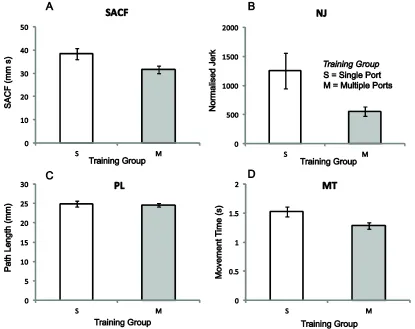
Results: The M-group showed a statistically significant performance advantage over the S-group at test as indexed by improved SACF (p < 0.05) and NJ (p < 0.05).
Conclusions: This study has demonstrated the potential benefits of incorporating a structural learning approach within MIS training. This may have practical applications when training junior surgeons and developing surgical simulation devices.
Key words: Minimally Invasive Surgery, Motor control, Kinematic, Motor learning
Introduction
advances in psychology, neuroscience and machine learning have started to explain the amazing capacity that humans show for learning to move within sparse environments [1–3]. Here we demonstrate how our theoretical understanding of motor learning makes predictions that can be usefully exploited to inform surgical training and safety.
First let us consider a laparoscopic gastric bypass or laparoscopic surgery for colorectal malignancy. Typically, four to six ports are required to gain adequate access to the target structures and the surgeon will switch between ports throughout the surgery. The physical properties of laparoscopic tools mean that switching ports changes the relationship between the surgeon‟s hand movements and the movement of the tool (a relationship known as the visual-motor mapping). For example, switching to a port which is closer to a target structure means smaller movements of the tool handle are required to create the desired movement of the tip, the force requirements change, and disparate arm movements recruiting different joints and muscle groups are needed. Heuer and Sulzenbruck [4] studied the trajectories of the hand and of the tip of a handheld sliding lever in aiming movements. They observed that the movement of the effective part of the tool is the primary kinematic variable in motor planning and control even in the absence of continuous visual feedback. If the surgeon‟s visual-motor system is unable to estimate these new task parameters, the accuracy and/or speed of movement will be impaired, increasing the risk of direct harm (such as inadvertent perforation of an organ) and indirect harm (prolonged general anesthesia [5, 6]) to the patient.
structure is a set of rules which describes how task parameters co-vary (i.e. how a set of forces applied to the brake results in different stopping times depending on the vehicle). Once the driver has discovered the structure, the problem of learning a related task (driving a new car) becomes much simpler [7].
A similar principle could apply to performing a surgical task through multiple ports. If surgeons are able to learn general rules about how port properties vary this may alleviate the negative consequences associated with port switching. Experimental findings show that training regimes in which task parameters are randomly or gradually varied provide support for the extraction of structural rules [2, 7–9]. Even when the structural rules are not extracted, motor task variation can improve future performance through other mechanisms [10–13]. Despite this, current training systems offer little opportunity for variability and many focus on improving performance metrics under constant task parameters. Given that the fundamental assumption of surgical training systems is that any performance benefits will transfer to the operating room, it seems essential to determine whether training regimes which vary task parameters (i.e. providing experience with different port conditions) would be better preparation for a novice surgeon.
Materials and Methods
ParticipantsParticipants (N=20; 10 male, 10 female) were recruited from the University of Leeds (age range 16-31 years, mean age 23.2 years, SD 3.3 years). Given the difficulty in recruiting surgeons with a similar level of experience we recruited only participants with no surgical background. We previously conducted a pilot study which revealed no differences between surgeons and non-surgeons when performing novel motor tasks. Thus our sample allows us to reliably estimate group differences with sufficient statistical power and extrapolate our results to surgical trainees.
[image:6.595.178.420.481.624.2]No participants had any known neurological conditions/deficits and all had normal/corrected to normal vision. All participants completed the task with their right hand, and all were right handed as indexed by the Edinburgh Handedness Inventory [15] except for two who were classified as ambidextrous. One participant in the multiple port site group showed exceptionally poor performance at test and was identified as an outlier (Z-score on SACF = 2.37) and was subsequently excluded from further analysis. Ethical approval was granted by the University of Leeds, in line with the declaration of Helsinki.
Apparatus
A laparoscopic box trainer (Ethicon Endo Surgery and Stryker) measuring 390 mm x 265 mm x 180 mm was positioned 700 mm above the floor and rotated 90° anticlockwise with the shorter sides orthogonal to the supporting table. The box trainer had seven entry ports positioned in a „H‟ configuration. Only the three proximal (P1, T1, P3) and a central port (P2) were used in the study (Figure 1c). The ports had a diameter of 40 mm and had a soft rubber entry in a cross hair shape. An ENDOPATH® XCEL™ Dilating Tip 12 mm trocar was fully inserted through each port with the gas valve facing away from the participant. A 73 mm x 60 mm x 15 mm section of soft foam was used as a collar between the port and trocar to allow free range of movement. A 330 mm long laparoscopic grasper with plastic tip was then inserted through the trocar and placed on the kinematic recording device (Figure 1a).
A Toshiba Portege M700-13P tablet PC (screen: 257 x 160 mm, 1280 x 800 resolution, 120 Hz refresh rate) running bespoke software (Kinematic Assessment Tool [15]) was used to record endpoint position at 120 Hz. The tablet was placed inside the box trainer at the distal right corner and the built-in touch screen acted as an input device (Figure 1a). Visual stimuli were presented on a Dell 1708FP monitor (screen 339 x 270 mm, 1280 x 1024 resolution, 75 Hz refresh rate) positioned behind the box trainer. The lowest point of the screen was 580 mm above the table. The rubber endpoint of the laparoscopic grasper was represented by an onscreen cursor and controlled by moving across the touch screen. Black markers were placed on the floor to indicate where the participants should stand in order to ensure a consistent viewing distance of approximately 800 mm.
Task and Procedure
Participants were given standardized instructions at the start of each experimental block to perform the task as „quickly and accurately as possible‟ using their right hand throughout.
movements to sequentially appearing targets (green circles, 4 mm diameter, 115 mm apart), keeping the end of the laparoscopic grasper in contact with the touch screen at all times. All baseline trials were performed through port P2. The trial was initiated by moving the cursor over the starting position (a target labeled „S‟), after which the next target appeared. Targets were presented in a pentagram orientation, disappearing after the next target was reached.
The M and S groups then completed a training block consisting of 30 trials. Similar to the baseline trial, participants made aiming movements to sequentially appearing targets. Each trial was made up of 20 targets (approximately between 18 – 22 mm apart) while a straight black line connected the visible targets indicating the most direct path (Figure 1c). During all learning trials a 40° visuo-motor rotation was applied with an origin at the “S” start symbol such that the cursor moved away from the origin at a 40° angle relative to the laparoscopic endpoint position. The M group performed each trial through port P1, P2 or P3 in a pseudo random, non-repeating order. The S group performed all 30 trials through port P2.
The following day the participants in both groups completed a test block, consisting of 14 trials identical to those in the training block. However, both groups then completed the test trials through the novel port-site T2.
Measures
Performance was characterized by examining four separate measures (see [16]): (i) Movement Time (MT), the time taken to move from one target to the next
in seconds.
(ii) Path Length (PL), the distance taken to move between one target to the next in millimetres.
(iii) Speed Accuracy Composite Function (SACF), is a measure that accounts for both the speed and accuracy of each movement (slower movements are usually more accurate, and vice versa). This was calculated as follows: SACF=MT × PL.
Analysis
The mean scores for movements within and across all trials were calculated for each participant. This was performed on SACF, MT, PL and NJ measures of movements. Independent t-tests to compare SACF and NJ between both M and S groups were then carried out.
Results
Baseline Performance
[image:9.595.89.504.390.719.2]Baseline visual-motor performance was calculated from the first 50 movements for each individual. There were no differences between the S and M groups on measures of SACF (t(17)= -0.67, p > 0.05), MT (t(17)= -0.31, p > 0.05), PL (t(17)= -0.35, p > 0.05 or NJ (t(17)=0.37, p > 0.05). Participants across groups were, therefore, considered to have similar levels of visual-motor ability at baseline.
by: a) Speed Accuracy Composite Function (SACF), b) Normalized Jerk (NJ), c) Path Length (PL) and d) Movement Time (MT). All error bars = Standard Error.
Performance at Test
Discussion
A lifetime of experience interacting with the world leads humans to develop finely tuned visual-motor maps used to help carry out skilled actions. One reason that minimally invasive surgery is such a challenging task is that it suddenly alters the relationship between a motor action and the outcome (as perceived visually), which requires a new mapping to be learnt (or existing mappings to be adjusted). Further complexity arises from the fact that these mappings may vary depending upon which tool and port site is being used. As such, it is not straightforward to determine the optimal training regime for learning to perform laparoscopic surgery.
In the present study we examined whether our theoretical understanding of how the central nervous system “learns to learn” could be used to inform laparoscopic training. For these purposes we chose the particular problem of how best to prepare an individual to use a familiar laparoscopic instrument through a completely novel port site. We trained one group with multiple port sites and compared their performance to another group which was trained using a single port site. While both groups experienced the same number of training trials, the single port site group experienced far more consistent conditions. Our results show, however, that performance at the novel port site was best after training using multiple port sites. This result is predicted by structural learning theory, which states that motor task variation can allow the central nervous system to learn general rules about how task parameters co-vary [2].
Specifically, training boxes and virtual reality trainers should be designed with motor task variation in mind.
In this paper we have examined one set of conditions that could impact on the performance of a surgeon during MIS. But there are a number of other potential conflicting/distorted sources of information in the surgical environment. In normal laparoscopic practice, frequent repositioning of the laparoscope (the camera) is required in order to view different areas of operative space. For example, in gastric bypass surgery it is sometimes necessary to divide adhesions in the pelvis. This seemingly simple task is made difficult as the „set-up‟ of the procedure is altered when operating switches to the pelvis, movements are „inverted‟ and the surgeon needs to reverse his/her movements. This can lead to a change in the alignment between the camera-axis and surgeon‟s body-axis (and their motor-axis) which results in slow and inaccurate movements [20–22]. While the visual properties of the tools could provide a useful cue as to the nature of the camera-axis, that information could also have negative consequences for certain forms of learning [23]. Similar misalignments between the motor-axis of the surgeon and the visual display can occur depending upon the monitor position and misalignments are exacerbated by surgeons choosing monitor orientations that optimize comfort over performance [24–26].
It is tempting to try to extrapolate from our findings further guidelines for training to cope with various variables present in the surgical environment. It seems reasonable to suggest that varying the relationship between body-axis and camera-axis (and/or
the display-axis) during training would help attenuate any adverse effects in terms of
surgical performance. What is crucial, however, is ensuring the right balance between
varying task parameters and allowing consolidation and improvement (i.e. repeating
similar conditions). While previous studies demonstrate that both random and gradual
variation of task parameters improve future learning [18], rapid changes in the
environment may result in reduced retention rates [27]. In essence while variability in
practice should improve the ability of a surgeon to cope with a changing surgical
environment, they still need some consistent performance feedback to hone their
In conclusion, we believe this is the first study to show that surgical training can be improved by exploiting the nervous system‟s ability to learn task structures. This simple evidence based exercise shows the potential to reduce the risk of human error in MIS while decreasing the time required for novice surgeons to reach proficiency. This has practical applications for trainers of junior surgeons and also for the development of surgical simulation devices that may need to incorporate greater variability into future training programs. One prediction of structural learning theory is that training regimes which promote the discovery of task structures should augment transfer from simulator training to the operating room. Our results provide indirect evidence to this effect, but testing this hypothesis in situ is a priority for surgical training.
Acknowledgments
This work was kindly supported by the Wellcome Trust, EPSRC and The Leeds Teaching Hospitals Charitable Trust. Thanks to Faisal Mushtaq for his contributions in proof reading the manuscript.
Disclosures
Alan D White has no conflicts of interest to declare Oscar Giles has no conflicts of interest to declare
Rebekah Sutherland has no conflicts of interest to declare Oliver Ziff has no conflicts of interest to declare
References
1. Tenenbaum JB, Kemp C, Griffiths TL, Goodman ND (2011) How to grow a mind:
statistics, structure, and abstraction. Science 331:1279–2385. doi:
10.1126/science.1192788
2. Braun D, Mehring C, Wolpert D (2010) Structure learning in action. Behav Brain Res
206:157–165.
3. Braun DA, Aertsen A, Wolpert DM, Mehring C (2009) Learning optimal adaptation
strategies in unpredictable motor tasks. J Neurosci 29:6472–6478. doi:
10.1523/JNEUROSCI.3075-08.2009
4. Heuer H, Sülzenbrück S (2009) Trajectories in operating a handheld tool. J Exp Psychol
Hum Percept Perform 35:375–389. doi: 10.1037/0096-1523.35.2.375
5. Reich DL, Bennett-guerrero E, Bodian CA, et al. (2002) Intraoperative Tachycardia and
Hypertension Are Independently Associated with Adverse Outcome in Noncardiac
Surgery of Long Duration. Anesth Analg 95:273–277. doi:
10.1213/01.ANE.0000019206.81178.75
6. Bandrinath SS, Bhaskaran S, Sundararaj I, et al. (1995) Mortality and morbidity associated
with opthalamic surgery. Opthalamic Surg Lasers 26:535–541.
7. Braun DA, Aertsen A, Wolpert DM, Mehring C (2009) Motor task variation induces
structural learning. Current Biology 19:352–357. doi: 10.1016/j.cub.2009.01.036
8. Kobak D, Mehring C (2012) Adaptation paths to novel motor tasks are shaped by prior
structure learning. J Neurosci 32:9898–908. doi: 10.1523/JNEUROSCI.0958-12.2012
9. Yousif N, Diedrichsen J (2012) Structural learning in feedforward and feedback control. J
Neurophysiol 108:2373–2382. doi: 10.1152/jn.00315.2012
10. Seidler RD (2001) Multiple motor learning experiences enhance motor adaptability.
Journal of cognitive neuroscience 16:65–73. doi: 10.1162/089892904322755566
11. Abeele S, Bock O (2001) Mechanisms for sensorimotor adaptation to rotated visual input.
12. Cunningham H, Welch R (1994) Multiple concurrent visual-motor mappings:
implications for models of adaptation. J Exp Psychol Hum Percept Perform 20:987–999.
13. Roller CA, Cohen HS, Kimball KT, Bloomberg JJ (2001) Variable practice with lenses
improves visuo-motor plasticity. Brain research Cognitive brain research 12:341–52.
14. Fitts PM, Posner MI (1967) Human performance. Brooks/COles, Oxford, England
15. Oldfield R (1971) The assessment and analysis of handedness: the Edinburgh inventory.
Neuropsychologia 9:97–113.
16. Culmer PR, Levesley MC, Mon-Williams M, Williams JHG (2009) A new tool for
assessing human movement: the Kinematic Assessment Tool. J Neurosci Methods
184:184–192. doi: 10.1016/j.jneumeth.2009.07.025
17. Welch RB, Bridgeman B, Anand S, Browman KE (1993) Alternating prism exposure
causes dual adaptation and generalization to a novel displacement. Perception &
psychophysics 54:195–204.
18. Turnham EJA, Braun DA, Wolpert DM (2012) Facilitation of learning induced by both
random and gradual visuomotor task variation. J Neurophysiol 107:1111–1122. doi:
10.1152/jn.00635.2011
19. Johnson RL, Culmer PR, Burke MR, et al. (2010) Exploring structural learning in
handwriting. Exp Brain Res 207:291–295. doi: 10.1007/s00221-010-2438-5
20. Zhang L, Cao CGL (2012) Effect of automatic image realignment on visuomotor
coordination in simulated laparoscopic surgery. Appl Ergon 43:993–1001. doi:
10.1016/j.apergo.2012.02.001
21. Gallagher AG, Al-Akash M, Seymour NE, Satava RM (2009) An ergonomic analysis of
the effects of camera rotation on laparoscopic performance. Surg Endosc 23:2684–2691.
doi: 10.1007/s00464-008-0261-x
22. Cresswell AB, Macmillan AI, Hanna GB, Cuschieri A (1999) Methods for improving
performance under reverse alignment conditions during endoscopic surgery. Surg
23. Sülzenbrück S, Heuer H (2012) Enhanced mechanical transparency during practice
impedes open-loop control of a complex tool. Exp Brain Res 218:283–294. doi:
10.1007/s00221-012-3011-1
24. Rogers ML, Heath WB, Uy CC, et al. (2012) Effect of visual displays and locations on
laparoscopic surgical training task. Appl Ergon 43:762–767. doi:
10.1016/j.apergo.2011.11.010
25. Van Det MJ, Meijerink WJHJ, Hoff C, et al. (2009) Optimal ergonomics for laparoscopic
surgery in minimally invasive surgery suites: a review and guidelines. Surg Endosc
23:1279–1285. doi: 10.1007/s00464-008-0148-x
26. Veelen MA, Jakimowicz JJ, Goossens RHM, et al. (2002) Evaluation of the usability of
two types of image display systems, during laparoscopy. Surg Endosc 16:674–678. doi:
10.1007/s00464-001-9116-4
27. Huang VS, Shadmehr R (2009) Persistence of motor memories reflects statistics of the