This is a repository copy of
Numerical Implementation and Test of the Modified Variational
Multiconfigurational Gaussian Method for High-Dimensional Quantum Dynamics
.
White Rose Research Online URL for this paper:
http://eprints.whiterose.ac.uk/88797/
Version: Accepted Version
Article:
Ronto, M and Shalashilin, DV (2013) Numerical Implementation and Test of the Modified
Variational Multiconfigurational Gaussian Method for High-Dimensional Quantum
Dynamics. Journal of Physical Chemistry A, 117 (32). pp. 6948-6959. ISSN 1089-5639
https://doi.org/10.1021/jp310976d
© 2013 American Chemical Society. This document is the Accepted Manuscript version of
a Published Work that appeared in final form in Journal of Physical Chemistry A, copyright
© American Chemical Society after peer review and technical editing by the publisher. To
access the final edited and published work see http://dx.doi.org/10.1021/jp310976d.
Uploaded in accordance with the publisher's self-archiving policy.
[email protected] https://eprints.whiterose.ac.uk/
Reuse
Unless indicated otherwise, fulltext items are protected by copyright with all rights reserved. The copyright exception in section 29 of the Copyright, Designs and Patents Act 1988 allows the making of a single copy solely for the purpose of non-commercial research or private study within the limits of fair dealing. The publisher or other rights-holder may allow further reproduction and re-use of this version - refer to the White Rose Research Online record for this item. Where records identify the publisher as the copyright holder, users can verify any specific terms of use on the publisher’s website.
Takedown
If you consider content in White Rose Research Online to be in breach of UK law, please notify us by
1
Numerical Implementation and Test of the Modified Variational
Multiconfigurational Gaussian Method for High-dimensional
Quantum Dynamics
Miklos Ronto and Dmitrii V. Shalashilin1
School of Chemistry, University of Leeds, Leeds LS2 9JT, UK
Abstract
In this paper a new numerical implementation and a test of the modified variational Multiconfigurational Gaussian (vMCG) equations are presented. In vMCG the wave function is represented as a superposition of trajectory guided Gaussian Coherent States and the time derivatives of the wave function parameters are found from a system of linear equations, which in turn follows from the variational principle applied simultaneously to all wave function parameters. In the original formulation of vMCG the corresponding matrix was not well behaved and needed regularisation, which required matrix inversion. The new implementation of the modified vMCG equations seems to have improved the method, which now enables straightforward solution of the linear system without matrix inversion, thus achieving greater efficiency, stability and robustness. Here the new version of the vMCG approach is tested against a number of benchmarks, which previously have been studied by split-operator, Multiconfigurational Time Dependent Hartree (MCTDH) and Multilayer MCTDH (ML-MCTDH) techniques. The accuracy and efficiency of the new implementation of vMCG is directly compared with the method of Coupled Coherent States (CCS), another technique which uses trajectory guided grids. More generally we demonstrate that trajectory guided Gaussian based methods are capable of simulating quantum systems with tens or even hundreds of degrees of freedom previously accessible only for MCTDH and ML-MCTDH.
I INTRODUCTION
Exact analytical solvability of the time-dependent Schrödinger-equation for systems with large
number of degrees of freedom (DOF) is limited to a few simple models. There are two problems
which make multidimensional quantum mechanics difficult to deal with. First, determining the
potential energy surface is a complicated problem, which is also present in classical molecular
dynamics. Recently substantial progress has been made1, 2 with various forms of PES parametrisations
and fits. The second problem is the scaling of quantum mechanics with the number of degrees of
freedom (DOF): the number of quantum states increases exponentially with the size of quantum
system. Impressive progress has been made in calculations of quantum states for the systems
comprised of large numbers of coupled vibrational modes3some of which can be very “floppy”3, 4. In
dynamical calculations – when evolution of the wave packet is not restricted to a certain area – the
“exponential curse” of quantum mechanics is perhaps the most severe. If a static grid of states is used for a single-mode, a problem of DOF requires
2
(1.1)
grid points making the challenge of exponential scaling almost insurmountable.
In the last few decades a family of concepts based on trajectory guided Gaussians, which rely on
locally defined adaptable basis sets, gained considerable importance. A number of methods both
semiclassical and formally exact have been developed. The list of most important techniques can be
divided into two categories. Semiclassical methods include but not limited to the early application of
Frozen Gaussians5 and semiclassical Herman-Kluk propagator6, 7. For more details and new
developments of the semiclassical Gaussian based methods see review8. Fully quantum techniques
which at least in principle can be converted to fully quantum result include Multiple Spawning9,
Gaussian Multiconfigurational Time Dependent Hartree (G-MCTDH10), Coupled Coherent States
CCS11-13, variational Gaussian approach14 and variational Multiconfigurational Gaussians (vMCG)15.
All these techniques use grids (or basis sets) of trajectory guided Frozen Gaussian Coherent States,
which follow the wave function thus economising the basis set size. Another advantage of such
techniques is that a randomly sampled basis can be used, which is advantageous in high dimensional
problems because Monte Carlo techniques scale with dimensionality much better than (1.1).
Importance sampling, which is the crucial part of all above methods, allows the basis to be built only
around the dynamically important phase-space region. With such random sampling the Gaussian based
methods can potentially scale as , although in reality the scaling is often worse than that. However,
even with the ever increasing computational power, the methods based on trajectory guided Gaussians
sometimes suffer from two difficulties: scaling and robustness.
Variational Multiconfigurational Gaussians10, 15 (vMCG) is potentially one of the most efficient
methods of high dimensional quantum dynamics. In vMCG the wave function is represented as a
superposition of N trajectory guided Gaussian wave packets
(1.2)
The time evolution of the wave function can be determined from the variational principle. It yields time
derivatives of its parameters which can be obtained from a system of linear equations
(1.3)
where is the vector of wave function parameters, which includes both the amplitudes and all
positions of N coherent states (each one of them M-dimensional ) and is the
matrix which can be derived for example using the elegant formalism developed by Kramer and
Saraceno16 (See Ref17 for more details). Matrix D in (1.3), as well as similar matrices in other
variational approaches18-21, is often numerically nearly singular and has to be regularised. This may be
done by matrix inversion, during which the lowest eigenvalues of D are increased by a small and
somewhat arbitrary regularisation parameter so that the inverse matrix does not have extremely large
elements. As a result the equation is eventually written as
(1.4)
which is of course equivalent to (1.3) from the formal point of view. Numerically however matrix
3
equations of the Couple Coherent States (CCS) technique12, another method based on trajectory guided
Gaussians. In CCS special efforts were made to minimise coupling between the amplitudes by making
the coupling matrix small, smooth and sparse. CCS introduces a preexponential factor to smooth out
the rapid oscillations of quantum amplitudes. It appears that this simple trick works also for vMCG and
makes matrix D sufficiently well behaved. In the tests of the vMCG equations17 presented here we
were able to solve the equations (1.3) without inverting the matrix. Since our version of vMCG is
closely connected to the CCS theory we also compare accuracy and efficiency of the two techniques.
With the same basis size vMCG is more accurate simply because it employs more variational
parameters, as the time dependence of all the parameters in (1.2) are determined variationally. For the
same number of variational parameters however the accuracy of the two techniques is close and both
methods show similar levels of robustness and stability.
In the Chapter II we briefly sketch our version of the vMCG theory, which in the original paper17
was presented for 1D case only. Here we present the theory in multidimensional form, which is
conceptually simple but involves long algebra, given in the Appendix A1. Chapter III provides details
of the numerical tests. First, our implementation of vMCG was tested on simple Morse oscillator
because a 1D problem allows to visualise complicated variational trajectories. Then Henon-Heiles
(HH) model was investigated and the accuracy and efficiency of vMCG was compared with those of
CCS, using MCTDH benchmark obtained previously for 2D, 6D, 10D and 18D Henon-Heiles
systems22. To demonstrate the limitations of vMCG and its scaling with the number of degrees of
freedom we also performed CCS calculation for 1458D model previously studied in the ref23 by
ML-MCTDH, and show that vMCG calculation for a system of such size is not feasible but CCS yeilds a
good result. We also use this example to make some general remarks about the accuracy and
convergence of vMCG, CCS and MCTDH, ML-MCTDH methods24 of high-dimensional quantum
mechanics.
Throughout this paper natural units were used with , and the Coherent States were set to have
a�d
II THEORY 2.1 Coherent states
Coherent state (CS) based approaches gained considerable importance in molecular dynamics. As they
are minimum uncertainty states and Gaussian-functions they are compatible with both semiclassical
and quantum mechanical descriptions. A single-mode coherent state z is an element of the phase-space
where qi and pi are canonically conjugated variables. Using phase-space coordinates a 1D
coherent state can be written as
(2.1)
4
(2.2)
with , where z and z* are eigenstates of the annihilation and creation operators:
(2.3)
(2.4)
A multidimensional CS is a product of m single-mode CSs
(2.5)
and represents a point in M-dimensional phase space The overlap of
two M-dimensional CS’s
exp
exp
(2.6)
is a product of M 1D overlaps. Although continuum basis of coherent states is overcomplete in
numerical calculations we always deal with a finite set of CSs which simply represent a non-orthogonal
basis with the overlap matrix (2.6). In this finite basis of Coherent States the identity becomes
(2.7)
where are the elements of the inverse overlap matrix of CSs. The identity (2.7) is a discretisation
of that of the continuous manifold covering all z-space where is the product of M 1D integral
identities
(2.8)
with the single-mode integral measure . For more details about CS notations refer to Ref.12.
With the coherent state representation any time-dependent wave function and its conjugate can be
written up in coherent state basis in the general form (1.2). In coordinate representation a CS is simply
a multidimensional Gaussian wave packet with the following ansatz
exp (2.9)
Matrix elements of an arbitrary operator can be found via its normal ordered form in
which the powers of the creation operator precede those of the annihilation operator if are
5
This is also applicable to the single mode Hamilton operators:
(2.11)
The index “ord” simply reminds about the terms which originated from commuting . The Hamilton operator of the system is the sum over the dimensions of the individual single-mode
Hamiltonians and their coupling terms:
(2.12)
2.2 Dynamics
Time dependent variational principle (TDVP) provides a generic way to derive various forms of the
time-dependent Schrödinger-equation. Several formulations of TDVP exist16, 18-21; our description here
is based on the approach16 where TDVP is presented in a form similar to the principle of least action in
classical mechanics and defining equations of motion through Euler-Lagrange equations. According to
the principle of least action, the equations of motion can be obtained from the extremum of the
functional
(2.13)
where the Lagrangian is
(2.14)
with the differential-operator acting separately on bras and kets. Any state vector can be
rewritten in coherent state form (1.2) t t t , and therefore the Lagrangian can be
reparametrised with amplitudes and coherent states phase space positions as17:
(2.15)
Where is the vector of the wave function parameters which includes all N× M components of
the M-dimensional complex vectors describing the phase space positions of all basis coherent
states and N their amplitudes . Quantum equations of motion can now be written as standard
Lagrange equations for the wave function parameters
d
dt (2.16)
which after introduction of a conjugated momentum can be presented in the form of
6
(2.17)
where D is the matrix with the elements and is the effective Hamiltonian obtained from
the Lagrangian (2.14) in the usual way as . The operator should not be confused
with the actual physical Hamiltonian of the system. The Lagrangian and the effective Hamiltonian
are simply a tool to formally work out the quantum equations of motion. We have used Greek
letters to denote general momentum, action and Lagrangian associated with it to distinguish
them from p, S and L the momentum, action and Lagrangian of the actual trajectory of a physical
coordinate q. More details about the equations and their derivation can be found in17 and in Appendix
A1. Here we only point out that equations17 have been written not for the oscillating amplitude
exp (2.18)
but for smooth preexponential factor , where is the action along the trajectory. As a result matrix
D in (2.17) has many small elements and therefore sparse and smooth.
In vMCG at each time step one has to find the derivatives of the parameters from the system of
coupled N× (M+ 1) linear equations (2.17), where N is the basis set size and M is the number of degrees
of freedom. Coupled Coherent States (CCS) is another method, which utilises exactly the same
parametrisation of the wave function (1.2) as vMCG. The difference is that in CCS the trajectories
are predetermined and calculated from essentially classical equations of motion. Only N
amplitudes are found from a quantum variational principle. As a result the system of linear
equations for the derivatives of is much smaller and much simpler than in vMCG. Matrix D
used in vMCG has the size of [N× (M+ 1)] × [ N× (M+ 1)] and includes that of CCS as a small N× N
block. The elements of this small N× N matrix are simply those of the overlap matrix multiplied by the
exponentials of the classical actions. CCS trajectories are driven by a classical Hamiltonian with
quantum corrections Eq.(2.12), which is simply the expectation value of the classical
Hamiltonian with the Gaussian CS. The mathematical structure of the two methods has been compared
in17. In this paper we compare their computational cost and accuracy. At the first glance vMCG appears
more expensive than CCS. However, as it will be shown below that as vMCG works with a smaller
basis than CSs, the computational cost of the two related methods is comparable.
III NUMERICAL IMPLEMENTATION AND RESULTS 3.1 Basis set sampling
First we have tested vMCG in the form given in17 on the examples of 1D harmonic and 1D Morse
oscillators. Then we employed multidimensional Henon-Heiles model in 2D, 6D, 10D, 18D and
1458D. The results were compared with CCS and with the benchmarks provided earlier by MCTDH22
and ML-MCTDH23. Since both CCS and vMCG utilise the grids of trajectory guided coherent states
we also compare their accuracy and efficiency. In both CCS and vMCG methods the initial propagating
7
In both approaches the sampling of the Gaussian Coherent State basis is very important and we have
used the same techniques suggested previously in11 to select initial conditions for the basis set .
The simplest way to bias the basis to the dynamically important region would be to use the
“compressed swarm”. The initial phase space positions of CSs have been chosen randomly from a Gaussian distribution centred around
exp (3.2)
Then the initial amplitudes of are calculated by applying the identity (2.7) as follows
(3.3)
In (3.2) the “compression” parameter determines the degree of bias of the basis set to its centre . The smaller is the basis set, the more compressed the distribution should be. Parameter is chosen
such that the norm of the wave function
(3.4)
is close to 1, which is not the case for a small basis which is not “compressed” well enough. The norm
was always kept in the range between 0.990 and 0.995. With the sampling discussed above, the
two methods (CCS and vMCG) can be compared on equal footing. The sampling described above is
called Sampling 1 (S1) and used for the majority of the tests.
We also tried another sampling called S2, where the propagating CS was
included into the basis, such that the first basis function is
(3.5)
The rest of the basis was chosen randomly as in the sampling S1. In sampling S2 the initial conditions
for the amplitudes are if and if . These conditions are further described in
Appendix A2.
Another type of sampling strategy (S3) was used for the 1458D Henon-Heiles model where
only two modes are excited initially and the rest of the modes are act like a “bath”. For a multidimensional initial wave function for every mode k a different compression parameter
can be chosen, therefore different compression can be applied for the excited “system” modes and
for the “bath” modes. This allows to treat more important modes with less compression and therefore
with less bias. This sampling strategy is called “pancake” distribution and has successfully been used
for CCS previously11, 25 In the 1458D Henon-Heiles system investigated, two adjacent modes (
and ) are excited in the middle of the chain for these modes no compression was applied in the
sampling (i.e. ). For the “bath” modes the compression was applied according to
8
exp
(3.6)
where parameter gives the width of the discrete Gaussian distribution. Geometrically this means that
the compression rapidly increases for the sampling of less important “bath” modes which are far from
the excited modes and .
3.2 Harmonic oscillator and 1D Morse oscillator
For the Harmonic oscillator both CCS and vMCG give exact solution and their amplitudes and
trajectories are identical. This is due to the fact that with the Hamiltonian of the harmonic oscillator
vMCG equations are equivalent to CCS equations. The simple 1D Hamiltonian of a Morse oscillator
exp exp (3.7)
with the energy parameter , the parameter and initial condition at
, has also been investigated. This system has been previously used to
test CCS26, 27 and other related techniques. Methods like vMCG and CCS are suited for high
dimensional problems and for a 1D problem coherent state based methods do not have advantages
before standard techniques. Moreover if the CS basis becomes too large (which is often just few tens of
CSs) the overlap matrix in CCS and matrix D of vMCG become singular making propagation
numerically unstable. This challenge justifies using simple 1D Harmonic and Morse oscillator models
as a test problem. Also a 1D problem allows to visualise complicates vMCG trajectories. Fig 1 shows
the autocorrelation function obtained by the vMCG method and compares it with that of numerically
exact Split-Operator propagation. Fig 2 shows the guiding trajectories from vMCG methods, which are
very different from those of classical mechanics and almost classical CCS trajectories. The quantum
vMCG trajectories are “pushed” by each other and by their amplitudes.
We found that for the sampling S1 the equations of vMCG17 produce an accurate
autocorrelation function without matrix inversion and regularisation. For sampling S2 when
propagation of the CS is included into the basis and all initial amplitudes except one are zero the
vMCG system of linear equations is not well defined and the propagation is numerically unstable.
Inspection of the matrix D reveals the presence of rows and columns with all elements equal to zero
(Appendix A2), which makes its determinant zero. This has also been noted for the standard
implementation of vMCG15. Propagation with the CCS method is stable for both sampling S1 and S2.
For the S1 sampling vMCG propagation for 1D Harmonic and Morse oscillators worked with the same
time step as CCS and therefore the new version of vMCG was as robust and as stable as CCS. In the
case of sampling S2 vMCG can be made free of numerical instabilities by either regularising the matrix
at the first step as it has been done in the Ref15 or by propagating the system with CCS for a few steps
9
Multidimensional Henon-Heiles (HH) potential with strong coupling between the modes provides a
more challenging benchmark for vMCG and other methods of high dimensional quantum mechanics.
The potential
(3.8)
is multidimensional, anharmonic, unbound and includes coupling terms between the modes with the
coupling constant . The vMCG calculations were compared with CCS for 2D, 6D and
10D and 18D HH systems. In the 2D case comparison can be made with the split-operator method,
while 6D and 10D results can be compared with the benchmark MCTDH22 and CCS calculations. In
the case of 18D model ML-MCTDH benchmark is available23 for the standard HH model and the
“strong coupling” model with coupling constant twice that of the standard parameter
. In addition the ref23 reported a calculation for 1458D Henon-Heiles model. HH model
previously was also used to test semiclassical Gaussian based techniques28, 29.
For 2D, 6D and 10D models the initial conditions were the same for both CCS and vMCG: the
initial state is placed at (i.e. initially all modes are
stretched and have zero momentum). Those basis Coherent States which become so energetic that they
escape to the distance q> 10 were automatically removed from the calculations. The Figures 3-8 show
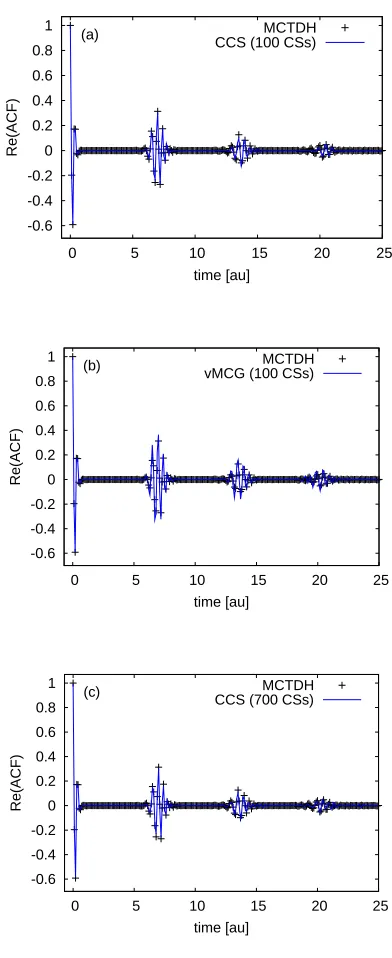
the real part of the autocorrelation function (ACF) for 2D, 6D and 10D Henon-Heiles potential.
For the 2D model the time step of vMCG propagation was reduced to to be able to
run it stably, while CCS was still robust with in all the cases. Therefore vMCG can be less
stable for lower dimensional systems (1D or 2D) but reducing time step solves the problem and it still
works well. For the basis set size used (i.e. 100) the result of vMCG is visibly better than that of CCS.
However CCS improves if the basis is increased to 300 CSs such that the number of variational
parameters for both methods is the same.
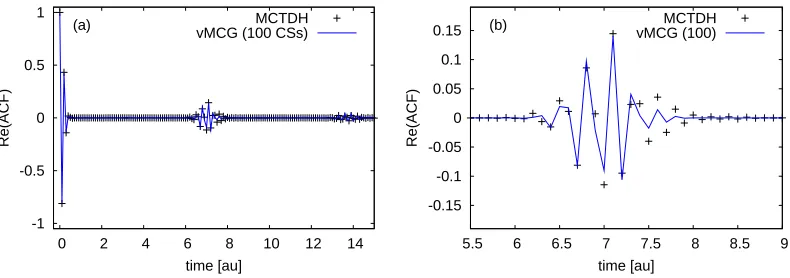
For both vMCG and CCS we observed similar behaviour in 6D and 10D cases shown at the
figures 4-8. Running time was with timestep of for both cases of CCS and
vMCG. The initial norm was kept close to by setting the compression parameter. For
the 10D case we compared the deviation of vMCG and CCS from the MCTDH result. To quantify the
quality of propagation for the 10D case the deviation from benchmark MCTHD was calculated for the
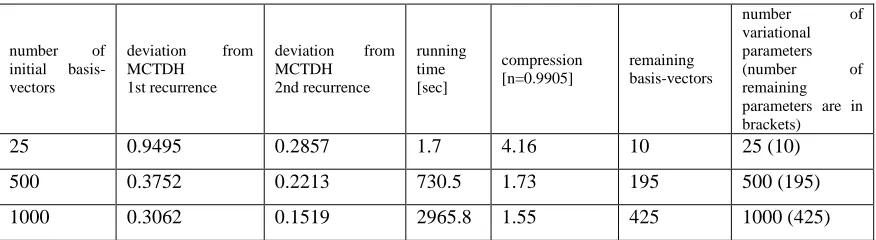
first (Fig. 6-7) and the second recurrence (Fig. 8) for both CCS and vMCG. The comparison of the
results can be seen in Table 1 and Table 2 respectively. Deviation is defined as the square root of the
integral of the square modulus of the difference between the real parts of the two autocorrelation
functions. The conclusion is that for the same number of variational parameters both CCS and vMCG
perform on the same level of accuracy. In high dimensional 6D and 10D cases the time step was the
same for both vMCG and CCS and vMCG performance was sufficiently robust and stable.
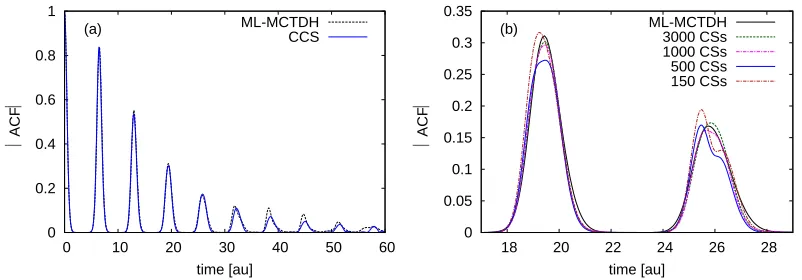
Two different 18D HH systems were investigated and the results are shown on Figures 9-11,
which present the absolute value of the autocorrelation function. The first system had the coupling
10
stronger coupling increased by the factor of 2. Only the modes 4, 8,12 and 16 were
excited in both the standard and
stronger coupling cases. For 18D HH simulations running time was and the time step had
to be reduced to for CCS and for vMCG. The initial norm was set with the
compression parameter to be close to . The results of the standard and strong coupling
can be seen in the Figures 9-11. These results were compared with ML-MCTDH simulations23 (Fig.
9a) and (Fig. 10a). For CCS 3000 basis vectors were used, while in the case of vMCG the basis set size
was 150 Coherent States, however essentially the same result can be obtained with 1000 CSs for CCS
and 50 CSs for vMCG (frame (b) on Figures 9-10) so that both vMCG and CCS calculations were well
converged. The strongly coupled Henon-Heiles model is a more demanding problem: after a few
oscillations the autocorrelation function decays so rapidly that it almost vanishes. On Fig. 11 the CCS
and vMCG results are shown, compared with ML-MCTDH results. Although a relatively large basis
set was used – 4000 CSs for CCS and 200 for vMCG – the running time of the simulation was shorter
compared to the previous case of standard HH model. This is due to the trajectories of the basis
Coherent States escaping from the well of the Henon-Heiles potential and being removed from the
propagation. By the end of the propagation only 300 CSs were left in the case of CCS and only 8 for
vMCG, making the basis very small. The quality of basis can be easily improved by generating new
basis functions instead of escaping ones, but we have not done it in this work. As can be seen from the
figure 11 even a very small basis provides quite accurate result where the autocorrelation function is
not very small.
Since the HH 1458D benchmark result was available for the 1458D Henon-Heiles model23 we
endeavoured to attempt similar calculation with vMCG and CCS methods. In ref23 two cases of 1458D
HH model were investigated. In the first case, called System 1, only the modes 486 and 487 were
initially excited to . In the second case called System 2
only the modes 729 and 730 were stretched as . In both
systems the excited modes are in the midle of the chain of coupled oscillators and far from its ends.
Thus, our expectation is, that the results from the two exact propagations should lie very close to one
another. The difference between the two cases is that for the System 1 the mode combination in not
good. Quoting the ref23, System 1 “represents an example of the wrong choice of tree structure” in
ML-MCTDH. On the contrary the mode combination and ML-MCTDH tree structure for the System 2
is correct. Simulations of the 1458D Henon-Heiles model would be very time consuming for vMCG
albeit not impossible. Even a basis set as small as 5 Gaussian Coherent Sets would include
1458×5+5=7295 variational parameters which would require the solution of a system of 7295 linear
equations (1.3) for derivatives of the parameters. On the other hand CCS was able to tackle this very
high dimensional problem, yielding the results shown on Figures 12-14 for the basis of 500CSs
sampled with Sampling S3. Sampling S1 gives similar result. Fig.12 shows that CCS autocorrelation
function deviates from that of ML-MCTDH for the System 1 very quickly, but agreement for the
System 2 is much better. Figure 13 indicates that for the System 2 the first two recurrences are in good
agreement with ML-MCTDH. Unlike ML-MCTDH results from CCS for System 1 and System 2 are
11
CCS basis always deteriorates because a) the Coherent States run away from each other and eventually
stop exchanging amplitudes, and b) CCS trajectories may guide basis in the wrong place. As a result,
at longer times CCS works as a semiclassical technique. Good sampling of the basis set is crucial for
the efficiency and convergence of CCS and the same can be said about vMCG or any other trajectory
based method. MCTDH is also a short time method and it provides accurate results only if appropriate
mode combination is found.
V CONCLUSIONS
In this paper the numerical implementation of the modified vMCG equations was discussed. The
results are directly compared with the results obtained by CCS on equal formal footing. The tests and
comparisons have been made for 1D harmonic, 1D Morse oscillator and for 2D, 6D, 10D and 18D
Henon-Heiles models. For the same basis set size vMCG is more accurate but for the same number of
variational parameters the quality of vMCG and CCS propagations is similar. Convergence and
efficiency of CCS has been investigated previously and the modified vMCG method shows very
similar numerical behaviour in terms of convergence of results and norm-conservation. The main result
of this paper is that for the test systems considered here our implementation of the modified version of
vMCG equations works without regularising and inverting the matrix D in Eq.(1.3), which significantly
reduces computational costs.
It is interesting to discuss the future of various trajectory based methods for quantum molecular
dynamics simulations where “on the fly” ab-initio dynamics is the current trend. Many ab-initio techniques such as Multiple Spawning (AIMS)9, 30, Multiconfigurational Ehrenfest dynamics (MCE)31,
which is a generalisation of CCS, and “on the fly” implementation of vMCG exist32, 33. In such methods the potential energy surfaces are calculated by applying an electronic structure package along
the trajectory, which is the most expensive part of calculations. Having fewer vMCG trajectories may
therefore have an advantage over the methods which use predetermined trajectories. On the other hand
methods like CCS/MCE allow the running of trajectories one by one independently from each other
which is not possible in vMCG, where trajectories are coupled with each other. Independent
trajectories allow a detailed exploration of the dynamically relevant part of the PES prior to actual
quantum dynamics calculation. Many electronic structure points can be accumulated and fit with the
modern algorithms1, 2. Perhaps a combination of vMCG and techniques which use predetermined
trajectories will provide an optimum solution in the future.
Acknowledgement
This work has been supported by EPSRC grants EP/I014500/1 and EP/J001481/1. We thank Irene
Burghardt and Graham Worth for useful discussions, Mathias Nest for providing the MCTDH
benchmark data, Hans-Dieter Meyer for providing the ML-MCTDH results and Christopher Symonds
12
REFERENCES
1
J. M. Bowman, B. J. Braams, S. Carter, C. Chen, G. Czako
, B. Fu, X.
Huang, E. Kamarchik, A. R. Sharma, B. C. Shepler, Y. Wang and Z. Xie, The Journal
of Physical Chemistry Letters, 1, 1866-1874.
2
J. M. Bowman, G. Czako and B. Fu, Physical Chemistry Chemical Physics, 13,
8094-8111.
3
J. M. Bowman, S. Carter and X. Huang, International Reviews in Physical
Chemistry, 2003, 22, 533-549.
4
J. M. Bowman, T. Carrington and H.-D. Meyer, Molecular Physics, 2008, 106,
2145-2182.
5
E. J. Heller, J. Chem. Phys., 1981, 75, 2923-2931.
6
M. F. Herman and E. Kluk, Chemical Physics, 1984, 91, 27-34.
7
M. S. Child and D. V. Shalashilin, J. Chem. Phys., 2003, 118, 2061-2071.
8
K. G. Kay, in Annual Review of Physical Chemistry, Annual Reviews, Palo
Alto, 2005, vol. 56, pp. 255-+.
9
M. Ben-Nun and T. J. Martinez, Advances in Chemical Physics, Volume 121,
2002, 121, 439-512.
10
I. Burghardt, H. D. Meyer and L. S. Cederbaum, J. Chem. Phys., 1999, 111,
2927-2939.
11
D. V. Shalashilin and M. S. Child, J. Chem. Phys., 2008, 128, 054102-054102.
12
D. V. Shalashilin and M. S. Child, Chemical Physics, 2004, 304, 103-120.
13
D. V. Shalashilin and M. S. Child, J. Chem. Phys., 2001, 115, 5367-5375.
14
S. I. Sawada, R. Heather, B. Jackson and H. Metiu, J. Chem. Phys., 1985, 83,
3009-3027.
15
G. A. Worth and I. Burghardt, Chemical Physics Letters, 2003, 368, 502-508.
16
P. Kramer and M. Saraceno, Geometry of the Time-Dependent Variational
Principle in Quantum Mechanics NewYork, 1981.
17
D. V. Shalashilin and I. Burghardt, J. Chem. Phys., 2008, 129.
18
J. Frenkel, Wave Mechanics, Advanced General Theory, Clarendon Press,
Oxford, 1934.
19
J. Broeckhove, L. Lathouwers, E. Kesteloot and P. Vanleuven, Chemical
Physics Letters, 1988, 149, 547-550.
20
K. G. Kay, Chemical Physics, 1989, 137, 165-175.
21
A. D. McLachlan, Molecular Physics, 1964, 8, 39.
22
M. Nest and H. D. Meyer, J. Chem. Phys., 2002, 117, 10499-10505.
23
O. Vendrell and H. D. Meyer, J. Chem. Phys., 2011, 134, 044135.
24
G. F. Meyer H.-D., Worth G.A. ed., Multidimensional Quantum Dynamics.
MCTDH Theory and Applications, Wiley-VCH, 2007.
25
P. A. J. Sherratt, D. V. Shalashillin and M. S. Child, Chemical Physics, 2006,
322, 127-134.
26
D. V. Shalashilin and M. S. Child, J. Chem. Phys., 2000, 113, 10028-10036.
27
D. V. Shalashilin and B. Jackson, Chemical Physics Letters, 2000, 318,
305-313.
28
T. Sklarz and K. G. Kay, The Journal of chemical physics, 2004, 120,
2606-2617.
29
M. L. Brewer, J. Chem. Phys., 1999, 111, 6168-6170.
13
31
K. Saita and D. V. Shalashilin, The Journal of chemical physics, 2012, 137,
22A506-508.
32
G. A. Worth, M. A. Robb and B. Lasorne, Molecular Physics, 2008, 106,
2077-2091.
14
A
PPENDIXA1 Working equations of modified vMCG
Derivation of the equations of motion for from the time-dependent variational principle
enables us to investigate CCS and vMCG on the same formal footing. The Euler-Lagrange equations
(2.16) for dynamic parameters and can be obtained separately from the Lagrangian (2.15)
as
d
dt and
d
dt (A1.1)
Performing the variation for amplitudes gives
(A1.2)
and the variation of is
.
(A1.3)
For the sake of greater stability and better robustness it is convenient to introduce a smoothing
preexponential factor to describe the rapidly oscillating amplitudes :
exp (A1.4)
where can be calculated from the classical action:
(A1.5)
With this preexponential factor equation (A1.2) can be rewritten as
exp exp
exp (A1.6)
15
exp
exp
exp
(A1.7)
The time evolution of can be described by solving the equations for , and . In
the case of CCS the equations of motion for are given by Hamilton’s equations:
(A1.8)
This can be obtained from (A1.6) if all terms containing small overlaps between different coherent
states are neglected. In CCS the equations for the amplitudes (preexponential factors) are still the same
as (A1.6). Although the trajectories (A1.8) are not fully variational the CCS technique is still fully
quantum because it relies on the exact coupled equations for the amplitudes. It has been shown in CCS
that better stability is achieved by smoothing the amplitude by (A1.4). In vMCG both fully variational
equations (A1.5) and (A1.6) are used, these are in principle equivalent to those of original vMCG
theory15. The equations are forming a system of linear equations for the dynamical variables and
:
(A1.9)
where
(A1.10)
This set of linear equation can be written in matrix form as
(A1.11)
where in this block matrix every letter represents an matrix with the following elements:
exp
exp
exp
exp
exp
16
exp
(A1.12)
The only improvement is that they are written for the smooth preexponential factor d rather than for the
amplitude itself. Although an attempt has been made in the original vMCG15 to take oscillating part
away from the amplitude the exact way of how this should be done can be important. In the current
formulation the smoothening is done in a fashion similar to the CCS technique and the matrix D
appears to be small, smooth and sparse and reasonably well behaved.
Numerically CCS can be implemented easier than vMCG. The two differences in the program code are
the way and are calculated and the derivative matrix of the Hamiltonian. The structure of the
working matrix of CCS is simpler as it contains coefficients for only, thus it is independent of the
dimension of the system. The other significant difference is that CCS uses only the diagonal elements
of the derivative of the Hamiltonian, whereas for vMCG all the elements for all dimensions have to be
calculated.
A2 Numerical instabilities of Sampling S2
Let us set one of the initial CS to such as in (3.5)
(A2.1)
Then the initial amplitude is
(A2.2)
and the overlap-matrix will be:
. (A2.3)
Amplitude d is calculated from the set of linear equations
(A2.4)
17
a�d (A2.5)
The initial action and therefore exp With these conditions the components of matrix
D and vector b in equations (A1.11) will be as follows:
if a�d elsewhere
if a�d elsewhere
if a�d elsewhere
if a�d elsewhere
if a�d elsewhere
(A2.6)
It can be seen, that in matrix D every th column and every th row
contains zeros only. This makes D singular, although the matrix is not inverted; therefore the problem with det is still solvable. The under-determined system of linear equations in the case of vMCG will lead to numerical difficulties which requires regularisation. In the case of CCS only D1 and b1 are calculated; this system has unambiguous solutions.
18
Figures
Fig.1 Real part of the autocorrelation function of a 1D Morse-potential given by vMCG with the basis set size of 10 Gaussians (solid line), compared results from Split-Operator method (crosses)
Fig.2 Typical complicated quantum variational trajectories of a 1D Morse-potential with vMCG (dashed line) and simple CCS (solid line)
-1 -0.5 0 0.5 1
0 5 10 15 20
R
e
(A
C
F
)
time [au] Split-operator
vMCG
-3 -2 -1 0 1 2 3
-2 -1 0 1 2 3 4 5 6 7 8 9
p
[
a
u
]
q [au]
19
Fig. 3 Real part of the autocorrelation function for 2D Henon-Heiles problem. CCS and vMCG with
the basis of 100 CSs (frames a and b). CCS with the basis of 300 CSs and therefore with the same
amount of variational parameters (frame c). The results are compared with those of split operator
method (crosses).
-0.8 -0.6 -0.4 -0.2 0 0.2 0.4 0.6 0.8 1
0 5 10 15 20 25 30 35 40
R
e
(A
C
F
)
time [au]
(b) Split-operator vMCG (100 CSs)
-0.8 -0.6 -0.4 -0.2 0 0.2 0.4 0.6 0.8 1
0 5 10 15 20 25 30 35 40
R
e
(A
C
F
)
time [au]
[image:20.595.194.395.91.571.2]20
Fig. 4 Real part of the autocorrelation function for 6D Henon-Heiles problem. CCS and vMCG with
the basis of 100 CSs (frames a and b). CCS with the basis of 700 CSs and therefore with the same
amount of variational parameters (lower frame c). The results are compared with those of MCTDH
method (crosses).
-0.6 -0.4 -0.2 0 0.2 0.4 0.6 0.8 1
0 5 10 15 20 25
R
e
(A
C
F
)
time [au]
(a) MCTDH
CCS (100 CSs)
-0.6 -0.4 -0.2 0 0.2 0.4 0.6 0.8 1
0 5 10 15 20 25
R
e
(A
C
F
)
time [au]
(b) MCTDH
vMCG (100 CSs)
-0.6 -0.4 -0.2 0 0.2 0.4 0.6 0.8 1
0 5 10 15 20 25
R
e
(A
C
F
)
time [au]
(c) MCTDH
[image:21.595.196.392.73.552.2]21
Fig. 5 Real part of the autocorrelation function for 10D Henon-Heiles problem with CCS with the
basis of 100 CSs (solid line) compared with results from MCTDH (crosses) (frame a) and the first
recurrence (frame b)
Fig. 6 Real part of the autocorrelation function for 10D Henon-Heiles problem with CCS with the
basis of 1000 CSs (solid line) compared with results from MCTDH (crosses) (frame a) and the first
recurrence (frame b)
-1 -0.5 0 0.5
0 2 4 6 8 10 12 14
R e (A C F ) time [au] (a)
CCS (100 CSs)
-0.15 -0.1 -0.05 0 0.05 0.1 0.15
5.5 6 6.5 7 7.5 8 8.5 9
R e (A C F ) time [au] (b) CCS (100) -1 -0.5 0 0.5 1
0 2 4 6 8 10 12 14
R e (A C F ) time [au] (a) MCTDH
CCS (1000 CSs)
-0.15 -0.1 -0.05 0 0.05 0.1 0.15
5.5 6 6.5 7 7.5 8 8.5 9
[image:22.595.94.493.78.217.2] [image:22.595.97.494.347.487.2]22
Fig. 7 Real part of the autocorrelation function for 10D Henon-Heiles problem with vMCG with the
basis of 100 CSs (solid line) compared with results from MCTDH (crosses) (frame a) and the first
recurrence (frame b)
Fig. 8 Comparison of the second recurrence of the autocorrelation function for 10D Henon-Heiles
problem obtained with CCS (1000 CSs) and vMCG (100 CSs) (frame a and b). Results from MCTDH
are shown by crosses.
-1 -0.5 0 0.5 1
0 2 4 6 8 10 12 14
R e (A C F ) time [au] (a) MCTDH
vMCG (100 CSs)
-0.15 -0.1 -0.05 0 0.05 0.1 0.15
5.5 6 6.5 7 7.5 8 8.5 9
R e (A C F ) time [au] (b) MCTDH vMCG (100) -0.04 -0.02 0 0.02 0.04
12 12.5 13 13.5 14 14.5 15 15.5 16
R e (A C F ) time [au] (a) MCTDH CCS (1000) -0.04 -0.02 0 0.02 0.04
12 12.5 13 13.5 14 14.5 15 15.5 16
[image:23.595.98.493.95.234.2] [image:23.595.95.492.381.520.2]23
Fig. 9 Absolute value of the autocorrelation function for 18D Henon-Heiles problem with CCS
(3000CSs) and its convergence (frame a and b). Results from ML-MCTDH are shown by dashed line
on frame (a).
Fig. 10 Absolute value of the autocorrelation function for 18D Henon-Heiles problem with vMCG
(150CSs) and its convergence (frame a and b). Results from ML-MCTDH are shown by dashed line on
frame (a). 0 0.2 0.4 0.6 0.8 1
0 10 20 30 40 50 60
½ A C F ½ time [au] (a) ML-MCTDH CCS 0 0.05 0.1 0.15 0.2 0.25 0.3 0.35
18 20 22 24 26 28
½ A C F ½ time [au] (b) ML-MCTDH 3000 CSs 1000 CSs 500 CSs 150 CSs 0 0.2 0.4 0.6 0.8 1
0 10 20 30 40 50 60
½ A C F ½ time [au] (a) ML-MCTDH vMCG 0 0.05 0.1 0.15 0.2 0.25 0.3 0.35
18 20 22 24 26 28
[image:24.595.89.490.93.233.2] [image:24.595.92.488.338.482.2]24
Fig. 11 Absolute value of the autocorrelation function for 18D Henon-Heiles problem of strong
coupling, with CCS (4000 CSs) (frame a) and with vMCG (200 CSs) (frame b). Results from
ML-MCTDH are shown by dashed line on both frames.
Fig. 12 Absolute value of the autocorrelation function for 1458D Henon-Heiles problem (System 1)
with CCS (500CSs) (frame a and b). Results from ML-MCTDH are shown by dashed lines on both
frames. 0 0.05 0.1 0.15 0.2 0.25 0.3 0.35 0.4
0 10 20 30 40 50 60
½ A C F ½ time [au] (a) ML-MCTDH CCS 0 0.05 0.1 0.15 0.2 0.25 0.3 0.35 0.4
0 10 20 30 40 50 60
½ A C F ½ time [au] (b) ML-MCTDH vMCG 0 0.2 0.4 0.6 0.8 1
0 5 10 15 20
½ A C F ½ time [au] (a) ML-MCTDH CCS 0 0.1 0.2 0.3 0.4 0.5
25 30 35 40 45 50 55 60
[image:25.595.89.492.94.236.2] [image:25.595.88.494.385.527.2]25
Fig. 13 Absolute value of the autocorrelation function for 1458D Henon-Heiles problem (System 2)
with CCS (500CSs) (frame a and b). Results from ML-MCTDH are shown by dashed lines on both
frames. The difference between CCS and ML-MCTDH autocorrelation function for the System 2 is
less then the difference between ML-MCTDH results for System 1 and System 2
Fig. 14 Comparison of absolute value of the autocorrelation function for 1458D Henon-Heiles
problem. The CCS autocorrelation functions for System 1 and System 2 shown at the frame (a)
coinside. The ML-MCTDH results for the two systems are shown at the frame (b).
0 0.2 0.4 0.6 0.8 1
0 5 10 15 20
½ A C F ½ time [au] (a) ML-MCTDH CCS 0 0.1 0.2 0.3 0.4 0.5
25 30 35 40 45 50 55 60
½ A C F ½ time [au] (b) ML-MCTDH CCS 0 0.2 0.4 0.6 0.8 1
0 10 20 30 40 50 60
½ A C F ½ time [au]
(a) System 1
System 2 0 0.2 0.4 0.6 0.8 1
0 10 20 30 40 50 60
½ A C F ½ time [au]
(b) System 1
[image:26.595.91.494.105.247.2] [image:26.595.90.493.424.565.2]26
Tables
number of initial basis-vectors
deviation from MCTDH
1st recurrence
deviation from MCTDH 2nd recurrence
running time [sec]
[image:27.595.80.518.157.277.2] [image:27.595.79.518.378.502.2]compression [n=0.9905]
remaining basis-vectors
number of
variational parameters (number of remaining parameters are in brackets)
25 0.9495 0.2857 1.7 4.16 10 25 (10)
500 0.3752 0.2213 730.5 1.73 195 500 (195)
1000 0.3062 0.1519 2965.8 1.55 425 1000 (425)
Table 1. Deviation of the CCS result from that of MCTDH for a different number of initial
basis-vectors
number of initial basis-vectors
deviation from MCTDH
1st recurrence
deviation from MCTDH 2nd recurrence
running time [sec]
Compression [n=0.9905]
remaining basis-vectors
number of
variational parameters (number of remaining parameters are in brackets)
10 1.0586 0.2419 0.4 7.055 1 111 (11)
50 0.5252 0.2650 24.7 3.24 20 550 (220)
100 0.2536 0.1639 138.7 2.65 35 1100 (385)
Table 2. Comparison of the vMCG result with that of MCTDH for a different number of initial