Capsules with external navigation and triggered release
Dmitry G. Shchukin, Elena Shchukina
Stephenson Institute for Renewable Energy, University of Liverpool, Liverpool L69 7ZF, UK
Corresponding author: Shchukin, Dmitry ([email protected]).
Encapsulation is an important technology for pharmaceutical industry, food production, etc.
Its current level of development requires capsule functionalization. One of the interesting
ideas to provide new functionality to the micro- and nanocapsules is Layer-by-Layer
deposition of functional species. This technique provides step-by-step adsorption of various
species (polyelectrolytes, nanoparticles, proteins) when the layer growth is controlled by
electrostatic, hydrogen bonding, hydrophobic forces and forming multilayer shells with
nanometer precision. This review article introduces recent achievements of Layer-by-Layer
technique attaining external navigation ability and release properties the capsule shell.
Introduction
Delivery vehicles modified in order to respond to a certain external triggers in a defined
manner have major role in a new generation of intelligent materials, which enable fine spatial
and temporal control in 3D environment and replicate natural events during materials’
exploitation time. This is very challenging task with requirements, which depend on the
application area, such as encapsulation of molecules keeping of their pharmaceutical or other
activity during the encapsulation and storage, controlled and sustained release, release at
selected target sites.
Different methods for the design of capsule depot systems have specific advantages and
drawbacks concerning the upscaling possibility, performance, feasibility to employ different
active materials. Capsules with LbL assembled polyelectrolyte shell were used for
encapsulation and release of drugs, DNA, sensor dyes and enzymes [1]; inorganic halloysite
nanotubes were demonstrated to be suitable for loading of ferments and inorganic
nanoparticles [2]. Mesoporous nanoparticles with polypeptide multilayer shell were used for
encapsulation and delivery of enzymes [3]. Hydrogels were used for encapsulation of
phospholipids, drugs, as liposome reactors and plant growth media [4]. There are numerous
would address several recent reviews to provide better understanding of the current
achievements in this area [5,6].
LbL capsules can be fabricated under mild conditions both from water solutions and
organic solvents. Moreover, the availability of different polyelectrolytes and other charged
materials used as building blocks of LbL assembly, offers interesting prospects for
engineering capsules tailored for targeted applications [7].
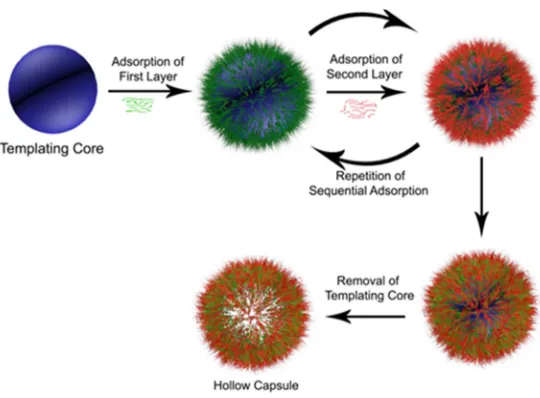
Figure 1. Scheme of the polyelectrolyte capsule formation (from Master Thesis of Simona-Vyara Kolarova,
2014, The University of Liverpool).
As depicted in Figure 1, the template core can be dissolved after applying LbL layers
resulting hollow LbL capsules. Initially, organic templates based on polystyrene or melamine
formaldehyde were used for capsule fabrication. After deposition of polyelectrolyte
multilayers, templates were dissolved by organic solvents and aqueous acidic solutions,
respectively, to obtain hollow capsules. However, acidic solutions should be avoided for
capsules to be employed for delivery of bioactive material due to the possible inactivation of
the latter. Therefore, inorganic template materials were used: silica and carbonates [8,9].
Capsules with external navigation
The best way to receive the external control over capsule movement is to include magnetic
nanoparticles inside LbL shell as one or several monolayers. In most cases, chemically inert
magnetite and γ-Fe2O3 are used [10,11,12]. These oxide nanoparticles possess very good
magnetic susceptibility and, at the same time, inert enough to withstand changes of local pH
[image:2.595.161.431.212.411.2]follows. The capsules are firstly modified with several layers of polyelectrolytes to provide a
positively charged surface that provokes subsequent adsorption of magnetic nanoparticles
(usually stabilised with acids like citric acid and have, therefore, negative surface charge)
from their colloidal solutions. Additional positive polyelectrolyte layer is deposited at the last
stage to stabilize Fe3O4 nanoparticles in the capsule shell. Figure 2A presents the initial
solution containing the suspension of magnetic capsules. When a magnet is placed close to
the vial, as shown in Figure 2B, the capsules are forced to the wall of the vial close to the
magnet.
Figure 2. The prepared magnetic capsules in aqueous solution and their targeted movement under external
magnetic stimuli [13].
So, capsules with magnetic nanoparticles in the shell can be moved by an external magnet
in a desired direction. After removal of magnet, magnetic capsules can be easily redispersed
in the solution by gentle agitation. When a magnet is placed on the vial again, the precipitates
forms againdemonstrating the ability of magnetic containers can be redirected without loss of
the magnetic property. Another way to get magnetic properties is to in situ synthesize
magnetic nanoparticles inside capsules. Fe3O4 nanoparticles were in situ synthesized inside
nanoporous poly(L-glutamic acid)/chitosan (PGA/CS) microcapsules [13, 14]. The
carboxylate groups of PGA in the shell could be used as binding sites for the absorption of
iron ions for the synthesis of magnetic nanoparticles [15]. Unlike earlier reported ‘magnetic
backpacks’ (microconfinements carrying magnetic properties) attached to the cell membrane,
[image:3.595.71.526.254.434.2]Triggered release of encapsulated species
Since LbL method provides high versatility in the shell components, it is possible to fit
capsule shell to the certain trigger(s), which remotely and sometimes reversibly open capsule
shell. Triggers can be divided into two main groups: (i) internal triggers, where capsule
response is based on the intrinsic properties of polyelectrolyte shell and (ii) external ones,
where the response is affected by special components (mostly nanoparticles) inside the
capsule shell.
Internal triggers are pH, ionic strength of the solution and addition of new solvent. Classic
polyelectrolyte shell is permeable for macromolecules and nanoparticles at low pH (<3) and
high pH (>8) or high ionic strength while it is “closed” at moderate pH range [16]. An
explanation of the permeability properties is influenced by polyelectrolyte interactions in the
shell. At the pH of capsule formation, the common charge densities of both polyelectrolytes
determine their stoichiometric ratio during adsorption. However, the excess of charging in
one polyelectrolyte layercan induce positive (negative) excess of charge in the shell. This
may alter the shell morphology by repulsionresulting in defects and pores. The same is valid
for the permeability changed at increased ionic strength [17] and addition of a solvent with
lower dipole moment [18], which lead to the screening of the interactions between
[image:4.595.176.420.468.691.2]polyelectrolyte layers in the shell followed by shell opening.
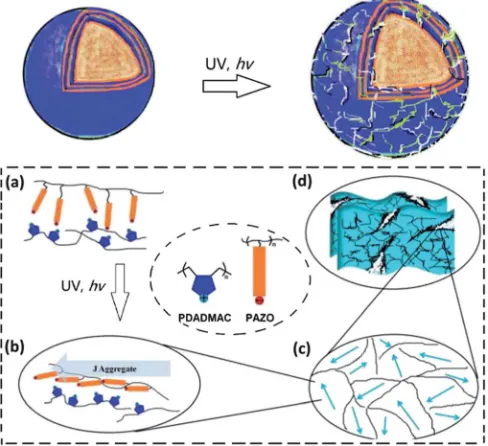
Figure 3. Schematic illustration of poly(diallyldimethyl ammonium) chloride / PAZO microcapsule disruption
External triggers are light, magnetic field, ultrasound, electrochemical and enzymatic
degradation [19]. All of them require additional components in the capsule shell sensitive to
the trigger impact. Light-responsive capsules are the most developed ones and based on the
inclusion of the light-sensitive elements (either dyes or nanoparticles) into the capsule shell.
Tao et al. have described photoinduced permeability of polyelectrolyte capsules with Congo
Red exposed to visible light [20]. Sukhorukov et al. demonstrated light-induced
encapsulation of active materials in capsules with azo-groups in the shell [21,22]. Upon
exposure to a light source, these capsules start to swell and this process continues for several
hours. However, long illumination time clearly limits the applicability of the system based on
organic dyes. This can be overcome using laser light as a trigger for capsule opening.
Skirtach et al. developed light responsive capsules with light-sensitive nanoparticles (Ag, Au)
inside the LbL shell [23,24]. Upon laser irradiation, the nanoparticles were locally heated
causing ruptures in the capsule wall andallowing the release of encapsulated materials. The
efficiency of this concept was demonstrated by release of the cargo into the cell cytosol from
Ag-containing capsules [25]. Here, near-IR part of the spectrum (800–1200-nm) was used to
minimize the absorption of laser light by cells and tissues. Although near-IR light is relatively
harmless, it has to be stressed that Ag/Au nanoparticles acting as absorption centers for
energy from the laser beam cause substantial local heating due to the small cell volume. By
modulating laser power, decreasing illumination time and the concentration of nanoparticles
in the shell, cell viability could be improved [26]. The ability to move and open
microcapsules by external light has been implemented by simultaneously functionalizing
these capsules with magnetic and gold nanoparticles [27].
Other remote forces used for opening of polyelectrolyte capsules are magnetic field and
ultrasonic irradiation. Ferromagnetic gold-coated cobalt 3 nm nanoparticles were introduced
inside the capsule shell [28]. Resulting 5 micron microcapsules had shell consisting of 9
polyelectrolyte layers and 1 layer of Co@Au. External alternating magnetic field (100-300
Hz and 1200 Oe) was applied to rotate the embedded Co@Au nanoparticles, which
subsequently distorted the integrity of the capsule shell drastically increasing its permeability.
When the capsules are subjected to ultrasound, a morphological change in the shell occurs
due to the shear forces between the successive fluid layers, which results in the disruption of
the capsule shell and release of encapsulated materials (even at short (5 s) sonication times)
[29,30]. The presence of metal or oxide nanoparticles in the capsule shell is necessary for
ultrasonically stimulated release due to the density gradient in the capsule shell perpendicular
polyaniline), chemical stability and mechanical properties allow one to employ them as
matrix or shell components for polyelectrolyte capsules combining electric conductivity of
the polymer with redox controlled permeability of polyelectrolyte shell [31]. Incorporation of
the capsules inside conducting polypyrrole( PPy) results in electrochemically controlled
storage and release properties of the capsules. Similar approach was shown for tetrasulfide
bridges successfully introduced into the shell, where they can be reduced to yield thiol groups
increasing the permeability of the capsule shell [32].
Degradation of capsule shell by biomacromolecules (e.g., enzymes and proteins) requires
the presence of the biodegradable polyelectrolytes and enzyme or other catalyst (either inside
or outside capsule) to catalyse the degradation of the shell. In this case, the overall
polyelectrolyte shell and separate polyelectrolyte layers must be the substrates of the
enzymes. Self -disintegrating microcapsules were fabricated by introducing a highly active
mix of proteases (Pronase (R)), a mix of proteolytic enzymes isolated from Streptomyces
Griseus, into biodegradable polyelectrolyte shell [33]. Pronase was captured by micron-sized
calcium carbonate particles that were subsequently covered by onion-like layers of
poly(L-arginine) and poly(L-aspartic acid). After dissolution of CaCO3, pronase was released inside
the capsule and started to digest polyelectrolyte shell. Lifetimes of thus developed capsules
could be successfully adjusted to seconds, hours or days by varying the amount of
encapsulated pronase. Being activated, this type of controlled release system becomes
autonomic, as it does not require any additional external impact. Similar effect, but after
addition of thiol-disulfide exchange reagent dithiothreitol, was observed for hydrogen-bonded
multilayer thin films constructed from poly(vinylpyrrolidone) and poly(methacrylic acid)
functionalized with cysteamine [34]. The resulting films included thiol moieties that were
cross-linked to stabilize the films at physiological pH. Films without disulfide bonds were
readily destroyed at physiological pH, while those with disulfide bonds were swollen upon
exposure to pH 7 and remained intact. Addition of thiol-disulfide exchange reagent,
dithiothreitol (DTT) led to disassembly of the multilayer films. The function of DTT can be
also performed by some of intracellular proteins.
Conclusion
The review article described a number of promising directions for application of LbL
assembled capsules for targeted delivery and controlled release, but one has to know that
properties, size, homogeneitylow cost and facile fabrication. On the other hand, the
achievement made in the last years is encouraging that one can easily find solutions for many
different types of polyelectrolyte micro- and nanocapsules. Additional knowledge is required
in understanding the interplay of structural units in multilayered shell. This is also a challenge
demanding more sophisticated preparative and analytical methods covering length scales
from nanometers in the shell to microns in the capsule lumen.
Acknowledgements
References and recommended reading
Papers of particular interest, published within the period of review, have been highlighted as:
٠ of special interest
٠٠ of outstanding interest
1 De Geest BG, Willart MA, Hammad H, Lambrecht BN, Pollard C, Bogaert P, De
Filette M, Saelens X, Vervaet C, Remon JP, Grooten J, De Koker S: Polymeric multilayer
capsule-mediated vaccination induces protective immunity against cancer and viral
infection. ACS Nano 2012, 6: 2136-2149.
٠٠ Capsules can be used for antigen delivery toward antigen-presenting cells in vivo, which is
of great interest for the development of therapeutic vaccines against cancer and prophylactic
vaccination against insidious pathogens such as HIV, malaria, and tuberculosis.
2 Lvov YM, Shchukin DG, Möhwald H, Price RR: Halloysite clay nanotubes for
controlled release of protective agents. ACS Nano 2008, 2: 814-820.
3 Yu AM, Wang YJ, Barlow E, Caruso F: Mesoporous silica particles as templates
for preparing enzyme-loaded biocompatible microcapsules. Adv Mater 2005, 17:
1737-1741.
4 Motornov M, Royter H, Lupitskyy R, Roiter Y, Minko S: Stimuli-responsive
hydrogel hollow capsules by material efficient and robust cross-linking-precipitation
synthesis revisited. Langmuir 2011, 27: 15305-15311.
5 Gupta S, Moulik SP: Biocompatible microemulsions and their prospective uses in
drug delivery. J Pharmaceut Sci 2008, 97: 22-45.
6 Narang AS, Delmarre D, Gao D: Stable drug encapsulation in micelles and
microemulsions. Int J of Pharmaceutics 2007, 345: 9-25.
7 Stuart MAC, Huck WTS, Genzer J, Muller M, Ober C, Stamm M, Sukhorukov GB,
Szleifer I, Tsukruk VV, Urban M, Winnik F, Zauscher S, Luzinov I, Minko S: Emerging
applications of stimuli-responsive polymer materials. Nat Mater 2010, 9: 101–113.
8 Wang YJ, Yu AM, Caruso F: Nanoporous polyelectrolyte spheres prepared by
sequentially coating sacrificial mesoporous silica spheres. Angew Chem Int Ed 2005, 44:
2888–2892.
9 Antipov AA, Shchukin D, Fedutik Y, Petrov AI, Sukhorukov GB, Mohwald H:
Carbonate microparticles for hollow polyelectrolyte capsules fabrication. Colloids Surf A
10 Han YS, Radziuk D, Shchukin DG, Mohwald H: Sonochemical synthesis of
magnetic protein container for targeted delivery. Macromol Rapid Commun 2008, 29:
1203-1207.
11 Du PC, Zeng J, Mu B, Liu P: Biocompatible magnetic and molecular
dual-targeting polyelectrolyte hybrid hollow microspheres for controlled drug release.
Molecular Pharmaceutics 2013, 10: 1705-1715.
12 Mu B, Zhong W, Dong Y, Du PC, Liu P: Encapsulation of drug microparticles
with self-assembled Fe3O4/alginate hybrid multilayers for targeted controlled release. J
Biomedical Materials Research B 2012, 100B: 825-831.
13 Yan SF, Zhang X, Sun YY, Wang TT, Chen XS, Yin JB: In situ preparation of
magnetic Fe3O4 nanoparticles inside nanoporous poly(L-glutamic acid)/chitosan
microcapsules for drug delivery. Colloids and Surfaces B 2014, 113: 302-311.
14 Bukreeva TV, Orlova OA, Sulyanov SN, Grigoriev YV, Dorovatovskiy PV: A new
approach to modification of polyelectrolyte capsule shells by magnetite nanoparticles.
Crystallography Reports 2011, 56: 880-883.
15 Pavlov AM, De Geest BG, Louage B, Lybaert L, De Koker S, Koudelka Z, Sapelkin
AV, Sukhorukov GB: Magnetically engineered microcapsules as intracellular anchors
for remote control over cellular mobility. Adv Mater 2013, 25: 6945-6950.
٠ Two different cell types that multilayer capsules loaded with iron oxide magnetic
nanoparticles can render cells magnetically responsive once these cells internalize the
capsules.
16 Liang K, Such GK, Johnston APR, Zhu Z, Ejima H, Richardson JJ, Cui J, Caruso F:
Endocytic pH-triggered degradation of nanoengineered multilayer capsules. Adv Mater
2014, 26: 1901-1905.
٠٠ Endocytic pH-degradable multilayer capsules were synthetized through noncovalent
stabilization. Physiological pH variations from extracellular to intracellular acidic
compartments trigger capsule degradation and cargo release within 30 min, highlighting the
potential of these capsules as intracellular delivery vehicles.
17 Sukhorukov GB, Donath E, Davis SA, Lichtenfeld H, Caruso F, Popov VI, Möhwald,
H: Stepwise polyelectrolyte assembly on particle surfaces: a novel approach to colloid
design. Polymers for Advanced Technologies 1998, 9: 759-767.
18 Lvov Y, Antipov AA, Mamedov A, Mohwald H, Sukhorukov GB: Urease
19 Antipina MN, Sukhorukov GB: Remote control over guidance and release
properties of composite polyelectrolyte based capsules. Adv Drug Delivery Rev 2011, 63:
716-729.
20 Tao X, Li JB, Mohwald H: Self-assembly, optical behavior, and permeability of a
novel capsule based on an azo dye and polyelectrolytes. Chemistry 2004, 10: 3397–3403.
21 Yi QY, Sukhorukov GB: Photolysis triggered sealing of multilayer capsules to
entrap small molecules. ACS Applied Materials & Interfaces 2013, 14: 6723-6731.
22 Yi QY, Sukhorukov GB: UV-induced disruption of microcapsules with
azobenzene groups. Soft Mater 2014, 10: 1384-1391.
23 Volodkin D, Skirtach A, Mohwald H: Bioapplications of light-sensitive polymer
films and capsules assembled using the layer-by-layer technique. Polymer International
2012, 61: 673-679.
٠ Review covers the area of bioapplications of layer-by-layer assembled polymer
microcapsules – biologically relevant responses stimulated by light.
24 Skirtach A, Yashchenok AM, Mohwald H: Encapsulation, release and applications
of LbL polyelectrolyte multilayer capsules. Chem Comm 2011, 47: 12736-12746.
25 Skirtach AG, Javier AM, Kreft O, Alberola AP, Mohwald H, Parak WJ, Sukhorukov
GB: Laser-induced release of encapsulated materials inside living cells. Angew Chem Int
Ed 2006, 45: 4612–4617.
26 Skirtach AG, Dejugnat C, Braun D, Susha AS, Rogach AL, Parak WJ, Mohwald H,
Sukhorukov GB: The role of metal nanoparticles in remote release of encapsulated
materials. Nano Letters 2005, 5: 1371-1377.
27 Gorin DA, Portnov SA, Inozemtseva OA, Luklinska Z, Yashchenok AM, Pavlov AM,
Skirtach AG, Möhwald H, Sukhorukov GB: Magnetic/gold nanoparticle functionalized
biocompatible microcapsules with sensitivity to laser irradiation. Phys. Chem. Chem.
Phys. 2008, 10: 6899-6905.
28 Lu ZH, Prouty MD, Guo ZH, Golub VO, Kumar CSSR, Lvov YM: Magnetic switch
of permeability for polyelectrolyte microcapsules embedded with Co@Au
nanoparticles. Langmuir 2005, 21: 2042–2050.
29 Pavlov AM, Saez V, Cobley A, Graves J, Sukhorukov GB, Mason, TJ: Controlled
protein release from microcapsules with composite shells using high frequency
30 Kolesnikova TA, Gorin DA, Fernandes P, Kessel S, Khomutov GB, Fery A, Shchukin
DG, Mohwald H: Nanocomposite microcontainers with high ultrasound sensitivity. Adv
Funct Mater 2010, 20: 1189-1195.
31 Shchukin DG, Kohler K, Mohwald H: Microcontainers with electrochemically
reversible permeability. JACS 2006, 128: 4560-4561.
32 Fickert J, Schaeffel D, Koynov K, Landfester K, Crespy D: Silica nanocapsules for
redox-responsive delivery. Colloid and Polymer Sci 2014, 292: 251-255.
33 Borodina T, Markvicheva E, Kunizhev S, Mohwald H, Sukhorukov GB, Kreft O:
Controlled release of DNA from selfdegrading microcapsules. Macromol Rapid Commun
2007, 28: 1894–1899.
34 Zelikin AN, Quinn JF, Caruso F: Disulfide cross-linked polymer capsules: en route
![Figure 2. The prepared magnetic capsules in aqueous solution and their targeted movement under external magnetic stimuli [13]](https://thumb-us.123doks.com/thumbv2/123dok_us/8055765.224699/3.595.71.526.254.434/prepared-magnetic-capsules-solution-targeted-movement-external-magnetic.webp)