123
Anirban Chakrabarti
Grid
Library of Congress Control Number: 2007922355
ACM Computing Classification (1998):C.2, D.4.6, K.6.5
ISBN 978-3-540-44492-3 Springer Berlin Heidelberg New York
This work is subject to copyright. All rights are reserved, whether the whole or part of the material is concerned, specifically the rights of translation, reprinting, reuse of illustrations, recitation, broadcasting, reproduction on microfilm or in any other way, and storage in data banks. Duplication of this publication or parts thereof is permitted only under the provisions of the German Copyright Law of September 9, 1965, in its current version, and permission for use must always be obtained from Springer. Violations are liable for prosecution under the German Copyright Law.
Springer is a part of Springer Science+Business Media springer.com
© Springer-Verlag Berlin Heidelberg 2007
The use of general descriptive names, registered names, trademarks, etc. in this publication does not imply, even in the absence of a specific statement, that such names are exempt from the relevant pro-tective laws and regulations and therefore free for general use.
Typeset by the author
Printed on acid-free paper 5 4 3 2 1 0
Electronic City Hosur Road 560100 Bangalore India
Integra
Production: Integra Software Services Pvt. Ltd., India Cover design: KünkelLopka Werbeagentur, Heidelberg
Preface
Grid computing is widely regarded as a technology of immense potential in both industry and academia. The evolution pattern of grid technologies is very similar to the growth and evolution of Internet technologies that was witnessed in the early 1990s. Similar to the Internet, the initial grid computing technologies were also developed mostly in the universities and research labs to solve unique research problems and to collaborate between different researchers across the globe. Recently, the high computing indus-tries like finance, life sciences, energy, automobiles, rendering, etc. are showing a great amount of interest in the potential of connecting stand-alone and silo based clusters into a department and sometimes enterprise-wide grid system. Grid computing is currently in the midst of evolving standards, inheriting and customizing from those developed in the high performance, distributed, and recently from the Web services community. Due to the lack of consistent and widely used standards, several enterprises are concerned about the implementation of an enterprise-level grid system, though the potential of such a system is well understood. Even when the enterprises have considered grid as a solution, several issues have made them reconsider their decisions. Issues related to application engineering, manageability, data management, licensing, security, etc. have prevented them from implementing an enterprise-wide grid solution. As a technol-ogy, grid computing has potential beyond the high performance computing industries due to it's inherent collaboration, autonomic, and utility based service behavior. To make this evolution possible all the above-mentioned issues need to be solved. Some of the issues are technical and some of them have business and economic overtones like the issue related to licens-ing. Each of the issues mentioned above is important and deserves a close look and understanding. In this book we will solely concentrate on the is-sue related to grid computing security.
networks and operating systems which may affect the design of future grids. We have categorized the issues pertaining to grid computing security into three main buckets viz. architecture related issues, infrastructure re-lated issues, and management rere-lated issues. Architecture rere-lated issues are concerned about the overall architecture of the grid system like the con-cerns pertaining to information security, concon-cerns about user and resource authorization, and issues pertaining to the overall service offered by the grid system. The infrastructure related issues are concerned about the un-derlying infrastructure which includes the hosts or the machines, and the network infrastructure. In addition, several management systems need to be in place for an all pervasive enterprise level and secure grid system. There are three main types of management systems which are important from the grid perspective, namely the credential management systems, the trust management systems, and the monitoring systems. All the three issues mentioned above are dealt with in this book, along with existing solutions and potential concerns.
Organization
Acknowledgments vii
security aspects of the grid system. Here we look at the grid standards like GSI, and security implementations of popular grid standard Globus. In Chap. 5, we look at the authorization systems namely the Community Au-thorization Service (CAS), Virtual Organization Membership Service (VOMS), Akenti, PERMIS, among others. In Chap. 6, we look at the is-sues pertaining to the grid service viz. Denial-of-Service (DoS) attacks and Quality of Service (QoS) violation attacks. Different solutions and con-cerns are also discussed in this chapter. It is to be noted that since grid sys-tems have relatively limited deployments, most of these attacks and solu-tions described in the chapter have been borrowed from the domain of the Internet. Many of these solutions would be useful in designing the future secure grid. Chapter 7 looks at the security issues pertaining to the hosts or the machines comprising the grid system. Different solutions like sandbox-ing, flexible kernels, virtualization, etc. have been discussed in detail in this chapter. Chapter 8 looks at another important infrastructure component namely the network. The immediate issues like integrating firewalls, VPNs, etc. are looked at in this chapter. In addition some long term issues like secure grid multicasting sensor grids, and others are also discussed in this chapter. Chapters 9 - 11 deal with the different management systems. Chapter 9 discusses about credential management systems like MyProxy, Smartcards, etc. and issues pertaining to them. Chapter 10 talks about trust management systems and issues like trust creation, negotiation among oth-ers. These issues are important in dynamic systems and have enormous re-search potential. Chapter 11 talks about the monitoring systems that are currently present. Two grid security case studies are provided in Chap. 12. These case studies should help readers in getting a holistic view of the dif-ferent concepts, principles, protocols, and technologies mentioned in the book. Finally Chap. 13 concludes the book by looking at a few future technologies and mapping the issues and solutions into immediate, me-dium term and long term categories.
Acknowledgments
Contents
Preface ... v
Organization ... vi
Acknowledgments ...vii
1 Introduction...1
1.1 Background...1
1.2 Grid Computing Overview ...3
1.2.1 Evolution of Grid Computing ...4
1.2.2 Benefits of Grid Computing...6
1.2.3 Grid Computing Issues and Concerns...8
1.3 About the Book...11
1.3.1 Target Audience...12
1.3.2 Organization of the Book...12
2 Overview of Security ...15
2.1 Introduction ...15
2.1.1 Characteristics of Secure System ...15
2.1.2 Security Threats ...16
2.2 Different Encryption Schemes...17
2.3 Different Authentication Schemes...20
2.3.1 Shared Secret Based Authentication ...20
2.3.2 Public Key Based Authentication ...21
2.3.3 Third Party Authentication Schemes ...21
2.4 Different Integrity Schemes...22
2.4.1 Message Authentication Code (MAC)...22
2.4.2 Keyed MAC ...23
2.5 Standard Protocols...24
2.5.1 Public Key Infrastructure ...24
2.5.2 Secure Socket Layer (SSL) ...27
2.5.3 Kerberos...27
2.5.4 IP Security (IPSec)...29
2.6 Chapter Summary ...31
..
3 Taxonomy of Grid Security Issues ...33
3.1 Introduction ...33
3.1.1 Grid Security Taxonomy...35
3.2 Architecture Related Issues ...36
3.2.1 Information Security ...36
3.2.2 Authorization ...37
3.2.3 Service Security ...38
3.3 Infrastructure Related Issues...40
3.3.1 Host Security Issues...40
3.3.2 Network Security Issues...41
3.4 Management Related Issues ...42
3.4.1 Credential Management ...43
3.4.2 Trust Management ...44
3.4.3 Monitoring ...45
3.5 Chapter Summary ...46
4 Grid Information Security Architecture ...49
4.1 Introduction ...49
4.2 Grid Security Infrastructure (GSI)...50
4.2.1 Grid Security Model...52
4.3 Authentication in GSI...54
4.3.1 Certificate based Authentication...54
4.3.2 Password based Authentication ...57
4.3.3 Integration with Kerberos ...59
4.4 Delegation in GSI ...59
4.5 An Example: Security in Globus Toolkit 4.0 (GT4) ...61
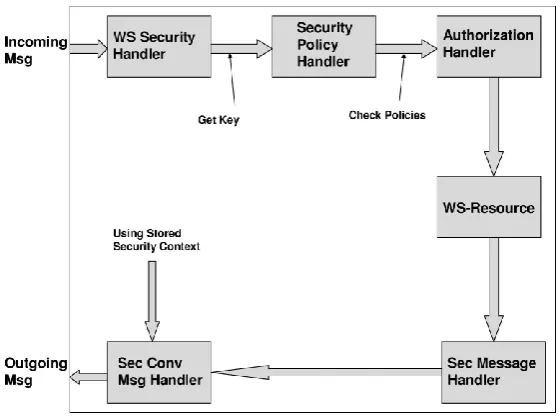
4.5.1 Message Protection in GT4...61
4.5.2 Delegation in GT4...64
4.6 Chapter Summary ...65
5 Grid Authorization Systems ...67
5.1 Introduction ...67
5.1.1 Different Access Control Models...69
5.1.2 Push vs. Pull Authorizations ...72
5.2 Characteristics of Grid Authorization Systems ...74
5.2.1 Scalability Issues...75
5.2.2 Security Issues ...76
5.2.3 Revocation Issues...77
5.2.4 Inter-operability Issues...79
Contents xi
5.3 VO Level Authorization Systems...80
5.3.1 Community Authorization Service (CAS) ...80
5.3.2 Virtual Organization Membership Service (VOMS) ...87
5.3.3 Enterprise Authorization and Licensing Service (EALS) ....88
5.4 Resource Level Authorization Systems...90
5.4.1 Akenti...90
5.4.2 Privilege and Role Management Infrastructure Standards Validation (PERMIS) Project...94
5.4.3 Authorization Using GridMap ...100
5.5 Comparing the Different Authorization Systems ...100
5.5.1 Comparison ...100
5.5.2 Roadmap to Grid Authorization Systems ...103
5.6 Chapter Summary ...103
6 Service Level Security in Grid Systems ...105
6.1 Introduction ...105
6.1.1 Components of Service ...106
6.1.2 Service Vulnerabilities...106
6.2 DoS Attacks and Countermeasures ...108
6.2.1 Effect of DoS attacks ...108
6.2.2 Distributed Denial-of-Service Attacks...111
6.2.3 Existing DoS Countermeasures...118
6.2.4 Preventive DoS Counter-measures ...119
6.2.5 Reactive DoS Countermeasures...123
6.2.6 Comparison between DoS Countermeasures ...126
6.3 QoS Violation Attacks and Countermeasures ...127
6.3.1 Different Types of QoS Violation Attacks...128
6.3.2 Existing Solutions ...129
6.4 Chapter Summary ...131
7 Host Level Security...133
7.1 Introduction ...133
7.2 Data Protection Issue ...135
7.2.1 Application Level Sandboxing...136
7.2.2 Virtualization ...138
7.2.3 Flexible Kernel Systems ...145
7.2.4 Sandboxing...149
7.3 Job Starvation Issue ...154
7.3.1 Advanced Reservation Techniques...155
7.3.2 Priority Reduction Techniques...156
8 Grid Network Security ...159
8.1 Introduction ...159
8.1.1 Grid Network Security Issues ...159
8.2 Firewalls ...161
8.2.1 Different Types of Firewalls...163
8.2.2 Firewalls and Grid – Issues...165
8.2.3 Firewalls and Web Services...167
8.3 Virtual Private Networks (VPN) ...168
8.3.1 VPNs and Grid – Types of VPNs ...169
8.3.2 VPNs and Grid – Issues ...170
8.3.3 VPNs and Grid – Some Solutions...171
8.4 Secure Routing ...173
8.4.1 Impacts of Routing Table “Poisoning” ...173
8.4.2 Different Routing Protocols...175
8.4.3 Routing Attacks and Countermeasures ...175
8.5 Multicasting...178
8.5.1 Secure Multicasting...178
8.6 Sensor Grids ...182
8.6.1 Security in Sensor Networks – Issues ...183
8.6.2 Existing Solutions ...186
8.7 High Performance Interconnects ...188
8.7.1 10-Gigabit Ethernet...188
8.7.2 Infiniband Architecture (IBA) ...188
8.7.3 Some High Performance Security Solutions...189
8.8 Chapter Summary ...190
9 Grid Credential Management Systems...193
9.1 Introduction ...193
9.1.1 Types of Credentials ...194
9.1.2 Characteristics of Credential Management Systems...195
9.1.3 Different Credential Management System ...197
9.1.4 Centralized Vs. Federated Credential Management...198
9.2 Credential Repositories...200
9.2.1 Smart Cards...200
9.2.2 Virtual Smart Cards ...201
9.2.3 MyProxy Online Credential Repository...202
9.3 Federated Credential Management Systems...205
9.3.1 Virtualized Credential Manager (VCMan) ...206
9.3.2 KX.509...208
9.3.3 Liberty Alliance for Federated Identity...209
9.3.4 Shibboleth Identity Federation...210
Contents xiii
10 Managing Trust in the Grid...215
10.1 Introduction ...215
10.1.1 Definition of Trust...215
10.1.2 Reputation and Trust ...217
10.1.3 Categories of Trust Functions ...218
10.2 Trust Management Systems...221
10.2.1 Life Cycle of Trust Management Systems ...223
10.2.2 Characteristics of Trust Management Systems ...225
10.3 Reputation-Based Trust Management Systems ...228
10.3.1 PeerTrust – A P2P Trust Management System ...228
10.3.2 XenoTrust Trust Management System...231
10.3.3 NICE Trust Management System...233
10.3.4 Secure Grid Outsourcing (SeGO) System...236
10.4 Policy-Based Trust Management Systems ...238
10.4.1 PeerTrust Trust Negotiation ...238
10.4.2 TrustBuilder...240
10.4.3 Trust Negotiation for the Grid...242
10.5 Comparing the Trust Management Systems...243
10.5.1 Generic Understanding of Trust Management Systems .243 10.5.2 Applicability of the Trust Management Systems ...245
10.6 Chapter Summary ...246
11 Grid Monitoring...247
11.1 Introduction ...247
11.1.1 Stages of Monitoring ...248
11.1.2 Requirements of Distributed Monitoring System...250
11.2 Grid Monitoring Architecture (GMA)...251
11.3 Different Monitoring Tools/Frameworks ...253
11.3.1 Simple Network Management Protocol (SNMP)...254
11.3.2 Different System Monitoring Tools ...255
11.3.3 Ganglia ...256
11.3.4 Hawkeye Monitoring System ...258
11.3.5 Relational GMA (RGMA)...259
11.3.6 Globus Monitoring and Discovery System (MDS) ...261
11.3.7 Management of Adaptive Grid Infrastructure (MAGI)..263
11.3.8 GlueDomains...265
11.4 Discussions on the Different Monitoring Systems ...266
11.4.1 Comparison ...266
11.4.2 Applicability...268
12.1 Security in the European Data Grid (EDG)...271
12.1.1 Authentication and Delegation...271
12.1.2 Credential Management...272
12.1.3 Job Execution ...272
12.2 An Enterprise Case Study...274
12.2.1 Overview of the Security Architecture...275
12.3 Chapter Summary ...278
13 Conclusion ...281
13.1 Looking at the Future ...281
13.1.1 Identity Based Encryption (IBE)...281
13.1.2 Application Oriented Networking (AON)...282
13.2 Summarizing the Security Issues in Grid ...283
13.2.1 Immediate Issues ...284
13.2.2 Medium-term Issues ...285
13.2.3 Long-term Issues ...287
13.3 Summarizing the Security Solutions in the Grid ...289
13.3.1 Solutions to Immediate Issues...289
13.3.2 Solutions to Medium Term Issues...290
13.3.3 Solutions to Long Term Issues...291
Appendix...293
A.1 Web Services ...293
A.1.1 Components of Web Services ...294
A.2 Web Services Security...296
A.2.1 WS-Security ...299
A.2.2 WS-Policy* ...301
A.2.3 WS-SecureConversation...302
A.2.4 Security Assertions Markup Language (SAML)...304
A.2.5 eXtensible Access Control Markup Language ...306
A.3 Open Grid Services Architecture (OGSA) ...307
A.3.1 Open Grid Services Infrastructure (OGSI)...308
A.3.2 Web Services Critique of OGSI ...309
A.3.2 Web Services Resource Framework (WSRF) ...310
Bibliography...313
Index...329
1 Introduction
1.1 Background
When we watch the recent spectacular science fiction and fantasy thrillers, we remain totally under the spell of the amazing scenes and the underlying special effects that are being displayed. We watch the movies, applaud the actions, and come home totally enchanted and wanting for more. Most of the time we forget about the enormous amount of effort that is required to produce such a spectacle. Even if we acknowledge that, we tend to ignore the proverbial “work horses” or computers that generate such remarkable special effects. We have got used to the special effects so much that we take the computing power required to provide such visual spectacles for granted. It takes billions and trillions of CPU cycles to create special ef-fects like those in Spiderman [1], Shrek [2], and other such visual treats. To satisfy the ever increasing hunger for better special effects among movie-goers, more and more complex animations are being developed which are continuously raising the bar for computing power required.
computing power. Similarly, EDA and Oil & Gas explorations also require computing power to do more computations in a shorter time to satisfy the ever increasing demands of the market.
Therefore huge computing power is required in several industries. Now if we look at the computing resources available, we will find that the laptops of today are perhaps as powerful as servers a decade ago. Moore’s law, which states that computing power doubles every eighteen months, is valid even today and will probably be true for the next five to six years. With the advancements in the field of multi-core technologies, this growth can be extended further [9]. Therefore computing power is increasing and so is the demand. In this rat race, researchers have found an able ally in the form of networking. Between 2001 and 2010, while processing power is supposed to increase 60 times, networking capabilities is supposed to in-crease by 4000 times. This means that at the same cost 4000 times the same bandwidth will be available in 2010 as compared to 2001 [10]. Therefore the computing architectures developed a decade back would probably require a rethink based on the technological progress in the fields of computers and networks. Last decade saw the development of a field called cluster computing [11] where the different computing resources are connected together using a very high speed network like the Gigabit Ethernet or more recently Infiniband [12].
1.2 Grid Computing Overview 3
grid as a natural choice among the other enterprises. However, the wide-spread adoption of grid computing as an automatic choice in enterprises depends upon the ability of the researchers and practitioners in reducing the pitfalls that lie on the way. One such pitfall is security which is the fo-cus of the book as a whole. In this chapter we will briefly look at the evo-lution of grid computing, its benefits, and concerns.
1.2 Grid Computing Overview
One of the earliest proponents of grid technology is Ian Foster of the Ar-gonne National Laboratory and professor at the University of Chicago. In 1998, in a book called The Grid: Blueprint for a New Computing Infra-structure co-authored with Carl Kesselman, Foster defined the grid as “A computational grid is a hardware and software infrastructure that pro-vides dependable, consistent, pervasive, and inexpensive access to high-end computational capabilities” [13]. Over the years even Foster's defini-tion of a computadefini-tional grid has evolved, by his own admission. In a sub-sequent article, The Anatomy of the Grid, co-authored with Steve Tuecke in 2000, he changed the definition to include some element of social and policy issues, stating that grid computing is concerned with, “coordinated resource sharing and problem solving in dynamic, multi-institutional vir-tual organizations” [14].
in-side an organization's own walls – that can be given jobs to do, and that with only a limited amount of user intervention, will get them done quickly, reliably, and cheaply.
In a more generic sense, a grid is a hardware and software infrastruc-ture that allows service oriented, flexible, and seamless sharing of hetero-geneous network of resources for compute and data intensive tasks and provides faster throughput and scalability at lower costs.
1.2.1 Evolution of Grid Computing
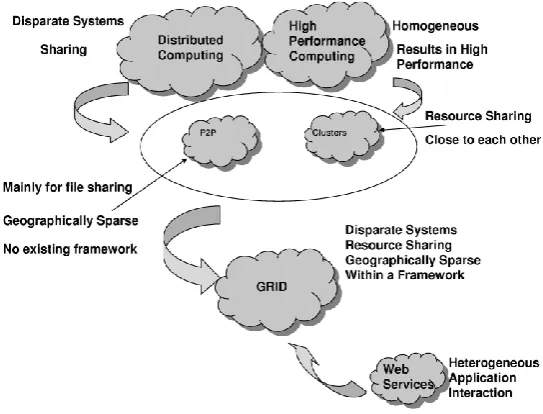
Though grid computing has become the buzzword in both industry and academic communities, it is not a technology which has been developed from scratch. Rather, it is a conglomeration of different existing gies like cluster computing, peer-to-peer (P2P), and Web services technolo-gies.
1.2 Grid Computing Overview 5
Fig. 1.1. Evolution of grid computing
1.2.2 Benefits of Grid Computing
In recent years, the IT infrastructure of most enterprises is facing a huge amount of stress due to the significant increase in transaction volumes. In addition, there are requirements in terms of collaboration and virtualization of resources and policies. All these business requirements drive the need and deployment of the grid in enterprises. There are mainly four distinct benefits of using grids viz. performance and scalability, resource utiliza-tion, management and reliability, and virtualization.
Performance and Scalability
Many pharmaceutical and financial enterprises are on a constant lookout for solutions which can reduce their time to market. In some cases, even a 5 - 10% improvement results in huge cost savings. Grid computing solu-tions of having a shared infrastructure provide more computational capa-bilities and increase scalability of the IT infrastructure. Most of the enter-prises are therefore currently looking at the grid as a more flexible and scalable versions of their cluster infrastructure. As a result, most of the ap-plications running on the grid infrastructure are compute intensive or batch-type applications.
Resource Utilization
1.2 Grid Computing Overview 7
[image:21.439.74.344.120.334.2]cycles that are available in desktop PCs located in various locations across multiple time zones. For example, PCs that would typically remain idle overnight at a company’s Mumbai manufacturing plant could be utilized during the day by its North American operations.
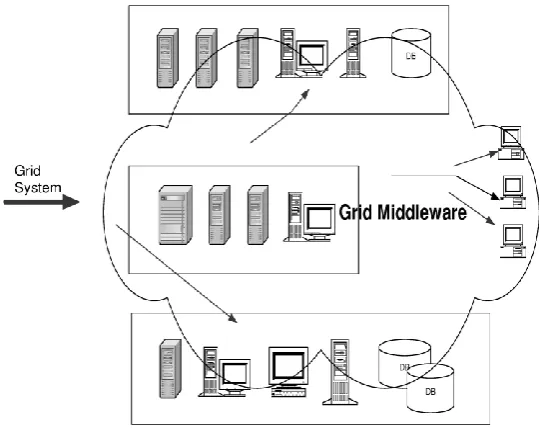
Fig. 1.2. Sharing of resources using the grid
Management and Reliability
Virtualization
[image:22.439.94.373.197.382.2]With the growth of mergers and acquisitions in the enterprise world, het-erogeneity is inevitable. Hethet-erogeneity exists in the type of hardware, stor-age, operating systems, and policies within the enterprises. The grid pro-vides virtualization of heterogeneous resources resulting in better management of the resources. It is to be noted that the problem is not en-tirely solved. As one will find out in the subsequent chapters of the book, managing heterogeneous security policy is still a challenge and requires re-search attention.
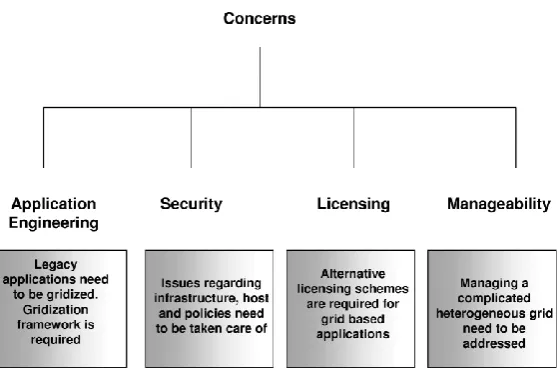
Fig. 1.3. Grid computing concern areas
1.2.3 Grid Computing Issues and Concerns
1.2 Grid Computing Overview 9
and grid computing were first researched on by the academic community, later handed over to the research labs and finally industry has taken over in the use and adoption of the technology. Will grid computing become as ubiquitous and widely adopted as the Internet technologies? The answer to the question lies in answering a few concerns that clog the mind of the us-ers of grid technologies. As shown in Fig. 1.3, the concerns are: applica-tion and data engineering, security, manageability, and licensing issues. The adoption of grid computing in a big way depends on how the re-searchers and practitioners answer these critical concerns.
Application and Data Engineering
Though grid computing is more than just a technology to abet high per-formance computing, most of the early adopters of the grid are users in the areas where there are huge amounts of data and computation involved like life sciences, finance, automotive and aerospace, energy etc. Most of the users have been using applications in high performance clusters or in some cases SMPs and find grid computing an excellent opportunity to move their applications to a cluster of clusters or a combination of cluster and desktops or PCs available in the organization to get the performance bene-fits without putting in too much investment. The questions that immedi-ately come to their mind are: “Will my Cobol application run on the grid?” “Will I get performance benefits?” “What is my return on investments?” There is a significant dearth of tools, frameworks, platforms, analyses which can immediately answer these questions or in other words there are no tools, frameworks, or platforms to help users gridize their applications. Gridization has two aspects: (i) Data can be manipulated, striped across the grid for enhanced performance. There are applications in life sciences like BLAST [25] and in other domains where this type of technique will be useful. We call this data engineering. (ii) Another aspect involves manipulating the applications themselves so that they are able to extract maximum bene-fit out of the grid computing infrastructure. We call this application engi-neering.
some mechanisms for writing parallel applications or analysis of applica-tions. However, most of these tools and techniques are insufficient for en-terprise needs. Typically, enen-terprise applications are complex and have several business level, application level, and temporal dependencies, which these tools do not handle very well. Therefore, significant research and de-velopment efforts need to be undertaken in this direction to develop tools for enterprise applications. Even tools which would be able to analyze and provide hints whether the application(s) are gridizable would be greatly appreciated by the enterprise grid community. Some efforts are undertaken in this direction by ASPEED® and Cornell Theory Center (CTC) [32,33].
Grid Manageability
From its inception, IT systems were besotted with problems like schedul-ing, management, security, and other challenges. To solve these problems, substantial work has been carried out at different levels, for example in the form of infrastructure management systems, job schedulers, mechanisms for implementing security, etc. One class of such systems is being used in industry and it consists primarily of proprietary solutions which combine technological elements like Web services, J2EE, distributed computing, and others to solve specific business problems. Another class is that of ini-tiatives in the academic community – mainly through joint efforts of uni-versities around the world which take elements of freely available grid middleware and build upon them to fulfill their specific needs. All this has happened in the midst of evolving standards for grid computing, for exam-ple the development of OGSA and the ongoing evolution of the WS set of standards, including WS-RF and WS-Agreement.
It is becoming clear that one key concern which this evolutionary growth of the technology has resulted in is complexity, and the ensuing problem of manageability. Manageability is often cited as one of the key issues in any real world grid implementation [34]. The problem of man-ageability is closely related to that of integration. Since grids bring to-gether software components, frameworks, middleware and hardware ele-ments, integrating them together often entails gluing together systems which may not be designed and developed with that in mind.
Grid Licensing
1.3 About the Book 11
increasingly being developed using service orientation and virtualization of resources, as evident in the growth and adoption of Web services and grid computing technologies. While software architectures and products are evolving rapidly to realize these visions, the very way in which software is priced and licensed is not aligned with this new reality. The grid allows the sharing of resources across different systems. For custom defined applica-tions this vision holds good. However, for vendor applicaapplica-tions the gain in sharing of resources is offset by the licensing needs of the applications sharing the resources.
The intriguing part about the whole pricing and licensing equation in the grid is the technology and business nature of it. The technology chal-lenge is there to develop suitable pricing and licensing infrastructure. Ex-tensive research is being carried out to develop such systems. However, the challenge also lies in the business nature of the problems and hence application providers like Microsoft®, Oracle®, Sun®, IBM®, and others have to develop models so that the grid vision can be realized more effec-tively. Slowly but surely, we are seeing the adoption of a more flexible model for the grid system. Sun® Microsystems have come forward with their vision of charging the users 1$ for using the grid resources. With the growth of Grid systems, we would probably see the emergence of a flexi-ble licensing and pricing model in the line of transport business.
Grid Security
Lastly, we come to the issue of security. In addition to the typical security challenges like authentication, confidentiality, and integrity, the grid offers several other unique security challenges. Policy integration, authorization, credential management related issues are unique mainly due to the typical heterogeneous nature of the grid systems. Additionally, the integration is-sues and the evolving standards make the problem challenging for re-searchers. Keeping in mind the importance of the security issues in the grid, the whole book is dedicated to provide insights into grid security is-sues, challenges, and solutions.
1.3 About the Book
principles and/or grid computing technologies will be required to un-derstand the chapters covering advanced security issues in grid computing. The book has a brief and concise background on grid computing security which would be used in explaining the specific issues of grid computing security in later chapters. A small primer on Web services security and grid computing standards like OGSA is also provided in the appendix for readers who are new to this field.
1.3.1 Target Audience
The book aims at covering most of the important issues, challenges, re-search and deployed solutions, and rere-search roadmaps that are needed for taking the grid to the enterprises. The book is aimed at providing benefits to researchers as well as professionals working on different aspects of grid computing through the insights about the solutions and the issues. Through this book professionals working on grid computing would be made aware of the security requirements. It would also enlighten them about the secu-rity features about some existing open source as well as some proprietary products. The book therefore would be able to provide them with informa-tion which would be useful for making important business decisions. Graduate students working on grid computing security would be able to get all the information about the different aspects in a single place. The book will also provide pointers for further research directions which will benefit students who are looking for potential research areas. Experienced researchers in the field of grid computing will be able to get a comprehen-sive overview of different security issues in grid computing. The book aims at providing insights into the different solutions and issues which would help experienced researchers take important research decisions.
1.3.2 Organization of the Book
infrastruc-1.3 About the Book 13
2.1 Introduction
In the previous chapter we have provided an overview of grid computing. In this chapter we will provide an overview of the computer security tech-nologies, protocols, and principles. Since computer security particularly cryptography is a discipline by itself, in this chapter we will only concen-trate on protocols, principles, and technologies which are applicable to the grid computing area. The motivation of this chapter is to provide readers with a “one stop shop” on security which would be referred to later during the description of grid computing security. For more inquisitive readers substantial references will be provided.
2.1.1 Characteristics of Secure System
16 2 Overview of Security
may later say that she had not given him that letter. However, since the let-ter has been signed, Alice cannot deny writing such a letlet-ter. This is called the nonrepudiation requirement of a secure system. Nonrepudiation works at different levels. Let us assume Alice delegates the responsibility of dropping the letter to Charlie. However, Charlie loses the letter. If Charlie had signed in a register mentioning that he picked up the letter then he cannot later say that he was not assigned the responsibility. This simple example illustrates that every day we have confidentiality, authentication, integrity, and nonrepudiation embedded into our systems. To make a com-puter system secure, all the above characteristics need to be followed. The characteristics are achieved in the same way as described in the above ex-ample, only the mechanisms are different.
2.1.2 Security Threats
such example is routing updates and creation of routing tables in the Inter-net scenario.
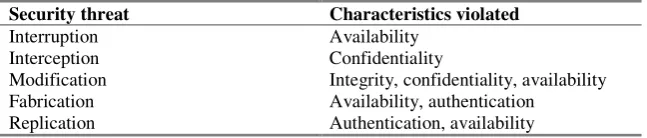
Table 2.1. Threat characteristics mapping
Security threat Characteristics violated
Interruption Availability
Interception Confidentiality
Modification Integrity, confidentiality, availability
Fabrication Availability, authentication
Replication Authentication, availability
In Table 2.1, mapping between different threats and characteristics is provided. When an adversary interrupts a message then the receiver is not able to receive the message resulting in loss of availability for the receiver. In case of interception, the characteristic violated is confidentiality as the adversary is able to read the contents of the message which may be confi-dential in nature. When an adversary modifies the contents of a message then the characteristics violated are integrity, confidentiality, and availabil-ity. Since the adversary modifies the content of the message integrity of the message is violated, and if the adversary is able to read the contents of the message confidentiality is violated, while availability is violated be-cause the receiver receives the wrong message. Fabrication violates avail-ability similar to modification and authentication as the sender of the mes-sage is an adversary who poses as somebody else. Similarly, replication violates authentication and availability.
2.2 Different Encryption Schemes
18 2 Overview of Security
be encrypted. This can be implemented by having the characters of any particular book as a key. This technique was employed on a wide scale in World War II. Other than this transformation technique, transposition techniques are also used where the order of the characters are changed to deceive the unintended receivers. One implementation of such a technique would be to arrange the characters in equal sized rows and then inter-change the rows with the columns. It can be shown that while transforma-tion techniques aim at creating confusion, transpositransforma-tion techniques aim at creating diffusion, which means that in transposition techniques two changes in the same message will result in changes in different positions of the message. More recent techniques like the Data Encryption Standard (DES) [36], Advanced Encryption Standard (AES) [37], etc. combine the above mentioned two techniques to generate both confusion and diffusion.
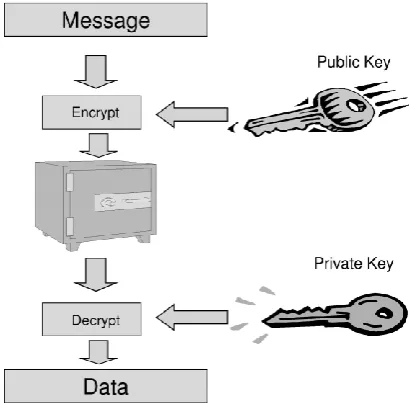
Encryption schemes may be broadly categorized into two main types: symmetric key encryption and asymmetric key encryption. In the former there is only one key which is shared between the sender and the receiver. In this type of scheme, the sender encrypts using the shared key and the re-ceiver decrypts using the same key. Examples of such encryption schemes are DES and AES where a combination of transformation and transposition using the shared key is applied.
Fig. 2.1. Overview of public key encryption
Now readers may have questions in mind that why do we require two different types of encryption and what are the scenarios where each of them can be applied. Symmetric encryption schemes like the DES are
20 2 Overview of Security
key using the Diffie-Hellman [41] technique where information from both the parties is used to generate the session key. Another variation would be to use the Key Distribution Center (KDC) which is responsible for generat-ing the session key.
2.3 Different Authentication Schemes
Let us now concentrate on the problem of authenticating a system or a user. This problem is generally handled using three different mechanisms: based on shared secret, based on public key, and based on third party.
2.3.1 Shared Secret Based Authentication
dogs the challenge based systems is the man-in-the-middle attack. Let us assume that Alice is the user and Bob is the authenticator and Charlie is a malicious adversary. When Bob challenges Alice, Charlie grabs the mes-sage and sends the same mesmes-sage to Alice. Alice sends the answer to the challenge; Charlie taps those and sends it to Bob. Now Bob will think that it has authenticated Alice and would allow Alice to access the system. In realty it is Charlie who is accessing the systems as he is acting as the man in the middle between Alice and Bob. This vulnerability prevents the chal-lenge based systems to be the sole mechanism of authentication and is generally used in conjunction with the other mechanisms which will be discussed subsequently.
2.3.2 Public Key Based Authentication
Going back to the example of the HR manager sending the letter of promo-tion to the employee, how does the employee believe the contents of the letter? When the employee looks at the letter he finds that the letter is signed by the HR manager. Since he can always verify the signature of the HR manager he can always determine the authenticity of the letter. Public key based authentication uses the principle described above. In this type of scheme the user has a public and private key pair and the authenticator knows the public key of the user. The user encrypts standard information with his/hers private key. The authenticator can verify the authenticity by decrypting the same information with the user’s public key. This type of mechanism is very secure and is generally tamper proof. The biggest prob-lem in adopting the system in wide scale is the scalability of the system. Take a scenario where there are millions of users using a particular com-puting infrastructure and there is the need for authentication of each and every user. This happens in case of a Website where not only there are mil-lions of users but also the nature of the users is transient. Many of the users may be home users who do not possess a public-private key pair. It is also difficult for the authenticator to maintain the public information of so many users. So in reality a variation of this scheme is used which is called the certificate based system or third party authentication schemes.
2.3.3 Third Party Authentication Schemes
22 2 Overview of Security
third party like the person’s own country issuing the passport and the con-sulate issuing the visa. This is a classic case of third party authentication where the authenticator does not know the user, however uses a third party credential (in this case passport/visa) for authentication purposes. In digital systems also this type of authentication is very popular. Here the user gets a digital certificate from a Certificate Authority (CA) which is a known third party. Certificates are nothing but information about the user hashed and then signed by the CA’s private key. Since the public key of the CA is widely known therefore the authenticator has no problem in validating the certificate and hence authenticating the user to access the system based on the certificate. However this type of system mandates that each user has a public key which can be validated by the Certificate Authority. This means that there is a need for Public Key Infrastructure (PKI) to make the above scheme work. This may not be feasible always, especially in the Internet scenario. Another mechanism of third party based authentication used in the Kerberos system is to have a key distribution center (KDC) which au-thenticates the user using a standard mechanism like using a password. The KDC generates a session key for the user to access the system encrypted with the systems public key. More details about the Kerberos system will be provided subsequently.
2.4 Different Integrity Schemes
Let us now look at the problem of message integrity where the contents of the message may be changed by a malicious adversary. It is like sending an open and signed letter which is being tampered by an adversary in the middle where the signature is kept intact. This type of attack would work even if the message is encrypted because in most of the cases the purpose of the attacker is to mislead and confuse the receiver. Therefore changing the contents of the message may confuse the receiver though the attacker may not be able to understand the contents of the message. This problem of message integrity is generally solved using two mechanisms: Message Authentication Code (MAC) and Keyed MAC.
2.4.1 Message Authentication Code (MAC)
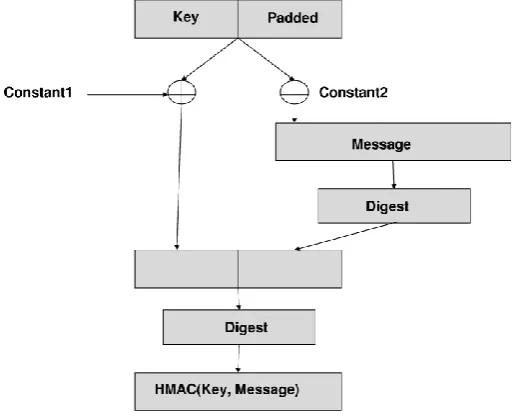
applied to two messages results in a same hash it is called a collision. Good hash functions should be able to minimize collision as much as pos-sible. This hash or MAC (sometimes referred to as Message Digest) is ap-pended to the message and sent to the receiver. Therefore if anyone tam-pers with the message the hash sent with the message will not match with the hash of the tampered message. On receiving the message, the receiver would be able to ascertain that the message has been tampered with. Hence the receiver can drop the message or can ask the sender to re-send the mes-sage. This scheme is constrained by the fact that anyone can generate the MAC by knowing the message. Therefore the scheme can only be em-ployed if both the message and the hash are encrypted. MD5 [43] and SHA-1 [44] are examples of such a scheme.
Fig. 2.2. Overview of the HMAC scheme
2.4.2 Keyed MAC
24 2 Overview of Security
fixed length string using some simple functions like XOR and the message is hashed using a common hash function. Now the hashed message and the string are combined and hashed again using the hash function. The final hash is the MAC which is dependent on both the message and the key. Dif-ferent algorithms will use variations of the above scheme and they may also run the steps multiple times to make the final MAC very secure. HMAC [45] (see Fig. 2.2) is an example of Keyed MAC.
2.5 Standard Protocols
In this section we will concentrate on some of the standard protocols and mechanisms used in grid computing systems. We will discuss public key infrastructure, Secure Socket Layer (SSL), Kerberos, and IP security as part of this section.
2.5.1 Public Key Infrastructure
An infrastructure which supports the public key based authentication and encryption is called the Public Key Infrastructure (PKI). As the name sug-gests, each entity user in the PKI environment possesses a public and a corresponding private key. At the heart of the PKI lies the concept of cer-tificates, which are used to validate the user and the public key associated with the user, and Certification Authority (CA), who issue these certifi-cates. A certificate validation process is illustrated in Fig. 2.3.
Certificates
Certificates are credentials of a specific user containing the user details which is signed by the CA. Different types of certificates are available. The most popular and commonly used certificate format is called X.509 format [46]. A typical X.509 certificate consists of the following informa-tion:
• The version of X.509 that has been used.
• The information about the user or the issuing CA.
• The algorithms used to compute the signature of the certificate.
• The subject whose public key is being certified.
• The validity of the certificate which indicates the time for which the certificate is valid.
• The signature field which is actually a hash of the above informa-tion signed by the CA’s private key.
• In addition there are some optional fields and extensions so that some customization of the X.509 certificate is possible.
If we take a closer look at the above certificate format, we find that it bears a close resemblance to a driving license or a passport issued to people in the physical world. Since the purpose of both digital and physical certifi-cates is the same therefore this resemblance is not at all surprising.
Fig. 2.3. Certificate overview
Certification Authority (CA)
26 2 Overview of Security
• Monopoly Model: In this model, there is only one CA which is trusted by all other entities who get the certificate from the trusted CA. This is a very simple model; however it has scalability prob-lem, especially for large systems.
• Monopoly plus RA: This model is similar to the monopoly model,, except that the single CA chooses other organizations (known as Registration Authorities or the RAs) to securely verify the public keys. The RAs communicate this information to the CA.
• Delegated CA: In this type of model, the trusted CA (called the trust anchor CA) can issue certificates for other CAs called the delegated CA. The users can then obtain certificates from the delegated CAs rather than from the trust anchor CA. This type of delegation is used in the open source Globus implementation.
• Oligarchy: This type of model is commonly used in browsers. Here, the different products come with a single key, configured with many CAs, and the certificate issued by any one of them is accepted.
• Others: There are other trust models like Anarchy, used in PGP, which is a distributed model where each user is responsible for configuring trust anchors or public keys of some other set of users. There are also concepts like the Name Constraints where the trustworthiness of CA is not a binary value, completely trusted or untrusted for everything. Rather, CA should only be trusted for certifying a set of users.
2.5.2 Secure Socket Layer (SSL)
One of the most popular protocols to secure the transport layer is called the Secure Socket Layer (SSL), whose newer versions are called Transport Layer Security (TLS) [48]. SSL/TLS works on top of Transport Layer Pro-tocol (TCP), and provides security in managing sessions over the transport channel. The SSL version 2 was deployed with Netscape Navigator 1.1 by Netscape® [49] in 1995. Netscape® came out with version 3 a few years later. The Internet Engineering Task Force (IETF) [50] extended the con-cept to develop a standard called Transport Layer Security (TLS).
The protocol works as follows:
• The client contacts the server to initiate a SSL/TLS session. In this step the client does not identify itself, however it mentions the set of cryptographic algorithms the client can support. In addition, the client also sends a random number RC, which will be used to create
the session key.
• The server replies by sending its certificate to the client. It also sends a random number RS which will contribute towards the
crea-tion of session key.
• The client then verifies the certificate, extracts the public key of the server, and then selects a random number S. In addition, the client also computes K, which is the master secret computed as a function of RC, RS, and S.
• The client sends S and the hash of K encrypted with the server’s public key.
• Subsequently, all the data sent over the SSL/TLS channel is en-crypted with the session key K.
It is to be noted that the SSL/TLS protocol defined above helped the client to authenticate the server. However, the server cannot authenticate the client. As a protocol, SSL/TLS allows the option for mutual authentica-tion, where the server can authenticate the client if the client possesses the required certificate. However, in most cases, if such an authentication is required the client generally sends its user name and password encrypted with the server’s public key.
2.5.3 Kerberos
28 2 Overview of Security
of Needham and Schroeder [52]. It is one of the examples of a third party authentication scheme described earlier.
Fig. 2.4. Overview of the Kerberos system
Kerberos consists of a Key Distribution Center (KDC) which runs on a secure node, in the network. The KDC is composed of basically two components: the Ticket Granting Server (TGS) and the Authenticating Server (AS). Kerberos was designed to provide authentication between two entities who are trying to communicate on an insecure network. Kerberos is based on three clear design goals:
• Minimum Exposure: Kerberos ensures that the client passwords do not flow as a cleartext on the network. It also allows the mini-mum exposure of client key on workstations.
• Containment: This indicates that if there is a compromise, only one client or server is affected. This is also ensured through lim-ited authentication lifetime (which is typically 8 hours to 24 hours).
Figure 2.4 shows the overview of the operation of the Kerberos system. The following steps are performed:
1. The client logs in to the Authentication Server (AS) mentioning that it wants to access the Ticket Granting Server (TGS).
2. The AS replies by providing the TGS ticket encrypted with the TGS’s public key and the session key for the client to access the TGS. The whole information is encrypted by the client’s public key, which can be the client’s password.
3. The client sends the ticket information and the authentication in-formation (which is typically time, client inin-formation, etc.). The client encrypts the information by the TGS’s public key.
4. TGS replies with the ticket to access the server.
2.5.4 IP Security (IPSec)
The IPSec [53,54] is a method proposed to solve the attacks mentioned
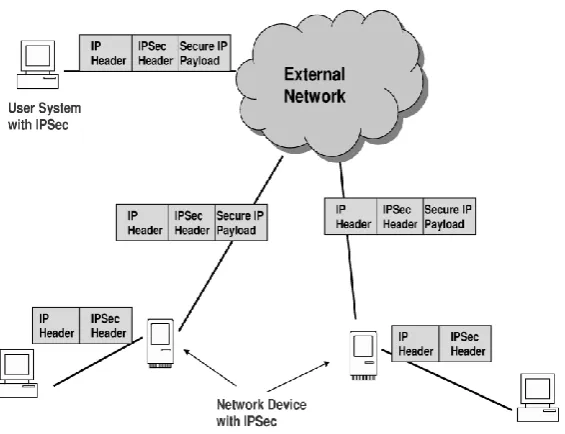
IPSec that enables it to support a variety of application scenarios is that it can encrypt or authenticate all traffic at the IP level. Thus, all distributed applications, including remote login, client/server, e-mail, file transfer, Web access, and so on, can be secured. Figure 2.5 shows a typical scenario of IPSec usage. An organization maintains local area networks at dispersed locations. Traffic on each LAN does not need any special protection, but the devices on the LAN can be protected from the untrusted network with firewalls. Since we live in a distributed and mobile world, the people who need to access the services on each of the LANs may be at sites across the Internet. These people can use IPSec protocols to protect their access. These protocols can operate in networking devices, such as a router or firewall that connects each LAN to the outside world, or they may operate directly on the workstation or server. In the diagram, the user workstation can establish an IPSec tunnel with the network devices to protect all the subsequent sessions. After this tunnel is established, the workstation can have many different sessions with the devices behind these IPSec gate-ways. The packets going across the Internet will be protected by IPSec but will be delivered onto each LAN as a normal IP packet.
IPSec is composed of the following main components:
30 2 Overview of Security
authentication and encryption function, called the Encapsulating Security Payload (ESP) [56], that provide the basic security mechanisms within IP.
• Security associations (SA) that represent an agreement between two peers on a set of security services to be applied to the IP traffic stream between these nodes.
[image:43.439.92.375.187.404.2]• Key management infrastructure that sets up SA between two communicating peers.
Fig. 2.5. Overview of IPSec
tunnel mode. With transport mode, AH or ESP is applied only to the packet payload, while the original IP packet header remains untouched. The AH or ESP header is inserted between IP header and layer 4 header, if any. In tunnel mode, AH or ESP is applied to the entire original IP packet, which is then encapsulated into a new IP packet with a different header.
For Virtual Private Networks (VPN), both authentication and encryp-tion are generally desired, because it is important both to (1) assure that unauthorized users do not penetrate the virtual private network and (2) as-sure that eavesdroppers on the Internet cannot read messages sent over the virtual private network. Because both features are generally desirable, most implementations are likely to use ESP rather than AH. However, by providing both AH and ESP, IPSec provides implementers with flexibility in terms of performance and security. This flexibility is also extended to the key exchange function where both manual and automated key ex-change schemes are supported.
2.6 Chapter Summary
3 Taxonomy of Grid Security Issues
3.1 Introduction
Once I started writing this book, I noticed an uncanny similarity be-tween our college carpooling mechanisms and the grid system. Similar to the car pooling system, a grid system also is a mechanism to pool re-sources on-demand to improve the overall utilization of the system. Simi-larities do not end here also. The issues and concerns that we had for per-sonal safety, trust, authorization, etc. are important issues for grid computing systems as well. For example, similar to the car pooling system where we were concerned about cassettes and CDs, in grid systems also one is concerned about the data processed. Moreover, the concerns of a user donating his/her host to the grid system are very similar to the con-cerns I had about my car. Similar to the car pooling system, the grid sys-tem also requires a monitoring syssys-tem in place to monitor the resource us-age, trust management system to create, negotiate, and manage trust between other systems or “strangers,” and an authorization system to au-thorize the users to a access certain set of resources. In this chapter we will briefly talk about the different security issues and solutions in the grid sys-tem. However, this chapter is not meant to be comprehensive as all the components will be elaborated upon in the course of the book. This chapter would provide an overall landscape so that readers can choose the issues they are interested in.
3.1 Introduction 35
3.1.1 Grid Security Taxonomy
Figure 3.1 shows the categorization of the different security issues in a grid. The grid security issues can be categorized into three main categories: architecture related issues, infrastructure related issues, and management related issues.
Architecture Related Issues
These issues address concerns pertaining to the architecture of the grid. Similar to car pooling, where we were concerned about our cassettes and CDs, users of the grid are concerned about the data processed by the grid and hence there is a requirement to protect the data confidentiality and in-tegrity, as well as user authentication. We categorize these requirements under information security. Similarly, resource level authorization is a critical requirement for grid systems. Finally, there are issues where users of the grid system may be denied the service of the grid or the Quality-of-Service (QoS) is violated. These fall under the purview of service level se-curity issues.
Infrastructure Related Issues
These issues relate to the network and host components which constitute the grid infrastructure. Host level security issues are those issues that make a host apprehensive about affiliating itself to the grid system. The main subissues here are: data protection, job starvation, and host availabil-ity. A grid involves running alien code in the host system. Therefore, the host can be apprehensive about the part of the system which contains im-portant data. Similarly, a host can also be concerned about the jobs that it is running locally. The external jobs should not reduce the priority of the local jobs, and hence lead to job starvation. Similarly, if the host is a server, it can be concerned about its own availability. There should be mechanisms to prevent the system from going down resulting in denial-of-service to the clients attached to the host.
Management Related Issues
re-source monitoring for auditing purposes. Much of the information obtained from the monitoring systems is fed back to higher level systems like intru-sion detection and scheduling systems.
3.2 Architecture Related Issues
Architecture level issues address the concern of the grid system as a whole. Issues like Information security, authorization, and service level security generally destabilize the whole system and hence an architecture level so-lution is needed to prevent those. In this section we will briefly touch upon the issues and some solutions.
3.2.1 Information Security
We define information security as the security related to the information exchanged between different hosts or between hosts and users. The con-cerns at the information security level of the grid can be broadly described as issues pertaining to secure communication, authentication, and issues concerning single sign on and delegation. Secure communication issues include those security concerns that arise during the communication be-tween two entities. These include confidentiality and integrity issues. Con-fidentiality indicates that all data sent by users should be accessible to only “legitimate” receivers, and integrity indicates that all data received should only be sent/modified by “legitimate” senders. There are also issues related to authentication, where the identities of entities involved in the overall process can be accurately asserted. These are critical issues in all areas of computing and communication and become exceedingly critical in grid computing because of the heterogeneous and distributed nature of the enti-ties involved there. In addition to the secure communication features users are also concerned about single sign on capability provided by the grid computing infrastructure. In single sign on the authentication is done once.
3.2 Architecture Related Issues 37
Globus toolkit is an open source implementation of OGSA. Details about
Solutions to Information Security Issues
The Grid Security Infrastructure (GSI), developed independently and later
• Secure Communication: The GSI uses public key cryptography, as the basis for creating secure grids and SSL/TLS for data encryp-tion. In public key cryptography, the entities generate pub-lic/private key pairs based on some cryptographically secure mathematical function. A message when encrypted by the public key can only be decrypted by the private key corresponding to the public key. The public keys are known to everyone.
• Authentication: A central concept in GSI authentication is the certificate. Every user and service on the grid is identified via a certificate, which contains information vital to identifying and au-thenticating the user or service.
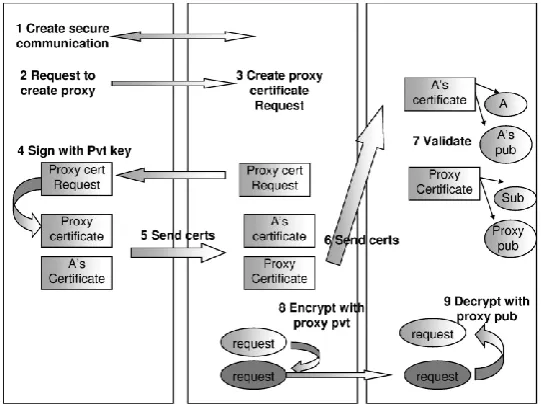
• Single Sign on and Delegation: The GSI provides a single sign on and delegation capability, which reduces the number of times the user must enter his/her pass phrase when multiple resources are used, which is common in a grid scenario. This is done by creating a proxy. A proxy consists of a new certificate (with a new public key in it) and a new private key. The new certificate contains the owner's identity, modified slightly to indicate that it is a proxy. The new certificate is signed by the owner, rather than a Certifica-tion Authority (CA). The certificate also includes a time notaCertifica-tion after which the proxy should no longer be accepted by others.
3.2.2 Authorization
Another important security issue is that of authorization. Like any resource sharing system, grid systems also require resource specific and system specific authorizations. It is particularly important for systems where the resources are shared between multiple departments or organizations, and grid information security are provided in Chap. 4.
department wide resource usage patterns are pre-defined. Each department can internally have user specific resource authorization also. The authori-zation systems can be mainly divided into two categories: VO Level Sys-tems and Resource Level SysSys-tems. Virtual Organization or VO level sys-tems have a centralized authorization system which provides credentials for the users to access the resources. Resource level authorization systems, on the other hand, allow the users to access the resources based on the cre-dentials presented by the users.
Grid Authorization Solutions
Several authorization systems can be applied to the grid context.
• VO Level Systems: VO level grid authorization systems are cen-tralized authorization for an entire Virtual Organization (VO). These types of systems are necessitated by the presence of a VO which has a set of users, and several Resource Providers (RP) who own the resources to be used by the users of the VO. Whenever a user wants to access certain resources owned by a RP, he/she ob-tains a credential from the authorization system which allows cer-tain rights to the users. The user presents the credentials to the re-source to gain access to the rere-source. In this type of systems, the resources hold the final right in allowing or denying the access to the users. Examples of VO level grid authorization systems are Community Authorization Service (CAS) Virtual Organization Membership Service (VOMS), and Enterprise Authorization and Licensing System (EALS).
• Resource Level Systems: Unlike the VO level authorization sys-tems, which provide a consolidated authorization service for the virtual organization, the resource level authorization systems im-plement the decision to authorize the access to a set of resources. Therefore, VO level and resource level authorization systems look at two different aspects of the grid authorization. In Chapter 5, we have provided details of different resource level authorization Sys-tems like Akenti, Privilege and Role Management Infrastructure Standards Validation (PERMIS), and the GridMap system.
3.2.3 Service Security
exam-3.2 Architecture Related Issues 39
ples exist in the Internet space where servers and networks are brought down by a huge amount of network traffic and users are denied the access to a certain Internet based service. Since grid computing deployment has not reached the “critical mass” yet, the service level attacks are also cur-rently nonexistent. However, with the grid computing poised for a huge growth in the next few years, this area should be looked upon with utmost concern by the grid security experts. The grid service level security issues can be further subdivided into two main types: QoS Violation Issues and Denial-of-Service (DoS) related issues. The first issue is about the forced QoS violation by the adversary through congestion, delaying or dropping packets, or through resource hacking. The second one is more dangerous where the access to a certain service is denied. More details about the at-tacks and solutions are provided in Chap. 6.
Solutions to Service Attacks
It is to be noted that the DoS attacks and QoS violation attacks are research topics for researchers in the areas of networks, services, and operating sys-tems. In Chap. 6, we provide an overview of different research efforts that are being undertaken and the solutions that have been proposed.
• DoS Solutions: The solutions proposed for Denial-of-Service (DoS) attacks can be categorized into mainly two types: preventive solutions and reactive solutions. Preventive solutions try to prevent the attack from taking place by taking precautionary measures. Re-active solutions, on the other hand, react to a DoS attack and are generally used to trace the source of the attack. Some examples of preventive solutions are filtering, throttling, location hiding, and intrusion detection. Examples reactive solutions include logging, packet marking, Link testing, and others.
3.3 Infrastructure Related Issues
A grid infrastructure consists of grid nodes and the communication net-work. The security issues related to the grid infrastructure are also of paramount importance.
3.3.1 Host Security Issues
Host level security issues are those issues that make a host apprehensive about affiliating itself into the grid system. The main subissues here are: data protection and job starvation. Whenever a host is affiliated to the grid, one of the chief concerns is regarding the protection of the already existing data in the host. The concern stems from the fact that the host submitting the job may be untrusted or unknown to the host running the job. To the host running the job, the job may well be a virus or a worm which can de-stroy the system. This is called the Data protection issue. Job starvation refers to a scenario where jobs originating locally are deprived of resources by alien jobs scheduled on the host as part of the grid system.
Solutions to the Host Security Issues
Several solutions have been proposed for data protection and job starvation
• Data Protection: Solutions in this space use isolation to restrict the data to the grid or external applications. In Chap. 7 we dis-cuss several isolation techniques viz. application level sandbox-ing, virtualization, and sandboxing. The first type of solution is through the use of proof carrying code (PCC) where the code generators generate proofs of application safeness and embed those in the compiled code. The second solutions looks at creat-ing Virtual Machines (VM) on the physical machine resultcreat-ing is strong isolation properties. The third type of solution, or the sandboxing solutions, traps system calls and sandboxes the ap-plications to prevent them from accessing data and memory based on certain policies.