Anthony H. Richmond
Introduction
A
rising out of an examination of refugee policies and procedures in the decade of the 1980s, and up to the early 1990s, the question was asked, “[A]re we creating a system of global apartheid based on discrimina-tion against migrants and refugees from poorer develop-ing countries?”1 Subsequently, Aiken repeated the question. She examined the issue of racism in Canadian refugee policy and concluded that Canada was still “quite far from the vision of an anti-racist refugee program.”2 This article con-trasts selected elements of the refugee regime in Canada with those of European countries. The 1980s are compared with the 1990s.First, it is necessary to note the changing size, character, and composition of refugee movements in recent years.
Trends in Refugee Movements
In 1989, the unhcr recorded approximately 15 million refu-gees, of whom 4.6 million were located in Africa, 6.7 mil-lion in Asia, 1.2 million in Latin America and the Carib-bean, and 1.4 million in North America (including 447,000
in Canada). The total in Europe was 788,720. The total rose to 18 million in 1992, the largest increase being in Europe, which then reported over 3 million refugees and asylum applicants. By the end of 1999, the unhcr identified 11.68
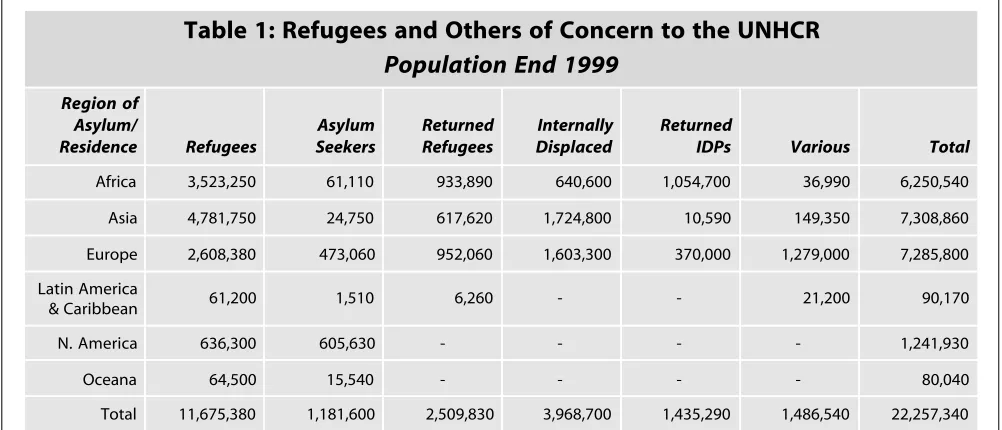
million refugees and an additional 10.58 million “others of concern,” of whom approximately 1.2 million were currently asylum seekers. The overall distribution at the end of 1999
is shown in table 1.
In its annual report, the unhcr noted that “1999 was one of the most challenging years in unhcr’s history. Con-flicts in Kosovo, East Timor, and Chechnya dominate the daily headlines and many of unhcr’s resources, but there were ‘forgotten’ humanitarian cries around the world, es-pecially in Africa.”3 More than half a million new asylum applications were lodged in the main industrialized coun-tries in 1999, an increase of 21 per cent over the previous year, giving rise to growing concern over humanitarian
Abstract
Trends in the numbers and location of refugees and asylum seekers during the 1980s and the 1990s are compared. The question of whether the world has created a system of “global apartheid” is reviewed. The outcome of asylum applications filed in European countries is compared with those in Canada and the United States. It is concluded that racism still prevails in the treatment of refugees. Canada’s record compares favourably with those of other developed countries, although the main burden of refugee protection still falls on less developed regions of the world.
Résumé
considerations in relation to questions of human security, organized crime involved in “people smuggling,” and “eco-nomic migrants.” The involvement of transnational organ-ized crime has been described as the “dark side” of globali-zation. The unhcr Policy Unit stated that “there are very few legal possibilities for refugees to enter the European Union and so the majority are required to attempt ever more clandestine forms of entry.”4
Recognition of Asylum Seekers
In order to understand the differential treatment of asy-lum seekers among countries, it is necessary to appreciate that, notwithstanding the un Convention on the Status of Refugees (1951/1967), every state has its own legal and ad-ministrative procedures for dealing with asylum applicants.5 Furthermore, the interpretation of the un convention defi-nition of a refugee varies considerably from one adminis-tration to another. The most important distinction is be-tween those who use a convention definition for recogni-tion only, and those that have introduced a form of “tem-porary asylum,” which affords limited protection but does not give the right to permanent residence and eventual citi-zenship.6
When one considers the total number of asylum appli-cations in Europe and North America for the whole of dec-ade of the 1980s, there were 2,247,600 submissions, of which
421,730 (18.8 per cent) were given full convention recogni-tion, and a further 103,150 (4.6 per cent) “humanitarian and other comparable status.” The total for the decade 1990–9
was 5,549,560 submissions, of which only 648,000 (11.7 per cent) were given full convention status. A further 475,260
(8.6 per cent) of the applicants were given “humanitarian and other comparable status.”7 In the 1980s, there were
923,870 rejections of asylum applications, compared with
3,194,460 rejections in the whole of the decade 1990–9. It is evident that the last decade saw a huge increase in the number of applications for asylum, a decline in the pro-portion given full convention status, and an increase in the numbers and proportion who were give some form of “tem-porary asylum.”
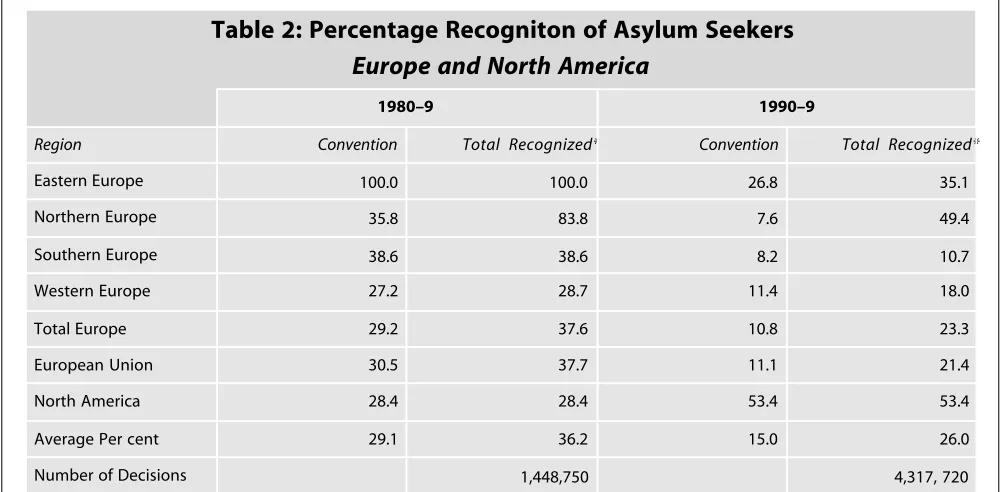
Given that at the end of each decade there were asylum applications still pending, or at an appeal stage, a slightly different picture emerges when only substantive decisions are taken into account. These are shown in table 2 for the main regions of Europe and for North America, compar-ing the situation in the 1980s and the 1990s. The numbers of refugees increased by more than 50 per cent, and asy-lum seekers in industrialized countries by 300 per cent.8 When convention and other humanitarian status are com-bined, the acceptance rate fell from an average 36.2 per cent in the 1980s to 26 per cent for the decade of the 1990s. Spe-cific country rates varied. Germany’s overall acceptance rate fell from 15 per cent to 11.5 per cent; the United Kingdom’s overall rate was 78.9 per cent in the 1980s but fell to 43 per cent in the 1990s, although an average of only 12.1 per cent were given full convention refugee status. The arrival of Kosova refugees in Britain in 1999 changed the pattern somewhat, as they were given more favourable treatment,
Table 1: Refugees and Others of Concern to the UNHCR
Population End 1999
Region of Asylum/
Residence Refugees
Asylum Seekers
Returned Refugees
Internally Displaced
Returned
IDPs Various Total
Africa 3,523,250 61,110 933,890 640,600 1,054,700 36,990 6,250,540
Asia 4,781,750 24,750 617,620 1,724,800 10,590 149,350 7,308,860
Europe 2,608,380 473,060 952,060 1,603,300 370,000 1,279,000 7,285,800
Latin America
& Caribbean 61,200 1,510 6,260 - - 21,200 90,170
N. America 636,300 605,630 - - - - 1,241,930
Oceana 64,500 15,540 - - - - 80,040
Total 11,675,380 1,181,600 2,509,830 3,968,700 1,435,290 1,486,540 22,257,340
raising the acceptance rate to 22 per cent in 1999. It fell to
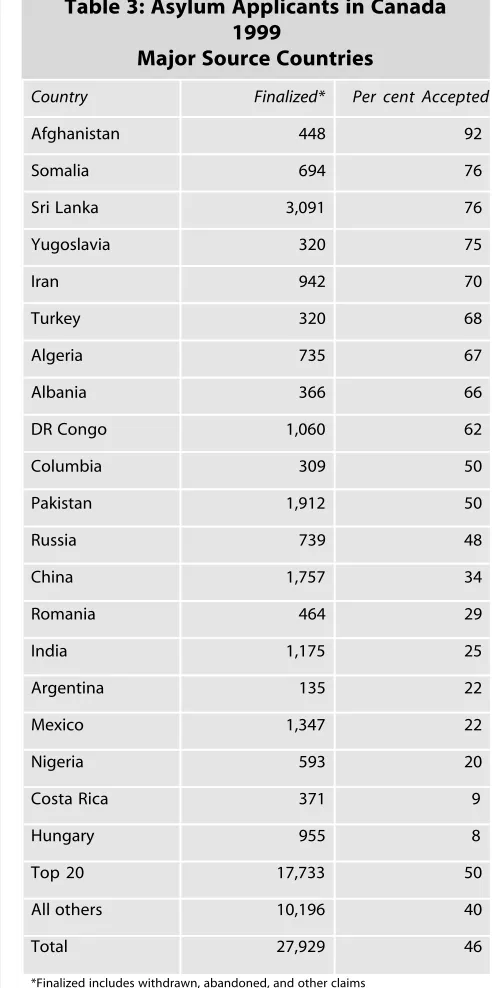
12 per cent again in the first half of the year 2000.9 The pattern in Canada and the United States was different. Nei-ther offered temporary asylum, although the Kosova situ-ation was exceptional. The acceptance rate in the U.S. rose from 26.8 per cent in the 1980s to an average of 43.9 per cent in the 1990s.10 Canada saw a similar increase in ac-ceptance of asylum seekers as full refugees, from 36 per cent of applicants in the earlier period to 61.8 per cent in the subsequent decade (see table 2). In 1999 the average was 46
per cent acceptance, but there was considerable variation by country of origin, as shown in table 3. (Table 3 shows the percentage accepted as convention refugees, as a pro-portion of claims finalized—the sum of positive and nega-tive decisions, together with cases withdrawn and aban-doned. When only cases actually adjudicated are consid-ered, the overall acceptance rate, in 1999, was 58 per cent.) Following the decline of the Soviet Union, the end of the cold war, the removal of many barriers to trade and commerce, the electronic linking of money markets, and the technological revolution in travel and communications that is associated with globalization, economically related international migration of the “proactive” type burgeoned. At the same time, political upheavals have generated eth-nic conflicts and civil wars, giving rise to a rapid growth in reactive migration. Nevertheless, the main burden of sup-port for victims of war, political persecution, and forced displacement from other causes remains in the developing countries of the Third World. The largest concentrations of refugees and others of concern to the unhcr in 1999
were in Asia and Africa (with a combined total of 13.6 mil-lion). Europe’s share increased to 7.3 million by 1999, com-pared with 1.24 million in North America. The largest sin-gle concentrations were 1.8 million in Iran and 1.2 million in Pakistan.
The response in Europe and North America has been a tightening of regulations and new legislation designed to deter migration, interdict undocumented travellers, rein-force border controls, and penalize airlines, shipping com-panies, and truckers if they are discovered to have know-ingly, or unknowknow-ingly, carried passengers who do not have a legal right of entry. Special efforts have been made to punish those involved in the organized smuggling of ille-gal immigrants across borders. Canada’s Bill c-31, which died on the order paper as a result of a general election, was designed to “harmonize” its laws and administrative procedures with those of the United States and other coun-tries. The concepts of a “safe third country” has been
insti-tutionalized, requiring asylum seekers to apply in the first country they enter after flight from persecution.
Discrimination or Persecution?
There is a fine distinction in law between “a well-founded fear of persecution” and the experience of “discrimination.” The former is generally interpreted to mean a life-threat-ening situation, or one involving torture, unjust imprison-ment, or exile. Furthermore, claimants must show that they cannot rely on the protection of the state from which they have come, whose agents may be the source of the perse-cution. Problems of interpretation of the un Convention arise when non-state agents of persecution are involved.11
The Roma in central Europe provide an interesting case study. There is no doubt that historically they have been victims of individual and systemic discrimination in many countries and that this discrimination persists to the present day.12 It may even have been exacerbated by the economic crises that many former Communist countries have expe-rienced since the end of the cold war. Following a televi-sion broadcast in the Czech Republic and Slovakia that described Canada as a “safe haven” for the Roma, there was a sudden surge of asylum applications from that region in
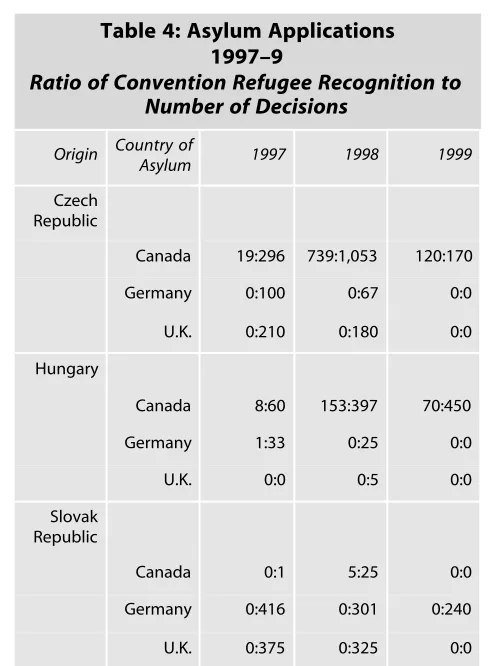
1998. (It cannot be assumed that all applications from these countries were Roma, but a high proportion were.) In or-der to stem the flow, Canada subsequently imposed visa requirements on travellers from countries in central and eastern Europe. The results of asylum applications in 1997–
9 for the Czech Republic, Hungary, and Slovakia are shown in table 4. The Canadian refugee determination system was more sympathetic to such claims than other countries, such as Germany and the United Kingdom.
Courts in Britain held that, in the case of the Roma, states such as the Czech Republic and Slovakia provide a meas-ure of protection for the Roma (even when neglecting to enforce their own laws in this respect). Consequently, Romany asylum seekers from central Europe have gener-ally failed to establish a claim to refugee status. The issue was judicially reviewed in the British House of Lords in the case of Horvath v. Secretary of State for the Home
De-partment.13 The appellant was a citizen of the republic of
not been afforded the normal public facilities as to his mar-riage and schooling for his child, and that in these respects he was being discriminated against. He maintained that he was afraid that if he and his family were returned to Slovakia, as Roma, they would again be attacked by skinheads. They believed that they would not get protec-tion from the police. In the course of the hearing it was stated,
This purpose has a direct bearing on the meaning that is to be given to the word “persecution” for the purposes of the Con-vention. As Professor James C. Hathaway, The Law of Refugee Status (Butterworths, 1991) p. 112 has explained, “persecution is most appropriately defined as the sustained or systemic fail-ure of state protection in relation to one of the core entitle-ments which has been recognised by the international com-munity.” At p. 135 he refers to the protection which the Con-vention provides as “surrogate or substitute protection”, which is activated only upon the failure of protection by the home state. On this view the failure of state protection is central to the whole system. It also has a direct bearing on the test that is to be applied in order to answer the question whether the protection against persecution which is available in the coun-try of his nationality is sufficiently lacking to enable the per-son to obtain protection internationally as a refugee. If the principle of surrogacy is applied, the criterion must be whether the alleged lack of protection is such as to indicate that the home state is unable or unwilling to discharge its duty to
es-tablish and operate a system for the protection against perse-cution of its own nationals.14
After arguments for and against deportation were heard, one judge concluded and the others agreed,
Where the allegation is of persecution by non-state agents, the sufficiency of state protection is relevant to a considera-tion whether each of the two tests—the “fear” test and the “protection” test—is satisfied. The proper starting point, once the tribunal is satisfied that the applicant has a genuine and well-founded fear of serious violence or ill-treatment for a Convention reason, is to consider whether what he fears is “persecution” within the meaning of the Convention. At that stage the question whether the state is able and willing to af-ford protection is put directly in issue by a holistic approach to the definition which is based on the principle of surrogacy. I consider that the Tribunal was entitled to hold, on the evi-dence, that in the appellant’s case the requirements of the defi-nition were not satisfied. I would refuse the appeal.15
There are many examples of discrimination (including those experienced by the First Nations in Canada) that fall short of “persecution” in the un convention sense of that term. The evidence suggests that, in Europe particularly, there is a media-promoted and popular prejudice against the growing number of asylum applicants. Government actions to deter, interdict, and deport undocumented travellers have been described as a form of presumptive refoulement.16 A
Table 2: Percentage Recogniton of Asylum Seekers
Europe and North America
1980–9 1990–9
Region Convention Total Recognized* Convention Total Recognized*
Eastern Europe 100.0 100.0 26.8 35.1
Northern Europe 35.8 83.8 7.6 49.4
Southern Europe 38.6 38.6 8.2 10.7
Western Europe 27.2 28.7 11.4 18.0
Total Europe 29.2 37.6 10.8 23.3
European Union 30.5 37.7 11.1 21.4
North America 28.4 28.4 53.4 53.4
Average Per cent 29.1 36.2 15.0 26.0
Number of Decisions 1,448,750 4,317, 720
number of recommendations have been made, designed to establish the right to asylum as a core value, to make the principle of non-refoulement absolute, and to protect peo-ple from exploitation by unscrupulous criminals involved in people smuggling. It remains to be seen whether any of these recommendations will be implemented.
Conclusion
The un Convention on the Status of Refugees (1951/1967) was a cold-war instrument that has proved inappropriate to deal with the crises of the late twentieth and early twenty-first centuries. The possibility of a new more humanitar-ian convention receiving the necessary approval at this time seems unlikely. Ad hoc measures to cope with immediate crises, such as those that have occurred in the former Yu-goslavia, are likely to persist. Arguably, the post–cold war global regime uses “humanitarian intervention” as an ide-ology to justify the use of military force. It uses “the lan-guage of human rights to legitimise a range of dubious practises.”17nato countries have adopted the doctrines of “humane deterrence,” designed to limit the number of asy-lum seekers arriving, and “instrumental humanitarianism” as a pragmatic response to the militar-ization of refugee camps and other crises. Some refugee flows may even be seen as threats to international security, thereby invoking intervention by the un Security Council, or by nato. There is a “clash of norms” in current refugee policies that makes the implementation of an idealistic, ethically based, hu-manitarian program very difficult.18
The question remains, Is the treatment of refugees and asylum seekers in wealthier industrial countries sufficiently negative to be described as racist? Have we created a sys-tem of “global apartheid” designed to exclude people sim-ply because of their ethnicity? The answer would seem to be yes and no. Europe and North America appear to be willing to accept “genuine” refugees from Africa and Asia, together with persons of colour, or other religions, as long as the need is dire and the numbers are small enough not to be perceived as a threat to the livelihood, or to the tradi-tional ways of life, of the members of the receiving coun-try. At the same time, the fear of overwhelming numbers has led to draconian measures that have a differential im-pact on those in peril. As Aiken rightly suggested, in this new millennium “the project of anti-racism” remains a “work in progress.”19 Meanwhile, some comfort may be drawn from the Canadian example where the record of approval of asylum applications is more generous than that of most European countries. (The unhcr praised Canada
Table 3: Asylum Applicants in Canada
1999
Major Source Countries
Country Finalized* Per cent Accepted
Afghanistan 448 92
Somalia 694 76
Sri Lanka 3,091 76
Yugoslavia 320 75
Iran 942 70
Turkey 320 68
Algeria 735 67
Albania 366 66
DR Congo 1,060 62
Columbia 309 50
Pakistan 1,912 50
Russia 739 48
China 1,757 34
Romania 464 29
India 1,175 25
Argentina 135 22
Mexico 1,347 22
Nigeria 593 20
Costa Rica 371 9
Hungary 955 8
Top 20 17,733 50
All others 10,196 40
Total 27,929 46
*Finalized includes withdrawn, abandoned, and other claims
urgent asylum cases, and for “ground-breaking guidelines” on gender-related persecution.20 There remain controver-sial questions about documentation, interdiction, and the involvement of organized crime in people-smuggling. It is hoped that any future legislation and administrative prac-tice will not be retrograde in this respect, although the new Bill c-11 has the potential of making it harder for “genuine” refugees to reach this country and be treated fairly.
Notes
1. Anthony H. Richmond, Global Apartheid: Refugees, Racism and the New World Order (Don Mills, Ont.: Oxford University Press,
1994), 208.
2. Sharryn Aiken, “Racism and Canadian Refugee Policy.” Refuge
18, no. 4 (1999): 7.
3. unhcr, Refugees and Others of Concern to the unhcr: 1999 Sta-tistical Overview (Geneva: unhcr, 2000), 15.
4. John Morrison and B. Crosland, The Trafficking and Smuggling of Refugees: The End Game in European Asylum Policy (Geneva:
unhcr Policy Unit, 2000).
5. J. C. Hathaway and J. A. Dent, Refugee Rights: Report of a Com-parative Survey (Toronto: York Lanes Press, 1995).
6. Howard Adelman and C. M. Lanphier, eds., Refuge or Asylum? A Choice for Canada (Toronto: York Lanes Press, 1990), 0; Adam Roberts, “More Refugees, Less Asylum: A Regime in Transfor-mation.” Journal of Refugee Studies 11, no. 4 (1998): 375–95.
7. unhcr, Refugees and Others of Concern to the unhcr: 1999 Sta-tistical Overview (Geneva: unhcr, 2000).
8. In the first six months of 2000 there were 186,000 asylum ap-plications filed in the European Union, 20 per cent of which were made in each of Germany and the U.K., and 11 per cent in the Netherlands (unhcr, The State of the World’s Refugees [Ge-neva: unhcr,2000]).
9. Anthony H. Richmond, “Refugees and Asylum Seekers in Brit-ain: uk Immigration and Asylum Act, 1999.” Refuge 19, no. 1
(2000): 35–42.
10. The figures for the U.S. do not take into account the interdic-tion program, introduced in 1981, that prevented many Hai-tians from reaching American shores. The Haitian Refugee Act,
1998, allowed those who had arrived in the U.S. before Decem-ber 31, 1995, to obtain permanent residence, but interdiction at sea continued (unhcr, The State of the World’s Refugees [Ge-neva: unhcr,2000], 177).
11. unhcr, unhcr Global Report, 1999 (Geneva: unhcr, 2000), 163.
12. Holly Cartner, Destroying Ethnic Identity: The Persecution of Gypsies in Romania (New York: Helsinki Watch, 1991); David Crowe, A History of Gypsies in Eastern Europe and Russia (New York: St. Martin’s Press, 1995). European Roma Rights Centre. Roma Rights. Vols. 1–3. European Roma Rights Centre, 1998–
2000.
13. House of Lords. July 2000. Horvath v. Secretary of State for the Home Department.
14. Ibid.
15. Ibid.
16. Morrison and Crosland, The Trafficking and Smuggling of Refu-gees, 6.
17. B. S. Chimni, Globalisation, Humanitarianism and the Erosion of Refugee Protection (Oxford: Refugee Studies Centre, Queen Elizabeth House, 2000), 2.
18. J. S. Goodwin-Gill and J. Kumin, Refugees in Limbo and Cana-da’s International Obligations (Toronto: Caledon Institute of So-cial Policy, 2000). Myron Weiner, “The Clash of Norms: Dilem-mas in Refugee Policies.” Journal of Refugee Studies 11, no. 4
(1998): 433–53.
19. Aiken, “Racism and Canadian Refugee Policy,” 7.
20. unhcr, unhcr Global Report, 1999 (Geneva: unhcr, 2000), 181.
Anthony H. Richmond, f.r.s.c., is emeritus professor of sociology and senior scholar, Centre for Refugee Studies, York University, Toronto. He is author of Global Apartheid:
Refugees, Racism and the New World Order.
Table 4: Asylum Applications
1997–9
Ratio of Convention Refugee Recognition to
Number of Decisions
Origin Country of
Asylum 1997 1998 1999
Czech Republic
Canada 19:296 739:1,053 120:170
Germany 0:100 0:67 0:0
U.K. 0:210 0:180 0:0
Hungary
Canada 8:60 153:397 70:450
Germany 1:33 0:25 0:0
U.K. 0:0 0:5 0:0
Slovak Republic
Canada 0:1 5:25 0:0
Germany 0:416 0:301 0:240
U.K. 0:375 0:325 0:0