Phase Behavior in the LiBH
4−
LiBr System and Structure of the
Anion-Stabilized Fast Ionic, High Temperature Phase
Irene Cascallana-Matias,
†,‡David A. Keen,
§Edmund J. Cussen,
*
,‡and Duncan H. Gregory
*
,††WestCHEM, School of Chemistry, Joseph Black Building, University of Glasgow, Glasgow G12 8QQ, United Kingdom
‡WestCHEM, Department of Pure and Applied Chemistry, University of Strathclyde, Glasgow G1 1XL, United Kingdom
§ISIS Facility, Rutherford Appleton Laboratory, Harwell Oxford, Didcot, Oxfordshire OX11 0QX, United Kingdom
*
S Supporting InformationABSTRACT: The fast ionic, high temperature (HT) phase of LiBH4
can be stabilized by Br¯ substitution. Lithium borohydride bromide
compounds, Li(BH4)1−xBrx, have been synthesized mechanochemically, with and without thermal treatment and the resulting phase behavior determined as a function of composition. Single phase materials exist for
0.29 ≤x ≤0.50 with conductivity 2 orders of magnitude higher than
LiBH4at 313 K. Powder neutron diffraction has been used to resolve the
details of the crystal structure of one such compound. These
demonstrate that 7Li(11BD
4)0.667Br0.333 retains the HT structure
(hexagonal space group P63mc, a ≈ 4.2 Å, c ≈ 6.7 Å) from 293 to
573 K. The borohydride bromide exhibits considerable static and dynamic disorder, the latter invoking complex rotational motion of the (BH4)¯anions.
■
INTRODUCTIONThe decomposition and release of hydrogen from a number of complex hydrides such as lithium borohydride is linked to a
transition to a fast lithium ion conducting state.1,2 At room
temperature LiBH4 crystallizes with an orthorhombic (LT)
structure and at 383 K undergoes a phase transition to a hexagonal (HT) phase that exhibits fast lithium ion conductivity, with values of up to 10−2S cm−1.1The structure of the LT phase has been thoroughly examined and can be described as a distorted variant of the wurtzite structure with
the Li+ cations occupying the four-coordinate tetrahedral sites
between hexagonally stacked layers of BH4−.3The distortion to
orthorhombic symmetry allows buckling of the anion layers and ordering of the slightly distorted tetrahedral anions. The structure of the HT phase contains considerable disorder in the anion orientation and has been the subject of experimental and theoretical studies.4−6 Several results and interpretations have
been advanced to explain the behavior of the BH4−units in the
fast Li+ conducting material. Various degrees of dynamic
orientational disorder have been proposed from the threefold
rotation of BH4about a single B−H bond (possibly combined
with occasional exchange between rotationally disordered H
atoms and thefixed H atom) to unconstrained, free rotation of
all H atoms to give an effectively spherical anion.2,7,8Attempts have been made to stabilize the hexagonal phase at room temperature using anion substitution. Partial anion replacement
effected by mechanical and thermal reaction with appropriate
halides leads to the formation of the hexagonal structure
analogous to the HT phase of LiBH4.
9−11
However, the HT form has never been isolated at room temperature as a single
phase with bromide. Here we show that two preparative methods can produce phase pure samples of the fast ion
conductive phase with controlled molar ratios 0.29≤x≤0.50
in the series Li(BH4)1−xBrx. These materials have been
obtained by either extensively mechanically milling a mixture
of LiBH4and LiBr or by combining a shortened milling with
thermal treatment. The resultant materials have been characterized by both powder X-ray and powder neutron
diffraction, thermal analysis, transport measurements, and
electron microscopy. We have used these data to compile a phase diagram for the full compositional series Li(BH4)1−xBrx,
and we report these results together with a detailed structural model of the orientational disorder of the BH4anion in the fast
Li+ conducting hexagonal phase.
■
EXPERIMENTAL SECTIONSynthesis.All manipulations were performed in a nitrogen-filled or argon-filled glovebox (<5 ppm of O2; < 10 ppm of H2O). Anhydrous LiBH4(Sigma-Aldrich,≥95%) and LiBr (Sigma-Aldrich,≥99%) were obtained commercially and used directly without further purification. Approximately 0.5 g of LiBH4−LiBr mixtures were mechanically milled under a nitrogen atmosphere using a Retsch PM100 ball mill. The ball milling was performed in periods of 2 min of milling interspersed by 2 min breaks to minimize heating of the samples. The sample to ball ratio was 1:40 and both the vial and 10 mm diameter balls were made from stainless steel. The agitation frequency was 500 rpm.
Received: September 17, 2015 Revised: October 26, 2015 Published: October 26, 2015
Article
pubs.acs.org/cm License, which permits unrestricted use, distribution and reproduction in any medium,
The materials were prepared by two different routes: (a) by mechanochemical milling for 24 h or (b) milling for 4 h followed by heating the milled mixtures to 573 K for 5−24 h. The longer annealing times were necessary to give a single phase product for higher bromide concentrations (Table S1).
The sample for the neutron scattering experiment was isotopically enriched with D, 7Li and 11B to avoid problems with neutron incoherent scattering and absorption. Anhydrous7Li11BD
4(Katchem, > 99.8%7Li, > 99.8% 11B, > 98% D) and LiBr (Sigma−Aldrich, ≥ 99%) were obtained commercially and used directly without further purification. The samples (1.0 g) were prepared by ball milling and thermal heating with longer heating times being necessary due to the larger quantity of material being prepared. Since the sample is air-sensitive, it was loaded into a sealed vanadium can in an inert atmosphere glovebox before the experiment.
Characterization. Powder X-ray diffraction (PXD) was used to identify the reaction products and characterize their respective structures. PXD experiments were conducted with a Bruker D8 Advance powder diffractometer operating with Cu Kα radiation in transmission geometry with samples mounted in spinning sealed capillaries. Diffraction data for phase identification were typically collected over 5°≤2θ≤85°with a 0.017°step size and scan times of 1 h and over 5°≤2θ≤95°for 12 h for structural analysis. Raman data were collected at room temperature using a Horiba Jobin Yvon system with a 532 nm green laser. A hole aperture of 50μm, 100 g mm−1 grating, and a synapse CCD detector were employed. Sealed glass capillaries were used to contain samples and thereby prevent air/ moisture exposure during spectroscopic analysis.
Thermogravimetric−differential thermal analysis−mass spectrome-try (TG-DTA-MS) experiments were conducted underflowing argon (99.998%, BOC) in a Netzsch 409 PC STA Instruments coupled to a Hiden Analytical HPR 20 mass spectrometer at a heating rate of 4 K min−1. The STA Instruments was located in an argon-filled glovebox (O2, H2O < 0.5 ppm, UNILab, MBraun) where samples (≈10 mg) were loaded in high-walled Al2O3 pans. Sample morphology and composition were studied using SEM (XL 30 ESEM, Philips, 25 kV accelerating voltage). An Oxford Instruments X-act spectrometer was coupled to this microscope for EDX analysis. The instrument is calibrated using the INCA EDX analysis software (Cu used for all calibration measurements), and the software also allows selection of regions for analysis and definition of measurement parameters.
Electrochemical impedance measurements were performed on cylindrical sample pellets of 13 mm diameter and 1−2 mm thickness that had been formed by pressing at room temperature under a load of 1 tonne for 20 min. A platinum paste was applied to opposite faces of the pellet to make electrical contacts. Data were collected on heating, and the temperature of the system was allowed to equilibrate for at least 1 h before every data collection. Data were collected using a Solartron 1260 impedance analyzer and were analyzed using equivalent circuit analysis as implemented in the ZView2 software package.
Time-of-flight powder neutron diffraction (PND) data were collected between 293 and 573 K using the General Materials diffractometer, GEM, at the ISIS neutron source at the Rutherford Appleton Laboratory in Oxfordshire.12 Samples were contained in vanadium cans with a diameter of 6 mm. Using standard procedure, the data from each of the instrument’s detector banks were corrected for absorption, normalized to account for the incident neutron spectrum and detector efficiencies and summed.12 The data were analyzed using Rietveld refinement as implemented in the GSAS software package13 via the EXPGUI interface14against multiple data sets.
■
RESULTS AND DISCUSSIONReactivity and Preparation.Combinations of mechanical
and thermal treatments have been used in borohydride−halide
systems before, and various techniques were employed to investigate the roles of these two processes in the
reactions.10,15,16,10,17 Raman spectroscopy is sensitive to the
orthorhombic to hexagonal transition in LiBH4 via the
characteristic B−H bending mode splitting at ν2= 1282 cm−1
andν2′ = 1297 cm−1 in the lower symmetry structure.
3,18−20
Data from our bromide-doped samples show that the orthorhombic symmetry has been eliminated in Li-(BH4)0.667Br0.333 indicating that the reaction has stabilized the
high temperature structure of LiBH4(Figure S1). Examination
of the samples using scanning electron microscopy reveals particle morphologies that bear little resemblance to those of either of the reagents. Li(BH4)0.667Br0.333can be prepared either by (1) extensive milling or (2) by a reduced period of milling followed by thermal treatment (at 573 K). Micrographs from samples prepared via these two routes revealed that milling only
leads to well-defined petal-like structures agglomerated into
discrete, relatively uniform and almost spherical aggregates.
Each sphere is of the order of 50μm in diameter. The effect of
thermal treatment is to give more homogeneous, dispersed particles as shown inFigure 1.
The effect of the thermal treatment is further understood by
examining TG-DTA data from Li(BH4)0.667Br0.333 (Figure 2)
that had been milled for 4 h only (i.e., prior to the heat treatment part of the synthesis process). DTA data show one endothermic event at 368(1) K and no other higher
temperature features while the TG profile demonstrates that
no mass loss occurs from room temperature to 573 K. The
endothermic event corresponds to the orthorhombic−
[image:2.625.336.564.275.431.2]hexago-Figure 1.SEM images from Li(BH4)0.667Br0.333prepared by (a) milling and thermal treatment; (b), (c), and (d) milling only.
Figure 2. TG-DTA profile of milled Li(BH4)0.667Br0.333 on heating from room temperature to 573 K. The temperature is indicated by the dashed line.
[image:2.625.329.559.499.639.2]nal phase transition with a reduction in transition temperature
from that observed in pure LT−LiBH4 (383 K).1,21 Further,
unlike pure LiBH4 (MP 541 K)22 there is no evidence of a
melting transition (or decomposition) below 573 K.
PXD was used to characterize the materials prepared by both the extended milling and milling/heating routes. Inspection of
the diffraction patterns collected from samples across the
compositional series showed that all Bragg peaks could be
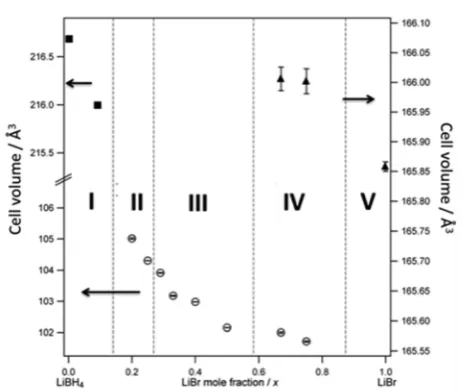
indexed to one of three phases (Figure 3,Table S3, Figures S4
and S5). In composition region I, for the most (BH4)−-rich
compositions (0 ≤ x < 0.20), an orthorhombic (LT LiBH4
-type) phase is observed with a progressive contraction of the
unit cell with increasing Br−content. Fromx= 0.20 a second,
hexagonal (HT LiBH4-type) phase coexists with the
ortho-rhombic material (region II). Although the cell volume of the orthorhombic phase in region II was observed to continue to decrease with increasingx, the weak, broad reflections were not
sufficient to allow structure refinement (and hence the points
are not indicated in Figure 3). With further increasing Br−
content the orthorhombic phase is eliminated to give
single-phase hexagonal HT LiBH4-type samples in the range 0.29≤x
≤0.50 (region III). Forx≥0.67 a cubic (rock salt) phase is
apparent within a two phase hexagonal/cubic region existing
over at least 0.67 ≤ x ≤ 0.75 (region IV). Finally region V
contains the single cubic rock salt phase of LiBr. Although from the compositions discovered in region IV, we know that LiBr is not a line phase, the precise position of the phase boundary
(IV−V) is yet to be determined. For each of the orthorhombic,
hexagonal, and cubic phases (regions I, III, V) there is a
progressive decrease in the cell volume as the Br− content is
increased.
Ion Transport Properties.Impedance data analyzed in the complex plane showed the semicircle at high frequencies and the linear response at low frequencies characteristic of ionic conductivity and ion blocking electrodes. At the lower temperatures two semicircles were observed, suggesting
intra-and intergrain transport could be resolved. However, the high frequency semicircle moved out of the measurement range at higher temperatures, and so the data were analyzed using an equivalent electrical circuit to extract the values for the total
[image:3.625.329.561.141.316.2]resistivity of the material (Figures S2 and S3). As shown in
Figure 4, the mixed borohydrides demonstrate conductivities of
ca. 10−6S cm−1at 313 K, 2 orders of magnitude higher than the
orthorhombic phase of LiBH4.23 At 413 K the lithium ionic
conductivity is ca. 10−4 S cm−1. The activation energies for
these materials vary in the range 0.52(2)−0.64(1) eV (Table
S2). The x = 0.333 material was prepared both by extended
milling and by milling/thermal routes. The latter method notably led to a higher value of conductivity.
The method of synthesis has a clear impact on the total
resistance of these samples. The Li(BH4)0.667Br0.333 sample
prepared exclusively by mechanochemical processing (MT) shows a conductivity that is ca. an order of magnitude lower than the sample of the same composition prepared by a mixture of mechanical and thermal treatments (MT/TT). The contribution of grain boundaries to the overall conductivity can be substantial, and the similar activation energy values indicate the same mechanism for charge transport is operative in both samples. There are extensive differences in particle sizes and morphology between these two samples, and this is therefore the probable cause of the variation in transport properties.
Structural Analysis. Although it was possible to identify the presence of single-phase samples of hexagonal material from the PXD data, they were unable to provide substantial insight into the structure of the phases due to the dominance of the X-ray scattering by the relatively heavy bromide ion. We
therefore undertook powder neutron diffraction experiments in
order to elucidate the structural chemistry that underpins the fast ionic conducting hexagonal phase further. For this purpose, a single composition, Li(BH4)0.667Br0.333, was studied in detail as a function of temperature.
High quality PND data were collected from isotopically enriched Li(BH4)0.667Br0.333at room temperature. One existing
structural model of the hexagonal phase of LiBH4comprises a
fully ordered array of (BH4)− tetrahedral anions and Li+
[image:3.625.66.298.175.370.2]Figure 3.Structure field map manifested as the respective unit cell volumes as a function of LiBr mole fraction in Li(BH4)1−xBrx. I−V represent the distinct phase regions within compositional space. Black squares denote the LT orthorhombic LiBH4structure (top-leftyaxis); open circles denote the HT hexagonal LiBH4structure (bottom-lefty axis); black triangles denote the cubic LiBr (NaCl-type) structure (rightyaxis).
Figure 4. Plot of conductivity as a function of temperature for Li(BH4)(1−x)Brxon heating. All the materials shown were prepared by the combined mechanochemical and thermal treatment (MT/TT) except thex= 0.333 compound which was prepared by either MT/TT methods or by extended milling only MT.
cations.3Our interpretation of the neutron diffraction data from Li(BH4)0.667Br0.333 therefore began by attempting to fit this
structural model to our data using a randomly disordered
arrangement of bromide and (BH4)− anions with Br and B
occupying the same 2bsite (2/3, 1/3,z; wherez≈0.2) in the
lattice. This failed to give a satisfactory fit to the data, and a Fourier search of the asymmetric unit showed a second scattering center close to that occupied by the boron and
bromine atoms. Attempts to refine occupancies on both the
sites simultaneously against neutron diffraction data alone were
unsuccessful in producing a stable refinement. Therefore,
laboratory X-ray diffraction data were incorporated into a
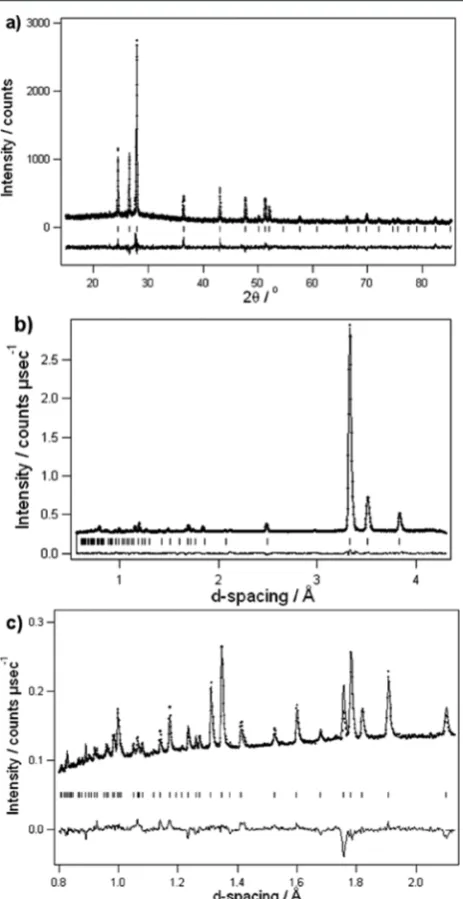
multiple histogram refinement (Figure 5). This exploited the
strong scattering of X-rays by the bromide anion to give an
unambiguous and robust identification of the bromide position
and site occupancy. From this point on, our analysis of structure proceeded simultaneously against neutron and X-ray diffraction data sets.
The deuterium atoms were initially assumed to be located on the vertices of a distorted boron-centered tetrahedron with one crystallographically unique atom and the other three related by
a threefold rotation about thez direction.7 No constraint was
imposed on the ratio of BH4−to bromide; the refinement was
able to proceed freely to select the anion ratio which best
modeled the data. The ratio wasfixed once the refinement was
stable. With the deuterium atoms thus placed and their fractional occupancies constrained to be consistent with that of
the boron atom to maintain the BD4 stoichiometry, the
structure was again refined and a Fourier map used to identify
deficiencies in the model. This map showed positive scattering
density to be present around the crystallographically unique
deuterium atom occupying the 2bsite, (2/3, 1/3,z; with z≈
0.4) and thus suggested that the deuterium arrangement around the boron anion was heavily positionally disordered in a
manner which can be described as a pseudoreflection in thexy
plane containing the boron atom. The deuterium atoms in the complex anion were distributed around a single boron atom in a manner yielding two distorted tetrahedra; one tetrahedron aligned with an apical B−H bond parallel to thec-axis pointing
“up” and conversely one aligned diametrically oppositely
(pointing “down”). Attempts to construct a model with two
separate boron centers were unsuccessful with the discrete boron atoms converging to one position. The overall fractional
occupancy of the deuterium atoms was fixed such that the
atoms refined as part of one of the tetrahedral units and the
total deuterium content matched the stoichiometry demanded by the (BH4)−anions.
Attempted refinement of anisotropic displacement
parame-ters revealed an exceptionally elongated scattering center manifested by Li+.2
Due to the extreme nonphysicality of this
distribution we elected to refine the lithium in an isotropic
manner. In order to mimic the anisotropic scattering two lithium sites were introduced leading to a stable refinement.12,24 The thermal displacement parameters of the boron and bromine atoms were constrained to the same single value, and likewise all the deuterium and lithium atoms were required to take the sameUisovalue, respectively. We note that the space
group P63mc is noncentrosymmetric and so it is necessary to
define the z coordinate of one of the atoms in the structural
model in order tofix the origin for thec-parameter (Figure 6).
Further neutron diffraction data sets were rapidly collected
on heating up to 573 K. The count statistics of these data are poorer as a consequence of the procedure, and so full structural
refinement was not attempted. Nevertheless, the same
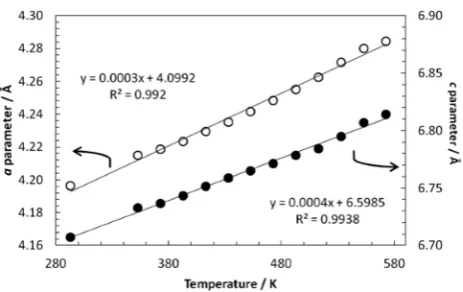
structural model gave good fits to these data and showed a
linear evolution in the lattice parameter with temperature (Figure 7), indicative of a straightforward thermal expansion with no anomalous structural effects.
An additional data set was collected at 393 K with the same counting statistics as the room temperature data.
Again these data could befitted in a similar manner, although
it is noteworthy that it was not possible to obtain a stable
refinement if the positions of all the deuterium atoms were
[image:4.625.65.297.224.674.2]allowed to vary simultaneously.
Figure 5. Rietveld profilefits for (a) PXD data and high-resolution neutron powder diffraction data collected from (b) bank 4 (50°≤2θ
≤ 74°) and (c) bank 5 (79° ≤ 2θ ≤ 106°)12 of the GEM diffractometer for 7Li(11BD
Inspection of the patterns collected at 393 K show a considerable reduction in the overall Bragg scattering intensities.
This would suggest further that at higher temperatures the structure displays an even higher level of disorder consistent
with motion of the complex anions and diffusion of the lithium
cations (as manifested in the thermal displacement parameters, for example).
Discussion. Reaction between lithium borohydride and lithium bromide can be driven stoichiometrically either by mechanically grinding materials together for 24 h or more readily by a 4 h mechanical treatment followed by heating at 573 K. PXD analysis before and after the TG-DTA examination of the heating stage of the MT/TT synthesis procedure (for example, for Li(BH4)0.667Br0.333as discussed above) shows that
the initial 4 h grinding process causes a partial reaction between
the LiBr and LiBH4 to give a combination of an almost
inappreciable quantity of the orthorhombic (LT-LiBH4-type)
phase and mostly a hexagonal (HT-LiBH4-type) and cubic
(LiBr-type) phase. That the temperature of the endothermic transition from the orthorhombic to hexagonal phase is reduced gives a strong indication that some degree of bromide incorporation into the hexagonal lattice has occurred during 4 h of MT. PXD evidence corroborates this premise. Both a steady decrease in the proportion of the LiBr-phase and a reduction in the cell parameters of the hexagonal phase can be observed on increasing the milling duration or as a result of subsequent heating. The process can thus be completed to give a single phase material either by further extended grinding (14
h) or by heating to 573 K after initial milling. Although we used intermittent grinding and rest periods to try and avoid excessive heat generation due to mechanical friction, we note that ball
milling is often associated with very significant localized
temperatures.25The degree of heating will of course depend
on the heat capacities of the reagents and products involved as well as the coefficients of friction, hardness, and toughness, but it should be noted that the relatively modest temperature of
573 K necessary to afford a chemical reaction thermally is
significantly lower than might be achieved by milling. For
example, in the case of La7Mo7O30, ball milling affords a phase
which would otherwise only be stabilized by heating at
temperatures above 1033 K.26
Although powder X-ray diffraction results indicate that the
materials produced by either mixed mechanochemical/thermal or extended mechanochemical treatments are identical, their
morphologies differ very substantially. The mechanochemical/
thermal treatment affords regularly shaped particles of broadly
cubic symmetry measuring approximately 1 μm across.
Extended mechanochemical treatment, however, gives larger particles which appear to be aggregated into spheres around a central point. The observations of these petal-like structures have been made in other chemical systems where the presence
of solvent is an essential condition to achieve flower-like
growth.27 Although the reaction described herein is between
two solids to afford a solidfinal product, it should be noted that a eutectic mixture could readily form between the reagents. The localized heating during milling may deliver a sufficient quantity of liquid phase to initiate a mechanism of growth analogous to that seen in solution phase chemistry (the melting points of
LiBH4and LiBr are 541 and 823 K, respectively).
22
Syntheses and X-ray diffraction analysis have provided a
structure−composition map for the LiBH4−LiBr system. The
end members of the system are orthorhombic and face-centered cubic, respectively, whereas our data demonstrate that intermediate compositions crystallize with the hexagonal
structure of the HT phase of LiBH4. Two-phase regions have
been identified close to the orthorhombic-hexagonal and
hexagonal-cubic phase boundaries (i.e., regions II and IV). It should be noted that adjustment of the heating conditions and cooling rates may be able to slightly increase the compositional limits of the single phases. Nevertheless our data show a number of interesting points in this compositional system which has hitherto been underappreciated.
Significant incorporation of the bromide anion into the
LiBH4 structure can be achieved within the orthorhombic
structure. This substantial solubility means that it is necessary to introduce ca. 25% bromide into the structure before the hexagonal polymorph is stabilized at room temperature as a single phase. This hexagonal structure is stable for a wide range
of anion compositions; a single phase exists from 0.29≤ x≤
0.50. Interestingly, however, although a threshold value of bromide substitution is required to stabilize the higher Li ion conducting HT phase, beyond this composition point subsequent bromide substitution only serves to reduce the ionic conductivity. One can assume that this is associated with the concomitant contraction of the hexagonal unit cell and a less open migration pathway for Li+ ions to diffuse.
For higher bromide concentrations the face centered (NaCl-type) cubic structure familiar from the LiBr phase is present in
growing quantities as x increases. The variation in lattice
parameters of the cubic phase for different reaction
[image:5.625.64.299.65.185.2]compositions suggests that the cubic material is not present
Figure 6. Crystal structure models of 7Li(11BD
4)0.667Br0.333 with a polyhedral representation of the BD4−anion and showing (a) a single Li site with displacement parameters refined anisotropically and (b) two partially occupied Li positions with isotropic displacement parameters (D atoms are omitted; ellipsoids at 50% probability level).
Figure 7. Cell dimensions of 7Li(11BD
4)0.667Br0.333 as a function of temperature.
[image:5.625.65.297.250.396.2]as a line phase of composition LiBr; the incorporation of
borohydride into thefcclattice appears to be non-negligible.
Detailed inspection of the lattice parameters shows that
significant changes in the unit cell volume occur with anion
content of the overall reaction mixture. Where we have two-phase mixtures it is not possible to assign compositions unambiguously to each of the two phases. Nevertheless, inspection of the unit cell volumes for various reaction mixtures shows smooth evolutions in the lattice parameters implying substantial dissolution of both anions into all three structures. For each of the three structures (orthorhombic, hexagonal, and cubic), incorporation of the bromide anion with a radius of 1.96 Å in place of the larger borohydride anion radius of 2.05 Å gives the anticipated reduction in the unit cell volume.28
The high symmetry unit cell of Li(BD4)0.667Br0.333 contains considerable occupational and positional disorder. Similar
disorder has been observed in the hexagonal phase of LiBH4
itself, which is stable above 383 K.7,29,30Nonetheless, Rietveld
refinement against the neutron data was able to identify a
narrow distribution of B−D distances in Li(BD4)0.667Br0.333
(1.147(5)−1.32(1) Å at 293 K). Our analysis of the mixed
anion compound shows that the presence of Br− and BH4−
within the structure leads to lithium bromide distances of
2.45(1) Å and 2.55(1) Å. Consideration of the BH4−and Br−
species shows that the two anions are displaced up and down
the c-axis from the normal plane containing the borohydride
anions in HT-LiBH4to sites which are separated by 0.31(1) Å
in thez-direction. This displacement is mainly exhibited by the BH4−units leading to B···Li separations of only 2.476(3) and
2.68(7) Å (seeTables S4−S10).
The bestfits to the diffraction data were obtained when the
lithium ions were distributed over two tetrahedral (2/3, 1/3,z)
sites: the position with z ≈ 0.8 and that with z ≈ 0.6. The
former position is the one that has been previously identified as
occupied in the HT-LiBH4 structure,2,30,31 but in the model
refined here, this 2bsite is 80% occupied.32,33Interestingly, the location and distribution of the lithuim ions is almost identical
to that of the cations in another Wurtzite-related compound,β
-CuI.34,35 The Cu+ ions in β−CuI exhibit a complex diffusion
mechanism involving movement of the cations through the edges of the surrounding tetrahedral “cages” formed by I−.36 The structural similarities suggest that the disorder and diffusion of the Li+and Cu+ions in the respective borohydride
and iodide fast ion conducting phases have a very similar origin. Nevertheless, the presence of complex ions in (HT-)Li-(BH4)1−xBrx necessitates anion orientations that facilitate the
anticipated Li+diffusion process, given the observed high values of conductivity.
The orientation of the tetrahedral BH4− units is of crucial
interest in understanding the lithium ion mobility through the
structure. Considerable effort has been expended on examining
the ionic transport behavior of undoped LiBH4, although due to
the presence of disorder and the challenges of identifying hydrogen atom positions there remains a considerable degree of uncertainty in this.2,7,8Our data could only be satisfactorily modeled by incorporating a distribution of deuterium atoms such that the tetrahedra were composed of two units centered on the same boron atom but with an inverted deuterium distribution. Although there is significant scatter in the B−D distances the observation of this inversion is robust and can be usefully compared with models of disorder that have been proposed from other techniques and calculations.5,6,24It should be noted that the understanding of the behavior of this anion is
considerably complicated by the conflict between the trigonal
symmetry of the crystallographic site and the tetrahedral
symmetry expected for BH4−.
Various analyses have suggested that the dynamic disorder associated with the (BH4)−anion arises from rotation about the
threefold molecular axis or by complete spherical motion of the
atoms around the boron center.2,8,21,27 Our data show that
neither of these descriptors provides a complete picture. While there is disorder around the trigonal axis, the data clearly identify well-localized atoms and attempts to delocalize them to other positions to give a halo of scattering density degraded the quality offit and refinements failed to stabilize. Likewise, it was necessary to introduce an inverted distribution of deuterium atoms, but again these refined to specific positions and did not exhibit the instability that would be expected if the atoms
occupying the unconstrained x, y, z coordinates of the 6c
general position were free to move around points on a spherical scattering surface. A previous detailed study of the Raman
spectra of HT-LiBH4 suggested two thermally activated
reorientations of the [BH4]− unit with both rotation about
the trigonal axis and a higher energy exchange being accessible.3 Any assignment must remain tentative, but our structural data are most compatible with such a model. It is important to point out that no restraints were placed on the anion symmetry
during refinement (nor, for example, were rigid body
constraints applied).
Diffraction data collected on heating the material show that
the key features of the crystalline structure are retained up to at least 573 K. Due to the diminishing Bragg scattering (and
increase in diffuse scattering) from the sample at elevated
temperatures it was necessary to introduce additional constraints to the structural refinement and so it is not possible
to assign the disorder with complete confidence to either
thermal motion or the static effects introduced by occupational
disorder in the Br− and BH4− sublattice.37 The interplay of
static and dynamic disorder should become clearer with a detailed study of structure as a function of both temperature and composition within each of the phase regions in the LiBH4−LiBr system.
■
CONCLUSIONSThe hexagonal phase of LiBH4has been stabilized and isolated
at room temperature by anion substitution over a composi-tional range Li(BH4)1−xBrx(0.29≤x≤0.50). Fast lithium ion
conductivity is retained in these phases, although the value of the total conductivity is reduced as the bromide content
increases abovex= 2/7. There is considerable disorder in both
the position and orientation of the anions in this structure leading to highly anisotropic distribution of lithium scattering.
The Br−and BH4−anions are displaced by a distance of 0.31 Å
from each other in the crystallographic model with the latter exhibiting orientational disorder which can only be satisfactorily modeled using an inversion of the deuterium atoms. This implies substantial rotation of the BH4−units although not the free spherical rotation which has been observed in other complex anion fast ion conductors. Analysis of the Bragg scattering up to 573 K shows that the material retains this structure, although the reduced intensity of the Bragg
reflections does suggest increasing disorder (loss of
long-range order) in the material with heating.
■
ASSOCIATED CONTENT*
S Supporting InformationThe Supporting Information is available free of charge on the
ACS Publications website at DOI: 10.1021/acs.chemma-ter.5b03642.
A list of samples and preparative procedures, Raman
spectra, PXD data, AC impedance plots, refinement data,
and tables of bond lengths and angles (PDF)
■
AUTHOR INFORMATIONCorresponding Authors
*(E.J.C.) E-mail:[email protected].
*(D.H.G.) E-mail: [email protected].
Notes
The authors declare no competingfinancial interest.
■
ACKNOWLEDGMENTSThe authors thank the University of Glasgow and University of Strathclyde for supporting this work and the Science and Technologies Facilities Council, UK, for the provision of
neutron diffraction beam time.
■
ABBREVIATIONSLT, orthorhombic phase; HT, hexagonal phase; MT, mechanochemical treatment; TT, thermal treatment
■
REFERENCES(1) Matsuo, M.; Orimo, S. Lithium Fast-Ionic Conduction in Complex Hydrides: Review and Prospects.Adv. Energy Mater.2011,1, 161−172.
(2) Ikeshoji, T.; Tsuchida, E.; Ikeda, K.; Matsuo, M.; Li, H. W.; Kawazoe, Y.; Orimo, S. Diffuse and doubly split atom occupation in hexagonal LiBH4.Appl. Phys. Lett.2009,95, 221901.
(3) Soulie, J. P.; Renaudin, G.; Cerny, R.; Yvon, K. Lithium boro-hydride LiBH4.J. Alloys Compd.2002,346, 200−205.
(4) Filinchuk, Y.; Chernyshov, D.; Cerny, R. Lightest borohydride probed by synchrotron X-ray diffraction: Experiment calls for a new theoretical revision.J. Phys. Chem. C2008,112, 10579−10584.
(5) Hempelmann, R.Quasielastic Neutron Scattering and Solid State Diffusion; Oxford University Press: New York, 2000.
(6) Bee, M.́ Quasielastic Neutron Scattering; Adam Hilger: Bristol, 1988.
(7) Verdal, N.; Udovic, T. J.; Rush, J. J. The Nature of BH4 -Reorientations in Hexagonal LiBH4(vol 116, pg 1614, 2012).J. Phys.
Chem. C2012,116, 5275−5275.
(8) Ikeshoji, T.; Tsuchida, E.; Morishita, T.; Ikeda, K.; Matsuo, M.; Kawazoe, Y.; Orimo, S. Fast-ionic conductivity of Li+in LiBH
4.Phys.
Rev. B: Condens. Matter Mater. Phys.2011,83, 144301.
(9) Martelli, P.; Remhof, A.; Borgschulte, A.; Ackermann, R.; Strassle, T.; Embs, J. P.; Ernst, M.; Matsuo, M.; Orimo, S. I.; Zuttel, A. Rotational Motion in LiBH4/LiI Solid Solutions. J. Phys. Chem. A 2011,115, 5329−5334.
(10) Rude, L. H.; Groppo, E.; Arnbjerg, L. M.; Ravnsbaek, D. B.; Malmkjaer, R. A.; Filinchuk, Y.; Baricco, M.; Besenbacher, F.; Jensen, T. R. Iodide substitution in lithium borohydride, LiBH4-LiI.J. Alloys
Compd.2011,509, 8299−8305.
(11) Rude, L. H.; Nielsen, T. K.; Ravnsbaek, D. B.; Bosenberg, U.; Ley, M. B.; Richter, B.; Arnbjerg, L. M.; Dornheim, M.; Filinchuk, Y.; Besenbacher, F.; Jensen, T. R. Tailoring properties of borohydrides for hydrogen storage: A review.Phys. Status Solidi A2011,208, 1754− 1773.
(12) Hannon, A. C. Results on disordered materials from the GEneral Materials diffractometer, GEM, at ISIS. Nucl. Instrum. Methods Phys. Res., Sect. A2005,551, 88−107.
(13) Larson, A. C.; Von Dreele, R. B. General Structure Analysis System (GSAS); Los Alamos National Laboratory Report LAUR 86-748; Los Alamos National Laboratory: 1994.
(14) Toby, B. H. EXPGUI, a graphical user interface for GSAS.J. Appl. Crystallogr.2001,34, 210−213.
(15) Maekawa, H.; Matsuo, M.; Takamura, H.; Ando, M.; Noda, Y.; Karahashi, T.; Orimo, S. I. Halide-Stabilized LiBH4, a Room-Temperature Lithium Fast-Ion Conductor.J. Am. Chem. Soc. 2009,
131, 894−895.
(16) Sveinbjornsson, D.; Myrdal, J. S. G.; Blanchard, D.; Bentzen, J. J.; Hirata, T.; Mogensen, M. B.; Norby, P.; Orimo, S. I.; Vegge, T. Effect of Heat Treatment on the Lithium Ion Conduction of the LiBH4-Lil Solid Solution.J. Phys. Chem. C2013,117, 3249−3257.
(17) Miyazaki, R.; Karahashi, T.; Kumatani, N.; Noda, Y.; Ando, M.; Takamura, H.; Matsuo, M.; Orimo, S.; Maekawa, H. Room temperature lithium fast-ion conduction and phase relationship of LiI stabilized LiBH4.Solid State Ionics2011,192, 143−147.
(18) Hartman, M. R.; Rush, J. J.; Udovic, T. J.; Bowman, R. C.; Hwang, S. J. Structure and vibrational dynamics of isotopically labeled lithium borohydride using neutron diffraction and spectroscopy. J. Solid State Chem.2007,180, 1298−1305.
(19) Orimo, S.; Nakamori, Y.; Zuttel, A. Material properties of MBH4 (M= Li, Na, and K).Mater. Sci. Eng., B2004,108, 51−53.
(20) Gomes, S.; Hagemann, H.; Yvon, K. Lithium boro-hydride LiBH4II. Raman spectroscopy.J. Alloys Compd.2002,346, 206−210. (21) Mosegaard, L.; Mo̷ller, B.; Jorgensen, J. E.; Bosenberg, U.; Dornheim, M.; Hanson, J. C.; Cerenius, Y.; Walker, G.; Jakobsen, H. J.; Besenbacher, F.; Jensen, T. R. Intermediate phases observed during decomposition of LiBH4.J. Alloys Compd.2007,446, 301−305.
(22) Haynes, W. M.; Bruno, T. J.CRC Handbook of Chemistry and Physics, 95th ed.; CRC Press: 2014−2015.
(23) Matsuo, M.; Nakamori, Y.; Orimo, S.; Maekawa, H.; Takamura, H. Lithium superionic conduction in lithium borohydride accom-panied by structural transition.Appl. Phys. Lett.2007,91, 224103.
(24) Renaudin, G.; Gomes, S.; Hagemann, H.; Keller, L.; Yvon, K. Structural and spectroscopic studies on the alkali borohydrides MBH4 (M = Na, K, Rb, Cs).J. Alloys Compd.2004,375, 98−106.
(25) James, S. L.; Adams, C. J.; Bolm, C.; Braga, D.; Collier, P.; Friscic, T.; Grepioni, F.; Harris, K. D. M.; Hyett, G.; Jones, W.; Krebs, A.; Mack, J.; Maini, L.; Orpen, A. G.; Parkin, I. P.; Shearouse, W. C.; Steed, J. W.; Waddell, D. C. Mechanochemistry: opportunities for new and cleaner synthesis.Chem. Soc. Rev.2012,41, 413−447.
(26) Goutenoire, F.; Retoux, R.; Suard, E.; Lacorre, P. Ab initio determination of the novel perovskite-related structure of La7Mo7O30 from powder diffraction.J. Solid State Chem.1999,142, 228−235.
(27) Benjacob, E.; Garik, P. The formation of patterns in noneequilibrium growth.Nature1990,343(6258), 523−530.
(28) Housecroft, C. E.; Sharpe, A. G.Inorganic Chemistry, 1st ed.; Peason Education: Harlow, Essex, U.K., 2001.
(29) Buchter, F.; Lodziana, Z.; Mauron, P.; Remhof, A.; Friedrichs, O.; Borgschulte, A.; Zuttel, A.; Sheptyakov, D.; Strassle, T.; Ramirez-Cuesta, A. J. Dynamical properties and temperature induced molecular disordering of LiBH4and LiBD4.Phys. Rev. B: Condens. Matter Mater.
Phys.2008,78, 094302.
(30) Remhof, A.; Lodziana, Z.; Martelli, P.; Friedrichs, O.; Zuttel, A.; Skripov, A. V.; Embs, J. P.; Strassle, T. Rotational motion of BH4units in MBH4 (M = Li,Na,K) from quasielastic neutron scattering and density functional calculations.Phys. Rev. B: Condens. Matter Mater. Phys.2010,81, 214304.
(31) Remhof, A.; Yan, Y. G.; Embs, J. P.; Sakai, V. G.; Nale, A.; de Jongh, P.; Lodziana, Z.; Zuttel, A. Rotational disorder in lithium borohydride.EPJ Web Conf.2015,83, 02014.
(32) Aeberhard, P. C.; Refson, K.; David, W. I. F. Molecular dynamics investigation of the disordered crystal structure of hexagonal LiBH4.Phys. Chem. Chem. Phys.2013,15, 8081−8087.
(34) Hull, S.; Keen, D. A. High-pressure polymophism of the copper (I) halides - a neutron-diffraction study to similar to 10 GPa.Phys. Rev. B: Condens. Matter Mater. Phys.1994,50, 5868−5885.
(35) Keen, D. A.; Hull, S. Determination of the structure of beta-CuI by high-resolution neutron powder diffraction. J. Phys.: Condens. Matter1994,6, 1637−1644.
(36) Zheng-Johansson, J. X. M.; McGreevy, R. L. A molecular dynamics study of ionic conduction in CuI 0.2. Local ionic motion and conduction mechanisms.Solid State Ionics1996,83, 35−48.
(37) Elliott, S. R.Physics of amorphous materials, 2nd ed.; Longman Scientific & Technical; J. Wiley: Harlow, Essex, England; New York, 1990.