City, University of London Institutional Repository
Citation
: Pino, Luca (2015). Security Aware Service Composition. (Unpublished Doctoral
thesis, City University London)This is the accepted version of the paper.
This version of the publication may differ from the final published
version.
Permanent repository link:
http://openaccess.city.ac.uk/13170/Link to published version
:
Copyright and reuse:
City Research Online aims to make research
outputs of City, University of London available to a wider audience.
Copyright and Moral Rights remain with the author(s) and/or copyright
holders. URLs from City Research Online may be freely distributed and
linked to.
City Research Online: http://openaccess.city.ac.uk/ [email protected]
Security Aware Service
Composition
Luca Pino, Department of Computer Science
School of Mathematics, Computer Science and Engineering
City University London
Supervisor: Professor George Spanoudakis
Table of Contents
Acknowledgements ... 16
Declaration ... 17
Abstract ... 18
1. Introduction ... 19
1.1 Research Area and Questions ... 19
1.2 Research Objectives ... 24
1.3 Research Assumptions ... 25
1.4 Contributions ... 27
1.5 Publications ... 29
1.6 Outline ... 31
2. Literature Review ... 33
2.1 Overview ... 33
2.2 Service Discovery ... 33
2.2.1 Text matching service discovery ... 35
2.2.2 Semantic service discovery ... 35
2.2.3 Graph matching techniques ... 36
2.2.4 Context awareness ... 37
2.2.5 Summary ... 37
2.3 Service Composition ... 40
2.3.1 Definition of Service Workflows ... 40
2.3.3 Summary ... 48
2.4 Security in Service Oriented Computing ... 49
2.4.1 Security Languages and Standards ... 49
2.4.2 Security Design and Implementation ... 52
2.4.3 Security aware Service Discovery ... 54
2.4.4 Security aware Service Composition ... 56
2.4.5 Security aware Design of SBS ... 59
3. Conceptual Foundations ... 63
3.1 Overview ... 63
3.2 Software Service ... 63
3.2.1 Web Service ... 65
3.3 Service Discovery ... 66
3.4 Service Composition ... 67
3.4.1 Business Process Management ... 68
3.5 Cloud Computing ... 69
4. Enabling Languages, Techniques and Tools ... 71
4.1 Overview ... 71
4.2 Web Services Languages ... 71
4.2.1 WSDL ... 71
4.2.2 BPEL ... 74
4.3 Drools ... 74
4.4 Runtime Service Discovery Tool ... 77
4.4.1 Architecture ... 77
4.4.2 Discovery process ... 78
4.5 Eclipse BPEL Designer ... 82
5. Secure Composition Patterns ... 85
5.1 Overview ... 85
5.2 Orchestration Patterns ... 86
5.3 Secure Composition Patterns ... 91
5.3.1 Representation of a Secure Composition Pattern ... 92
5.3.2 Integrity ... 94
5.3.3 Confidentiality ... 99
5.3.4 Availability ... 106
5.4 Security Inference Rules ... 110
5.4.1 Methodology to Encode the Rules ... 110
5.4.2 Integrity ... 118
5.4.3 Confidentiality ... 120
5.4.4 Availability ... 123
5.5 Summary ... 128
6. Security Aware Service Composition Process ... 130
6.1 Overview ... 130
6.2 Scenario ... 130
6.2.1 Stock Broker SBS ... 131
6.2.2 Security Threats ... 133
6.3 Workflows ... 136
6.4 Algorithms ... 141
6.4.1 Inference of Security Requirements ... 141
6.4.2 Verification of Security Requirements ... 146
6.4.3 Validation of Workflows ... 148
6.4.5 Workflow Instantiation ... 155
6.5 Summary ... 158
7. Implementation ... 159
7.1 Overview ... 159
7.2 Security Aware Runtime Discovery Tool ... 160
7.2.1 Query language ... 160
7.2.2 Architecture ... 162
7.2.3 Detailed Design of the Composition Manager ... 163
7.2.4 Example ... 170
7.3 Security Aware BPEL Design Tool ... 181
7.3.1 Architecture ... 182
7.3.2 Detailed Design of the Security Extension ... 184
7.3.3 Example ... 191
7.4 Summary ... 196
8. Evaluation ... 198
8.1 Overview ... 198
8.2 Evaluation Setup ... 198
8.2.1 Scenario ... 198
8.2.2 Configuration ... 201
8.2.3 Threats to validity ... 203
8.3 Evaluation Results ... 204
8.4 Summary ... 212
9. Conclusions ... 214
9.1 Overview ... 214
9.2 Contributions ... 214
9.4 Future Work ... 219
Bibliography ... 221
List of Figures
Figure 4.1: Discovery Framework structure ... 77
Figure 4.2: Overview of the schema of SerDiQueL ... 79
Figure 4.3: Screenshot of the BPEL Designer ... 83
Figure 5.1: Example of workflow pattern recursion ... 88
Figure 5.2: Example of a sequential orchestration pattern ... 89
Figure 5.3: The Cascade orchestration pattern ... 90
Figure 5.4: Example of a parallel orchestration pattern ... 91
Figure 5.5: Example of a secure composition pattern ... 93
Figure 5.6: Precede Integrity on Cascade Pattern ... 96
Figure 5.7: PSP on Cascade Pattern ... 102
Figure 5.8: PSP on Product Pattern ... 104
Figure 5.9: Maximum Execution Time on Generic Sequential Pattern 108 Figure 5.10: Maximum Execution Time on Generic Choice Pattern ... 109
Figure 5.12: Class diagram of the requirement and security property classes available for the security production rules ... 115
Figure 6.1: The Stock Broker SBS workflow ... 132
Figure 6.2: The Workflow element of the abstract workflow schema . 138
Figure 6.3: The OrchestrationType type of the abstract workflow schema ... 139
Figure 6.4: The PlaceholderType type of the abstract workflow schema ... 140
Figure 6.5: The ProcessOrder workflow ... 144
Figure 6.6: The Orchestration Patterns of the ProcessOrder workflow 145
Figure 6.7: Services used by the ProcessOrder SBS ... 150
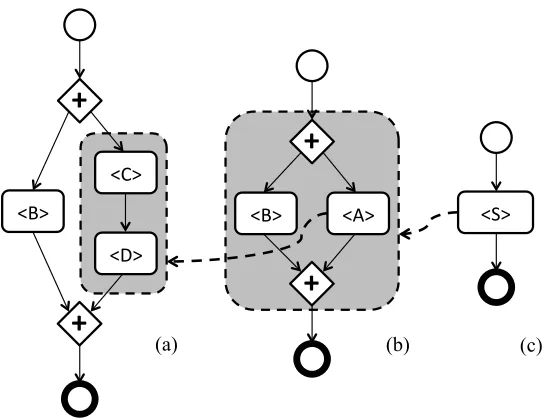
Figure 6.8: The GetStockDetails service (a) and the workflow that can replace the GetStockDetail service (b) ... 153
Figure 7.1: Architecture of the Security Aware Runtime Discovery Tool ... 162
Figure 7.2: Class Diagram of the package compositionmanager ... 164
Figure 7.3: Class Diagram of the package compositionmanager.secrule ... 165
Figure 7.4: Class Diagram of the package compositionmanager .workflow ... 167
Figure 7.6: Representation of the abstract workflow extracted from the tests execution ... 174
Figure 7.7: Representation of the abstract workflow after the first instantiation ... 179
Figure 7.8: Representation of the abstract workflow after the second instantiation ... 180
Figure 7.9: Representation of the final workflow ... 180
Figure 7.10: Execution result of the composition example ... 181
Figure 7.11: Architecture of the Security Aware BPEL Design Tool .. 183
Figure 7.12: Class Diagram of the package securityextension ... 184
Figure 7.13: Class Diagram of the package securityextension .securitymodel ... 186
Figure 7.14: Class Diagram of the package securityextension.gui ... 188
Figure 7.15: Class Diagram of other packages part of the extension ... 190
Figure 7.16: Security Specification for the GetCurrentStockDetails activity ... 192
Figure 7.17: The activity contextual menu showing the “Verify Security Property” option ... 193
Figure 7.18: The Validation and Adaptation view ... 194
Figure 8.1: Comparison of the single service discovery, inference rules, and abstract WF matching execution times over the different queries ... 206
Figure 8.2: Proportion of the execution time spent for each composition operation over the different queries ... 206
Figure 8.3: Correlation between the number of generated sub-queries and the composition time over the different queries ... 207
Figure 8.4: Comparison of the single service and service composition discovery times over the different sizes of the registry ... 209
Figure 8.5: Comparison of the abstract WF matching and the inference rule times over the different sizes of the registry ... 210
List of Tables
Table 2.1: Summary of the single service discovery approaches. ... 39
Table 2.2: Summary of approaches supporting automated construction of service compositions. ... 44
Table 2.3: Summary of the automated service discovery in service composition approaches. ... 48
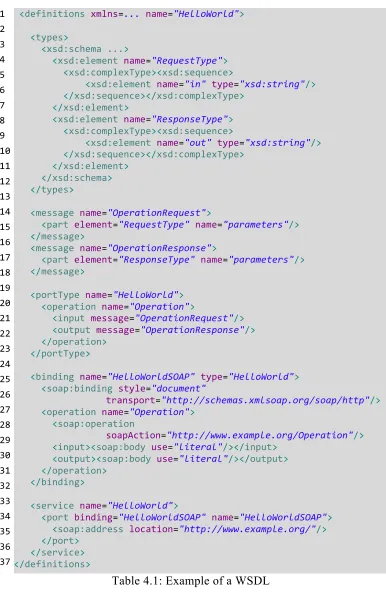
Table 4.1: Example of a WSDL ... 73
Table 4.2: Drools rule structure ... 75
Table 4.3: Example of Drools conditions ... 76
Table 4.4: Example of a Drools rule ... 76
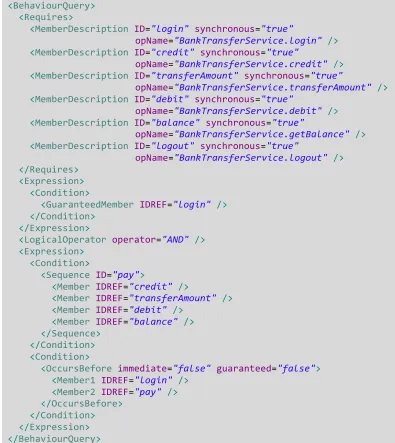
Table 4.5: Example of behavioural conditions of a SerDiQueL query .. 80
Table 4.6: Example of constraint conditions of a SerDiQueL query ... 82
Table 5.1: Snippet encoding an orchestration pattern into a Drools rule ... 114
Table 5.2: Snippet encoding a security requirement into a Drools rule ... 116
Table 5.4: Inference rule for Precede Integrity on Cascade Pattern .... 119
Table 5.5: Inference rule for PSP on Cascade Pattern ... 121
Table 5.6: Inference rule for PSP on Product Pattern ... 122
Table 5.7: Inference rule for Availability ... 124
Table 5.8: Verification rule for the Maximum Execution Time on Partner Link Activity ... 125
Table 5.9: Verification rule for the Maximum Execution Time on Generic Sequential Pattern ... 126
Table 5.10: Verification rule for the Maximum Execution Time on the Choice Pattern ... 128
Table 6.1: Example of a workflow ... 137
Table 6.2: Example of an abstract workflow ... 140
Table 6.3: Algorithm for the inference of Security Requirements ... 143
Table 6.4: Algorithm for the verification of Security Requirements ... 147
Table 6.5: Algorithm for the validation of workflows ... 149
Table 6.6: Algorithm for the discovery of secure workflows ... 152
Table 6.7: Example of query making explicit references to certificate parts through XPath ... 154
Table 6.8: Workflow Instantiation Algorithm ... 156
Table 7.2: Description of the classes in the package compositionmanager ... 164
Table 7.3: Description of the classes in the package compositionmanager .secrule ... 166
Table 7.4: Description of the classes in the package compositionmanager .workflow ... 168
Table 7.5: Description of the classes in the package compositionmanager.bpel ... 170
Table 7.6: Stock Service replacement query ... 173
Table 7.7: Get ISIN discovery query ... 178
Table 7.8: Description of the classes in the package securityextension ... 185
Table 7.9: Description of the classes in the package securityextension .securitymodel ... 187
Table 7.10: Description of the classes in the package securityextension .gui ... 189
Table 7.11: Description of the classes in the other packages part of the extension ... 191
Table 8.1: Execution times by operations, with 1200 services in the registry ... 204
Acknowledgements
I would like to thank all the people that have supported and assisted me during these years. My appreciation goes to my supervisor Professor George Spanoudakis for providing me the opportunity to work on stimulating project, and for his useful comments, remarks and engagement throughout my experience.
I would like to express my gratitude to all the members of the Department of Computer Science, including the administrative and technical staff that contributed through my journey at City University. In particular amongst all I would like to thank Mark Firman and the Technical Support Team (TST) for their continuous support. Many thanks go also to all the ASSERT4SOA project partners for the great support and collaboration.
I would like to extend my appreciation to the friends that I made during this journey, for their encouragements and for the great time spent together, so thanks Dr. Daniel Wolff, Reinier de Valk, Srikanth Cherla, Muhammad Asad, Maria Krotsiani, Spyros Katopodis, Icamaan da Silva, Dr. Ricardo Contreras, Dr. Evangelia Kalyvianaki and Dr. Christos Kloukinas.
My deepest gratitude goes to my closest friends, now spread all around the world, for their support, advice and patience. So long and thanks for all the fish, Dr. Mayla Brusò, Benedetta Basile, Giulia Borghini and Veronica Varanini.
Declaration
Abstract
Security assurance of Service-Based Systems (SBS) is a necessity and a key challenge in Service Oriented Computing. Several approaches have been introduced in order to take care of the security aspect of SBSs, from the design to the implementation stages. Such solutions, however, require expertise with regards to security languages and technologies or modelling formalisms. Furthermore, existing approaches allow only limited verification of security properties over a service composition, as they focus just on specific properties and require expressing compositions and properties in a model based formalism.
In this thesis we present a unified security aware service composition approach capable of validation of arbitrary security properties. This approach allows SBS designers to build secure applications without the need to learn formal models thanks to security descriptors for services, being they self-appointed or certified by an external third-party.
Chapter 1
Introduction
1.1
Research Area and Questions
The service-oriented computing (SOC) paradigm is aimed at addressing the need for constructing adaptable interoperable applications involving heterogeneous components over networks, known as software services, and offering access to utilities from a broad range of different devices. SOC focuses on interoperability and reuse by promoting the development of applications through composition of software services that might be deployed and running on different computational infrastructures. Technically a software service is a piece of autonomous and self-contained software accessible over a network through a collection of operations that are listed in the service interface.
services that are used in service based systems (SBS) and the existence of agreements between service providers and service consumers to regulate them, the ability to discover and compose services and the ability to adapt a SBS dynamically [55].
Service composition, in particular, follows the SOC concept of building software out of existing or new reusable services, in order to provide a new functionality or to automate a task. The new functionality can be made available as a new service that solves more complex problems. The SBS lifecycle benefits from the service composition concept, as service compositions can be used to help both the SBS design phase -allowing the interoperation with more than one service per task- and whilst a SBS is in operation at runtime -allowing discovery and adaptation (i.e., replacement) of service compositions when single services providing a functionality are no longer available.
From the business perspective, however, an additional and very critical concern is about the security of services and the SBSs that use them [55]. Some of the characteristics that make SOC a successful paradigm, in fact, are also the ones that facilitate security attacks: e.g. the network access to services introduce all the security threats of classical distributed systems [102], whilst service interfaces and interoperability features preclude to adopt the concept of security-by-obscurity [17][24][78].
extensions to languages and protocols have been through a process of standardization, following the concept of interoperability of SOC. These extensions introduce solutions to: ensure integrity and confidentiality in the messages exchanged (i.e., WS-Security [77], WS-SecureConversation [74]), provide mechanisms to construct trust relationships between organizations, or “security domains”, through the usage of a special security service providing security tokens (i.e., WS-Trust [76]), and provide authentication and authorization of identities between organizations, or “security domains”, thanks to federation agreements (i.e., WS-Federation [73], SAML [72]).
An open problem in this field is about security of service compositions. To assess the security of a service composition, in fact, the security of the individual services part of the composition must be taken into account, but it is not enough. In order to evaluate the security of the service composition, the order of execution of the composing services and the communications between them must be examined. In this scenario two key questions arise: (1) which security properties can be deducted from the security of the services within a service composition, and (2) how is it possible to require a service composition to preserve a security property?
This work is about assessing and constructing secure compositions of services allowing the support of security at both design and runtime. A possible use of secure service composition is to help the design and development of a SBS that calls different services. In this case a SBS design
tool can also offer some security validation mechanisms that automatically
replacement) of services that are no longer available with services or service compositions that guarantee the same level of security requested from the initial service. In this case, it is very important to support the discovery and construction of service compositions that preserve the requested security
properties.
Another issue in the security field is how to obtain assurance that a service complies with a given security property (e.g., confidentiality, integrity, availability, authenticity). Policy [109] and WS-SecurityPolicy [75] allow the specification, by the service provider, of which security mechanisms are in place. These policy languages support the development and negotiation of the security aspects of the communication, however they do not provide a general and objective assurance (i.e., based on third-party evaluation) of the security property guaranteed by the service. A proposed solution for this problem is the introduction of security certificates providing assurance that a service complies with a given security property [80].
infrastructures. Since these certificates are produced in order to be checked by IT or government personnel, they are human-readable system-wide documents that can easily exceed the hundreds of pages (e.g. by putting together the Certification Report, Security Target and Protection Profile of a CC certificate: see [19] for some examples).
The service-oriented paradigm, instead, introduces automatic software provisioning with concepts like runtime service discovery, service adaptation and service composition, thanks to a set of machine-readable interfaces. In order to ensure also the security of a SBS, then, certificates should also have a machine-readable equivalent for software services available at runtime and digitally signed as advocated, for example, by the ASSERT4SOA project [5][80].
With such certification scheme in place it is possible to envision a
security aware service discovery mechanism that would allow also the
specification of security requirements in a query to find and sort the services relevant for a task. In particular a security aware service discovery process can find sets of relevant services during the design and the development of a SBS, but it can be also quite useful in the context of run-time replacement. In this case the service discovery system should maintain an updated buffer of relevant services for a query so that the SBS can receive updates and substitute an unavailable or underperforming service with another one at run-time, while maintaining the same security features required to the original service.
1.2
Research Objectives
The overall aim of this thesis is to investigate the problem of assessing the security of service compositions and develop a solution that would enable the generation of secure service compositions out of software services with known (certified) security properties. To address this overall aim, our goal was to construct a framework that automatically infers the security requirements for the services part of a service composition, in order to guarantee general security requirements on the whole composition. This framework is aimed at SBS designers and developers engaged in building applications that require some security constraints.
The research objectives planned to achieve this can be listed as follows:
I. Literature review.
To provide an analysis of the related works regarding security aware service composition that defines the subject area, its terminology, the existent models and case studies. This analysis should describe the different frameworks and highlight the strengths and weaknesses of each approach, in order to identify the gap that this research intends to fill.
II. Model of secure composition framework.
computed offline, in order to use those at run-time to ease the reasoning process and make the framework more responsive.
III. Prototype of a discovery tool performing security aware service composition.
To design and develop a plugin for a service discovery tool that takes into account security requirements and that is able to automatically build service compositions that would answer a given discovery query. The focus should be on the inference of security requirements from the composition level to the services in the composition, by means of the framework designed as objective II.
IV. Prototype of a design tool for security aware service compositions.
To design and develop a plugin for a SBS design tool that uses the framework results to propagate general security requirements to the single activities in a composition, to be able to automatically query for the services that will be used by the designed system and guarantee the required security at the same time.
V. Evaluation of the discovery tool.
The aim of the evaluation is to assess that the prototype resulting from the above objective behave as it would be expected and in a reasonable amount of time. This translates in some assessments of relevance from end-user developers to be able to evaluate the recall and precision of the system, and performance tests.
1.3
Research Assumptions
• The availability of machine-readable descriptors of service security.
• The service compositions supported by our research are orchestrations, i.e., processes which coordinate individual software services and in which there is a single central coordinator that determines the order of the interaction and acts as an intermediary of all the communications (e.g., it receives results from a service and passes them, or some of them, to other services).
• The prototype of the discovery tool described as objective III makes usage of a service discovery approach supporting the proactive discovery of services at runtime. Such approach has been researched and implemented in a tool, called RSDT [115], by the Software Engineering Group of City University (a more detailed description is in Section 4.3).
• The discovery approach allows service discovery at development time, when there is already an estimated structure of the needed service. This means that the tool won’t allow a simple browse of the registry, based only on service names or similar.
• The service discovery is envisioned as an incremental process of refinement of the query based on the discovery results.
• The focus of the research is on the inference of security in service compositions, so the functional composition part of the process might use existing state of the art ideas.
1.4
Contributions
This research is aimed to provide a framework for service discovery and composition supporting inference and validation of security requirements. The framework allows constructing dynamically a service composition that respects given security requirements by means of a set of production rules and service discovery. Contributions of this research work include:
• Design of a service composition mechanism to infer and validate
security requirements
To handle the question, we introduce the concept of secure composition patterns, i.e., models describing abstract dependencies between the service composition security requirements and the component service security requirements. The dependencies are formally proven in order to ensure the same level of security of the original requirements.
The patterns can be applied in different steps of a composition lifetime, to discover services guaranteeing the security or to validate the security of an existing composition.
• Initial set of secure composition patterns and production rules
An initial set of secure composition patterns, comprising patterns for integrity, confidentiality and availability, is given to prove and exemplify the approach. The secure composition patterns are encoded into security production rules that can be deployed to a rule-based system.
The process of security requirements inference from the service composition layer to the single composing services is achieved through a recursive algorithm that makes use of the secure composition patterns. This information can be used to assess the security of existing compositions (e.g. during the SBS design time) or to construct secure service compositions (e.g. to replace a service with a composition with the same level of security at either design or runtime).
• Prototype of a discovery and composition tool supporting security
This prototype allows the creation of service compositions during the discovery of a service, and guarantees that the service compositions have the requested level of security. The tool allows adaptation of SBS at both design and runtime. The latter is achieved by taking advantage of the proactive capabilities of the discovery tool.
• Prototype of a design tool supporting validation and adaptation
based on the security of service compositions
This prototype allows the validation of the security requirements during an SBS design. The tool shows alternative services or service compositions that comply with the functionality and the security requested. The alternative services or service composition can be used to request automatic adaptation of the designed SBS.
• Integration with the ASSERT4SOA toolkit
the security of the services, increasing the level of trust in the solutions provided by the presented approach.
• Evaluation of the approach
To prove the feasibility and scalability of the approach, the service discovery and composition performances have been tested.
1.5
Publications
The contributions in this thesis have been submitted to conferences and workshops in order to collect feedback and disseminate the ideas presented to fellow researchers and organizations that work in the field.
In the following you can find a list of the published papers:
• Pino, L., and Spanoudakis, G. (2012, May). Finding secure compositions of software services: Towards a pattern based approach. In 5th IFIP International Conference on New
Technologies, Mobility and Security, 2012 (NTMS'12), pp. 1-5.
IEEE. DOI: 10.1109/NTMS.2012.6208741. [82]
This paper describes an early version of the framework and introduces the concept of secure composition patterns. In this work the security production rules were encoded in Situation Calculus [62] and it was necessary to retain some information about the services internals (i.e., the “Security related actions on data”).
• Pino, L., and Spanoudakis, G. (2012, June). Constructing secure service compositions with patterns. In IEEE Eighth World Congress
on Services, 2012 (SERVICES'12), pp. 184-191. IEEE. DOI:
This paper presents an updated version of the framework and introduces an early version of the secure composition algorithm. In this version of the algorithm we were using patterns to address the construction of security composition respecting the required functionality (through the usage of ontologies and OWL-S [61] based patterns), and the security production rules were used to infer the security requirements of the composition.
• Pino, L., Spanoudakis, G., Fuchs, A., and Gürgens, S. (2014, April). Discovering Secure Service Compositions. In 4th International Conference on Cloud Computing and Services Sciences
(CLOSER'14). DOI: 10.5220/0004855702420253. [84]
This paper presents an example of a formal proof underlying a secure composition pattern on integrity, allowing trusting the solutions based on such pattern. Furthermore, the paper presents the encoding of the secure composition pattern into security production rules as Drools production rules, which represents our final choice for the encoding of the rules (as Drools is a fast, reliable and widely support rule-based decision system [47]). Finally the paper describes an updated version of the algorithm and presents the service discovery and composition prototype, with some initial evaluation figures.
• Pino, L., Spanoudakis, G., Fuchs, A., and Gürgens, S. (to appear). Generating Secure Service Compositions. In Cloud Computing and Services Science: Fourth International Conference, CLOSER 2014,
Barcelona, Spain, April 3-4, 2014, Revised Selected Papers.
This work is an extension of the previous paper that elaborates some further the formalisms used for the proof, based on Security Modelling Framework (SeMF) [37].
• Pino, L., Mahbub, K., and Spanoudakis, G. (2014, November). Designing Secure Service Workflows in BPEL. In Proceedings of the international conference on Service-Oriented Computing
(ICSOC’14), pp. 551-559. Springer Berlin Heidelberg. DOI:
10.1007/978-3-662-45391-9_48. [83]
This paper is focused on the SBS design tool that supports validation and adaptation based on the security of compositions. This work presents the latest version of the security requirement inference algorithm and how this is applied in order to validate the security of portions of BPEL workflows and to adapt secure service compositions in a BPEL workflow.
1.6
Outline
The thesis is organised in 9 chapters as follows.
Chapter 2 presents an analysis of the existing approaches dealing with service discovery, service composition. We focus in particular on the security support in these fields and the existing standards and languages that address the security issue.
In Chapter 3 we summarise the concepts and definitions that are used in this thesis, from the Service Oriented Computing field.
composition languages, and on Drools, RSDT and Eclipse BPEL Designer, respectively the rule-based system, the runtime discovery platform and the SBS design tool used for the implementation of the prototypes.
Chapter 5 presents the secure composition pattern approach. We introduce some examples of secure composition patterns with the respective proofs. Furthermore, this chapter contains a methodology to encode the patterns into security production rules and the rules corresponding to the patterns presented earlier.
Chapter 6 describes the service composition process based on the secure composition patterns. This process makes usage of the security production rules introduced in Chapter 5. The algorithms underlying the service composition process are presented and discussed through the usage of examples.
Chapter 7 contains the implementation details of the two prototypes that use the secure service composition process in order to offer validation and adaptation of secure service compositions. In particular, it describes how the discovery platform and the SBS design tool presented in Chapter 4 have been extended in order to support security and service compositions.
Chapter 8 presents the setup and the results of the performance evaluation of the discovery and the composition process. The chapter contains the description of the configuration and the scenario, and the explanation of the numerical results obtained from the tests.
Chapter 2
Literature Review
2.1
Overview
This chapter presents an analysis of the existing works in the fields of service discovery and service composition, focusing in particular on the supported security features. This is followed by an analysis of the standard and languages that support security in the SOC field. Furthermore, all the approaches are summarized and put into relation with the contents of this thesis.
2.2
Service Discovery
discovery process does not attempt to create a new composition. Techniques supporting the discovery of service compositions are overviewed in Section 2.3 below.
The techniques that we overview are classified into groups depending on the main characteristics of the algorithmic approach deployed for service discovery. According to this criterion, techniques are grouped into:
• Text matching service discovery – These are techniques that make
use of information retrieval techniques. In this group, discovery criteria are expressed as keywords which are subsequently matched with textual or structural descriptions of services. Typically, such techniques are deployed for early and design time service discovery.
• Semantic service discovery – These are techniques that assume
descriptions of services that have been expressed in an ontology or annotated with links to ontological descriptions. Such techniques make use of the ontological descriptions during the matching process in order to improve the precision and completeness of the discovery process.
• Graph matching techniques – These are techniques that make use of
different types of graph matching techniques (e.g. weighted bipartite graph matching, graph transformations, etc.) without relying on any form of ontology or formal reasoning of semantic service descriptions.
2.2.1
Text matching service discovery
Keyword-based retrieval underpins some service registries available on the Internet (e.g. Xignite [112] and WebserviceX [111]) and some basic built-in clients for development platforms (e.g. jUDDI GUI [103], Eclipse
Web Services Explorer [26]). These approaches may also offer discovery
through service categories and the use of tagged service descriptions. Text based service discovery is easy to use, due to the simplicity in the expression of the discovery queries. It is also useful in static service discovery, where the developers of SBS are usually concerned with finding a service that fits their requirements or the requirements of an application being designed. However, it cannot offer the matching precision that is required in dynamic service discovery that is executed to support automatic service replacement in applications at runtime. This is because in the analysis and design stages of SBSs, it is often useful to identify even services that do not match perfectly with what is required as a means of exploring alternative solutions and considering alterative designs and implementation paths for the application. At runtime, however, when the design of the overall application and its coordination logic have been fixed, the imprecision that typically characterizes keyword-based techniques is not acceptable, as decisions about replacing the partner services of a system with alternatives identified during the discovery process, in many cases, need to be taken in an automated manner.
2.2.2
Semantic service discovery
A system realising the semantic approach is MX [50]. OWLS-MX uses logic based approximate matching and information retrieval techniques.
A semantic approach has also been advocated in [56], where a service discovery prototype that uses a Description Logic reasoner to match service discovery requests with ontology based service descriptions expressed in DAML-S.
Despite some experimental evidence showing acceptable precision and recall over competitors, however, the semantic approaches do not appear to be adequate for dynamic service discovery. This is because the ontological matches do not necessarily coincide with behavioural and interface matching at the level required for dynamic service discovery.
2.2.3
Graph matching techniques
Other approaches for service discovery consider graph transformation rules [49], or behavioural matching [32][67][92]. The work in [49] is limited since it cannot account for changes in the order or names of the parameters. In [92], the authors use service behaviour signatures to improve service discovery. In AOWS [33][96] the functional and quality characteristics of components and services are described as aspects and discovery is based on a formal analysis and validation of these descriptions. The work in [67] advocates the use of behavioural specifications represented as BPEL for service discovery for resolving ambiguities between requests and services and uses a tree-alignment algorithm to identify matches between request and services.
interfaces and graph search algorithms to identify the compatibility of behavioural discovery criteria with behavioural service description models expressed in BPEL. Furthermore, this tool offers the capability to subscribe queries in order to have them executed and maintained proactively, in order to offer timely runtime service discovery to SBSs.
2.2.4
Context awareness
Several approaches have also been proposed to support context awareness in service discovery [11][20][79][113]. In [20], context information is represented by key-value pairs attached to the edges of a graph representing service classifications. This approach does not integrate context information with behavioural and quality matching. Furthermore, the context information is stored explicitly in a service repository that must be updated following context changes. In [9] queries, services and context information are expressed in ontologies. The approach in [11] focuses on user context information (e.g. location and time) and uses it to discover the most appropriate network operator before making phone calls. The work in [113] locates components based on context-aware browsing. The above context-aware approaches support simple conditions regarding context information in service discovery, do not fully integrate context with behavioural criteria in service discovery, and have limited applicability since they depend on the use of specific ontologies for the expression of context conditions.
2.2.5
Summary
including but not limited to structural, functional, quality, and contextual characteristics. This tool supports both reactive and proactive service discovery, resulting in more efficient service replacement during the execution of a SBS.
Approach Algorithm Service descr. language
QoS support
Xignite [112] Keyword-based WSDL No
WebserviceX [111] Keyword-based WSDL No
OWLS-MX [50] Semantic
(logic-based and IR)
OWL-S No
Li, L. et al. [56] Semantic (logic-based)
DAML-S No
Mikhaiel, R. et al. [67] Graph-based (tree alignment)
BPEL No
Shen, Z. et al. [92] Graph-based (RE-tree [15])
Behaviour signatures (new language)
No
AWOS [33][96] Graph-based AOWSDL [95] (new language)
Yes
RSDT [115][116] Graph-based
(morphism detection)
WSDL, BPEL and XMLs
Yes
Cuddy, S. et al. [20] Context graph-based Not explained No
Beeri, C. et al. [9] Context graph-based BPEL No
Bormann, F. et al. [11] Context n/a – not on WS No
Ye, Y. et al. [113] Context n/a – not on WS No
2.3
Service Composition
If the basic single service discovery fails to find the requested functionality, there is another way a discovery platform can try to fulfil the request: to compose an ad-hoc service on the fly by discovering and combining some services that provide the different parts of the functionality.
This additional step in the discovery process can be realized with the aid of different approaches arising from several areas of research (formal methods, automated reasoning, semantic computing, distributed systems, etc.) [8]. This wide range of possibilities offers a lot of solutions that can satisfy different types of discovery (static or dynamic, with human intervention or not), based mostly on which parts of the composition process can be automated. In particular we categorize the works in this area within two main groups:
• Approaches which automate the translation of the service query into workflows containing activity placeholders that need to be bounded to concrete services;
• Approaches that focus on automating the service discovery, adaptation and binding, when the workflow is already available.
2.3.1
Definition of Service Workflows
the discovery and adaptation of services in order to instantiate the service composition, as explained in Section 2.3.2.
A solution to this problem is using reference process models, in domains in which such models exist, in order to generate a set of standard workflows that offer specific business functionalities. Some examples of such standard process models are the Health Level 7 (HL7) in the health domain [40], SWIFT used by financial institutions [98], and Electronic Data Interchange (EDI) [70], RosettaNet [34], IBM BPM Industry Packs [43] that specify models for a variety of fields (e.g., manufacturing, telecommunications, …).
Whenever a process model does not yet exist, however, the need to construct a workflow ad-hoc arises. An early work on this is SAHARA [60][87], a framework to compose services in a Wide-Area network, where the approach is not specific on services, rather it composes more generic data operators. The “composition path” (i.e., the workflow) is built by running the shortest path algorithm on the graph of the operator space. They propose to build domain-specific graphs and to cache popular results to limit the size of the graphs, but the solution isn’t scalable in a more general context without the notion of local and wide-area paths. Furthermore the data operator point of view is a little restricting, not allowing for example a service to just retrieve information or to compose data from/to different services.
simple queries, by not allowing arbitrary joins (like “find all pairs of movies with the same director”) and not providing arithmetic/function symbols, to maintain an efficient and simple model.
Most recent works, however, prefer to use standard languages to describe services (and composition requests), in particular OWL-S (and DAML-S). The reasons are mostly business-related and include: (a) in this way developers don’t need to learn further languages, (b) it simplifies the process of integrating an existent service discovery platform and (c) to avoid the error-prone (manual) process of converting the service descriptions in another language.
A framework for the automated service composition is described in [58] and it uses the services’ DAML-S description (DAML-S is a predecessor of OWL-S). In particular, the approach of this work is to try to find a single service corresponding to the high-level goal requested by the user, in case this step fails then a repository of abstract workflows is interrogated. Only if also this other step fails the framework tries to build a new composition, by chaining services through their input-output and precondition-effect descriptions. The matching of IOPEs (i.e., Input, Output, Precondition and Effect) is provided by a specific component that admits the composition of the I/O data from different services, allowing the creation of complex compositions.
like security and QoS ones, are taken in consideration as well as the functional ones, thanks to inference rules.
CoSMoS [30][31] is a semantic-based model for services and compositions that is slightly different from OWL-S since it allows also semantic annotation of operation “concepts” (in addition of I/O) that cannot be defined as data types. In this context they introduce SeGSeC: a service composition mechanism that supports CoSMoS (i.e., semantic annotations). In this work the services must be described in CoSMoS/WSDL and the service request can be written in natural language: the tool then translates it into a CoSMoS semantic graph representation. The composition starts with the discovery of the service for the initial concept in the request (the one that provides the goal output) and then goes on by finding the services that provide the inputs for the initial service, using also the semantic information. At the end of the composition process the workflow is checked to guarantee that it satisfies the semantic request; otherwise the tool tries to find other compositions.
One of the most recent works in the field is DynamiCoS [53][94], a framework for dynamic service composition that supports requests in natural language (but also in a formal language based on OWL) and functional and non-functional properties. The first step of the composition in this framework is the service discovery, based on semantic concepts. The semantic connections between the I/O of the discovered services are stored in a Casual Link Matrix (CLM); so then the composition is built starting from the requested output searching backwards for compatible services through the CLM.
OWL-S Service Profile, WSMO Capability Model or SA-WSDL specification).
Approach Algorithm Service description language Allowed WF patterns Security support SAHARA [60][87]
Graph-based n/a - not only on WS
Choice No
SWORD [86]
Logic-based (rule-based system)
Based on ER-model
(new language)
Parallel No
Majithia, S. et al. [58]
Backward chain of I/O
DAML-S - No
Rao, J. [88][89]
Logic-based (theorem proving)
DAML-S Choice
and parallel As service goals and constraints CoSMoS / SeGSeC [30][31] Semantic graph-based CoSMoS/WSDL (new language)
Choice No
DynamiCoS [53][94] Semantic graph-based Internal, needs interpreters (new language)
- Yes / not explained
Table 2.2: Summary of approaches supporting automated construction of service compositions.
2.3.2
Instantiation of Service Workflows
matches are available, to adapt the workflow to consider the services that behave in a very similar way to the activities involved. The “most suitable” unit of measure is in the majority of the works based on the semantic correlation. Some other works focus on reaching the best QoS, after a first selection of services.
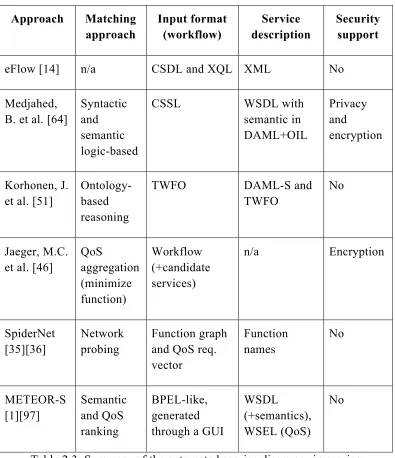
The earliest work on this subject is eFlow [14]: a platform for composition of services. This platform offers means of describing the workflow of the services through the GUI (by defining flow graphs) or through a simple composition language (an XML language called CSDL: Composite Service Definition Language) that allows dynamic discovery of services or dynamic selection and instantiation (with possibilities of multiple instantiations) of services from a list. The discovery is obtained by executing generic XQL queries on the repository of the service descriptions as the platform allows any XML format for the service descriptions. The obtained dynamic composition, however, isn’t guaranteed to be working correctly: the framework is built just to compose but it doesn’t perform any verification after the composition.
particular the first two measures are calculated on the basis of stored templates).
Another work on automatic composition based on ontologies is [51]. In this work the service request is defined with TWFO (Transactional WorkFlow Ontology), an ontology used to describe workflows with transaction support. The main difference with other works is that the service registry must also contain the workflow of the services used in the discovery process (expressed in TWFO as well). Then, after the candidate services are found through the DAML-S registry, the system tries to compose the workflow of each service in the requested workflow (called Master Workflow). The work does not go too much into details on the discovery process.
Regarding the automatic service composition based on QoS criteria, it should be noted that this kind of approach needs, in addition to the workflow of the composite service, the list of the compatible services for each activity as input. So, since a list of services has been already discovered, the matter to solve is reduced to just aggregate the different QoS data to find the best composition. A work in this area is [46], that uses some of the workflow patterns from [107] to define aggregation functions for QoS criteria. The patterns are used to do a stepwise graph reduction, and for every step the aggregated value of the QoS criteria is calculated.
provides as a result the list of the service components that implement the desired functions and the statistical QoS (the assumption is that the nodes are cooperative and trustworthy). The drawbacks of this work are that the composition process is slow and that the algorithm is based on probing the network, so it can be used only on bounded networks.
A more complete approach is given in METEOR-S [1][97], where the semantic and the QoS approaches are combined in a single automatic service composition framework. METEOR-S is more broadly a framework for the complete lifecycle of semantic web services; the particular component that deals with service composition is called MWSCF (METEOR-S Web Service Composition Framework).
Approach Matching approach Input format (workflow) Service description Security support
eFlow [14] n/a CSDL and XQL XML No
Medjahed, B. et al. [64]
Syntactic and semantic logic-based
CSSL WSDL with
semantic in DAML+OIL Privacy and encryption Korhonen, J. et al. [51]
Ontology-based reasoning
TWFO DAML-S and
TWFO
No
Jaeger, M.C. et al. [46]
QoS aggregation (minimize function) Workflow (+candidate services)
n/a Encryption
SpiderNet [35][36]
Network probing
Function graph and QoS req. vector Function names No METEOR-S [1][97] Semantic and QoS ranking BPEL-like, generated through a GUI
WSDL (+semantics), WSEL (QoS)
[image:49.595.95.490.103.561.2]No
Table 2.3: Summary of the automated service discovery in service composition approaches.
2.3.3
Summary
community. The recent trend, however, has been to adopt semantic-aware specifications and solutions.
In more detail, we have presented the works in this field by categorizing them in the ones that discover or build a composition plan that can provide a given functionality, and the ones that instantiate workflow plans with services that will collaborate to implement the given functionality. In the context of this thesis we do not wish to address directly the former, as our assumption is that any approach in the literature may be used, but we enhance the solutions for the latter with extended security support. The described works that handle the instantiation of service workflows, in fact, present a very limited support for security, as described in more detail in Section 2.4.4.
2.4
Security in Service Oriented Computing
In this section we provide an overview of how the security problem has been addressed in the service-oriented computing (SOC) field. In particular, we are going to describe first the security standards and solutions that have been introduced in the SOC field and then how security has been handled in the context of Service Discovery, Service Composition and SBS Design.
2.4.1
Security Languages and Standards
In order to deal with security issues that used to hold back a wider usage of services, the SOC community has actively worked on standardizing a set of languages and protocols that would help the development of secure services and SBS.
capabilities. This standard does not provide a complete solution for security, however is used as a building block for further protocols. WS-SecureConversation [74] extends the use cases of WS-Security providing a way to establish security contexts for multiple message exchanges, reducing the overhead introduced by key negotiation.
WS-Trust [76] is another OASIS standard that introduces the mechanisms to manage security tokens in order to build trust relationships between organizations, or “security domains”. WS-Trust defines the process of issuing, renewing and validating of security tokens by the Security Token Service, the key exchange process and the format of the message used for each one of these operations.
SAML [72] and WS-Federation [73] are two OASIS standards for identity federation specifications that provide the means for shared authentication and authorization of identities between organizations, or “security domains”, thanks to federation agreements (e.g., single sign-on mechanisms).
WS-Policy [109] is a W3C recommendation that allows the specification, by the service provider, of which QoS or security policies are in place. WS-SecurityPolicy [75] is an OASIS standard used to specify and negotiate security policies, based on WS-Policy, that can defined on a wide range of technologies, from transport layer security to the usage of protocols specified by WS-Security, WS-Trust and so on.
software in order to check if it meets the security functional and assurance requirements (SFRs and SARs) they claim. After testing, CC certificates can be released produced by certification bodies in order to be checked by the users; for this reason the certificates are human-readable system-wide documents that can easily exceed the hundreds of pages (e.g. by putting together the Certification Report, Security Target and Protection Profile of a CC certificate: see [19] for some examples).
The ASSERT4SOA project [5][80] aimed to solve the shortcomings of traditional software certification in the SOC field. In particular, the proposed approach advocates the usage of machine-readable security certificates available at runtime and digitally signed by trusted third-parties (Certification Authorities, or CA). Each security certificate describes a security property that has been verified to hold for a given service. The certificates can be seen as additional service descriptions placed in service registries and available to clients and to service discovery processes.
2.4.1.1 Summary
The standards introduced in the SOC field encompass a number of mechanisms to support a wide range of security requirements, offering solutions to service developers for their implementations.
achieved, e.g. knowing that a piece of data is treated with confidentiality, or that the service is available at the 99.99% of the time.
Furthermore, users cannot always know, and therefore trust, the Service Provider that offers a service and the level of security he/she declares. Security certificates offer third-party security guarantee for service users, without the need to investigate the exact mechanism that assure the requested security property.
For these reasons the implementation of our work uses security certificates, since our approach is mainly directed to SBS designers; however our solution can support any kind of security descriptor.
2.4.2
Security Design and Implementation
For the design and implementation of secure services, the research has been focused on: (a) additional stages to the development process in order to take into consideration the security requirements during the design and implementation of a service [29][38][66], and (b) special security services that provide the mechanisms to protect other services (security-as-a-service) [16][38][39][76].
to be added to service development phases in order to support security. In particular WSSecReq is a first design phase aimed to specify the security requirements, WSSecArch is a phase where the requirements are used in conjunction with security architectural patterns in order to define the security architecture, and WSSecTech is the final design phase where a set of WS security standards (see the previous section) are identified starting from the security architecture designed in the previous stage. In particular during the WSSecArch stage, security services are added to the architecture in order to support a required security mechanism.
AO4BPEL [16] allows the integration of security specifications in a BPEL process. These specifications are then used to indicate security functionalities that are offered by a special Security Service, and integrate them in the AO4BPEL process. Sectet [39] is a framework for the implementation of security patterns from design to the implementation of an orchestration. Sectet enables the design of orchestrations as UML message flow diagrams, which are converted into workflows and used to generate stubs for actual orchestrations. In orchestrations, services are wrapped by Policy Enforcement Points, whose purpose is to provide the required security properties.
2.4.2.1 Summary
2.4.3
Security aware Service Discovery
In this section we provide an overview of single service discovery techniques supporting security constraints, i.e., techniques that perform the discovery of a service without attempting to perform service composition (even though a discovered service may be a composite service itself). Frameworks supporting the discovery of service compositions are overviewed in Section 2.4.4 below.
In [105] the authors describe an approach to Web Service discovery based on privacy preferences. The preferences are specified as part of privacy policies (architecturally placed with service descriptions in a central service repository). The privacy descriptions consist of a vocabulary for properties including terms for disclosure, openness and anonymity. The process of applying the privacy-aware policy for the web services is accomplished in several stages. First, a client sends their preferences to a discovery agent. Then, a correspondence will be established between the user’s interests and the web service privacy policies. Finally, the degree of user confidence to the privacy-aware policies on services is evaluated and a selection is made based upon the confidence levels obtained.
Similarly, the work presented in [48] uses policies described in extended service descriptions for authorization and privacy for semantic web services. The descriptions are proposed ontologies to annotate OWL-S input and output parameters with respect to their security characteristics, including encryption and digital signatures. Several extensions to OWL-S are proposed in the form of objects. First an information object which itself is extended to support either encrypted information or signed information. The approach also adds a series of policy types to OWL-S including a
PrivacyPolicy, ConfidentialityPolicy and AuthorizationPolicy. The authors
how this may be used for run-time compliance checking, but allude to the difficulties of trusting what providers offer as descriptions and what the services they provide actually undertake in execution.
[106] introduces a context-aware service discovery approach that makes usage of security policies. A threat analysis is given for the service discovery process, which led to the specification of security policies. The service client or the service provider can enforce security policies in order to restrict the access to their respective profiles during service discovery.
FSSD [69] is a decentralized peer-to-peer service discovery protocol that allows users to adjust their degrees of collaboration, security and privacy. In particular this work investigates the trade-off between these three characteristics and introduces a common secure trust overlay that may work in multiple administrative domains and that is independent of network and security infrastructures.
2.4.3.1 Summary
Existing research has focused largely on two sub-areas: the first being service discovery driven by some specific security or privacy constraint and second, the security of the service discovery mechanisms.
2.4.4
Security aware Service Composition
The efforts to provide security in service compositions can be summarized in two categories, the ones that merely verify that an existing service composition guarantee a given security property, and the ones that take security properties into account during the construction of a service composition.
2.4.4.1 Verification of Service Compositions security properties
Among the works focusing on security in service composition particular relevance has been given to verification, through model checking, of already existent compositions’ security. The service composition can be checked for flaws at design time or in a later stage of development, usually after concrete services are associated with each task. To perform the check the composition is modelled with formal languages and the requirements are expressed as properties on the model.
The design time verification is applied on a specification of the system. To encourage the use of this kind of verification, the language of the required specification is conventionally a common language of the Software Engineering area, usually UML.
then converted into the formal language CCS [68] through some rules. The model checking of the security properties can be done, in the end, on compositions of these security patterns, to verify if the security properties are preserved.
A more general work in the verification of security properties in service composition is in [6][7]. They introduce a calculus (a typed extension of λ -calculus) to describe and compose services. In particular their language can be used to describe a model and check the security-related activities (access events, e.g. writing a file, opening a socket connection) of a service composition. The main remark on this work is that there’s no description of the modelling phase, leaving to the reader the burden of planning how to convert the services into their language.
Another work in the verification of service composition area is Aniketos [4]. This work introduces a set of security patterns that are defined as design patterns that guarantee some security goal. These patterns are used to secure software during the design phase, which is human based, and to monitor changes related to the requested security policy at runtime.
2.4.4.2 Security aware Definition and Instantiation of Service Workflows
Another point of view regarding security in service composition is to obtain the guarantee that a composition respects some security policies directly from the discovery process, when an automatic composition of services approach is used.
find efficient algorithms for workflow planning, even though in the limited case of sequences of operators.
In [13] the authors describe an approach to security conscious web service composition through the declaration of security constraints required on service provision and of the constraints declared by service providers. Security constraints are declared in SAML assertions [72]. Examples are provided for both authentication and authorisation assertions although a common security ontology is not provided. The architecture of using the constraints specified is based upon a Web Service brokering model. A Secure WS-Broker (SWS-Broker) is used to manage service requests and sets of security constraints, identifies a well-known business process (i.e., the workflow) compatible with the request from a library and tries to instantiate such workflow with appropriate services that respect also the security constraints. The approach also provides an implementation of the broker consisting of a workflow modeller, service locator, security matchmaker and WS-BPEL generator. The security matchmaker builds a tree structure of the path of security considerations (from the constraints applied to the workflow) and analyses the possible composition paths and security constraints from discovered services. WS-Agreement nodes are also generated as part of service message structures to express the constraints applied.
2.4.4.3 Summary