RESEARCH ARTICLE
Selection of a suitable reference gene
for quantitative gene expression in mouse
lymph nodes after vaccination
Yung‑Yi C. Mosley
*and Harm HogenEsch
Abstract
Background: The quantification of gene expression is an important tool in the evaluation of the immune response to vaccines. Reliable reference genes for gene expression studies in mouse draining lymph nodes after vaccination have not been reported.
Results: The utility of seven potential reference genes was investigated using commercially available Taq‑man primer/probe mixes. Results were evaluated with RefFinder, a web‑based program including multiple algorithm methods such as geNorm, NormFinder, BestKeeper and the comparative delta‑Ct. Further assessment was done by applying the candidate reference genes in relative expression calculations with genes related to the magnitude and longevity of the humoral immune responses. The ubiquitin C gene, Ubc, was found to be the most reliable reference gene when validated with well‑known genes that are expressed at relatively low levels after vaccination. The optimal time of sample collection varied depending on the function of the target genes.
Conclusions: This study identified Ubc as the most reliable reference gene and provides useful information for stud‑ ies examining immunological gene expression in the draining lymph nodes after vaccination in mice.
Keywords: DTaP, Lymph nodes, Mouse, qPCR, Reference gene, Ubc
© The Author(s) 2017. This article is distributed under the terms of the Creative Commons Attribution 4.0 International License (http://creativecommons.org/licenses/by/4.0/), which permits unrestricted use, distribution, and reproduction in any medium, provided you give appropriate credit to the original author(s) and the source, provide a link to the Creative Commons license, and indicate if changes were made. The Creative Commons Public Domain Dedication waiver (http://creativecommons.org/ publicdomain/zero/1.0/) applies to the data made available in this article, unless otherwise stated.
Background
Quantitative real time PCR (qPCR) is an essential tech-nique that has brought great advances in life sciences. Relative quantification of mRNA levels is widely used to determine the expression levels of target genes [1]. The accuracy of this assay relies heavily on the choice of refer-ence genes for normalization [2, 3]. Ideal reference genes must have a relatively high but stable expression with minimal variation between individual samples and with-out disturbance from the experimental conditions [2, 3]. Commonly used reference genes such as β-actin (Actb) and glyceraldehyde-3-phosphate dehydrogenase (Gapdh) may not be suitable for every experimental condition [4, 5]. Thus, it is critical to select appropriate reference
gene(s) for each circumstance including particular tissues and specific experimental designs [6, 7].
Upon vaccination, antigen presenting cells at the injec-tion site take up vaccine antigens and actively migrate via a lymph vessel to the draining lymph nodes, followed by antigen processing and presentation to naïve T cells which initiates the adaptive immune responses to the vaccine antigens [8]. The activated antigen-specific T and B cells will interact, further differentiate and prolif-erate. Enormous changes in gene expression accompany the activation of the adaptive immune system. Several genes including tyrosine 3-monooxygenase/tryptophan 5-monooxygenase activation protein, zeta polypeptide (Ywhaz), ubiquitin C (Ubc), and Actb have been proposed as suitable reference genes for human lymph nodes with B cell lymphomas and non-neoplastic specimens [9]. On the other hand, while Ubc was identified as the most sta-ble reference gene, Actb was recognized as an inappro-priate reference genes in mouse lymphocytes purified
Open Access
*Correspondence: [email protected]
from lymph nodes under normal condition [10]. Other genes including hypoxanthine phosphoribosyltransferase (Hprt), hydroxymethylbilane synthase (Hmbs), and TATA box-binding protein (Tbp) have been reported as suitable reference genes for lymphoid tissues in human, marmo-sets, goats and chickens [4, 11–14]. It is uncertain which reference gene would be best suited for analysis of gene expression in the draining lymph node by RT-qPCR fol-lowing vaccination. Here, we examined the expression of the aforementioned genes and determined their suit-ability as reference genes for draining and non-draining lymph nodes in mice after vaccination with a diphtheria– tetanus–acellular pertussis vaccine (DTaP). The analysis included software tools such as geNorm, NormFinder, BestKeeper and the comparative delta-Ct method, and validation with genes that are known to be induced upon vaccination.
Methods Animal studies
Thirty 5 week old female BALB/cJ mice (Jackson Labora-tory, Bar Harbor, ME, USA) were housed at 3–4 mice/box in ventilated racks with a 12 h light/12 h dark–light cycle and ad lib access to water and chow. Mice were injected intramuscularly with 50 µl of DTaP vaccine, containing diphtheria toxoid, tetanus toxoid, pertussis toxin, fila-mentous hemagglutinin, and pertactin (Infanrix®, Glaxo Smith Kline, Rixensart, Belgium) at 6, 8, and 12 weeks of age in alternating hind legs. Mice were euthanized by CO2 inhalation and cervical dislocation for sample
col-lection. The protocol was approved by Purdue University Animal Care and Use Committee.
RNA extraction
Axillary (non-draining) and iliac (draining) lymph nodes [15–17] were collected at 1 and 7 days after the first and third vaccination (V1D1, V1D7, V3D1 and V3D7, respectively) and stored in RNAlater® (Life technologies, Carlsbad, CA, USA) at 4 °C for at least 24 h before RNA extraction. Fat tissue around lymph nodes was removed with a fine tip forceps and 30G needle under a dissect-ing microscope. Excess RNAlater® was blotted away and the tissue was homogenized with a mortar and pestle in the presence of liquid nitrogen. The total RNA from homogenized tissue was extracted by Quick-RNA™ Min-iPrep Plus (Zymo Research, Irvine, CA, USA) following manufacturer’s instruction with proteinase K and DNase I digestion. RNA concentration and purity were checked with a NanoDrop spectrophotometer (Thermo Scientific, Wilmington, DE, USA).
Reverse transcription
Total RNA of 1 µg was reverse-transcribed with iScript™
cDNA Synthesis Kit (Bio-Rad, Hercules, CA, USA) in a total volume of 20 µl which contains a blend of oligo dT/ random hexamer primers. The synthesis of cDNA was conducted in Mastercycler® pro (Eppendorf, Hamburg,
Germany) with the following protocol: priming at 25 °C for 5 min, reverse transcription at 42 °C for 30 min and inac-tivation at 85 °C for 5 min. The interference of genomic DNA carryover in RNA samples was tested using no-RT control supermix included in the cDNA synthesis kit.
Quantitative real time PCR
Real time qPCR was performed in a total volume of 10 µl using iTaq™ Universal Probes Supermix (2×
concen-trated master mix) (Bio-Rad) and primer/probe sets from Taqman® Gene Express Assay (Applied Biosystems,
Waltham, MA, USA) with 5′-FAM TaqMan® MGB probe
and 3′-nonfluorescent quencher for genes including Hprt
(Mm03024075_m1), Hmbs (Mm01143545_m1), Gapdh
(Mm99999915_g1), Ubc (Mm01201237_m1), β-actin (Actb, Mm00607939_s1), Tbp (Mm01277045_m1), Ywhaz
(Mm03950126_s1), interferon regulatory factor 4 (Irf4, Mm00516431_m1), interleukin 4 (Il4, Mm00445259_m1), zinc finger and BTB domain-containing protein 20 (Zbtb20, Mm00457765_m1) and tumor necrosis factor receptor superfamily member 17 (Tnfrsf17, Mm00495683_m1). All samples were prepared in duplicate in strips with clear cap (VWR, Radnor, PA, USA). No-RT and non-template con-trols were included for each qPCR run in Mastercycler®
RealPlex4 (Eppendorf) with cycle profile as denaturing at 95 °C for 30 s and 40 cycles at 95 °C for 15 s, 60 °C for 60 s.
Data and statistical analysis
Mean values of the quantification cycle (Cq) [6] from duplicate reactions were used to determine the stability of each reference gene by RefFinder (http://150.216.56.64/ referencegene.php or http://leonxie.esy.es/RefFinder/) [18], a web-based tool for comparing and ranking refer-ence genes with four computational programs (geNorm [19], NormFinder [20], BestKeeper [21] and the com-parative delta-Ct method [22]). Reference genes were also evaluated with the relative gene expression levels calculated by the ΔΔCq method [23] with fold changes between immunized and age-matched naïve mice.
CA, USA). For relative gene expression, ΔΔCq values were used for statistical analysis.
Results
RNA quality and RT controls
The draining lymph nodes in vaccinated mice were larger than the non-draining lymph nodes and lymph nodes in unvaccinated mice and this was reflected in the RNA concentrations. The average RNA concentra-tions of the non-draining axillary lymph nodes (aLN) from vaccinated (177.94 ± 59.50 ng/µl; range 84.51– 306.71) and naïve mice (177.57 ± 83.21 ng/µl; range 78.24–335.33) were similar. On the other hand, the RNA concentration of the draining iliac lymph nodes (iLN) was significantly larger (P = 0.0017) in vaccinated mice (371.49 ± 232.27 ng/µl; range 109.07–930.85) than naïve mice (111.64 ± 30.39 ng/µl; range 51.28–162.59). For vaccinated mice, the total RNA concentrations obtained from the iLN were significantly higher than those from aLN (P = 0.0009). The RNA of one mouse from the V1D1 group had a very low RNA concentration (22.83 ng/µl) and A260/280 ratio (1.61) and was removed from further
experiments. The A260/280 ratio of RNA samples among
all axillary and iLNs were within a narrow variation with a mean of 1.94 ± 0.04 (range 1.82–2.05).
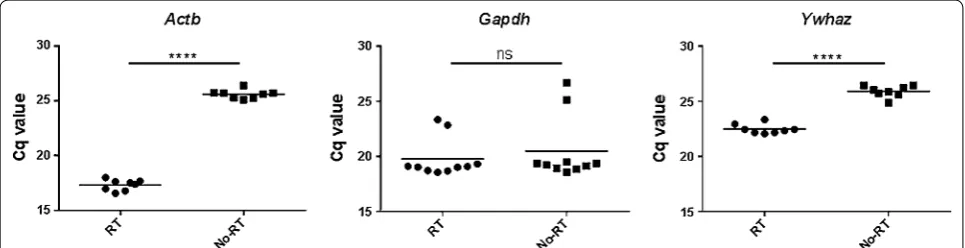
Although DNase was used during the RNA extraction process, three of the primer/probe sets detected signals from No-RT controls in qPCR including Actb, Gapdh
and Ywhaz. While the Cq values of No-RT controls were significantly larger than those of cDNA samples for Actb
and Ywhaz, those of Gapdh showed no difference (Fig. 1). There was no signal detected from non-template controls.
Identification of the optimal reference gene by RefFinder software
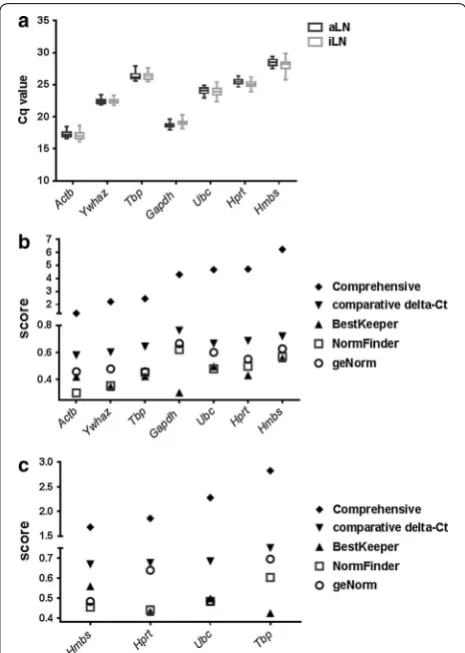
Lower Cq values among the seven reference genes were observed from Actb, Gapdh and Ywhaz (Fig. 2a,
Additional file 1: Tables S1, S2). Although this suggests abundant expression of these three genes, this may be confounded by contributions from genomic DNA and/or non-specific signals. Among the rest of the four reference genes, Ubc had the lowest Cq value (24.00 ± 0.62) and
Hprt had the smallest sample variation when Cq values were averaged from total LNs (25.31 ± 0.54).
RefFinder assesses potential reference genes based on four computational programs: geNorm, NormFinder, BestKeeper and the comparative delta-Ct method, and provides a comprehensive score to rank the stability of the reference genes across experimental groups (higher stability with lower scores). When all seven genes were included in the analysis, RefFinder identified Actb as the most stable gene (by comprehensive score), followed by
Ywhaz and Tbp (Fig. 2b and Additional file 1: Table S3). However, genomic DNA and nonspecific signals in Actb,
Gapdh and Ywhaz samples could confound the stabil-ity assessment. After eliminating these genes, the com-prehensive score recognized Hmbs as the most stable gene (Fig. 2c and Additional file 1: Table S4). However, the stability scores given by the four programs were not consistent. For example, while NormFinder gave the low-est score to Hprt, geNorm gave the lowest score to both
Hmbs and Ubc (Fig. 2c and Additional file 1: Table S4).
Evaluation of the optimal reference gene by Irf4, Zbtb20, Tnfrsf17 and Il4 expression
The suitability of the reference genes was further evalu-ated by ΔΔCq method with target genes that are known to be expressed after vaccinations. The expression of
Tnfrsf17 is associated with antibody magnitude following immunization with a live attenuated yellow fever vaccine, trivalent inactivated influenza vaccine and polysaccha-ride-protein conjugate vaccine for Neisseria meningitidis,
and is a potential biomarker for predicting the anti-body response at 2–3 months after vaccination [24–26].
[image:3.595.57.540.562.686.2]Since DTaP is an aluminum-adjuvanted vaccine which is known to induce a Th2-biased immune response [27,
28], we also examined the expression of IL-4. In addition, IRF4 and ZBTB20 have been identified as crucial tran-scription factors for long term survival of plasma cells with aluminum-adjuvanted antigens [29, 30]. Although their induced expression levels are expected to be rela-tively low, we included these two genes as positive con-trols following DTaP vaccination.
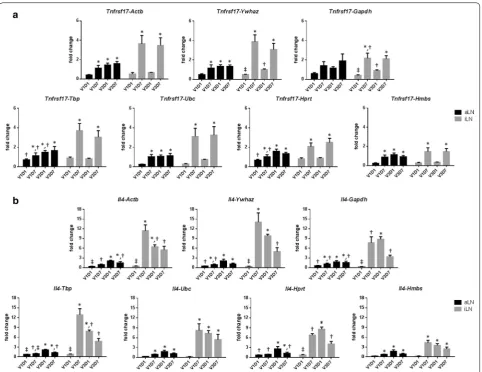
The reference genes were evaluated by using their Cq values to calculate the relative expression level for each of the target genes. A significantly higher expression of
Tnfrsf17 was observed at 7 days after the 1st and 3rd vaccination but not at 1 day after vaccination with all seven reference genes (Fig. 3a). The expression of Il4 was
increased at 7 days after the 1st vaccination and the level was not enhanced after the 3rd vaccination although the calculated fold-change varied among different reference genes (Fig. 3b). Overall, the use of these seven reference genes yielded similar patterns of relative gene expression for Tnfrsf17 and Il4 (Fig. 3).
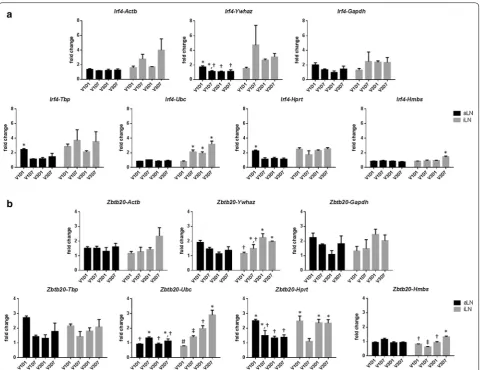
However, the variation caused by using a different ref-erence gene became evident when the induced expres-sion levels of target genes was lower such as for Irf4 and
Zbtb20 (Fig. 4). Among the seven reference genes, Ubc
consistently delivered low background expression in non-draining aLN and more distinct expression of Irf4 and
Zbtb20 in draining iLNs (Fig. 4). The use of Hmbs yielded similar pattern but lower expression levels, whereas Actb,
Ywhaz, Gapdh, Hprt and Tbp failed to show the low grade expression patterns (Fig. 4).
Discussion
The current study was carried out to search for suitable reference genes for gene expression studies in mouse draining lymph nodes after DTaP vaccination. The sam-ples collected after the first vaccination (V1D1 and V1D7) were considered priming responses whereas those collected after the third vaccination (V3D1 and V3D7) were mainly a memory response which reacts quicker and stronger compared to the primary response.
As expected, the total RNA concentrations obtained from the draining lymph nodes were significantly larger than those from non-draining lymph nodes from vaccinated mice and the iLN and aLN of naïve mice. For the genes whose No-RT controls showed signals, the Cq values of No-RT were significantly larger than those of cDNA sam-ples for Actb and Ywhaz, and those of Gapdh showed no difference. It indicates the signals of No-RT controls from
Actb and Ywhaz are derived from residual genomic DNA and those of Gapdh might be non-specific amplification.
The expression of Tnfrsf17 was significantly higher at 7 days after the 1st and 3rd vaccination but not at 1 day after vaccination with all seven reference genes. This result is consistent with previous studies that Tnfrsf17
expression is associated with antibody magnitude after 7 days but not at 1 or 3 days after vaccination [24–26]. TNFRSF17, also known as B cell maturation antigen (BCMA), is expressed in terminally-differentiated B cells and is one of the three receptors for B cell activat-ing factor (BAFF). While loss of the BCMA receptor has no impact on B cell development and the generation of mature peripheral B cells, the BCMA signaling pathway is important for the survival of plasma cells [31].
The computer programs used in this study identified
Hmbs as the most stable gene when Actb and Ywhaz, and
Gapdh were not included in the analysis. However the ΔΔCq method using gene expression of transcription
[image:4.595.57.290.87.414.2]factors confirmed Ubc performed better than Hmbs as a reference gene. These results also suggest that geNorm provides more relevant assessment than the other com-putational programs used in this study. In addition to the uniformity of gene expression, ideal reference genes should have similar expression levels with the target genes [2]. Although the mean Cq values of Actb was within the moderate expression range of 15–30 Cq [32], it was the lowest (17 ± 0.53) among the seven reference genes and created the largest ΔCq values with the Cq values from the targets genes, i.e., the average Cq values of target genes ranges from 26.63–30.18. The Cq values of Actb
might lose its sensitivity to reflect the difference in sample loading or RNA extraction due to its abundant expression.
The suitable reference gene identified in this study was
Ubc, which encodes the protein polyubiquitin C. Poly-ubiquitin C is one of the precursors for Poly-ubiquitin (Ub)
that has nine tandem repeats of Ub and is cleaved by deu-biquitinating enzymes to release functional monomeric Ub units [33]. Ubiquitination regulates all aspects of cell biology, including protein degradation, cell signaling, cell cycle, gene expression, intracellular trafficking and the DNA damage response [34]. Although ubiquitina-tion plays an important role in the regulaubiquitina-tion of immune responses such as dendritic cell maturation and T cells activation and differentiation [35], the expression of Ubc
was found to remain stable following vaccination in the current study.
Conclusion
The choice of reference gene can markedly affect the interpretation of gene expression especially for those genes with low expression levels. Here, we identified Ubc
as the ideal reference gene for gene expression analysis
[image:5.595.58.541.86.458.2]in mouse lymph nodes following DTaP vaccination. Although the commercial Taqman primer/probe sets are generally well-designed, careful evaluation for each appli-cation is recommended.
Abbreviations
qPCR: quantitative real time PCR; Actb: β‑actin; Gapdh: glyceraldehyde‑ 3‑phosphate dehydrogenase; Ywhaz: tyrosine 3‑monooxygenase/tryptophan 5‑monooxygenase activation protein, zeta polypeptide; Ubc: ubiquitin C;
Hprt: hypoxanthine phosphoribosyltransferase; Hmbs: hydroxymethylbilane synthase; Tbp: TATA box‑binding protein; DTaP: diphtheria–tetanus–acellular pertussis vaccine; V1D1: one day after the 1st vaccination; V1D7: seven days after the 1st vaccination; V3D1: one day after the 3rd vaccination; V3D7: seven Additional file
Additional file 1. Selection of a suitable reference gene for quantitative gene expression in mouse lymph nodes after vaccination.
days after the 3rd vaccination; Irf4: interferon regulatory factor 4; Il4: interleukin 4; Zbtb20: zinc finger and BTB domain‑containing protein 20; Tnfrsf17: tumor necrosis factor receptor superfamily member 17; aLN: axillary lymph node; iLN: iliac lymph node; Cq: quantification cycle; BCMA: B cell maturation antigen; BAFF: B cell activating factor; Ub: ubiquitin.
Authors’ contributions
YCM and HH designed the study, YCM performed the experiments and YCM and HH wrote the manuscript. Both authors read and approved the final manuscript.
Acknowledgements
We thank Dr. Fangjia Lu for his technical assistance.
Competing interests
The authors declare that they have no competing interests.
Availability of data and materials
The datasets collected in this study are available in the Additional file.
Consent for publication Not applicable.
[image:6.595.59.541.86.456.2]Ethics approval and consent to participate
The experimental animal studies were performed in strict accordance with the Guide for the Care and Use of Laboratory Animals of the National Institutes of Health. The protocol was approved by the Purdue University Animal Care and Use Committee.
Funding
This study was generously supported by gifts from the Hayward Genetics Foundation and the BMWLR Foundation.
Publisher’s Note
Springer Nature remains neutral with regard to jurisdictional claims in pub‑ lished maps and institutional affiliations.
Received: 29 September 2016 Accepted: 28 November 2017
References
1. VanGuilder HD, Vrana KE, Freeman WM. Twenty‑five years of quantitative PCR for gene expression analysis. Biotechniques. 2008;44(5):619–26. 2. Kozera B, Rapacz M. Reference genes in real‑time PCR. J Appl Genet.
2013;54(4):391–406.
3. Thellin O, Zorzi W, Lakaye B, De Borman B, Coumans B, Hennen G, Grisar T, Igout A, Heinen E. Housekeeping genes as internal standards: use and limits. J Biotechnol. 1999;75(2–3):291–5.
4. Dheda K, Huggett JF, Bustin SA, Johnson MA, Rook G, Zumla A. Validation of housekeeping genes for normalizing RNA expression in real‑time PCR. Biotechniques. 2004;37(1):112–9.
5. Hruz T, Wyss M, Docquier M, Pfaffl MW, Masanetz S, Borghi L, Verbrugghe P, Kalaydjieva L, Bleuler S, Laule O, et al. RefGenes: identification of reliable and condition specific reference genes for RT‑qPCR data normalization. BMC Genomics. 2011;12:156.
6. Bustin SA, Benes V, Garson JA, Hellemans J, Huggett J, Kubista M, Mueller R, Nolan T, Pfaffl MW, Shipley GL, et al. The MIQE guidelines: minimum information for publication of quantitative real‑time PCR experiments. Clin Chem. 2009;55(4):611–22.
7. Jeong JK, Kang MH, Gurunathan S, Cho SG, Park C, Seo HG, Kim JH. Evalu‑ ation of reference genes in mouse preimplantation embryos for gene expression studies using real‑time quantitative RT‑PCR (RT‑qPCR). BMC Res Notes. 2014;7:675.
8. Parham P. The immune system. 4th ed. USA: Garland Science; 2015. 9. Potashnikova D, Gladkikh A, Vorobjev IA. Selection of superior reference
genes’ combination for quantitative real‑time PCR in B‑cell lymphomas. Ann Clin Lab Sci. 2015;45(1):64–72.
10. Albershardt TC, Iritani BM, Ruddell A. Evaluation of reference genes for quantitative PCR analysis of mouse lymphocytes. J Immunol Methods. 2012;384(1–2):196–9.
11. Zhang Y, Zhang XD, Liu X, Li YS, Ding JP, Zhang XR, Zhang YH. Reference gene screening for analyzing gene expression across goat tissue. Asian– Australas J Anim Sci. 2013;26(12):1665–71.
12. Ledderose C, Heyn J, Limbeck E, Kreth S. Selection of reliable reference genes for quantitative real‑time PCR in human T cells and neutrophils. BMC Res Notes. 2011;4:427.
13. Tsaur I, Renninger M, Hennenlotter J, Oppermann E, Munz M, Kuehs U, Stenzl A, Schilling D. Reliable housekeeping gene combination for quan‑ titative PCR of lymph nodes in patients with prostate cancer. Anticancer Res. 2013;33(12):5243–8.
14. Fujii Y, Kitaura K, Matsutani T, Shirai K, Suzuki S, Takasaki T, Kumagai K, Kametani Y, Shiina T, Takabayashi S, et al. Immune‑related gene expres‑ sion profile in laboratory common marmosets assessed by an accurate quantitative real‑time PCR using selected reference genes. PLoS ONE. 2013;8(2):e56296.
15. Van den Broeck W, Derore A, Simoens P. Anatomy and nomenclature of murine lymph nodes: descriptive study and nomenclatory standardiza‑ tion in BALB/cAnNCrl mice. J Immunol Methods. 2006;312(1–2):12–9. 16. Langlet C, Tamoutounour S, Henri S, Luche H, Ardouin L, Grégoire C, Mal‑
issen B, Guilliams M. CD64 expression distinguishes monocyte‑derived and conventional dendritic cells and reveals their distinct role during intramuscular immunization. J Immunol. 2012;188(4):1751–60. 17. Lu F, Mosley Y‑YC, Rosales RJ, Carmichael BE, Elesela S, Yao Y, HogenEsch
H. Alpha‑D‑glucan nanoparticulate adjuvant induces a transient inflam‑ matory response at the injection site and targets antigen to migratory dendritic cells. npj Vaccines. 2017;2(1):4.
18. Xie F, Xiao P, Chen D, Xu L, Zhang B. miRDeepFinder: a miRNA analysis tool for deep sequencing of plant small RNAs. Plant Mol Biol 2012. 19. Vandesompele J, De Preter K, Pattyn F, Poppe B, Van Roy N, De Paepe A,
Speleman F. Accurate normalization of real‑time quantitative RT‑PCR data by geometric averaging of multiple internal control genes. Genome Biol. 2002;3(7):RESEARCH0034.
20. Andersen CL, Jensen JL, Ørntoft TF. Normalization of real‑time quantita‑ tive reverse transcription‑PCR data: a model‑based variance estimation approach to identify genes suited for normalization, applied to bladder and colon cancer data sets. Cancer Res. 2004;64(15):5245–50. 21. Pfaffl MW, Tichopad A, Prgomet C, Neuvians TP. Determination of stable
housekeeping genes, differentially regulated target genes and sample integrity: bestkeeper–excel‑based tool using pair‑wise correlations. Biotechnol Lett. 2004;26(6):509–15.
22. Silver N, Best S, Jiang J, Thein SL. Selection of housekeeping genes for gene expression studies in human reticulocytes using real‑time PCR. BMC Mol Biol. 2006;7:33.
23. Livak KJ, Schmittgen TD. Analysis of relative gene expression data using real‑time quantitative PCR and the 2(‑Delta Delta C(T)) Method. Methods. 2001;25(4):402–8.
24. Querec TD, Akondy RS, Lee EK, Cao W, Nakaya HI, Teuwen D, Pirani A, Gernert K, Deng J, Marzolf B, et al. Systems biology approach predicts immunogenicity of the yellow fever vaccine in humans. Nat Immunol. 2009;10(1):116–25.
25. Li S, Rouphael N, Duraisingham S, Romero‑Steiner S, Presnell S, Davis C, Schmidt DS, Johnson SE, Milton A, Rajam G, et al. Molecular signatures of antibody responses derived from a systems biology study of five human vaccines. Nat Immunol. 2014;15(2):195–204.
26. Nakaya HI, Wrammert J, Lee EK, Racioppi L, Marie‑Kunze S, Haining WN, Means AR, Kasturi SP, Khan N, Li GM, et al. Systems biology of vaccination for seasonal influenza in humans. Nat Immunol. 2011;12(8):786–95. 27. Ross PJ, Sutton CE, Higgins S, Allen AC, Walsh K, Misiak A, Lavelle EC,
McLoughlin RM, Mills KH. Relative contribution of Th1 and Th17 cells in adaptive immunity to bordetella pertussis: towards the rational design of an improved acellular pertussis vaccine. PLoS Pathog. 2013;9(4):e1003264. 28. HogenEsch H. Mechanisms of stimulation of the immune response by
aluminum adjuvants. Vaccine. 2002;20(Suppl 3):S34–9.
29. Chevrier S, Emslie D, Shi W, Kratina T, Wellard C, Karnowski A, Erikci E, Smyth GK, Chowdhury K, Tarlinton D, et al. The BTB‑ZF transcription factor Zbtb20 is driven by Irf4 to promote plasma cell differentiation and longevity. J Exp Med. 2014;211(5):827–40.
30. Wang Y, Bhattacharya D. Adjuvant‑specific regulation of long‑term anti‑ body responses by ZBTB20. J Exp Med. 2014;211(5):841–56.
31. Coquery CM, Erickson LD. Regulatory roles of the tumor necrosis factor receptor BCMA. Crit Rev Immunol. 2012;32(4):287–305.
32. Lland H, Hertzberg M, Marlton P. Humana. Berlin: Springer Science & Busi‑ ness Media; 2006. p. 53.
33. Kimura Y, Tanaka K. Regulatory mechanisms involved in the control of ubiquitin homeostasis. J Biochem. 2010;147(6):793–8.
34. Swatek KN, Komander D. Ubiquitin modifications. Cell Res. 2016;26(4):399–422.