R E S E A R C H A R T I C L E
Open Access
Role of maternity waiting homes in the
reduction of maternal death and stillbirth
in developing countries and its
contribution for maternal death reduction
in Ethiopia: a systematic review and
meta-analysis
Tegene Legese Dadi
1,3*, Bayu Begashaw Bekele
1, Habtamu Kebebe Kasaye
2and Tadesse Nigussie
1Abstract
Background:Every family expect to have a healthy mother and new born baby after pregnancy. Especially for
parents, pregnancy is a time of great anticipation. Access to maternal and child health care insures safer pregnancy and its outcome. MWHs is one the strategy. The objective was to synthesize the best available evidence on effectiveness of maternity waiting homes on the reduction of maternal mortality and stillbirth in developing countries.
Methods:Before conducting this review non-occurrences of the same review is verified. To avoid introduction of bias because of errors, two independent reviewers appraised each article. Maternal death and stillbirth were the primary outcomes. Review Manager 5 were used to produce a random-effect meta-analysis. Grade Pro software were used to produce risk of bias summary and summary of findings.
Result:In developing countries, maternity waiting homes users were 80% less likely to die than non-users (OR = 0. 20, 95% CI [0.08, 0.49]) and there was 73% less occurrence of stillbirth among users (OR = 0.27, 95% CI [0.09, 0.82]). In Ethiopia, there was a 91% reduction of maternal death among maternity waiting homes users unlike non-users (OR = 0.09, 95% CI [0.04, 0.19]) and it contributes to the reduction of 83% stillbirth unlike non-users (OR = 0.17, 95% CI [0.05, 0.58]).
Conclusion:Maternity waiting home contributes more than 80% to the reduction of maternal death among users
in developing countries and Ethiopia. Its contribution for reduction of stillbirth is good. More than 70% of stillbirth is reduced among the users of maternity waiting homes. In Ethiopia maternity waiting homes contributes to the reduction of more than two third of stillbirths.
Keywords:Maternity waiting homes, MWHs, Maternal mortality, Stillbirth, Developing countries, Ethiopia, Maternal death
* Correspondence:[email protected];[email protected] 1Department of public health, Collage of Health Science, Mizan-Tepi University, Tepi, Ethiopia
3Mizan Teferi, Ethiopia
Full list of author information is available at the end of the article
Background
Pregnancy is a time of great anticipation to have healthy baby and mother after pregnancy. Experiencing maternal death and stillbirth in the final stages of pregnancy is unfortunate for families [1]. To make pregnancy and its outcome safer, every woman should have access to maternal and child health care services during preg-nancy, delivery and a period after delivery [2]. As the recommendation of WHO, improvement of obstetric care services can be accomplished by the following three methods: “1. Providing health care services for mothers in need - “flying squads””, “2. Making favourable condi-tion for mothers who need medical services - emergency transport”, and “3. Making health care services more
accessible to women [2]. The third solution, needs
extensive expenditure on health service, including ex-panded skilled human resources, which is difficult for developing countries [2,3].
Many women in low and middle income countries face the challenges of inaccessibility of obstetric care in rural and urban areas. Even where services are available the facilities are unequipped [2]. Rural women are 3.572 times more likely to die because of pregnancy or delivery than women who came from urban areas with 95% CI (1.001, 6.726). This might be rural females do not utilize maternal health services due to different reasons. As a result they may face high obstetric complications [4].
To minimize these problems, developing countries used MWH (maternity waiting homes) as an alternative to increase accessibility of obstetric care services. MWH are homes built in the compound or near to health facil-ities that provides standard medical and emergency obstetric care services. This is the easiest way to de-crease the complication related to child birth through avoiding the second delay. It decreases barriers, which includes: distance, geography, transport, cost of trans-port and communication between referral points, that inhibit access to service, [2,3,5].
Globally low and middle income countries contribute about 99% of maternal death in 2015, from this sub-Saharan Africa accounts for 66% of maternal death which is discriminately high [6]. In 2015 the estimated global stillbirth was 18·4 per 1000 births, it was de-creased by 25% from that of 2000. In the same year, in sub-Saharan Africa it was decreased by 19%, which was low progress [6]. Low and middle income countries con-tributes 98% of stillbirths; sub-Saharan Africa and South Asia share about 77% [7]. Majority of losses related to pregnancy and child birth can be prevented through providing high quality and evidence based services [1].
According to EWEC technical workstream working group, by 2030 from 2010, all countries have to decrease MMR (maternal mortality rate) by a minimum of two thirds. In 2030 the target for the globe is < 70 per
100,000 live births, but no country have to have a MMR of more than 140 per 100,000 live births. By 2030, the maximum stillbirth’s rate is <= 12 per 1000 live births for every country [8, 9]. To achieve these targets each country has to work towards minimizing barriers of accessing quality maternal and child health care services. Therefore, planners should analyse their contextualised problems, researching available services, and implemen-tation of rational framework for prioritizing and scaling up of essential services [8,9].
Research gaps identified
There is one scoping review by Julie M. Buser et al. which shows new born outcomes of maternity waiting homes. This review doesn’t appraise the quality of evi-dence and doesn’t provide evidences of effectiveness of MWHs, it only narrate the available researches [10]. The systematic review on the Cochrane Review published in 2012 didn’t include any randomized controlled studies and did not perform meta-analyses. It provides limited
information on the potential benefit of MWH [11].
Thus, it is essential to prove efficacy of MWH through systematic reviews and meta-analysis.
In addition to the above reasons, the WHO 2015 en-dorsements on“health promotion interventions for mater-nal and newborn health states that there is a research gap on identifying efficacy of MWH.”So there is a need for a study whether the MWH effectively improves birth out-comes or not [3].
Objective of this review
The objective of this review was to systematically iden-tify, appraise and synthesize the best available evidence on effectiveness of MWHs on the reduction of maternal mortality and stillbirth in developing countries.
Research questions
Is constructing MWHs in developing countries is effect-ive in decreasing maternal death and stillbirth?
How much MWHs kick in to the reduction of mater-nal death and stillbirth in Ethiopia?
Methods
Search strategy
keyword and index search terms: Maternity waiting homes and maternity waiting areas with maternal death and stillbirth.
Except one review by Van Lonkhuijzen L. et al. from Cochrane Database of Systematic Reviews, no review is conducted as well as no protocol is developed. The ob-jective of the study by Van Lonkhuijzen L. et al. was to see the effect of MWHs on maternal outcome using only clinical trials study. This review did not get any clinical trials and no result is provided by the review [11]. A sci-entific literature search from AJOL, PubMed, Google scholar, EMBASE, Ovid and Scopus databases was
con-ducted from March – June 2017 GC using different
search terms, which is listed in Additional file 1. Gray literatures were searched from Google and Google scholar, the largest store of gray literatures.
In addition, literatures were searched from research gate. For additional studies that may have been missed in the electronic search, cross reference was undertaken using the reference lists of all identified articles. Articles identified from variety sources were assessed for importance as per the objective of the study. All authors participated in searching each data-base. An abstract and full report was captured that meet the inclusion criteria.
Inclusion and exclusion criteria
The criteria for inclusion in the review includes quanti-tative research reports on effectiveness of MWHs on the decreasement of maternal death and stillbirth. In addition to the above mentioned, articles performed in developing countries and published in the English lan-guage are the criteria. We don’t have a limitation on starting time of paper publication. Articles were excluded, if they are pure qualitative research, if data not presented for a comparator, if no data presented for the desired outcome, editorials and short commentaries.
Selection of articles
Study selection was conducted by all authors independ-ently. The selection process was first started by avoiding duplicates using Mendeley Desktop reference manager. Next reviewing the titles and abstracts of all collected lit-eratures were performed. Litlit-eratures with unrelated title and abstract were excluded. All relevant articles were considered for full review. When there were disagree-ments in the grouping of articles, decision was made by discussion and by reviewing the articles together.
Besides above mentioned inclusion criteria’s, each paper that meet the inclusion criteria are critically reviewed by two independent reviewers for a single stud for
[image:3.595.58.540.404.720.2]methodological validity. It is appraised by appraisal instru-ments from the Joanna Briggs institute meta-analysis of statistical assessment and review instrument (JBI--MAStARI) (Additional file 1).
Study outcomes
Primary outcomes
Maternal death Stillbirth
Secondary outcomes
Neonatal mortality Parity
Assessment of quality of evidence across studies
[image:4.595.56.546.97.618.2]Grade Pro software (Grade Pro 2016) is used to measure the quality across studies and to summarize findings. It has four levels: high, moderate, low or very low. Obser-vational studies were categorized as low quality. But can
Table 1summary of included studies
Author Set up Study design Outcome measure Proportion for MWHs users Proportion for non MWHs users
J.M. Tumwine et al. 1996 [17]
Zimbabwe Retrospective cohort Stillbirth 3/280 16/773
Early neonatal mortality 4/280 7/773
Maternal death 1/277 3/757
Parity = 0 89/280 215/773
1–4 121/280 367 /773
> = 5 70/280 191 /773
P.Millard et al. 1991 [18] Zimbabwe Comparative study Stillbirth 9 /486 14 /336
Early Neonatal mortality 8 /486 14 /336
Parity = 0 123 /486 80 /336
1–3 204 /486 137 /336
4–6 121 /486 86 /336
> = 7 36 /486 30 /336
Lonkhuijzen Luc van et al. 2003 [19]
Zambia Retrospective cohort Maternal death 0 /218 1 /292
Parity =0 54 /218 31 /292
> 6 12 /218 8 /292
Andemichael Ghirmay et al. 2009 [20]
Eritrea Before and after study Maternal death 0 /866 5 /266
Jody R Lori et al. 2013 [21]
Liberia Prospective cohort Maternal death 3 /248 12 /255
Singh Kavita et al. 2017 [22]
Malawi Cross sectional Stillbirth 3 /255 1 /287
Parity =1 115 /249 104 /288
2–3 73 /249 112 /288
> = 4 61 /249 68 /288
Age = 15–19 62 /259 45 /288
20–34 164 /259 216 /288
> = 35 33 /259 26 /288
Poovan Pia et al. 1990 [23] Ethiopia Retrospective cohort Maternal death 0 /142 13 /635
Stillbirth 4 /142 161 /635
J Kelly et al. 2010 [24] Ethiopia Retrospective cohort Maternal death 6 /6805 187 /17343
Stillbirth 120 /6805 3316 /17343
Parity =0 193 /615 525 /1099
1–3 294 /615 366 /1099
> = 4 118 /615 177 /1099
D.Chandramohan et al. 1994 [25]
Zimbabwe Retrospective cohort Maternal death 1 /1573 2 /2915
Primiparas 661 /1573 1108 /2915
be upgraded to moderate quality depending on the types of studies and factors that can increase the quality level. The factors that increase the levels are: large effect, if all plausible confounding would lead to an underestimation of the effect and if there is a dose-response gradient.
Data extraction
We extracted results of above-mentioned outcomes using data extraction tool from JBI-MAStARI (Additional file1). All results were taken out by two independent reviewers to avoid extraction error.
Data analysis
Review Manager 5 is used for statistical analysis and Grade Pro software (Grade Pro 2016) is used to produce a summarized findings. Random-effect meta-analysis was performed to pool the odds ratio (OR) of the outcomes of maternal death and stillbirth. The assumption for random effect meta-analysis is from a range of populations in which the effect size varies and our goal is to summarize this range of effects. The conditions of the fixed effect model are not met, since the true effect size for all studies is identical, and the only reason the effect size varies be-tween studies is random error. Each study is estimating an effect size for its unique population, and so each must be given appropriate weight in the analysis. We summarized the effect in terms of OR with their 95% CI, risk difference (RD) and anticipated absolute effects. Forest plot contain-ing OR, 95% confidence intervals (CI),Pvalue, effect size, and, heterogeneity (I2) were constructed.P value <= 0·05
was considered statistically significant. Sensitivity analysis or subgroup analysis is performed for meta-analysis incorporating more than two studies when the heterogen-eity (I2) is above 60% by removing outlier study. The forest plot is presented for each subgroup analysis.
Result
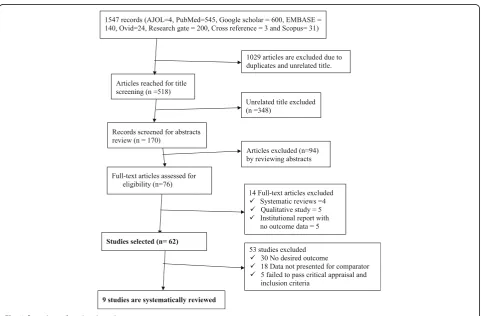
A total of 1547 articles were identified through databases searching. Of these, 1029 articles were excluded as dupli-cates and by observation of titles. Seventy six articles were identified for full text review, 67 of them are excluded due to not meeting the inclusion criteria. Nine studies were in-cluded in the review (Fig.1).
Summary of findings and description of included studies
Nine studies are included to assess the primary and sec-ondary outcomes. Parity is reported by 6 studies, but they reported in a different classification. Early neonatal mortality is reported by two studies. Age of mother is re-ported by only Singh Kavita et al. (Table1).
[image:5.595.56.541.99.185.2]The quality of our evidence across studies is moderate. All of studies are consistent that uses of MWHs have a better outcome in the prevention of maternal death and stillbirth. The result of anticipated absolute effect shows, the risk of maternal death with MWHs is 1 per 1000 live births. However the risk for pregnant females who don’t use MWHs is 10 per 1000 live births. There is a great disparity in the occurrences of stillbirth among MWHs users and non-users. Among the users’ risk of stillbirth is 17 per 1000 live births, but for non-users risk raises
Table 2Quality assessment and summary the findings for the primary outcomes in developing countries
Outcomes №of participants (studies)
Quality of the evidence (GRADE)
Anticipated absolute effects
Risk with MWH Risk with Non MWH Risk difference with MWH
Maternal death 32,592 (7 observational studies) ⨁⨁⨁◯ MODERATE
1 per 1000 (11/10,129)
10 per 1000 (223/22,463)
9 fewer per 1000 (10 fewer to 8 fewer)
Stillbirth 27,342 (5 observational studies) ⨁⨁⨁◯ MODERATE
17 per 1000 (139/7968)
181 per 1000 (3508/19374)
164 fewer per 1000 (166 fewer to 159 fewer)
GRADE Working Group grades of evidence
High quality: We are very confident that the true effect lies close to that of the estimate of the effect
Moderate quality: We are moderately confident in the effect estimate: The true effect is likely to be close to the estimate of the effect, but there is a possibility that it is substantially different
Low quality: Our confidence in the effect estimate is limited: The true effect may be substantially different from the estimate of the effect
Very low quality: We have very little confidence in the effect estimate: The true effect is likely to be substantially different from the estimate of effect
Table 3Quality assessment and summary the findings for the primary outcomes in Ethiopia Outcomes among MWH
and Non MWH users №
of participants (studies)
Anticipated absolute effects*(95% CI) Quality of the evidence (GRADE) Risk with Non MWH Risk with MWH Difference
Maternal death in Ethiopia 24,925 (2 observational studies) 11 per 1000 0.86 per 1000 (0 to 2)
10.14 fewer
(9 fewer to 8 fewer) ⨁⨁⨁MODERATE◯
Stillbirth in Ethiopia 24,925 (2 observational studies) 65 per 1000 18 per 1000 (16 to 22)
47 fewer
(49 fewer to 43 fewer)
⨁⨁⨁◯
[image:5.595.58.539.644.732.2]by more than ten times (181 per 1000 live births) (Table2).
Anticipated absolute effects result for studies retrieved from Ethiopia shows maternal death among non MWHs users (11 per 1000 live births) is more than ten times higher than MWHs users (0.86 per 1000 live births). The risk of stillbirth is 3.6 times higher among MWHs non users than users (Table3).
Maternal death
Effect of MWHs on maternal death in developing countries
[image:6.595.64.540.87.272.2] [image:6.595.63.540.609.726.2]Seven studies including a total of 32,592 participants re-ported the occurrence of maternal death among MWH users and non-users. There are 11 maternal deaths out of 10,129 MWHs users and 223 maternal deaths out of 22,463 MWHs non users. MWH user mothers are 80% less likely to die than non-users (OR = 0. 20, 95% CI [0.08, 0.49]), I2= 39%, (P< 0.00001) (Fig.2).
Effect of MWHs on maternal death in Ethiopia
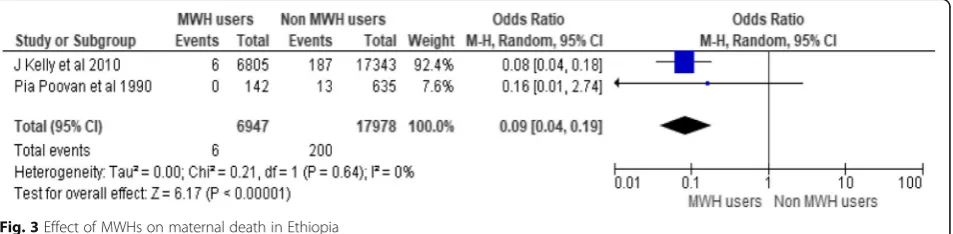
There are three studies conducted in Ethiopia incorporat-ing a total of 24,925 participants (6947 MWH users and 17,978 non users). Only 6 maternal death occurred among users of MWH but, 200 deaths occurred among non-users. There is a 92% reduction of maternal death
among MWHs users as compared to non-users (OR = 0.09, 95% CI [0.04, 0.19]), I2= 0%, (P< 0.00001) (Fig.3).
Stillbirth
Effect of MWHs on stillbirth in developing countries
To assess effects of MWHs on stillbirth five studies are pooled, including 27,342 participants (7968 MWHs users and 19,374 non users). Occurrences of stillbirth among non-users are more than ten times as compared to non-users. There is 73% less occurrence of stillbirth
among users (OR = 0.27, 95% CI [0.09, 0.82]), Chi2=
34.06, df = 4(P < 0.00001); I2= 88% (Fig.4).
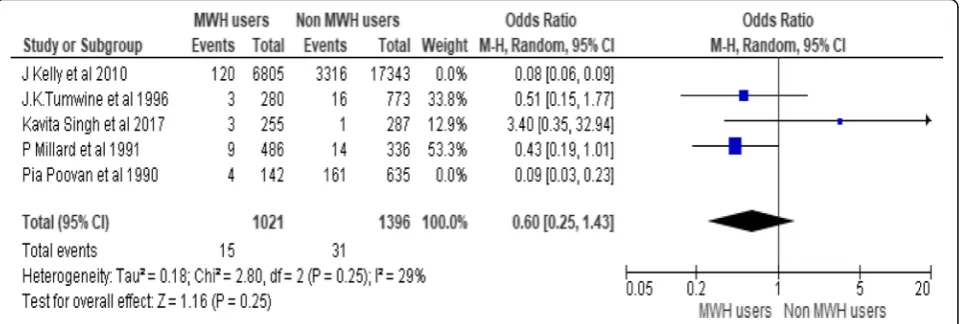
The heterogeneity is large (I2= 88%). In order to treat this heterogeneity, Subgroup analysis is conducted by re-moving outlier studies. The subgroup analysis is per-formed by removing the effect of J Kelly et al. 2010 and Pia Poovan et al. 1990 the heterogeneity becomes 29%. However the odds ratio is not significant (Fig.5).
Effect of MWH on stillbirth in Ethiopia
To observe the contribution of MWHs on reduction of stillbirth only two studies are included in the analysis of fixed effect meta-analysis. These studies incorporate a total of 24,925 participants. MWHs utilization contrib-utes to the reduction of 83% stillbirth as compared to
Fig. 2Effect of MWHs on maternal death in developing countries
non-users (OR = 0.17, 95% CI [0.05, 0.58]), Chi2= 5.56, df = 1(P< 0.02); I2= 82% (Fig.6).
Even though the difference is significant the hetero-geneity among the study is 82% (I2= 82%). The reason for this heterogeneity is the number of participants included. JKelly et al. 2010 includes more than 20 times of participants than the other study. This makes JKelly et al. 2010 as outlier or vice versa.
Secondary outcomes
Early neonatal mortality
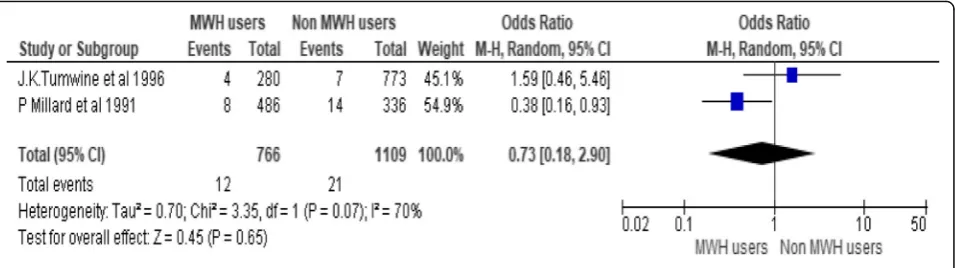
There are only two studies that include early neonatal mortality as an outcome in addition to the primary out-comes. They include a total of 1875 participants. Both of the studies are not in line whether MWH utilization reduces early neonatal mortality or not. Their aggregate effect is also not significant. But a higher proportion of early neonatal death occurred among non-users of MWHs than users (Fig.7).
Age of mother
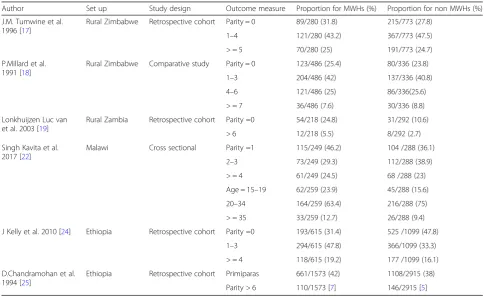
Age of mother is reported only by Singh Kavita et al. 2017. Most of users of MWHs (63.4%) are mothers in the
age group of 20–34. From females who are not users of MWHs 75% of them are in between 20 and 34 (Table4).
Parity
Six studies reported parity distribution of study partici-pants. Each of them reported in different ways so unable to pool the results together. The two studies from Zimbabwe (by J.M.Tumwine et al. and P.Millard et al) shows when females’parity is > = 1 they less likely utilize
MWHs. But they most likely use when they don’t have
children (parity = 0). In addition, study from Zambia (by Lonkhuijzen Luc van et al) shows females more likely
use MWHs when they don’t have children. In contrast
to the above result from Zimbabwe, study from Ethiopia (by J.Kelly et al) shows females most likely use when they have children (parity > = 1) (Table4).
Discussion
MWH is one part of the strategy to boost uptake of maternal health services in developing countries by overcoming demand-side barriers. It avoids problems created due to long distance from health institutions. Since they can stay and await labour for high-risk
Fig. 4Effect of MWHs on stillbirth in developing countries
[image:7.595.66.540.87.256.2] [image:7.595.59.540.554.716.2]pregnant women [3, 12]. This meta-analysis depicts MWHs has a great contribution in decreasing maternal death and stillbirth rate in developing countries. The fixed effect meta-analysis shows MWHs have 80% con-tribution for reduction of maternal mortality among users (OR = 0. 20, 95% CI [0.08, 0.49]). This result might be underestimated since most of the time high-risk preg-nant women are admitted in MWHs. The implication, for developing countries is that further expansion of MWHs an alternative best solution for rural areas.
Ethiopia reduced maternal mortality by 71.8% from 1250 in 1990 to 353 per 100,000 live births in 2015.
Studies on health care institutions also show there is decreasing trend of maternal mortality [6, 13, 14]. Increasing accessibility of health services has its own contribution to the reduction. The meta-analysis depicts 91% reduction of maternal death among MWHs users unlike non-users (OR = 0.09, 95% CI [0.04, 0.19). MWHs have their own contribution by decreasing second delay or by bridging high-risk pregnant women living far away from health institutions [6,12].
The highest burden of stillbirth is found in low and mid-dle- income countries (98%). Sub-Saharan Africa and southern Asia regions accounts for 77% of stillbirth. Its
[image:8.595.58.538.89.224.2]Fig. 6Effect of MWHs on stillbirth in Ethiopia
Table 4maternal age and parity distribution among MWHs users and non-users
Author Set up Study design Outcome measure Proportion for MWHs (%) Proportion for non MWHs (%)
J.M. Tumwine et al. 1996 [17]
Rural Zimbabwe Retrospective cohort Parity = 0 89/280 (31.8) 215/773 (27.8)
1–4 121/280 (43.2) 367/773 (47.5)
> = 5 70/280 (25) 191/773 (24.7)
P.Millard et al. 1991 [18]
Rural Zimbabwe Comparative study Parity = 0 123/486 (25.4) 80/336 (23.8)
1–3 204/486 (42) 137/336 (40.8)
4–6 121/486 (25) 86/336(25.6)
> = 7 36/486 (7.6) 30/336 (8.8)
Lonkhuijzen Luc van et al. 2003 [19]
Rural Zambia Retrospective cohort Parity =0 54/218 (24.8) 31/292 (10.6)
> 6 12/218 (5.5) 8/292 (2.7)
Singh Kavita et al. 2017 [22]
Malawi Cross sectional Parity =1 115/249 (46.2) 104 /288 (36.1)
2–3 73/249 (29.3) 112/288 (38.9)
> = 4 61/249 (24.5) 68 /288 (23)
Age = 15–19 62/259 (23.9) 45/288 (15.6)
20–34 164/259 (63.4) 216/288 (75)
> = 35 33/259 (12.7) 26/288 (9.4)
J Kelly et al. 2010 [24] Ethiopia Retrospective cohort Parity =0 193/615 (31.4) 525 /1099 (47.8)
1–3 294/615 (47.8) 366/1099 (33.3)
> = 4 118/615 (19.2) 177 /1099 (16.1)
D.Chandramohan et al. 1994 [25]
Ethiopia Retrospective cohort Primiparas 661/1573 (42) 1108/2915 (38)
[image:8.595.55.540.436.733.2]reduction is lowest in sub-Saharan Africa (1·4%) [7]. The causes for the high rates of stillbirth is due to poor maternal health care services [15]. There is a great disparity on the occurrences of stillbirth among MWHs users and non-users. This meta-analysis tells us that MWHs have an amicable role to reduce stillbirth. There is 73% less occur-rence of stillbirth among MWHs users (OR = 0.27, 95% CI [0.09, 0.82]) as compared to non-users. This finding implies that, constructing MWHs or strengthening its construction as a strategy to reduce stillbirth is effective mode of interventions.
Ethiopia is the fifth country in the world by having 97, 000 stillbirths [7]. MWHs utilization contributes to the reduction of 83% of stillbirth unlike non-users (OR = 0.17, 95% CI [0.05, 0.58]). As above mentioned, MWHs are crucial as a prevention modalities.
Low and middle income countries contribute 99% of neonatal deaths; about half of them occur at home. The first week of life covers three fourth of death. The high-est risk of death is on the first day of life [16]. There are only two studies pooled together. Study by P.Millard et al. shows MWHs use reduce early neonatal mortality. The other study is not significant. Their aggregate effect is not significant. But a higher proportion of early neonatal death occurred among non-users of MWHs than others.
These findings suggest that construction of maternity waiting home near health facility is one of the effective strategies to break phase II delays or transportation delays in developing countries.
Limitation of study
This systematic review and meta-analysis is conducted incorporating observational studies only. Literatures written by other than English is not included. Litera-tures included from Ethiopia in this review is con-ducted in only one place at different times. It does not represent the whole country. There might a pos-sibility of publication bias since published literatures written in English is included.
Conclusion
Having the abovementioned limitation of the study: Ma-ternity waiting home contributes almost 80% for the re-duction of maternal death among users in developing countries and Ethiopia as per this review. Its contribu-tion for reduccontribu-tion of stillbirth is good. More than 70% of stillbirth is reduced among the users. In Ethiopia MWHs contributes to a reduction of more than two third still-births among users. The effect of MWHs on early neo-natal mortality among MWHs users and non-users is not significant. But, a higher proportion of deaths occur among non-users. The major implication of this review is MWHs are effective for the accomplishment of sus-tainable development goals related to maternal and child health. The authors recommend further review as a pri-mary outcome to confirm whether MWHs is effective in reducing early neonatal death or not. In addition ran-domized controlled trial study is the gold standard method to prove the effectiveness of maternity waiting home.
Additional file
Additional file 1:This file contain Index and mesh terms, the search strategy used in different databases, critical appraisal formats, and data extraction format (DOCX 645 kb)
Abbreviations
AOR:Adjusted odds ratio; CI: Confidence interval; DHS: Demographic and health survey; EDHS: Ethiopian demographic and health survey; EPPI-Centre: Evidence for Policy and Practice Information; HTA: Health Technology Assessment; JBI- DSRIR: Joanna Briggs Institute Database of Systematic Reviews and Implementation Reports; JBI-MAStARI: Joanna Briggs institute meta-analysis of statistical assessment and review instrument;
MWHs: Maternity waiting homes; OR: Odds ratio; SSA: Sub–Saharan Africa; WHO: World health organization
Funding
There was no funding for this study. The corresponding author had full access to all the data in the study, and had final responsibility for the decision to submit for publication.
Availability of data and materials The data is available when there is demand.
Author’s contributions
TLD did article searching, critical appraisal, data extraction, data analysis, and edited manuscript. BBB did article searching, critical appraisal, data extraction, data analysis, and edited manuscript. HKK did article searching, critical appraisal, data extraction, data analysis, and edited manuscript. TN did article searching, critical appraisal, data extraction, data analysis, and edited manuscript. All authors have read and approved the manuscript.
Ethics approval and consent to participate not applicable.
Consent for publication Not applicable.
Competing interests
We declare no competing interest.
Publisher’s Note
Springer Nature remains neutral with regard to jurisdictional claims in published maps and institutional affiliations.
Author details 1
Department of public health, Collage of Health Science, Mizan-Tepi University, Tepi, Ethiopia.2Department of midwifery, Collage of Health Science, Wollega University, Nekemte, Ethiopia.3Mizan Teferi, Ethiopia.
Received: 23 February 2018 Accepted: 24 September 2018
References
1. WHO. Maternity waiting homes: a review of expereinces. Geneva: WHO; 1996. Available from:http://www.who.int/reproductivehealth/publications/ maternal_perinatal_health/MSM_96_21/en/.
2. WHO. Maternity waiting homes: a review of expereinces. Geneva:WHO; 1996.
3. WHO. WHO recommendations on health promotion interventions for maternal and newborn health. Geneva: WHO; 2015. p. 24–7. 4. Legese T, Abdulahi M, Dirar A. Risk factors of maternal death in Jimma
University specialized Hospital : a matched case control study. Am J Public Heal Res. 2016;4(4):120–7.
5. Vermeiden T, Stekelenburg J. Maternity waiting homes as part of an integrated program for maternal and neonatal health improvements: Women’s lives are worth saving. J Midwifery Womens Health United States. 2017 Mar;62(2):151–4.
6. WHO, UNICEF, eUNFPA, World Bank Group the UNPD. Trends in maternal mortality 1990-2015. Geneva:WHO; 2015.
7. Blencowe H, Cousens S, Jassir FB, Say L, Chou D, Mathers C, et al. National , regional , and worldwide estimates of stillbirth rates in 2015 , with trends from 2000 : a systematic analysis. Lancet Glob Heal [Internet]. 2015;4(2):e98– 108. Available from:https://doi.org/10.1016/S2214-109X(15)00275-2. 8. EWEC Technical Content Workstream working Group on ending
preventable maternal and newborn mortality and stillbirths. Ending Preventable Maternal and Newborn Mortality and Stillbirths. 2015. 9. WHO. The Global Strategy for Women’s and Children’s and Adolescents’
Health (2016–2030): Survive, Thrive, Transform. United Nations. 2015;1:1–108. Available from:www.unaids.org/sites/default/files/media.../
EWECGSMonitoringReport2018_en.pdf. Accessed April 2016.
10. Buser JM, Lori JR. Newborn Outcomes and Maternity Waiting Homes in Low and Middle-Income Countries : A scoping review. Matern child health J. New York: Springer; 2016.
11. van Lonkhuijzen L, Stekelenburg J van RJ. Maternity waiting facilities for improving maternal and neonatal outcome in low-resource countries ( Review ). Cochrane Database Syst Rev. 2009;3:D006759.
12. Elmusharaf K, Byrne E, Donovan DO. Strategies to increase demand for maternal health services in resource-limited settings : challenges to be addressed. BMC Public Health. 2015;15(870):1–10.
13. Legese T, Mulatu K, Kahsay T. Trends and determinants of maternal mortality in Mizan-Tepi University teaching and Bonga general hospital from 2011–2015 : a case control study. Heal Sci J. 2016;10(5):1–8.
14. Legesse T, Abdulahi M, Dira A. Trends and causes of maternal mortality in Jimma University specialized hospital , Southwest Ethiopia : a matched case –control study. Int J Women’s Heal. 2017;9(2017):307–13.
15. Kiguli J, Munabi IG, Ssegujja E, Nabaliisa J, Kabonesa C, Kiguli S, et al. Stillbirths in sub-Saharan Africa : unspoken grief. Lancet [Internet]. Elsevier Ltd; 2016;6736(15):10–11. Available from: https://doi.org/10.1016/S0140-6736(15)01171-X.
16. Lawn JE, Cc A, Kinney M, Sibley L, Carlo WA, Paul VK, et al. Two million intrapartum-related stillbirths and neonatal deaths : Where , why , and what can be done ? Int J Gynecol Obstet [Internet]. International Federation of Gynecology and Obstetrics; 2009;107(2009):S5–19. Available from:https:// doi.org/10.1016/j.ijgo.2009.07.016
17. Tumwine JK, Dungare PS. Maternity waiting shelters and pregnancy outcome : experience from a rural area in Zimbabwe. Ann Trop Paediatr [Internet] 1996;16(1):55–59. Available from:https://doi.org/10.1080/02724936. 1996.11747804
18. Millard P, Balley J, Hanson J. Antenatal village stay and pregnancy outcome in rural Zimbabwe. Cent Afr J Med. 1991;37(I):1–4.
19. Luc van Lonkhuiyzen, Margreet Stegeman, Rebecca Nyirongo Van Roosmalen J. Use of Maternity Waiting Home in Rural Zambia. Africa J Reprod Heal [Internet]. 2003 [cited 2014 Jan 1];7(1):32–36. Available from: https://www.ncbi.nlm.nih.gov/pubmed/12828140.
20. Andemichael G, Haile B, Kosia A, Mufunda J. Maternity waiting homes : a panacea for maternal / neonatal conundrums in Eritrea. J Eritrean Med Assoc. 2009;4(1):18–21.
21. Lori JR, Munro ML, Rominski S, Williams G, Dahn BT, Boyd CJ, et al. Maternity waiting homes and traditional midwives in rural Liberia. Int J Gynecol Obstet [Internet]. International Federation of Gynecology and Obstetrics; 2013;123(2):114–118. Available from:https://doi.org/10.1016/j.ijgo.2013.05. 024
22. Singh K, Speizer I, Kim ET, Lemani C, Phoya A, Foundation MG. Reaching vulnerable women through maternity waiting homes in Malawi. Int J Gynecol Obstet. 2017;136(August 2016):91–7.
23. Poovan P, Kifle F, Kwast BE. A maternity waiting home reduces obstetric catastrophes. World Health Forum. Switzerland. 1990;11(4):440–5. 24. Kelly J, Kohls E, Poovan P, Schiffer R, Redito A, Winter H, et al. The role of a
maternity waiting area (MWA) in reducing maternal mortality and stillbirths in high-risk women in rural Ethiopia. BJOG England. 2010;117(11):1377–83. 25. Chandramohan D, Cutts F, Chandra R. Effects of a maternity waiting home