2019 2nd International Conference on Informatics, Control and Automation (ICA 2019) ISBN: 978-1-60595-637-4
Design of Mutation Multi-target Detection and Tracking System
Wei-qiang WANG, Zeng-xue YANG, Hao LEI
*and Zhi-zheng ZHANG
Weapon testing center of Huayin, Shaanxi, China
*Corresponding author
Keywords: Mutation multi-target, Detection and tracking system, Visual attention mechanism, Star topology.
Abstract. In order to realize the effective detection and tracking of mutation multi-target in the new optical test tasks, a multi-target detection and tracking system was designed and established. The modular integration of various functions is applied to the system in the programming environment of VS2008 and OpenCV. Through image background suppression, target fast detection based on visual attention mechanism and cluster tracking based on star topology, the effective detection and tracking of mutation multi-target is realized. It has been proved by tests that the system effectively solves the problems of limited detection capability, unstable tracking and poor robustness of the traditional multi-target detection and tracking algorithm and provides reliable technical support for new multi-objective test tasks such as submunition separation, cluster bomb detonation, and interference bombing.
Introduction
In the optical test of the shooting range[1], with the increasing number of new test tasks, especially the ballistic test results of multi-target bombs such as submunitions, cluster bombs and jamming bombs, are of great significance to the launch performance, flight characteristics, comprehensive damage effectiveness evaluation, test situation detection of the weapon system and the test-assisted decision-making. This type of test task has many characteristics such as a large number of test targets, fast mutations, and large randomness of motion, which puts new and higher requirements for the optical measurement system.
At present, the general multi-target detection and tracking methods are mainly divided into two types: one is the aircraft to missile strategy under the edge tracking mode, which is suitable for the shooting test of helicopter-borne weapons; the other is the envelope tracking method, which is suitable for Shooting test with multiple shots such as rockets, and shells. Due to the limitation of field of view, algorithm model, etc., the traditional tracking algorithm can only perform real-time detection and tracking of 3-5 multi-objects with regular motion, which can not meet the multi-target detection and tracking requirements of new test tasks such as submunition separation, cluster bomb detonation, and interference bombing.
Therefore, this paper combines the characteristics of such tasks to design and develop a new set of mutation multi-target detection and tracking system, with the multi-target detection process based on visual attention mechanism and multi-target tracking algorithm based on star topology. Through the modular design idea, the image background suppression, target fast detection and clustering tracking are unified, and the effective detection and tracking of the mutation multi-target is realized.
System Overview
System function and composition
cluster tracking module, which is applied to mutation multi-target rapid detection and stable tracking with small, fast, numerous, random characteristics.
System development environment
Client hardware environment: CPU (Intel Core2,2.10GHz) Memory: 2GB
Hard disk: 320GB
Client software environment: The operating system is Windows 7 Development tool: VS2008+OpenCV[2].
VS2008 is widely used and OpenCV is mainly used in image processing direction. Because OpenCV is open source and is simple and efficient to write, it can quickly develop applications based on source code.
Main Modules and Functions of the System
Image pre-processing[3] module
In the optical test process, due to the complex background and the characteristics of the thermal imaging camera, combined with the influence of various types of noise, the original image of the test is a complex collection of the object, background and noise. Therefore, image preprocessing is the basis for the effective detection of targets. Through background suppression and significant object mapping and segmentation, it can suppress complex and diverse background, enhance contrast and improve target detection ability.
Since the background is a large number of continuously undulating and slowly changing low frequency signals, and the target signal is expressed as point singularity, it can be seen that the correlation between the target and the background is poor. The background suppression formula by means of anisotropic differential means is introduced to the image pre-processing module, which is shown as follows:
1,
, 1 , , 1
1,
0 0
ˆ( , ) ( , ) •
0 0
i j
i j i j i j
i j
u I i j sum H i j u u u
u
. (1) In it:I i jˆ( , )——the recovered image;
•
sum( )——the sum of the elements in the matrix.
The difference between the target feature region[4] and the edge feature region is that the edge feature region has spatial coherence, that is, the gradient along a certain direction must be equal to or close to 0, but the gradient of stationary characteristic region is equal to or close to 0 in all directions. In order to suppress the stationary and marginal feature areas in the background and enhance the target signal, the appropriate coefficient distribution function should be selected. In this system, the adaptive gradient threshold anisotropic filtering algorithm is adopted to take the maximum gradient modulus of each point in four directions, so as to play a forward diffusion effect (smoothing effect), and the minimum gradient modulus of each point in four directions is taken in the edge region of the dim small target, thus playing the role of reverse diffusion (enhancement). This method can effectively suppress the infrared complex background and enhance the infrared target while filtering out the noise.
(a) Image before background suppression
[image:3.595.164.434.68.303.2]
(b) Image after background suppression Figure 1. Background suppression effect. Target fast detection and capture module
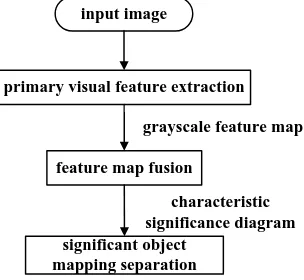
Target fast detection and capture is usually performed over a full field of view, requiring fast targeting of suspected targets. In this module, the target detection method based on visual attention mechanism is used to accurately segment the suspected target by simulating the working mechanism of the human eye. The inspection process is as shown in Figure 2.
primary visual feature extraction
feature map fusion
significant object mapping separation
input image
grayscale feature map
characteristic significance diagram
Figure 2. Suspected target detection process based on visual attention mechanism.
[image:3.595.219.371.412.552.2]
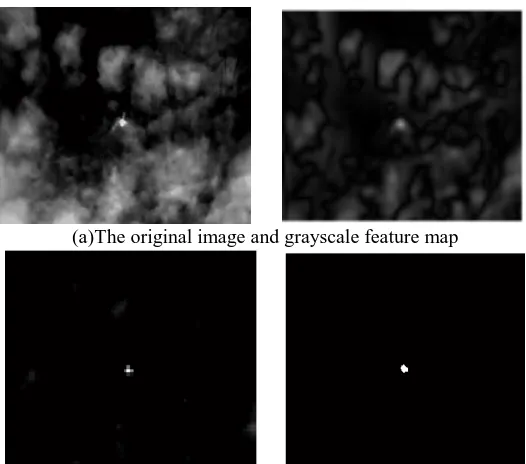
(a)The original image and grayscale feature map
[image:4.595.165.428.75.307.2]
(b) Characteristic saliency map and significant object mapping segmentation result Figure 3. Target detection effect based on visual attention mechanism.
Cluster tracking module
In the cluster tracking module, we define the multi-target mutation (tens of targets) as the group target, and construct a multi-objective clustering tracking algorithm based on the mutation multi-target clustering tracking algorithm of the star topology. The main principles of the algorithm are as follows:
All group target individuals in the field of view are divided into two types of targets, one is the majority of targets (primary target groups) that are gathered together, and the other is individual targets that are far from the main group. The position of all the targets in the field of view constitutes a data set, and the position of each target is a sample point. Set a total of N sample points, and set one of the sample points to beXi. Taking it as the center point, other sample points are connected to the
center point respectively, forming a typical star topology. The distance between the sample point Xi
and other sample points is set to be D ii( 1, 2...N1) and the average length of the star topology is
i D .
1
1
/ ( 1)
N
i i
i
D D n
. (2) Thus, each sample point has its own characteristics Di in this data set, which is equivalent to the
average distance between each target in the field of view and other targets. Let the average be D and the standard deviation be D.
1 1 N D i i D N
and 2 1 1 ( ) ND i D
i D N
.When Di is in (D D, DD), the target is defined as the main target, or it is defined deviation from the main group, which is eliminated when calculating the group position.
Experimental Verification
The effect of a type of jamming bomb throwing test is shown in Figure 4. It can be seen from the results that although the number of jamming bombs is large and the infrared characteristics are weak, the system designed in this paper can successfully detect the stable tracking.
Figure 4. Effect of the jamming bomb throwing test. Detonation test of a certain type of cluster bomb
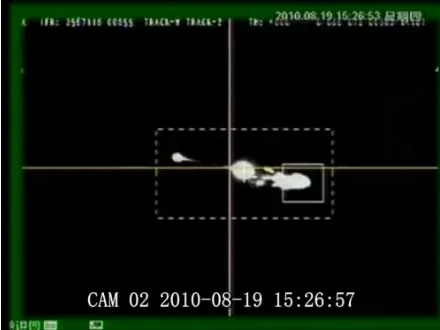
The effect of a certain type of cluster bomb detonation test is shown in Figure 5. It can be seen from the results that after the bomb is detonated, cluster bullets and individual bullet targets appear. The system has effectively detected and identified the cluster targets, and track them stably.
Figure 5 Effect of cluster bomb detonation test.
Conclusion
This paper comprehensively considers the such characteristics as large target number, quick mutation and random motion of submunition separation, cluster bomb detonation, jamming bombing and other new test tasks. Aiming at the problems of poor detection ability, tracking instability and poor robustness of traditional multi-target tracking detection algorithm, a multi-target detection and tracking system for mutation is designed and constructed. Through image background suppression, target fast detection based on visual attention mechanism and cluster tracking based on star topology, the effective detection and tracking of mutation multi-target is realized, which provides reliable technical support for experimental tasks.
References
[image:5.595.187.407.377.542.2][2] F B Wang, Realization of Image Process Technology for Computer Vision Based on OpenCV, Machinery & Electronics, 6(2010) 54-57.
[3] S F Zhang, Algorithm of Infrared Background Suppression and Small Target Detection, Journal of Image and Graphics, 21(2016) 1039-1047.
[4] B Ca, Salient Feature Regions Based on Conditional Random Field for Object Tracking, Electronic Measurement Technology, 39(2016), 64-69.