The Stylometric Processing of Sensory Open Source Data
A thesis submitted for the degree of Doctor of Philosophy of The Australian National University
David Kernot
October 2018
Acknowledgements
For someone who left school at 16 to become a boy soldier, the degree of Doctor of Philosophy is the penultimate celebration of what can happen if one applies themselves. This opportunity, to study at The Australian National University’s National Security College, would not have been possible without the support of my two academic supervisors, Professor Terry Bossomaier and Professor Roger Bradbury. I am grateful for this opportunity beyond words, and to observe such insightful melding of their collective minds was staggering. It shows in the methods used in the thesis, in their knowledge of complex systems, and their background in Ecology and Biology and the natural sciences. None of this would have been possible without them, and I thank them.
A special mention to my DST Group work colleague, Ph.D. mentor, and supervisor, Dr. David Crone who provided me a solid thesis structure to move on with, along with encouragement and a gently needed shove whenever I began to lag.
ANU’s Shakespearean expert, Dr. Kate Flaherty was instrumental at the initial research stages in highlighting that the early findings reflected expert scholars’ thoughts on the contested works of Shakespeare.
This research would not be possible without the support of the Defence Science and Technology Group, the Australian Government’s lead agency dedicated to providing science and technology support for the country’s defence and security needs. I am particularly grateful for the insightful advice provided by Dr David Crone, Dr Coen van Antwerpen, Dr Richard Taylor, Dr Tim Pattison, Dr Aaron Ceglar, Dr Dmitri Kamenetsky, Dr Richard Davis, Dr Yi Yue, Dr Paul Gaertner, and the numerous unknown reviewers, all who contributed to the quality of my eight research papers. This research is also supported by an Australian Government Research Training Program (RTP) Scholarship.
Abstract
This research project’s end goal is on the Lone Wolf Terrorist. The project uses an exploratory approach to the self-radicalisation problem by creating a stylistic fingerprint of a person's personality, or self, from subtle characteristics hidden in a person's writing style. It separates the identity of one person from another based on their writing style. It also separates the writings of suicide attackers from ‘normal' bloggers by critical slowing down; a dynamical property used to develop early warning signs of tipping points. It identifies changes in a person's moods, or shifts from one state to another, that might indicate a tipping point for self-radicalisation. Research into authorship identity using personality is a relatively new area in the field of neurolinguistics. There are very few methods that model how an individual's cognitive functions present themselves in writing. Here, we develop a novel algorithm, RPAS, which draws on cognitive functions such as aging, sensory processing, abstract or concrete thinking through referential activity emotional experiences, and a person's internal gender for identity. We use well-known techniques such as Principal Component Analysis, Linear Discriminant Analysis, and the Vector Space Method to cluster multiple anonymous-authored works. Here we use a new approach, using seriation with noise to separate subtle features in individuals. We conduct time series analysis using modified variants of 1-lag autocorrelation and the coefficient of skewness, two statistical metrics that change near a tipping point, to track serious life events in an individual through cognitive linguistic markers.
Contents
Acknowledgements ... iii
Abstract ... iv
Contents ... v
List of Figures ... viii
List of Tables ... x
List of Equations ... xii
Abbreviations ... xiii
Introduction ... 1
1.1
Thesis Statement
... 1
1.2
Introduction ... 2
1.3
Research Question
... 7
1.4
Research Hypothesis
... 8
1.5
Aim and Scope ... 9
1.6
Thesis Outline
... 12
1.7
Publications
... 14
Background and Related Work ... 16
2.1
Background
... 16
2.2
New Gender Components... 20
2.3
Referential Activity
... 22
2.4
New Sensory Components ... 28
2.5
Identification of Self
... 31
2.6
Extremist's Disorders
... 33
2.7
Classification Techniques ... 34
2.8
Philosophical Theory
... 37
2.9
Summary
... 38
Methodology ... 39
3.1
The Approach
... 39
3.2
Research Hypothesis Experiments ... 41
3.3
Reference Lists
... 43
3.4
Equations ... 44
3.5
Seriation
... 53
3.6
LIWC
... 54
3.7
Mann-Whitney U Testing ... 55
3.8
Step-wise Multiple Regression Analysis
... 55
3.9
k-fold Cross-validation
... 56
3.10
Vector Space Method ... 56
3.11
Imposters Method
... 57
3.12
Word Accumulation Curves ... 57
3.13
Hierarchical Cluster Analysis
... 59
3.14
Principal Component Analysis
... 59
3.15
Linear Discriminant Analysis ... 59
3.17
Summary
... 60
Part One: Elizabethan Authorship Studies ... 61
Shakespeare, Marlowe, and Cary... 62
4.1
Introduction
... 62
4.2
Material and methods
... 67
4.3
Results
... 71
4.4
Discussion
... 80
4.5
Testing the PCA and LDA Concepts on Contemporary Data
... 82
4.6
Conclusions ... 84
4.7
Summary
... 84
Edward III ... 85
5.1
Introduction
... 85
5.2
Methodology ... 86
5.3
Results
... 88
5.4
Discussion
... 95
5.5.
Conclusion ... 98
5.6
Summary
... 98
The Passionate Pilgrim ... 99
6.1
Introduction
... 99
6.2
Methodology
... 101
6.3
Analysis ... 102
6.4
Discussion
... 107
6.5
Conclusion ... 108
6.6
Summary
... 109
Part Two: Longitudinal Studies ... 110
The Dark Lady ... 112
7.1
Introduction ... 112
7.2
Methodology
... 114
7.3
Analysis
... 114
7.4
Discussion ... 121
7.5
Conclusion
... 121
7.6
Summary ... 124
Language Markers Using POS Analysis ... 125
8.1
Introduction ... 125
8.2
Methodology
... 127
8.3
Analysis
... 129
8.4
Discussion ... 140
8.5
Conclusion
... 143
8.6
Summary ... 143
RPAS Over Time and CSD Indicators ... 145
9.1
Introduction ... 146
9.2
Methodology
... 148
9.3
Analysis
... 149
9.4
Discussion ... 156
9.5
Conclusion
... 158
9.6
Summary
... 158
10.2
Methodology
... 163
10.3
Analysis
... 165
10.4
Conclusion ... 176
10.5
Summary
... 177
Discussion and Conclusions ... 178
11.1
Introduction
... 178
11.2
Significant and Original Outcomes ... 179
11.3
Answering the Research Questions
... 183
11.4
Impact
... 185
11.5
Limitations ... 187
11.6
Conclusions
... 188
11.7
Future Research
... 189
References ... 192
Appendix A ... 223
List of Figures
Figure 1: Islamic Caliphate in 750AD ... 4
Figure 2: Motor and Sensory Regions of the Cerebral Cortex ... 18
Figure 3: Methodology ... 40
Figure 4: Multi path problem ... 54
Figure 5: Word Accumulation Curves. ... 73
Figure 6: Results of Principal Component Analysis. ... 77
Figure 7: Results of the Linear Discriminant Analysis. ... 79
Figure 8: The Venus and Adonis play ... 79
Figure 9: Iris Murdoch and P.D. James Principal Component Analysis.. ... 83
Figure 10: Linear Discriminant Analysis of Iris Murdoch and P.D. James ... 83
Figure 11: Edward III gendered Personal pronouns (P) versus Richness (R) ... 89
Figure 12: Edward III Sensory Adjectives (S) versus Richness (R). ... 89
Figure 13: Spanish Tragedy to Edward III cosine similarity. ... 90
Figure 14: Venus and Adonis to Edward III cosine similarity. ... 91
Figure 15: Imposter Method on Hero and Leander to Edward III. ... 92
Figure 16: Spanish Tragedy scene comparisons. ... 93
Figure 17: The Passionate Pilgrim LDA, VSM, and PCA overlays. ... 103
Figure 18: Richness by Age at Publication ... 130
Figure 19: Iris Murdoch Content to Function Word Ratio Comparisons. ... 135
Figure 20: P.D. James Content to Function Word Ratio Comparisons. ... 136
Figure 21: Iris Murdoch and P.D. James’ Sensory Means. ... 138
Figure 22: Richness (R) by Age for Iris Murdoch and P.D. James ... 151
Figure 23: Personal Pronouns (P) by Age for Murdoch and James. ... 152
Figure 24: Referential Activity Power (A) by Age for Murdoch and James. ... 153
Figure 25: Sensory Adjectives (S) by Age for Iris Murdoch and P.D. James. .... 154
Figure 26: 1-lag autocorrelation (AR1) for Iris Murdoch and P.D. James. ... 155
Figure 27: Skewness (G1) for Iris Murdoch and P.D. James ... 155
Figure 28: LIWC negative emotion and anger categories. ... 167
Figure 29: ROC curves for Anger and Negative Emotion ... 168
Figure 30: Stepwise Multiple Regression using RPAV on Suicide Attackers. .. 170
Figure 31: Classification accuracy for regression scores... 170
Figure 32: ROC curves for Anger and RPAV. ... 171
Figure 33: RPAV stepwise regression results. ... 173
Figure 34: Depression comparison between Murdoch and Suicide Attackers. 175
Figure 35: A map of the cerebral cortex. ... 182
Figure 36: PCA Scree Plot for Shakespeare, Marlowe and Cary ... 242
Figure 37: Canonical discriminant analysis of Elizabethan playwrights ... 244
Figure 38: PtoR plots of Edward III. ... 245
Figure 39: Iris Murdoch Content Words POS Mean. ... 249
Figure 43: Iris Murdoch Visual Sensory Mean... 251
Figure 44: Iris Murdoch Auditory Sensory Mean ... 251
Figure 45: Iris Murdoch Haptic Sensory Mean ... 252
Figure 46: Iris Murdoch Olfactory Sensory Mean ... 252
Figure 47: Iris Murdoch Gustatory Sensory Mean ... 253
Figure 48: P.D. James Visual Sensory Mean ... 253
Figure 49: P.D. James Auditory Sensory Mean ... 254
Figure 50: P.D. James Haptic Sensory Mean ... 254
Figure 51: P.D. James Olfactory Sensory Mean ... 255
List of Tables
Table 1: Outline of different studies ... 11
Table 2: Chapter Experiments, Aims, and hypotheses ... 41
Table 3: A summary of all the techniques employed ... 42
Table 4: Hierarchical Cluster Analysis Membership for 3 clusters ... 74
Table 5: The Seriation results of Edward III scenes. ... 94
Table 6: OLO seriation results with noise applied. ... 95
Table 7: Edward III play with the Shakespearian scenes. ... 97
Table 8: Hamiltonian path distances of The Passionate Pilgrim poems. ... 105
Table 9: OLO seriation results of The Passionate Pilgrim. ... 106
Table 10: Dark Lady clustering results. ... 115
Table 11: Rival Poet and Persuasion sonnet clustering results. ... 116
Table 12: TSP seriation of Shakespeare's Dark Lady Sonnets. ... 116
Table 13: Hamiltonian path distances between the Dark Lady sonnets. ... 120
Table 14: Iterative Seriation of the Dark Lady sonnets . ... 122
Table 15: Iris Murdoch Mann-Whitney U-test 12-year ranks ... 131
Table 16: Iris Murdoch Mann-Whitney U-test 12-year statistics ... 131
Table 17: P.D. James Mann-Whitney U-test 12-year ranks ... 132
Table 18: P.D. James Mann-Whitney U-test 12-year statistics ... 132
Table 19: Iris Murdoch Aggregated Content and Function Word Ratios ... 133
Table 20: P.D. James Aggregated Content and Function Word Ratios ... 134
Table 21: Function to Content Word Ratios ... 134
Table 22: Iris Murdoch Mann-Whitney U-test Ranks ... 136
Table 23: Iris Murdoch Mann-Whitney U-test Statistics ... 136
Table 24: P.D. James Mann-Whitney U-test Ranks ... 137
Table 25: P.D. James Mann-Whitney U-test Statistics ... 137
Table 26: Iterative PCA of Iris Murdoch and P.D. James ... 139
Table 27: A comparison of the sensory contribution to PCA variance ... 140
Table 28: Summary of Sensory Means of Murdoch and James. ... 141
Table 29: Asymptotic Significance from LIWC2015. ... 166
Table 30: Area under the curve (AUC) for anger and negative emotion. ... 168
Table 31: Area under the curve (AUC) for anger and RPAV. ... 171
Table 32: Mann Whitney U-Test comparisons. ... 172
Table 33: Referential Activity Power data ... 223
Table 34: Sensory Adjectives data ... 225
Table 35: Argamon et al.'s (2003) gender study ... 234
Table 36: Shakespeare, Marlowe and Carey's chunk samples ... 234
Table 37: The Passionate Pilgrim Poems by Author. ... 236
Table 38: Pearson correlation coefficient results of RPAS. ... 237
Table 39: PCA Descriptive Statistics Shakespeare, Marlowe and Cary ... 238
Table 43: PCA Total Variance for Shakespeare, Marlowe and Cary ... 240
Table 44: PCA Component Matrix results ... 241
Table 45: PCA Rotated Component matrix results ... 241
Table 46: LDA Eigenvalues results ... 242
Table 47: LDA Wilks' Lambda results ... 242
Table 48: LDA Discriminant Function coefficients ... 243
Table 49: LDA Group Centroids ... 243
Table 50: Iris Murdoch's novels by year published ... 246
Table 51: P.D. James' novels by year published ... 247
Table 52: Iris Murdoch Sensory Word Mann-Whitney U-test ranks ... 247
Table 53: Iris Murdoch Sensory Word Mann-Whitney U-test statistics ... 248
Table 54: P.D. James Sensory Word Mann-Whitney U-test ranks ... 248
Table 55: P.D. James Sensory Word Mann-Whitney U-test statistics ... 248
Table 56: RPAV values of Iris Murdoch’s novels ... 256
Table 57: RPAV values of P.D. James’ novels ... 257
List of Equations
Equation 1: Richness ... 45
Equation 2: Personal Pronouns ... 49
Equation 3: Referential Activity Power... 50
Equation 4: Sensory Adjectives ... 51
Equation 5: Modified Autocorrelation at lag 1 ... 53
Equation 6: Modified Coefficient of Skewness ... 53
Equation 7: Mann-Whitney U Testing ... 55
Equation 8: Cosine Similarity ... 56
Abbreviations
A Auditory
A Referential Activity Power
AD Alzheimer’s disease
ADF Australian Defence Force
ANSF Afghanistan National Security Force
AR1 1-lag autocorrelation
ASG Afghan Security Guards
AtoR Referential Activity Power to Richness
BOW Bag of Words
CIED Counter Improvised Explosive Device
CSD Critical Slowing Down
DOCEX Document Exploitation
DOMEX Document and Media Exploitation
DSTO Defence Science Technology Organisation
G Gustatory
G1 Fisher-Pearson coefficient of skewness
H Haptic (tactile)
HUMINT Human Intelligence
HTT Human Terrain Team
IED Improvised Explosive Device
IS Islamic State
ISAF International Security Assistance Force
IW Information Warfare
K Kinaesthetic
LDA (Stepwise) Linear Discriminant Analysis
LIWC Linguistic Inquiry and Word Count
O Olfactory
P Personal Pronouns (Gender)
PCA Principal Component Analysis
PRS Primary or Preferred Representational System
PtoR Personal Pronouns to Richness
R Richness
RPAS R: Richness (R), P: Personal Pronouns, A: Referential Activity Power, S: Sensory Adjectives
RPAV R: Richness, P: Personal Pronouns, A: Referential Activity Power, and V: Visual from the Sensory Adjectives (S) element
S Sensory Adjectives
SNA Social Network Analysis
SPSS Statistical Package for the Social Sciences
StoR Sensory Adjectives to Richness
SVM Support Vector Machine
TTR Type Token Ratio
VAKOG Visual, Auditory, Kinaesthetic, Olfactory, Gustatory
V Visual
VSM Vector Space Method
Chapter 1
Introduction
1.1 Thesis Statement
The intent of this thesis is to create a method that extracts key linguistic features, or attributes, from a person’s writing style or speech that can characterise self for identification purposes and track changes in people’s mindset over time due to life events. By collecting open source data within cyberspace, such as blogs and chat room discussions, this identity signature of a person could be used to predict the likelihood of conflict and provide early warning indicators to aid in the defence and regional security of Australia. It might be possible to use this to indicate a tipping point and predict self-radicalisation in people.
To support an automated early warning system that can be deployed in the field, an algorithm must be constructed that can analyse an unknown author’s signature from anonymous, unstructured open source texts and through analysis of the content, key stylistic features that describe self must be extracted. By uncovering self with cognitive functions such as aging through word richness, internal gender identification from personal pronouns (Kernot, 2016), abstract or concrete thinking through referential activity emotional experiences (Murphy, Maskit, & Bucci, 2015), and the mind’s sensory processing, a signature of a person can be created from their writing style. Visualisation and trend analysis of those key characteristics, messages tagged by richness, gender, referential activity and sensory style can be used to highlight different levels of conflict within that person for early warning security.
1.2 Introduction
There have been more than 200 wars since the start of the 20th century, leading to about 35 million battle deaths. However, efforts at forecasting conflicts have so far performed poorly for lack of fine-grained and comprehensive measures of geopolitical tensions (Chadefaux, 2014). After the Vietnam War ended in 1975, the Australian government's military conflicts had been dominated by peacekeeping and low-risk deployments until the ANZUS Treaty was invoked in 2001 after the 9-11 terrorist attacks in the United States (US). Since 2001, Australian military force members and personnel from the International Security Assistance Force (ISAF) and the United Nations Assistance Mission in Afghanistan (UNAMA) suffered casualties in the war in Afghanistan. A significant threat that grew in Afghanistan during this period was the risk of the insider threat (Bordin, 2011; Smith, 2012), the trusted insider, known in military circles as a 'green-on-blue' incident when the individual turns on his friends and colleagues. Insurgents dressed as Afghanistan National Security Force (ANSF) members and Afghan Security Guards (ASG) perpetrated these "green-on-blue" incidents and accounted for a growing trend in that theatre of war. Added to this is the threat from Improvised Explosive Devices (IEDs) placed by unknown insurgents, which are a major cause of death and battle casualty. Such casualties are occurring, partly, because analysts do not have the right tools to identify the perpetrators pre-emptively. This need for tools to help identify perpetrators by scanning textual data and matching identifiable characteristics grew.
Existing tools might help to identify perpetrators by scanning textual data and matching identifiable characteristics. However, these tools only work when characteristics of possible perpetrators are known. Exploitation of documents and text (DOCEX) and media (DOMEX) found near insurgents and in hidden caches only help when the perpetrators can be identified. Therefore, tools are needed where the characteristics of the perpetrators are not known and can identify them through their linguistic style. A 2010 report by the US highlights that DOMEX is the new intelligence discipline and it crosses all aspects of intelligence (Cox, 2010).
(Bloxham, 2011; Cooper, 2011; Griffin, 2009, 2013). Nordin Mohammad Top, a key member of the Al-Qaeda-linked militant group, Jemaah Islamiah rose to prominence after the Bali bombings of 2002, and he was Indonesia's most wanted Islamist militant. In a similar style to bin Laden, he is thought to have escaped a safe-house raid, and doubt was raised about his identity in video footage because bin Laden hid behind a mask. He too was reluctant to use mobile phones, relied on a close network of sympathisers, and used couriers to send messages (Reuters, 2009; Shears, 2009). Many perpetrators operate inside of chat rooms, hidden in cyberspace where they can be anonymous and incite or plan violent acts. They can generate social influence, media "buzz," and cause violent responses from their posts (Colbaugh & Glass, 2012). This may have a lot to do with the power of cyberspace because of the anonymity it provides. A recent study has shown that people are more likely to open up to a stranger they meet on the Internet and divulge information about themselves they wouldn’t admit to their closest friends and relatives. This confiding of our true-self presents opportunities for people to make friends with someone they have never met (Bargh, McKenna & Fitzsimons, 2002).
The role in Afghanistan has now reduced in response to the diminished threat from the Taliban and Al-Qaeda. Many of Australia's military have returned home from Afghanistan since the major withdrawal in December 2013, when the Afghan people were deemed to be able to manage the threat of the Taliban and Al-Qaeda in the Uruzgan province. However, a new threat has emerged from Al-Qaeda in Iraq1 in the
form of the Islamic State (IS), otherwise known as DAISH (Arab acronym for Al-Dawlah Al-Islamiyah fe Al-Iraq wa Al-Sham meaning the Islamic State of Iraq and Syria, or Sham) (Saikal, 2015). This new threat is one where the people of Iraq and Syria now face shocking casualties as DAISH fights to create an Islamic caliphate spanning Iraq, Syria2
and other parts of the Levant to regain the territory they were promised before the Sykes-Picard Agreement of 1916, at the end of the First World War.
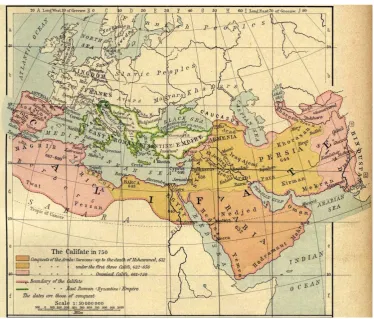
The map, (Figure 1), shows the extent of the Islamic Caliphate in 750AD in comparison to the East Roman Byzantine Empire. The three shaded areas highlight the conquests of the Arabs, or Saracens, up to the death of Mohammed in 632AD, then under the first three Khalifs in 632-656AD, and finally the Ommiad Khalifs in 661-750AD (Shepherd, 1926). The Sykes-Picard Agreement was a deliberate attempt by England, France, and
1 Listed as a Terrorist Organisation in Australia on 2 March 2005 as Tanzim Qa’idat Jihad fi Bilad
al-Rafidayn (http://www.nationalsecurity.gov.au/Listedterroristorganisations/Pages/default.aspx)
Russia to reduce the control held by the defeated Ottoman Empire that grew from the 750AD caliphate.3
[image:19.595.83.458.380.699.2]The threat from Islamic State is different from Al-Qaeda because of their approach. Through the power of social media, the group has been able to reach a vast population of disenfranchised youth and recruit them in their fight within Syria and northern Iraq. They have been able to encourage attacks across the globe. Australian military support has again travelled to Iraq, and now face a more complex IED threat from roadside bombs. There are more considerable differences from the fight in Afghanistan because of the inclusive actions of DAISH. Social media and the Internet provided a readily available opportunity to convince young Westerners and Muslims alike to join in their crusade, and it gave them a powerful tool. Now, many of these young people are returning to their homes, some to Australia. DAISH's online magazine, Inspire, recently published an article called "Make a Bomb in Your Mom’s Kitchen," which was translated into Bahasa by Indonesian jihadists (Ramakrishna, 2014).
Figure 1: Islamic Caliphate in 750AD
out attacks. Akbarzadeh (2013: 453) highlights that these were "the first successful suicide attacks on Western European soil carried out by four British-born men. The attacks catapulted into the public spotlight questions about the capacity of Muslims to integrate into secular, liberal democracies." Samantha Lewthwaite converted to Islam and married one of the London bombers, Germaine Lindsay, after meeting him in an internet chat room, and, after his death has become one of the world's most wanted terrorist suspects (Kirby, 2007; The Sydney Morning Herald, 2013).
The insider threat, or the threat of the lone wolf or lone actor, has been highlighted through the tragic death of passengers when Malaysian Aircraft flight MH370 vanished without a trace in 2014 with some suggestions the cause had something to do with pilot involvement (Holdaway, 2014). This was further reinforced when the co-pilot of Lufthansa subsidiary Germanwings Flight 4U 9525 crashed the plane into the French Alps killing 150 people in a suicide act (Flottau, 2015). Because of technological trends, easy Internet access can expedite direct action, and some military strategists warn of Fifth Generation Warfare in which lone wolves mount crippling cyber-attacks on national infrastructure or deploy small radiological devices, dirty bombs, against cities (Ramakrishna, 2014).
Australia's military involvement has now grown in response to the global threat against terrorism and is involved in over seven military operations throughout the Middle East and North Africa. However, there is a growing threat within Australia and from its near region.
There have been a number of self-radicalised people, lone wolves, conducting terror attacks throughout the world. The Westminster attacker, Khalid Masood, born Adrian Russell Ajao in Dartford, Kent, UK, had converted to Islam. With a violent criminal record, he had been investigated for violent extremism, but he was a ‘peripheral figure' and not part of the current intelligence picture. There was no prior intelligence of his intent, or of the plot when he killed five people and injured more than 50 (Bourke & Miller, 2017). Omar Mateen killed 49 people and injured 53 in a lone wolf attack on the Pulse nightclub in Orlando in 2016 and is the deadliest terrorist attack in the United States since 9/114, and while officials had no warning. Mateen was repeatedly
investigated by the FBI (Byman, 2016). A 15-year-old high school student Farhad Khalil Mohammad Jabar who shot dead a NSW police employee outside the force's
4Until 1st of October, 2017 when 64-year-old Stephen Paddock killed 58 people and injured 851 (452 from
headquarters in 2015 had not come to the attention of counter-terrorism police before he carried out the "politically motivated" attack, and it is believed the teenager was acting alone (Ralston, Benny-Morrison& Olding, 2015). In 2014, Lindt café gunman, Man Haron Monis, born Mohammed Hassan Manteghi Borujerdi, held 18 people hostage and as a result, two people were killed, but he was not believed to be a threat to national security. There were no indications he intended to engage in terrorism, although he was known to Australian and overseas security agencies for his ongoing offensive and nuisance behaviour with the potential to incite others to violence (Tucker & Gelineau, 2016). Melbourne teenager Numan Haider stabbed two police officers during an arranged meeting outside the Endeavour Hills police station in Victoria in 2014, just days after having undergone a degree of radicalisation (Cooper, 2016). Reinforcing the earlier conclusions of Sarma (2017), here too, many of these individuals were known to authorities and not considered a current threat, but some were not known at all.
recent measures on countering violent extremism (CVE) (Commonwealth of Australia, 2015).
The program of research reported in this thesis focuses on the lack of authorship analysis tools and the identification of anonymous authors to identify people that might be insurgents, 'insiders', or a lone wolf. It draws on existing anonymous authorship identification research and techniques (Kernot, 2013) and extends that research by addressing the gaps that were identified.
This research extends these concepts by describing self (for a more detailed determination of self and how it relates to psychology and identity refer to Chapter 2, Section 2.5), and the anonymous identification of authors in cyberspace, by drawing on neuropsychology and neuroscience markers within the brain that appears in writing and discourse analysis. The premise of the research is that by characterising an author's identity using multivariate features, or markers within writing, broken up into four categories, RPAS: Richness (R), Personal Pronouns that indicate Gender (P), Referential Activity Power (A), and Sensory-based Adjectives (S), it is possible to identify self from the textual data in cyberspace. Further, we draw on a phenomenon called Critical Slowing Down (CSD), a dynamical property used to develop early warning signs of tipping points (Slater, 2013). By conducting time series analysis using modified variants of 1-lag autocorrelation and the coefficient of skewness, two statistical metrics that increase near a tipping point (Slater, 2013) changes in a person’s moods, as they shift from one state to another can be observed. Applying this concept to a lone wolf, before the point when they commit a terrorist act, these hidden characteristics or cues that are inherent in someone's writing style might be able to be used to predict a tipping point and provide early warning signals to prevent a possible crisis.
1.3 Research Question
self-radicalisation within an individual and provide early warning indicators to aid in the defence and regional security of Australia.
Several terms (richness, referential activity, personal pronouns or gender, and sensory adjectives) have been discussed in this chapter. They have been highlighted as potential new stylometric characteristics of language that could identify self and be used in tools to identify people in cyberspace.
Given the need to identify linguistic characteristics of people, several questions can be asked. Can the content analysis of written text extract stylistic features that identify a person? Can a person be described from gender pronouns? Can richness be determined from a person’s writing style? Can a referential activity score be determined from linguistic particles? Can a sensory-based representational system be determined from adjectives? Can changes in these stylistic features identify conflict in an individual prior to it occurring? Can the stylistic features be placed into a framework to predict an event for early warning purposes? In considering these questions, it must be understood that they feed the broader and overriding research objective that drives this thesis. Given the need for tools to identify people in cyberspace who wish to harm Australia and its national interests, the research question is:
Can the automated extraction of key linguistic attributes from text-based data identify an author’s personality, or self, and be used to predict self-radicalisation?
1.4 Research Hypothesis
There are four research questions addressed:
1. Can a stylistic fingerprint of a person’s personality – their personal signature – reveal their ‘identity’ from their writing style?
2. Does a person’s ‘identity’ change over time because of life events, such as trauma, depression, and disease, or is it stable?
4. Can the final writings of suicide attackers be separated from ‘normal’ bloggers?
These research questions can be expressed as hypotheses tests, as follows:
Null hypothesis – H0: The stylistic fingerprint of a person’s personality – their
personal signature – cannot reveal their ‘identity’ from their writing style.
Alternate hypothesis - H1: The stylistic fingerprint of a person’s personality – their
personal signature – can reveal their ‘identity’ from their writing style.
Alternate hypothesis - H2:A person’s ‘identity’ changes over time because of life
events, such as trauma, depression, and disease.
Alternate hypothesis - H3:The application of techniques to visualise the critical
slowing down phenomena can identify changes in a person’s moods, or shifts from one state to another, that might indicate a tipping point for self-radicalisation. Alternate hypothesis - H4: The final writings of suicide attackers can be separated
from ‘normal’ bloggers.
If the approach to identity using personality, through RPAS, is successful and it is possible to create a personal signature of individuals (research hypothesis 1), and to separate ‘normal’ writing from that written before a terrorist attack (research hypothesis 4), when taking into account the ‘normal’ changes in a person’s personal signature over time (research hypothesis 2), it might be possible to use techniques to visualise the critical slowing down phenomena and determine the tipping point where a disenchanted person becomes self-radicalised (research hypothesis 3). If the answer is yes to all four hypotheses, then it might be possible to stop lone wolves before they act.
1.5 Aim and Scope
To meet the aim of the research reported in this thesis, three research phases that test the development of the algorithm are required. These are described briefly now. 1.5.1 Phase One
Data and Algorithms Development. In this phase, the algorithms are developed to identify self through four feature-sets comprising twelve linguistic features to classify a person through RPAS: Richness (R), Personal Pronouns (P), Referential Activity Power (A), and Sensory-based Adjectives (S). Reference data to identify a person is also generated to score the feature-sets.
1.5.2 Phase Two
Experiments. In this phase, seven studies are conducted across three distinct groups or phases to test key aspects of the research question. Table 1 shows the logic and structure of the experiments. Each of the experiments is discussed in the subsequent paragraphs.
Study 1 - Authorship Identification. In this study, the works of William Shakespeare, Christopher Marlowe, and Elizabeth Cary are used to test the premise that RPAS can be used to create signatures of more than one person and identify self.
Study 2 - Authorship Identification. In this study, the works of William Shakespeare, Christopher Marlowe, and Thomas Kyd are used to test the premise that RPAS can be used to identify the authorship of an unknown author’s work, through the anonymous play Edward III.
Study 3 - Authorship Identification. In this study, the works of William Shakespeare, Christopher Marlowe, Thomas Kyd, Bartholomew Griffin, and Richard Barnfield, are used as a test case to test the premise that RPAS can be used to identify the authorship of many unknown author's works, through the publication, The Passionate Pilgrim. Study 4 - Authorship Changes over Time. In this study, the single work of William Shakespeare, The Sonnets, is used to test the premise that RPAS can be used to characterise subtle differences, or changes, in a person’s writing style within small texts over time.
depression and Alzheimer’s disease that might mimic the proximal events and life stressors faced by a terrorist.
Study 6 – Authorship Changes over Time. In this study, the works of Iris Murdoch and P.D. James are used to test if a tipping point can be discovered using the Critical Slowing Down (CSD) dynamical property prior to when a life-changing event occurs. In this case, the event is Iris Murdoch's Alzheimer's disease progression. However, we believe this mimics the proximal events and life stressors faced by a terrorist as they become self-radicalised or prior to them conducting a terrorist act.
Study 7 – Lone Wolf Study. In this study, the suicide notes and final manifestos of suicide attackers are compared to normal bloggers and a person with depression to see if their writing can be separated using RPAS.
1.5.3 Phase Three
Evaluation and Recommendations. In this phase, the effectiveness of the algorithm to determine self and provide conflict early warning against the research question will be evaluated. Recommendations will be made on further research.
Table 1: Outline of different studies
Study Chapter Aim Data Source
1 4 Identifying features to identify authors
(known authorship) from RPAS Shakespeare, Marlowe, Cary
2 5 Testing RPAS on an unknown author. Edward III
3 6 Testing RPAS on a set of multiple unknown
authors.
Passionate Pilgrim
4 7 Identifying features of a single author to
identify characteristics in small texts that change over time from RPAS.
Shakespeare’s The Sonnets
5 8 Identifying features of two authors to
identify characteristics that change over time from RPAS when one has proximal events and life stressors that mimic a potential terrorist.
Iris Murdoch and P.D. James
6 9 Identifying characteristics that change over
time using a tipping point and Critical Slowing Down phenomena from RPAS prior to a life changing event.
Iris Murdoch and P.D. James
7 10 Identifying different RPAS features of lone
wolf suicide attackers that are different from normal or depressed writers.
1.6 Thesis Outline
There are eleven chapters and bibliography in this thesis, and the outline of them is as follows:
Chapter 1 – Introduction. We highlight the need for research in the field of self-radicalisation and how through author identification using personality or self might be beneficial.
Chapter 2 – Background and Related Work. A discussion on the changing nature of warfare brought about by the asymmetric tactics employed by insurgents, and summarise key findings of critical earlier research. We show how through several types of analysis of anonymous documents that it may be possible to identify insurgents, terrorists, and the lone wolf. The chapter focuses predominantly on examining the methods to identify a person and uncover self. We describe how word richness, a person's internal gender from personal pronouns, Referential Activity, and the sensory Representational System might overcome some of the current anonymous author identification shortfalls. In this chapter, we also state the research hypotheses that stem from the research objectives and questions.
Chapter 3 – Methodology. We address phase one, Data and Algorithms Development, and describe the methodology that is best used to gather the data and create the author signatures. We restate the research hypotheses and how they are tested through a series of studies. We describe how the reference data list selection is created and highlight how the works are reduced into a Bag of Words (BOW). We identify the RPAS equations that will be used to generate a signature of an author that describe self.
Chapter 5 – Authorship Identification. Again, we address one part of Phase Two, Experiments, and describe the second study in the first series of experiments on authorship identification. Drawing on the works of William Shakespeare, Christopher Marlowe, and Thomas Kyd, the proposed algorithms are tested to see if we can identify known authorship from an author’s anonymous writing style through the anonymous play, Edward III.
Chapter 6 – Authorship Identification. Again, we address one part of Phase Two, Experiments, and describe the last of the series of experiments looking at authorship identification. Drawing on the works of William Shakespeare, Christopher Marlowe, Thomas Kyd, Bartholomew Griffin, and Richard Barnfield, the proposed algorithms are tested to see if we can identify known authorship from a more complex dataset when there are multiple unknown authors through the publication, The Passionate Pilgrim.
Chapter 7 – Authorship Changes Over Time Study. We address another part of Phase Two, Experiments, and describe the second series of experiments (four through six). This first study in this next part, we draw on William Shakespeare’s work, The Sonnets. We examine the changes in writing in a single author over time.
Chapter 8 – Authorship Changes Over Time Study. Again, we address another part of Phase Two, Experiments, and describe the second experiment looking at authorship changes over time. Drawing on the works of the contemporary authors, Iris Murdoch and P.D. James, we examine the effects of time on an author’s signature. We examine larger texts when one author has depression and Alzheimer’s disease that might mimic the proximal events and life stressors faced by a terrorist.
Chapter 10 – Lone Wolf Study. We address the final part of Phase Two, Experiments, and describe the third series of experiments (study seven). In this study, we compare the suicide notes and final manifestos of suicide attackers to normal bloggers and a person with depression to see if their writing can be separated.
Chapter 11 – Discussion and Conclusions. We address Phase Three, Evaluation and Recommendations, and demonstrate that the aims as stated in Chapter One have been achieved by meeting the research objectives. We describe the significance of our findings and its limitations and provide our conclusions and where future research in this domain should be directed.
1.7 Publications
From Chapter 4: Kernot, D., Bossomaier, T., & Bradbury, R. (2018). Shakespeare's Sotto Voce: Determining True Identity from Text. Frontiers in Psychology Vol 9. March 2018 Article 289, 1-17.
From Chapter 5: Kernot, D., Bossomaier, T., & Bradbury, R. (2017). Did William Shakespeare and Thomas Kyd Write Edward III? International Journal on Natural Language Computing. Vol. 6, No. 6. December 2017.
From Chapter 6: Kernot, D., Bossomaier, T., & Bradbury, R. (2017). Stylometric Techniques for Multiple Author Clustering: Shakespeare’s Authorship in The Passionate Pilgrim. International Journal of Advanced Computer Science and Applications. Vol. 8 No. 3, 1-8.
From Chapter 7: Kernot, D., Bossomaier, T., & Bradbury, R. (2017). Novel Text Analysis for Investigating Personality: Identifying the Dark Lady in Shakespeare's Sonnets. Journal of Quantitative Linguistics. Vol 24 No 4, 255-272.
From Chapter 8: Kernot, D., Bossomaier, T. and Bradbury, R. (2017). The Impact of Depression and Apathy on Sensory Language. Open Journal of Modern Linguistics, 7, 8-32.
From Chapter 10: Kernot, D., Bossomaier, T., & Bradbury, R. (2017). Identifying Suicide Attackers in Cyberspace (under review).
Chapter 2
Background and Related Work
In this chapter, we describe the context of the work in which this program of research reported in this thesis is situated and provide some background for the work this research draws from. Drawing on the research questions and hypotheses, we highlight the problems faced by Australians in this context and summarise the related work that extends the earlier research.
2.1 Background
The program of research reported in this thesis draws on a Master of Philosophy thesis (Kernot, 2013). The thesis proposed that by being able to create a signature that described an anonymous person from their texts in cyberspace, that insurgents and bomb-makers of Improvised Explosive Devices (IEDs) could be identified and that this, in turn, could be used to reduce the threat to deployed Australian troops stationed within Afghanistan.
2.1.1 Gender Component
By extending Argamon et al.'s (2003) study and using their initial list of gender-based pronouns, Kernot (2013) assigned a gender to each pronoun, labelled M (more likely used by a male gender) or F (more likely used by a female gender) based on Argamon et al.'s (2003) median results, T-test significance levels, male and female means, and standard errors. This new reference list was compared against a Bag of Words that comprised 30 samples taken from the Internet, with an average size of 1,000 words each (6 articles from 5 authors with a contribution of 6,000 words per author) resulting in a total Bag of Words size of 30,000 words. This list was reduced to 1,981 instances of the gender-based pronouns. Using logistic regression analysis on the data, 27 of the 30 samples (90%) were correctly identified by gender using the three most statistically significantly words (my, her, and its), and a gender formula drew on the logistic regression predictor variables and coefficients.
A recommendation was made that the algorithm is further tested against wider and larger datasets. There was a belief that, outside of defining gender as male or female, the gender scores could be used to provide more fidelity to an author's anonymous signature.
2.1.2 Sensory Component
Figure 2
)5. While cognitive psychology is more focused on the mind, cognitive neuroscience focussed on the brain (Bechtel, 2002). Here, we use the sensory processing of the brain and how that impacts on the psychological aspects of the mind through linguistics. Our interests lie in how basic sensory information is represented, and how internal and external sensations of prior experiences are stored (see Oosterwijk et al., 2015) and integrated into language and cognition through a network of overlaid and combined neural functions, such as auditory, visual, tactile, and sensory-motor sensations (St Clair, 2017).Figure 2: Motor and Sensory Regions of the Cerebral Cortex
The sensory modalities of the Representation System was grounded in Neuro-Linguistic Programming (NLP) techniques, the study of the structure of human subjectivity, and a model to demonstrate the basic process used to encode, transfer, guide, and modify our behaviour (Bandler & Grinder, 1979; Grinder & Bandler, 1976; Dilts et al., 1980; Grosu et al., 2017; Marashi & Abedi, 2017). It grew from an idea that individuals have a "private language," a world of sensations, that is unique and individual to that person, and it defined how people interpreted their environment, and how they attached a ‘feeling' to each word expressed through their senses
(Wittgenstien, 1922). The Primary Representational System (PRS), a preferred or primary sensory cortex that people draw on to speak and write (Grinder & Bandler, 1976) unconsciously determines a person's use of noun/verb/adverb predicates in their communication, and this is reflected in both their oral and written communication style.
There was an assumption that NLP could provide techniques by which these hidden cues could be unmasked as a person speaks and/or writes because each person has a PRS (Grinder & Bandler, 1976; Heap 2008; Mercia & Johnson, 1984; Skinner & Stephens, 2003).
After extensive debate on the scientific validity of NLP (Heap, 1988a; Heap, 1988b; Heap, 2008; Sharpley, 1984; Sharpley, 1987), it had mostly been abandoned by academia and psychology (Witkowski, 2010). However, Colaco et al. (2010) developed a psychometrically-based Neuro-Linguistic analysis tool called NEUROMINER to classify one type of computer programmer from an OSS mailing list content and they used it to identify developer's personalities and general emotional content (Rigby & Hassan, 2007) from sensory-based Visual, Auditory and Kinaesthetic words or phrases. The Kernot (2013) study drew on the success of the Colaco et al. (2010) work and again tested the thirty articles obtained from the Internet by five authors across a range of sources. A sensory-predicate algorithm was developed from discriminate analysis testing, and while no PRS could be identified, it was found that a signature of anonymous individuals could be created from a combination of all of the Representational System (RS) scores to identify people.
2.2 New Gender Components
"There is no general agreement as to what extent – if at all – the psychological make-ups of the two sexes are different by nature, but there is no doubt that gender is represented through a person's choices of lexical and functional items" (Dam, 2014: 87-88). In determining the role of personal pronouns in the construction of female identity, Dam (2014) highlights the use of pronouns ‘we’, a deictic or dependent upon context pronoun, ‘you,' and ‘your,' as contributing to identity.
Hancock et al. (2014) suggest that recent research on gender differences in language present a diminishing picture. In their study (Hancock et al., 2014) of whether language use can predict perceptions of gender and femininity, 10 males, 12 females, and 13 transgendered women (male-to-female) speakers were rated against femininity. What the study highlighted was that 4 of the 14 variables differentiated males from females using T-units (known as the minimal terminable unit, where each T-Unit “is the shortest units into which a piece of discourse can be cut without leaving any sentence fragments and would contain one independent clause and its dependent clauses” (Hunt, 1965: p.189) and in Hancock et al. (2014) it focussed on dependent clauses and personal pronouns). Hancock et al. (2014) found that transgendered females tended to be more distinct from the females than the men were. In the second part of the study where they compared the use of language, the transgendered women's scores were not significantly different from the men, but none of the 14 individual variables alone were robust predictors of perceived gender or femininity. In a gender study, Lenard (2014), analysed 204 random speeches from the 113th United States Congress, split equally by gender with the LIWC (Linguistic Inquiry and Word Count) tool from Pennebaker et al. (2001). Lenard (2014) used US Congress speeches
and analysed 70 language categories and highlighted that women's personal pronoun use was larger than men and they used the word 'we' more. Men used nouns, articles, and numbers more and tended to use the pronoun 'I' more.
What is clear is from a literature search for further authorship identification techniques in the area of gender, that pronouns are a crucial part of speech in determining this. 2.2.1 Key Pronoun Studies
ignored pronouns to determine gender, and achieved a gender match of 0.58. Rangel and Rosso (2013) drew from the work of Pennebaker (2011) and used a Support Vector Machine method to categorize Parts Of Speech (POS), but this performed better at identifying age than gender. They achieved a gender match of 0.57 when including singular and plural pronouns into their POS list. Argamon et al. (2009) used a combination of pronouns (I, me, him, my) to identify females, but achieved 5-10% better success rates when they also considered content words about technology (males) and personal life and experiences (female). They achieved a gender match of 0.76 when looking at style and content feature sets. In Argamon et al. (2007), a study of how writing topic and style vary with age and gender of the blogger highlighted similar gender results to the Argamon et al. (2003) study. That Articles and Prepositions are used significantly more by male bloggers, while personal pronouns, conjunctions, and auxiliary verbs are used significantly more by female bloggers.
From the literature, much of the work that includes gender has focussed on determining age and looking at author emotion. In all cases, the focus of determining gender was to categorise people as male or female, and this was done using many different techniques with varying success. The closest aligned work was from Argamon et al. (2009), and this was the study with the highest success rate of gender matching at 76% from female use of the pronouns ‘I,' ‘me,' ‘him,' and ‘my.' While this is not as high as the 80% reached from Argamon et al. (2003), it demonstrates a reduction of the key contributing pronouns for gender identification and the power of personal pronouns. In the Kernot (2013) study, a gender success rate of 90% was reached using three pronouns, ‘my,' ‘her,' and ‘its.' A score of 93.3% was achieved using five pronouns, ‘my,' ‘her,' ‘its,' ‘themselves,' and ‘them,' but the underlying statistical results were not as significant, or reliable. Cheng et al. (2011) make the distinction between biological sex as male and female, and a person's gender-related language as a socially constructed aspect where not all men are masculine and not all women are feminine, but internally they can be other than their biological sex.
2.2.2 Summary
the internal, socially constructed gender of a person. Another important point is the power of a pronoun to relate to self closely, and this point is researched further and discussed next in Referential Activity.
2.3 Referential Activity
It became apparent that the pronoun is a key part of speech and it is able to identify a person from gender (refer to the section above). The use of first person pronouns is also associated with the identification of age, sex, depression, illness, and more broadly, self-focus (Pennebaker & Lay, 2002), and there are other ways to use pronouns outside of gender to identify self. Pronouns are relatively easy to identify cross-linguistically (Simon & Wiese, 2002), in other languages other than English which highlights their importance in language construction and their value to self.
In the Psychological Aspects of Natural Language Use: Our Words, Our Selves, Pennebaker, Mehl, and Niederhoffer (2003) move us from the single pronoun, through the function word type of particles, and on to the concept of Referential Activity, defined as the function of connecting non-verbal experience with language (Mergenthaler & Bucci, 1999), and underpinned by multiple code theory, a “cognitive model that emphasises the role of emotion in human cognition and the complex issues involved in translating emotional experience to verbal form.” (Bucci, 1997: 153). The five key areas relevant to this thesis are listed below:
(a) The words people use in their daily lives can reveal important aspects of their social and psychological worlds.
(b) Pronouns may be an overlooked linguistic dimension and are markers of self versus group.
(c) Pronouns are a group of function words known as particles, the glue that holds nouns and regular verbs together, and they can serve as markers of emotional state, social identity, and cognitive styles. Particles are processed in different regions of the brain and in different ways than content words.
(e) Particles are referential words that have tremendous social and psychological meaning. In particular, third person pronouns and prepositions capture the ability to verbalize nonverbal experiences through Referential Activity.
This self-referential process concerns stimuli that are experienced as strongly related to one’s own person (Northoff et al., 2006). Another way to describe it would be self, and Northoff et al. (2006: 441) highlight that "When objects and events are viewed through the eyes of the self, stimuli are no longer simply objective aspects of the world, but they typically become emotionally coloured, and thereby more intimately, related to one’s sense of self."
Grounded in Critical Realism, an approach that asserts the independence of an external world whilst accepting that knowledge of that world is socially constructed and transient (Bosward, 2017), the American philosopher, Roy Wood Sellers provided a linguistic framework guided by the brain's sensory referential sensations (Sellars, 1916; 1959; 1961). Sellars highlighted referential activity as a biological mechanism that had 'higher levels.' The concept was picked up for clinical studies into depression (Bucci & Freedman, 1981; Bucci, 1982; Bucci, 1984; Bucci & Millar, 1993).
of overlaid and combined neural functions, such as auditory, visual, tactile, and sensory-motor sensations (St Clair, 2017).
Figure 2
), and verbal symbolic codes, or modalities (words or low level symbols within the mind).A structure exists where discrete word entities refer to other discrete words and images, and similarly, discrete images refer to other entities across all of the sensory modalities (visual, auditory, tactual, kinesthetic, olfactory, and gustatory representing what we see, hear, feel, smell, and taste). With the sub-symbolic system, there is systematic processing that occurs across each sensory modality as sounds, smells, feelings, not as words and images, but through representations at the modality level. The sub-symbolic representations are only expressed indirectly by abstract symbols of the verbal symbolic codes, and these discrete representational elements, or non-verbal symbols, connect to the symbols of the verbal symbolic codes. In Kosslyn (1994) there is an emphasis on the notion that information is represented as images and in Kosslyn (2005) a suggestion that this mental imagery draws on many of the same mechanisms as visual perception.
Referential Activity (RA) is grounded in experimental cognitive psychology (Bucci & Kabasakalian-McKay, 2004: 3), and is defined as: "activity of the system of referential connections between verbal and non-verbal representations, as reflected in language style. Nonverbal representations include imagery in all sense modalities, as well as representations of action, emotion, and somatic experience…"
Clinical psychologists use the psycholinguistic variable, Referential Activity to score a person from their speech across four categories (Bucci, & Kabasakalian-McKay, 2004;
Murphy, Maskit & Bucci, 2015): the extent that verbal expressions refer to sensate properties of actual things or events or to anything that is experienced as a sensation or feeling sensory characteristics of language (Concreteness); the vividness and effectiveness with which the speaker’s language is reflecting and capturing imagery or emotional experience, in any sense modality (Imagery); the quality of detail, e.g. degrees of articulation (Specificity); and, the organisation and focus (Clarity). The RA measures the degree to which a speaker or writer is able to translate experiences into words in a way that evokes corresponding experiences for the listener or reader.
the human approach to coding RA has been automated and tested to perform as well, if not better than humans. The Computerized Referential Activity (CRA) program was developed to model against human raters of RA (Mergenthaler & Bucci, 1999) and from it grew the Weighted Referential Activity Dictionary (WRAD) dictionary of psycholinguistic variables which was used through the Discourse Attributes Analysis Program (DAAP) to automate the human process of determining a person's RA score (Bucci & Maskit, 2004; Bucci & Maskit, 2006; Bucci, Maskit, & Murphy, 2015). But there is another source of computerised psycholinguistic data. The Medical Research Council (MRC) Psycholinguistic Database is a computerised database of psycholinguistic information with around 98,538 words (Colheart, 1981) and it has a number of key linguistic word properties, including scores for imageability and concreteness (from RA).
2.3.1 Pronouns and Depression
Pronouns are important in creating an identity and a sense of self (Priest, 2013). Mental illnesses, such as depression and post-traumatic stress disorder (PTSD), are known to significantly alter pronoun use (Preotiuc-Pietro et al., 2015). The use of first person pronouns in people with depression is clear (Bucci & Freedman, 1981; Weintraub, 1981; Stirman & Pennebaker, 2001; Rude, Gortner, & Pennebaker, 2004; Ramirez-Esparza et al., 2008). Bucci and Freedman investigated the relationship between Referential Activity and depression and found impairment in referential activity with clinical patients with severe depression (Bucci & Freedman, 1981). This may in part be linked because of the contribution that particles, including pronouns, play in rating RA. 2.3.2 RA and Dementia
repetition. This richness can be mapped through the number of unique words used in the written text (Tweedie & Baayen, 1998), and an alternate way of describing it can be through species diversity (Karydis & Tsirtsis, 1996), or Menhinick’s Index (Menhinick, 1964).
2.3.3 Critical Slowing Down
It is an important notion that function words (the higher set of words more than particles) do vary according to a person’s psychological state (Chung & Pennebaker, 2007). By combining discrete and continuous dynamics a rigorous, expressive, and computationally-tractable framework for modelling the dynamics of the complex, highly-evolved networks can be achieved (Colbaugh & Glass, 2012). Slater (2013) highlight that complex systems across a variety of disciplines (ecology, climatology, finance, and medicine) demonstrate tipping-points or an abrupt, rapid change of state. Ecosystems and biological systems are known to be inherently complex and to exhibit nonlinear dynamics, and changing system dynamics have been suggested as early warning signals (EWS) for tipping points (Trefois et al., 2015). In his study of social media sentiment measuring happiness, anxiety, and tension in blogs, Slater (2013) highlighted that protests and rebellion manifest as tipping points through a rise in anger, sadness or tension. In a comparative study of four emotions in healthy and depressed people, van de Leemput et al. (2014) discovered that individuals go through a major transition in moods that are separated by tipping points.
Bos and De Jonge (2014) suggest van de Leemput et al.’s (2014) results might be correct in their conceptualisation of depression as a dynamic system, but highlight the empirical evidence in the study is weak, and further studies should disaggregate (inter and intra) individual variability more carefully. Wichers et al. (2014) further clarified van de Leemput et al. (2014) and agreed in part, highlighting that time series assessments obtained while individuals undergo a transition would be ideal because these would allow for direct intra-individual tests. The logic behind their analysis was that, if individuals display early warning signals when closing in on a transition, then individuals who are closer to a tipping point should show higher levels of autocorrelation and variance. In ecosystems, Dakos et al. (2012) state that CSD the coefficient of variance approach can be systematically underestimated if the rates of change are slow relative to the frequency characteristics of the forcing regime, and therefore close to the tipping point it might increase or decrease. However, autocorrelation is more effective because it always increases toward critical transitions. If social media sentiment measuring happiness, anxiety, and tension in blogs can highlight tipping points, manifested as a rise in anger, sadness or tension (Slater, 2013), then we would argue that as emotions such as anxiety, tension, fear and sadness increase prior to a tipping point, that the same change in a person’s mindset can be measured through a change in the use of particles (a subset of function words) used to measure Referential Activity. Function words contain emotion like content words. Hancock et al. (2007), in a study of 40 dyadic interactions of happiness versus sadness, suggest that people can express emotion through text without any other context, and they discovered happy people wrote larger texts, and while the pronouns used were not different, articles differentiated people's emotions. In people with neurodegenerative disorders, there can be a reduction in their syntactic complexity, in their proportion of words in sentences, and in the proportion of nouns with determiners (Garrard et al., 2005). Determiners are function words, and Pennebaker (2011) highlights function words, pronouns, and articles can indicate the ways people think, feel and connect.
2.3.4 Summary