White Rose Research Online URL for this paper:
http://eprints.whiterose.ac.uk/10577/
Article:
Davis, A.C., Brax, P.H. and van de Bruck, C. (2008) Brane inflation and defect formation.
Philosophical Transactions of the Royal Society A , 366 (1877). pp. 2833-2842. ISSN
0080-4614
https://doi.org/10.1098/rsta.2008.0065
Reuse
Unless indicated otherwise, fulltext items are protected by copyright with all rights reserved. The copyright exception in section 29 of the Copyright, Designs and Patents Act 1988 allows the making of a single copy solely for the purpose of non-commercial research or private study within the limits of fair dealing. The publisher or other rights-holder may allow further reproduction and re-use of this version - refer to the White Rose Research Online record for this item. Where records identify the publisher as the copyright holder, users can verify any specific terms of use on the publisher’s website.
Takedown
If you consider content in White Rose Research Online to be in breach of UK law, please notify us by
arXiv:0803.0424v1 [hep-th] 4 Mar 2008
Brane Inflation and Defect Formation
By Anne-Christine Davis1, Philippe Brax2 and Carsten van de Bruck3 1DAMTP, Centre for Mathematical Sciences,
University of Cambridge, Cambridge CB3 0WA, UK
2CEA, DSM, Institut de Physique Thorique, IPhT, CNRS, MPPU, URA2306,
Saclay, F-91191 Gif-sur-Yvette, France
3Department of Applied Mathematics, School of Mathematics and Statistics
Hounsfield Road, Sheffield S3 7RH, UK
Brane inflation and the production of topological defects at the end of the inflation-ary phase are discussed. After a description of the inflationinflation-ary setup we discuss the properties of the cosmic strings produced at the end of inflation. Specific examples of brane inflation are described: D −D¯ inflation, D3/D7 inflation and modular inflation.
Keywords: Brane inflation and cosmic superstrings
1. Introduction
Superstring theory is so far our best hope for a theory which unifies quantum mechanics, gravity and the other known forces in nature (see e.g. Becker et al. (2006) and Polchinski (1998) for an overview of string theory). Until recently it has been very difficult to conceive tests of stringy predictions, i.e. departure from usual particle physics, which are not all at very high energy scales close to the Planck scale. However, it was recently realized that cosmological considerations in string theory lead to verifiable predictions, testable with current and future cosmological experiments such as WMAP and PLANCK. The reason for this is twofold. On the one hand, theoretical developments have led to string predictions at energy scales less than the Planck scale due to a method of compactification with fluxes. On the other hand cosmologists now believe that the observed structures in the universe such as galaxies and clusters of galaxies have their origin in the very early universe (see e.g. Mukhanov (2006) for an overview). Most cosmologists believe that the seeds of these structures were created during a period of rapid exponential expansion, called inflation.
Inflation was proposed to solve a number of cosmological problems in the early Universe, such as the flatness problem, the horizon problem and the overproduction of defects. It predicts an almost scale-invariant power spectrum and temperature anisotropies in excellent agreement with the recent maps from satellite experiments of COBE and WMAP (see e.g. Liddle & Lyth (2000) and Mukhanov (2006)). A fundamental issue is to find realistic models of inflation within particle physics theories.
On the other hand, if string theory really is the theory of everything, then it would be natural to search for a model of inflation within string theory. A number of recent developments within string theory have enabled one to start to build a model of inflation, called brane inflation (see e.g. Dvali & Tye (1998), Kachru et
al. (2003b), Burgess et al. (2004) and references therein). In the following we will describe the idea of brane inflation and discuss the formation of topological defects in these models.
The outline of this article is as follows. We first give a general introduction to brane inflation in string theory. Brane inflation results in the formation of lower dimensional branes, and in particular strings. We discuss the properties of D-strings in the low energy supergravity description of brane inflation. Finally we discuss the possibility that cosmic string formation at the end of brane inflation may not be generic in the context of modular inflation.
2. Brane Inflation
The number of string inflation models is rather large, hence we will focus on a limited number of examples. All these examples will have a supergravity counterpart and are describable by a field theory at low energy. There are two types of relevant models. The first one is the D3−D3 system. The second one is theD3/D7 system; both realise hybrid inflation in string theory.
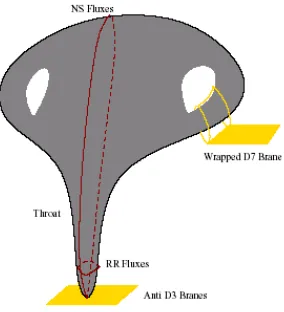
Before delving into the presentation of these systems, let us recall some basic notions about branes in string theory (see Becker et al (2006)). String theory is for-mulated in 10 space-time dimensions, 9 space and 1 time. It deals with closed and open strings. Open string are strands ending on extended objects called branes, i.e. their extremities are attached to submanifolds of the ten dimensional space-time. Type IIB string theory admits branes of odd spatial dimensions. After reducing space-time on a six dimensional manifold in order to retrieve our four dimensions of space-time, only D3 and D7 branes give supersymmetric (which is a symmetry between fermions and bosons) configurations. Anti D-branes preserve opposite su-persymmetries and therefore break all susu-persymmetries in the presence of branes. A D3−D3 system breaks all supersymmetries explicitly while a D3/D7 system preserves supersymmetry. The compactification process on a six dimensional man-ifold introduces a host of massless fields called moduli. They parameterise all the possible deformations of the six-manifold. The existence of massless moduli would have a catastrophic effect in the low energy description of string theory: they would imply a strong modification of Newton’s law of gravity. To avoid this, moduli must become massive and therefore acquire a potential which stabilises their value. The potential for the moduli has been obtained recently in a scenario called the KKLT approach, see Kachru et al (2003a). It involves two new ingredients. The first one are fluxes which resemble constant magnetic fields created by wires. These fluxes stabilise half of the moduli leaving only the moduli measuring the size of the six-manifold untouched. They also imply that the compactification six-manifold is warped, i.e. looks like an elongated throat attached to a region called the bulk, as shown in fig 1. When space-time is warped the invariant distance becomes
ds2=e−A(y)(dt2−dx2)−dy2 (2.1)
Brane Inflation and Defect Formation 3
Figure 1. A throat generated by the fluxes on the compactification manifold. An anti-brane sitting at the bottom of the throat is shown while another D-brane, where non perturbative effects can take place, has also been depicted.
ie anti-de Sitter space-time. It is necessary to lift this up to Minkowski space-time with an ‘uplifting’ mechanism.
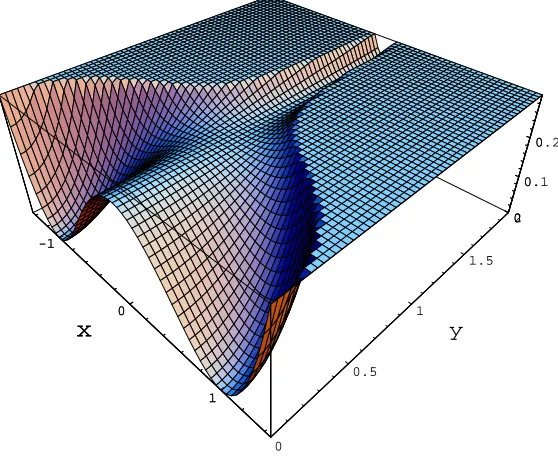
Let us first discuss inflation in the D3−D3 system (see Kachru et al (2003b)). First of all, the D3 has a very specific role in this model. It gives the positive energy which is necessary to lift up the negative minimum of the moduli potential. Inflation is obtained after introducing a D3 brane which is attracted towards the D3 brane. The inflaton field is the distance between the branes. As the branes get closer, an instability develops in a similar way to hybrid inflation, with potential as in fig 2. This model is a nice description of hybrid inflation in string theory and one of the main achievements of string inflation: providing a fundamental description of the inflaton field. There are however problems with this. As a paradigm, the D3−D3 system has a few unambiguous consequences: the level of primordial gravitational waves is very small and cosmic strings with a very low tension may be produced
µ=e−A(y)µ
0, (2.2)
where µ0 is the fundamental string tension. Nevertheless, the lack of a proper
supersymmetric setting for theD3−D3 renders it less appealing than the D3/D7 system that we are about to discuss.
The D3/D7 system has two big advantages over the D3−D3 systems: supersym-metry and it contains a shift symsupersym-metry which eliminates the so–calledη problem, see Dasgupta et al. (2004). In the D3/D7 system, the inflaton is the inter-brane distance while there are waterfall fields corresponding to open string joining the branes. It is a clean stringy realisation of D-term inflation. In this context, the existence of Fayet-Iliopoulos terms is crucial. They are needed to lift the moduli potential and to provide the non-trivial value of the waterfall fields at the end of inflation.
They can be obtained using magnetic fields on D7 branes. The condensation of the waterfall fields is the equivalent of the stringy phenomenon whereby aD3
-1
0
1
x
0
0.5 1
1.5 2
y
0 0.1
0.2
-1
0
1
x
0 0.1
[image:5.612.147.426.85.314.2]0.2
Figure 2. The potential for hybrid inflation. The inflaton field rolls down the almost flat direction until an instability results. The waterfall fields then acquire their vacuum values, resulting in the end of inflation.
brane dissolves itself into aD7 brane, leaving as remnants an embeddedD1 brane. These branes are one dimensional objects differing from fundamental strings. It has been conjectured and there is evidence in favour of the fact that these D-strings correspond to the BPS D-term strings of the low energy supergravity description. Unfortunately, it turns out that the tension of these strings is quite high implying that they would lead to strong features in the CMB spectra. At the moment, the problem of both generating a low tension D-string and inflation at the relevant scale, given by the COBE normalisation, has not been solved. Including moreD7 branes gives semi-local strings, see Urrestilla et al (2004), which alleviate the problem. On the positive side, these models have the nice feature of givingns≈0.98 which could be compatible with data. On the other hand, the spectrum of gravitational waves is undetectable.
The D3−D3 and D3/D7 systems are promising avenues to obtain realistic string inflation models. At the moment, they are no more than plausible scenarios. Inflation being a very high scale phenomenon, it is clear that the study of early universe phenomena could be a crucial testing ground for string theory.
3. Cosmic D-strings
Brane Inflation and Defect Formation 5
& Davis (2002)). It has been argued that D-strings have much in common with cosmic strings in supergravity theories and that they could be identified with D-term strings, see Dvali et al (2004). This is because D-strings should be minimum energy solutions known as BPS solutions. The D-term strings in supergravity are such BPS solutions. Not only are BPS strings minimum energy, but the BPS property means that the equations of motion, which should be second order differential equations, reduce to first order equations making them simpler to solve.
Whilst cosmic strings in global supersymmetric theories have been analysed before, see Davis et al(1996) the study of such strings in supergravity is at an early stage since there are added complications. In Brax et al (2006) an exhaustive study of fermion zero modes was performed. In supersymmetry there are fermions as well as bosons in the action. The fermion partners of the bose string fields can be zero modes. These are zero energy solutions of the Dirac equation. It was found that due to the presence of the gravitino, the number of zero mode solutions in supergravity is reduced in some cases. For BPS D-strings with winding number n the number of chiral zero modes is 2(n−1), rather than 2nin the global case. When there are spectator fermions present, as might be expected if the underlying theory gives rise to the standard model of particle physics, then there aren chiral zero modes per spectator fermion.
Following Dvali et al (2004) we use the supergravity description of D-strings by D-term strings. Consider a supergravity theory with fields φ±, charged under an
Abelian gauge group. The D-term bosonic potential
V = g
2
2 (|φ+|
2
− |φ−|2−ξ)2 (3.1)
includes a non-trivial Fayet-Iliopoulos termξ. Such a term is compatible with su-pergravity provided the superpotential has charge−ξ. Here the superpotential van-ishes. The minimum of the potential is|φ+|2=ξ. It is consistent to take the cosmic
string solution to be
φ+=f(r)einθ (3.2)
wherenis the winding number, andφ− = 0. The functionf(r) interpolates between
0 and√ξ. The presence of a cosmic string bends space-time. Its gravitational effects lead to a deficit angle in the far away metric of spacetime. In the following we consider the metric
ds2=e2B(−dt2+dz2) +dr2+C2dθ2 (3.3)
for a cosmic string configuration. This is the most general cylindrically symmetric metric. Far away from the string the energy momentum tensor is approximately zero and thereforeB is zero. Now we also find that
C=C1r+C0+O(r−1), (3.4)
When C1 6= 0, the solution is a cosmic string solution with a deficit angle ∆ =
2π(1−C1).
In supersymmetric theories, a cosmic string generally breaks all supersymmetries in its core. BPS objects are an exception to this rule, as they leave 1/2 of the original supersymmetry unbroken. D-strings, in which we will be interested in this paper,
are an example of this. These strings have vanishingTrr, and the conformal factor B is identically zero. Moreover for D-strings one finds
∆ = 2π|n|ξ . (3.5)
The supersymmetry algebra in four dimensions allows for 1/2 BPS configurations which saturate a BPS bound giving an equality between the mass, i.e. the tension, and a central charge. Other cosmic strings have higher tension and are not BPS, i.e. they break all supersymmetries. This implies thatC1 is less than the BPS case
giving
∆≥2π|n|ξ . (3.6)
Let us characterise the BPS cosmic strings. We are considering aU(1) symmetry breaking, so we take its generatorTsφi =nQiφi and Aµ =δθ
µna(r). The bosonic fields satisfy first order equations
∂rφi=∓n1−a C Qiφ
i (3.7)
and
∓n∂ra
C =D=ξ− X
i
QiKiφ¯i (3.8)
whereξis the Fayet-Iliopoulos term which triggers the breaking of theU(1) gauge symmetry andK is the Kahler potential. The Einstein equations reduce toB′= 0
and
C′
= 1±AB
θ (3.9)
where
ABµ = i
2( ¯KDµ¯ φ¯
¯
−KjDµφj) +ξAµ (3.10)
The simplest BPS configuration will just have oneφ, with unit charge and K = φ+φ−. Notice that BPS cosmic strings are solutions of first order differential
equa-tions. These equations are consequences of the Killing spinor equations when re-quiring the existence of 1/2 supersymmetry.
4. A Specific Realisation of Brane Inflation
As mentioned previously, a specific realisation of brane inflation is obtained in the system with aD3 and D7 brane, giving rise to the formation of D-strings at the end of inflation. Here we use the KKLT model with superpotential
W =W0+Ae−aT (4.1)
where W0 arises after integrating out the other moduli and the exponential term
arises from non-perturbative effects. In order to keep supersymmetry we can uplift with a so-called Fayet-Iliopoulos term. This is more complicated in supergravity than in ordinary supersymmetry. However, it can be achieved using a method to ensure any anomalies are cancelled, the so-called Green-Schwarz mechanism, see Achucarro et al (2006). This gives us a more complicated superpotential
Wmod(T, χ) =W0+Ae
−aT
Brane Inflation and Defect Formation 7
4 5 6 7 8 9 10
-2 2 4 6
V
VF
VD
Vmax~m 3/22
V
[image:8.612.107.384.82.249.2]T
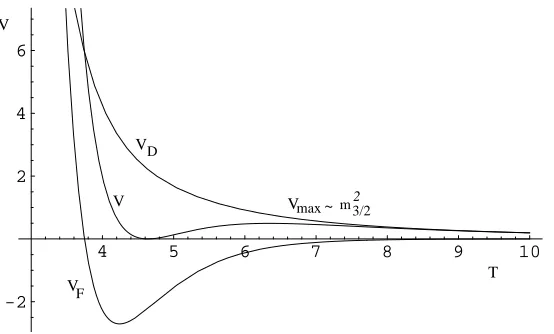
Figure 3. The potential for our model. Note that the F-term gives an AdS minimum, which is uplifted to Minkowski space with the D-term
whereχis a field living onD7 branes. Following Brax et al (2007a), we use a no-scale Kahler potential and include the inflationary terms arising from the superstrings between the branes,
Winf =λφφ+φ−. (4.3)
we get potentialV =VF +VD, where
VD =g
2
2 |φ
+|2− |φ−
|2−ξ2
(4.4)
for the D-term and the F-term is calculated from the superpotential. The Fayet-Iliopoulos term,ξis obtained from anomaly cancellation and depends on the fields, χ and T. The scalar potential is quite complicated, consisting of the part from the superpotential, which is called the F-term part, and the D-term part. We have plotted them in fig 3, where we can see that the original F-term part has a minimum that is less than zero, but the combined potential has a minimum at zero when one adds in the contribution ofVD.
Inflation proceeds as in fig 2 with the chargedφ±
fields being zero, butφfield being non-zero until the D3 brane gets close to the D7. The charged fields become tachyonic, acquiring a vacuum expectation value. They are called ‘waterfall’ fields since the fields fall to their minimum values. At this point cosmic superstrings, or D-strings, are formed. We have analysed the inflation in this theory and found that it gives the density perturbations and spectral index in agreement with the data from WMAP3. We have also analysed the string solutions formed at the end of inflation. In our model ofD-term inflation coupled to moduli, cosmic strings form during the breaking of the Abelian gauge symmetryU(1) by the waterfall fieldφ+
at the end of inflation. The cosmic strings in our model are not BPS as in usual D-term inflation. This is due to the non-vanishing of the gravitino mass and the coupling of the string fields to the moduli sector. We find the cosmic string solution has the form
φ+=ξ1/2einθf(r), φ−
=φ= 0, Aθ=na(r) (4.5)
and the moduli sector fields depend only on r. The functions f(r), a(r), differ from the standard ones appearing in the Abelian string model (see e.g. Vilenkin & Shellard (2000)) as include the effect of contributions from the moduli field andχ arising from the full potential. The Higgs field tends to its vacuum value at infinity, and regularity implies it is zero at the string core. Without loss of generality we can take the winding number positiven > 0. If the variation of the moduli fields inside the string is small, the string solution will be similar to a BPSD-string, with a similar string tension, which (forn= 1) is
µ≈2πξ . (4.6)
The above result will receive corrections from the one loop contribution to the potential. We also expect that the variation of the moduli fields inside the string will reduceµ.
5. Is Cosmic String Formation Generic?
There have been recent attempts to use the string moduli fields themselves as the inflaton field. This type of model is known as racetrack inflation, see Blanco-Pillado et al (2004) and Brax et al (2007b). One can either use an ¯D brane or a D-term for uplifting, as in the previous section. In this class of theory there are no matter fields since the open string modes between branes are not included. Consequently there are no cosmic strings produced at the end of inflation. However, this is a rather artificial situation. Here we will describe a preliminary attempt to include the matter fields.
The superpotential for racetrack inflation is
W =W0+Ae−aT+Be−bT (5.1)
wherea, bare constants andA, B are constant in the original racetrack model, but can be functions of fields in the case of D-term uplifting as in the previous section. To include the open string modes then one adds the additional term
W =WRT+λφφ+φ− (5.2)
Preliminary results suggest that cosmic strings are produced only during inflation and are inflated away (Brax et al 2008). It is therefore unlikely that cosmic strings are produced in the racetrack models discussed here.
6. Conclusions
Brane Inflation and Defect Formation 9
required before realising the possibility of testing string theory with cosmology. A better characterisation of the properties of D-strings would be necessary and a clear understanding of how their experimental signals might differ from ordinary cosmic strings would be required. Similarly, more theoretical work is necessary on string motivated inflation models. However, the progress so far has been fruitful.
This work is supported in part by STFC. ACD wishes to thank Tom Kibble and George Pickett for the invitation to speak at this discussion meeting. We wish to thank Stephen Davis, Rachel Jeannerot and Marieke Postma for collaboration on some parts of this work. ACD thanks Fernando Quevedo for fig 1.
References
Achucarro, A., de Carlos, C., Casas, J.A., Doplicher, L. 2006 De Sitter vacua from uplifting D-terms in effective supergravities from realistic strings, JHEP0606:014
Becker, K., Becker, M. & Schwarz, J., 2006 String Theory and M-Theory: A Modern Introduction, Cambridge University Press
Blanco-Pillado, J.J., Burgess, C.P., Cline, J.M., Escoda, C., Gomez-Reino, M., Kallosh, R., Linde, A. & Quevedo, F. 2004 Racetrack Inflation, JHEP0411:063
Blanco-Pillado, J.J., Burgess, C.P., Cline, J.M., Escoda, C., Gomez-Reino, M., Kallosh, R., Linde, A. & Quevedo, F. 2006 Inflating in a Better Racetrack, JHEP0609:002
Brax, P., van de Bruck, C., Davis, A.C. & Davis, S.C. 2006 Fermionic zero modes of supergravity cosmic strings JHEP0606:030
Brax P., van de Bruck, C., Davis, A.C., Davis, S.C., Jeannerot, R. & Postma, M. 2007a Moduli corrections to D-term inflation, JCAP0701:026
Brax P., Davis, A.C., Davis, S.C., Jeannerot, R. & Postma, M. 2007b D-term Uplifted Racetrack Inflation, JCAP0801:008
Brax P., van de Bruck, C., Davis, A.C., Davis, S.C., Jeannerot, R. & Postma, M. 2008, unpublished
Burgess, C.P., Cline, J.M., Stoica, H.& Quevedo F. 2004 Inflation in realistic D-brane models, JHEP0409:033
Copeland, E., Myers, R. C. & Polchinski, J. 2004 Cosmic F and D strings, JHEP0406:013
Dasgupta, K., Hsu, J.P., Kallosh, R., Linde, A. & Zagermann, M. 2004 D3/D7 Brane Inflation and Semilocal Strings, JHEP0408:030
Davis, A.C., Davis, S.C. & Trodden, M. 1997 N=1 supersymmetric cosmic strings Phys.Lett.B405:257-264
Davis, A.C. & Kibble, T.W.B. 2005 Fundamental cosmic strings, Contemp.Phys.46
:313-322
Dvali, G. & Tye S.H.H., 1998 Brane Inflation, Phys.Lett.B450, 72-82
Dvali, G., Kallosh, R. & van Proeyen, A. 2004 D Term Strings, JHEP0401:035
Kachru, S., Kallosh, R., Linde, A. & Trevedi, S.P. 2003a De Sitter Vacua in String Theory, Phys.Rev.D68, 046005
Kachru, S., Kallosh, R., Linde, A., Maldacena, J., McAllister, L.& Trivedi, S., 2003b Towards Inflation in String Theory, JCAP0310:013
Liddle, A. & Lyth, D., 2000Cosmological Inflation and Large Scale Structure, Cambridge University Press
Majumdar, M. & Davis, A.-C. 2002 Cosmological Creation of D-branes and Anti-D-Branes, JHEP0203:056
Mukhanov, V., 2006Physical Foundations of Cosmology, Cambridge University Press Polchinski, J., 1998String Theory Vol.1 & Vol. 2, Cambridge University Press
Polchinski, J. 2004 Introduction to cosmic F- and D-strings, hep-th/0412244
Sarangi, S. & Tye, S.H.H. 2002 Cosmic String Production Towards the End of Brane Inflation, Phys.Lett.B536, 185-192
Urrestilla, J., Achucarro, A. & Davis, A.C. 2004 D term inflation without cosmic strings, Phys.Rev.Lett.92:251302