Equitable representation in councils: theory
and an application to the United Nations Security
Council
Matthew Gould1•Matthew D. Rablen2
Received: 10 September 2015 / Accepted: 28 August 2016
The Author(s) 2016. This article is published with open access at Springerlink.com
Abstract We analyze democratic equity in council voting games (CVGs). In a CVG, a voting body containing all members delegates decision-making to a (time-varying) subset of its members, as describes, e.g., the relationship between the United Nations General Assembly and the United Nations Security Council (UNSC). We develop a theoretical framework for analyzing democratic equitability in CVGs at both the country and region levels, and for different assumptions regarding preference correlation. We apply the framework to evaluate the equitability of the UNSC, and the claims of those who seek to reform it. We find that the individual permanent members are overrepresented by between 21.3 times (United Kingdom) and 3.8 times (China) from a country-level perspective, while from a region perspective Eastern Europe is the most heavily overrepresented region with more than twice its equitable representation, and Africa the most heavily underrep-resented. Our equity measures do not preclude some UNSC members from exercising veto rights, however.
Keywords United Nations Security CouncilUnited NationsVoting powerSquare-root ruleEquity
JEL Classification D72D71C71C63
& Matthew Gould
Matthew D. Rablen [email protected]
1 Westminster Business School, University of Westminster, 35 Marylebone Road,
London NW1 5LS, UK
2
1 Introduction
Decision-making within international organizations is sometimes made by voting bodies that comprise a proper subset of the membership (a ‘‘council’’). The pre-eminent such council, and the primary motivator of this paper, is the United Nations Security Council (UNSC), the only international body with the power to authorize the use of armed force. At any one time, the UNSC contains only 15 members from a total United Nations (UN) membership of 193. Two further councils operating within the UN are the United Nations Economic and Social Council (ECOSOC) and the United Nations Human Rights Council (UNHRC). ECOSOC (54 members) is responsible for coordinating the work of 14 UN specialized agencies, including the World Bank and the International Monetary Fund, while the UNHRC (47 members) is responsible for promoting and protecting human rights around the world. Councils also operate within many of the UN’s specialized agencies, some examples being the Board of Governors of the International Atomic Energy Agency (35 members), the Council of the International Maritime Organization (40 members), and the Executive Board of the World Health Organization (34 members).1
In this paper we develop a simple and sober theoretical framework for analyzing democratic equitability in councils and present an application to the UNSC. Existing studies of equity in international voting bodies are predicated on an idealized two-stage democratic decision-making process—first, each member state holds a national vote; second, a delegate from each member state votes in the international body according to the outcome of the national vote. International voting bodies that have been analyzed in this framework include the Council of the European Union (e.g., Felsenthal and Machover
2001,2004,2007; Laruelle and Widgre´n1998; Leech2002a); the UN General Assembly (Manno 1966; Newcombe et al. 1971; Dixon1983), the IMF Executive Board (Leech
2002b; Leech and Leech2013; Rapkin and Strand2006), and the World Bank Executive
Boards (Leech and Leech2005).2The UNSC is notably absent from this list.
What lies behind this lacuna? When international decision-making is by a council, the conventional democratic decision-making process described above cannot be applied directly for at least two reasons. First, in a council, only a subset of country delegates gets to participate in the international vote. Second, this subset is not usually constant over time. We account for these factors in a new class of voting game we term acouncil voting game
(CVG). In a CVG a body comprising all members—an ‘‘assembly’’—assigns (by election or otherwise) a subset of its members to a ‘‘council’’. As the council’s membership must be allowed to change through time we cannot take it to be a primitive, thus distinguishing a CVG from the classical ‘‘simple voting game’’ of Shapley (1962). In a CVG the set of council members instead originates endogenously as a function of four primitive elements, (A,N,R,P), whereAis the set of members of the assembly;Ris a regional partition on
1 Why do councils exist? In the case of military or emergency action, the lengthy deliberations of a large
body are thought to prevent such a body from being able to react with sufficient speed to developing security threats. Alternatively, councils may function in domains deemed to require detailed or specialised analysis (ECOSOC being an example). From a realpolitik perspective, it is also possible that councils are a mechanism by which countries with greater stakes in the decisions being taken seek to acquire greater influence. Councils can also arise at the national level. For instance, some countries have ‘‘Privy’’ or ‘‘Executive’’ Councils with the right to enact legislation during states of emergency, committees that perform detailed tasks such as voting over proposed new legislation on a clause-by-clause basis prior to final approval by the national legislature, or both.
2
A(the UN membership is partitioned into five regions, for instance);N is a partition of seats on the council between regions, and Pis a stochastic process that determines the probability with which each member ofAis assigned to the council.
To analyze equitable representation, we embed a CVG within a democratic decision-making process. In the conventional two-stage process employed in the literature, the first (national) vote is held under a simple majority rule, with a binary set of voting possibilities {for, against}, and a dichotomous outcome space {mandate to vote ‘‘for’’, mandate to vote ‘‘against’’}. In the second (international) stage, countries vote ‘‘for’’ or ‘‘against’’ according to their national mandates and the outcome space is {pass, fail}. We generalize this process in three ways. First, we posit a tripartite process in which a national vote occurs in the first stage, countries are assigned randomly to the council in the second stage, and the council votes in the final stage. Second, we allow for the first stage to be a regional (rather than national) vote to study a notion of equity at the level of regions, distinct from equity at the level of countries. Last, in order to represent the distinct role of abstention in councils such as the UNSC faithfully, we generalize the set of voting possibilities and outcomes in the national and international votes, and we generalize the decision rule beyond simple majority rule.3
Our basic normative notion of democratic equity—theequalization of expected voting power (EVP) criterion—requires that every citizen have the same voting power (in expectation) over outcomes in the council, before the assignment of countries to the council is known.4This concept of equity, therefore, reflects both a country’s voting rights when serving as a council member, andhow oftenit is a council member.
We distinguish between equity at the country and region levels: the country-level equity concept presupposes that, when a member of the council, countries represent only their own citizens, whereas the region-level concept presupposes that, when a council member, countries act as representatives of their region as a whole. We also develop flavors of the EVP criterion under different a priori assumptions regarding intra-regional preference correlation. Interestingly, our country and region equity concepts are not, in general, mutually compatible: a CVG that is equitable if council members represent only them-selves (as opposed to their regions) will necessarily fail to achieve equitable regional representation, and the reverse also is true.
We characterize democratic equitability under each of our equity concepts. Under the assumption of random voting, we show that our country equity concept is satisfied when a citizen’s expected absolute voting power in the council (before the assignment of countries to the council is known) is inversely proportional to their absolute voting power in the national ballot. Regional equity under random voting requires that a citizen’s absolute voting power in the council (when each region votes as a bloc) is inversely proportional to their absolute voting power in the regional ballot.
With respect to applications, our paper is the first we are aware of to present a quan-titative assessment against formal equity concepts of the equitability of the UNSC for both individual countries and regions. As we discuss in more detail in Sect.3, the UNSC is witnessing a protracted reform debate that centers on national and regional representation (see, e.g., Franck2003). At the regional level, reformers argue that Africa and Asia have
3 Thus, we contribute to the growing literature on the theory and application of ternary voting games (see,
e.g., Birkmeier et al. 2011; Braham and Steffen 2002; Coˆrte-Real and Pereira 2004; Felsenthal and Machover1997; Freixas2012; Freixas and Zwicker2003,2009; Herrera and Mattozzi2010; Lindner2008; Uleri2002).
4
too little power, and that a north–south imbalance exists. At the national level, countries such as Germany and Japan—who are eligible only for Non-Permanent Member (NPM) status on the UNSC—claim to be severely underrepresented, and the permanent members (PMs)—who each wield an individual veto—are argued to have too much representation. Our modeling of the UNSC utilizes a specification of the democratic decision-making process in which the vote in the first stage is under an extension of the well-known majority threshold rule to allow for three voting possibilities, {for, abstain, against}, and three possible outcomes, {mandate to vote for, no mandate, mandate to vote against}. Specifi-cally, a threshold proportion of the eligible voters must vote for (against) a motion for a country to have a mandate to vote for (against) a motion in the council. Abstention in the council is identified with instances wherein a country fails to obtain a mandate for voting either for or against a motion in the national vote. We prove an extension of Penrose’s (1946) square-root law for the case in which the majority threshold is set at one-third of eligible voters.
Our findings give detailed insights into the UNSC reform debate. Our main notion of country equity shows that the permanent members (PMs) are heavily overrepresented: the United Kingdom is the most heavily overrepresented PM with over 21 times its equitable level of expected voting power, while China is the least heavily overrepresented PM with around 3.8 times its equitable level of expected voting power. Our equity con-cepts do not, however, preclude some countries holding a right of veto. The very smallest countries in terms of population suffer from very significant underrepresentation—Do-minica, for instance, is estimated to receive just 0.8 % of its equitable voting power. Our regional equity concept shows that Africa is the most underrepresented region with only around one-third of its equitable voting power, while Eastern Europe is the most over-represented with just over double its equitable representation. These findings suggest a case for a reallocation of the seats given to each region, and our notion of country equity is prescriptive in this regard.
The plan of the rest of paper is as follows: Sect.2develops a theoretical framework for the analysis of democratic equity in councils; Sect.3presents an application of the theory to the UNSC; and Sect.4concludes. All proofs are located in the Appendix.
2 Theory
In this section we consider a setting in which an ‘‘assembly’’ assigns a subset of its members to a ‘‘council’’. As with other aspects of the model, this setting is intended to mirror the UN’s observed structure, in which context the assembly should be thought of as the UN General Assembly (UNGA), the main deliberative body of the UN containing all 193 of its members, and the council could refer to any of the councils within the UN identified in the Introduction. As in the UNGA, we partition the assembly’s membership into regional groups. Countries are then assigned to the council in fixed numbers from each of the regions.
2.1 Council voting games
In this section we develop formally a class of voting games we term acouncil voting game
(CVG). We begin by describing the elements of a CVG.
Let the assembly (comprising all members) be denoted as the finite setA. We partitionA
into regions by writingA=[jRj, whereRjis thejth region,j[J. The set of all regions,
Rj j2J, we denote byR. Each region is a set of countries; we defineaijas theith country
within regionj.
The number of council seats for the members of each regionjis given bynjC1, where
it is assumed that the number of seats for each region is always smaller than the number of countries belonging to the region, |Rj|[nj. The set nj j2J we denoteN.
Rather than specify the procedure by which countries are assigned to the council, we adopt a reduced form representation that allows for any such procedure. Anassignment process P is a stochastic process that induces, for every motion kon which the council must vote, a probabilitypijkthat countryaijis assigned to the council for that vote. Under
P, the average assignment probability of countryaijon an infinite set of motionsk[Kis
given bypij¼EK pijk
.
The above elements together determine the set of council members, M, voting on a given motion. Hence, we writeM:M(A,N,R,P). The realized set of council members voting on motionkis signified byMk, and we denote byMjkthe intersectionMk\Rj.
Votes in the council are decided according to adecision rule U, which is a mapping from the space of voting possibilities to an outcome space, satisfying the monotonicity conditions given in Freixas and Zwicker (2003).5We may now define a CVG:
Definition 1 A council voting game is the pairC= {M,U}.
2.2 Equity in CVGs
2.2.1 The democratic decision-making process
To understand the equity properties of a CVG, it must be embedded in a democratic decision-making process that maps the preferences of citizens to outcomes. To analyze differing country and regional notions of equity, we introduce two such decision-making processes: the ‘‘country’’ process (CDP) and the ‘‘region’’ process (RDP). Under the CDP countries on the council represent only their national populations, allowing us to investi-gate equity at the country level. Under the regional process (RDP), countries are assumed a priori to act on the council as regional representatives, permitting us to investigate equity at that level.
For a given motionk, the CDP comprises three stages. In stage 1, anationalballot is held in each country. The decision rule in stage 1 is taken to be anonymous, such that every citizen of a country has symmetric voting rights. In stage 2, a subsetMjk,Rjof countries
are assigned to the council from each region. In stage 3, countriesaij [ Mk vote in the
council according to the outcome of their national ballot in stage 1. In contrast, in the RDP, a singleregionalballot is held in each region in stage 1 under an anonymous decision rule, such that every citizen of a region has symmetric voting rights. In stage 2 a subsetMjk,Rj
of countries are assigned to the council from each region. In stage 3, countriesaij[Mjk
5
vote as a bloc, each bloc member voting according to the outcome of the regional ballot in stage 1.6
2.2.2 Equity concepts
Our basic normative notion of democratic equity is that, from behind a veil of ignorance as to what a citizen’s preference is, and to which country or region they belong, a citizen should be able to influence outcomes in the council equally. This criterion is often referred to as the ‘‘one-person, one-vote’’ criterion, or the ‘‘equalization of voting power’’ criterion (for brevity, the EVP criterion). Crucially, we require that the EVP criterion holdbefore
the assignment of countries to the council occurs. That is, we require that expected voting power (before it is known which countries will vote in stage 3) to be equal across citizens. This notion of equity acknowledges that the democratic power of a citizen in a global council depends not only on the voting rights of his or her country when it is a member of the council, but also on how frequently his or her country is a member of the council.7
We posit two related forms of the EVP criterion. In its strong form, we require that the EVP criterion hold for each and every motion. This implies, for instance, that a country with a smaller assignment probability on a given motion must, by way of compensation, receive more voting power on the council if it is assigned.8
The weak form of the EVP criterion, however, allows for deviations from the EVP criterion on any one ballot, so long as deviations offset across an infinite sequence of ballots. Intuitively, the weak form permits intertemporal shifting of assignment probabil-ities and voting rights: a country might, for instance, have guaranteed representation on the council in a given period in return for a lesser assignment probability in other periods. Under weak EVP, a country with a smaller average assignment probability must be compensated for longer expected spells outside the council by the exercise of greater voting power when it is a member of the council.
Two variants of country equity are therefore possible—one under the strong form of the EVP criterion (CEs), and one under the weak form (CEw). In many contexts, the question
of whether a CVG is equitable on average over time is of primary interest. Accordingly, in the application we shall mainly employ the weak form of EVP. At minimum, however, the strong form can be used as a ‘‘tie-breaker’’ to choose between CVGs that stalemate with respect to weak EVP.
In contrast, when considering regional equity no meaningful distinction exists between evaluating the EVP criterion for every motion or across an infinite sequence of motions. This is so because each region always is represented on the council, and the identities of
6
As, in the context of regional equity, we are interested specifically in understanding the representation of regions as cohesive entities it is appropriate in this context to disregard the possibility—which might be very real in practice—that countries assigned to the council in stage 2 of the RDP might break ranks and vote according to the preference of their own citizens rather than according to the outcome of the regional ballot. This point underscores the need to understand both country and regional concepts of equity.
7
Several of the proposals for reforming the UNSC detailed in Cox (2009) modify only the assignment probabilities, leaving voting rights unchanged. This suggests that world leaders understand (at least intu-itively) the importance of assignment probabilities distinct from voting rights.
8
Our notion of country equity is procedurally equitable, but is compatible with individual countries experiencing short-term gluts and droughts of membership owing to the stochastic nature of the assignment process. That is, we consider ‘‘procedural’’ equity, rather than ‘‘outcome’’ equity (see, e.g., De Cremer et al.
the countries that form the regional bloc are immaterial. Accordingly, only one notion of regional equity must be considered, which we denote byRE.
2.2.3 Equity concepts—a formalization
We denote the population of country aij asqij [ N, and the population of region j as
qj¼Paij2Rjqij. We denote the absolute voting power of a citizen of countryaijin stage 1
under the CDP (RDP) as uCDP
ij uRDPj
. Similarly, absolute voting power in stage 3 is
denoted for countryaijunder the CDP (RDP) asxCDPij xRDPj
.9Candidate specifications
foruandxare given in, e.g., Freixas (2005a,b), but at this stage we need not specify a particular index of absolute voting power.
Under the CDP, we denote the overall (or composite) voting power of a citizen of countryaij(before it is known whetheraijwill be assigned to the council to vote on motion
k) byvCEs
ijk , and the expectation of v CEs
ijk overk [K is denotedv CEw
ij . Under the RDP, we
denote the composite voting power of a citizen of regionjbyvRE
j .
Definition 2 below formalizes our three perspectives on the EVP criterion. Equality across countries/regions of the relevant notion of composite voting power is expressed mathematically as the requirement that all individual country/regional deviations from the Assembly mean,EAð Þ, be zero. This approach shall provide a natural metric for measuring
deviations from each equity concept for the purposes of application.
Definition 2
(i) CsatisfiesCEsifvijkCEs¼EA vCEijks
for allaijand allk[K;
(ii) CsatisfiesCEwifvijCEw¼EA vCEij w
for allaij;
(iii) CsatisfiesREifvRE
j ¼EA vREj
for allaij.
We begin by analyzing Definition2under the assumption—termed uncorrelated pref-erences (UC)—that every world citizen votes independently, and is equally likely to vote for each of the given voting possibilities. UC is not understood as denying the possibility of preference correlation in this context, but instead harks to Bernoulli’s Principle of Insuf-ficient Reason (BPIR), according to which voting alternatives should be assigned equal epistemic probabilities if there is no known reason for assigning unequal ones (see, e.g., Felsenthal and Machover1997,2003).10An analysis under UC preferences captures the inequity that is inherent in the rules of a CVG, which is logically distinct from the actual, or empirical, level of inequity that might be observed at a point in time. Given the shifting sands of political ties over time, strong arguments exist for considering this concept of
9
Note that, under the CDP, a country’s absolute voting power on the council,xCDP
ij , is motion-invariant, yet
its relative voting power,xCDP
ij = P
aij2Mkx CDP
ij , may vary from motion to motion. A similar point also applies
to regional blocs under the RDP. In the UNSC, however, both absolute and relative voting power are motion-invariant (for countries and regions), but only because the rules of this particular council imply that a non-PM always is replaced by another such member from the same region with identical voting rights.
10
inherent, rather than empirical, inequity. Accordingly, we make UC preferences our benchmark assumption. As we shall discuss below, however, the assertion of BPIR may not be appropriate in all contexts, so we will examine later the implications of Definition2
when allowing a priori for degrees of preference correlation. For UC preferences it is straightforward to deduce that
vCEs
ijk ¼uCDPij pijkxCDPij ; v CEw
ij ¼uCDPij pijxCDPij ; vREj ¼uRDPj xRDPj ;
which gives rise to our first Proposition:
Proposition 1 Under UC preferences,C satisfies
(i) CEsif and only ifxCDPij /pijku1CDP ij
for all aijand all k[K;
(ii) CEwif and only ifxCDPij /piju1CDPij
for all aij;
(iii) RE if and only ifxRDP
j /uRDP1
j
for all j.
According to parts (i) and (ii) of Proposition1, country equity does not relate exclu-sively to the properties of the decision ruleU, but rather is a property of the interaction between Uand the (stochastic) assignment processP. According to part (i), to meet the EVP criterion in its strong form it must hold that, for every motion, expected voting power on the council is assigned in inverse proportion to a citizen’s expected voting power across stages 1 and 2 of the CDP. Many divisions of voting power and assignment probability that achieve strong EVP are possible: if thepijkare equal across countries (a flat rule) then
strong EVP holds if voting power in the council is proportional to 1.uCDP
ij . An alternative
possibility is that voting power in the council obeys a flat rule, and the assignment
probabilities are proportional to 1.uCDP
ij .
11
In its weak form, country EVP requires an understanding of the long-run properties of the assignment process, as summarized by pij—the average assignment probability of
countryaij. Weak country EVP is met if, on average, expected voting power on the council
is assigned in inverse proportion to a citizen’s long-run expected voting power across stages 1 and 2.
It is straightforward to observe that if thepijkare made invariant with respect tok, then
pijk¼pijholds for allk[K, such that strong country EVP coincides with weak country
EVP. In all other cases, however, the two concepts are distinct; strong country EVP implies weak country EVP, but the reverse implication does not hold.
Last, part (iii) of the proposition establishes the following: regional equity requires that the voting power of regional blocjon the council must be inversely proportional to the voting power of a citizen of regionjin stage 1. Assignment probabilities do not play a role here because each region always is represented on the council.
Are region and country equity mutually compatible? A complex relationship exists between the voting power of a bloc and the sum of the voting powers of its individual members when voting independently (see, e.g., Leech and Leech 2006). In general, this relationship is non-linear (and so also non-additive), yet compatibility of regional and
11
Both of these examples are monotonic in the sense that more populous countries receive weakly larger absolute voting power and assignment probability. We note, however, thatCEsalso is satisfied by a range of
less empirically plausible rules in which, e.g., assignment probability is declining in population and voting power is a function of population that rises faster than 1.uCDP
country equity requires a proportional relationship to hold between the two. While arte-factual examples can be constructed with this property, the probability of such a rela-tionship happening to hold, by chance, in an empirical example seems remote. Accordingly, under UC preferences, country and regional equity are, for practical pur-poses, incompatible.
2.3 Correlated preferences
Reasons sometimes exist for supposing preference correlation at the country/region level, in which case it is inappropriate to invoke BPIR. In the context of a cross-party committee, for instance, voting down party lines may be anticipated a priori.12We therefore outline two alternative possible configurations of citizen preferences. We stress, however, that the most appropriate configuration of preferences must be judged on a case-by-case basis depending on the council to which the theoretical model is being applied.
The first alternative, Region Correlation (RC), is the extreme case (relative to UC) in which all citizens of regionj have identical preferences, such that (i) voting is perfectly correlated across citizens within a country; and (ii) country voting outcomes are perfectly correlated across countries within a region. On a given motion, however, each voting possibility is equally likely to be the one chosen unanimously by all regional citizens, so voting outcomes between regions remain independent. Accordingly, under RC preferences, countries within each region vote as regional blocs on the council, but each bloc votes independently. As this outcome holds under both decision-making processes we consider, no meaningful distinction between country and regional equity arises in this case. Thus we may restrict attention to regional equity.
With RC preferences, every world citizen is a dictator in the stage 1 regional vote, in the standard sense that the outcome of the vote always coincides with his/her preferred out-come. A minimal property of all voting power indices of which we know is that a dictator receives the maximal voting power, which we denote by u[0. Thus, we may write:
vRE
j ¼ux RDPj .
A second configuration, Country Correlation (CC), constitutes an intermediate case in which all citizens of countryihave identical preferences, but preferences are independent across countries. With CC preferences every world citizen is again a dictator in the national (stage 1) vote under the CDP; we thus obtain vCEs
ijk ¼upijkxCDPij and v
CEw
ij ¼upijxCDPij .
Citizens are not dictators in stage 1 under the RDP, however, so, as under UC preferences, we obtain vRE
j ¼uRDPj xRDPj . Noting thatusimply can be subsumed into the constant of
proportionality we obtain:
Proposition 2 Under CC preferencesCsatisfies
(i) CEsif and only if xCDPij /1=pijk for all aijand all k [K; and CEwif and only if
xCDP
ij /1=pijfor all aij;
(ii) RE if and only ifxRDP
j /1=uRDPj for all j;
and under RC preferencesC satisfies
(iii) RE if and only ifxRDP
j is equal for all j.
12
3 Application
In this section we apply the theory of Sect.2to the case of the UNSC, the most powerful organ within the UN. The UNSC has the authority to make legally binding resolutions in fulfillment of its mandate to maintain international peace and security. To that end, it can suspend economic and diplomatic relations between countries, impose blockades, and authorize the use of armed force. Under the present arrangements—which have been in place since 1965—the UNSC is comprised of 15 members, of which five—China, France, Russia, the United Kingdom, and the United States—are ever-present and wield a veto on all non-procedural matters. The remaining ten non-permanent members are elected by the UNGA and serve time-limited two-year terms.
The UNSC is experiencing a protracted reform debate, in which both country and regional perspectives on equity are cited frequently (e.g., Russett et al. 1996; Hammer
2002; Schwartzberg2003; Annan2005; Blum2005). From the country perspective, it is argued commonly that the veto rights of the five PMs gives these countries too much influence. Nearly all governments wish to abolish or limit the right of veto, which is viewed as an unfair and anachronistic legacy of the Second World War (Fassbender2004; Schwartzberg2003).
From the regional perspective, it is argued that Africa and Asia are underrepresented as together they account for around 75 % of the populations of UNGA member countries, but are allocated only 20 % of the PM seats, and 50 % of the NPM seats, and, moreover, that an even larger representational imbalance exists between the developed north and the developing south.
In the absence of a formal theoretical framework for assessing the equitability of CVGs, or for addressing issues relating to regional- and country-specific notions of equity, existing quantitative analyses of equity in the UNSC are unable to verify these claims directly. Instead, extant studies use the voting power of a PM relative to a NPM as an informal indicator of equitability (see, e.g., Hosli et al.2011; O’Neill1996; Strand and Rapkin2011; Straffin1993, p. 180). The theoretical framework of Sect.2permits, for the first time, a formal quantitative assessment of the equitability of the UNSC for both individual countries and regions. The benchmark analysis is performed for UC preferences, although we shall comment briefly on the implications of assuming CC preferences.
Are our democratic notions of equity appropriate for a body such as the UNSC? After all, different countries make very different per capita contributions to peacekeeping and international disaster relief.13There are, however, strong arguments for operating inter-national organizations along democratic lines relating, in particular, to the need for such organizations to be seen as legitimate (Frey and Stutzer 2006; Stutzer and Frey 2006; Marchetti2008; Cowling et al.2010). Also, to our knowledge, an alternative equity notion with the philosophical clarity and widespread normative acceptability of the democratic notion of one person, one vote, is yet to be proposed. Last, as we comment further in the conclusion, even if implementation of the democratic equity concepts discussed here would violate implicit realpolitik constraints, these concepts still stand as benchmarks for identifying the optimal second-best choice from among the set of CVGs that satisfy such constraints.
13 As of 2014, the United States contributes 22 % of the UN’s regular budget, Japan contributes 10.8 %,
3.1 Modeling the UNSC
We consider the UNSC as of 2012; the corresponding CVG we denote byC2012
UNSC. We now
describe each of the elements (A,N,R,P,U) for this game. The assemblyAis the UNGA, which is partitioned into five regions: Africa, Asia, Eastern Europe (EE), the Latin America and Caribbean Group (GRULAC—el Grupo Latinoamericano y Cariben˜ o), and the Western European and Others Group (WEOG).14The ten NPM seats are divided between the five regions: one for EE; two for each of Asia, the GRULAC and the WEOG; and three for Africa.
3.1.1 The UNSC assignment process
LetPMbe the set of PMs andOMbe the set of the remaining 188 ‘‘ordinary’’ members. For simplicity, we imagine that the UNSC votes once per year—an assumption that is inconsequential to our findings, but that allows us to interpret naturally the index of motions,k, as an index of time (as motions are indexed in the same way as years). As a PM is guaranteed a seat on the UNSC, we havepijk=1 foraij[PM. We model the UNSC
assignment process for ordinary members by first giving eachaij[OMa probability,qij[
[0,1] (wherePa
ij2Rjqij¼1), with which it will be assigned to the UNSC if (i) it competes
with all other members of its region; and (ii) only a single seat is being assigned. We construct empirical estimates of theqijfrom the analysis of Dreher et al. (2014),
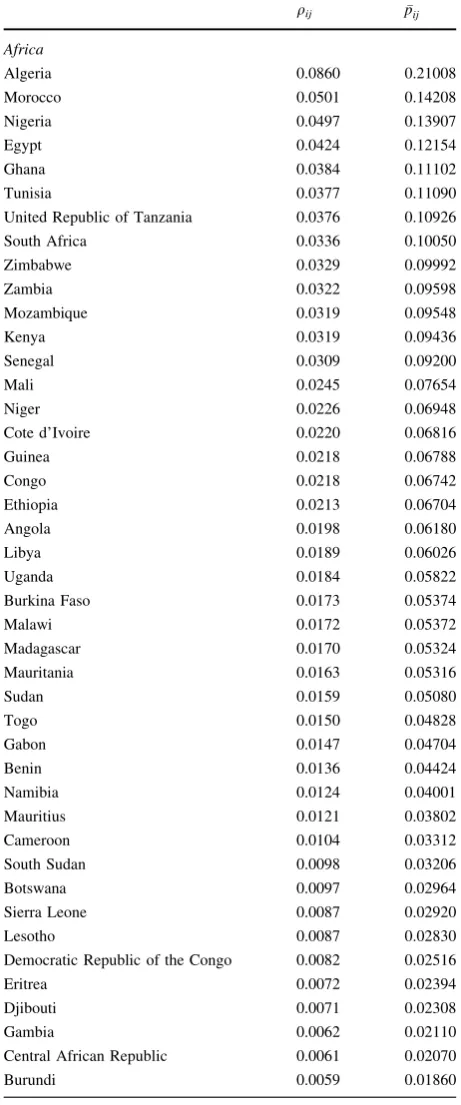
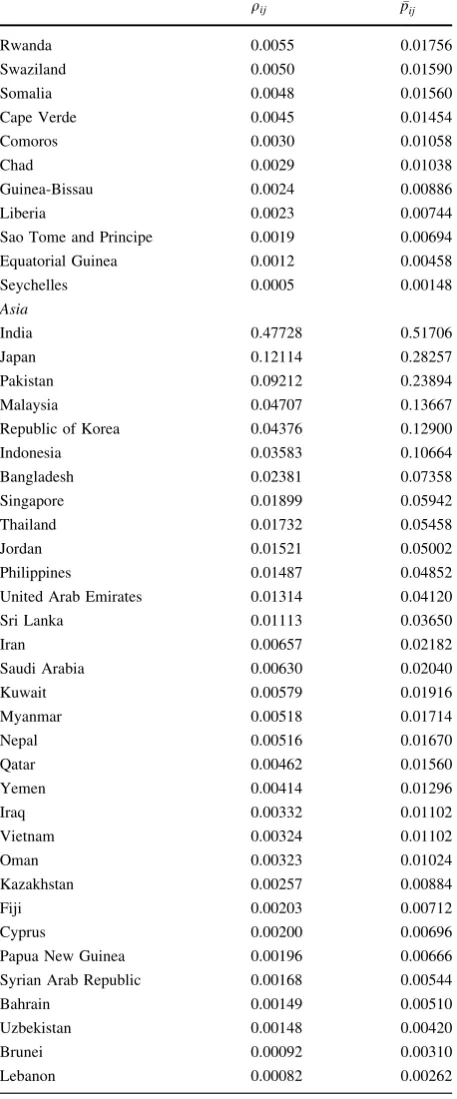
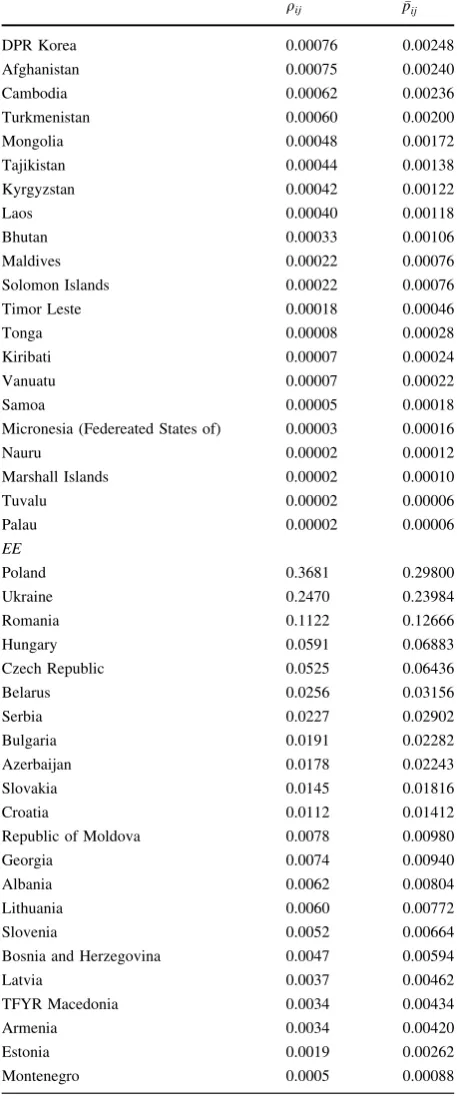
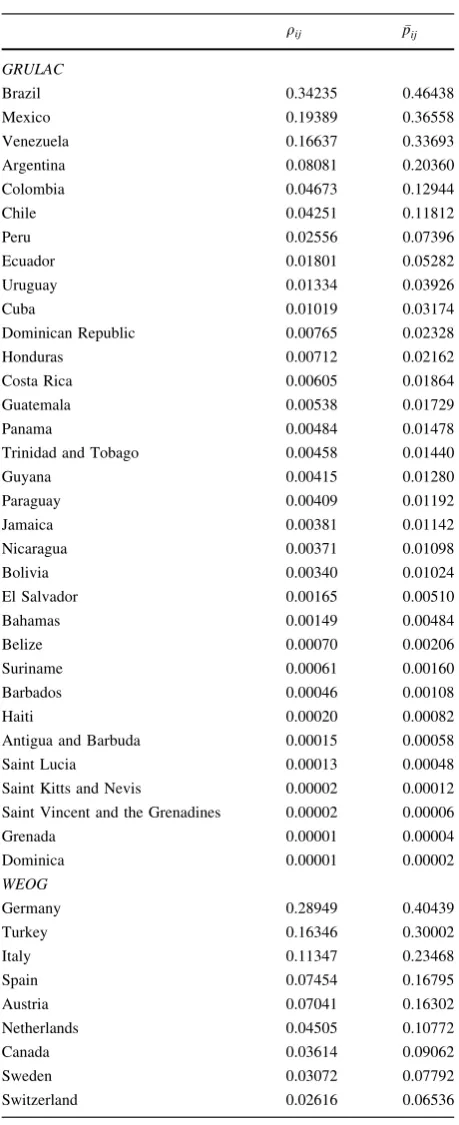
which estimates empirically the determinants of election to the UNSC as a NPM, accounting for the two-stage process by which such members presently are elected.15 These authors show that three country characteristics systematically predict UNSC elec-tion: population, gross national income per capita, and waiting time since last serving on the UNSC. The estimated coefficients for these three variables can be used in a straight-forward way to compute estimates of the qij.16 The resulting estimates are shown in
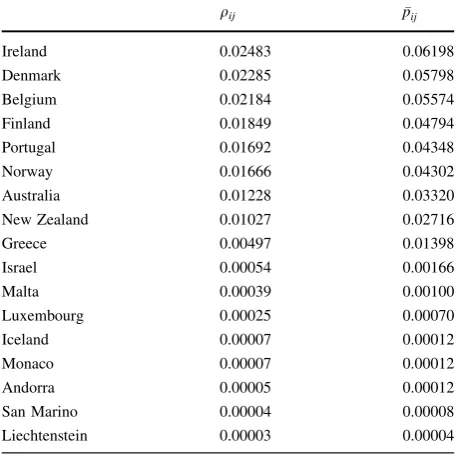
Table1.
To generate thepijkwe feed the empirical estimates of theqijinto a computer simulation
of the UNSC election process over a setK0spanning 100,000 simulated years. The precise details of the simulation will not be of interest to all readers, so these are relegated to the
Appendix. As we discuss below, the set ofpijkwe obtain in this way are used to estimate
the proximity of the UNSC to strong country EVP, and the obtained estimates of thepij
(see Table1) are used to estimate the proximity of the UNSC to weak country EVP.
14
See Table1for the full membership of each of the regional groups (excluding PMs). Of the PMs, China is a member in Asia, Russia in EE, and France and the United Kingdom in the WEOG. Technically, the United States is not a member of any regional group, but it attends meetings of the WEOG as an observer and is considered to be a member of that group for electoral purposes (UN2012). For the purposes of this paper, therefore, we give the United States membership in the WEOG.
15 In the first stage, the regions make nominations to the UNGA and, in the second stage, the UNGA votes.
See Dreher et al. (2014) for a detailed account of the election process.
16 Because the Dreher et al. dataset ends in 2006, we obtain estimates of country populations and gross
national incomes per capita (current USD) for 2012 from the CIA World Factbook (seehttps://www.cia.gov/ library/publications/the-world-factbook/index.html#). We update Dreher et al.’s variable measuring waiting time since last serving on the UNSC to 2012 using historical membership data from the UNSC Web site (http://www.un.org/Docs/sc). To produce the estimates in Table1, these data, along with the coefficient values for population, gross national income per capita, and waiting time since last serving on the UNSC reported in their Table 3a, are fed into their Eq. (5), where we assume that the sum in the denominator is over all countries in the region (i.e., their ‘‘Ejt’’—the set of countries competing for the seat—is assumed to
Table 1 Estimated (qij,pij) q
ij pij
Africa
Algeria 0.0860 0.21008
Morocco 0.0501 0.14208
Nigeria 0.0497 0.13907
Egypt 0.0424 0.12154
Ghana 0.0384 0.11102
Tunisia 0.0377 0.11090
United Republic of Tanzania 0.0376 0.10926
South Africa 0.0336 0.10050
Zimbabwe 0.0329 0.09992
Zambia 0.0322 0.09598
Mozambique 0.0319 0.09548
Kenya 0.0319 0.09436
Senegal 0.0309 0.09200
Mali 0.0245 0.07654
Niger 0.0226 0.06948
Cote d’Ivoire 0.0220 0.06816
Guinea 0.0218 0.06788
Congo 0.0218 0.06742
Ethiopia 0.0213 0.06704
Angola 0.0198 0.06180
Libya 0.0189 0.06026
Uganda 0.0184 0.05822
Burkina Faso 0.0173 0.05374
Malawi 0.0172 0.05372
Madagascar 0.0170 0.05324
Mauritania 0.0163 0.05316
Sudan 0.0159 0.05080
Togo 0.0150 0.04828
Gabon 0.0147 0.04704
Benin 0.0136 0.04424
Namibia 0.0124 0.04001
Mauritius 0.0121 0.03802
Cameroon 0.0104 0.03312
South Sudan 0.0098 0.03206
Botswana 0.0097 0.02964
Sierra Leone 0.0087 0.02920
Lesotho 0.0087 0.02830
Democratic Republic of the Congo 0.0082 0.02516
Eritrea 0.0072 0.02394
Djibouti 0.0071 0.02308
Gambia 0.0062 0.02110
Central African Republic 0.0061 0.02070
Table 1 continued
qij pij
Rwanda 0.0055 0.01756
Swaziland 0.0050 0.01590
Somalia 0.0048 0.01560
Cape Verde 0.0045 0.01454
Comoros 0.0030 0.01058
Chad 0.0029 0.01038
Guinea-Bissau 0.0024 0.00886
Liberia 0.0023 0.00744
Sao Tome and Principe 0.0019 0.00694
Equatorial Guinea 0.0012 0.00458
Seychelles 0.0005 0.00148
Asia
India 0.47728 0.51706
Japan 0.12114 0.28257
Pakistan 0.09212 0.23894
Malaysia 0.04707 0.13667
Republic of Korea 0.04376 0.12900
Indonesia 0.03583 0.10664
Bangladesh 0.02381 0.07358
Singapore 0.01899 0.05942
Thailand 0.01732 0.05458
Jordan 0.01521 0.05002
Philippines 0.01487 0.04852
United Arab Emirates 0.01314 0.04120
Sri Lanka 0.01113 0.03650
Iran 0.00657 0.02182
Saudi Arabia 0.00630 0.02040
Kuwait 0.00579 0.01916
Myanmar 0.00518 0.01714
Nepal 0.00516 0.01670
Qatar 0.00462 0.01560
Yemen 0.00414 0.01296
Iraq 0.00332 0.01102
Vietnam 0.00324 0.01102
Oman 0.00323 0.01024
Kazakhstan 0.00257 0.00884
Fiji 0.00203 0.00712
Cyprus 0.00200 0.00696
Papua New Guinea 0.00196 0.00666
Syrian Arab Republic 0.00168 0.00544
Bahrain 0.00149 0.00510
Uzbekistan 0.00148 0.00420
Brunei 0.00092 0.00310
Table 1 continued
qij pij
DPR Korea 0.00076 0.00248
Afghanistan 0.00075 0.00240
Cambodia 0.00062 0.00236
Turkmenistan 0.00060 0.00200
Mongolia 0.00048 0.00172
Tajikistan 0.00044 0.00138
Kyrgyzstan 0.00042 0.00122
Laos 0.00040 0.00118
Bhutan 0.00033 0.00106
Maldives 0.00022 0.00076
Solomon Islands 0.00022 0.00076
Timor Leste 0.00018 0.00046
Tonga 0.00008 0.00028
Kiribati 0.00007 0.00024
Vanuatu 0.00007 0.00022
Samoa 0.00005 0.00018
Micronesia (Federeated States of) 0.00003 0.00016
Nauru 0.00002 0.00012
Marshall Islands 0.00002 0.00010
Tuvalu 0.00002 0.00006
Palau 0.00002 0.00006
EE
Poland 0.3681 0.29800
Ukraine 0.2470 0.23984
Romania 0.1122 0.12666
Hungary 0.0591 0.06883
Czech Republic 0.0525 0.06436
Belarus 0.0256 0.03156
Serbia 0.0227 0.02902
Bulgaria 0.0191 0.02282
Azerbaijan 0.0178 0.02243
Slovakia 0.0145 0.01816
Croatia 0.0112 0.01412
Republic of Moldova 0.0078 0.00980
Georgia 0.0074 0.00940
Albania 0.0062 0.00804
Lithuania 0.0060 0.00772
Slovenia 0.0052 0.00664
Bosnia and Herzegovina 0.0047 0.00594
Latvia 0.0037 0.00462
TFYR Macedonia 0.0034 0.00434
Armenia 0.0034 0.00420
Estonia 0.0019 0.00262
Table 1 continued
qij pij
GRULAC
Brazil 0.34235 0.46438
Mexico 0.19389 0.36558
Venezuela 0.16637 0.33693
Argentina 0.08081 0.20360
Colombia 0.04673 0.12944
Chile 0.04251 0.11812
Peru 0.02556 0.07396
Ecuador 0.01801 0.05282
Uruguay 0.01334 0.03926
Cuba 0.01019 0.03174
Dominican Republic 0.00765 0.02328
Honduras 0.00712 0.02162
Costa Rica 0.00605 0.01864
Guatemala 0.00538 0.01729
Panama 0.00484 0.01478
Trinidad and Tobago 0.00458 0.01440
Guyana 0.00415 0.01280
Paraguay 0.00409 0.01192
Jamaica 0.00381 0.01142
Nicaragua 0.00371 0.01098
Bolivia 0.00340 0.01024
El Salvador 0.00165 0.00510
Bahamas 0.00149 0.00484
Belize 0.00070 0.00206
Suriname 0.00061 0.00160
Barbados 0.00046 0.00108
Haiti 0.00020 0.00082
Antigua and Barbuda 0.00015 0.00058
Saint Lucia 0.00013 0.00048
Saint Kitts and Nevis 0.00002 0.00012
Saint Vincent and the Grenadines 0.00002 0.00006
Grenada 0.00001 0.00004
Dominica 0.00001 0.00002
WEOG
Germany 0.28949 0.40439
Turkey 0.16346 0.30002
Italy 0.11347 0.23468
Spain 0.07454 0.16795
Austria 0.07041 0.16302
Netherlands 0.04505 0.10772
Canada 0.03614 0.09062
Sweden 0.03072 0.07792
3.1.2 The UNSC decision rule
The set of voting possibilities in the UNSC is given by {for, abstain, against} and the outcome space by {pass, fail}. The UN Charter states that decisions over non-procedural matters are made by an affirmative vote of nine or more members, including the con-curringvotes of the PMs. A ‘‘concurring’’ vote has come to be understood, in practice, as either an affirmative vote or an abstention (e.g., Blum2005), so a negative vote by a PM is distinct from an abstention. As commented by Felsenthal and Machover (1997, p. 348), this feature implies that the UNSC’s decision rule ‘‘cannot be faithfully represented’’ as a binary one.17This observation notwithstanding, the existing studies of equity in the UNSC cited previously, as well as other precursors in the literature (e.g., Shapley and Shubik
1954; Straffin1983), model the UNSC’s decision rule as binary.
We concur with Felsenthal and Machover that the distinct effects of abstention in the UNSC warrant a decision rule in stage 1 that is consistent with a non-zero level of abstention in stage 3.18This we now develop.
3.2 Stage 1 decision rule
[image:16.439.165.394.61.289.2]To allow for abstention in the UNSC, we consider a voting game for stage 1 in which the set of voting possibilities is {for, abstain, against} and the outcome space is {mandate to
Table 1 continued
Estimates computed from Table 3a of Dreher et al. (2014). Countries are listed in descending order ofqijwithin each region
qij pij
Ireland 0.02483 0.06198
Denmark 0.02285 0.05798
Belgium 0.02184 0.05574
Finland 0.01849 0.04794
Portugal 0.01692 0.04348
Norway 0.01666 0.04302
Australia 0.01228 0.03320
New Zealand 0.01027 0.02716
Greece 0.00497 0.01398
Israel 0.00054 0.00166
Malta 0.00039 0.00100
Luxembourg 0.00025 0.00070
Iceland 0.00007 0.00012
Monaco 0.00007 0.00012
Andorra 0.00005 0.00012
San Marino 0.00004 0.00008
Liechtenstein 0.00003 0.00004
17 The same point is also made in Freixas and Zwicker (2003).
18 In the existing literature, the stage 1 vote is modelled as a (2,2) simple voting game under a simple
vote ‘‘for’’ on the council (mandate for), no mandate, mandate to vote ‘‘against’’ on the council (mandate against)}. In the event that ‘‘no mandate’’ obtains, the country (or regional bloc under the RDP) is assumed to abstain in the council.
Several countries we know of, such as Belarus, Denmark, Germany and Hungary, employ rules for referendums that contain a majority threshold provision according to which, for a motion to pass, a minimum threshold of citizens must vote strictly in favor (Coˆrte-Real and Pereira2004).19We therefore employ a Trichotomous Majority Threshold (TMT) decision rule, which extends this basic principle. Under the TMT rule, there exists a thresholds[[0,1] such that for ‘‘mandate for’’ to obtain, (i) more citizens must vote ‘‘for’’ than vote ‘‘against’’; and (ii) at least a proportionsof all eligible voters must vote ‘‘for’’. For ‘‘mandate against’’ to obtain, (i) more citizens must vote ‘‘against’’ than vote ‘‘for’’; and (ii) at least a proportion s of all eligible voters must vote ‘‘against’’. In all other eventualities, ‘‘no mandate’’ obtains. How we specify the threshold parametersshall be explained shortly.
3.3 Absolute voting power
The stage 1 vote corresponds to a (3, 3) simple voting game in the sense of Freixas and Zwicker (2003).20Accordingly, absolute voting power in stage 1,u, is measured using the ‘‘Banzhaf measure for (j, k) simple voting games’’ given in Definition 3.4 of Freixas (2005a).21
To compute u under the TMT decision rule (for UC preferences) requires an under-standing of its asymptotic properties with respect to the size of the electorate. For a givens and electorate of sizeq, we writeuij=(q;s). Direct evaluation ofu(q;s) for a country
such as China (for whichqexceeds one billion) is computationally infeasible, however. Some special values ofsdo, however, permit simplification; for instance, Lindner (2008,
Corollary 4.1) givesu(q; 0)?pffiffiffiffiffiffiffiffi3=p1=pffiffiffiqasq??under UC preferences. When s=0, however, the ‘‘no mandate’’ outcome arises with measure zero.22To observe the ‘‘no mandate’’ outcome, we therefore prove a related result foru(q; 1/3).
Proposition 3 Under UC preferences ands=1/3, the absolute voting power of a citizen in stage 1, for an electorate of size q, satisfies
19 Other countries, notably Italy, implement a similar rule that requires a quorum for the number of people
that vote (rather than not voting), instead of a condition on the number of citizens voting in favor. We do not consider this rule, however, for it is well known that it violates the monotonicity requirement of (j,k) simple voting games (see, e.g., Coˆrte-Real and Pereira2004; Freixas and Zwicker2003,2009; Herrera and Mat-tozzi2010; Uleri2002). Freixas and Zwicker (2009) offer a ‘‘soft quorum’’ rule that avoids this difficulty, but we know of no examples in which it is used in practice.
20 In this terminology, (3,3) signifies three voting possibilities, and three possible outcomes.
21 In particular, we proceed under what Freixas (2005a) terms the ‘‘uniform numeric evaluation’’. This
appears to be the most appropriate choice in this setting, since the author notes (p. 58) that his Banzhaf measure coincides with ‘‘the probability that in a randomly chosenj-partition citizeniwill be in a position to change the outcome by altering his/her vote’’.
22
Lindner’s result is seen by settingt=1/3,wk=1 for allkandwa=1 in her Eq. (31), then taking the
u q;1
3
!3þ2
ffiffiffi
3 p
4pffiffiffiffiffiffiqp as q! 1:
Proposition3states that, asq??, the absolute voting power of a citizen in stage 1 is inversely proportional to pffiffiffiq. Thus, our result may be interpreted as an extension of Penrose’s (1946) original square-root law for the case in which both the set of voting possibilities and the set of voting outcomes are binary.
The vote in stage 3 corresponds to a (3, 2) simple voting game. Under the CDP,s=1/3 implies that countries will vote ‘‘for’’ and ‘‘against’’ with an equal probability, given by 5/12&0.42. The probability that a country will wish to abstain is therefore 1/6&0.17. Thus, as seems realistic, abstention is chosen less often than either of the remaining voting possibilities. Under the RDP, regional blocs vote according to these same probabilities.
As the Banzhaf measure of Freixas (2005a) assumes equal probabilities, it cannot be applied to stage 3, however. Instead we employ the ‘‘generalized Bz measure’’ of Lindner (2008), which applies only to (3, 2) simple voting games, but which allows for the (common) probability of voting ‘‘for’’ or ‘‘against’’ to differ from the probability of voting ‘‘abstain’’. On the class of (3,2) games, Lindner’s measure collapses to that of Freixas when every voting possibility is assigned the same probability.23
We write xCDP
ij ¼xPM for aij [ PM and xCDPij ¼xOM for aij [ OM. We compute
xOM;xPM
f gusing the method of generating functions (see, e.g., Freixas2012). We obtain xPM &0.0458 and xOM &0.0139, implying that a PM receives some 3.3 times more
voting power than a NPM.24 The bloc voting powers are computed similarly as
xRDP
Africa =xRDPGRULAC&0.05, xRDPAsia =xRDPEE &0.23, and xRDPWEOG &0.27. Thus, were
vot-ing along regional lines, WEOG would exercise around 5.3 times more votvot-ing power than Africa and the GRULAC (neither of which have any PMs). We compute theuCDP
ij and
uRDP
j using Proposition3.
3.4 Measuring deviations from equitability
We wish to measure, in an objective sense, the proximity ofC2012
UNSCto each equity concept.
We therefore adopt as our metric the ‘‘index of distortion’’ used in Felsenthal and Machover (2004,2007), and commonly attributed to Loosemore and Hanby (1971). Under this index, the ‘‘distance’’ between two unit vectors X andY is given by d(X,Y) = P |Xi-Yi|/2 .
Using Definition2, we define proximity measures on C2012
UNSC with respect to our three
equity concepts as
CEs
k k ¼1EK0ðdðvCEs;kÞÞ; kCEwk ¼1dðvCEw;kÞ; kREk ¼1dðvRE;kÞ;
wherevCEsis the scaled |A|91 unit vector of thevCEs
ij ;vCEw,v RE
are defined similarly; and
kis the |A|91 unit vector of the constant 1/|A|. Each of these three measures lies on the
23 In this instance, both measures also then correspond to the ‘‘absolute Bz index for ternary voting games’’
of Felsenthal and Machover (1997).
24 In contrast, if all voting possibilities are assumed equally probable, we obtain x
PM&0.10 and
xOM&0.05, implying that a PM receives almost exactly twice the voting power of a NPM. When, as in much of the existing literature, the UNSC’s decision rule is modelled as binary thenxPM&0.167 and
Table 2 Relative deviations
Country UC CC
RCEw
ij R RE j R
CEw
ij R RE j
Africa – -0.727 – -0.765
Algeria 0.880 – 0.530 –
Angola -0.224 – -0.537 –
Benin -0.242 – -0.692 –
Botswana 0.162 – -0.775 –
Burkina Faso -0.283 – -0.602 –
Burundi -0.644 – -0.859 –
Cameroon -0.601 – -0.759 –
Cape Verde 0.079 – -0.896 –
Central African Republic -0.505 – -0.858 –
Chad -0.839 – -0.926 –
Comoros -0.368 – -0.926 –
Congo 0.780 – -0.511 –
Cote d’Ivoire -0.167 – -0.494 –
Democratic Republic of the Congo
-0.816 – -0.795 –
Djibouti 0.276 – -0.836 –
Egypt -0.274 – -0.107 –
Equatorial Guinea -0.741 – -0.970 –
Eritrea -0.453 – -0.829 –
Ethiopia -0.622 – -0.530 –
Gabon 1.084 – -0.651 –
Gambia -0.180 – -0.853 –
Ghana 0.229 – -0.171 –
Guinea 0.167 – -0.496 –
Guinea-Bissau -0.628 – -0.938 –
Kenya -0.209 – -0.312 –
Lesotho 0.051 – -0.788 –
Liberia -0.776 – -0.939 –
Libya 0.238 – -0.573 –
Madagascar -0.363 – -0.604 –
Malawi -0.237 – -0.598 –
Mali -0.003 – -0.466 –
Mauritania 0.504 – -0.618 –
Mauritius 0.782 – -0.722 –
Morocco 0.307 – 0.009 –
Mozambique 0.061 – -0.299 –
Namibia 0.434 – -0.704 –
Niger -0.043 – -0.485 –
Nigeria -0.415 – 0.006 –
Rwanda -0.719 – -0.875 –
Sao Tome and Principe -0.111 – -0.951 –
Table 2 continued
Country UC CC
RCEw
ij R RE j R
CEw
ij R RE j
Seychelles -0.746 – -0.990 –
Sierra Leone -0.350 – -0.785 –
Somalia -0.728 – -0.886 –
South Africa -0.259 – -0.283 –
South Sudan -0.467 – -0.770 –
Sudan -0.536 – -0.632 –
Swaziland -0.220 – -0.884 –
Togo 0.041 – -0.651 –
Tunisia 0.830 – -0.190 –
Uganda -0.452 – -0.567 –
United Republic of Tanzania -0.092 – -0.181 –
Zambia 0.390 – -0.313 –
Zimbabwe 0.463 – -0.291 –
Asia – -0.371 – 0.067
Afghanistan -0.975 – -0.981 –
Bahrain -0.773 – -0.965 –
Bangladesh -0.679 – -0.466 –
Bhutan -0.939 – -0.993 –
Brunei -0.801 – -0.983 –
Cambodia -0.968 – -0.984 –
China 3.844 – 23.032 –
Cyprus -0.576 – -0.948 –
DPR Korea -0.973 – -0.982 –
Fiji -0.602 – -0.950 –
India -0.212 – 2.768 –
Indonesia -0.625 – -0.207 –
Iran -0.868 – -0.845 –
Iraq -0.903 – -0.925 –
Japan 0.346 – 1.068 –
Jordan 0.030 – -0.650 –
Kazakhstan -0.895 – -0.943 –
Kiribati -0.953 – -0.998 –
Kuwait -0.414 – -0.867 –
Kyrgyzstan -0.977 – -0.993 –
Laos -0.969 – -0.989 –
Lebanon -0.932 – -0.981 –
Malaysia 0.367 – -0.004 –
Maldives -0.918 – -0.994 –
Marshall Islands -0.995 – -1.000 –
Micronesia (Federated States of)
-0.981 – -0.999 –
Mongolia -0.954 – -0.990 –
Table 2 continued
Country UC CC
RCEw
ij R RE j R
CEw
ij R RE j
Nauru -0.958 – -0.999 –
Nepal -0.832 – -0.875 –
Oman -0.638 – -0.917 –
Pakistan -0.033 – 0.741 –
Palau -0.985 – -1.000 –
Papua New Guinea -0.855 – -0.948 –
Philippines -0.740 – -0.657 –
Qatar -0.359 – -0.884 –
Republic of Korea -0.026 – -0.076 –
Samoa -0.973 – -0.998 –
Saudi Arabia -0.794 – -0.853 –
Singapore 0.469 – -0.547 –
Solomon Islands -0.952 – -0.995 –
Sri Lanka -0.588 – -0.743 –
Syrian Arab Republic -0.936 – -0.960 –
Tajikistan -0.974 – -0.991 –
Thailand -0.651 – -0.603 –
Timor Leste -0.971 – -0.996 –
Tonga -0.967 – -0.999 –
Turkmenistan -0.953 – -0.985 –
Tuvalu -0.968 – -1.000 –
United Arab Emirates -0.167 – -0.688 –
Uzbekistan -0.951 – -0.965 –
Vanuatu -0.972 – -0.998 –
Vietnam -0.939 – -0.922 –
Yemen -0.845 – -0.896 –
EE – 1.156 – 0.613
Albania -0.767 – -0.943 –
Armenia -0.874 – -0.970 –
Azerbaijan -0.596 – -0.832 –
Belarus -0.447 – -0.766 –
Bosnia and Herzegovina -0.843 – -0.958 –
Bulgaria -0.517 – -0.819 –
Croatia -0.638 – -0.896 –
Czech Republic 0.015 – -0.551 –
Estonia -0.903 – -0.985 –
Georgia -0.726 – -0.922 –
Hungary 0.239 – -0.465 –
Latvia -0.833 – -0.966 –
Lithuania -0.760 – -0.940 –
Montenegro -0.962 – -0.996 –
Poland 1.568 – 1.171 –
Table 2 continued
Country UC CC
RCEw
ij R RE j R
CEw
ij R RE j
Romania 0.453 – -0.080 –
Russian Federation 13.709 – 23.032 –
Serbia -0.457 – -0.799 –
Slovakia -0.584 – -0.867 –
Slovenia -0.768 – -0.955 –
TFYR Macedonia -0.822 – -0.965 –
Ukraine 0.865 – 0.718 –
GRULAC – -0.639 – -0.698
Antigua and Barbuda -0.939 – -0.998 –
Argentina 0.703 – 0.479 –
Bahamas -0.599 – -0.968 –
Barbados -0.857 – -0.990 –
Belize -0.788 – -0.984 –
Bolivia -0.825 – -0.925 –
Brazil 0.779 – 2.393 –
Chile 0.545 – -0.127 –
Colombia 0.007 – -0.064 –
Costa Rica -0.554 – -0.868 –
Cuba -0.495 – -0.768 –
Dominica -0.992 – -1.000 –
Dominican Republic -0.624 – -0.838 –
Ecuador -0.252 – -0.611 –
El Salvador -0.900 – -0.966 –
Grenada -0.993 – -1.000 –
Guatemala -0.781 – -0.887 –
Guyana -0.216 – -0.907 –
Haiti -0.990 – -0.996 –
Honduras -0.573 – -0.839 –
Jamaica -0.612 – -0.912 –
Mexico 0.845 – 1.685 –
Nicaragua -0.763 – -0.922 –
Panama -0.607 – -0.899 –
Paraguay -0.747 – -0.912 –
Peru -0.281 – -0.470 –
Saint Kitts and Nevis -0.995 – -1.000 –
Saint Lucia -0.936 – -0.996 –
Saint Vincent and the Grenadines
-0.984 – -0.999 –
Suriname -0.857 – -0.986 –
Trinidad and Tobago -0.370 – -0.900 –
Uruguay 0.176 – -0.705 –
Venezuela 2.329 – 1.449 –
unit interval, with unity indicating maximal proximity, and zero indicating the minimum possible proximity.
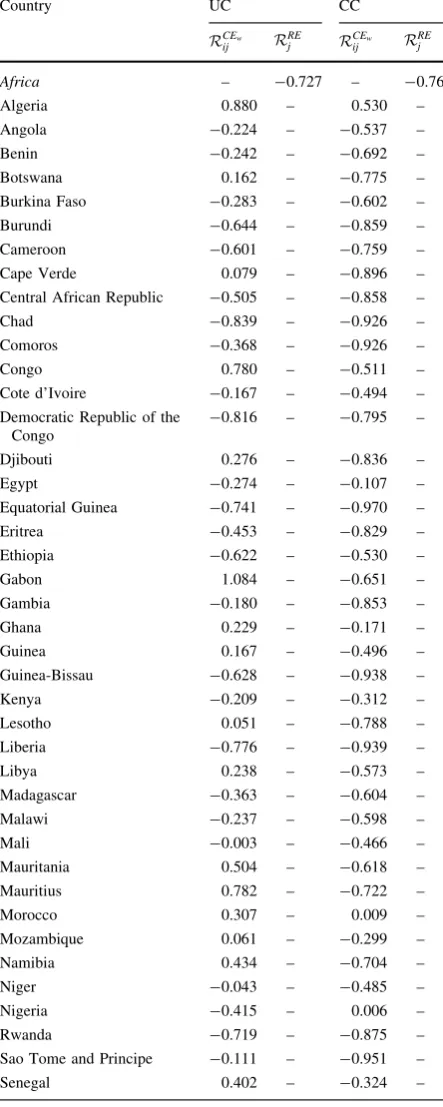
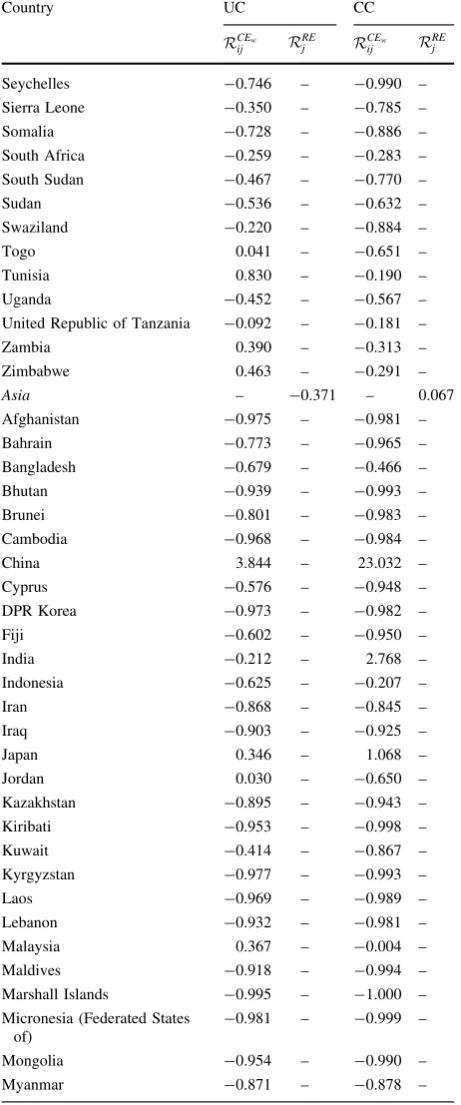
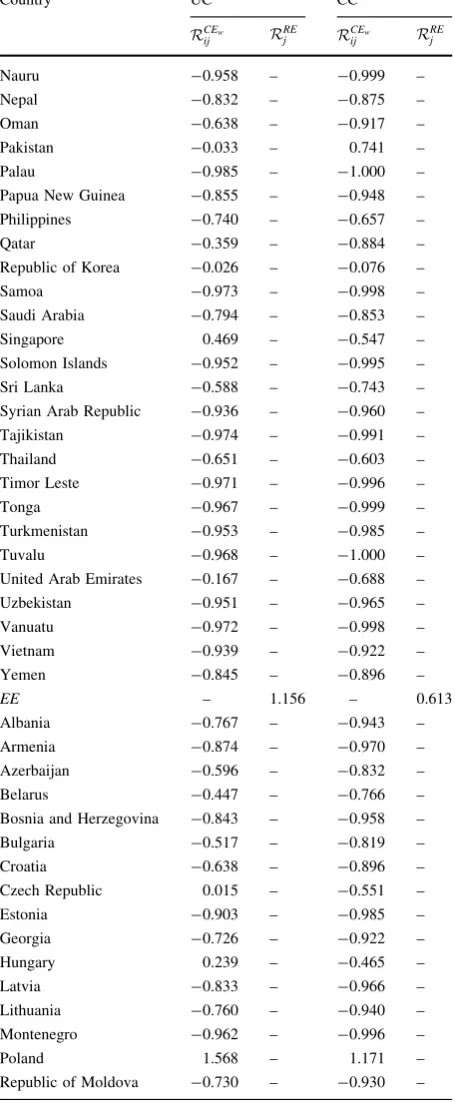
To gain further insight, we decompose the proximity measures for CEw andRE by
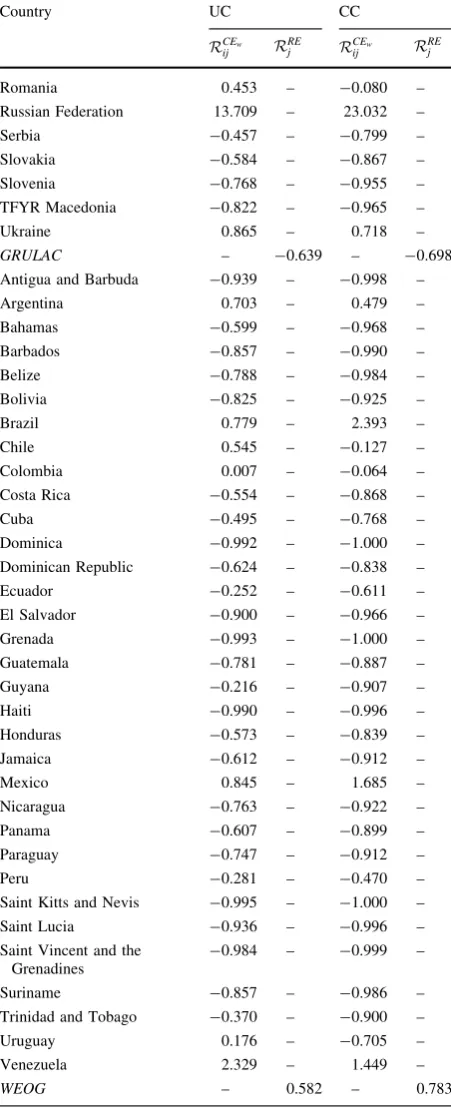
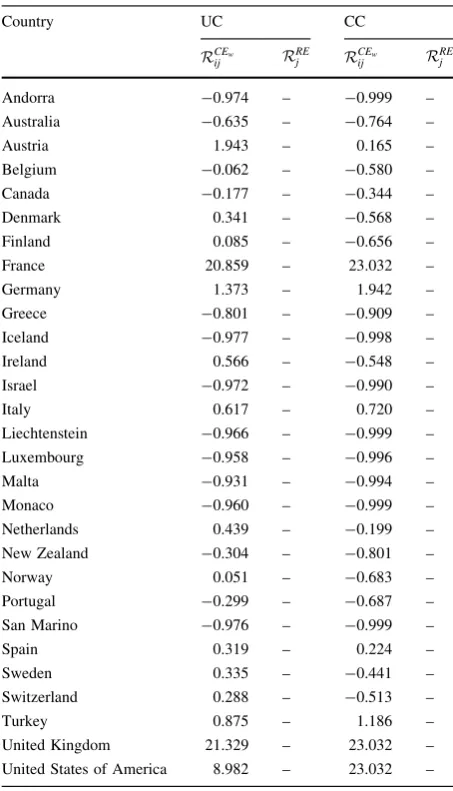
[image:23.439.165.392.56.452.2]country (Table2). Specifically, we report individual relativedeviations, R, from these equity concepts as25:
Table 2 continued
Country UC CC
RCEw
ij R RE j R
CEw
ij R RE j
Andorra -0.974 – -0.999 –
Australia -0.635 – -0.764 –
Austria 1.943 – 0.165 –
Belgium -0.062 – -0.580 –
Canada -0.177 – -0.344 –
Denmark 0.341 – -0.568 –
Finland 0.085 – -0.656 –
France 20.859 – 23.032 –
Germany 1.373 – 1.942 –
Greece -0.801 – -0.909 –
Iceland -0.977 – -0.998 –
Ireland 0.566 – -0.548 –
Israel -0.972 – -0.990 –
Italy 0.617 – 0.720 –
Liechtenstein -0.966 – -0.999 –
Luxembourg -0.958 – -0.996 –
Malta -0.931 – -0.994 –
Monaco -0.960 – -0.999 –
Netherlands 0.439 – -0.199 –
New Zealand -0.304 – -0.801 –
Norway 0.051 – -0.683 –
Portugal -0.299 – -0.687 –
San Marino -0.976 – -0.999 –
Spain 0.319 – 0.224 –
Sweden 0.335 – -0.441 –
Switzerland 0.288 – -0.513 –
Turkey 0.875 – 1.186 –
United Kingdom 21.329 – 23.032 –
United States of America 8.982 – 23.032 –
25 An analogous relative deviation from strong country EVP is given by
RCEs
ij ¼EK0 vCEijksEA vCEijks
=EA vCEijks
n o
. This measure considers the absolute value of deviations from the mean such that positive and negative deviations do not offset over time. As, however, we observe a high degree of correlation betweenRCEs
ij and the absolute value ofR CEw
ij across countries we choose, in the
interest of brevity, to omit the results forRCEs
RCEw
ij ¼EK0
vCEs
ijk EA vCEijks
EA vCEijks
0 @
1 A; RRE
ij ¼
vRE
ij EA vREij
EA vREij
:
3.5 Results
Our proximity measures under UC preferences are found as
CEs
k k ¼0:38; kCEwk ¼0:51; kREk ¼0:65:
The maximum deviation is observed to be from strong country EVP. Part of this inequity owes to the two-year term length of a NPM, which implies that countries half-way through their terms are assigned to the UNSC with probability one (and thereby wield too much expected voting power in that year). A second explanatory factor is the rule that prevents NPMs from running for immediate reelection, which implies that countries at the end of their terms as NPMs receive an assignment probability of zero (and thereby wield too little expected voting power in that year). As these two factors go in different direc-tions, deviations from equitability offset each other partially over time: comparing ||CEs||
with ||CEw|| we see that around 23 % of all deviations from strong country EVP are offset
in this way. The equity concept closest to being met isRE, suggesting that the UNSC is more equitable from a regional perspective than from a country perspective.
3.5.1 Country equity
To delve deeper, we now consider the individual country relative deviations reported in Table2, beginning with an analysis of country-level equity in the UNSC. As seen in the first column of the table, far too much expected voting power is given to citizens of PM countries. On average (i.e., under weak country EVP) the United Kingdom wields some 21.3 times its equitable level of expected voting power, and even China wields around 3.8 times too much expected voting power. Why are the PMs so heavily overrepresented? Part of the answer lies in the observation that a PM’s veto right gives it more voting power than a NPM. This effect, however, is compounded by a second effect that arises from the fact that a PM always is able to cast a vote on the UNSC, whereas an OM can do so only periodically. Existing approaches to assessing the equitability of the UNSC via the ratio xPM=xOMmiss entirely this second effect.
Ordinary members suffer a collective deficit of expected voting power. Only a small proportion of such members exceed their equitable expected voting power underCEw, and
the largest individual deviations are for members that receive too little expected voting power. For instance, under the estimated assignment probabilities in Table1, Dominica receives just 0.8 % of its equitable expected voting power. In other regions, countries such as Chad (16.1 %), Samoa (2.7 %), Montenegro (3.8 %) and Liechtenstein (3.4 %) also receive much too little expected voting power.
In summary, the current UNSC deviates significantly from country level equitability, and deviations fromCEwin any single year will tend to be significantly more pronounced
reform proposals in respect of the PMs must therefore be to either end their veto rights, end their right to be ever-present on the UNSC, or some combination of the two. Note, however, that our equity measures would permit a PM to exercise a veto when a UNSC member if they were willing to sacrifice sufficient assignment probability. Thus, there is nothing inherent in our country equity concept that supports the abolition of the veto.26If retaining the right of veto,CEwwould obtain for China if it were represented on the UNSC
in around 24 of every 100 years. The United States would qualify for membership under
CEwin only around 12 years in every 100, while the United Kingdom and France would
qualify for membership in only around six. On the other hand, in return for receiving the voting power of an OM only,CEwwould obtain for India if it were represented in around
76 of every 100 years.
The reason that the above insights are relevant just to the long-term is the impracticality of short- or even medium-term reforms affecting the existing PMs. No PM is willing to relinquish either its right of veto, or its right to be ever present, and the constitutional ability of the PMs to retain these powers seems impregnable.27Short-term reform pro-posals, therefore, seek to extend the right of veto and/or the right to be ever-present on the Council (Cox2009). The ‘‘winners’’ of such reforms become overrepresented, however, while the underrepresentation of the many ‘‘losers’’ is exacerbated. Accordingly, as a means of compensating the ‘‘losers’’, reform proposals typically also allow for some expansion of the council’s membership. While a full quantitative appraisal of the (many) reform proposals of this type to date is beyond the scope of this study, we show in a companion paper (Gould and Rablen 2014) that they generate always modest, and sometimes negative, net improvements in our measures of equity. Thus, those hoping for a step-change in the equitability of the UNSC in the short-term are likely to be disappointed.
3.5.2 Regional equity
We now analyze the UNSC from a regional perspective using the region equity concept (the second column of Table2). Africa is the most underrepresented region, with only about 28 % of its equitable voting power, Latin America has 36 %, and Asia 63 %. At the other end of the spectrum, EE and the WEOG are overrepresented. EE receives just over double its equitable voting power, making it the most overrepresented region.
These results imply the existence of substantial inequity between the north—defined in Zifcak (2006, footnote 9) as comprising EE and the WEOG—and the south (Africa, Asia and the GRULAC). If UNSC voting were along north–south lines, the ratio of bloc voting powers in the council would be exactly 1:1. As, however, the south is more populous,RE
requires that it receive more voting power than the north. Accordingly, the south achieves just 63 % of its equitable voting power. Therefore, the regional equity concepts advocate that voting power should be shifted away from EE and the WEOG, and towards Africa, Asia and the GRULAC.
An approach to reform of the UNSC that could address these regional imbalances in representation effectively is to alter the allocation of NPM seats between regions (possibly in conjunction with an increase in the total number of NPMs). Our regional equity concept is not prescriptive in this regard, however, as only the voting power of the regional bloc
26
For an alternative analysis of the veto from the perspective of bargaining theory, see Winter (1996).
27
matters, so, for a given bloc voting power, the number of countries that form the bloc is irrelevant. Strong country EVP is prescriptive in this regard, however.
Proposition 4 IfC2012
UNSCsatisfies strong country EVP then nj/Paij2Rj ffiffiffiffi
qij
p
xCDP ij
for all j.
The proof of Proposition 4first establishes that, under the assumptions of this appli-cation, strong EVP implies pijk/pffiffiffiffiffiqij=xCDPij . Then, as must be true by construction,
P
aij2Rjpijk =nj and the Proposition follows. According to Proposition 4, the
(approxi-mate) optimalnjfor the current 15-member UNSC would be: 5.5 members from Asia, four
members from Africa, two members from each of the GRULAC and the WEOG, and 1.5 members from EE.28Thus the WEOG, with four seats in the present UNSC, has twice its entitlement under CEs, while Asia and Africa—which both receive three seats—are
underrepresented, in Asia’s case by close to one-half.
From a reform perspective, Proposition4suggests that NPM seats should be reallocated away from WEOG towards Africa and Asia (or, that any expansion of the UNSC be suitably tilted towards Africa and Asia). While, again, a detailed analysis is beyond the scope of this paper, we show in Gould and Rablen (2014) that existing reform proposals do not reap the full equity benefits available from expanding the Council, as the proposed allocation of new NPM seats is tilted insufficiently in favor of Africa and Asia.
3.6 Preference correlation
We now briefly consider alternative a priori assumptions regarding preference correlation for the UNSC. We note that country behavior suggests very weak a priori grounds for considering RC preferences. For instance, countries on the UNSC do seem to act as distinct entities within regions. Each council member has full sovereignty over how it votes and countries pour large sums of money into campaigns for election to the UNSC (e.g., Malone
2000), suggesting that they do not perceive membership by another country in their region to be a perfect (or even a good) substitute for their own membership. Also, the voting behavior in the UNGA of serving members of the UNSC is no more similar to that of their regional members than to the votes of the remaining UNGA members (Lai and Lefler
2009). With the exception of the WEOG—whose composition partly reflects that of the British Commonwealth (Daws 1999)—the regional groups are not self-selected, but determined solely by an exogenous factor in geographic location. Accordingly, we shall discuss only the case of CC preferences.
For CC preferences the TMT rule specified in Sect.3.2 cannot be employed in the context of the RDP, for it does not satisfy anonymity for all regional citizens.29A simple way to permit an analysis of regional equity in this case is to define a counterpart TMT rule at the level of countries—the ‘‘Country TMT’’ (CTMT) rule. For brevity, when the citizens of countryivotexunanimously, we say that ‘‘countryivotedx’’. Under the CTMT rule, for the regional outcome to be ‘‘mandate for’’, (i) more countries must vote ‘‘for’’ than vote ‘‘against’’; and (ii) at least a proportion s[0 of all countries must vote ‘‘for’’. A
28 Here the fractional Asia and EE membership would be achieved by alternating between (i) Asia having
six seats, and EE one; and (ii) Asia having five seats and EE two.
29
symmetric condition applies for ‘‘mandate against’’ to obtain, with ‘‘no mandate’’ obtaining in all other eventualities. For comparability, we again assumes=1/3.
Using the above approach, the proximity measures for CC preferences are found as:
CEs
k k ¼0:24; kCEwk ¼0:31; kREk ¼0:71:
Country equity falls in comparison to the results under UC preferences. In the third column of Table2, we see that the least populous countries warrant larger expected voting powers under CC preferences than they do under UC preferences, whereas the most populous countries (including the PMs) warrant lesser expected voting powers. Accord-ingly, the least populous countries become even more heavily underrepresented, while the PMs become even more heavily overrepresented.
Proximity toREis, however, improved under CC preferences. This arises as, under UC preferences, regional equity in the UNSC requires that voting power reflect (inversely) the population of each region. This results in inequity as the regions vary greatly in population, while voting power in the UNSC is relatively flat across regional blocs. Under CC pref-erences, however, regional equity in the UNSC requires that voting power reflect the
number of countriesin each region. This reduces inequity as there is less variability across regions in the number of countries per region than in the regional populations.
4 Conclusion
The councils of the United Nations play important roles in upholding global wealth, health, law and security. Yet, to our knowledge, no previous analysis has developed formal equity principles for the analysis of such bodies, in which only a subset of members may vote at a point in time. We formulate democratic equity concepts for such bodies in a new class of voting game we term a council voting game. In particular, we develop separate notions of equity for such games at both the country and region levels.
We demonstrate the utility of our theoretical framework with an application to the United Nations Security Council (UNSC). We find that significant degrees of inequity exist in the long-run average levels of representation across countries, and that these deviations from long-run equitability typically are exacerbated in any single iteration of the UNSC viewed in isolation. Exploiting our distinction between country and regional notions of equity, we also find that the UNSC is more inequitable if its members are viewed as representing only themselves, than if they are viewed as representing their region as a whole. We emphasize that, in our framework, the excessive representation of the UNSC’s permanent members (PMs) derives from their right to be ever-present on the UNSC, not only from their right of veto. Our measure of regional equity suggests that Africa (not Asia) is the most heavily underrepresented region, while Eastern (not Western) Europe is the most heavily overrepresented region.