AN INTRODUCTORY COURSE WITH A HUMANITARIAN
ENGINEERING CONTEXT
Aruna Shekar, Mark Tunnicliffe
School of Engineering and Advanced Technology, Massey University, New Zealand
ABSTRACT
The Engineers Without Borders (EWB) Design Challenge is an excellent example of how universities from across the globe allow students to engage with humanitarian engineering. Massey University has been utilising the EWB Design Challenge as a framework to introduce engineering practice to first year students, and this has led to our teams winning multiple regional and international prizes. This article shares our experience of the design and teaching of this first year course and provides engineering educators with a successful example of how students learn about engineering practice in product, process, and system building, as well as their personal and interpersonal skills. We highlight how, by using a humanitarian engineering context, we embed CDIO thinking. Our case study illustrates how we project manage this process using Stage-Gate™ (Cooper, 2008); support students to conduct reflective practice by using logbooks (Osgood, 2013); include practising engineers as consultants; and provide detailed assessment guidelines and rubric examples to guide students through the myriad challenges during engineering practice. This case study shows that the implementation of the EWB Design Challenge has been successful in providing a useful framework to introduce engineering practice. It is particularly effective in exposing students to a number of ethically driven social competencies required for the global engineer. It is hoped that by sharing our experience of operating this course that engineering faculty may take on-board some of our learning and assessment practices to improve the offering of an introductory design project at their institution.
KEYWORDS
Humanitarian engineering, project-based learning, CDIO Standards 4 and 8.
INTRODUCTION
be implemented. “Implement” refers to the transformation of the design into a product, including its manufacturing, testing and validation. “Operate” considers how the implemented product will deliver the intended value, including maintaining, evolving and retiring the system (http://www.cdio.org/).
There are global challenges facing the world with regard to accessible clean water, shelter, waste disposal, health and wellbeing. The United Nations’ Millennium Development goals and the current Sustainable Development agenda have identified these and other areas for improvement with specific reference to remote rural communities and urban areas in developing countries (www.undp.org). Previous papers (Shekar, 2015; Goodyer and Anderson, 2011; Gustafsson et al., 2002) as well as recommendations by professional engineering boards have highlighted the need to educate students to address these global challenges and fix the gaps in practical engineering education. Practising engineers, our alumni and Advisory Board members informed us of the importance of good communication skills, team working and problem solving abilities. Students must be prepared to work on technical and non-technical areas as many of these real world problems are complex and interrelated. They must learn to work in teams, make decisions, solve problems and create innovative solutions. In the future there will be more demand for engineers who can interact with people from different disciplines such as supply chain, marketing, social sciences and similar, and have appreciation of inter-disciplinary solutions. This paper presents our first year course, Engineering Practice I: Global Perspectives, which is based on the CDIO learning skills (Table 1). It outlines the structure, assessments and rubrics that are used, so that other educators can adopt some of these successful methods. The key principles of CDIO learning are shown in Table 1, along with their application in our first year course.
Table 1. CDIO Learning Skills and Application in the Global Perspectives Course
CDIO Learning Skills Application in Global Perspectives Course Introduce a framework for
engineering fundamentals and practice.
The EWB Design Challenge is an excellent way to introduce the CDIO method with a focus on a socio-cultural context.
Build personal and interpersonal skills.
Teams of three or four students work together from understanding the brief to finding the best solution. Communication skills Written reports, referencing styles, team meetings, progress meetings with staff, exhibition display and presentation.
Professional skills Project management, ethics, appropriateness to context, safety and hazard assessments, sustainability and environment protection.
HUMANITARIAN ENGINEERING CONTEXT OF THE COURSE
in communities in other parts of the world for the students to solve. From the EWB Design Briefs students are expected to identify an area for potential improvement and to develop a solution that solves problems faced by, and provides benefits to the community, with an appreciation of the community’s culture, economics, and materials availability in mind. The solutions should enhance their quality of life, make daily tasks easier and help make their lives healthier and safer. Students are taught that the needs of these communities can be quite different to people living in the Western world. These needs are generally more basic in nature, and students must research the context, community, available resources and current situation thoroughly.
STRUCTURE OF THE COURSE
This first year project-based course is common to all of the engineering majors: Electronics, Mechatronics, Innovation Management and Chemical & Bioprocess Engineering. The students are placed in teams of four by staff, who intentionally balance the mix of majors, student backgrounds (domestic or international students) and gender. This course introduces students to engineering practice (CDIO Standard 4) and active learning (CDIO Standard 8), and is based on working through a project that is based on a humanitarian context. The course project is structured to follow four main stages and has gates at the end of each stage, as per Cooper’s Stage-Gate™ model (Cooper, 2008). This is introduced as the Engineering Method. The gates are check points to ensure students are maintaining progress.
The stages of the project are:
1. Problem Definition; focuses on defining the problem (weeks 1 to 4 approximately).
2. Design; develops the project requirements, designs potential solutions and selects one design solution to proceed with (weeks 5-6).
3. Evaluation; allows for detailing and evaluation of the selected design solution against the project objectives and community's requirements (weeks 7-10).
4. Implementation; this includes having a viable implementation plan (including maintenance), and its communication. The students’ solution could be a product, process or system that fits the context. (weeks 11 and 12).
LEARNING OUTCOMES
1. Identify and solve a contextually complex engineering problem using a systems thinking approach.
2. Explain an engineering system, its behaviour, its elements (including materials) and its interactions.
3. Apply the basic inputs and processes required for project management. 4. Define the key elements of the design process, including safe practice. 5. Reflect on own professional practice using required strategies and modes.
6. Communicate clearly and concisely using appropriate styles in a range of academic and professional settings.
an outline of the course, the five assignments and related rubrics. It also includes an
activities schedule for the project weekday
–
this has guided workshops in the mornings and team-project work in the afternoons. During the guided workshops, the lecturers introduce concepts and methods and encourage students to apply them in their projects. These [image:4.595.77.521.210.371.2]sessions are not long, formal lectures, but are short, informative, coaching sessions, followed by staff moving around the class to observe how students apply the methods. Students are asked a number of questions during these sessions to ensure they understand what is expected of them, and to make them think about their decisions and to justify them.
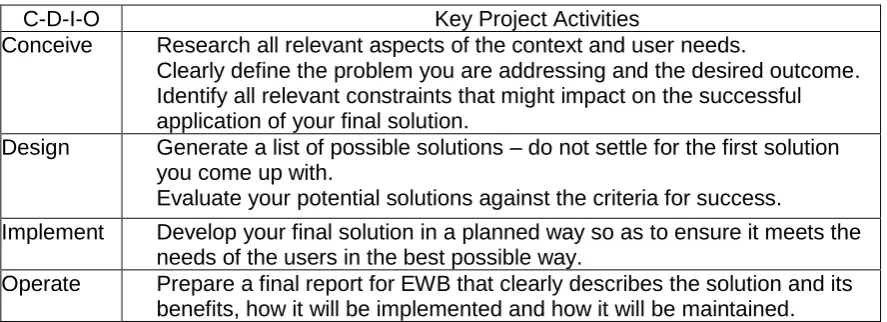
Table 2. CDIO and Project Activities
C-D-I-O Key Project Activities
Conceive Research all relevant aspects of the context and user needs.
Clearly define the problem you are addressing and the desired outcome. Identify all relevant constraints that might impact on the successful application of your final solution.
Design Generate a list of possible solutions – do not settle for the first solution you come up with.
Evaluate your potential solutions against the criteria for success.
Implement Develop your final solution in a planned way so as to ensure it meets the needs of the users in the best possible way.
Operate Prepare a final report for EWB that clearly describes the solution and its benefits, how it will be implemented and how it will be maintained.
During project activity and assessment, staff look for:
1. Clear and objective decision-making based on sound and appropriate research (the context, appropriate technologies, applications in other locations and so on).
2. Professionalism in all aspects of the project – communication, timeliness, planning, ethics, teamwork.
3. A well-developed, feasible, solution that is based on sound research and decision-making. 4. Justification of the appropriateness of the solution to meet the outcome, and
5. A final report with a concise summary of their final solution, how it was developed, including any recommendations.
ASSESSMENTS
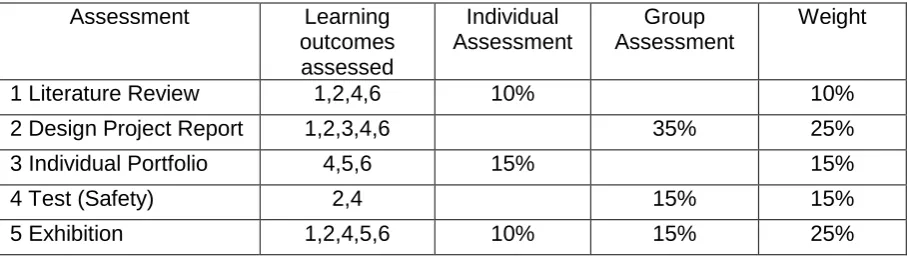
Table 3: Course Assessments
Assessment Learning
outcomes assessed
Individual Assessment
Group Assessment
Weight
1 Literature Review 1,2,4,6 10% 10%
2 Design Project Report 1,2,3,4,6 35% 25%
3 Individual Portfolio 4,5,6 15% 15%
4 Test (Safety) 2,4 15% 15%
5 Exhibition 1,2,4,5,6 10% 15% 25%
The Literature Review is used to communicate how the problem is explored. The Design Report communicates the entire project. The Portfolio shows the professionalism of the student and includes their logbook and an interview. The Test is a bridge-build performed by the students and is used to emphasise safe practice in engineering. The Exhibition communicates the entire project and its solution using verbal, visual and prototype forms.
The solutions need to be simple in order to fit the context, meet environmental constraints (in terms of being robust to withstand weather conditions, frequency of usage) and resources available. This suits a first-year course as the students at this stage do not have advanced technical knowledge, and are able to apply some of the basic physical principles they learn. Students also realize what they do not know and recognise how some of that advanced knowledge can be useful to learn in the future. Hence they are encouraged to speak to experts in their particular project area. Expert consultants are also invited to meet with project teams on two separate afternoons during project-day.
TYPICAL PROJECT EXAMPLES
Student projects range from rainwater harvesting to affordable transportation of crops; from water filtration to improved construction materials for houses or roofs. The students consider the ethical, socio-cultural and economic aspects of their solution. For example, for a project that involved transport of crops from a farm to markets, students researched and determined that it was mostly women who carried out this task, that they generally do not ride bicycles and are not comfortable doing so. Hence a simple hand-cart version was developed that was light, easy to manoeuvre and made of natural materials that are easy to access. Creating affordable solutions means that the materials must be of low cost and easily available in these villages. Students are taught how to carry out a hazard and safety assessment of their design in order to ensure that it does not pose a risk to users, and also during the build and maintenance phases.
STUDENT REFLECTIONS IN LOGBOOKS
progress notes. Student feedback reveals that they are motivated to learn in a real-world project environment and enjoy the practical sessions. Student engagement is shown with some teams putting in more effort and many extra hours outside the regular timetabled hours. They also learn about the wider role of engineers and how they can apply their theoretical knowledge to solve real-world problems. We teach students to discuss issues with their group and sign a team contract at the start of the course, based on their expectations and how they would manage their team during the project. We found that this helps them think about team-work, and we get them to refer back to it if team issues arise.
Student Comments on Information Gathering
“It was interesting to learn about people whose lives are so different from ours”.
“At first it was difficult to think about a place that is so far from us, but after doing research we gained more direction and ideas about potential solutions”.
“We learnt that just a Google search was not enough for research about the community, and that we had to connect with people from the community via the EWB website or with local representatives”.
Student Comments on Teamwork
“Dividing the tasks was important in order to make progress”.
“There was a lot of information to research so it was good to have four in our team”. “It was difficult because the rest of the team were happy with a C and did not put in the effort that I expected. One student was ill and I had to take on his work at the last minute, which put extra stress on me”.
“Teamwork for me was not as good as I expected at the start. There were several breaches of the team contract, and I ended up writing most of the report”.
COURSE EVALUATION
An online course evaluation was gathered from the class relating to a number of areas at the end of the 2016 semester (administered anonymously and automatically by the Massey University system). In 2016 the four-year old course was revised due to staff changes.
The Online Survey Questions are given below:
1. Overall, I was satisfied with the quality of the learning experience in this paper 2. This paper helped develop my thinking skills
3. The content of the paper was structured in a way that assisted my learning 4. It was clear how the parts of this paper contributed to the learning outcomes 5. The support materials were useful to my learning
6. Assessment requirements were clear
7. My marked assessment was returned within the turnaround time stated in the paper outline
8. Feedback on my work helped me learn 9. The workload for this paper was reasonable
The scale of responses is: Strongly Disagree, Disagree, Tend to disagree, Tend to agree, Agree and Strongly Agree. Students can comments after each question, and enter overall comments.
Results and Discussion
The results are presented graphically. There are two sets of results as the course is delivered on two campuses by staff located at each campus. Twenty-five students out of sixty-seven at Campus 1 answered all ten questions, and their responses are shown in Figure 1. Twenty-one students out of forty-eight at Campus 2 answered all ten questions and their responses are shown in Figure 2. The survey is analysed qualitatively due to the low number of participants.
[image:7.595.82.515.386.648.2]The overall satisfaction (Q1) was high, 88% on Campus 1 and 64% on Campus 2. The workload, online support material and guidance given by staff were well received. Some students felt they needed more guidance relating to expectations in each assessment (Q6) – this is attributed to several factors. Firstly, assessment requirements were changed during the semester to ensure formative assessment of the design report occurred, and there were also different expectations of staff assessing the material. Cross-campus moderation assists with the second issue but this is not visible to students. To address this, it was decided to show previous years’ student example assignments. There was some dissatisfaction with the study materials (Q5 – 44% on Campus 1 and 42% on Campus 2.), mainly relating to the recommended textbook Dowling et al (2016) as the students struggled with the focus of the textbook on largely infrastructure projects.
Figure 2: Campus 2 Responses to Survey Questions
The course was considered by students to have developed their thinking skills (Q2), which is considered important as “Systems Thinking” is emphasised throughout the project. The workload (Q9), online support material (Q10) and guidance given by staff (Q8) were well received. There are some challenges in getting students to connect course information from across the theory courses and apply it to the project courses. This was addressed by using subject experts during student team-time to encourage them to apply theoretical and physical principles. We continue to review the project courses to ensure their alignment with the CDIO framework for knowledge and skills development.
The results show that the students at Campus 2 were more likely to disagree with a statement than those on Campus 1. It is not known why these differences have occurred, though differences are noted in other engineering courses when compared across the campuses. The academic results of each cohort of students were similar, and it is likely some differences are due to subject delivery by different staff in each location. The required capability of staff involved in Project-based learning is to be investigated in a wider study.
CONCLUSIONS
potential options. The final stage includes an exhibition, a visual display of the prototype and a written report. At this stage students also submit their individual logbooks and self and peer assessments.
The student project examples highlight the application of CDIO competencies, including ethically and socially relevant approaches to problem solving, within a resource-constrained context. A range of assessment methods were used throughout the course and an example rubric is shown in Appendix A. The course evaluations and student comments were mostly positive but also show the variation that occurs in student opinion when teaching the same course on different campuses. The paper has demonstrated how we have integrated and implemented the CDIO framework and Standards 4 (introductory engineering) and 8 (active learning) through social innovation projects in the first year.
ACKNOWLEDGEMENT
The authors wish to thank EWB for their partnership and the staff and students involved in the course.
REFERENCES
Cooper, R. G. (2008). Perspective: The Stage‐Gate® idea‐to‐launch process—update, what's new, and NexGen systems. Journal of Product Innovation Management, 25(3), 213-232.
Dowling, D., Hadgraft, R., Carew, A., McCarthy, T., Hargreaves, D. & Baillie, C. (2016). Engineering Your Future: An Australasian Guide. Milton Qld: John Wiley & Sons Australia.
Goodyer, J., & Anderson, A. Professional practice and design: key components in curriculum design. Proceedings of the 7th International CDIO Conference, Technical University of Denmark, Copenhagen, 20-23 June 2011.
Gustafsson, G., Malmqvist, J., Newman, D. J., Stafström, S., & Wallin, H. P. (2002). Towards a new model for first-year introductory courses in engineering education programmes. NordDesign 2002, Trondheim, Norway, 14-16 August 2002.
Osgood, L. (2013). Effective use of logbooks in engineering education: enhancing communication through short design activities. Teaching Innovation Projects, 3(1), Article 4. Available at: http://ir.lib.uwo.ca/tips/vol3/iss1/4
Shekar, A. (2015). Global perspectives: first-year engineering students’ views on social engineering projects. International Journal of Mechanical Engineering Education, 43(2), 102-109.
Shekar, A., & Drain, A. (2016). Community engineering: raising awareness, skills and knowledge to contribute towards sustainable development. International Journal of Mechanical Engineering Education, 44(4), 272-283.
United Nations Development Programme <http://www.undp.org>, accessed 16 January 2017.
APPENDIX A
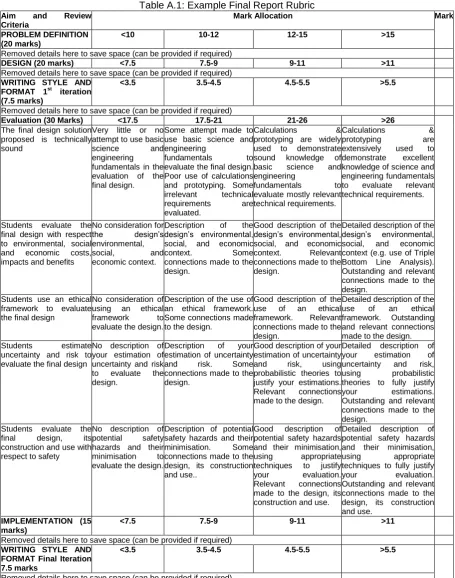
Table A.1: Example Final Report Rubric
Aim and Review Criteria
Mark Allocation Mark PROBLEM DEFINITION
(20 marks)
<10 10-12 12-15 >15
Removed details here to save space (can be provided if required)
DESIGN (20 marks) <7.5 7.5-9 9-11 >11
Removed details here to save space (can be provided if required)
WRITING STYLE AND FORMAT 1st iteration (7.5 marks)
<3.5 3.5-4.5 4.5-5.5 >5.5
Removed details here to save space (can be provided if required)
Evaluation (30 Marks) <17.5 17.5-21 21-26 >26
The final design solution proposed is technically sound
Very little or no attempt to use basic science and engineering fundamentals in the evaluation of the final design.
Some attempt made to use basic science and engineering
fundamentals to evaluate the final design. Poor use of calculations and prototyping. Some irrelevant technical requirements are evaluated.
Calculations & prototyping are widely used to demonstrate sound knowledge of basic science and engineering
fundamentals to evaluate mostly relevant technical requirements.
Calculations & prototyping are extensively used to demonstrate excellent knowledge of science and engineering fundamentals to evaluate relevant technical requirements.
Students evaluate the final design with respect to environmental, social and economic costs, impacts and benefits
No consideration for the design’s environmental, social, and economic context.
Description of the design’s environmental, social, and economic context. Some connections made to the design.
Good description of the design’s environmental, social, and economic context. Relevant connections made to the design.
Detailed description of the design’s environmental, social, and economic context (e.g. use of Triple Bottom Line Analysis). Outstanding and relevant connections made to the design.
Students use an ethical framework to evaluate the final design
No consideration of using an ethical framework to evaluate the design.
Description of the use of an ethical framework. Some connections made to the design.
Good description of the use of an ethical framework. Relevant connections made to the design.
Detailed description of the use of an ethical framework. Outstanding and relevant connections made to the design. Students estimate
uncertainty and risk to evaluate the final design
No description of your estimation of uncertainty and risk to evaluate the design.
Description of your estimation of uncertainty and risk. Some connections made to the design.
Good description of your estimation of uncertainty and risk, using probabilistic theories to justify your estimations. Relevant connections made to the design.
Detailed description of your estimation of uncertainty and risk, using probabilistic theories to fully justify your estimations. Outstanding and relevant connections made to the design.
Students evaluate the final design, its construction and use with respect to safety
No description of potential safety hazards and their minimisation to evaluate the design.
Description of potential safety hazards and their minimisation. Some connections made to the design, its construction and use..
Good description of potential safety hazards and their minimisation, using appropriate techniques to justify your evaluation. Relevant connections made to the design, its construction and use.
Detailed description of potential safety hazards and their minimisation, using appropriate techniques to fully justify your evaluation. Outstanding and relevant connections made to the design, its construction and use.
IMPLEMENTATION (15 marks)
<7.5 7.5-9 9-11 >11
Removed details here to save space (can be provided if required)
WRITING STYLE AND FORMAT Final Iteration 7.5 marks
<3.5 3.5-4.5 4.5-5.5 >5.5
BIOGRAPHICAL INFORMATION
Aruna Shekar, Ph. D. is a Senior Lecturer in Product Development at Massey University’s School of Engineering and Advanced Technology, Auckland, New Zealand. She has coordinated the first year Humanitarian Engineering course in conjunction with Engineers Without Borders (EWB) for four years, and every year her students have won National and International awards. She has been nominated in 2015 and 2016 as ‘Lecturer of the Year’ by students in a recent initiative. Aruna led the curriculum design and delivery for a compressed first year engineering ‘Accelerate Programme’, which included project-based learning. She has presented at National and International Conferences. Her educational interests are in developing skills in user-oriented innovation with a humanitarian engineering focus.
Dr Shekar established the New Zealand Affiliate of the global Product Development & Management Association (PDMA) along with a colleague, and continues to be on the Board. She currently holds the position of Vice-President for Asia-Pacific with PDMA (USA).
Mark Tunnicliffe, Ph. D. is a Senior Lecturer in Product Development and Innovation at Massey University’s School of Engineering and Advanced Technology, Palmerston North, New Zealand. He has taught and supervised the first year Humanitarian Engineering course in conjunction with Engineers Without Borders (EWB) for three years. He has also coordinated the second year project course, “Product Development” for two years. His education interests are in developing young engineers through project-based learning with skills relevant to industry. He joined Massey University after 18 years working as a Research and Development Engineer at a medium-sized New Zealand manufacturing company.
Dr. Aruna Shekar
School of Engineering and Advanced Technology
Massey University
Level 2, 229 Dairy Flat Highway Albany
Auckland 0632 New Zealand
MASSEY UNIVERSITY
MASSEY RESEARCH ONLINE http://mro.massey.ac.nz/
Massey Documents by Type Conference Papers
An introductory course with a humanitarian
engineering context
Shekar, A
2017-06-18