The Impact of Changes to HELP Design on Students
The 2014-15 Budget announced the following changes to Higher Education Loan Program (HELP):
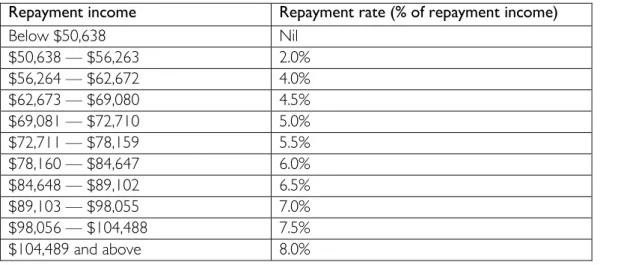
The minimum income threshold will be reduced to $50,638 for HELP repayment and will apply to graduates commencing repayments from 1 July 2016. A two per cent repayment rate will apply for those with incomes above this new threshold, but below the existing indexed threshold, estimated at $56,264 for the 2016-17 income year.
The repayment arrangements applying to students with incomes above the existing repayment threshold will not change.
The annual indexation applied to HELP debts will increase from the existing rate (CPI) to a rate equivalent to the yield on the Treasury 10-year bond rate, capped at six per cent per annum, from 1 June 2016.
These changes are estimated to achieve savings of $3.2 billion over four years from 2014–15. Universities Australia (UA) has modelled the impact of the above changes on engineering and nursing university graduates. Engineering and nursing were selected as samples as they are offered by a large number of universities, are both occupations in demand but graduate salaries vary.
Assumptions:
i. Starting salary and income progression are those reported by the Australian Nursing Federation for nursing graduates and the latest Beyond Graduation Survey for engineering graduates. Income is assumed to grow at four per cent per annum1.
ii. Debt repayment thresholds are the current 2014-15 thresholds indexed by 1.0547 and repayment thresholds have not been indexed beyond 2016-172.
Table 1: HELP loan repayment rates from 2016-17
Repayment income Repayment rate (% of repayment income)
Below $50,638 Nil
$50,638 –– $56,263 2.0% $56,264 –– $62,672 4.0% $62,673 –– $69,080 4.5% $69,081 –– $72,710 5.0% $72,711 –– $78,159 5.5% $78,160 –– $84,647 6.0% $84,648 –– $89,102 6.5% $89,103 –– $98,055 7.0% $98,056 –– $104,488 7.5% $104,489 and above 8.0%
1 Except in relation to Scenario A and C for engineering graduates and Scenario A and B for nursing graduates discussed below, where they experience a step up in income in early career.
2 1.0547 is the indexation factor indicated by the Government to calculate the 2014-15 minimum repayment threshold of $53,345 in 2016-17 (that is, $56,264). Beyond 2016-17 indexation rates are not known. Any increase in the thresholds would lengthen repayment periods.
2 iii. From 1 January 2016, tuition fees will increase to offset the 20 per cent on average reduction in the
government contribution to tuition fees. Tuition fees are indexed at 2.5 per cent over the course of the degree.
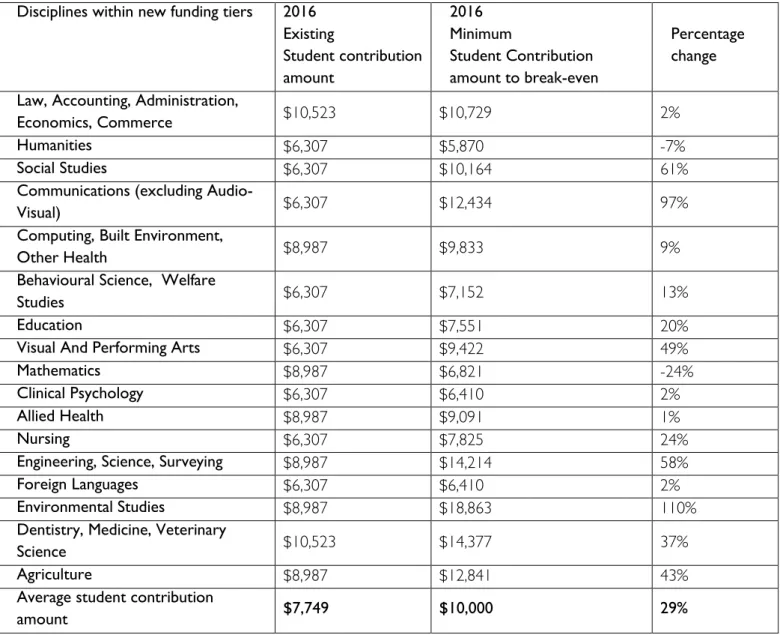
Table 2: Estimated minimum student contribution amount to offset 20 per cent on average reduction in government funding
Disciplines within new funding tiers 2016 Existing
Student contribution amount
2016 Minimum
Student Contribution amount to break-even
Percentage change Law, Accounting, Administration,
Economics, Commerce $10,523 $10,729 2%
Humanities $6,307 $5,870 -7%
Social Studies $6,307 $10,164 61%
Communications (excluding
Audio-Visual) $6,307 $12,434 97%
Computing, Built Environment,
Other Health $8,987 $9,833 9%
Behavioural Science, Welfare
Studies $6,307 $7,152 13%
Education $6,307 $7,551 20%
Visual And Performing Arts $6,307 $9,422 49%
Mathematics $8,987 $6,821 -24%
Clinical Psychology $6,307 $6,410 2%
Allied Health $8,987 $9,091 1%
Nursing $6,307 $7,825 24%
Engineering, Science, Surveying $8,987 $14,214 58%
Foreign Languages $6,307 $6,410 2%
Environmental Studies $8,987 $18,863 110%
Dentistry, Medicine, Veterinary
Science $10,523 $14,377 37%
Agriculture $8,987 $12,841 43%
Average student contribution
amount $7,749 $10,000 29%
iv. Three fee levels were modelled:
Low-fee level: the estimated minimum student contribution amount that a university will need to charge to offset the 20 per cent average reduction in government funding.
Medium-fee level: the fee calculated as an average of the low- and high-fee levels.
High-fee level: the average international student fees charged in 20143 after deducting the
new government contribution amount.
3 For an engineering degree, the high fee level is calculated based on the 18 institutions’ international fees published on the Study In Australia website for a four-year Bachelor of Engineering degree. For a nursing degree, the high fee level is calculated based on the 27 institutions’ international fees published on the Study In Australia website for a three-year Bachelor of Nursing degree.
3
Engineering Graduates
For engineering graduates, their initial debt for a four-year degree will increase from $37,319 under the existing system:
i. to $59,024 under the low-fee level (an increase of 58.2 per cent);
ii. to $61,241 under the medium-fee level (an increase of 64.1 per cent); and iii. to $63,455 under the high-fee level (an increase of 70 per cent).
We have modelled for the following three scenarios:
Scenario A: A graduate working full-time, with starting income of $56,000 and income stepping up to $80,000 in year three and remaining constant for year four and five.
Scenario B: A graduate working full-time, with starting income of $56,000.
Scenario C: A graduate working part-time at 0.5 full-time equivalent (FTE) for six years after six years of working full-time, before returning to work full-time. Starting income of $56,000 and income steps up to $80,000 in year three and remains constant for year four and five.
While we have modelled the above three scenarios, it is worth noting that because HELP is an income-contingent loan, the repayment period and the total amount of debt and interest vary depending on the cost of the degree and its length and the assumptions on the level of starting income and its rate of growth. For example, even if we assume a high starting income of $70,000 for an engineer working full-time with a four per cent annual income growth, the individual will pay off the total debt and interest of $91,184, 19 years after commencement of study under the low-fee scenario at a four per cent interest rate.
Engineering graduate – Scenario A
Under this scenario, an engineering graduate with a starting income of $56,000 will reach an income of around $90,000 after eight years of working full-time. Under the existing system with CPI indexation, the individual will pay off the total debt and interest of $46,701, 14 years after the commencement of study. At a four per cent interest rate, we find that:
Under the low-fee level, the individual will pay off the total debt and interest of $94,372, 20 years after the commencement of study.
Under the medium-fee level, the individual will pay off the total debt and interest of $98,952, 20 years after the commencement of study.
Under the high-fee level, the individual will pay off the total debt and interest of $103,611, 21 years after the commencement of study.
4
Table 3: Repayment profiles for engineering graduates under Scenario A
Scenario A
Existing System with 2.6% CPI Indexation
New system with 2.6% CPI indexation
New system with 4% interest
New system with 5% interest
New system with 6% interest
Low-fee level
Debt - Existing fees $37,319 $37,319 $37,319 $37,319 $37,319 Additional Debt - $21,705 $21,705 $21,705 $21,705 Total Interest Charges $9,382 $19,382 $35,348 $51,040 $72,804 Number of years to pay off
total debt and interest (including years of study)
14 18 20 21 23
Medium-fee level
Debt - Existing fees $37,319 $37,319 $37,319 $37,319 $37,319 Additional Debt - $23,923 $23,923 $23,923 $23,923 Total Interest Charges $9,382 $20,550 $37,711 $54,776 $78,726 Number of years to pay off
total debt and interest (including years of study)
14 18 20 22 24
High-fee level
Debt - Existing fees $37,319 $37,319 $37,319 $37,319 $37,319 Additional Debt - $26,136 $26,136 $26,136 $26,136 Total Interest Charges $9,382 $21,798 $40,156 $58,580 $84,927 Number of years to pay off
total debt and interest (including years of study)
5
Engineering graduate – Scenario B
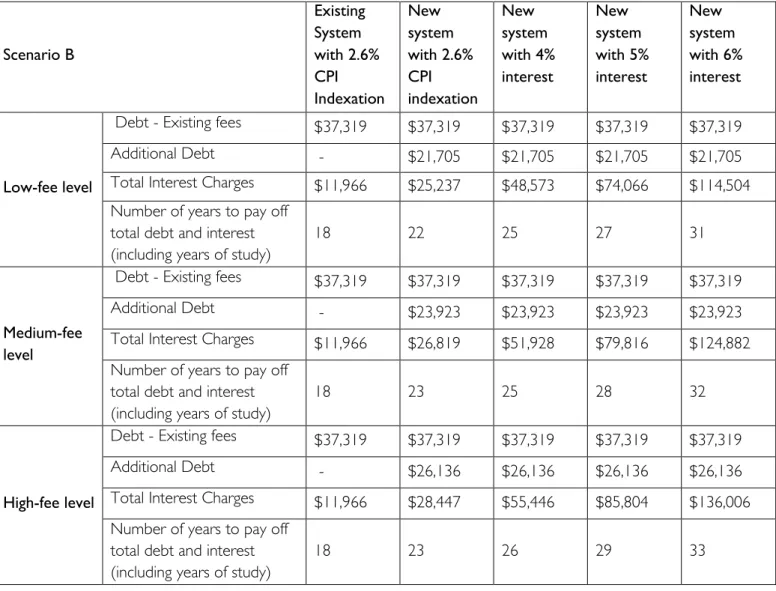
Under this scenario, an engineering graduate with a starting income of $56,000 will reach an income of around $90,000 after 13 years of working full-time. Under the existing system with CPI indexation, the individual will pay off the total debt and interest of $49,284, 18 years after the commencement of study. At a four per cent interest rate, we find that:
Under the low-fee level, the individual will pay off the total debt and interest of $107,597, 25 years after the commencement of study.
Under the medium-fee level, the individual will pay off the total debt and interest of $113,169, 25 years after the commencement of study.
Under the high-fee level, the individual will pay off the total debt and interest of $118,901, 26 years after the commencement of study.
Table 4: Repayment profiles for engineering graduates under Scenario B
Scenario B Existing System with 2.6% CPI Indexation New system with 2.6% CPI indexation New system with 4% interest New system with 5% interest New system with 6% interest Low-fee level
Debt - Existing fees $37,319 $37,319 $37,319 $37,319 $37,319 Additional Debt - $21,705 $21,705 $21,705 $21,705 Total Interest Charges $11,966 $25,237 $48,573 $74,066 $114,504 Number of years to pay off
total debt and interest (including years of study)
18 22 25 27 31
Medium-fee level
Debt - Existing fees $37,319 $37,319 $37,319 $37,319 $37,319 Additional Debt - $23,923 $23,923 $23,923 $23,923 Total Interest Charges $11,966 $26,819 $51,928 $79,816 $124,882 Number of years to pay off
total debt and interest (including years of study)
18 23 25 28 32
High-fee level
Debt - Existing fees $37,319 $37,319 $37,319 $37,319 $37,319 Additional Debt - $26,136 $26,136 $26,136 $26,136 Total Interest Charges $11,966 $28,447 $55,446 $85,804 $136,006 Number of years to pay off
total debt and interest (including years of study)
6
Engineering graduate – Scenario C
Under this scenario, an engineering graduate with a starting income of $56,000 will reach an income of around $83,000 after six years working full-time. This graduate will then work part-time at 0.5 full-time equivalent (FTE) for the next six years to raise a family before returning to work full-time. Under the existing system with CPI indexation, the individual will pay off the total debt and interest of $50,269, 19 years after the commencement of study.
At a four per cent interest rate, we find that:
Under the low-fee level, the individual will pay off the total debt and interest of $111,110, 25 years after the commencement of study.
Under the medium-fee level, the individual will pay off the total debt and interest of $116,686, 26 years after the commencement of study.
Under the high-fee level, the individual will pay off the total debt and interest of $122,470, 26 years after the commencement of study.
7
Table 5: Repayment profiles for engineering graduates under Scenario C
Scenario C
Existing System with 2.6% CPI Indexation
New system with 2.6% CPI indexation
New system with 4% interest
New system with 5% interest
New system with 6% interest
Low-fee level
Debt - Existing fees $37,319 $37,319 $37,319 $37,319 $37,319 Additional Debt - $21,705 $21,705 $21,705 $21,705 Total Interest Charges $12,950 $27,211 $52,086 $78,702 $119,468 Number of years to pay off
total debt and interest (including years of study)
19 23 25 27 30
Medium-fee level
Debt - Existing fees $37,319 $37,319 $37,319 $37,319 $37,319 Additional Debt - $23,923 $23,923 $23,923 $23,923 Total Interest Charges $12,950 $28,842 $55,444 $84,349 $129,287 Number of years to pay off
total debt and interest (including years of study)
19 23 26 28 31
High-fee level
Debt - Existing fees $37,319 $37,319 $37,319 $37,319 $37,319 Additional Debt - $26,136 $26,136 $26,136 $26,136 Total Interest Charges $12,950 $30,493 $59,015 $90,199 $139,641 Number of years to pay off
total debt and interest (including years of study)
8
Nursing Graduates
For nursing graduates, their initial debt for a three-year degree will increase from $19,398 under the existing system to:
i. to $24,067 under the low-fee level (an increase of 24.1 per cent);
ii. to $30,729 under the medium-fee level (an increase of 58.4 per cent); and iii. to $37,390 under the high-fee level (an increase of 92.8 per cent).
We have modelled for the following two scenarios:
Scenario A: A graduate working full-time, with starting income of $48,729 and stepping up to $61,547 in year two.
Scenario B: A graduate working part-time at 0.5 full-time equivalent (FTE) for six years after six years of working full-time, before returning to work full-time. Starting income of $48,729 and income steps up to $61,547 in year two.
Nursing graduate – Scenario A
In this scenario, a nursing graduate with a starting income of $48,729 will reach an income of around $80,000 after eight years of working full-time. Under the existing system with CPI indexation, the individual will pay off the total debt and interest of $23,367, 11 years after the commencement of study.
At a four per cent interest rate, we find that:
Under the low-fee level, the individual will pay off the total debt and interest of $33,495, 13 years after the commencement of study.
Under the medium-fee level, the individual will pay off the total debt and interest of $44,784, 15 years after the commencement of study.
Under the high-fee level, the individual will pay off the total debt and interest of $56,912, 17 years after the commencement of study.
9
Table 6: Repayment profiles for nursing graduates – Scenario A
Scenario A
Existing System with 2.6% CPI Indexation
New system with 2.6% CPI indexation
New system with 4% interest
New system with 5% interest
New system with 6% interest
Low-fee level
Debt - Existing fees $19,398 $19,398 $19,398 $19,398 $19,398 Additional Debt - $4,669 $4,669 $4,669 $4,669 Total Interest Charges $3,969 $5,503 $9,428 $12,877 $16,982 Number of years to pay off
total debt and interest (including years of study)
11 13 13 14 15
Medium-fee level
Debt - Existing fees $19,398 $19,398 $19,398 $19,398 $19,398 Additional Debt - $11,331 $11,331 $11,331 $11,331 Total Interest Charges $3,969 $8,032 $14,055 $19,493 $26,262 Number of years to pay off
total debt and interest (including years of study)
11 14 15 16 17
High-fee level
Debt - Existing fees $19,398 $19,398 $19,398 $19,398 $19,398 Additional Debt - $17,992 $17,992 $17,992 $17,992 Total Interest Charges $3,969 $10,959 $19,522 $27,505 $37,810 Number of years to pay off
total debt and interest (including years of study)
10
Nursing graduate – Scenario B
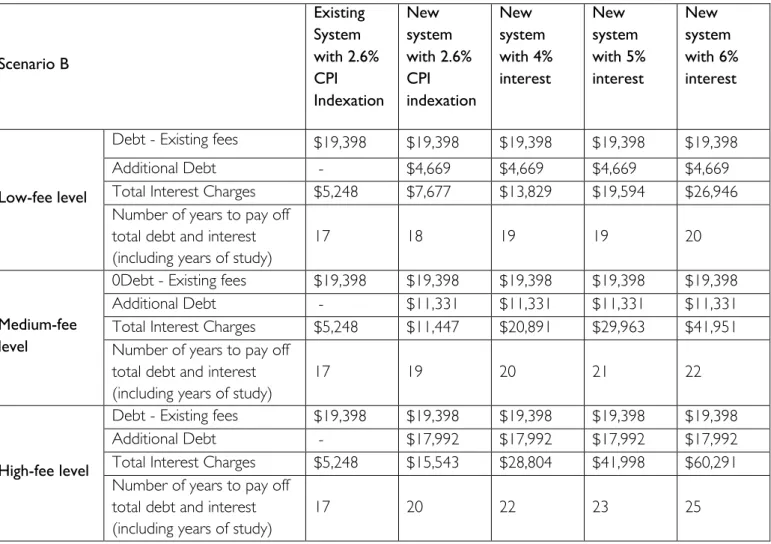
Under this scenario, a nursing graduate with a starting income of $48,729 will reach an income of around $72,000 after six years of working full-time. This graduate will then work part-time at 0.5 full-time equivalent (FTE) for the next six years to raise a family before returning to work full-time. Under the existing system with CPI indexation, the individual will pay off the total debt and interest of $24,646, 17 years after the commencement of their study.
At a four per cent interest rate, we find that:
Under the low-fee level, the individual will pay off the total debt and interest of $37,896, 19 years after the commencement of study.
Under the medium-fee level, the individual will pay off the total debt and interest of $51,620, 20 years after the commencement of study.
Under the high-fee level, the individual will pay off the total debt and interest of $66,195, 22 years after the commencement of study.
Table 7: Repayment profiles for nursing graduates – Scenario B
Scenario B Existing System with 2.6% CPI Indexation New system with 2.6% CPI indexation New system with 4% interest New system with 5% interest New system with 6% interest Low-fee level
Debt - Existing fees $19,398 $19,398 $19,398 $19,398 $19,398 Additional Debt - $4,669 $4,669 $4,669 $4,669 Total Interest Charges $5,248 $7,677 $13,829 $19,594 $26,946 Number of years to pay off
total debt and interest (including years of study)
17 18 19 19 20
Medium-fee level
0Debt - Existing fees $19,398 $19,398 $19,398 $19,398 $19,398 Additional Debt - $11,331 $11,331 $11,331 $11,331 Total Interest Charges $5,248 $11,447 $20,891 $29,963 $41,951 Number of years to pay off
total debt and interest (including years of study)
17 19 20 21 22
High-fee level
Debt - Existing fees $19,398 $19,398 $19,398 $19,398 $19,398 Additional Debt - $17,992 $17,992 $17,992 $17,992 Total Interest Charges $5,248 $15,543 $28,804 $41,998 $60,291 Number of years to pay off
total debt and interest (including years of study)