THE COMBINED EFFECT
OF ALCOHOL AND TEMAZEPAM
ON INFORMATION PROCESSING
bY
Andre Declerck
A thesis submitted as partial requirement
for the degree of Master of Psychology
in the Department of Psychology
at the University of Tasmania
ACKNOWLEDGEMENTS
Firstly, a big thankyou to Frances Martin for her fantastic supervision, guidance and friendship throughout this project and during my time at University.
Thanks to my comrade Robert Guidici for his enthusiastic and exuberant assistance in the many hours of running the experiment, and of course his diligent testing of alcohol/drug dosage procedures.
Thanks to all those willing subjects who agreed to give some of their time to participate in the 'VO effect'.
A grateful thankyou to Maurice Gourley and Maria Hennesey for their initial encouragement to embark on a Masters course in Psychology, and to Auntie 'Ros' for her encouragement to complete it! Expressions of gratitude to Peter Tattam for his computer expertise and once again my good mate Maurie for his fantastic help, assistance and advice.
Thanks to my good friend Jen 'No. 1 Wus' Nichols for her patient explanations of the specifics of the project, etc, etc, and to the rest of the Masters class for helping to make the whole process enjoyable!
Finally, a special thanks to Tor for her wonderful encouragement, support and patience in the latter stages of the project and a very grateful thankyou to my family Jerome, Jillian and Nicholas Declerck for their continued love and support.
SOURCES STATEMENT
I certify that this thesis contains no material which has been
accepted for the award of any degree or diploma in any
university, nor any material previously published
or written by another person, except when due
reference to such material is made in the text.
Signed
ABSTRACT
The present research investigated the separate and interactive effects of high doses of a minor tranquilliser (temazepam) (20 mg) and alcohol (BAC = 0.10%) on human information processing using a dual-task paradigm.
For this purpose dual task methodology was combined with P300 amplitude and latency as an index of resource allocation. A dual task paradigm in which subjects were instructed to attend to two tasks
concurrently (which had the effect of increasing overall cognitive load) was used to indicate if the affects of alcohol and/or temazepam impaired the contextual updating of neuronal models in the brain and/or reduced specific 'pools of available resources'.
Twelve subjects completed four drug treatments in a repeated measures design. The four drug treatments organised in a two by two design, included a placebo condition (alcohol no/temazepam no), an alcohol only condition (alcohol yes/temazepam no), a temazepam only condition (alcohol no/temazepam yes), and a combined condition (alcohol yes/temazepam yes). Event-related potentials were recorded from midline sites Fz, Cz and Pz within a dual task paradigm.
The results indicated that at higher doses, widespread neural depression by alcohol overlapped the specific depressant effects of
The RT data suggested that alcohol and temazepam may have had an additive effect on psychomotor processing. Both alcohol and temazepam significantly increased RT when ingested separately, but there was no interaction between the two drugs. Therefore alcohol and temazepam appeared to affect different aspects of RT processing.
CONTENTS
Chapter 1. Introduction
Chapter 2. Effects of Alcohol
2.1 CNS
2.2 Behavioural/Cognitive
Chapter 3. Effects of Benzodiazepines
3.1 CNS
3.2 Behavioural/Cognitive
Chapter 4. Interaction of Alcohol and Benzodiazepines
Chapter 5. The P300 ERP Component
Chapter 6. Context updating, resource allocation
and dual task paradigms
Chapter 7. Combined effects of Alcohol and Temazepam
Chapter 8. Summary and Hypothesis
Chapter 9. Method
Chapter 10. Results
Chapter 11. Discussion
Chapter 12. References
Chapter 13. Appendix
Chapter 1
Introduction
The effect that drugs such as alcohol and benzodiazepines have on the physical and behavioural functions of the human body when ingested separately are well documented (Wallgren & Barry III, 1970; Greenblatt & Shader, 1974). Alcohol causes dose dependent impairment, disorganisation and depression of CNS functioning. Temazepam is a short acting amdolytic from the benzodiazepine group, which inhibits neural firing in a dose dependent fashion creating CNS depression, sedation and anxiety reduction (Davies, 1990).
The few available studies on the simultaneous ingestion of alcohol and benzodiazepines have shown widely differing results on the
physiological and behavioural functioning of the human body. Including antagonistic, in which the effects of one of the drugs are lessened in the presence of the other and synergistic in which the combined effects are greater than the sum of the two separate effects (Mhatre, Mehta, & Ticku, 1988). If the drugs do not interact, then they are said to work additively, that is, the effect of each is the same whether or not the other is present. In this situation the drug effects are summed, that is, the behavioural and
physiological effects of alcohol and benzodiazepines are equal to the sum of the separate effects of the two drugs (Smith, Corbascio, & Ty-Smith, 1986).
Psychophysiological measures of brain activity in the form of the event-related potential (ERP) have been utilised to assess the effects of alcohol and benzodiazepines on CNS functioning. The P300 component of the ERP can be used in combination with reaction time (RT) to investigate the neural events that underlie information processing and the
mechanisms that affect the psychophysiological processes of attention. At a functional level, P300 amplitude indexes stimulus significance and
performs an important role in memory (Donchin, 1984). P300 latency is suggested to be determined by the time required for stimulus evaluation and to be independent of response selection and execution times (Johnson, 1986; Donchin, Kramer, & Wickens, 1986; Magliero, Bashore, Coles, & Donchin, 1984; Kutas, McCarthy, & Donchin, 1977). RT is thought to be an indicator of psychomotor processes underlying components of motor response. In addition, the P300 component has been employed as an index of resource allocation theories of attention and it has been shown that P300 amplitude is a valid measure of limited capacity perceptual-cognitive resources (Donchin et al., 1986). Resource allocation theories (Israel, Chesney, Wickens, & Donchin, 1980a) assume that there are distinct kinds of resources, rather than a single pool of resources, and that different types of processing utilise specific pools of resources, which can be shared by different cognitive operations (Wickens, 1980).
A dual task paradigm can be utilised as a tool to assess the demand for specific pools of available resources. A task in which subjects are instructed to attend to two tasks concurrently may be a useful strategy to indicate if the effects of alcohol and/or temazepam reduce distinct pools of available resources. It is suggested that the amount of processing capacity available to either of the two tasks would be less than the amount available if only one task was being performed.
This study aims to investigate the separate and interactive effects of high doses of alcohol and temazepam on human information processing using a dual-task paradigm and P300 amplitude, latency, and RT as an index of resource allocation. Chapter 2 will review the literature on the effects of alcohol on the CNS and the cognitive and behavioural effects of alcohol. Chapter 3 will examine the effects of benzodiazepines on the CNS and the cognitive and behavioural effects of benzodiazepines. An analysis of what
3
is known about the combined effects of alcohol and benzodiazepines will be conducted in Chapter 4. Chapter 5 will describe the late component of the ERP known as P300 which has evolved as a useful tool in cognitive
psychophysiology. Chapter 6 will discuss the efficacy of using the P300 as an index of the neural events that underlie the psychophysiological processes of attention and theoretical models of this process will be reviewed.
Chapter 2
Effects of Alcohol
2.0 Introduction
The ingestion of alcohol results in progressive and simultaneous impairment of function (Barry LEL 1979). The effects of alcohol vary depending on many factors including: amount, type, method consumed, and such individual factors as: percentage of body fat, tolerance, age, sex, nutritional state, personality, and physical state. Impairment occurs
progressively with increasing levels of blood alcohol concentration (BAC), (Wallgren & Barry III, 1970). Although the most visible effects of alcohol are on the physical and behavioural functions of the body, its most serious effect is on the brain and CNS.
2.1 Effects of alcohol on the Central Nervous System
Alcohol causes universal and progressive impairment,disorganisation, retardation, and depression of CNS functioning. The sedative effect of alcohol is generally thought to result from inhibition of brain functions (Donelson, 1988). Low doses of alcohol suppress inhibitory mechanisms in the brain, leading to what is outwardly observed as
behavioural excitation. At higher doses, excitatory suppression takes over, and CNS depression is observed as simultaneous behavioural inhibition (Arif & Westermeyer, 1988). Physiologically, at low alcohol levels, increased neuronal excitation reflects synaptic transmission enhancement, while at higher doses, the progressive reduction of excitation is due to the delay of synaptic impulses which at increasing levels of intoxication can lead to a complete block of synaptic transmission (Berry & Pentreath, 1980; Block, 1973; Julien, 1978).
5
unclear. Calcium is a transmitter which is vital in regulating the excitatory impulses of the brain. Alcohol depletes calcium levels within the CNS which causes deregulation of neuronal excitation. Another of the neural effects of alcohol which has received attention is its action on the inhibitory neurotransmitter gamma-aminobutyric acid (GABA). Alcohol is a CNS depressant which depresses GABA inhibition, therefore alcohol may depress the brain's activity through GABA (Nestoros, 1980). Alcohol administration may increase the binding capacity of GABA binding sites. Nestoros (1980) suggests that alcohol enhances the effects of GABA. Using much lower concentrations of alcohol than many earlier studies he found that alcohol did not produce inhibition alone, but only in the presence of GABA, suggesting that it does not directly mimic the actions of GABA. Therefore at lower doses, alcohol may facilitate GABAergic inhibition
producing behavioural disinhibition. Whereas at higher doses alcohol may cause CNS inhibition through a general depressing effect and also through potentiating GABA.
2.2 Behavioural and Cognitive effects of alcohol
The most visible effects of alcohol are on the physical and behavioural functions of the body. The immediate effects of alcohol ingestion include loss of inhibition, dizziness, loss of co-ordination and motor skills, slow reactions, staggering, slurred speech, and impairment of senses (Wallgren & Barry III, 1970; Berry & Pentreath, 1980). Impairment of function is progressive with increasing levels of BAC, (Barry III, 1979), that is, the effects of alcohol are dose dependent.
6
obvious signs of motor impairment primarily due to the depression of the cortical centres that control muscular activity. Peripheral action of alcohol on muscle tissue and other structures have slight influence.
Psychomotor impairment is greatest at high levels of alcohol consumption (BAC: 0.05% and above) (Young, 1970; Franks, Hensley, & Starmer, 1976; Ellinwood & Heatherley, 1985). However, even at low doses hand eye co-ordination, muscular co-ordination and smooth motor
operating processes are impaired (Franks, Hensley, Hensley, Starmer, & Teo, 1976b). Due to the inherent difficulties in measuring the effects of alcohol consumption on psychomotor performance, the RT measure has been used. RT refers to the time it takes for a subject to respond to a stimulus with a motor response. A direct relationship exists between alcohol dosage and performance on tasks involving simple and choice reaction time (CRT) in that a dose dependent slowing of response occurs: as BAC increases, RT increases (Ross & Pihl, 1987). Some controversy exists with inconsistent results being found at BACs under 0.07% (Wallgren & Barry III, 1970). Alcohol has little effect on RT at low doses and has even been found to decrease RT (Wallgren & Barry III, 1970). At moderate alcohol doses (BAC of 0.02% - 0.05%), Declerck (1990) found no impairment on RT in a task requiring rapid response to unexpected stimuli. At higher BACs (0.05% and above), RT is consistently slowed (Declerck, 1990; Rohrbaugh, Stapleton, Parasuraman, Zubovic, Frowein, Varner, Adinoff, Lane, Eckardt, &
7
It is generally considered that alcohol consumption disrupts
cognitive functions. Franks et al. (1976) suggest that cognitive performance is more resilient to alcohol effects than psychomotor performance.
Impairment is substantial after high doses, whereas at lower levels results are ambiguous. Such tasks as intellectual reasoning, judgement,
psychometric performance, memory for words and numbers, attention, and concentration are all severely diminished after moderate to high doses of alcohol (Franks, et al., 1976; Minocha, Barth, Roberson, Herold, & Spyler, 1985; Oscar-Berman, 1987). Also information processing indexed by the distribution of attention over a complex situation seems to be sensitive to alcohol consumption (Buikhuisen & Jongman, 1972). Buikhuisen and Jongman (1972) found that intoxicated individuals (BAC 0.08%) showed reduced range of attention and less flexible searching strategies than sober individuals. Alcohol consumption results in a decreased ability to deal with the unexpected because of the additive demands on attention and
Chapter 3
Effects of Benzodiazepines
3.0 Introduction
Unlike alcohol, the minor tranquillisers known as benzodiazepines are not generally considered neuronal depressants, however, like alcohol they inhibit neural firing in a dose dependent fashion creating CNS depression (Davies, 1990). As dose increases the signs of CNS depression become more apparent. These signs include ataxia, somnolence, and slurred speech at very high doses and overdose can cause death through respiratory depression (Benzer, 1987). Benzodiazepines loci of effect lies in the spinal cord, the ascending reticular activating system, hypothalamus, cerebellum, limbic system and the cerebral cortex (Balderssarini, 1980; Colesanti, 1982; Greenblatt & Shader, 1981; Shalleck, Scholsser, & Randell, 1972; Davies, 1990).
3.1 Effects of benzodiazepines on the Central Nervous System
As with alcohol, benzodiazepines enhance inhibitory interneuronal action resulting in the brain being unable to respond to rapid impulses generated by the CNS (Greenblatt & Shader, 1976). Neurochemically, benzodiazepine specific receptors are found predominantly in the cerebral cortex and cerebellum. When benzodiazepines are ingested they bind to these receptors which are in close association with GABA receptors. As with alcohol, benzodiazepines act predominantly by potentiating inhibitory neurotransmission mediated by GABA. Thus benzodiazepines stimulate the transfer of GABA-mediated inhibitory signals which cause an opening of chloride ion channels and result in increased feelings of calmness, ease and relaxation (Davies, 1990; Costa, Guidotti, Mao, & Suria, 1975;; Martin, Siddle, Gourley, Taylor, & Dick, 1992b; Gray, 1988; Mant, et al., 1987;Mashford, 1984; Ray & Ksir, 1987; Hayward, Wardle, & Higgitt, 1989). The CNS depressant actions of benzodiazepines are far more localised than those of alcohol, concentrating mainly in the limbic system and the RAS (Iversen, 1983; Young & Kuhar, 1980). The limbic system is thought to be involved in the regulation of emotional behaviour and is closely associated with the presence of anxiety. Benzodiazepines relieve anxiety and tension by reducing autonomic functioning and selectively inhibiting limbic system activity, that is, exerting their hypnosedative effect throughout the system (Greenblatt & Shader, 1976).
3.2 Behavioural and Cognitive effects of Benzodiazepines
The predominant effects of the benzodiazepines include the reduction of hostility and aggressive behaviour, and the lessening of the behavioural consequences of frustration, fear, and punishment, producing a reduction of tension, stress, and anxiety and a calm sense of relaxation
(Greenblatt & Shader, 1974; Burrows, Norman, & Vajda, 1990). The cognitive and motor effects of benzodiazepines can be
differentiated. As with alcohol both of these kinds of action are centrally controlled by the CNS. Peripheral action of benzodiazepines on muscle tissue and other structures exercise little if any influence.
Due to the diverse effects of benzodiazepines across a range of dosage levels, a discussion of psychomotor impairment is tentative.
Benzodiazepines appear to produce a decrement in psychomotor
performance but the degree of impairment is in dispute. Co-ordination and standing steadiness were found to be impaired at 5 mg and 10 mg doses of diazepam (Seppala, Korttila, Hakkinen, & Linnoila, 1976), but at a dose of 6 mg no decrement was reported (Wittenborn, 1979). Studies involving the psychomotor performance measurement of RT have yielded similar
10
findings. In a review of the literature Kleinknecht and Donaldson (1975) found that benzodiazepine RT decrements are dose dependent, dependent
on the mode of administration and on the sub-type of benzodiazepine used. Palva, Linnoila, Routledge, and Seppala (1982) found that a 10 mg dose of diazepam did not impair performance on CRT. Kleinlcnecht and
Donaldson (1975) cite a study where CRT was not impaired at an oral dose of 15 mg of diazepam but was after a 0.2 mg/kg dose intravenously
administered. In a recent study Martin et al. (1992b) found that temazepam had no significant effect on RT at the 10 mg dose used. Temazepam has been discovered not to slow CRT at a 15 mg oral dose but does after a 30 mg dose (Bond & Lader, 1980; Hindmarch, 1988). It would appear that moderate doses of benzodiazepines produce little decrement in psychomotor
performance, this may suggest that there is little detriment to the cognitive processes which underlie RT.
It is generally understood that benzodiazepine consumption
influences cognitive functions. Cognitive impairment after benzodiazepine ingestion is dose dependent (Wittenborn, 1979). Decision making, card sorting, cancelling designated letters, perceptual speed tests, and digit symbol substitution tests are all effected by benzodiazepine administration (McKim, 1986; Smith, Kroboth, & Phillips, 1986; Wittenborn, 1979). Learning and memory consolidation deficits also appear after benzodiazepine ingestion (Lister, 1985), but the more established higher mental functions are less sensitive to benzodiazepine interference (Lader, 1983). It has also been postulated that the cognitive correlate of benzodiazepine GABAergic
Chapter 4
Interaction of alcohol and benzodiazepines
The simultaneous ingestion of alcohol and benzodiazepines, if taken in high enough concentrations, may lead to excessive CNS depression and even death. At lower doses simultaneous benzodiazepine and alcohol ingestion results in motor co-ordination impairment and in the
impairment of judgement and psychomotor tasks (Martin et al., 1992a; Tong & Bernstein, 1988; Funderburk, Bigelow, Liebson, & MacKenzie, 1989). The interactive effects of these two classes of drugs have shown widely differing effects, including antagonistic, in which the effects of one of the drugs are lessened in the presence of the other and synergistic in which the combined effects are greater than the summated individual effects (Mhatre et al., 1988). If the drugs do not interact, then they are said to work additively, that is, the effect of each is the same whether or not the other is present. In this
situation the drug effects are summed, that is, the behavioural and
physiological effects of alcohol and benzodiazepines are equal to the sum of the separate effects of the two drugs (Smith et al., 1986).
Clinical literature (Davies, 1990; MIMS, 1989) cautions of an interaction between the two types of drugs however, the origin of this information is unclear, since the few studies of the combined effect of alcohol and benzodiazepines have shown inconsistent results. Greenblatt and Shader (1974) believe that any benzodiazepine-alcohol interactions are minimal or non-existent. In a review of five studies that combined
benzodiazepines with alcohol Greenblatt and Shader (1974) found no evidence of an interaction, as measured by psychomotor tasks. Palva et al. (1982) found that a combination of 0.03-0.04% BAC and 10 mg of diazepam had no significant effect on CRT, tracking or attention. Martin et al. (1992a) found no interaction between the two drugs, using a BAC of 0.04% and 10
12
mg of temazepam, that is, there was no indication of an antagonistic or synergistic effect of the combined drugs. The majority of researchers believe that the benzodiazepine-alcohol combination is of an additive nature
(American Medical Association, 1986; Balderssarini, 1980; Stock, 1981; Hansten, 1979; Julien, 1978; Milner, 1972; Wincor, 1988).
On a neurophysiological level, alcohol is a CNS depressant which depresses GABA inhibition (Nestoros, 1980). Drugs with a similar
pharmacological profile such as the benzodiazepines may potentiate the effects of alcohol. Thus, benzodiazepine and alcohol administration depress the brain's activity through GABA. It is possible that benzodiazepines cause the brain to become more receptive to the effects of alcohol (Linnoila,
Chapter 5
The P300 ERP component
The interaction between information processing and behavioural output may be reflected via cognitive psychophysiological measures of brain activity in the form of event-related potentials (ERPs). The late ERP
components are assumed to be neuronal manifestations of information processing or stimulus evaluation and response execution (Brandeis & Lehmann, 1986). The P300 is a late component of the ERP which has evolved as a useful tool in cognitive psychophysiology, it can be used in combination with reaction time (RI) to deduce the neural events that underlie the psychophysiological processes of attention (Donchin, 1984).
Event Related Potential (ERP)
The ERP consists of a series of positive and negative waveforms. The ERP can be defined in terms of polarity (positive, negative), latency (time of occurrence after stimulus presentation), amplitude (the electrical magnitude in microvolts), and scalp distribution. Sutton, Braren, Zubin, and John (1965) suggest that components of the waveform occurring within the first 250 ms after stimulus presentation are a reflection of activity
associated with the physical characteristics of the stimulus (which are known as exogenous influences). Subsequent components, that occur after 250 ms are independent of these parameters and therefore are generated endogenously, that is, they are defined by internal processes of the brain.
Exogenous waveform
Exogenous components represent the response of brain tissue to the activation of a peripheral sense organ by an external event. They are
living person with an intact auditory system, these potentials will
invariably appear. In fact, if these potentials do not appear, we can assume the person to have some hearing loss (Davis, 1976b). The exogenous
components are very sensitive to the sensory characteristics of the eliciting stimulus (Donchin & Isreal, 1980). As exogenous components are
influenced by physical characteristics of the stimulus, they vary in their distribution over the scalp relative to the primary cortical area subserving the stimulus modality (Spong, Haider, & Lindsley, 1965), thus such
components are often called 'sensory evoked potentials' (Ritter, Simson, & Vaughan, 1972). These components are affected by variations in stimulus frequency, intensity, and duration (Squires, Squires, & Hillyard, 1975).
Of note are the N200 and P200 components which are thought to index physical characteristics of stimuli. The N200 and P200 components are considered to be primarily exogenous in origin and as such to be related to the quality of sensory input and are relatively insensitive to changes in information processing demands (Rohrbaugh et al., 1987; Hillyard & Kutas, 1983).
Endogenous waveform
The endogenous components are unaffected by external stimulus characteristics. Of particular interest is the P300 (or late positive
component), exhibited at approximately 300 ms latency, which has been postulated to reflect cognitive processing invoked by preceding stimuli.
The P300 is found in both auditory and visual evoked potentials. It's latency and amplitude can be affected by discriminability, duration and the complexity of the assigned task. P300 will not occur until the stimulus is categorised, thus the longer it takes to discriminate a stimulus, the longer P300 latency will be (Ritter et al., 1972; Squires, Donchin, Squires, &
15
Grossberg, 1977). In addition P300 amplitude will not reach maximum amplitude until all information has been evaluated. The two main
parameters of interest are the amplitude of the P300, and it's latency, that is, the time which elapses between stimulus onset and the peak of the P300.
Amplitude of P300
P300 amplitude is a measurement taken from a baseline to the peak of the response. Maximum amplitude of P300 is recorded at parietal and central recording sites (Duncan-Johnson & Donchin, 1977). The amplitude of P300 can be influenced by a number of factors; including, manipulation of probability, meaning, and stimulus information transmission (Johnson, 1986; Squires, Donchin, Herning, & McCarthy, 1977).
P300 amplitude is directly related to the amount of uncertainty produced by a stimulus, that is the greater the uncertainty, the greater the P300 amplitude. The variables that influence the magnitude of this
dimension contributing to the overall P300 effect include a priori probability
and formation of expectancies (Johnson, 1986; 1979). An inverse relationship exists between a priori stimulus probability and P300
The magnitude of P300 elicited by a particular stimulus at a given level of probability varies as a function of the subject's task (Johnson, 1986). The portion of P300 amplitude sensitive to changes in meaning is
influenced by task complexity, stimulus complexity, and stimulus value. Generally, the greater the complexity of the task demand, the more
extensive processing of a stimulus is required in order to extract its full content. P300 amplitude increases directly with the degree of task complexity (Chesney & Donchin, 1979; Johnson & Donchin, 1978; 1982). Also the P300 amplitude is directly related to stimulus complexity. That is, some stimuli require more processing and categorisation than others (Johnson, 1986). Stimuli that have greater value, or significance (e.g. monetary rewards) elicit larger P300s than insignificant stimuli (Johnson, 1979; Obitz, Rhodes, & Creel, 1977).
P300 and Latency
The occurrence of a positive waveform component at a latency of approximately 300 ms (P300) was initially recognised by Sutton et al. (1965). However, P300 latency can vary from 200 ms (Roth & Kopell, 1973), to 750 ms (Donchin, 1979; Donchin et al., 1986).
The latency of P300 is a reflection of the time taken to evaluate and categorise a stimulus (Maglerio, Bashore, Coles, & Donchin, 1984). P300 latency is a sensitive index of the duration of stimulus evaluation processing (encoding, recognition and classification) and is affected by similar variables as for P300 amplitude (Hillyard, 1985). Generally the longer it takes to evaluate and categorise a stimulus, the longer P300 latency, thus the measure of P300 latency is indexing the time required for stimulus evaluation. Recent research has concentrated on the relationship between P300 and RT, as the two measure in combination yield useful data
concerning information processing.
P300 Latency and Reaction Time
In the P300 literature behavioural reaction time (RT) measures have been examined in attempts to identify categorisation and response factors (Craft & Simon, 1970). In this context RI refers to the time it takes a subject to respond with a motor response to a rare task relevant stimulus. There is considerable literature on the association or dissociation between P300 latency and RT. Tueting et al. (1971) noted that a majority of studies show a dissociation between P300 latency and RT. McCarthy and Donchin (1981) found RI was affected by discriminability and stimulus response
compatibility, while P300 latency was affected only by stimulus
discriminability. Donchin (1979) suggested that the dissociation between P300 latency and RI may depend on the strategy of the subject as many different processes determine RI but only a small subset of these processes determine P300 latency.
Kutas, McCarthy, and Donchin (1977) demonstrated that when subjects try to respond accurately to stimuli, that the correlation between P300 and RT is high. However, if subjects are trying to respond as quickly as possible, the stimuli may not be processed completely before responding, thus RT is faster and precedes P300 latency. Probable events are identified faster as reflected by the latency of both P300 and RT, but as probability increases the RT incrementally decreases at a faster rate than the P300 latency. Therefore in the case of low probability presentations, the P300 can precede the RI but at higher probability the RI markedly precedes the P300 (Duncan-Johnson, 1981). On trials where an incorrect response is made, RI typically precedes P300. Thus latency is determined largely by the duration of categorisation process and not by the response selection and execution
processes (Donchin et al., 1986; Kutas et al., 1977).
Chapter 6
Context updating, resource
allocation
and
Context updating, resource allocation
and
dual task paradigms
Cognitive psychophysiology is the relationship between cognitive processes and physiological measures. If psychophysiological measures are sensitive to particular information processing activities they can be used to understand how these processes interact to produce behavioural output.
It has long been suggested that brain waves might be used for the timing of mental events or processes (Kutas et al., 1977). Kutas et al. (1977) suggested that the timing of mental processes independent of response selection and execution time can be used to analyse stages of processing
independently of motor responses. The P300 component of human ERP can serve as an index for measuring stimulus evaluation time. A number of theoretical views about the relationship between P300 and cognitive processes exist. These include Donchin's (1981) 'context updating theory' and the theory of resource allocation.
Context Updating
One of the most systematic and influential theoretical views to the functional significance of P300 is Donchin's (1981) 'context updating theory'. This assumes that the brain carries a neuronal model which is a
representation of all the information which exists in the immediate environment. When the brain detects differences between its neuronal model and actual occurrences in the environment, a process of contextual updating occurs. This updating process brings the neuronal model into line with the new information that has become available. The P300 is a
20
differing substantially from the current representation in the brain require more context updating resulting in larger P300s and this may suggest that P300 reflects the updating of working memory. Once a certain stimulus is identified and categorised it is hypothesised that 'context updating'
commences. Surprising, low probability stimuli impinge on a subject's ongoing cognitive processes leading to a revision of those processes and an updating of the models of the environment held by the subject: the context revision is manifested by the P300 (Donchin, 1979., in Pritchard, 1981;
Donchin & Coles, 1988).
Resource allocation
Another theoretical view has been to think of P300 as signifying the allocation of processing resources to a task. Several theories suggest that 'attention' should be viewed as a resource of limited supply, different quantities of which can be allocated to different information processing activities (Kahneman, 1973). The term 'resource' is used here to describe processing capabilities which must be used in a task performance.
'Resource' like attention is a hypothetical construct which is invoked to account for variance in performance (Isreal et al., 1980a). The processing capacity postulated by Kahneman (1973) is conceived as a pool of multi-purpose resources which can be drafted into any process.
limited-capacity perceptual or perceptual-cognitive resources (Donchin et al., 1986). This can be applied in situations such as divided attention and dual task performance.
Dual task paradigms
The use of dual task methodology has frequently been employed in research on human information processing (Fisk, Derrick, & Schneider, 1986). Dual task paradigms reflect a variety of different factors, depending on the particular dual task methodology used to address the identified research question. The dual task procedure may attempt to index any excess mental capacity of the individual while engaged in some task or some mental activity, that is assess the resource demands of some task or task components. It may be used to suggest the amount of cognitive
effort/capacity demanded by a primary task. Or it may be used to assess the effects of increased cognitive load on an individual's performance, that is asking an individual to complete an additional task will increase the demand for cognitive processing and may reduce the ability to perform an initial task. The interpretation of dual task results in terms of overlapping demands is consistent with resource models of attention which assume that processing resources are limited in quantity and shareable between
concurrently performed tasks (Kahneman, 1973).
22
of the dual task paradigm is to postulate whether performance on a secondary task is predictive of primary task difficulty.
The implication is that only one hypothetical construct, which can assume different values, is necessary to account for performance variability in a dual-task paradigm (Isreal et al., 1980a). According to this view, when one of several concurrent tasks utilises some proportion of the available resource pool, fewer resources are available for the performance of the other task. (Isreal et al., 1980a). Within this framework, the failure of rare, ignored events to elicit P300 is due to the fact that the subject's resources are not utilised to process the secondary task whenever those resources are
demanded by a 'primary task'. Similarly a reduction in P300 amplitude to the attended secondary task demonstrates the demand by the primary task for processing resources and vice versa, that is a reduction in P300
amplitude to the attended primary task if processing resources are used on the secondary task.
Isreal et al. (1980a) suggest that P300 amplitude may be used as a reliable measure in the study of the allocation of processing resources among concurrently performed tasks. In a dual task paradigm the
amplitude measurement to surprising, task relevant stimuli would index the amount of processing resources being allocated to performing the
required task. If we assume that the individual being studied is performing the task to the best of his/her ability, then the recorded P300 amplitude would be an indicator of the total processing capacity available for
allocation. Within a dual task paradigm, P300 has been found to increase in amplitude with increased processing demands when elicited by task
relevant events in a primary task. On the other hand, P300s elicited by secondary task events decrease in amplitude with increases in
23
Wickens, Chesney, & Donchin, 1980b). This pattern of changes in P300 amplitude is consistent with predictions of resource models of attentional allocation (Navon & Gopher, 1979). Thus, it appears that while P300 latency provides information concerning the mental chronometry of information processing, P300 amplitude is sensitive to changes in the resource demands of processing (Kramer & Strayer, 1988).
However, current formulations of resource theory hold that a number of processing units have their own supply of resources that can be shared by several on going cognitive operations (Friedman & Poison, 1981). One such model proposed by Wickens (1980), the 'multiple attentional pool model' argues that processing resources may be represented by three
dimensions: stages of processing (perceptual/central and response), codes of processing (verbal and spatial) and modalities (visual and auditory). In a multiple resource model, resources for task performance are not allocated in a continuous manner from one pool, but rather competition among tasks for attentional capacity occurs as a function of the tasks' stages of processing, codes of verbal and spatial processing, modalities of input, and response type (Fisk et al., 1987). Tasks that place demands on the same limited capacity processes are predicted to be more poorly time shared than tasks that do not overlap in their processing requirements (Kramer & Strayer, 1988).
Important substantiating data from the point of view of resource allocation theory was provided by Hoffman, Houck, MacMillan, Simons, and Oatman (1985), who showed in a dual task situation combining a Schneider and Shiffrin (1977) consistent-mapping search task with a
24
was closely related to the accuracy with which a given task was performed (Ndatanen, 1988). Reductions in P300 amplitude resulted in linear
reductions in accuracy, and the same linear relationship between the reduction in accuracy and the P300 amplitude held for both tasks, this
suggests the presence of a single resource required by both tasks. Hoffman et al. (1985) suggests that this resource plays a pivotal role in the accuracy of performance.
A dual task paradigm in which subjects are instructed to attend to two tasks concurrently may be used to assess the effects of increased
Chapter 7
Combined effects of Alcohol and
Temazepam
The effects of alcohol and temazepam
on
information processing as indexed by P300
Effects of alcohol on early ERP components
The administration of alcohol has been associated with a decrease in amplitude of early ERP components, but no change in latency (in waveform components prior to 250ms) (Lewis, Dustman, & Beck, 1969; Lewis,
Dustman, & Beck, 1970; Rhodes, Obitz, & Creel, 1975; Declerck, 1990).
Effects of alcohol on information processing as indexed by the P300
There have been a prolific number of studies designed to assess the effect that alcohol has on human information processing as indexed by P300. Alcohol consumption reduces the amplitude of the late components of evoked responses regardless of sensory modality (Salamy, Wright, & Faillace, 1986; Lewis et al., 1970; Wagman, Allen, Funderbunk, & Upright, 1978; Tharp, Rundell, Lester, & Williams, 1974; Teo, & Ferguson, 1986). In a review of five studies that considered the effects of alcohol on late ERP components related to cognitive processes Oscar-Berman (1987) noted a consistent finding of reduced P300 amplitude, but found the increase of latency due to alcohol less reliable. Campbell and Lowick (1987) examined the acute effects of alcohol on ERPs elicited by auditory stimuli. Using an oddball task they found that alcohol ingestion had a significant effect on a number of ERP components, P300 amplitude was reduced (in relation to alcohol dosage, task difficulty, stimulus meaning, and value) and P300 latency to targets was increased by alcohol.Rohrbaugh et al. (1987) used three levels of alcohol dosage (BAC 0.00% - 0.05%, 0.05% - 0.08%, and above 0.08%) to evaluate dose related
26
interactions with ERPs in a visual sustained attention task. They
demonstrated a dose dependent decline in detection performance and an increase in reaction time to detected targets. ERP components (Ni and P2) were not influenced by dose, but the latency's of N2 and P300 increased as a function of dose (paralleled by RT increases) whereas amplitude decreased. ERP and performance data were interpreted as demonstrating an adverse effect of ethanol on central processing capacity. Taken together these two studies show that alcohol reduces amplitude of P300, this reduction is not restricted to task difficulty or type of task (visual/auditory) as ERP
impairment may be prominent before any particular performance decrement (Oscar-Berman, 1987).
Roth, Tinklenberg, and Kopell (1977) found that visual ERPs were effected by alcohol (using a 0.95 mg/kg of body weight dose of alcohol). They found a reduction in P300 amplitude, but no effect on latency. Zuzewicz (1981) using a 1 g/kg of body weight dose of alcohol, and a visual flash evoked potential found that P300 latency increased due to alcohol, and that P300 amplitude varied as a function of time. That is, 30 mins after ingestion of alcohol P300 increased, whereas after 60 mins P300 decreased. However, the results of this study were contaminated by a number of uncontrolled variables such as unclear alcohol administration procedures, unrecorded BAC, and insufficient recording sites which raise doubts concerning the validity of this research.
27
latency of P300 increased and amplitude decreased as a function of alcohol dosage.
Krein, Overton, Young, Spreior, and Yolton (1987) studied the effects on ERPs of using three dose levels of alcohol (0.00%, 0.06%, and 0.13%), in a simulated traffic signal task. A dose dependent effect of P300 latency was found. That is, as BAC increased, latency increased, P300 amplitude also decreased as a function of dosage. This finding indicates that an increase in mental processing time was required to determine if a green or a red light had been presented. Overall the finding of reduced P300 amplitude (Oscar-Berman, 1987; Martin et al., 1992b; Roth et al., 1977) across a wide range of blood alcohol concentrations (0.02% to 0.10%) has been found consistently, the increase of latency due to alcohol is less consistent.
In information processing terms, as P300 amplitude is a recognised physiological marker of the context updating process in the brain reduced P300 amplitude due to the ingestion of alcohol indicates an inability to update existing neuronal models in the brain. In terms of resource allocation theory, alcohol reduces the amount of resources available for allocation to specific tasks. Together this amounts to the total processing capacity of the individual being reduced.
The finding albeit less consistently of increased P300 latency after alcohol ingestion indicates an overall increase in the processing stage of stimulus evaluation. The increase in RT due to alcohol indicates the effect that alcohol has on psychomotor brain centres responsible for response organisation and execution. Thus alcohol appears to effect areas in the brain responsible for stimulus evaluation and psychomotor performance.
Effects of benzodiazepines on early ERP components
The ingestion of benzodiazepines has been associated with a decrease in amplitude of early ERP components, but no change in latency (in waveform components prior up to 250ms) (Ebe, Meirerewert, &
Broughton, 1969; Boker & Heinze, 1984).
Effects of benzodiazepines on information processing as indexed by the P300
In comparison to the prolific number of studies on the effect that alcohol has on human information processing there have been relatively few studies conducted which have considered the effect that
benzodiazepines have on such processing.
The available evidence suggests that temazepam decreases P300 amplitude (Martin et al., 1992a; Martin et al., 1992b). The results for P300 latency have been less consistent. P300 latency, in one experiment
conducted by Martin et al. (1992b), was found to increase after a 10 mg dose of temazepam, while in other studies P300 latency has not been found to change with a 10 mg dose of temazepam (Martin et al., 1992a; Mills, 1990). This may suggest that information processing which is indexed by P300 amplitude may not occur at the same neural site as the processes denoted by P300 latency, namely stimulus evaluation. Martin et al. (1992a) also found that RT was unaffected by the ingestion of temazepam, suggesting a lack of significant effects on the psychomotor processes responsible for response execution.
As temazepam decreases P300 amplitude, but does not increase P300 latency, it can be suggested that the cognitive processes indexed by P300 amplitude do not occur within the series of stages measured by RT, since they do not increase RT or P300 latency. It would seem that certain
29
processes, denoted by P300 amplitude, are made less efficient by temazepam, while others, within the RT envelope, are not. Martin et al. (1992a) suggest
therefore that temazepam acts selectively on specific areas of the brain, that is, at different neural locations.
In terms of theories of information processing a reduction of P300 amplitude after temazepam ingestion indicates a reduced ability to
contextually update, or in terms of resource allocation theory, an
impairment in the capacity of an individual to allocate resources. This is reflected at a physiological level by the amount of GABA potentiation caused by temazepam not being sufficient enough to cause generalised inhibition of neural firing, using low to moderate doses.
The effects of temazepam on information processing at higher doses remains to be investigated. It is suggested that increased GABA potentiation would effect either stimulus evaluation, as indexed by P300 latency,
response execution, as indexed by RI, or both. P300 amplitude would be expected to be even further decreased.
Effects of alcohol and benzodiazepines on information processing
as indexed by the P300
30
mental processing.
On the other hand, alcohol not only affects the pool of resources which are responsible for information processing but also affects the pool of resources which are responsible for speed of mental processing (Martin et al., 1992b). At lower doses the stimulus evaluation stage of processing is selectively affected by alcohol. The results of the study conducted by Martin et al. (1992b) indicated that temazepam, with or without the presence of alcohol reduces P300 amplitude, which although not directly tested by these authors could be explained in terms of resource allocation theory. That is, temazepam effects one or more of the pools of possible processing resources available. Alcohol on the other hand, with or without the presence of
temazepam, affected information processing indexed by P300 amplitude and motor processing speed and speed of evaluation as indexed by RT and P300 latency. In summary of the results found by Martin et al. (1992a; 1992b), low doses of alcohol and temazepam have separately been shown to reduce P300 amplitude, however when ingested together no interaction has been
evident, that is, there was no antagonistic or synergistic effect of the combined drugs. It can be concluded therefore, that at the low dose levels used in the Martin et al. (1992b) experiment (BAC 0.04% and temazepam 10 mg orally) alcohol and temazepam appeared to affect different levels of processing in the CNS or to affect different pools of available resources. In terms of the context updating theory, this could mean that each drug
Chapter 8
Summary and Hypothesis
The physiological, behavioural and cognitive effects of alcohol and benzodiazepines have been considered both separately and in combination. In an attempt to define the extent of their effect/s on human cognitive processes, specifically information processing, the psychophysiological measurement of the ERP component known as P300 has been utilised.
The aim of the present study is to investigate the separate and interactive effects of high doses of temazepam and alcohol on human information processing. For this purpose dual task methodology will be combined with P300 amplitude and latency as an index of resource
allocation. A dual task paradigm in which subjects are instructed to attend to two tasks concurrently is a useful strategy to indicate if the affects of alcohol and/or temazepam reduce specific 'pools of available resources'. The amount of attention given to either of the two tasks would be less than the amount available if only one task was being performed.
On the basis of the literature presented and adhering to dual task methodology the following hypotheses are made:
Firstly, at higher doses, widespread neural depression by alcohol may overlap the specific depressant effects of temazepam as
benzodiazepines appear to potentiate the action of alcohol (O'Reilly, 1980) causing an increase in general CNS depression. This may result in specific sections of the brain being affected separately by each drug as well as areas of the brain affected by both drugs. The ingestion of both drugs
simultaneously may reduce P300 amplitude more than the sum of their separate effects, thus the effect would be synergistic. In terms of context updating, the process of updating the pre-existing neuronal model may be restricted, or from the resource allocation perspective the actual pool of
32
resources may be reduced.
Secondly, temazepam/alcohol may show a dose dependent impairment of speed of mental processing thus separate
temazepam/alcohol ingestion at higher doses may increase GABA potentiation which would affect stimulus evaluation as indexed by P300 latency. At high doses a synergistic effect may occur when temaz,epam and alcohol are combined.
Thirdly, similarly to P300 latency temazepam/alcohol may produce a dose dependent impairment on psychomotor performance as indexed by RT that is, at higher doses temazepam may effect areas of the brain responsible for psychomotor performance combined with alcohol may cause an overlap in the neural locus of effect. An interaction of the two drugs would
therefore cause marked decrements in performance.
Fourthly, high doses of alcohol and/or temazepam may produce general neural depression of the primarily exogenous ERP components of P200 and N200, as indexed by a reduction in amplitude and an increase in latency.
However, the effects of alcohol and temazepam may be constrained if at high doses there is an antagonistic effect or the two tasks in the dual task paradigm require more cognitive processing. That is, the effects of the two drugs may be less in the presence of one another than separately or that a greater amount of attention and concentration may be required to
Chapter 9
Method
Subjects
The subjects were twelve male university undergraduates aged between 18 and 23, who were paid for their participation. All subjects had regular driving experience of at least one year, normal vision and a normal medical history. All subjects were 'normal' social drinkers, non-users of nicotine or other drugs and no subject was related in the first degree to any person who had been diagnosed as an alcoholic (Buffington, Martin, & Becker, 1981). Subjects were required to attend the Psychophysiology laboratory in the Department of Psychology at the University of Tasmania for 4 sessions each of which lasted approximately 2 to 4 hours. The
experimental procedure was explained and informed consent was obtained from all subjects. Ethical approval was attained from the University of Tasmania's Ethics Committee.
Apparatus
Electroencephalographic (EEG) recordings were made using a Grass Model 12 Neurodata Acquisition System, connected to an IBM compatible 386 computer, using an electrode skull cap with tin electrodes and tin mastoid reference and EOG electrodes. Visual stimuli were presented by means of two slide projectors fitted with Uniblitz (Model 225) tachistoscopic shutters. The duration of each slide presentation was controlled by two interval generators and stimulus presentation was controlled by an IBM compatible 386 computer. The stimuli were slides of driving scenes and were made and presented as detailed by Martin et al. (1992b). Each condition contained 160 slides which depicted either safe driving (85%) or imminent accident (15%) scenes projected onto a screen 60 cm in front of the subject.
34
The space average luminance of each slide was measured using a Tektronix J16 photometer with a J6523-2 1 degree narrow angle luminance probe. The average luminance of the central spot was 40.7 cd/m2 and 45.1 cd/m2 for the imminent accident (rare) and safe driving (common) slides respectively. The average spot measured in each of the four quadrants for the rare slides was 32.4 cd/m2 and 41.6 cd/m2 for the common slides. Subjects were seated with their chins in a chin rest such that slides subtended a visual angle of 30° horizontally x 20° vertically. Auditory stimuli were presented in Bernoulli series of low-pitched (1000 Hz) (65%) and high-pitched (1200 Hz) (35%) tone bursts which were delivered bi aurally (75 dB). The duration, pitch and timing of the auditory tones were controlled by an IBM
compatible 386 computer.
Design
A within subjects 2 (alcohol: yes/no) x 2 (temazepam: yes/no) x 2 (stimuli: common/rare) x 3 (site: Fz, Cz, Pz) repeated measures design was used, with drug treatment order and slide presentation order
counterbalanced using a Latin square procedure. The design resulted in each subject completing four drug treatments: (i) Placebo: BAC 0.00% and Vitamin E tablet, (ii) Alcohol: BAC 0.10% and a Vitamin E tablet, (iii) Temazepam: BAC 0.00% and Temazepam 20 mg orally, and (iv) Alcohol/ Temazepam combined: BAC 0.10% and Temazepam 20 mg orally. All sessions for each subject were conducted during early evening to control for circadian variability. Independent variables were the two alcohol
35
Drug Administration
Subjects were given four drink combinations consisting of Vodka (37%) (in the alcohol and the alcohol/temazepam conditions only),
unsweetened orange juice and peppermint water. Subjects received a 2.45 ml/kg of body weight dose of vodka calculated to give rise to BACs in the range of 0.08 to 1.0 %. Peppermint water was added in the ratio of 0.1 ml per kilogram of body weight to provide a mask to the alcohol and placebo
conditions. Orange juice was added in the ratio of 5.71 mls per kilogram of body weight. The volume of each drink was calculated so that a 70 kg person would receive a total quantity of 400 ml of fluid. The premixed drink was divided into three equal parts and ingested at a rate of one part every five minutes. The drug dose consisted of two 10 mg tablets
(Temazepam: NORMISON) that were consumed 30 minutes before the subject began the first drink portion. In the placebo and alcohol treatments two 100 mg Vitamin E tablets in the same shape and size as the temazepam tablets were substituted for the temazepam tablets.
EEG recordings
The EEG was recorded from midline (Fz, Cz and Pz) sites, referenced to the right ear. The EOG was recorded vertically, the electrodes placed at the superior and inferior margin of the right orbit at the midline of the eye (Jasper, 1958). The electrode impedances did not exceed 10 kOhms. The amplifiers were set to a high frequency cut off of 30 Hz and a time constant of 15s. The EEG was sampled at a rate of 500 Hz for a 1000 ms epoch
36
Procedure
Prior to the commencement of the experiment subjects were asked to complete a medical history questionnaire and a consent form. Subjects who did not meet the preset criteria were rejected. Subjects were required not to drink alcohol for 24 hours prior to testing and to abstain from food for at least 4 hours prior to the time of experimentation. Sessions were conducted one week apart in order to avoid potential hang-over affects.
An oddball paradigm with the probability of the rare event being 15% was used to elicit the P300. Subjects were instructed to depress a hand-held microswitch as quickly as possible whenever they would normally brake in a car driving at 60 kilometres per hour, that is in response to imminent accident scenes. A small central fixation point was present continuously on the screen. Stimulus duration was 200 ms with an
interstimulus interval (ISI) (offset to onset ) of 1600 ms. In addition subjects were instructed to count covertly the number of higher pitched tones in the Bernoulli series and to report this count at the end of the trial. Tones were 60 ms in duration (including 10 ms rise/fall) and were presented during the ISI. The probability of occurrence of a high tone on any trial was 35%, and the low tone occurred with complimentary probability. The pre-determined slide stimulus presentation order allowed for 160 trials and at the end of each series it recommenced until 40 rare and at least 40 common responses had been accepted and averaged. The visual task was regarded as the
"primary" task and the tone counting as "secondary".
37
minutes after completion of the last drink. An assessment was made as to whether the desired BAC had been reached. If not breath analysis was repeated at 5 minute intervals until either the desired reading was obtained or it was apparent that the level had peaked, at which time the subject commenced the experiment.
On completion of each experimental condition subjects were
required to fill out subjective ratings on their estimate BAC, 0 being totally unaffected, and 4 being extremely affected. Subjects were fed a substantial meal and then driven home after their BAC was recorded below .05, twice over a half hour period, and their blood pressure had reached pre-drug administration levels. In most cases this took approximately 3 to 5 hours.
Data Analysis
Grand Mean averages were computed for responses to both 'rare' and 'common' stimuli for each electrode site for each condition. The scoring of the records was carried out by the experimenter who was blind to both the subject and to the dose level associated with the data. P200 was defined as being the second and P300 as the third major positive peak following stimulus presentation, and N200 the negative peak preceding P300. The latency of P200, N200, and P300 was determined by measuring the time between stimulus onset and the maximum deflection within the search epoch. The search epochs for each target components were as follows: P200 (150-250 ms), N200 (250-350 ms) and P300 (350-550 ms). P200, N200, and P300 amplitude were quantified with a baseline to peak measure by subtracting the activity in the 100 ms prestimulus baseline from the amplitude of the largest positive peak within the search epoch at each of Fz, Cz and Pz for each subject in each condition. In addition to the ERP
38
button. The subjects estimated number of high pitched tones was recorded for each trial. A score was calculated by subtracting the actual number of high pitched tones from the estimated number of tones. The subject's actual BAC, estimated BAC and rating of subjective intoxication were also
recorded.
To test for significant amplitude and latency differences across conditions repeated measures ANOVAs evaluated the effects of alcohol condition (2), temazepam condition (2), stimuli (2) and electrode site (3). A rejection region of p < .05 was used for all ANOVAS. A significance level of p < .01 was used for all Fisher LSD post-hoc tests. Reaction Time was
Chapter 10
Results
Grand Mean Averages
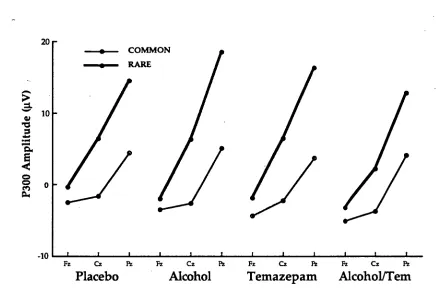
Figure 1 displays the grand mean ERP waveforms elicited for rare and common stimuli for the three electrode sites and the two levels of each of the alcohol and temazepam conditions. P300 amplitude was larger at Pz, than at Cz, or at Fz for all conditions. The difference between the P300 amplitude for rare and common stimuli was largest at Pz and smallest at Cz and Fz.
The P300 amplitude differences between the alcohol and/or temazepam conditions at sites Fz and Cz were small in accordance with previous research (Donchin, Ritter, & McCallum, 1978) as P300 is maximally elicited at Pz. Figure 1 indicates that for the placebo condition P300
amplitude for rare stimuli decreased, particularly at Pz. Alcohol and
temazepam separately increased the amplitude of P300 for rare stimuli at all electrode sites, principally at Pz. However, alcohol and temazepam in
combination reduced P300 amplitude for rare stimuli at Pz. Overall there was a larger P300 amplitude at all sites measured when subjects were under the influence of alcohol when temazepam was not present.
Amplitude Results
P200: Figure 2 shows P200 amplitude for both rare and common stimuli at each site for all conditions.
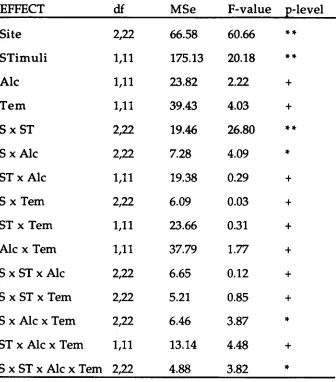
The four-way ANOVA: Alcohol (2) x Temazepam (2) x Stimuli (2) x Site (3) showed that P200 amplitude was not influenced by the alcohol [F(1, 11) = 0.18, MSe = 16.141 or temazepam [F(1, 11) = 0.15, MSe = 31.02] condition or by stimuli [F(1, 11) = .0008, MSe = 20.95]. There was a significant main effect of site [F(2, 22) = 66.50, MSe = 34.30] indicating that P200 amplitude was
PLACEBO
ALCOHOL TEMAZEPAM ALCOHOL &
TEMAZEPAM
FZ
CZ
PZ
0 100 300 500 700 900 0 100 300 500 700 900
LATENCY Ems] LATENCY Ems]
0 100 300 500 700 900
LATENCY [ms]
0 100 300 500 700 900
[image:56.830.87.722.66.446.2]LATENCY Ems]
Figure 1: Shows the Grand Mean Average ERPS elicited by the Common and Rare stimuli at the Fz, Cz and Pz sites for each of the conditions, Placebo, Alcohol, Temazepam, and Alcohol/Temazepam.
= Stimulus Duration).
40
larger at Pz than at Cz and Fz, further analysis showed P200 amplitude was significantly larger at Pz than at Cz, and at Fz (Fisher LSD). However there were no significant differences in P200 amplitude between Fz and Cz (Fisher LSD).
The alcohol x site interaction was significant [F(2, 22) = 15.77, MSe = 1.21] indicating that P200 amplitude at each site varied across alcohol
conditions as can be seen in Figure 2. Fisher LSDs showed no significant differences of P200 amplitude for alcohol yes/no at Cz, whereas differences at Fz (alcohol yes was more negative than alcohol no) and Pz (alcohol yes had a larger amplitude than alcohol no) were significant.
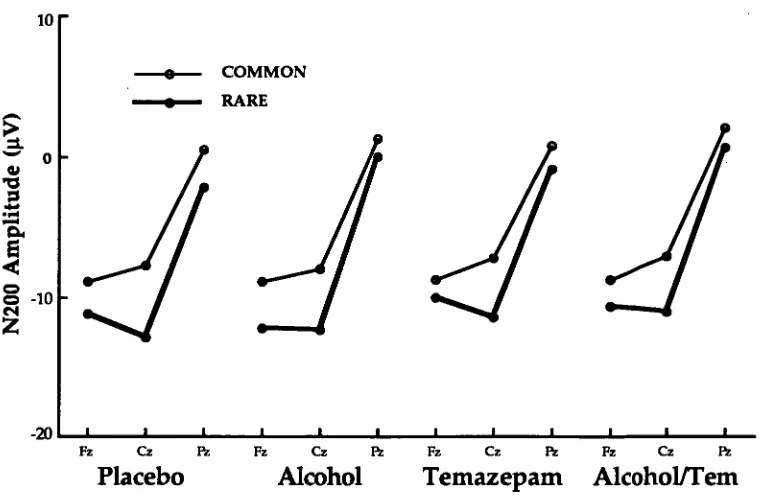
N200: Figure 3 shows N200 amplitude for both rare and common
stimuli at each site for all conditions.
The four-way ANOVA: Alcohol (2) x Temazepam (2) x Stimuli (2) x Site (3) showed that N200 amplitude was not influenced by alcohol [F(1, 11) = 0.61, MSe = 20.88] or temazepam [F(1, 11) = 0.77, MSe = 62.36] conditions. However a significant main effect of site was recorded [F(2, 22) = 71.41, MSe = 46.26]. N200 amplitude was significantly less negative at Pz than at Cz and Fz (Fisher LSD), but there were no significant differences in N200 amplitude between Fz and Cz (Fisher LSD). A significant main effect also occurred for stimuli [F(1, 11) = 6.52, MSe = 87.30] indicating that N200 amplitude was less negative for responses to common stimuli than to rare stimuli. The
interaction between site and stimuli was also significant [F(2, 22) = 7.48, MSe = 6.45]. Fisher LSDs indicated that the largest differences between common and rare stimuli occurred at Cz than at Fz than at Pz.
20
•
COMMON.■•■•■.... RARE
-10
Fz Cz Pz Fz Cz Pz Fz Cz Pz Fz Cz Pz
[image:58.557.72.487.81.343.2]Placebo Alcohol Temazepam Alcohol/Tem
Figure 2: P200 amplitude for both common and rare stimuli at each site for all
conditions.
10
--0-- COMMON ••■•■•■• RARE
20
Fz Cz Pz Fa Cz Pz Fz Cz Pz Fz Cz
[image:58.557.99.479.410.659.2]Placebo Alcohol Temazepam Alcohol/Tern
Figure 3: N200 amplitude for both common and rare stimuli at each site for all