A Longitudinal Study funded by the DfEE
department for
education and skills
Technical Paper 3 – June 1999
Contextualising EPPE: Interviews with
Local Authority Co-ordinators and
Centre Managers
The Effe
ctiv
e Provi
sio
n of Pre
-School
Educ
atio
n (EPP
E) Pro
jec
The Effective Provision of Pre-School
Education [EPPE] Project
A longitudinal Study funded by the DfES
(1997 – 2003)
Technical Paper 3 – June 1999
Contextualising EPPE : Interviews with
Local Authority Co-ordinators and
Centre Managers
Address for correspondence:
EPPE Project
University of London
Institute of Education Tel:+44 (0) 207 612 6219 20 Bedford Way Fax:+44 (0) 207 612 6230
Technical Paper 3
C
ONTEXTUALISING
EPPE:
INTERVIEWS WITH
L
OCAL
A
UTHORITY
C
O
-
ORDINATORS AND
C
ENTRE
M
ANAGERS
A
UTHORS
:
Iram Siraj-Blatchford
Kathy Sylva
Edward Melhuish
Pam Sammons
Brenda Taggart
Rose Jennings
A
CKNOWLEDGEMENT
T
HE
EPPE
R
ESEARCH
T
EAM
Principal Investigators
Professor Kathy Sylva
Department of Educational Studies, University of Oxford
Professor Edward Melhuish
Birkbeck, University of London
Professor Pam Sammons
Institute of Education, University of London
Professor Iram Siraj-Blatchford
Institute of Education, University of London
Research Co-ordinator
Brenda Taggart
Institute of Education, University of London
Regional Research Officers
Anne Dobson
Isabella Hughes
Marjorie Jeavons
Margaret Kehoe
Katie Lewis
Maria Morahan
Sharon Sadler
First Published in September 1999 by the Institute of Education University of London 20 Bedford Way, London WC1H OAL
Pursuing Excellence in Education
ISBN 085473 593 3
Printed by Formara Ltd. Southend on Sea. Essex.
The views expressed in this report are the authors’ and do not necessarily reflect those of the Department for Education and Skills.
Contents
Page Number
Overview of the Project
1-10
Executive Summary
i -iv
Introduction
1
Sample and procedure
1
Perceived benefits of recent national initiatives
2
Expansion in provision as a response to the initiative
7
Progress being made in partnership/collaboration
8
Quality assurance: arrangements and responsibilities
12
Training
16
Involvement of qualified teachers in early years provision
17
The effect on new initiatives on parental choice
18
The effects of new initiatives on parental involvement
19
Improvements in children’s experience
20
Perceived effects of the Early Excellence Centres
24
Perceived effects on Special Needs provision
24
Local Priorities
25
Suggestions for National Policy
25
References
27
FIGURES
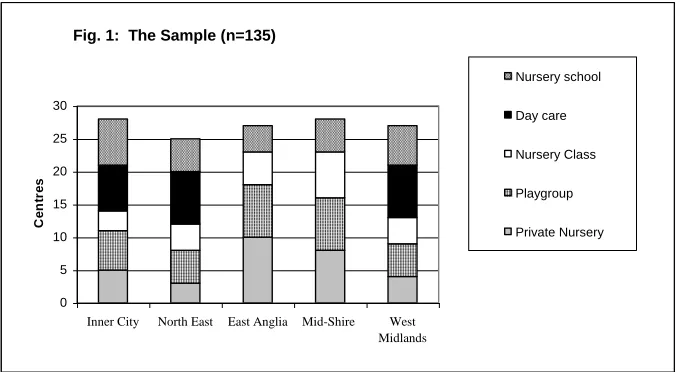
FIGURE 1 The sample 2
FIGURE 2 What are the main characteristics of effective pre-school practice? 4
FIGURE 3 Has your centre changed as a consequence of recent national initiatives? 6
FIGURE 4 What has been the key issue in these changes for your centre? 6
FIGURE 5 Do you think that enrolment has been/will be affected by recent national changes? 7
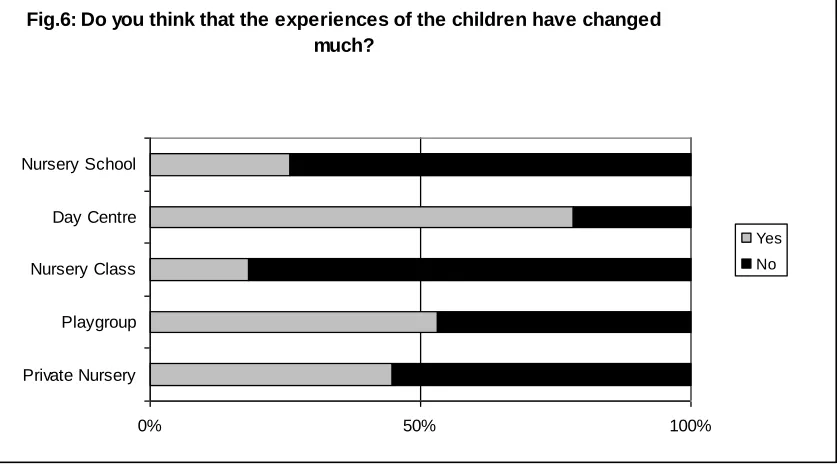
FIGURE 6 Do you think the experiences of children have changed much? 20
FIGURE 7 Impact of Desirable Learning Outcomes on centres. 21
APPENDICES
Tables 1-7 Frequencies shown in Figures 1-7 28
Semi-structured interview schedule for centre managers 30
Semi-structured interview schedule for local authority co-ordinators 31
1
Effective Provision of Pre-school Education
“EPPE”
Overview of the Project
This series of 12 reports describes the research on effective pre-school provision funded by the UK Department for Education & Employment (DfEE). Further details appear in Technical Paper 1 (Sylva, Sammons, Melhuish, Siraj-Blatchford & Taggart 1999). This longitudinal study assesses the attainment and development of children followed longitudinally between the ages of 3 and 7 years. Three thousand children were recruited to the study over the period January 1997 to April 1999 from 141 pre-school centres. Initially 114 centres from four types of provision were selected for the study but in September 1998 an extension to the main study was implemented to include innovative forms of provision, including ‘combined education and care’ (Siraj-Blatchford et al. 1997).
Both qualitative and quantitative methods (including multilevel modelling) have been used to explore the effects of individual pre-school centres on children's attainment and social/behavioural development at entry to school and any continuing effects on such outcomes at the end of Key Stage 1 (age 7). In addition to centre effects, the study investigates the contribution to children’s development of individual and family characteristics such as gender, ethnicity, language, parental education and employment. This overview describes the research design and discusses a variety of research issues (methodological and practical) in investigating the impact of pre-school provision on children’s developmental progress. A parallel study is being carried out in Northern Ireland.
There have been many initiatives intended to improve educational outcomes for young children. Will these initiatives work? Will they enable children to enter school ‘more ready’ to learn, or achieve more at the end of Key Stage 1? Which are the most effective ways to educate young children? The research project described in this paper is part of the new emphasis on ensuring ‘a good start’ for children.
P
REVIOUS
R
ESEARCH ON THE
E
FFECTS OF
E
ARLY
E
DUCATION IN THE
UK
There has been little large-scale, systematic research on the effects of early childhood education in the UK. The ‘Start Right’ Enquiry (Ball 1994; Sylva 1994) reviewed the evidence of British research and concluded that small-scale studies suggested a positive impact but that large-scale research was inconclusive. The Start Right enquiry recommended more rigorous longitudinal studies with baseline measures so that the ‘value added’ to children’s development by pre-school education could be established.
occurred. To date no research using multilevel models (Goldstein 1987) has been used to investigate the impact of both type of provision and individual centre effects. Thus little research in the UK has explored whether some forms of provision have greater benefits than others. Schagen (1994) attempted multilevel modelling but did not have adequate control at entry to pre-school.
In the UK there is a long tradition of variation in pre-school provision both between types (e.g. playgroup, local authority or private nursery or nursery classes) and in different parts of the country reflecting Local Authority funding and geographical conditions (i.e. urban/rural and local access to centres). A series of reports (House of Commons Select Committee 1989; DES Rumbold Report 1990; Ball 1994) have questioned whether Britain's pre-school education is as effective as it might be and have urged better co-ordination of services and research into the impact of different forms of provision (Siraj-Blatchford 1995). The EPPE project is thus the first large-scale British study on the effects of different kinds of pre-school provision and the impact of attendance at individual centres.
O
VERVIEW OF
R
ESEARCH
M
ETHODS
The EPPE project is a major study instituted in 1996 to investigate three issues which have important implications for policy and practice:
• the effects on children of different types of pre-school provision,
• the ‘structural’ (e.g. adult-child ratios) and ‘process’ characteristics (e.g. interaction styles) of more effective pre-school centres, and
• the interaction between child and family characteristics and the kind of pre-school provision a child experiences.
An educational effectiveness research design was chosen to investigate these topics because this enabled the research team to investigate the progress and development of individual children (including the impact of personal, socio-economic and family characteristics), and the effect of individual pre-school centres on children's outcomes at both entry to pre-school (the start of Reception which children can enter between the ages of 4 and 5 plus) and at the end of Key Stage 1 (age 7 plus). Such research designs are well suited to social and educational research with an institutional focus (Paterson & Goldstein 1991). The growing field of school effectiveness research has developed an appropriate methodology for the separation of intake and school influences on children's progress using so called 'value added' multilevel models (Goldstein 1987, 1995). As yet, however, such techniques have not been applied to the pre-school sector, although recent examples of value added research for younger ages at the primary level have been provided by Tymms et al. 1997; Sammons & Smees 1998; Jesson et al. 1997; Strand 1997; and Yang & Goldstein 1997. These have examined the relationship between baseline assessment at reception to infant school through to Key Stage 1 (age 7 plus years).
3
The 8 aims of the EPPE Project
• To produce a detailed description of the 'career paths' of a large sample of children and their families between entry into pre-school education and completion (or near completion) of Key Stage 1.
• To compare and contrast the developmental progress of 3,000+ children from a wide range of social and cultural backgrounds who have differing pre-school experiences including early entry to Reception from home.
• To separate out the effects of pre-school experience from the effects of education in the period between Reception and Year 2.
• To establish whether some pre-school centres are more effective than others in promoting children's cognitive and social/emotional development during the pre-school years (ages 3-5) and across Key Stage 1 (5-7 years).
• To discover the individual characteristics (structural and process) of pre-school education in those centres found to be most effective.
• To investigate differences in the progress of different groups of children, e.g. second language learners of English, children from disadvantaged backgrounds and both genders.
• To investigate the medium-term effects of pre-school education on educational performance at Key Stage 1 in a way which will allow the possibility of longitudinal follow-up at later ages to establish long-term effects, if any.
• To relate the use of pre-school provision to parental labour market participation.
The sample: regions, centres and children
In order to maximise the likelihood of identifying the effects of individual centres and also the effects of various types of provision, the EPPE sample was stratified by type of centre and geographical location.
• Six English Local Authorities (LAs) in five regions were chosen strategically to participate in the research. These were selected to cover provision in urban, suburban and rural areas and a range of ethnic diversity and social disadvantage. (Another related project covering Northern Ireland was instituted in April 1998 [Melhuish et al. 1997]. This will enable comparison of findings across different geographical contexts.)
• Six main types of provision are included in the study (the most common forms of current provision; playgroups, local authority or voluntary day nurseries, private day nurseries, nursery schools, nursery classes, and centres combining care and education. Centres were selected randomly within each type of provision in each authority.
In order to enable comparison of centre and type of provision effects the project was designed to recruit 500 children, 20 in each of 20-25 centres, from the six types of provision, thus giving a total sample of approximately 3000 children and 140 centres1. In some LAs certain forms of provision are less common and others more typical. Within each LA, centres of each type were selected by stratified random sampling and, due to the small size of some centres in the project (e.g. rural playgroups), more of these centres were recruited than originally proposed, bringing the sample total to 141 centres and over 3000 children.
1
Children and their families were selected randomly in each centre to participate in the EPPE Project. All parents gave written permission for their children to participate.
In order to examine the impact of no pre-school provision, it was proposed to recruit an additional sample of 500 children pre-school experience from the reception classes which EPPE children entered. However in the five regions selected a sample of only 200+ children was available for this ‘home’ category.
The progress and development of pre-school children in the EPPE sample is being followed over four years until the end of Key Stage 1. Details about length of sessions, number of sessions normally attended per week and child attendance have been collected to enable the amount of pre-school education experienced to be quantified for each child in the sample. Two complicating factors are that a substantial proportion of children have moved from one form of pre-school provision to another (e.g. from playgroup to nursery class) and some will attend more than one centre in a week. Careful records are necessary in order to examine issues of stability and continuity, and to document the range of pre-school experiences to which individual children can be exposed.
Child assessments
Around the third birthday, or up to a year later if the child entered pre-school provision after three, each child was assessed by a researcher on four cognitive tasks: verbal comprehension, naming vocabulary, knowledge of similarities seen in pictures, and block building. A profile of the child’s social and emotional adjustment was completed by the pre-school educator who knew the child best. If the child changed pre-school before school entry, he or she was assessed again. At school entry, a similar cognitive battery was administered along with knowledge of the alphabet and rhyme/alliteration. The Reception teacher completed the social emotional profile.
Further assessments were made at exit from Reception and at the end of Years 1 and 2. In addition to standardised tests of reading and mathematics, information on National Assessments will be collected along with attendance and special needs. At age 7, children will also be invited to report themselves on their attitudes to school.
Measuring child/family characteristics known to have an impact on children’s
development
1) Information on individual ‘child factors’ such as gender, language, health and birth order was collected at parent interview.
2) Family factors were investigated also. Parent interviews provided detailed information about parent education, occupation and employment history, family structure and attendance history. In addition, details about the child's day care history, parental attitudes and involvement in educational activities (e.g. reading to child, teaching nursery rhymes, television viewing etc) have been collected and analysed.
Pre-school Characteristics and Processes
5
‘Process’ characteristics such as the day-to-day functioning within settings (e.g. child-staff interaction, child-child interaction, and structuring of children's activities) were also studied. The Early Childhood Environment Rating Scale (ECERS) which has been recently adapted (Harms, Clifford & Cryer 1998) and the Caregiver Interaction Scale (Arnett 1989) were also administered. The ECERS includes the following sub-scales:
• Space and furnishings • Personal care routines
• Language reasoning
• Activities
• Interaction
• Programme structure • Parents and staffing
In order that the more educational aspects of English centres could be assessed, Sylva, Siraj-Blatchford, Taggart & Colman (unpublished) developed four additional ECERS sub-scales describing educational provision in terms of: Language, Mathematics, Science and the Environment, and Diversity.
Setting the centres in context
In addition to describing how each centre operated internally, qualitative interviews were conducted with centre managers to find out the links of each setting to local authority policy and training initiatives. Senior local authority officers from both Education and Social Services were also interviewed to find out how each local authority implemented Government early years policy, especially the Early Years Development Plans which were established to promote education and care partnerships across providers in each local authority.
Case Studies
In addition to the range of quantitative data collected about children, their families and their pre-school centres, detailed qualitative data will be collected using case studies of several “effective” pre-school centres (chosen retrospectively as ‘more effective’ on the basis of the multilevel analyses of intake and outcome measures covering the period baseline to entry into reception). This will add the fine-grained detail to how processes within centres articulate, establish and maintain good practice.
The methodology of the EPPE project is thus mixed. These detailed case studies will use a variety of methods of data gathering, including documentary analysis, interviews and observations and the results will help to illuminate the characteristics of more successful pre-school centres and assist in the generation of guidance on good practice. Particular attention will be paid to parent involvement, teaching and learning processes, child-adult interaction and social factors in learning. Inevitably there are difficulties associated with the retrospective study of process characteristics of centres identified as more or less effective after children in the EPPE sample have transferred to school and it will be important to examine field notes and pre-school centre histories to establish the extent of change during the study period.
A
NALYTIC
S
TRATEGY
Identifying individual centre effects and type of provision at entry to school
Longitudinal research is essential to enable the impact of child characteristics (personal, social and family) to be disentangled from any influence related to the particular pre-school centre attended. Multilevel models investigate the clustered nature of the child sample, children being nested within centres and centres within regions. The first phase of the analysis adopts these three levels in models which attempt to identify any centre effects at entry to reception class.
Given the disparate nature of children's pre-school experience it is vital to ensure that the influences of age at assessment, amount and length of pre-school experience and pre-school attendance record are accounted for when estimating the effects of pre-school education. This information is also important in its own right to provide a detailed description of the range of pre-school provision experienced by different children and any differences in the patterns of provision used by specific groups of children/parents and their relationship to parents' labour market participation. Predictor variables for attainment at entry to reception will include prior attainment (verbal and non-verbal sub scales), social/emotional profiles, and child characteristics (personal, social and family). The EPPE multilevel analyses will seek to incorporate adjustment for measurement error and to examine differences in the performance of different groups of children at entry to pre-school and again at entry to reception classes. The extent to which any differences increase/decrease over this period will be explored, enabling equity issues to be addressed.
After controlling for intake differences, the estimated impact of individual pre-school centres will be used to select approximately 12 ‘outlier’ centres from the 141 in the project for detailed case studies (see ‘Case Studies’ above). In addition, multilevel models will be used to test out the relationship between particular process quality characteristics of centres and children's cognitive and social/behavioural outcomes at the end of the pre-school period (entry to school). The extent to which it is possible to explain (statistically) the variation in children's scores on the various measures assessed at entry to reception classes will provide evidence about whether particular forms of provision have greater benefits in promoting such outcomes by the end of the pre-school period. Multilevel analyses will test out the impact of measures of pre-school process characteristics, such as the scores on various ECERS scales and Pre-School Centre structural characteristics such as ratios. This will provide evidence as to which measures are associated with better cognitive and social/behavioural outcomes in children.
Identifying continuing effects of pre-school centres at KS1
Cross-classified multilevel models have been used to examine the long term effects of primary schools on later secondary performance (Goldstein & Sammons, 1997). In the EPPE research it is planned to use such models to explore the possible mid-term effects of pre-school provision on later progress and attainment at primary school at age 7. The use of cross classified methods explicitly acknowledges that children's educational experiences are complex and that over time different institutions may influence cognitive and social/behavioural development for better or worse. This will allow the relative strength of any continuing effects of individual pre-school centre attendance to be ascertained, in comparison with the primary school influence.
T
HE
L
INKED
S
TUDY IN
N
ORTHERN
I
RELAND
1998-2003
7
Ireland: playgroups, day nurseries, nursery classes, nursery schools and reception groups and classes. The data from England and Northern Ireland offer opportunities for potentially useful comparisons.
S
UMMARY
This “educational effectiveness” design of the EPPE research study enables modelling of the complicated effects of amount and type of pre-school provision (including attendance) experienced by children and their personal, social and family characteristics on subsequent progress and development. Assessment of both cognitive and social/behavioural outcomes has been made. The use of multilevel models for the analysis enables the impact of both type of provision and individual centres on children's pre-school outcomes (at age 5 and later at age 7) to be investigated. Moreover, the relationships between pre-school characteristics and children's development can be explored. The results of these analyses and the findings from the qualitative case studies of selected centres can inform both policy and practice. A series of 12 technical working papers will summarise the findings of the research.
EPPE Technical Papers in the Series
Technical Paper 1 – An Introduction to the Effective Provision of Pre-School Education (EPPE) Project
ISBN: 0 85473 591 7 Published: Autumn 1999 Price £3.50
Technical Paper 2 – Characteristics of the Effective Provision of Pre-School Education (EPPE) Project sample at entry to the study ISBN: 0 85473 592 5 Published: Autumn 1999 Price £4.00
Technical Paper 3 – Contextualising EPPE: Interviews with Local Authority co-ordinators and centre managers ISBN: 0 85473 593 3 Published: Autumn 1999 Price £3.50
Technical Paper 4 – Parent, family and child characteristics in relation to type of Pre-School and socio-economic differences ISBN: 0 85473 594 1 Published: Autumn 1999 Price £4.00
Technical Paper 5 – Report on centre characteristics in the EPPE Study : (Interviews)
ISBN: 0 85473 595 X Published: Autumn 2000 Price £5.00
Technical Paper 6 – Characteristics of the Centres in the EPPE Sample: Observational Profiles ISBN: 0 85473 596 8 Published: Autumn 1999 Price £5.00 Technical Paper 6A – Characteristics of Pre-School Environments
ISBN: 0 85473 597 6 Published: Autumn 1999 Price £3.50
Technical Paper 7 – Social/behavioural and cognitive development at 3–4 years in relation to family background ISBN: 0 85473 598 4 Published: Spring 2001 Price £5.00
Technical Paper 8a – Measuring the Impact of Pre-School on Children's Cognitive Progress over the Pre-School Period ISBN: 0 85473 599 2 Published : Autumn 2002 Price £8.00
Technical Paper 8b – Measuring the Impact of Pre-School on Children's Social Behavioural Development over the Pre-School Period ISBN: 0 85473 684 2 Publication Date: Spring 2003
Technical Paper 9 – Report on age 6 assessment ISBN: 0 85473 600 X Publication Date: Summer 2003
Technical Paper 10 – Case Studies ISBN: 0 85473 601 8 Publication Date: Summer 2003
Technical Paper 11 – Report on the continuing effects of pre-school education at age 7
ISBN: 0 85473 602 6 Publication Date: Autumn 2003
Technical Paper 12 – The final report ISBN: 0 85473 603 4 Publication Date: Spring 2004
The Early Years Transition and Special Educational Needs (EYTSEN) is a linked project which draws on data from the EPPE study . EYTSEN Papers :
Technical Paper 1 – Special needs across the Pre-School Period ISBN 085473 680 8
Published Autumn -2002 Price £6.00 Technical Paper 2 – Special needs in the Early Years at Primary School ISBN 085473 681 6
Publication Date Summer 2003.
Technical Paper 3 – Special needs in the Early Years : The Parents’ Perspective ISBN 085473 682 4 Publication Date Summer 2003.
Ordering information
The Bookshop at the Institute of Education. 20, Bedford Way. London WC1H OAL. Tel: 00 44 (0) 207 612 6050 Fax: 0207 612 6407 Email: [email protected]
website: www.johnsmith.co.uk/ioe
or The EPPE Office. The University of London, Institute of Education. 20 Bedford Way, London. WC1H OAL. U.K. Tel: 00 44 (0) 207 612 6219 Fax: 00 44 (0) 207 612 6230 Email: [email protected]
Website: http://www.ioe.ac.uk/projects/eppe
9
R
EFERENCES
Arnett, J. (1989) Caregivers in Day-Care Centres: Does training matter? Journal of Applied Developmental Psychology, 10, 541-552.
Ball, C. (1994) Startright: The Importance of Early Learning, London: RSA.
Borge, A., & Melhuish, E., (1995) A Longitudinal Study of Childhood Behaviour Problems, Maternal Employment and Day-care in Rural Norwegian Community, International Journal of Behavioural Development, 18, 23-42.
Davies, J. & Brember, I. (1992) The Effects of Gender, Attendance Period and Age on Children's Adjustment to Nursery Classes, Research in Education, 47, 89-103.
Davies, J, & Brember, I. (1997) The Effects of Pre-School Experience on Reading Attainment: a four year cross-sectional study, Educational Psychology, 178, 3, 255-266.
Department of Education & Science (1990) The Report of the Committee of Inquiry into the Quality of the Educational Experience offered to 3- and 4-year olds (Rumbold, A), London: HMSO.
Feinstein, L., Robertson, D. & Symons, J. (1998) Pre-school Education and Attainment in the NCDS and BCSI Centre for Economic Performance, London
Goldstein, H. (1987) Multilevel Models in Educational and Social Research, London: Charles Griffin and Co.
Goldstein, H. (1995) Multilevel Statistical Models (2nd Edition), London: Edward Arnold.
Goldstein, H. & Sammons, P. (1997) The Influence of Secondary and Junior Schools on Sixteen Year Examination Performance: A Cross-Classified Multilevel Analysis, School Effectiveness and School Improvement, 8, (2): 219-230.
Harms, T., Clifford, R. & Cryer, D. (1998) Early Childhood Environment Rating Scale Revised, New York and London: Teachers' College Press.
Hill, P. & Rowe, K. (1996) Multilevel Modelling in School Effectiveness Research, School Effectiveness and School Improvement, 7, (1): 1-34.
House of Commons Select Committee (1989) The Education of Children 3-5, London: HMSO.
Jesson, D., Bartlett, D., & Machon, C., (1997) Baseline Assessment and School Improvement - the use of data from the assessment of children on entry to school to support the raising of standards, paper presented to the annual conference of the British Educational Research Association, University of York, September 1997.
Luyten, H. (1994) Stability of School Effects in Dutch Secondary Education: The impact of variance across subjects and years, International Journal of Educational Research, 21, (2): 197-216.
Luyten, H. (1995) Teacher Change and Instability Across Grades, School Effectiveness and School Improvement, 1, (1): 67-89.
Melhuish, E.C. (1993) Pre-school care and education: Lessons from the 20th and the 21st century, International Journal of Early Years Education, 1, 19-32.
Melhuish, E.C., Lloyd, E., Martin, S. & Mooney, A. (1990) Type of day-care at 18 months: ii Relations with Cognitive and Language Development, Journal of Child Psychology and Psychiatry, 31, 861-870.
Melhuish, E.C., Sylva, K., Sammons, P. & Siraj-Blatchford, I. (1997) Effective Pre-School Provision in Northern Ireland, proposal to the DfEE for research linked to the Effective Provision of Pre-school Education Project.
National Institute of Child Health & Development (1997) The effects of infant child care on infant-mother
attachment security: Restuls of the NICHD study of early child care, Child Development, 68, (5): 860-879.
Paterson, L. & Goldstein H. (1991) New statistical methods of analysing social structures: an introduction to multilevel models, British Educational Research Journal, 17, (4): 387-393.
Sammons, P. (1996) Complexities in the judgement of school effectiveness. Educational Research and Evaluation, Vol. 2 113 – 149
Sammons, P. & Smees, R. (1998) Measuring Pupil Progress at Key Stage 1: using baseline assessment to investigate value added. School Leadership and Management, Vol. 18, No. 3, pp.389 – 407
Schweinhart, L.J. & Weikart, D.P., (1997) Lasting Differences, The High/Scope preschool curriculum comparison through age 23. High/Scope Press, Ypsilanti, Michigan.
Siraj-Blatchford, I. (1995) Expanding Combined Nursery Provision: Bridging the gap between care and education, in P Gammage and J Meighan The Early Years: The Way Forward, Nottingham: Education New Books.
Siraj-Blatchford, I., Sylva, K., Melhuish, E. & Sammons, P. (1997) Studying the Effects of Innovations in Nursery School Provision, a proposal to the DfEE for research linked to the Effective Provision of Pre-school Education Project
Strand, S. (1997) Pupil Progress during Key Stage 1: A value added analysis of school effects, British Educational Research Journal, 23, (4): 471-487.
Sylva, K., Sammons, P., Melhuish, E., Siraj-Blatchford, I. & Taggart, B. (unpublished) Technical Paper 1. An Introduction to the EPPE Project
Sylva, K., Siraj-Blatchford, I., Taggart, B. & Colman, P. (forthcoming) The Early Childhood Environment Rating Scales: 4 Curricular Subscales, London: Institute of Education.
Sylva, K. (1994) A Curriculum for Early Learning. In Ball, C. (Ed.) Startright: The Importance of Early Learning, London: RSA.
Sylva, K. & Wiltshire, J. (1993) The Impact of Early Learning on Children's Later Development. A review
prepared for the RSA enquiry 'Start Right', European Early Childhood Education Research Journal, 1, (1): 17-40.
Tizard, P., Blatchford, P, Burke, J., Farquhar, C. & Plewis, I. (1988) Young Children at School in the Inner City, Hove: Lawrence Erlbaum Associates Ltd.
Tymms, P., Merrell, C. & Henderson, B. (1997) The First Year at School: A quantitative Investigation of the Attainment and Progress of Pupils, Educational Research and Evaluation, 3, (2): 101-118.
i
Contextualising EPPE: Interviews with Local Authority
Co-ordinators and Centre Managers
E
XECUTIVE SUMMARY
This report looks at the impact of recent government initiatives on early childhood care and
education for 3 to 5-year olds in the full range of pre-school centres. The report is based on
interviews conducted with 135 heads of pre-school settings and 12 local authority
co-ordinators in six local authorities between April 1998 and March 1999. The study shows that
the main impact has come from:
The Desirable Learning Outcomes (DLOs) (SCAA, 1996): First introduced in 1996, the
DLOs have been extremely influential in determining the curriculum to be delivered by
centres receiving government funding for four-year-olds.
Section 10 inspection arrangements: Introduced to ensure the quality of educational
provision for nursery classes and nursery schools under local education authority
provision (Section 10 of the School Inspections Act, 1996).
Section 5 inspection arrangements: Introduced to ensure the quality of educational
provision for the private, voluntary and independent sector provision (Section 5 of the
Nursery Education and Grant Maintained Schools Act, 1996)
Increased collaboration: In 1997 the Government required local authorities to devise
Early Years Development Plans (EYDP) in collaboration with the state, private and
voluntary sectors to be in place from 1 April 1998.
Meeting the Childcare Challenge
(1998): The publication of new regulations and funding
for a childcare strategy for children 0-14.
The Revenue Support Grant and the Specific Grant for four-year-olds and other
pre-school children: Providing new funding arrangements.
The Standards Fund (1998): Introduced to support the training of early years staff (50%
met by the local authority).
The 25 Early Excellence Centres: Establishing a network intended to act as a model for
cross-sectoral partnership. So far, 23 have been designated.
The involvement of qualified teachers: Local authorities have been required to address
this issue in their EYDPs.
Early childhood care and education have experienced a period of rapid change and a
central aim of the study has therefore been to establish the extent to which this has had an
impact on the centres within which the EPPE study is taking place. We have found that the
earlier policy initiatives, for instance, the Desirable Learning Outcomes (DLOs) and
arrangements for inspection and funding have had the main impact. The EYDPs have had a
major impact at the local authority level but this has not been so apparent at centre level.
Other policies are only just beginning to have an effect and this is at a point when most of
the children in the EPPE study are leaving to enter primary schools
EYDPs and they were especially concerned that the current level of funding needed to be
sustained, and should be improved in the future.
All of the co-ordinators approved of the underlying principles that informed the new
initiatives but most of them felt that the changes they were being expected to manage were
happening too quickly. Most of the authorities seemed to be coping because they had
already achieved some degree of collaboration before the new policy initiatives came into
place. The co-ordinators and their local authorities were rising to the challenges that they
faced regardless of the uncertainties which they felt lay ahead of them.
1. Response to the change
The area perceived to be of greatest stress, was the over-emphasis on provision and
education for four-year-olds. This focus appears to have raised conflict between service
providers. Problems have been concerned with; provisions for 3-year-olds; admissions
policies within local authorities; what has often been perceived as the unfair advantage
schools have in encouraging parents to send their children to school at four; and the
requirement to deliver a curriculum leading to the DLOs for four-year-olds. All these were
seen as major changes over the period of the EPPE study. The inspection arrangements
associated with the DLOs, and the integration of care and education have also been seen
as major changes to the way the private, voluntary and daycare sectors have worked in the
past. These issues are seen as less of a problem by the education sector, and by nursery
classes and nursery schools which already had established patterns of inspection along the
lines of the school system through DfES registration. There seems to be more conflict in
rural areas between providers relating to admissions, collaboration, falling roles, the
distances to get to training and regarding parental choice. Authorities which had a history of
integration and innovation appeared to be on a fast-track to implementing their initiatives.
At local authority level, where co-ordinators had the benefit of seeing the 'big picture',
through being an instrumental part of the EYDPs, they especially valued the emphasis on
quality, which the new initiatives were requiring them to focus upon. Inspection data were
being used to monitor quality and to plan future training. However, there was widespread
recognition that these were 'early days' and that there was a long way to go before they
would see the level of improvement that they would like in the training of staff and
inspectors, and in terms of integration between care and education.
Daycare managers reported the greatest change, followed by managers of nursery schools,
playgroups and private nurseries. There was no suggestion that nursery classes were
integrating care into their settings in the same way that education was being defined and
monitored through the DLOs and the system of inspection. The nursery schools, while set
within an educational framework, were more likely to perceive change because they faced
greater demands for more flexible childcare provision, for after-school care, the introduction
of under-threes and because five of them were designated Early Excellence Centres.
Nursery schools have also been under threat of closure in some authorities.
iii
'qualified' to undertake their new role. Most of the playgroup managers commented on the
role of playgroups as play oriented, informal provision. In contrast some of the private
nurseries said they welcomed the DLOs because it made their practice 'less formal'.
Daycare and playgroup managers reported the highest level of change to their centres as a
result of recent initiatives, but the daycare managers were more positive in their comments.
They were more positive about the DLOs, the emphasis generally on curriculum, and in
particular the emphasis on further training.
2. Enrolment and admissions
All the local authorities had planned carefully for their under-fives provision. There was little
evidence of any expansion of provision for under-fives but there was some evidence of the
reconfiguration of services to meet the demands and shortfalls in particular areas of each
authority. In this respect the EYDPs were most effective, two of the local authorities had
discovered that some of their lowest provision was in high multi-ethnic areas and they were
keen to rectify the situation.
In terms of admissions and enrolment, the private sector in our sample was most likely to be
affected by falling roles. This was followed by the playgroups and daycare and the least
likely to be affected were nursery classes, followed by nursery schools. However, to some
extent, nearly all of these existing providers were experiencing a loss of their 4-year-olds as
primary schools were creating additional places. Many settings were resorting to enrolling
younger children to keep their numbers. The child population of most of the centres was
becoming younger. Parents reported a number of reasons for taking their 4-year-olds to
reception classes, the main ones being to secure admission to the school of their choice
and to obtain full-day, free provision. Some managers claimed that some playgroups and
private nurseries were closing down as a result of the reduced numbers of children or the
increased pressures associated with the curriculum and inspection.
3. Greater collaboration?
Most providers welcomed the initiative to create greater integration of care and education as
well as the concept of partnership between providers across their local authorities. Five of
the six local authorities reported increased collaboration between providers with particular
benefits to the voluntary and private sectors who had had very little 'voice' before the
EYDPs at local authority level. At the centre level only 50 centres reported being involved in
any way with the EYDP. This is not surprising given the short time that has elapsed since
the initiatives were first implemented, almost everyone agreed that these were 'early days'.
For the EPPE study this suggests that the EYDPs were not, generally speaking, having very
much impact at the centre level. It was only the nursery schools that reported a relatively
high level of effect (63%), this is likely to be partly accounted for by the fact that five of them
became Early Excellence Centres recently. Some of them are also used by the local
authorities to 'lead' change in combining care and education, after school care and in
changing their intake age of children and their opening times. The greatest impact on
settings was from those areas where policy initiatives had begun in the mid-1990s.
4. Aiming at quality
authorities saw training as the key route to improving quality, but they expressed the view
that it was the greatest challenge for them given current resources and the large number of
early years educators who needed sustained, upgraded training.
1
I
NTRODUCTION
Technical Paper 3 reports on two interviews (see appendices for copies of interview schedules) conducted during April-August 1998, and February-March 1999. One interview was devised for local authority early years co-ordinators in our study. The other was for the managers of the 141 pre-school centres in the extended EPPE study. The aim of the two interviews is to provide contextual information for the EPPE research project which is being conducted in pre-school centres in our 5 regions (six local authorities) in England. We are studying changing centres (at a time of rapid policy development) and not static ones, and because of the diversity in pre-school provision, different providers might be experiencing the impact of policy in different ways. Members of the DfES EPPE project Steering Committee were eager for us to provide an account of how recent changes in local authority under-fives provision might be affecting the 141 centres that we are studying. The main ‘changes’ were likely to be the result of recent initiatives concerning Partnership Plans and increased collaboration across pre-school services, the introduction of the Desirable Learning Outcomes (DLOs) and inspection arrangements, new funding arrangements and plans for training (see Appendix for the two semi-structured centre and local authority level interview schedules). For readers who are not familiar with recent English Early Years policy initiatives, a brief explanation has been provided at the beginning of the report in the executive summary.
S
AMPLE AND PROCEDURE
The semi-structured interview schedules and the direction of the study were agreed with the DfES. Co-ordinators in our six local authorities (LAs)2 were sent copies of the interview schedule prior to being interviewed in the period April – August 1998. The local authority co-ordinators were interviewed face-to-face in their authority by the same interviewer (a member of the Central Research Team). Each interview lasted between 1 - 3 hours, depending on the number of respondents present. Their responses were recorded, transcribed and returned to the co-ordinators to allow them to check any inaccuracies during September and October 1998. All but one of the authorities took the opportunity of making minor editorial changes to the transcriptions at this stage. A total of 12 co-ordinators were interviewed, all were senior members of staff in their authority, with direct responsibility for overseeing early years services and implementing change in early year provision.
Local Authority No. of Early Years Education Social Services Co-ordinators background background
T 3 2 1
V 2 1 1
W 1 0 1
X 1 1 0
Y 3 2 1
Z 2 1 1
Total Number 12 7 5
Telephone interviews were conducted with centre managers in the EPPE project in two stages by one interviewer. In the first stage 108 out of a total of 114 managers from four types of provision; nursery classes, local authority daycare centres, playgroups and private nurseries were interviewed between April to early August 1998. In September 1998 the EPPE project was extended to include a fifth type of provision, nursery schools, and the same interviewer conducted telephone interviews with all 27 nursery school headteachers during a period of four weeks between February-March
1999. The information collected from both sets of managers is comparable because the interviews were all conducted within a working period defined by the 1998-1999 Partnership Plan frameworks. Of the 27 nursery schools in our sample 5 are designated Early Excellence Centres and 7 can be described as fully integrated, combined (care and education) nursery schools (some nursery schools are in more than one category). A copy of the interview schedule had been sent to each centre manager before the initial telephone contact was made. In the majority of cases it was the head of centre who gave the final interview although where this was not possible a member of staff was designated by them (in 11% of cases). At least one in three interviews were tape-recorded.
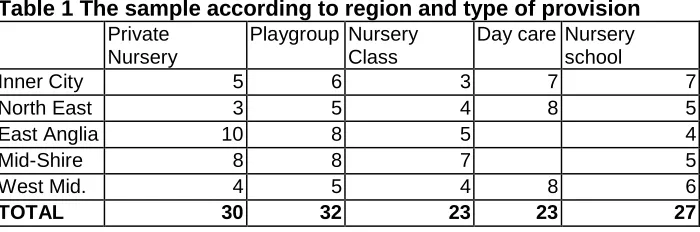
The centres were selected to provide a representative sample across the five regions making a total of 141 centres of which 135 (96%) were able to respond (n=135) (see FIGURE 1 below, frequency tables are also provided in the Appendices). The final sample in this study included 30 Private Nurseries (PNs), 32 Playgroups (PGs), 23 Nursery Classes (NCs), 23 local authority Daycare Centres (DCs) and 27 Nursery Schools (NSs). The designation of the respondents was 40 managers, 45 headteachers, 27 play group leaders, 7 teachers, 4 deputy managers, 3 playgroup supervisors, 2 chair of governors (pgs), 1 nursery officer, 1 private nursery school owner, 1 nursery nurse, 1 head of nursery, 1 nursery co-ordinator, 1 pre-school worker and 1 joint manager of a nursery cooperative.
All the information received from the interviews has been analysed and triangulated with the information contained in the 1998-1999 Early Years Development Plans and from the interviews conducted with the local authority co-ordinators in each of the 6 local authorities.
T
HE PERCEIVED BENEFITS OF RECENT NATIONAL INITIATIVES
[image:21.612.78.418.318.504.2]The recent initiatives were generally considered beneficial by Local Authority (LA) co-ordinators who referred to very positive effects upon local initiatives. The co-ordinators’ reported that early years staff were generally feeling more valued, and receiving a much needed boost to their morale. The additional funding made available by Government was also appreciated especially where this resulted in additional staffing. However, there were concerns that a good deal more resourcing would be required if the policies were to be fully implemented and sustained. One co-ordinator expressed special concern regarding the practice of allocating funding according to the 4-year-olds in the maintained sector, while the authority’s needs related to their work in all their settings. She
Fig. 1: The Sample (n=135)
0 5 10 15 20 25 30
Inner City North East East Anglia Mid-Shire West Midlands
C
e
n
tr
e
s
Nursery school
Day care
Nursery Class
Playgroup
3
argued that all sectors are now funded from the Local Authority but they are not allowed to ‘top-slice’ to cover the extra work.
While the integration of education and care at the authority level is clearly advanced, some concern was expressed regarding the difficulties to be faced in establishing integrated provision on the ground.
We’re just at the beginning (Z4) (Z=local authority and 4=No. of the question responded to).
It was also clear that, historically, some authorities and centres have spent much longer developing integrated provision than others have.
There are now lots of local initiative but it is not integrated yet, as it is still too early (X4).
Integration at the local level is a time consuming and a challenging developmental task. (W4).
Many of the co-ordinators considered the issues surrounding the development of provision for 4-year-olds had dominated the work so far and a number of them referred to their concerns regarding the relative neglect in provision for the under-3s. The literacy hour (1997, National Literacy Strategy, HMSO) was specifically mentioned by most co-ordinators as having distracted attention from the wider issues of integration and quality.
The opportunities to review provision and to consult more openly across all the sectors and with parents/carers has been welcomed and was generally seen to be successful although the co-ordination has clearly presented something of a challenge for many authorities:
All these different layers of planning involving different people for some parts and others for all are very difficult to co-ordinate! (V2).
References were made to the development of collaborative frameworks within the authorities as well as with those working outside and the overlap, which sometimes occurred across the work of different committees in the same authority. However, it was felt that the focus on quality within authorities was very valuable and that there were a number of key issues associated with standards, that people shared concern over, across the various sectors of provision. However, some co-ordinators felt that the lack of status accorded to early childhood workers, their care worker training, and the deep divisions in services had still to be acknowledged sufficiently. In this respect it is interesting to note that local authority co-ordinators’ reactions to some of the issues in our questionnaire were responded to differently by those with a social services or voluntary sector history compared to those with an education background. In some cases, for instance, over the issue of teacher involvement in all early years settings there was open disagreement during the interview.
When the co-ordinators were asked about the relative contribution made by national and local initiatives they suggested that:
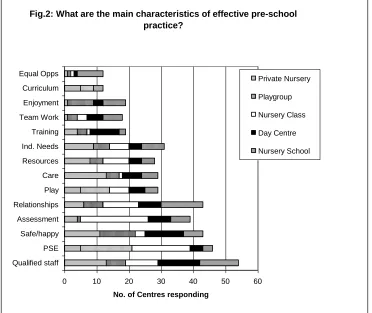
We were concerned to identify and understand the perceptions of quality held by centre managers in the five kinds of provision we are studying; we suspected that their responses might be determined by different priorities. We therefore asked them to tell us what they considered were the main characteristics of effective nursery practice. The responses related to both the service provided and the child outcomes (see FIGURE 2 below). The day care centre managers tended to refer to the need for 'qualified staff' and argued that ongoing 'training and staff development’ should be provided to ensure a sound knowledge of the needs of young children and child development. References were made to the need for INSET and for non-contact time. The managers of Private Nurseries also emphasised the need for qualified staff and for 'safe' provision for the children's ‘individual needs’. Perhaps surprisingly, they were also the most likely group to emphasise ‘care’.
A good nursery is only as good as the staff that are in it. So you need to employ qualified experienced staff who always want to move forward, who are enthusiastic, think about what they do, they actually want to be where they are (PN).
The nursery school respondents referred to the need for 'qualifications', 'good relationships' and 'enjoyment', as well as equality of opportunity and provision for 'individual needs'.
[image:23.612.92.464.291.604.2]I think it’s getting people over the front door initially and just welcoming them in. and seeing that they’re part of the nursery. That building up of relationships and trust and a good feeling about them using the centre, all those kind of things. The actual practice of what happens in the nursery well, we could talk about that one for a long time couldn’t we, but that’s what I feel initially. You can’t have effective nursery practice until you have built up that initial relationship with people that are going to come in and use the centre. (NS)
Fig.2: What are the main characteristics of effective pre-school practice?
0 10 20 30 40 50 60
Qualified staff PSE Safe/happy Assessment Relationships Play Care Resources Ind. Needs Training Team Work Enjoyment Curriculum Equal Opps
No. of Centres responding
Private Nursery
Playgroup
Nursery Class
Day Centre
5
The playgroups and nursery classes tended to emphasise the 'social, personal and physical development' of the child. More of the playgroups emphasised a commitment to learning ‘through play and exploration’ as well as to providing ‘enjoyment’.
‘In ours it’s a friendly environment and the safety of the children and as I say the learning through play. We don’t force any of them…The social side is very important in our group. One of our priorities to learn and to help the children and guide the children in their social skills because that’s very important’ (PG).
Nursery classes, which are strongly embedded within the culture of primary schools were the most likely to refer to the need for ‘planning, observation and assessment’, and to the need to develop; ‘good relationships between children, parents and staff’. They were less likely to prioritise care, enjoyment or safety, this might be because they are taken-for-granted through day-to-day regulation.
‘Good planning for all areas of development; social, emotional, and physical, and intellectual. All the education is based on first hand experience actually seeing things and doing things, obviously the individual needs of children. Keeping in touch with parents, health visitors and social workers’ (NC).
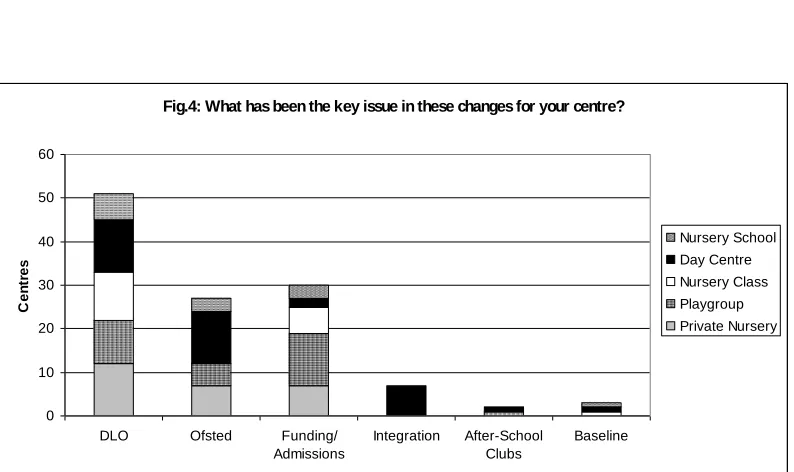
Only 12 (under 9%) of the centre managers referred to the need for ‘a well developed curriculum’ (5 PN, 4 PG, 3NS). However, later in this report (see below) it is clear that DLOs which were implemented earlier than other initiatives have had one of the deepest effects on centre practice.
In all 95 (70%) of the centres told us that they had not changed in their approach to any of these key areas as a result of recent initiatives. Many felt that they had always had ‘those kind of aims and
objectives in mind anyway’ (PN). Thirty six (27%) of the centres said that they had changed although only 15% of NS felt that they had done so.
Yes we have. It’s not all doom and gloom because I think we’ve changed for the better (DN).
Staff training has become a big priority. Experience now no longer counts. It’s certificates on the wall now that count so you have to work towards that and all staff have to be committed and the educational side has now, if you like, really become compulsory (PG).
It’s been a centre for many years that responds positively to change and the whole work of the centre is developing and evolving all the time. I honestly find it really difficult to tell you what I think is linked to recent initiatives in particular, because inevitably those impinge on how you perceive the situation. (NS)
The two big differences is the amount of paperwork and it’s slightly more formal (PN).
We have found some of the school nurseries are taking the children a bit younger so they’ve got them there to get the money when they’re 4. We’ve actually had parents come in and say that they’ve taken the place because they have more or less been told that if they take the place they’re more or less guaranteed a place at the school. If they don’t take the place there’s no guarantee they can have the place at the school (PG).
[image:25.612.79.492.217.445.2]The main issue has been OfSTED inspection because of the curriculum guidelines, observations and record keeping (DC).
Fig.4: What has been the key issue in these changes for your centre?
0 10 20 30 40 50 60
DLO Ofsted Funding/ Admissions
Integration After-School Clubs
Baseline
C
e
n
tr
e
s
[image:25.612.72.469.478.714.2]Nursery School Day Centre Nursery Class Playgroup Private Nursery Fig.3: Has your centre changed as a consequence of recent national
initiatives?
0% 50% 100%
Private Nursery Playgroup Nursery Class Day Centre Nursery School
No
7
E
XPANSION IN
P
ROVISION AS A RESPONSE TO THE INITIATIVE
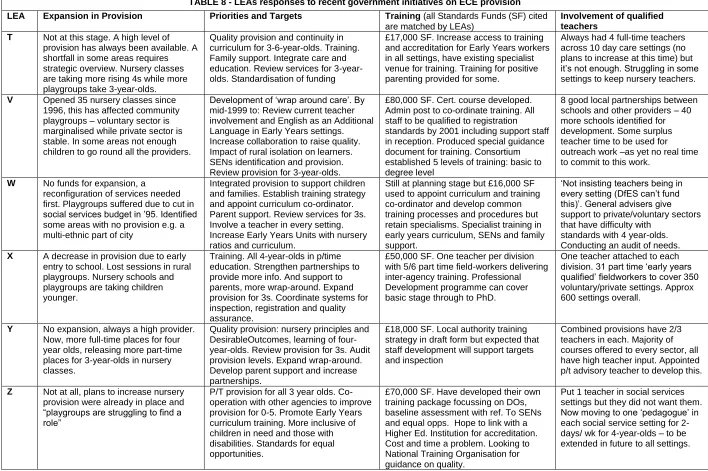
According to the co-ordinators most of the authorities have plans to increase nursery provision but little or no progress has been made at all in the period 1997/98. Please see the Table in the appendices. In some regions, where provision has increased in one sector it has been matched by a contraction in another so some difficulties have been reported that are seen to pose threats to the partnership. One co-ordinator reported that 80% of their 4-year-olds were now in reception classes (V5). In every case this was seen as problematic, and to the voluntary sector in particular.
This has had an effect on playgroups – who are finding it difficult to recruit children of 3 years old and over (Y5).
Nursery school and playgroup populations are therefore significantly younger than they used to be (by one whole year) – which is considered to be detrimental:
Other provisions decreased because of admitting rising 5s – we used to do this only in the summer term (X5).
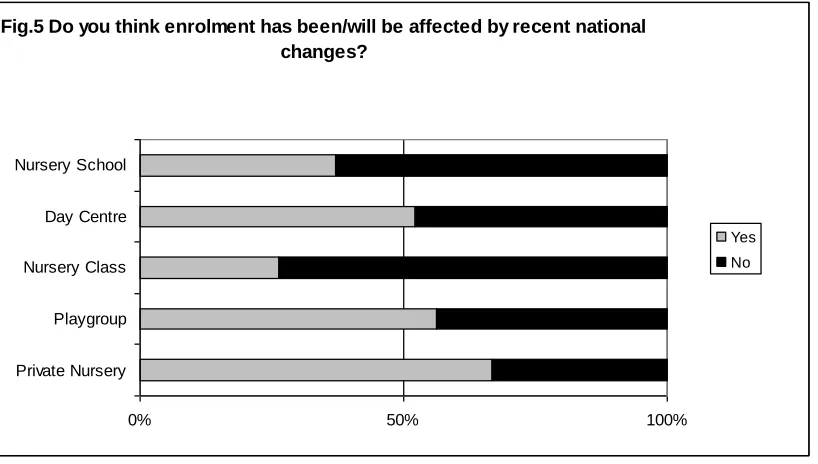
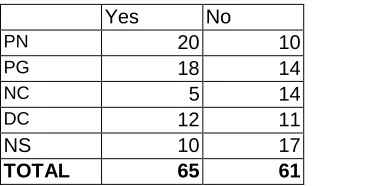
Our telephone interview data provided further evidence of these concerns. We asked the centre managers if they considered that enrolment had been, or would be, affected by recent national changes (for example the Early Years Development Plan (EYDP). Sixty four of them told us Yes (see FIGURE 5), 47 of the managers said that they are losing 3 and 4-year-olds to state nurseries.
Some children are attending both state and private nursery provision (split placements) and one of the private school managers expressed concern about this. Managers of private nurseries, playgroups and day care centres are therefore admitting younger children to fill up their nurseries. The question of admissions emerged as the most controversial issue affecting centres and the relationships between them. Private nurseries and playgroups frequently said that schools are obliging parents, against their better judgement, to take up places early with the threat that if they do not the place may not be available when their child becomes of statutory age.
[image:26.612.77.486.358.590.2]
Fig.5 Do you think enrolment has been/will be affected by recent national changes?
0% 50% 100%
Private Nursery Playgroup Nursery Class Day Centre Nursery School
Yes
In September we will have no 4-year-olds at all. But we will have to fill up as soon as we can. So of course the next term when there are some 4-year-olds anyone from the outside won’t get in. I am sure it’s the same all over. We can’t keep places for 4-year-olds. We depend on the money that comes in each month from our fees so we have to fill up as soon as possible…. So the way that it’s going is that we get phone calls from parents of 4-year-olds when they get their vouchers but we can’t take them because we’re full of 2 year olds (PN).
Many parents don’t want to send children to school but they report the schools as saying that when the child is 5 there won’t be a place for them. Headteachers deny they are doing this. Grant maintained schools are doing what they want (PN).
We heard many more comments of this nature:
We had a dad came in and said ‘I would like her to stay here a little bit longer’ because we only take 16 children. The schools have got like 30 odd and he said she was just starting to build her confidence and everything up and she has just turned 3, the little girl, and he said ‘I would have liked to have kept her here but I’m getting it free there.’ There was an emphasis on the free part. …The ones we get are the ones that haven’t got the money so it’s a shame because she would probably have done a lot better if she’d stayed here a few more months. Built her confidence up and then gone into a class with 30 odd children (PG).
Increased provision has affected the numbers applying for places. We have more 3-year-olds in the nursery. If the LEA don’t fund 3 year olds it will have a radical affect. We have taken in more 3 year olds than we would have liked to keep the nursery full (NC).
Children are leaving younger and we are losing 4-year-olds like anything. It’s had a very bad effect. They are here a shorter time so there’s less time to build up relationships; some are only here a term. Schools are offering places and saying if the parents don’t take it they won’t get in later. There are 2 points of entry in September and January, so the children are very young even at the right time. Some schools have 1 point of entry. Schools are taking children in for ½ the day as they need to fill places (DC).
One particularly damaging effect of this is that a range of provision is being lost entirely in some inner city and rural areas. Two of the co-ordinators referred to the positive effects of the new initiatives on childminders and the development of childminding as a business.
Childminders are increasingly seen as ‘equals (Y5).
After School Club & Holiday Schemes (for 4-8 yrs) are also being developed (Y5).
P
ROGRESS BEING MADE IN PARTNERSHIP
/
COLLABORATION
The general perception among the co-ordinators seemed to be that things have improved significantly and that the new structures provide a basis for further development:
There is a clear realisation that everyone has to work together to do any real, local development work (V7).
9
suggested that there was still insufficient recognition on the part of those employed within the maintained sector that private and voluntary sector could offer the same quality of provision (V4).
There was evidence of disagreement and a clear tension between some of the co-ordinators drawn from education and those drawn from the social services. The staffing structure in at least one authority was currently considered insufficient to support the partnership adequately in transforming the ideals into action:
The infrastructure is creaking at the seams (V3).
Although fifty of the centre managers had been involved in setting up a partnership, the majority of respondents said that they had had no involvement. Others reported attending meetings and receiving information, but there was clearly some confusion about what the term ‘Partnership’ actually meant.
We’ve attended endless meetings. We’re members of a nursery link group and they have been very much involved in it (PN).
There is a local partnership… I have noticed I’ve had more communication from them, when meetings were and agendas and things like that. Whether that has come about because there is more interest in partnerships I’m not really sure (NC).
...it’s quite an exciting time being a part of what I consider is still the beginning stages of it. It makes you more aware of that wider world out there (NS).
In total 48 respondents told us that they weren’t consulted (40%PN, 41%PG, 35%NC, 35%DC, 26%NS) and 72 (53%) said that they were, 12 said they had received information and 3 told us that they knew nothing about partnerships. (1 PN, 1 NC, 1 DC). In terms of the impact of the partnership on the centres themselves there was little enthusiasm and some respondents would have welcomed the opportunity to contribute more:
Yes, but not how I would have liked to have been consulted. I would have liked to have been able to sit down and draw up a draft as well, not be sent a draft. I think it’s something we all need to draw up together (DC.)
It’s a bit of a farce really. We keep getting mail about it and we keep going to meetings but really I have felt we haven’t made the slightest difference. The LEA and schools have done what suited them, I don’t think it has even particularly suited the children. It has been the staff at schools that Heads have been more concerned with. I can understand where they’re coming from. But I really feel we are at the bottom of the heap and we really go along with it or get out of it. And so far we’re going along with it (PN).
When we asked how their centres had been affected by the introduction of partnerships 104 (77%) respondents said their centre had not been affected at all, whereas 17 (63%) of the nursery schools told us that they were affected.
We’re very much involved in providing training for other providers and that is clearly a very important part of the work of the Partnership as well, supporting and disseminating good practice across the Partnership.
There is more paper work (PN).
There is a poor relationship with local schools because of the snatch and grab over admissions (PN).
‘The LEA is paying for a teacher to work in the playgroup for a term’ (PG)
As one headteacher of a Nursery class said:
It’s very early days to say whether it has been effective or not. We’ve only just got the final draft of the final document.
One manager of an inner city day care centre said:
Yes we have been consulted. They’re asking for a higher standard. They are asking for a hell of a lot more that we can achieve with the funding that they give us at this moment in time (DC).
When we asked the managers how the Early Years Development Plans (or the plans being made for one) affected their centre and centre staff 76 (56%) said that they had not (or hadn’t yet). Twenty two told us that the main effect has been changes in admissions relating to the new funding for 4-year-olds (5PN, 5PG, 8NC, 2DC, 2NS). Nine said the introduction of Desirable Learning Outcomes and OfSTED. Four referred to staff training relating to SEN and appraisal and 3 daycare centre and 5 nursery school managers referred to the integration of childcare into education. Two playgroup leaders commented on the Plans helping to make ‘things clearer’ and one emphasised how it had highlighted the need for training.
Frankly it’s put a lot of pressure on the staff. No training was offered. We’ve had to step into a different mode of teaching. We’re not teachers, we’re child care workers and now we’ve stepped up a grade and we’ve had to train ourselves and it’s just put a lot of pressure on us. And the focus puts pressure on the children as well, because now we’re talking about, everybody’s looking at, what these children can achieve instead of letting these children play to achieve. And also the workload has increas