Evaluation of the Higher
Education Transforming
Workforce Development
Programme
Report to HEFCE by CFE and KSA
December 2011
James Kewin Iain Nixon
The project team would like to acknowledge the support of Peter Seddon and his colleagues at HEFCE and particular thanks must go to all the institutions and stakeholders that participated in interviews and to those that responded to the online survey. For more information about this report please contact Abigail Diamond:
CFE Phoenix Yard, Upper Brown Street, Leicester, LE1 5TE T: 0116 229 3300
Email: [email protected] Website: www.cfe.org.uk
Contents
1 | Executive summary 4
2 | Introduction 17
3 | Strategic intent and operational models 31
4 | Employer engagement approaches and delivery 47
5 | Transformational change 66
6 | External impact 74
7 | Sector implications 92
8 | Key findings, conclusions and recommendations 111
Appendix 1 | Logic chain: HEFCE Workforce Development Programme 124
Appendix 2 | Indicator framework: HEFCE Workforce Development Programme 125
Appendix 3 | Methodological note 127
Appendix 4 | Programme background 131
Appendix 5 | Participants in the evaluation 138
Appendix 6 | Glossary of abbreviations 140
1 |
Executive summary
1.1 This report presents findings from an evaluation of the Higher Education Transforming Workforce Development Programme – „the Programme‟. The evaluation was conducted by CFE Research and Consulting Ltd (CFE) and The KSA Partnership (KSA) on behalf of the Higher Education Funding Council for England (HEFCE) between September 2010 and July 2011.
Background to the Programme
1.2 The Programme was established following an invitation to the three Higher Level Skills Pathfinder regions in April 2006 to bid for project funding to extend Train to Gain to higher levels. This developed further with the publication of the Leitch Review of Skills in England,1 followed by the 2007 annual HEFCE grant letter2 which called for “a new model for funding higher education that is co-financed with employers, achieves sustained growth in employer-based student places, and introduces the principles of employer demand-led funding”. HEFCE‟s response was to establish the Programme, which broadly had two foci: the introduction of a co-funding employer engagement model and the instigation of transformational change in employer engagement across the higher education (HE) sector. All of the available investment for the Programme was allocated for the period 2008 to 2011; this comprised a total of £103 million in capacity and infrastructure developments (transformational change) and £45 million to support delivery of co-funded entrants to HE.
1.3 This evaluation has assessed the extent to which the Programme has
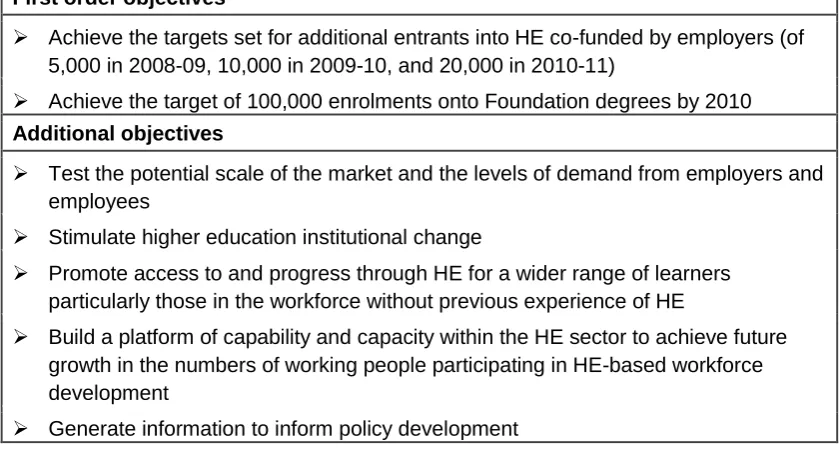
progressed against its first order and additional objectives. It has also considered the nature of this progress and factors that should be taken into account in developing the next phase of HEFCE policy on workforce development and higher level skills. The objectives of the Programme are presented in Table 1 below:
First order objectives
Achieve the targets for additional entrants into HE co-funded by employers (of 5,000 in 2008-09, 10,000 in 2009-10, and 20,000 in 2010-11)
Achieve the target of 100,000 enrolments onto Foundation degrees (FDs) by 2010
Additional objectives
Test the potential scale of the market and the levels of demand from employers and employees
Stimulate higher education institutional change
Promote access to and progress through HE for a wider range of learners particularly those in the workforce without previous experience of HE
Build a platform of capability and capacity within the HE sector to achieve future growth in the numbers of working people participating in HE-based workforce development Generate information to inform policy development
Table 1: The Programme objectives
1 Leitch, S. (2006) Prosperity for All in the Global Economy – World-Class Skills. London: HM Treasury 2
Methodology
1.4 In order to evaluate the Programme and its progress against these objectives, we conducted a primarily qualitative investigation. This was backed by an online survey as well as secondary analysis of: Programme data, development project monitoring reports, Higher Education Statistics Agency (HESA) student record data, Higher Education Students Early Statistics Survey (HESES) and Higher Education in Further Education Students Survey (HEIFES) data, and Co-Funded Employer Engagement (CFEE) monitoring returns. Primary research included:
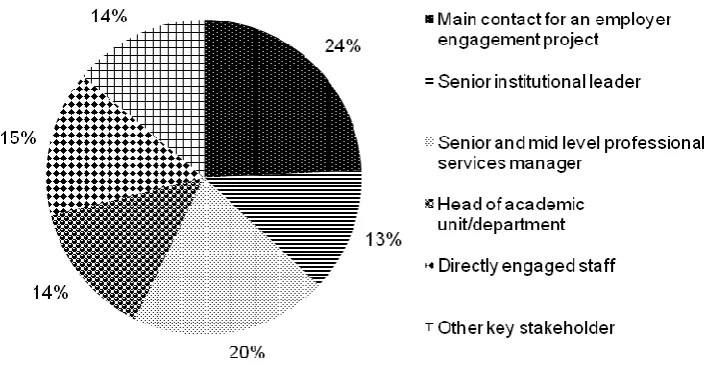
An online survey administered by email to representatives from workforce development projects (WFDPs) and stakeholders within and beyond the HE sector, with a total of 173 respondents; and
In-depth interviews with: 128 senior and operational staff from 32 universities and colleges, including both higher education institutions (HEIs) that did and did not receive workforce development (WFD) funding; 28 employers and 13 employee learners that accessed higher level provision through the Programme (L); and 7 other stakeholders (SH) with an interest and involvement in the development in HE-based workforce development.
Key findings
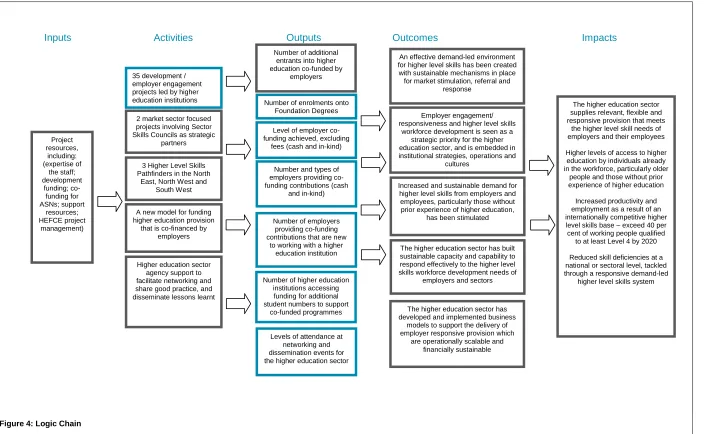
1.5 Our key findings draw on a synthesis of the qualitative and quantitative data gathered through the evaluation and are made in relation to the outcome statements that were identified in the evaluation logic chain (See Appendix 1). The following points summarise the key findings from this evaluation:
Demand for higher level skills from employers and employees
1.6 The primary first order objective, to achieve targets set by Government for additional entrants into HE co-funded by employers, (5,000 in 2008-09 and 10,000 in 2009-10), has been met. The secondary first order objective, to achieve the target set by Government of 100,000 enrolments onto Foundation degrees by 2010, has been
exceeded.
1.7 The Programme has enabled HEIs to leverage significant investment from employers to deliver Additional Student Numbers (ASNs). HEI data indicates that co-funding contributions from employers increased from £4.3 million in 2008/09 to £12.8 million in 2009/10, and the number of employers providing contributions increased from 631 to 2,706. The number of employers supporting employees through co-funding (including both cash and in-kind contributions) increased significantly between 2008-09 and 2009-10. In addition, the disparity in the proportion of in-kind contributions made by public and private sector employers levelled out during the Programme.3
1.8 Analysis of the profile of co-funded learners also shows that increased levels of access to HE by individuals with no prior experience of HE has been partly achieved; in 2008-09, just over half (51%) of co-funded learners did not hold a qualification at Level 4
3
or above. By comparison, over a third (35%) of the working age population in employment in the period January to December 2009 held a degree or higher level qualification.
1.9 Whilst demand for higher level skills from employers and employees has increased as a consequence of the Programme, HEIs and employers were uncertain what impact the Government‟s new funding arrangements would have on the extent and nature of future demand. Concerns were raised over the impact of increased fees and the demise of co-funding. Employers indicated that any significant increase in fees and/or the contribution towards HE is likely to affect their future purchasing decisions. Two areas identified as particularly vulnerable to the funding changes are the
accreditation, validation and quality assurance of employers‟ in-house training and training delivered for employers by third party providers such as further education (FE) colleges and private training providers. This is because, whilst this activity has grown significantly in recent years, it has been primarily dependent on the ability of HEIs to draw down co-funding from HEFCE.
1.10 Of course, the new funding regime also brings with it new opportunities. For example, individuals undertaking their first undergraduate course on a part-time basis will be able to access loans to cover their tuition fees for the first time.4 Many HEIs with WFD projects are assessing how they can re-orientate their employer-facing operations to support sustainable workforce development activities in a student-fee-driven
environment. Increasingly, HEIs are beginning to capitalise on the links they have made with employers through workforce development activity to improve their employability offer to students, and some are exploring the potential to offer Higher Apprenticeships.
The effectiveness and sustainability of the employer demand-led environment
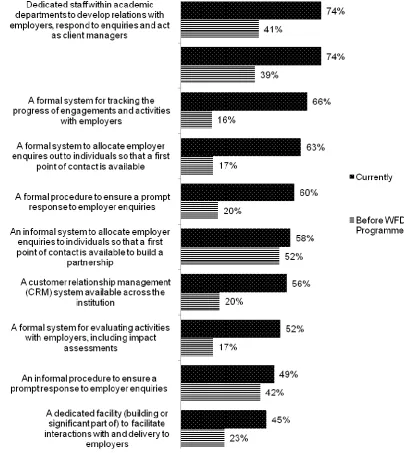
1.11 As a direct consequence of the Programme, HEIs now use a much wider range of business development and marketing interventions to systematically generate leads and secure new contracts. Systems and processes to refer and respond to employer enquiries and leads have also been widely implemented. Furthermore, many are systematically maintaining contact with existing and previous clients, identifying and targeting warm employer leads, working with industry networks and following up recommendations from business support organisations, clients or partners.
1.12 Notable adaptations have also been made to accreditation and quality assurance processes which have been developed to align with the demands of the employer
market; and to accelerate validation, Accreditation of Prior and Experiential Learning (APEL) and shell frameworks. There has also been more widespread use of customer relationship management (CRM) systems to both track interaction with employers and support a more joined-up approach across institutions. In many cases, student record systems have been adapted to accommodate non-traditional learners.
1.13 As the Programme has evolved there has been a shift to a „solutions‟ rather than a „product‟-based approach, reflecting the increasing application of relationship
management as opposed to one-off interventions. HEIs involved in the Programme have become more business-like and professional in their approach to employers. Modes of
delivery are also changing to meet new markets with distance, work-based and blended learning increasingly being used to support non-traditional, employee learners.
1.14 HEIs are starting to be more targeted in their promotion, lead generation and engagement activities, and focusing marketing at high growth sectors. The predominant focus of this targeting has been on extending existing employer relationships or
networks, rather than stimulating demand from new customers. This leaves considerable scope for expansion into new markets and for increased use of the full range of
marketing interventions to build a „sales pipeline‟5, which is currently low.
1.15 Although 50 per cent of HEIs involved in the Programme are working with small and medium-sized enterprises (SMEs) to some degree, most are focused primarily on engaging with large employers. This reflects both the practical challenges of engaging with SMEs and the economies of scale of working with larger organisations. HEIs recognise both the commercial risks of relying exclusively on relationships with a small number of large organisations and the need to work with, and through, sector and employer bodies to aggregate demand from SMEs. HEIs also recognise that more can be done to access demand from the supply chains of their larger employer clients.
1.16 A small number of HEIs have fully implemented formalised and integrated approaches to account management and customer relationship management. However, it is less clear to what extent these mechanisms have been embedded operationally and culturally, or will be sustainable in the long term.
Employer engagement/responsiveness as a strategic priority
1.17 Employer engagement/responsiveness has become a strategic priority for most HEIs in receipt of development funding. Evidence also suggests that development funding has stimulated transformational change in some instances, particularly where it has led some HEIs to orientate or reaffirm their mission as an employer (or business) facing institution in order to differentiate their offer in an increasingly competitive market. In some cases this commitment has been embedded in institutional strategies and operations as a strategic objective; whilst for others the „standalone‟ nature of their WFD projects means that institutional missions and strategies are only beginning to be
influenced.
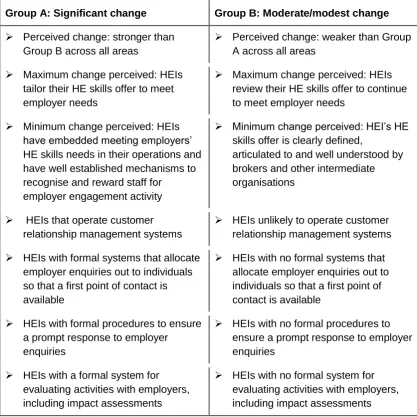
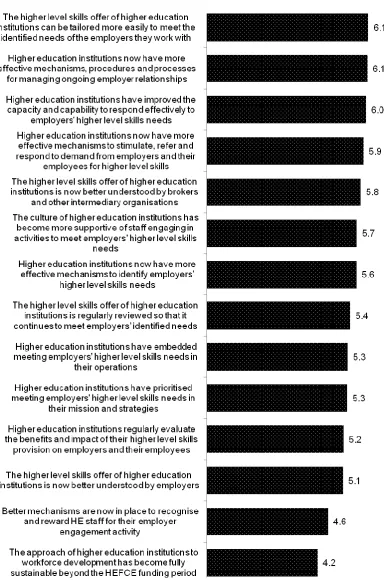
1.18 Most HEIs involved in the Programme reported that they had observed a degree of cultural change as a result of development funding and/or co-funding, although in most cases it had not become transformational and there remained pockets within the
institution that were still not as „business facing‟ as they would like.
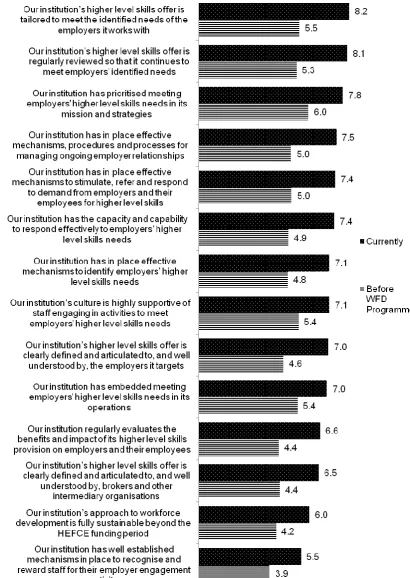
1.19 Most stakeholders agree that HEIs have developed mechanisms to stimulate and respond to employer demand; however, these are not yet fully embedded in their entire operations and further transition is required if the institutional culture is to be fully aligned with the workforce development agenda.
5 A 'sales pipeline' comprises a set of employer leads (i.e. prospective clients or opportunities) at the different stages
1.20 Active leadership at the most senior level has been critical in influencing the extent to which employer engagement/responsiveness is seen as a strategic priority for the institution. A Vice-Chancellor, Deputy or Pro-Vice-Chancellor „championing‟ the agenda was seen as a, if not the, key driver of change.
1.21 Most HEIs involved in the Programme intend to sustain and develop their
workforce development activity to some degree, and are critically appraising their market position and the market opportunities available to them. This reflects the need to adapt to the changing economic and political climate, and to learn from the experience of
participating in the Programme.
Sustainable capacity and capability
1.22 Through the Programme, HEIs have developed the capacity and capability to respond more effectively to employers‟ higher level workforce development needs. This has involved changing attitudes of staff, improving the skills of staff who engage directly with employers and recruiting new staff with commercial experience to enhance their „business-facing‟ capability. In particular, there has been increasing use of dedicated account managers to serve as the point of contact between the institution and the employer.
1.23 While significant progress has been made, many HEIs have found it difficult to encourage some academic staff to take up the challenge of designing and delivering employer provision. Many also found it difficult to attract and retain the „right‟ staff with a mix of HE and commercial experience to take their workforce development activities forward. As such, some HEIs have had to introduce new types of roles to fulfil certain operational activities, or to optimise the capabilities of existing staff to undertake workforce development activities.
1.24 The Programme‟s legacy is demonstrated in various ways; through the
knowledge acquired by HEIs, the employer relationships developed, the processes and systems implemented, and new or increased capacity. Moving beyond the Programme, HEIs are exploring ways to sustain their workforce development activities in a very different policy environment. As such, transition plans will inevitably involve some
reorganisation and realignment of capacity, resources and activities, to bring them in line with wider institutional plans and potential levels of income generation.
Operationally scalable and financially sustainable operatingmodels
1.25 Diverse approaches have been adopted by those HEIs involved in the
Programme to bridge the gap between „traditional‟ academic processes geared to the (majority) undergraduate market, and the very different requirements of engaging employers to support higher level skills development. For this engagement to be successful, considerable innovation is required to develop and agree on the right operating model. These models need to incorporate sales, marketing and business development, with products and services that deliver on propositions made to employers, and adapt to their specific requirements. This is challenging territory for all HEIs;
Offer integrated solutions not narrow products: integrate workforce development with the institution‟s wider business offer (applied research, consultancy,
graduate recruitment, facilities) into a coherent solutions-led proposition. HEIs can make such a broad offer, backed by a valuable asset base, in a way few other business services providers can.
Design solutions with demonstrable business benefit: solutions should be
designed and delivered based on a robust analysis of employers‟ business needs rather than a „product push‟ of existing provision. Solutions should always be geared to achieving demonstrable return on investment for employers.
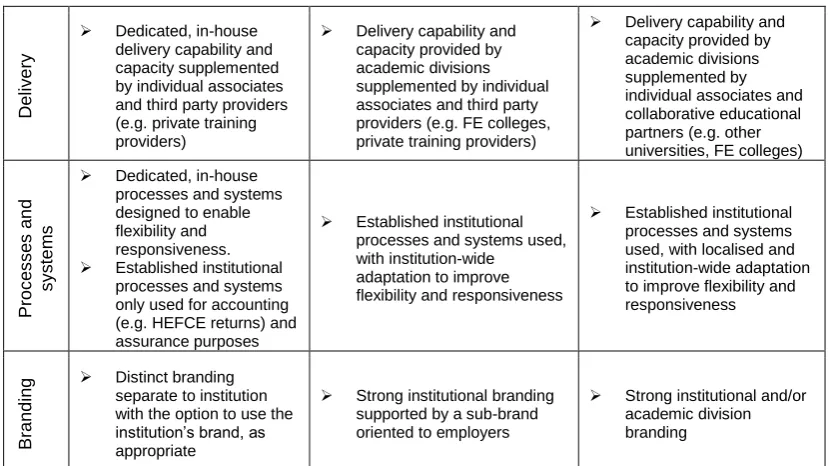
1.26 Through the Programme, three relatively discrete operating models have been adopted by individual HEIs to deliver employer responsive provision; these are
„standalone‟, „hub and spoke‟ and „distributed‟. The standalone model is characterised by the HEI establishing a wholly owned subsidiary as part of a group structure or a
separate, largely self-contained division within the institution. The hub and spoke model involves a centrally co-ordinated business development function with varying levels of pro-activity, sophistication and integration with the HEI‟s academic divisions. The distributed model is characterised by business development, marketing and sales being decentralised and embedded in the academic divisions with little, if any, central co-ordination or support. In adopting a particular model, HEIs have their own nuances on a particular approach.
1.27 The HEIs which have created autonomous employer-facing operations suggest that they have found it easier to make progress. However, this model may not be appropriate for all, or even most, HEIs. Although it might be tactically easier, separating employer operations from the HEI‟s main body can make it difficult to develop a
genuinely integrated offer that is the strongest, most clearly differentiated value proposition. There is an especially important final point; for most HEIs, successful employer engagement will come less through the elegance of their operating model than in their ability to implement it, as developing employer relationships requires a high level of flexibility.
Conclusions and recommendations
1.28 The Programme has succeeded in supporting an expansion of workforce development activity within the HE sector, which has led to additional entrants to HE. The first order objectives, to achieve targets for Additional Student Numbers into HE co-funded by employers and 100,000 enrolments onto Foundation degrees by 2010, have been met and exceeded respectively. Most of the additional objectives for the
Programme have also been achieved.
1.29 Without doubt, many individual HEIs have also benefited substantially from their involvement in the Programme. Co-funded provision has certainly helped HEIs test the scale of the market and employer demand by mitigating some of the risk involved in initiating new employer relationships or deepening existing ones at lower cost. While the Programme has helped HEIs stimulate increased demand for higher level skills from employers, sustaining this demand will necessitate their continued focus in the long term.
activities and improving systems, processes and capabilities. As a result, some HEIs have established much stronger footholds in their chosen markets, and have made significant internal changes – in many instances changing attitudes about the workforce development agenda.
1.31 The Programme has also helped to promote access to, and progress through, HE for a wide range of learners. While our analysis of co-funded learners suggest that the participation of individuals without previous experience of HE has been lower than anticipated, this reflects the demand-led nature of the Programme and the training preferences and business model that participating employers have chosen to adopt.
1.32 In summary, the Programme has been successful in providing a platform of capability and capacity for workforce development within the HE sector. The
Programme‟s legacy at an institutional level is likely to be the systems and resources, staff capability and employer relationships that HEIs have developed. It is more difficult to conclusively determine whether this platform will be used to achieve future growth in employer demand and the numbers of individuals already in work participating in HE-based workforce development.
1.33 While the HEIs that participated in the Programme have derived significant benefits from it, evidence from the evaluation suggests that the sector-wide impact of the Programme has been more modest. It was perhaps unrealistic to expect a Programme of this scale, which engaged a limited number of HEIs, to transform the workforce
development capability of the entire sector, particularly as not all HEIs have made – or will make – the strategic decision to pursue the workforce development agenda.
Recommendations for higher education institutions
1.34 Through the Programme, HEIs have proved it is possible to build an employer market for higher level skills from a relatively low base. However, if HEIs are looking to sustain a financially viable portfolio of workforce development activity in the new policy and funding environment, our evaluation findings suggest that consideration should be given to the recommendations outlined below.
Recommendation
Summary
1: Gather evidence to make a robust business case for continued investment.
Buy-in and active support from academics,
Vice-Chancellors and senior executives is crucial to sustaining workforce development activity; as such, HEIs should ensure appropriate evidence is gathered to demonstrate the value of the activity internally and to make a robust business case for continued investment. This could include key metrics on income generated; number and variety of employer relationships developed; and positive impact on other external facing activities such as
will be measured from the senior executives‟ perspective is critically important in this respect.
2. Critically appraise the current 'state of readiness' to respond to employers’ needs.
To ensure employer engagement and workforce
development become embedded as a core activity, HEIs should critically appraise the extent to which: there is active leadership across all functions and levels; the HEI‟s culture is truly supportive of this area of activity; plans are in place to ensure a „smooth‟ transition to a new funding environment; the operational model is fit for purpose and adequately staffed and resourced; and processes, systems and delivery modes are flexible and responsive enough to meet employers' needs.
3: Identify and develop opportunities to
collaborate with other providers.
Notwithstanding the increased levels of competition and „marketisation‟ of the HE sector in line with current Government policy, opportunities still exist to collaborate. HEIs should identify and develop opportunities to
collaborate with other providers (universities, FE colleges, private training providers) as a means to strengthen and extend their workforce development offer and exploit new and existing markets. Collaboration should be built on aligned intent, complementary
expertise and (crucially) shared values and mutual trust.
4: Adopt pro-active and sophisticated approaches to business development.
Building a sustainable „pipeline‟ of employer demand can be a challenge, particularly during an economic
downturn, but is vital to success. HEIs should consider adopting pro-active and sophisticated approaches to business development which draw on a better
understanding of employers‟ procurement strategies and purchasing decisions, and a fuller range of marketing and sales interventions, including working through intermediaries such as the Chambers of Commerce, Sector Skills Councils (SSCs), and other employer-facing bodies to access, for instance, the SME market.
5. Ensure that existing relationships with
employers are optimised.
In conjunction with establishing new employer contacts, HEIs should ensure that existing employer relationships are optimised by building stronger (more strategic) partnerships which can lead to repeat business, „cross-selling‟ other services and referrals to other employers – a formalised approach to customer relationship and key account management can help in this respect.
6. Approach working with employers as a
collaborative venture.
Given the diversity of employers and their needs, HEIs should approach working with employers as a
understand the nature of their business and the challenges they face. This will, as part of a more integrated and holistic approach to business/employer engagement, help to identify the „right‟ solution to meet the identified needs. It will require a shift away from the „product push‟ approach that HEIs have tested in the past by bringing together the HEI‟s wider employer offer (applied and near market research, consultancy,
education and training, graduate recruitment, etc.) as many have begun to explore.
7. Continue to develop and enhance pedagogical approaches.
The needs and expectations of employee learners can be very different to traditional undergraduate students; as such, HEIs should continue to develop and enhance pedagogical approaches which are increasingly more facilitative than didactic, and supportive of learning in the workplace as a means to ensure an exceptional student experience; integrating skills, knowledge and experience gained in the workplace with higher level learning.
8. Strive to provide maximum flexibility
around delivery mode and timings.
Flexibility has been highlighted as a factor limiting an HEI‟s ability to respond in a timely manner to employers‟ requirements. HEIs should therefore strive to continue to provide maximum flexibility around delivery mode and timings. Streamlining internal processes and reducing timescales required for course development by, for example, establishing „open‟ content (or shell)
frameworks will enable greater levels of responsiveness.
9. Ensure an adequate ‘supply chain’ to support delivery.
Delivery capacity has similarly been identified as a key factor inhibiting an HEI‟s ability to respond in a timely manner; as such, HEIs should build „workforce
development activity‟ into workload planning models and establish a network of individual associates and
collaborative provider partnerships (with other
universities, FE colleges and private training providers) to ensure an adequate „supply chain‟ for delivery.
10. Evaluate the
contribution and impact of the higher level skills interventions.
employer at a specification stage how these will be measured will help to focus efforts in respect to evaluating impact.
11. Incentivise, reward and recognise the contribution of staff.
Motivating staff to engage in workforce development activity and recognising their contributions will produce better results and ensure greater parity with research, other teaching activities and employer-facing activity; as such, HEIs should establish new or enhance existing mechanisms to incentivise, reward and recognise the contribution of staff engaged in workforce development activity. This will further help to ensure that institutional culture is highly supportive of this area of work.
12. Remodel the approach to costing and pricing.
The new funding system will potentially affect the uptake of HE by employers and employees alike; to mitigate the impact, HEIs should remodel their approach to costing and pricing based on a better understanding of their cost base, taking into account a range of factors (mode of delivery, location of delivery, access to learning resources, the level of employer contributions, nature and level of learner support required, and the number of learners) and a pricing strategy which is market
sensitive. Developing a better understanding of the cost base will help to ensure that an appropriate overhead level is used in costing a workforce development solution.
Recommendations for HEFCE
1.35 HEFCE has provided funding to develop employer-responsive provision and piloted co-funding in response to the previous Government‟s policy priorities. As a consequence of the HE reforms, HEFCE funding will no longer be available to support the activity previously funded through the Programme. HEFCE will no longer pursue the co-funding model, although co-funding will still be available in 2011-12 to support the transition from an employer and Government-funded activity to an individual and/or employer-funded activity. There will also be loan support for part-time learners studying at an intensity of a quarter of a full-time equivalent (FTE) or above.
1.36 Notwithstanding these changes to the policy and funding environment, we have drawn on the findings of the evaluation to formulate a number of recommendations for HEFCE to inform the sustainability of workforce development activities and the
Securing the future of workforce development activity
Recommendation
Summary
1: HEFCE should consider tapering the level of co-funding drawn down by HEIs over a two-year period.
HEIs are highly concerned about approaching the „cliff-edge‟ of funding support for workforce development and as such supporting a smooth transition to the new HE funding system will be critically important. When devising an exit strategy for the co-funding model, it will be critically important for HEFCE to take into account the employer as well as the learner – it is not merely as simple as „teaching out‟ students on existing courses. HEFCE should therefore consider tapering the level of co-funding drawn down by HEIs over a two-year period (post 2012-13) in order to minimise the potentially detrimental impact on the relationships that an HEI has built with employers.
2. HEFCE should give particular consideration to the implications of changes to student number controls for part-time students who are already in the workforce.
Given the phasing out of the co-funding grant, HEFCE should take account of part-time students who are already in the workforce to ensure that the development and implementation of the student number controls does not create barriers to part-time study. This is particularly important because in this Programme, almost all the co-funded cohort studied part-time and the vast majority of these students studied institutional credits at low intensities.
3: The Government, in partnership with the HE sector, could consider innovative payment plans to enable those individuals studying at an intensity of less than a quarter of the FTE to continue to access HE.
Many of the HEIs in the Programme offered employee learners the opportunity to undertake less than 30 credits, which means that they have not been studying at an intensity of at least a quarter of the full-time equivalent. Under the future funding arrangements such students would not be eligible for co-funding or a fee loan and with neither available, their access to HE would not be free at the point of entry. As such, the Government should consider the effect of these changes, in line with its commitment to improving social mobility, increasing fair access and widening participation.
4: HEFCE should observe workforce development activity in the new system and consider how it can best be supported, encouraged and enabled.
The Programme has revealed willingness from employers to pay course fees for a cohort of employees and make in-kind contributions in the context of co-funding that HEIs could draw down from HEFCE. In all likelihood this activity will continue to some degree, but the demise of the co-funding grant poses a considerable risk to this activity. The extent of growth will depend on the impact of the increased fee regime and the willingness of individuals and/or
there is eligibility for a tuition loan; in this context an employer may be willing to support individual employees studying at a higher level by repaying an individual
employee‟s loan over an agreed period of time. This would negate the employer having to make a significant upfront investment (through the payment of fees) and could
potentially mean that the employer could benefit more from the investment, by „tying‟ the individual into the organisation until the loan is repaid. By observing workforce
development activity in the new system, HEFCE should consider where it could provide further support and encouragement.
5: HEFCE should feed the lessons learnt from this Programme and its evaluation into
Professor Tim Wilson’s review.
Workforce development is an important component of an integrated approach to HEIs collaborating with industry. The HEIs involved in the Programme have considerable experience in building deeper links with employers in order to meet the higher level skills needs of the workforce. They have also gained a better understanding of what strategies and models are most effective in engaging with employers.
HEFCE should ensure that this area of work is a key point of focus for the Professor Tim Wilson‟s review and that evidence from this evaluation and insights from the HEIs involved in the Programme are taken into account.
6. If HEFCE wishes to support workforce development in the future, an appropriate funding approach for WFD activity based on performance should be established.
Recognising and rewarding the importance of workforce development activity is critical to its sustainability. Should HEFCE decide to support workforce development again in future, an appropriate funding approach, based on
performance in this area, and integrated with other business/employer-facing funding such as the Higher Education Innovation Fund (HEIF), would support and reinforce its relative prioritisation across the HE sector and in the strategies of HEIs.
Developing and managing future funded programmes
Recommendation
Summary
1: HEFCE should provide as much clarity and focus as possible around the objectives and the desired
outcomes and impacts of any future funded programmes.
To ensure the HE sector and participating HEIs fully
understand a funded programme‟s intent and requirements, HEFCE should provide as much clarity and focus as
2: HEFCE should take steps to ensure that the design of future funded programmes ensures that deadweight is minimised.
This Programme resulted in a degree of deadweight as a proportion of the Additional Student Numbers were employees who already held a Level 4 qualification and were enrolled onto courses at a lower level than the qualifications they already held. If HEFCE wishes to develop a co-funding model in the future, it should seek to minimise the potential for deadweight (such as where there is an ambition to target particular student cohorts). In developing future programmes, HEFCE should consider at the outset how deadweight can affect impact, which may necessitate revising strategies.
3: HEFCE should ensure that the funding regulations and
monitoring
arrangements reflect and align to, as far as possible, the nature of the activity being supported.
Funding mechanisms and regulations can be complex, and difficult to interpret, implement and explain to others (e.g. employers). They may also skew demand by only
rewarding certain types of activity rather than being truly demand-led. To make the process easier, HEFCE should ensure that funding regulations and monitoring
2.1 This report is submitted by CFE (Research and Consulting) Ltd (CFE) and The KSA Partnership (KSA) to the Higher Education Funding Council for England (HEFCE). It summarises the key findings from our evaluation of the Transforming Workforce
Development Programme.
Programme background
2.2 The Transforming Workforce Development Programme originated in April 2006 when the three Higher Level Skills Pathfinders regions were invited to bid to undertake projects to extend Train to Gain to higher levels. This developed further with the publication of the Leitch Review, followed by the 2007 annual HEFCE grant letter6 in which the Secretary of State asked for the development of „radical approaches‟, and a “new model for funding higher education that is co-financed with employers”. HEFCE‟s response was to establish the Programme, which broadly had two foci: the introduction of a co-funding employer engagement model and the instigation of transformational change in employer engagement across the higher education (HE) sector.
2.3 All of the available investment for the Programme has been allocated for the period 2008 to 2011; this comprised a total of £103 million in capacity and infrastructure developments (transformational change) and £45 million to support delivery of co-funded entrants to HE. Further details of the Programme background can be found in Appendix 4.
Policy context
2.4 Over the past decade, there has been a growing expectation that HE should play a greater role in increasing the skills of the workforce. This has been a recurring theme in Government policy; particularly the need to encourage higher education institutions (HEIs) to engage more with employers to meet the country‟s skill needs, which have been re-calibrated over time to focus increasingly on higher level skills. Key policy initiatives have included: Enterprise and Employability (introduced in the 1990s to improve undergraduates‟ broader skills); Foundation degrees (FDs); Lifelong Learning Networks (LLNs); and the extension of Train to Gain to Level 4 and above.
2.5 It was not until the Leitch Review in late 2006, with its vision of a skill, high-value economy, and the subsequent Government response7 that the momentum began to build in UK skills policy towards increasing higher level skills. Although the Lambert Review in 2003 had called for closer working between HE and business, it had not addressed skills mismatches to any great extent. The argument put by Leitch that the UK‟s future competitiveness was dependent on increasing the percentage of the
6
Johnson, A. (2007) HEFCE Grant Letter: Higher Education Funding 2007-08. London: HEFCE
7
Department for Innovation, Universities and Skills (DIUS) (2007) World Class Skills: Implementing the Leitch Review of Skills in England. Sheffield: BIS; and, DIUS (2008) Higher Education at Work – High Skills: High Value.
2 |
Introduction
workforce with higher level skills (with a target for more than 40 per cent of the workforce to hold a Level 4 or higher qualification by 2020) was widely accepted. But, to achieve this target, attention would have to be switched to upskilling the existing workforce rather than simply increasing the numbers of new entrants, particularly considering that, at the time, 75 per cent of the 2020 workforce was already in work.8 To succeed here, HEIs‟ role in the workplace would need to be enhanced.
2.6 As a result, significant new funding was directed towards the HE sector to encourage HEIs to stimulate the demand for, and develop the supply of, workforce development. Through accessing increased funds from HEFCE (channelled mainly through the Programme) HEIs could make the necessary infrastructure developments and strategic changes, establish more contacts with business and set up new activities geared to employer and employee needs. For some HEIs, this built on many years of working with employers and improving responsiveness, often in a local environment, and through a range of earlier Government policy initiatives; for others, it was intended to initiate a step-change in their employer engagement activities.
2.7 In the last couple of years, however, the political and economic situation has changed radically. A new Coalition Government took power in May 2010, and is yet to set out clearly its plans for higher level workforce development. Meanwhile, the impact of the global recession has led to some uncertainty about employer investment in skills and employee demand for upskilling in the future. The ambition of the UK to be „a world class economy built on world class skills‟ (as set out by the Government in 2007)9 still holds,
but the challenges are much greater.
2.8 Whilst the Coalition Government initially continued to support the previous administration‟s policy direction regarding „world class skills‟ and HE, its November 2010 paper, Skills for Sustainable Growth, removed Labour‟s 2020 targets (for skill levels of the workforce) and made little specific reference to HE and higher skills. However, it did commit to improving vocational routes into and through HE as well as investing more in Higher Apprenticeships and skills at Level 4 and above.
2.9 In broader policy terms, the Comprehensive Spending Review of October 2010 resulted in significant reforms to further and higher education in England. Lord Browne‟s report on HE fees and funding, published in October 2010,10 proposed that the majority of public funding for teaching should be placed in the hands of students, whose choices would establish a market in HE. As a result of this, HEFCE expects that the annual grant it receives from the Government to contribute to the costs of teaching HE in higher education institutions (HEIs) and further education colleges (FECs) will be greatly reduced in coming years. The recent announcement of plans to reform HE broadly support the „marketisation‟ thrust of the Browne Review (particularly by shifting the burden of funding from the state to individuals and employers) but made no reference to workforce development activities of universities.
8
This increased to 80% in 2010
9
DIUS (2007) World Class Skills: Implementing the Leitch Review of Skills in England. Sheffield: BIS
10 Lord Browne of Madingley (2010) Securing a Sustainable Future for Higher Education: An Independent Review of
2.10 The latest White Paper, Students at the Heart of the System,11 proposes a new role for HEFCE as an independent „lead regulator‟, working in partnership with the other higher education regulatory bodies. Subject to consultation and legislation HEFCE will oversee a new regulatory framework and take on a major new role as a consumer champion and it is already clear that its primary purpose will be to safeguard the collective student interest.
2.11 HEFCE provided funding to develop employer-responsive provision and piloted co-funding in response to the previous Government‟s policy priorities. The Coalition is pursuing a policy agenda that places less emphasis on this agenda and Students at the Heart of the System and the recent strategy statement from HEFCE Opportunity, choice and excellence in higher education12 made little reference to the HE sector‟s contribution to workforce development. Where reference is made to employer engagement, it is in the context of ensuring that (often younger) full-time students come out of universities
equipped to excel in the workforce.
2.12 As a consequence of the HE reforms, HEFCE funding will no longer be available to support the activity previously funded through the Programme. HEFCE will no longer pursue the co-funding model although co-funding is being provided in 2011-12 including some Additional Student Numbers (ASNs) previously committed from earlier bidding exercises. This funding is intended to support transition from an employer and
Government funded activity to an individual and/or employer funded activity. However, HEFCE will not invite new ASN proposals for 2011-12. As part of the changes there will be loan support for part-time learners studying at an intensity of 0.25 of a full-time equivalent (FTE) or above.
Change has built on earlier progress
2.13 By the middle of the last decade, several reports had shown how the landscape of higher education was changing in relation to work-based learning and employer engagement.13 The majority of HEIs had received HEFCE Higher Education Reach Out to Business and the Community funding (HEROBC) and its successor the Higher Education Innovation Fund (HEIF) since 2000, which supported employer engagement, but primarily in the areas of innovation and technology transfer. Few HEIs took up the opportunity to use this resource to support the development of the existing workforce. Whilst a great deal of employer engagement activity was already taking place across the sector by 2006, it was a somewhat fragmented picture, with some HEIs more heavily engaged than others; and workforce development activity seen as mainly niche. It comprised long established relationships with employers, some mediated through professional bodies, as well as recently established new work-based degrees (notably funded through Foundation Degree Forward (fdf), LLN and other policy developments). On the whole, where universities were catering for the needs of individuals in work, it was mostly through standardised programmes such as off-the-shelf continuing
11
Department for Business, Innovation and Skills (BIS) (2011) Higher Education: Students at the Heart of the System. London: BIS
12 Higher Education Funding Council for England (HEFCE) (2011) Opportunity, choice and excellence in higher
education. Bristol: HEFCE.
13
professional development (CPD) courses, Masters of Business Administration (MBAs) and new Foundation degrees. In addition, the development of flexible part-time provision, progression routes from Apprenticeships and accreditation of prior and experiential learning (APEL) was also beginning to gather pace. Yet employer engagement remained more likely to be treated as part of „third-stream‟14 activity and not an integrated strategy
of most HEIs.15
2.14 Positively, trend data from the Higher Education-Business and Community Interaction survey (HE-BCI) shows that CPD has been the fastest-growing employer-facing activity in HEIs over the period just discussed. It saw 67% growth from 2003/04 to 2008/09 (from £335 million in income to £559 million). This compares to 43% growth in contract research over the same period (from £665 million to £937 million), 39% for consultancy income (from £239 million to £332 million), and 19% growth in collaborative research (from £614 million to £732 million).16 The figures indicate the greater levels of income that HEIs receive from research work with employers, but it is clear that CPD is catching up (or at least being better captured in HE-BCI reporting and so is more visible in HEIs).
Other key drivers
2.15 While much of the new workforce development provision by HEIs was being driven by the national skills agenda, in particular the Leitch targets, other „drivers‟ have been identified, such as: the need for businesses to be supported by HE in improving their innovation, enterprise and creativity (HEROBC and HEIF); and the drive to increase participation in HE through vocational or work-based qualification routes.17 Increasing social diversity at certain HEIs18 was also seen as a way of achieving Government targets around social mobility improvement. In some cases, though, it was more local and regional, rather than national economic and skills agendas which encouraged HEIs to develop better employer responsiveness, especially for smaller companies operating locally or in niches.19
2.16 Another important „driver‟ has been the changing workplace and the UK‟s continued progression towards a „knowledge economy‟. The previous administration‟s last major policy document on higher education was clear that, “in a knowledge economy, universities are the most important mechanism we have for generating and preserving, disseminating, and transforming knowledge into wider social and economic benefits.”20 This might manifest itself as „high performance working‟ in organisations,
14
Third stream activities often refer to activities covering higher education institutions' roles in economic
regeneration, regional engagement, relations with industry, intellectual property, knowledge production and transfer, and related matters.
15
Bolden, R. et al. (2009) Employer Engagement with Higher Education: Defining, Sustaining and Supporting Higher Skills Provision. London: CIHE.
16HEFCE (2010) Higher Education-Business and Community Interaction survey 2008-09. London: HEFCE 17
See: Nixon, I. et al. (2006) Work-based Learning: Illuminating the Higher Education Landscape. York: Higher Education Academy; and Bolden, R. and Petrov, G. (2008) Employer Engagement with Higher Education: A Literature Review. Exeter: University of Exeter (SW Higher Level Skills Project)
18
Cabinet Office, Fair Access to the Professions (2009) Unleashing Aspiration: The Final Report of the Panel of Fair Access to the Professions. London: Cabinet Office
19 See: Banim, M. and Evans, A. (2008) Creating and Managing Partnerships with Employers: Workforce
Development with Public Sector and Private Sector Employers. York: HEA; and Nixon, I. and Haywood, M. (2010) A Longitudinal Evaluation of the North West Higher Level Skills Partnership. KSA Partnership
which opens up new opportunities for HE,21 and is characterised by more complex job design, greater use of team working and more devolved lines of responsibility. Moreover, it can lead to demands for better organisational leadership, wider employee skill sets, and less distinction between formal and informal learning at work.
Rationale for the Programme
2.17 The rationale for developing the Programme was to engender transformational change in the HE sector and help stimulate and meet employer demand for higher level skills. The Leitch Review was the primary policy driver and as was indicated in the brief, the Programme was designed to “apply conclusions of the Leitch report”22
in the following ways:
Exceed 40 per cent of working people qualified to at least Level 4 by 2010 by
building capacity in higher education to create a platform for accelerated growth from 2010-11;
Encompass the whole working-age population by extending opportunities for
employer co-funded workforce development to the 11.4 million working people aged 19 and over who hold Level 2 or 3 qualifications but have no experience of higher education;
Share responsibility to increase investment and action by encouraging
employer co-funding;
Focus on economically valuable skills by ensuring activity is targeted at
employer market(s), that it reflects regional priorities and engages employers in curriculum development;
Ensure that the skills system meets the needs of individuals and employers
and is demand-led rather than centrally planned through the provision of
learning as short, accredited „bite-sized‟ units through to full qualification bearing courses;
Adaptive and responsive to market needs by targeting the HEFCE
contribution at the point of employer demand and enabling employers to respond rapidly to new demands from employers; and
Building on existing structures by assessing bids for the involvement of local
partners and intermediaries, such as Train to Gain, Business Link and Lifelong Learning Networks.
2.18 Implicit in HEFCE‟s rationale for the Programme was therefore an aim to bring about change in behaviour within the sector (i.e. ways of working) among HE partners and embed these changes in a new (or realigned) supportive culture. The strategy that HEFCE sought to adopt through the Programme was designed to create the „right‟ conditions by which to incentivise HEIs to expand and change approaches both within HEIs and throughout the sector to become more employer responsive. Therefore the true impact and added value of the Programme might not be felt until (well) after the initial funding timeframe.
21 Brennan, J. et al. (2006) Towards a Strategy for Workplace Learning: Report to HEFCE. London: CHERI and
KPMG.
2.19 In order to consider the impact of the Programme across the HE sector, externally on employers and employees and internally on transforming HEIs, we have summarised the Programme‟s response to the Leitch Review into four key impact statements. These are as follows:
Ensured the HE sector supplies relevant, flexible and responsive provision that meets the higher level skill needs of employers and their employees;
Increased levels of access to HE by individuals already in the workforce, particularly older people and those without prior experience of HE;
Increased productivity and employment as a result of an internationally competitive higher level skills base – exceed 40 per cent of working people qualified to at least Level 4 by 2020;
Reduced skill deficiencies at a national or sectoral level, tackled through a responsive demand-led higher level skills system.
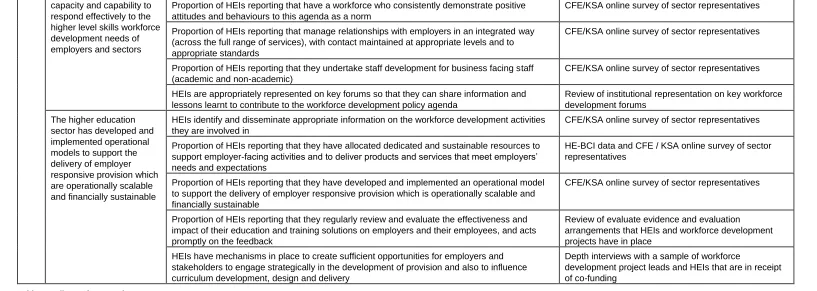
2.20 A logic chain can be found in Appendix 1. This can be interpreted as a temporal sequence running from left to right and therefore the impact statements are included on the right hand side of the logic chain for the Programme. As we recognise that it will not be possible to infer the nature or extent of causality between the Programme and changes in these key impact areas we have not therefore developed indicators or identified data collection sources for these impact statements. Instead we have focused solely upon developing indicators and data collection strategies for the identified
outcomes and outputs which have been derived from the Programme objectives.
Assumptions that underpin the Programme
2.21 The Programme‟s rationale focused on building the necessary infrastructural capacity in the HE sector to support a growth in provision; therefore assuming that there was latent employer demand. Yet, despite this initial rationale, some interviewees described how demand for HE among employers has historically been low and that it was important for HEIs to build this demand over time. Evidently, there were perceptions amongst stakeholders that accreditation is not useful to employers and that the HE sector has been slow to respond to employers‟ needs. So, whilst HEFCE and the Department for Business, Innovation and Skills (BIS) had sought to remedy supply-side issues by establishing the Programme, this intervention needed to be instigated in parallel to interventions on the demand-side, beyond those initiated by the HE sector, to increase the uptake of higher level skills provision by employers. The extension of Train to Gain to Levels 4 and above is one example of such an intervention.
its offer in quite the same way as a move from a largely predictable, publicly funded undergraduate (and, to a degree, postgraduate) market to a more volatile employer market. Furthermore, demand side issues have been identified. It is acknowledged that where skills gaps are identified, employers do not always use training as a route to meet these. This led one interviewee to comment, “There is a demand side problem as well. You can change the supply all you like, but demand is always going to be a problem”.
2.23 Whether this could be described as a market failure was less clear. One
interviewee acknowledged that education and training might not be the right decision for some businesses, or that there were alternative solutions open to employers to acquire the right skills (e.g. contracting in, taking over or merging with another company). So there was recognition that it should be seen as a complex set of issues or barriers to the market. However, another interviewee was of the view that there is a, “strong case for market failure in relation to skills”. This argument suggests that employers‟ perception that training is more beneficial to the employee than the employer, may lead to under investment in training. In this context, there is a market failure around certain types of employers and their employees, particularly small and medium-sized enterprises (SMEs) to which the Programme has justifiably responded.
Definitions of higher level skills
2.24 Learning and/or qualifications at Levels 4 to 8 of the Qualifications and Credit Framework (QCF) is generally taken to be a proxy for higher level skills. As such the provision encompassed in this definition forms part of the HE sector‟s initial and continuing professional development offer, including HE delivered in further education (FE). This type of provision comprises „full programmes‟ that lead to the achievement of an HE level award such as professional body accreditation, National Vocational
Qualifications (NVQs), VRQs, Higher National Certificates (HNCs) and Higher National Diplomas (HNDs), Foundation degrees, part-time undergraduate and postgraduate taught programmes, postgraduate research programmes; and „short courses‟ and standalone blocks of learning – accredited and non-accredited – which in themselves do not lead to an HE level award.
2.25 To better understand the distinguishing elements of higher level skills it is important to look beyond the QCF levels. The framework for higher education qualifications in England, Wales and Northern Ireland published by the Quality Assurance Agency (QAA)23 provides descriptors which exemplify the nature and characteristics of the main qualifications at each level. The characteristics of each level demonstrate the importance of not separating the development of skills from the increasingly more complex situations in which they are applied. Consequently the development of higher level skills should not be isolated from the knowledge and
understanding required by a learner (in this instance an employee) to operate effectively in a particular context (in this instance a specific job, sub-sector or sector) now and into the future.
2.26 Moreover, an individual‟s confidence (self efficacy) to apply their knowledge and skills in these contexts will, in part, depend on the extent to which their cognitive skills (e.g. critical analysis, conceptualisation) have been enhanced through the process of
learning. It is therefore critical that the development of the higher level skills is underpinned by an approach to learning which encourages individuals to move from considering how work is carried out to deliver best practice (competence) to
understanding why and how it might be carried out in different ways in future to meet both the changing needs of business and the drive for continuous improvement (capability). Thus learning at a higher level tends to focus more on extending an individual‟s potential to do things in the future which might not yet be defined.
2.27 Interviews with employers as part of the evaluation provided interesting insights into their perceptions of skills development and higher level skills in particular. Whilst most employers are keen for their employees to develop themselves further, often necessitating higher level courses, certain sectors increasingly require employees to have more practical and vocational skills (for example the creative industries). These perceptions will be explored in greater detail further on in this evaluation; however, at this stage it is important to remember one thing in particular: the concept of skill levels and what is defined as higher level (e.g. QCF Level 4 to 8) is one which employers and employees are far less familiar with than academics.24
Definitions of workforce development
2.28 Before we explore the effectiveness of HEIs in embracing employer engagement and workforce development activities, it is important that we understand what it is meant by these very concepts.
2.29 Starting with workforce development, Jacobs (2002)25 used this term to describe a wide range of learning-for-work activities and programmes. For Grubb et al (1999)26, the term refers to occupational preparation for employment, including basic, technical and academic competencies. Martinson (1999)27 suggests that workforce development encompasses a broad range of employment and training services that enable job
seekers, students and employers to access a wide range of information about the labour market, education and training providers, skills standards and requirements, and funding. Harrison and Weiss (1998)28 claim that training is just one element of workforce
development which includes other activities such as work orientation, recruitment, mentoring, and crisis intervention. Potter et al. (2003)29 point out that workforce
development links improvements in individual workers‟ performance with improvements at organisational level.
2.30 The term employer engagement on the other hand, is described as “the process through which employers directly participate in activity facilitated by an external
24
For more on this point, see CFE (2010) Generation Crunch: The Demand for Recent Graduates from SMEs, Leicester: CFE p9
25
Jacobs, R. L. (2002) Understanding Workforce Development: Definition, Conceptual Boundaries, and Future Perspectives. International Conference on Technical and Vocational Education and Training (Canadian Vocational Association and UNEVOC), Canada.
26
Grubb, W. N. and Associates (1999) Toward order from chaos. Berkeley, CA, National Centre for Research in Vocational Education.
27
Martinson, K. (1999) Literature Review on Service Coordination and Integration in the Welfare and Workforce Development Systems. Urban Institute
28
Harrison, B. & Weiss, M., (1998) Workforce development networks: Community-Based Organizations and Regional Alliances. Thousand Oaks, CA, SAGE Publications.
29
organisation in pursuit of shared objectives”.30 Even as recently as 2008, „engagement‟
was still seen as a fairly new term though; one which “broadly incorporates employer engagement – interpreted as higher education for the workforce – and knowledge
transfer as exemplified by Higher Education Innovation Fund (HEIF) activity.”31 McDonald
(2008) believes there is a tension between the use of commercial and academic
language between agency and university stakeholders; universities tend towards selling qualifications and credit recognition which prove attractive to employees whilst agencies sell business solutions invariably linked to „just-in-time‟ training needs and improved employee and organisational efficiency.32
2.31 Even within the Programme, the understanding and description of workforce development used by HEFCE evolved over the years, encompassing a diverse range of descriptors regarding the nature of the intervention and the target market.
Representatives interviewed during the scoping phase described it as “really about widening access, but also about improving business productivity through an
intervention”. The emphasis was intentionally focused on people who were “already in the workforce who did not have a substantial history of learning” but who might, if the right opportunities were created be willing to take on, “not just simply learning but higher level education” (HEFCE representative). All of the provision that was funded through he Programme had to be accredited training and, wherever possible, funded by the
employer.
2.32 HEIs who participated in the Programme also found themselves debating the true meaning of the terms in order to reach an accurate definition to use both internally as well as externally with their customers. They reported back that work-based learning means different things to different people. Whilst employers might interpret this as on-the-job training, academics often perceive work-based learning (WBL) to mean „authentic assessment or learning‟. One HEI found that certain terms were more effective than others at engaging academics in workforce development activities, with „commercial work‟ or „extended income generation‟ often deterring academics. In this case, the term „employer responsive provision‟ was most effective.
2.33 Nixon et al summarised it when they said, “Everyone has a view on what work-based learning means…they use a wide range of terms interchangeably – e.g. – workplace learning, work-related learning, vocational learning.”33 This chimes with the
findings of previous research carried out by CFE on behalf of HEFCE that concluded, “The absence of an agreed definition is perhaps the fundamental reason why studies attempting to accurately assess the extent of higher level skills training produce such widely different results.”34
30
Sector Skills Development Agency (2007) SSDA Employer Engagement Guidance, Astrid Flowers Ltd & Simpson Consulting Ltd p3.
31 Wedgwood, M. (2008) Higher Education for the Workforce: Barriers and Facilitators to Employer Engagement DIUS Research Report 08 04, p8.
32
McDonald H (2008) A Report on the Relevance of Language Barriers to Work Based Learning/Employer Engagement, LSDA
33
I Nixon, K Smith, R Stafford and S Camm (2006) Work-based learning: illuminating the landscape, Higher Education Academy
34
2.34 Whilst we have explored the different perceptions of what workforce development and employer engagement really mean, it is evident that no common definition exists. Given the diversity of terminology employed to describe this area, it is probable, therefore, that we will see equal diversity of models and activities across the HEIs participating in this Programme.
Programme objectives and outcomes
2.35 All of the stakeholders consulted during the first stage of the evaluation felt that success for the Programme would be the achievement of its objectives as outlined in the original brief; interestingly none of the stakeholders defined success of the Programme in any other terms. The Programme‟s objectives as documented in the original brief are presented in Table 2 below:
First order objectives
Achieve the targets set for additional entrants into HE co-funded by employers (of 5,000 in 2008-09, 10,000 in 2009-10, and 20,000 in 2010-11)
Achieve the target of 100,000 enrolments onto Foundation degrees by 2010
Additional objectives
Test the potential scale of the market and the levels of demand from employers and employees
Stimulate higher education institutional change
Promote access to and progress through HE for a wider range of learners particularly those in the workforce without previous experience of HE
Build a platform of capability and capacity within the HE sector to achieve future growth in the numbers of working people participating in HE-based workforce development
[image:26.595.124.544.274.501.2] Generate information to inform policy development
Table 2: The Programme objectives
2.36 By reviewing Programme documentation and conducting in-depth interviews with stakeholders we sought to determine the characteristics of „success‟ for the Programme if these objectives were realised. By documenting what the achievement of these objectives might look like in practice we are able to provide additional information on the first and second order objectives against which to review progress and impact. This enables us to identify whether actual changes match predicted changes and therefore indicate the likelihood of predicted outcomes manifesting themselves in the longer term. This approach has particular benefits, through providing a critical framework which helps to give coherence to the diverse elements of the Programme and the evaluation.
Programme strands and activities
Development (or employer engagement) projects – a total of £103 million has
been invested in 37 transformational projects to drive through change in HEIs to enable the sector to better respond to employer demand. This includes £4.2 million in two market sector focused projects involving Sector Skills Councils as strategic partners; these projects have also been allocated co-funded ASNs.
Co-funding for Additional Student Numbers (ASNs) – a further 58 HEIs have
been drawing down co-funded ASNs to support the delivery of programmes and leverage co-funding contributions from employers, without the need for
development funding.
Regional pathfinders – a total of £11.8 million35 was invested in three Higher
Level Skills Pathfinders projects (HLSPs) in the North East, North West and South West to develop sustainable capacity and mechanisms to enable employers to better access appropriate HE provision.
HE sector agency support – initial pump-priming investment alongside the core
budget for agencies which support the HE sector was made to facilitate
networking and sharing of good practice, undertake action-based research, and disseminate lessons learnt more widely.
2.38 In addition to these four strands of funded activity, HEFCE intended to focus its energies on developing a longer term strategy and funding model. As separate
evaluations of the regional pathfinders have already been conducted, this evaluation predominantly focuses upon the first two strands of the Programme, development projects and co-funded ASNs.
Objectives of the evaluation
2.39 In September 2010, CFE and KSA were commissioned by HEFCE to conduct a formative evaluation of the Programme. The fundamental question to address was the extent to which the Programme has progressed against its original first order and
additional objectives. Having now completed the four stages of the evaluation, this report provides the full findings.
2.40 HEFCE commissioned this formative evaluation of the Workforce Development Programme to deliver the following objectives:
To inform HEFCE policy development and to inform its advice to Government;
To inform further developments in employer and employee focused provision across higher education; and
To provide accountability for the use of public funds and to help HEFCE deliver value for money for any future funding investment, should this become available.
2.41 Meeting HEFCE‟s aims and objectives for this evaluation required a synthesis of qualitative and quantitative data on: external impact (i.e. impact on employers/
employees); institutional change (i.e. structural and transformational change) and sector implications (i.e. cultural change and the longer term expansion of workforce
development activities). The key delivery challenges were to define a workable scope in
35
terms of these evaluation areas and then to bring together sufficient evidence and insights to inform further developments in employer and employee focused provision across HE.
Approach and methodology
2.42 The overall design and implementation of the Programme has had implications for the approach taken to conducting the evaluation. As the intervention has primarily been on the supply side, for instance seeking to improve the flexibility and
responsiveness of HEIs and their internal cultures, the evaluation has inevitably included consultations with those employed by HEIs and others associated with the projects. Had the Programme been an intervention that focused upon increasing purchasing power in the hands of employers, then the evaluation would have primarily focused upon the employer perspective of processes, implementation and impact. That said, the project‟s leads have provided HE employer contacts to capture the external perspective of HEIs‟ workforce development activity.
Methodology
2.43 The Programme is an intervention designed to support developments and implement change through a chain of cause and effect relationships. In response to this a „theory of change‟ methodology was adopted for the evaluation as it enabled us to systematically investigate the tacit or underlying assumptions or rationale underpinning the Programme and