A Robust Ensemble Classification Method for
Microarray Data Analysis
Zhongwei Zhang1, Jiuyong Li2, Hong Hu3 and Hong Zhou4
Abstract Apart from the dimensionality problem, the uncertainty of Microarray data quality is another major challenge of Microarray classification. Microarray data contains various levels of noise and quite often are high levels of noise, and these data lead to unreliable and low accuracy analysis as well as the high dimen-sionality problem. In this paper, we propose a new Microarray data classification method, based on diversified multiple trees. The new method contains features that, (1) make most use of the information from the abundant genes in the Mi-croarray data, and (2) use a unique diversity measurement in the ensemble deci-sion committee. The experimental results show that the proposed classification method (DMDT) and the well known method (CS4), which diversifies trees by us-ing distinct tree roots, are more accurate on average than other well-known en-semble methods, including Bagging, Boosting and Random Forests. The experi-ments also indicate that using diversity measurement of DMDT improves the classification accuracy of ensemble classification on Microarray data.
1. Introduction
The primary purpose of Microarray data classification is to build a classifier from the classified historical Microarray data, and then use the classifier to clas-sify future incoming data or predict the future trend of data. Due to the advent of DNA Microarrays technology, the vast amount of DNA microarray datasets have
1 Zhongwei Zhang
Department of Mathematics and Computing, University of Southern Queensland, Australia, e-mail: [email protected]
2 Jiuyong Li
School of Computer and Information Science, University of South Australia, Mawson Lakes, Adelaide, Australia, e-mail: [email protected]
3 Hong Hu
Office of Research and Higher Degrees, University of Southern Queensland, Australia, e-mail: [email protected]
4 Hong Zhou
been widely available for Microarray data classification. However, as a new tech-nology, Microarrays present new statistical problems to the Microarray data clas-sification
1. Curse of dimensionality problem. Microarray data contains a huge number of genes with small number of samples and his problem has prevented many ex-isting classification systems from direct dealing with this type of databases. 2. Robustness problem. In addition, DNA Microarray database contains high level
of noise, irrelevant and redundant data, and those data will lead unreliable and low accuracy of analysis. Most current system can not robust enough to handle these types of data properly.
Ensemble decision tree classification methods [6, 4] have shown promise for achieving higher classification accuracy than single classifier classification method, such as C4.5 [8]. The essence of ensemble methods is to create diversi-fied classifiers in the decision committee. Aggregating decisions from diversidiversi-fied classifiers is an effective way to reduce bias existing in individual trees. However, if classifiers in the committee are not unique, the committee has to be very large to create certain diversity in the committee.
Up to date, all ensemble decision trees methods have kept diversity in mind [1, 9]. However, among those methods, most of them, such as Boosting and Bagging, do not guarantee that each ensemble decision tree in the committee is different from outputs, namely identical trees and overlapping genes are not prohibited from an ensemble committee. Identical trees decrease the diversity of an ensemble committee, and noise in one gene may affect a number of ensemble decision trees; the noise will ultimately affect the reliability of Microarray classification. There-fore, committees built on those methods may not be as effective as a committee that contains no identical trees and overlapping genes.
A quick fix to improve diversity in the ensemble decision tree committee is to include a set of diversified decision trees with no overlapping genes. If classifiers in the ensemble decision tree committee are not guaranteed to be different to each other, the committee must be very large, in order to create certain diversity in the committee. This behooves us to pay special attention while designing our algo-rithm. One concern for such a split is that it might break down some attribute combinations that are good for classification. However, an apparent benefit of such trees is that a noise attribute cannot affect more than one tree in the commit-tee. Considering that Microarray data normally contains much noise and many missing values, the idea of using diversified trees with no overlapping genes may provide a better solution.
2. Measurement of diversity
All ensemble decision tree classification methods generate a set of decision trees to form a committee. Due to the different approaches applied to generate the committee, the decision trees in the final ensemble committee could be diverse from each other in certain ways. In the past decades, measuring diversity has be-come a very important issue in the research of Microarray ensemble classification methods [1, 5, 9].
Measuring outputs is a most natural way to measure the diversity of ensemble classifiers [1]. The output from measuring the classifiers in a committee may give a result of total different, partially different or identical with each other. If the classifiers in a committee are all identical in a committee, we can say these classi-fiers are not diversified; if the classiclassi-fiers are partially different, we can say they are diversified. When the classifiers are totally different or unique to each other, we say the classifiers are maximally diversified.
There are also many statistical diversity measures available, such as diversity of errors [1, 2, 7], and pairwise and non-pairwise diversity measures [1, 9, 5]. It is desirable if every classifier in an ensemble committee can agree on most samples which are predicted correctly. At the same time, we also expect that they do not make same incorrect predictions on testing samples. Those methods are also very important measurements of diversity, because if their errors were correlated, clas-sification prediction would not lead to any performance gain by combining them.
The approach of measuring diversity based on statistical methods has draw-backs. There is a lack of robustness consideration in Microarray classification in terms of incorrect and missing data values. Identical trees are excluded from the ensemble committee since they are not helpful in improving the prediction accu-racy of classification. However, this measurement allows overlapping genes among diversified trees. Overlapping genes are a problem for reliable Microarray data classification.
In our proposed method, diversity is measured by the difference of outputs for Microarray data classification problems. The degree of diversity is dependent on how many overlapping genes are included between the decision trees of an en-semble committee.
Definition 1(Degree of diversity) Given a data set
D
withn
attributes,}
,
,
{
att
1att
nA
=
L
;C
is an ensemble decision tree committee withk
(
k
>
1
)
individual decision trees generated from
D
,C
=
{
c
1,
L
,
c
k}
;c
i∈
C
andC
c
j∈
are any single decision trees;c
i contains a set of attributes}
|
{
att
att
A
A
i
c
=
∈
andA
cj=
{
att
|
att
∈
A
}
;Let
|
|
j
i c
c
A
A
∩
= the number of elements contained inj
i c
c
A
A
∩
, and|
|
j
i c
c
A
A
∪
= the number of elements contained inj
i c
c
A
A
∪
. Then the degree)
1
0
(
|
|
|
|
1
≤
≤
∪
∩
−
=
DD
A
A
A
A
DD
j i j i c c c cWhen an ensemble committee contains only decision trees which have totally dif-ferent outputs, or unique trees with no overlapping genes, we say that the ensem-ble committee is maximally diversified. According to Definition 1,
DD
=
1
for the unique decision trees.Definition 2 (Unique decision trees).
c
iandc
jare called unique decisiontrees, if
∩
=
φ
j
i c
c
A
A
.We say an ensemble decision tree classification method has greater diversity when its decision trees have a higher degree of different outputs with less overlap-ping genes. It is clear that diversified decision trees have a
DD
value which is be-tween0
and1
.Definition 3 (Diversified decision trees). If
j
i c
c
A
A
≠
and∩
≠
φ
ji c
c
A
A
,then
c
i andc
j are called diversified decision trees.Similarly, if all decision trees in an ensemble decision tree committee are identi-cal, the degree of its diversity would be
0
.Definition 4 (Identical decision trees).We call
c
iandc
jare identicaldeci-sion trees, if
j
i c
c
A
A
=
3. Diversified multiple decision trees algorithm
We design a diversified multiple decision tree (DMDT) algorithm to deal with the problems of Microarray classification, namely small samples versus high dimsions and noisy data. DMDT aims to improve the accuracy and robustness of en-semble decision tree methods. In our proposed algorithm, we avoid the overlap-ping genes among alternative trees during the tree construction stage. DMDT guarantees that constructed trees are truly unique and maximizes the diversity of the final classifiers. Our DMDT algorithm is presented in Algorithm 1. The DMDT algorithm consists of the following two steps:
1. Tree construction
re-peats until the number of trees reaches a preset number. As a result, all trees are unique and do not share common genes.
Algorithm 1: Diversified multiple decision trees algorithm (DMDT)
1. TREECONSTRUCTION (
D
, T,DD
,n
)INPUT: A Microarray dataset
D
, the degree of diversityDD
and the number of treesn
.
OUTPUT: A set of disjointed trees T let F
=
φ
let
DD
=
1
for
i
=
0
to
n
−
1
docall C4.5 to build tree
T
i onD
;remove genes used in
T
i fromD
;T = T
∪
T
i.endfor
Output T;
2. CLASSIFICATION( T,
x
,n
)INPUT: A set of trained trees T, a test sample
x
, and the number of treesn
.OUTPUT: A class label of
x
let
vote
(
i
)
=
0
, wherei
=
1
to
c
= the number of classes.for
j
=
1
to
n
dolet
c
be the class outputted byT
j;)
(
)
(
)
(
c
vote
c
accuracy
T
jvote
=
×
;endfor
Output
c
that maximizesvote
(
c
)
;2. Classification
4. Experimental results and discussion
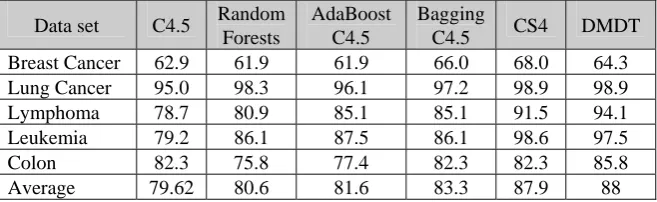
[image:6.595.132.461.226.327.2]In this section, we first present the accuracy of individual methods and the average prediction accuracy of the six methods [3, 4], which are all based on the ten-fold validation technique [6, 10, 11]. Table 1 shows the individual and average accu-racy results of the six methods based on tenfold cross-validation method.
Table 1: Average accuracy of five datasets with six classification algorithms
Data set C4.5 Random Forests
AdaBoost C4.5
Bagging
C4.5 CS4 DMDT Breast Cancer 62.9 61.9 61.9 66.0 68.0 64.3 Lung Cancer 95.0 98.3 96.1 97.2 98.9 98.9
Lymphoma 78.7 80.9 85.1 85.1 91.5 94.1
Leukemia 79.2 86.1 87.5 86.1 98.6 97.5
Colon 82.3 75.8 77.4 82.3 82.3 85.8
Average 79.62 80.6 81.6 83.3 87.9 88
Our DMDT outperforms other ensemble methods. For instance, compared to the single decision tree, DMDT is a more favorable ensemble method and outper-forms C4.5 by 10.0% on average.
From Table 1, we notice that CS4 also performs very well and improves the ac-curacy by 8.4% on average. Random Forests, AdaboostC4.5 and BaggingC4.5 improve the accuracy on average by up to 4.3%. More specifically,
1. Among the five ensemble methods used in our experiments, DMDT turns to be the most favorable classification algorithm with the highest accuracy, which improves the accuracy of classification on all cancer data sets by up to 26.7%. 2. CS4 is comparable to DMDT in the test which improves the accuracy of
clas-sification on all data sets by up to 17.4%.
3. BaggingC4.5 also outperforms C4.5 on all data sets by up to 9.6%.
4. Random Forests improves the accuracy on lung cancer, Lymphoma, Leukemia and Prostate data sets by up to 19.1%, but fails to improve the accuracy on breast cancer, Colon and Ovarian data sets. AdaBoostC4.5 can only improve the accuracy on Lung Cancer, Lymphoma and Leukemia and decreases the ac-curacy performance on the Breast Cancer and Colon data sets.
classification. In contrast, DMDT and CS4 are designed specially for Microarray data analysis. DMDT keeps the alternative trees using all available samples in or-der to minimize the impact of the unreliability problem.
5. Conclusions
In this chapter, we studied the concept of diversity measurement in ensemble clas-sifiers. We then proposed an algorithm that diversifies trees in the ensemble deci-sion tree committee. We conducted experiments on six Microarray cancer data sets. We conclude that the proposed DMDT performs the best among all algo-rithms used in the experiments. DMDT is more resistant to the noise data while keep the highest classification accuracy rate. From the robustness point of view, Random Forests is comparable to DMDT and outperform than other compared al-gorithms. Without increase the noise data level, CS4 is comparable to DMDT. However, its performance decreases while comparing with DMDT when the noise level increases in the training and test data.
References
1. Matti Aksela and Jorma Laaksonen. Using diversity of errors for selecting members of a committee classifier. Pattern Recognition, 39(4):608–623, 2006.
2. M. Brown, W. Grundy, D. Lin, N. Cristianini, C. Sugnet, T. Furey, M. Jr, and D. Haussler. Knowledge-based analysis of Microarray gene expression data by using support vector ma-chines. In Proc. Natl. Acad. Sci., volume 97, pages 262–267, 2000.
3. T. Dietterich. An experimental comparison of three methods for constructing ensembles of de-cision trees: Bagging, Boosting, and randomization. Machine Learning, 40(2):139–158, 1998. 4. Mordechai Gal-Or, Jerrold H. May, and William E. Spangler. Using decision tree models and
diversity measures in the selection of ensemble classification models. In Nikunj C. Oza, Ro-biPolikar, Josef Kittler, and Fabio Roli, editors, Multiple Classifier Systems, volume 3541 of Lecture Notes in Computer Science, pages 186–195. Springer, 2005.
5. Ludmila I. Kuncheva and Christopher J. Whitaker. Measures of diversity in classifier ensem-bles and their relationship with the ensemble accuracy. Machine Learning, 51(2):181–207, 2003.
6. Jinyan Li and Huiqing Liu. Ensembles of cascading trees. In ICDM, pages 585–588, 2003. 7. Derek Partridge and Wojtek Krzanowski. Distinct failure diversity in multiversion software.
Technical report, Dept. Computer Science, University of Exeter, [email protected], 1999.
8. J. R. Quinlan. C4.5: Programs for Machine Learning. Morgan Kaufmann, San Mateo, Califor-nia, 1993.
9. Geoffrey I. Webb and Zijian Zheng. Multistrategy ensemble learning: Reducing error by com-bining ensemble learning techniques. IEEE Trans. Knowl. Data Eng, 16(8):980–991, 2004. 10. C. Yeang, S. Ramaswamy, P Tamayo, and et.al. Molecular classification of multiple tumor
types. Bioinformatics, 17(Suppl 1):316–322, 2001.