Secured AODV to Prevent Single and Collaborative
Black Hole Attack in MANETs
Charu Wahi
Abstract: This paper addresses one of the most important security attacks against routing in Mobile Ad Hoc Networks – Black hole attack. We propose an algorithm called Secured AODV (SAODV) to reduce the susceptibility of AODV routing protocol against Black hole attack. The proposed algorithm combats the effect of both single and collaborative Black hole attack. Essentially it requires the intermediate node to validate the Sequence Numbers and Speed of node (which replies with a route to the destination) based on well-defined thresholds prior to instantiating a communication with destination to send data packets; without imposing any additional overhead on source and destination nodes.
AT veryT smallT numberT ofT solutionsT existT thatT canT
collectivelyT preventT bothT singleT andT collaborativeT blackT
holeT attacks.T Moreover,T thoseT whoT do,T haveT highT amountT
ofT overheadT andT delay.T SimulationT usingT NS-2T showsT thatT
SAODVT providesT betterT securityT againstT singleT andT
collaborativeT blackholeT attacksT andT alsoT betterT
performanceT inT termsT ofT PacketT deliveryT ratioT andT
ThroughputT againstT originalT AODVT inT presenceT ofT
BlackholeT nodes.T InT comparisonT toT AODV,T thereT isT anT
improvementT inT PDRT byT 60-80%T andT throughputT
increasesT byT 70-80%T whenT maliciousT nodesT areT presentT
inT theT network;T withT aT marginalT increaseT inT delayT andT
overhead.T
Keywords: MANET, AODV, SAODV, Black-Hole, Single, Collaborative
I. INTRODUCTION
InT theT currentT age,T theT studyT ofT MobileT Ad-hocT
NETworksT (MANETs)T hasT securedT researchers’T
attentionT dueT toT theT recognitionT ofT theT emergingT
computingT paradigmT [1].T AT MANETT isT aT
self-configuringT networkT ofT wirelessT mobileT nodesT thatT
createT aT networkT withT dynamicallyT changingT topology.T
TheyT areT characterizedT byT self-organization,T dynamicT
topology,T limitedT resources,T self-configurationT andT
lackT ofT infrastructure.T TheseT featuresT makeT MANETsT
bestT suitableT forT applicationsT likeT disasterT recoveryT
operations,T emergencyT searchT andT rescue,T battlefieldsT
andT smartT buildingsT orT classT rooms.T
TheT dynamicT topology,T wirelessT nature,T lackT ofT aT
fixedT infrastructureT andT centralizedT control,T makeT
MANETsT vulnerableT toT theT securityT intrusions.T InT thisT
article,T weT proposeT toT strengthenT theT prevailingT
routingT protocolsT toT facilitateT secureT routingT forT
MANETs.T TheseT routingT mechanismsT areT particularlyT
susceptibleT inT MANETsT becauseT ofT theT dependenceT ofT
theseT algorithmsT onT nodesT cooperationT toT establishT
communication.
Revised Manuscript Received on May 22, 2019.
Charu Wahi, Birla Institute of Technology, Mesra, Noida Campus
OneT ofT theT principalT routingT protocolsT usedT inT
MANETsT isT Ad-hocT On-demandT DistanceT VectorT
(AODV)T [2].T AODVT isT aT reactiveT routingT protocolT
thatT hasT beenT designedT withoutT securityT
considerations.T TheT networkT layerT inT MANETsT isT
vulnerableT toT numerousT attacksT likeT Denial-of-serviceT
attacksT namelyT Sinkhole,T Wormhole,T Blackhole,T andT
GrayholeT attacks,T informationT disclosureT attack,T SybilT
attacks,T routingT attacksT viz.T packetT replication,T routeT
cacheT poisoningT andT rushingT attacks.T AmongstT these,T
weT focusT onT examiningT andT enhancingT theT securityT ofT
AODVT routingT protocolT againstT BlackholeT attacks.T
TheT simulationT resultsT andT investigationT shownT inT
sectionT 5T testifiesT thatT theT proposedT solutionT
effectivelyT improvesT securityT ofT AODV,T inT preventingT
bothT singleT andT collaborativeT BlackholeT attacksT inT
MANETsT withT insignificantT performanceT penalty.
ThisT paperT proceedsT asT follows:T SectionT 2T providesT
theT problemT statementT byT givingT anT insightT onT AODVT
routingT protocolT andT thenT BlackholeT attack.T NextT inT
sectionT 3,T weT haveT discussedT theT workT ofT researchersT
toT mitigateT theT effectT ofT Black-HoleT attackT againstT
AODV.T InT sectionT 4,T weT discussT theT proposedT
algorithmT SAODV.T AndT sectionT 5T describesT theT
simulationT setup,T itsT resultsT andT analysis.T Lastly,T
sectionT 6T concludesT theT paperT andT discussesT theT
futureT researchT directions.
II. PROBLEM STATEMENT A. Overview of AODV
AODVT isT aT routingT mechanismT thatT implementsT aT
purelyT reactiveT approach;T itT establishesT aT routeT
wheneverT neededT towardsT theT beginningT ofT aT
conversationT andT utilizesT tillT itT breaks.T ItT employsT
RouteT REQuestT (RREQ)T andT RouteT REPlyT (RREP)T
packetsT duringT routeT discoveryT stageT andT RouteT
ERRorT (RERR)T packetT inT routeT maintenanceT stage.T
MoreT aboutT theseT messagesT canT beT seenT inT [2].T
BeingT aT reactiveT strategy,T AODVT onlyT hasT toT retainT
theT routingT informationT regardingT theT activeT routes.T
EveryT nodeT inT theT networkT storesT thisT dataT inT theT
routingT tables.T EachT ofT theT mobileT nodeT retainsT aT nextT
hopT routingT table,T whichT isT aT collectionT ofT routesT toT
distinctT nodesT withinT theT network.T InformationT inT theT
tableT perishesT ifT itT hasT notT beenT utilizedT forT aT
pre-designatedT expiryT time.
“OneT uniqueT featureT ofT AODVT isT itsT useT ofT aT
sequenceT number,T aT monotonicallyT increasingT numberT
maintainedT byT eachT originatingT node,T forT eachT routeT
entry”.T EveryT entryT
mustT compriseT theT mostT
recentT informationT
numberT forT theT destinationT node,T forT whichT theT routeT
replyT isT maintained.T ThisT sequenceT numberT isT calledT
“destinationT sequenceT number”.T ItT isT updatedT eachT
timeT aT nodeT receivesT freshT informationT regardingT theT
sequenceT numberT fromT RREQ,T RREPT orT RERRT
messages.T “UsingT destinationT sequenceT numbersT
ensuresT loopT freedomT andT isT simpleT toT program”T [2].
InT AODV,T asT soonT asT aT deviceT needsT toT initiateT
communicationT withT anyT otherT device,T itT initiatesT aT
routeT discoveryT operationT ifT noT routeT isT availableT inT
theT routingT table.T TheT sourceT nodeT broadcastsT aT
RREQT packetT whichT includesT DestinationT SequenceT
Number,T inT theT routeT discoveryT processT (fig.T 1).T OnceT
anT intermediateT orT destinationT device,T whichT hasT aT
routeT toT theT destinationT receivesT theT RREQT packet,T itT
examinesT theT destinationT sequenceT numberT itT presentlyT
recognizesT andT theT oneT indicatedT inT theT packet.T InT
orderT toT maintainT freshnessT inT theT network,T aT RREPT
frameT isT createdT andT forwardedT backT toT theT sourceT
nodeT onlyT ifT theT destinationT sequenceT numberT isT equalT
[image:2.595.319.552.52.182.2]toT orT greaterT thanT theT oneT specifiedT inT RREQ.T
Figure 1: Route Discovery Process in AODV
B. Black-Hole attack
BlackholeT attackT belongsT toT theT categoryT ofT theT
Denial-of-serviceT (DoS)T attacksT inT adT hocT networksT
thatT disruptsT theT workingT ofT networkT layer.T “InT thisT
attack,T aT maliciousT nodeT sendsT aT falseT RREPT packetT
toT aT sourceT nodeT thatT initiatedT theT routeT discovery,T inT
orderT toT poseT itselfT asT aT destinationT nodeT orT anT
intermediateT nodeT toT theT actualT destinationT node”T [1].T
Thereon,T sourceT willT transmitT allT itsT dataT messagesT
towardsT theT illegitimateT node.T TheT maliciousT nodeT
ultimatelyT willT neverT forwardT theT dataT packetsT toT theT
intendedT destination.T Consequently,T sourceT andT
destinationT willT neverT beT ableT toT establishT aT
communicationT together.
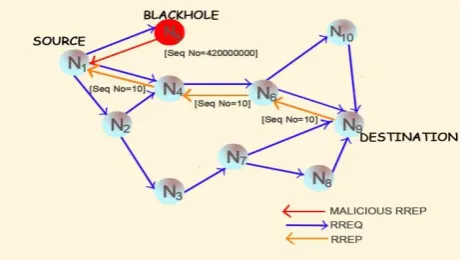
TheT blackT holeT nodeT isT aT maliciousT nodeT thatT joinsT
theT networkT withT theT intentionT ofT droppingT theT
transmittedT dataT packetsT insteadT ofT deliveringT themT toT
theT desiredT destinationT [4].T AnT exampleT isT shownT inT
fig.T 2.T InT AODV,T uponT receivingT aT numberT ofT RREP,T
aT sourceT nodeT selectsT theT oneT withT greatestT
DestinationT sequenceT numberT toT constructT aT route.T ToT
succeed,T aT blackholeT nodeT mustT generateT itsT RREPT
withT DestinationT sequenceT greaterT thanT thatT ofT theT
destinationT node.
Figure 2: Single Black Hole Attack
[image:2.595.320.563.300.456.2]It is quite possible that some malicious nodes will collaborate together in order to capture the routing information and moreover, hide from the existing routing mechanism. When numerous black hole nodes work in collaboration with the intention of disrupting the normal flow of communication, is known as collaborative black hole attack, node N2 sends the RREP and identifies the route through node N3 (fig. 3).
Figure 3: Collaborative Black Hole Attack
III. RELATED WORK
ResearchT toT mitigateT theT effectT ofT blackholeT attackT
againstT AODVT inT MANETsT isT anT evolvingT process.T
ManyT researchersT haveT proposedT solutionsT toT reduceT
theT effect,T hereT isT anT overview:T
InT [5],T DengT etT al.T proposedT aT solutionT forT singleT
blackT holes.T AccordingT toT theirT solution,T whenT anyT
intermediateT nodeT sendsT RREPT itT shouldT haveT
informationT aboutT theT nextT hopT toT destination.T TheT
sourceT deviceT doesn’tT transmitT dataT packetsT toT anT
intermediateT nodeT instantly.T ItT ratherT waitsT forT theT
RREPsT andT thenT transmitT aT furtherT requestT (FREQ)T
packetT toT nextT hopT ofT repliedT nodeT andT enquiresT
regardingT theT repliedT nodeT andT routeT toT theT
destination.T TheT nextT hopT nodeT sendsT FurtherReplyT
packetT toT theT source.T IfT itT doesT notT haveT aT route,T thenT
theT sourceT willT transmitT anT alarmT packetT toT alarmT
otherT nodes.T However,T thisT solutionT isT unableT toT avertT
cooperativeT blackT holeT attacks.T ForT instance,T ifT theT
nextT hopT alsoT collaboratesT withT theT repliedT device,T theT
replyT forT theT FREQT willT beT simplyT “yes”T forT bothT
questions.T AtT thatT time,T
theT sourceT willT trustT
nextT hopT andT sendT dataT
[image:2.595.68.271.311.420.2]nodeT whichT isT aT blackT holeT node.
InT [6],T theT authorsT proposedT anT approachT thatT
involvesT aT sourceT nodeT toT waitT untilT aT RREPT packetT
arrivesT fromT moreT thanT twoT nodes.T AfterT receivingT
multipleT RREPs,T theT requestingT nodeT examinesT ifT
thereT isT aT sharedT hopT orT not.T IfT thereT is,T theT sourceT
concludesT thatT theT routeT isT safe.T TheT mainT limitationT
ofT thisT approachT isT thatT itT takesT moreT time,T becauseT itT
isT requiredT toT waitT forT severalT RREPsT toT arrive.
TheT authorsT inT [7]T talkT aboutT anT approachT inT whichT
theT sourceT nodeT waitsT forT theT responsesT fromT otherT
neighboringT nodesT forT aT pre-establishedT time.T AfterT
theT timeout,T itT firstT inspectsT forT aT repeatedT next-hopT
nodeT inT theT CollectT RouteT ReplyT TableT (CRRT)T table.T
IfT anyT suchT nodeT isT presentT inT theT replyT routes,T itT
presumesT theT routesT areT safeT orT theT possibilityT ofT
maliciousT pathsT isT limited.T TheT drawbackT ofT theT
approachT isT thatT itT addsT aT delayT andT thereT isT anT
additionalT overheadT involvedT inT theT processT ofT findingT
repeatedT nextT hop.
RamaswamyT etT al.T discussedT aT techniqueT forT
recognizingT multipleT blackT holeT nodesT [8].T TheyT wereT
theT firstT toT proposeT aT solutionT forT cooperativeT blackT
holeT attacks.T TheyT revisedT theT AODVT protocolT toT
someT extentT viaT establishingT aT DataT RoutingT
InformationT (DRI)T tableT andT aT crossT checkingT
mechanism.T ThisT methodT usesT theT reliableT nodesT toT
transferT theT packets.T Nevertheless,T theyT onlyT
consideredT thoseT multipleT blackT holeT nodes,T withoutT
anyT collaborationT amongstT them.
InT [9],T authorsT discussT aT protocolT SRD-AODVT thatT
providesT secureT routeT discoveryT toT preventT blackT holeT
attacks.T TheT solutionT entailsT theT sourceT andT
destinationT nodesT toT verifyT theT sequenceT numbersT inT
theT RREQT andT RREPT packets,T basedT onT establishedT
thresholdsT beforeT initiatingT dataT communicationT withT
theT destination.T TheT limitationT ofT thisT solutionT isT thatT
itT doesT notT addressT collaborativeT blackT holeT attacks.
LathaT TamilselvanT andT Dr.T VT SankaranarayananT
proposedT anT approachT whichT talksT aboutT theT
cooperativeT behaviorT ofT twoT blackT holeT nodesT
functioningT togetherT [10].T EveryT nodeT maintainsT aT
fidelityT tableT toT recordT theT fidelityT valuesT ofT theT
participatingT nodes.T ThisT valueT isT incrementedT orT
decrementedT proportionalT toT theirT behavior.T TheT
approachT worksT asT follows:T aT sourceT nodeT sendsT aT
RREQT andT waitsT forT aT pre-establishedT amountT ofT timeT
toT gatherT theT RREPs.T OnceT theT routesT areT collected,T
theT sourceT examinesT theT fidelityT valuesT ofT bothT theT
replyingT nodeT andT itsT nextT hopT inT eachT receivedT
route.T TheT sourceT nodeT choosesT theT routeT withT theT
highestT fidelityT valueT andT sendsT itsT dataT viaT thatT
route.T IfT thereT isT moreT thanT oneT routeT withT theT sameT
fidelityT value,T theT sourceT choosesT theT oneT withT leastT
numberT ofT hops.T OnceT theT destinationT nodeT receivesT
theT dataT itT sendsT anT acknowledgementT toT theT sourceT
informingT itT thatT itT hasT successfullyT receivedT theT data.T
OnT receiptT ofT acknowledgement,T theT sourceT
incrementsT theT fidelityT valuesT ofT theT replyingT nodeT
andT itsT nextT hopT andT decrementT themT ifT theT
acknowledgementT isT notT received.T ThisT updatedT
fidelityT valuesT areT exchangedT overT theT network.T WhenT
theT fidelityT valueT ofT theT replyingT nodeT dropsT toT zero,T
bothT ofT theT nodeT andT itsT nextT hopT areT consideredT asT aT
cooperativeT teamT ofT blackT holeT nodesT andT eliminatedT
fromT theT network.
InT [11],T authorsT provideT solutionT forT bothT singleT andT
collaborativeT blackT holeT nodes,T byT divertingT theT trafficT
fromT theT blackT hole.T TheT proposedT solutionT GAODVT
isT utilizesT theT conceptT ofT gratuitousT RREPT packetT sentT
toT theT destinationT node.T TheyT addedT fewT packets:T
CONFIRM,T CHCKNFRMT andT REPLYCONFIRMT andT
tablesT calledT Confirm,T ReplyConfirm,T BlackHoleT andT
CollaborativeBlackHole.T However,T theT protocolT
sufferedT fromT aT hugeT increaseT inT delayT toT achieveT
security.
IV. SAODV
A. Terminology
S : Source Node
D : Destination Node
Y : Intermediate node that replies with RREP
X : Node preceding to Y
Z : Node few hops (at the max 2) away from Y enroute to D
Dest_Seq : Destination Sequence Number
Dest_Seq_TH : Destination Sequence Number Threshold
Speed_TH : Speed Threshold MHELLO : Modified HELLO packet
B. The Proposed Solution
WeT proposeT aT solutionT thatT isT anT enhancementT ofT theT
AODVT routingT protocolT andT designedT toT reduceT theT
effectT ofT singleT andT collaborativeT blackT holeT attacksT
againstT theT performanceT ofT AODVT inT MANETs.T TheT
proposedT solutionT SAODVT doesT notT alterT theT defaultT
operationsT ofT eitherT theT sourceT nodesT orT destinationT
nodes.T TheT methodT followedT basicallyT modifiesT theT
workingT ofT theT intermediateT nodesT only,T usingT
additionalT variablesT toT defineT theT thresholdT ofT
sequenceT numbersT andT speedT ofT node.T ApartT fromT
this,T weT alsoT addedT aT ModifiedT HELLOT (MHELLO)T
packetT whichT isT similarT toT HELLOT packetT usedT inT
AODV,T exceptT withT aT differenceT inT theT valueT ofT
hopcount.
TheT workingT ofT SAODVT reliesT onT aT nodeT precedingT
toT theT intermediateT nodeT thatT isT sendingT RREPT toT
establishT secureT connectionT betweenT ST andT D.T ItT doesT
notT alterT theT workingT ofT theT originalT AODVT protocolT
ifT ST receivesT RREPT fromT D,T whichT isT consideredT toT
beT reliable.
InT [7],T theT maximumT valueT forT theT sequenceT numbers,T
basedT onT signedT 32-bitT arithmeticT willT beT 4294967295T
andT whenT incrementedT willT haveT aT valueT ofT zero.T
ThisT propertyT ofT AODVT whenT exploitedT byT maliciousT
nodesT deterioratesT itsT performance.T Therefore,T theT
intermediateT nodeT XT (precedingT toT intermediateT nodeT
YT whoT isT generatingT RREP)T mustT resolveT whichT ofT
theT messagesT isT aT genuineT RREPT andT whichT oneT isT aT
fakeT messageT generatedT fromT theT blackT holeT node.T ToT
ensureT this,T SAODVT
requiresT theT nodeT XT toT
useT theT definedT
sequenceT numbersT andT nodeT speed.T IfT theT Dest_SeqT inT
theT RREPT messageT isT greaterT thanT theT Dest_Seq_TH,T
theT intermediateT nodeT XT considersT thisT messageT toT beT
aT fakeT messageT generatedT byT aT blackT holeT nodeT andT
doesT notT forwardT itT toT S.T Otherwise,T itT isT anT authenticT
messageT receivedT fromT anyT intermediateT nodeT YT andT
hence,T XT forwardsT itT toT S.
TheT algorithmT alsoT incorporatesT theT factT thatT aT
maliciousT nodeT willT haveT tendencyT toT moveT abruptlyT
andT fastlyT inT theT networkT toT disruptT itsT working.T
Therefore,T toT verifyT theT authenticityT ofT RREPsT
receivedT SAODVT alsoT checksT whetherT theT nodeT speedT
isT greaterT thanT theT Speed_TH.T IfT true,T algorithmT
proceedsT toT checkT collaborativeT attack.
However,T thisT enhancementT willT onlyT beT effectiveT ifT
maliciousT nodeT isT notT workingT inT aT group.T So,T toT
mitigateT theT collaborativeT blackT holeT attack,T weT addT
theT followingT process:T nodeT XT willT sendT aT MHELLOT
packetT toT aT nodeT ZT whichT isT fewT hopT countsT awayT
fromT Y.T IfT XT successfullyT receivesT acknowledgementT
fromT Z,T itT considersT allT nodesT asT genuineT nodesT andT
forwardsT RREPT toT ST andT henceT secureT routeT isT
establishedT betweenT ST andT D.T inT caseT ofT noT receiptT ofT
acknowledgement,T XT sendsT anT alertT signalT toT ST
indicatingT thatT nodeT YT andT ZT areT maliciousT nodes.T ItT
shouldT beT notedT thatT maximumT valueT ofT hopcountT inT
MHELLOT isT limitedT toT 3.
C. Algorithm
TheT mechanismT aboveT providesT efficientT performanceT
forT detectingT andT preventingT singleT andT collaborativeT
blackT holeT attacksT inT MANETs.T ReferT fig.T 4T forT theT
algorithmT ofT SAODV.
V. SIMULATION RESULTS AND ANALYSIS
A. Simulation Environment
WeT employT NetworkT SimulatorT (NS2)T toT evaluateT theT
performanceT ofT SAODVT underT differentT conditionsT
[12].T “NS2T isT anT event-drivenT simulatorT toolT thatT isT
specificallyT designedT toT studyT theT dynamicT natureT ofT
wirelessT communicationT networks”T [9].T TheT sameT
connectionT patternT hasT beenT usedT inT allT experimentsT
toT ensureT uniformityT andT consistency.
The experiment involves creation of ad-hoc networks of 10, 20, 30, 40 and 50 nodes, moving at a speed of 5 m/s in a terrain area of 1000x1000. Each experiment lasts for 300 seconds of simulation time. Table 4.1 lists the fixed simulation parameters. It simulates a network of randomly moving nodes communicating with each other with Constant Bit Rate (CBR), where some nodes behave maliciously.
Table 4.1: Fixed simulation parameters
Parameter Value
Simulator NS-2 (2.35)
Area size 1000x1000
Simulation Time 300s
Routing protocol AODV, SAODV
Traffic model CBR
Mobility model Random way point No. of malicious node 1-3
TableT 4.2T showsT theT variableT parametersT forT
simulatingT SAODVT inT theT twoT experimentsT toT studyT
theT impactT ofT mobilityT andT scalability.T TheseT
parametersT areT (i)T theT numberT ofT nodesT inT theT
MANETT andT (ii)T TheT distributionT ofT nodes’T speed.T
ExperimentT 1T isT performedT byT varyingT numberT ofT
nodesT fromT 10T toT 50T whileT keepingT theT nodeT speedT
constant.T ExperimentT 2T variesT theT nodeT speedT andT
maintainsT constantT numberT ofT nodesT andT maliciousT
nodes.
Table 4.2: Variable simulation parameters
Experiment no.
Malicious nodes
Max. speed(m/s)
Number of nodes
1 1, 2 50 10-50
2 3 5-25 30
B. Scenario
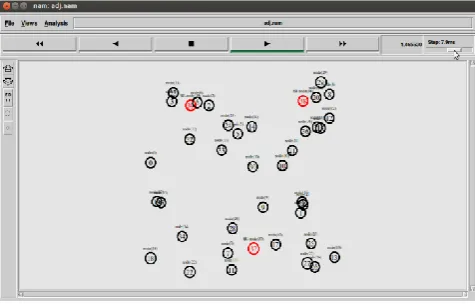
[image:4.595.318.556.300.452.2]Various scenarios have been designed in NS-2 to assess the performance of SAODV in presence of Black Hole attacks by varying network size, number of malicious nodes and node speeds. A screenshot of a network of 30 nodes with 3 blackhole nodes is shown in fig. 5.
Figure 5: Screenshot of MANET with 30 nodes and 3 blackhole nodes
C. Metrics used for Simulation
We use the following metrics to evaluate the performance
of the routing protocols:
Throughput:T theT numberT ofT dataT packetsT
successfullyT deliveredT perT unitT timeT throughT aT
networkT [3].
PacketT deliveryT ratioT (PDR):T theT ratioT ofT
packetsT receivedT byT theT destinationT nodeT toT
theT totalT numberT ofT packetsT sentT byT theT
sourceT node.
AverageT end-to-endT delay:T theT averageT timeT
takenT forT aT dataT packetT toT beT transmittedT
acrossT theT networkT fromT sourceT toT destinationT
[3].
NormalizedT routingT loadT (NRL):T theT totalT
numberT ofT controlT packetsT transmittedT forT
routingT perT dataT packetT sentT byT theT sourceT
node.T ThisT metricT isT alsoT highlyT correlatedT
withT theT numberT ofT routeT changesT occurredT
inT simulation.
D. Graphs and
To prove the efficiency of the proposed algorithm SAODV, we have also plotted the original AODV protocol which can be considered as benchmark for the respective scenario. SAODV’s performance has been analyzed to study the effect of mobility and scalability as well. The results have been shown for AODV without Blackhole (AODV-WOBH), AODV with Blackhole (AODV-WBH) and SAODV with Blackhole (SAODV-WBH).
Impact of scalability
InT theT firstT experiment,T weT compareT theT
performanceT ofT theT protocolsT asT theT numberT ofT
nodesT inT theT networkT increasesT fromT 10T toT 50T inT
theT presenceT ofT 1T andT 2T maliciousT nodes.T TheT
nodesT moveT randomlyT withT aT maximumT speedT ofT
50m/s.
(a) Throughput vs. No. of Nodes
(b) PDR vs. No. of Nodes
(c) Average end-to-end delay vs. No. of Nodes
[image:5.595.343.525.182.391.2](d) NRL vs. No. of Nodes
(a) Throughput vs. No. of Nodes
(b) PDR vs. No. of Nodes
(c) Average end-to-end delay vs. No. of Nodes
[image:6.595.339.527.59.268.2](d) NRL vs. No. of Nodes
Figure 7: Effect of scalability with 2 blackhole nodes
Impact of mobility
In experiment 2, we evaluate the protocols by varying the maximum speed of nodes from 5m/s to 25m/s. The various performance graphs are plotted in fig. 4.10. An increase in node speed typically leads to frequent route breaks because of the increased link changes.
(b) PDR vs. Node Speed
(c) Average End-to-end Delay vs. Node Speed
(d) NRL vs. Node Speed
Figure 8: Effect of mobility with 3 blackhole nodes
Throughput: Effect of scalability and mobility on
throughput is shown in fig. 6.(a), 7.(a) and 8.(a). SAODV achieves high throughput in comparison to original AODV routing protocol in presence of blackhole nodes. This is because it prevents malicious packet drops by black hole nodes. As throughput is a measure of how effective the protocol is, the results testify the same.
EffectT ofT scalability:T WithT anT increaseT inT
numberT ofT nodes,T thereT isT alwaysT anT
improvementT inT throughputT ofT AODVT andT
henceT SAODV.T HoweverT thereT isT aT declineT
inT throughputT ofT AODVT inT theT presenceT ofT
blackholeT nodes.T ButT withT anT increaseT inT
numberT ofT maliciousT nodes,T throughputT hasT
declinedT slightlyT (fig.T 7.(a))
EffectT ofT mobility:T RegardlessT ofT theT nodeT
speed,T throughputT ofT AODVT showsT aT slightT
variation,T becauseT highT mobilityT speedT causesT
higherT probabilityT ofT linkT failuresT andT inT turnT
introducesT moreT routeT discoveryT process.T OurT
approachT gaveT higherT throughputT asT highT asT
theT benchmarkT (AODV-WBH).
PDR: Fig. 6.(b), 7.(b) and 8.(b) clearly shows that PDR of SAODV is equivalent to the benchmark in all scenarios, which is expected from any solution to ensure reliable data transmission. PDR is very high in SAODV because it is able to detect malicious node and enable source node to prevent the occurrence of black hole attacks. On the other hand, AODV gives poor PDR in presence of black hole nodes because maximum number of packets is consumed by the malicious node. The modified protocol improves the PDR by 60-80%.
Effect of scalability: As the network size increases, there is a constant increase in the PDR of the proposed modification from 79.54 for 10 nodes to 98.3 for 50 nodes. Whereas there is a constant decline in the PDR of AODV in presence of blackhole nodes from 22.64 to 0.95. Effect of mobility: With mobility, SAODV
shows a variation between 98-100%, which is same as that achieved by the original AODV.
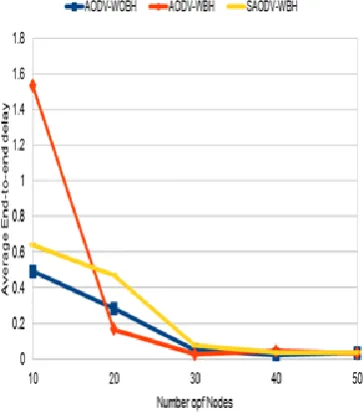
Average End-to-end Delay: As shown in fig., SAODV has slightly more delay than AODV with an increase in network size and node speed. The increase in delay is due to processing overhead involved at the intermediate nodes as shown in fig. 4.(b), thereby taking more time to find a secure route. Hence, there will a tradeoff between delay and PDR. With small number of nodes, routing protocols take more time because of the limitation on the alternative routes. Results shown in fig. 6.(c), 7.(c) and 8.(c) shows the reliability of SAODV protocol with respect to delay.
Effect of scalability: The delay decreases with increase in number of nodes. It is slightly more than the original AODV (benchmark). For instance, in presence of a single blackhole node, delay for 10 nodes is 0.491 of AODV and that of
SAODV is
number of blackhole nodes was increased to 2. Effect of mobility: Overall, the delay decreases
as the node speed increases. As said earlier, this delay is slightly more than the benchmark, which is acceptable in order to achieve security.
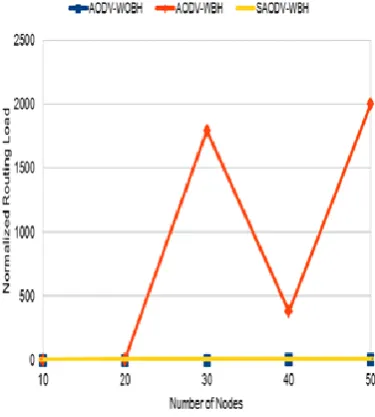
NRL: AODV has the lowest overhead since it doesn’t use
any control packets to discover secure routes; whereas SAODV uses extra control packets MHELLO and RMHELLO, thereby increasing the overhead. At the same time, it ensures more number of data packets reaching the destination successfully. As observed from the fig., NRL of AODV-WBH is highest due to the dropping of data packets by the black hole nodes. The NRL of SAODV with respect to varied node speed and network size is found to be more than AODV-WOBH because of extra control packets used. It is desirable to have a relatively stable NRL for scalability of the protocols, as it signifies that the actual routing load increases linearly with the number of sources.
Effect of scalability: NRL is slightly more than the original AODV due to addition of control packets, but very less than AODV-WBH. With scalability, NRL of SAODV increases as presence of more number of nodes implies more transmission of control packets to check the reliability of a node.
Effect of mobility: In presence of malicious nodes, hardly any data packets reach destination, thereby increasing NRL. However, though the number of control packets is more in SAODV but it ensures the successful transmission of data packets. Hence, it is more than AODV with increase in node speed.
Although many solutions exist to ensure security of MANETs against Blackhole attack; but none of them have achieved such high PDR and Throughput, with a very small amount of delay. It can be seen from the graphs that SAODV has accomplished more than 85-90% PDR in presence of any number of blackhole nodes, with a marginal increase in overhead and delay. There is a tradeoff between NRL and security when cooperative black hole exists. Hence we conclude that the proposed modification in AODV thereby provides high detection and prevention accuracy against single and collaborative black hole attack.
VI. CONCLUSION & FUTURE WORK
HavingT testifiedT theT susceptibilityT ofT AODVT againstT
BlackholeT attacks,T itT isT necessaryT toT proposeT solutionsT
toT counterT theT BlackholeT attackT onT AODVT routingT
protocol.T WeT haveT successfullyT demonstratedT thatT
withT aT minimalT additionalT overheadT ofT THRESHOLDT
variablesT andT MHELLOT packet,T weT areT ableT toT
counterT theT effect.T FromT theT experimentalT results,T weT
concludeT thatT SAODVT yieldsT betterT performanceT inT
termsT ofT Throughput,T PDR,T NRLT andT infinitesimalT
penaltyT inT delay.T Moreover,T theT proposedT solutionT
doesT notT involveT anyT hiddenT overheadT onT eitherT theT
sourceT nodesT orT theT destinationT nodes.T Consequently,T
inT comparisonT toT theT otherT approachesT discussedT inT
sectionT III,T weT believeT theT proposedT algorithmT isT
simpleT andT efficientT inT implementation.
AsT partT ofT ourT futureT work,T simulationsT canT beT
developedT toT analyzeT theT performanceT ofT SAODVT
basedT onT moreT parametersT likeT memoryT usage,T pauseT
time,T meanT delayT timeT etc.T WeT aimT toT extendT theT
proposedT solutionT toT secureT AODVT againstT otherT
attacksT suchT asT GrayT HoleT attack,T WormholeT attackT
etc.T
REFERENCES
1. NitalT Mistry,T DeveshT CT JinwalaT andT MukeshT Zaveri,T
“ImprovingT AODVT ProtocolT againstT BlackholeT attacks”,T
ProceedingsT ofT theT InternationalT MultiConferenceT ofT EngineersT
andT ComputerT Scientists,T Vol.T 2,T MarchT 2010,T HongT Kong.
2. C.T E.T Perkins,T E.T M.T B.T RoyerT andT S.T R.T Das,T “Ad-hocT
On-DemandT DistanceT VectorT (AODV)T Routing,”T MobileT Ad-hocT
NetworkingT WorkingT Group,T InternetT Draft,T
draft-ietf-manetaodv-T 00.txt,T Feb.T 2003.T
3. C.T Wahi,T S.K.T Sonbhadra,T S.T ChakravertyT andT V.T
Bhattacharya,T “EffectT ofT scalabilityT andT mobilityT onT
On-DemandT routingT protocolsT inT aT MobileT Ad-HocT network”,T
InternationalT ConferenceT onT SoftwareT andT ComputingT
TechnologyT (ICSCTT 2012),T 21-22ndT Dec’2012,T Malaysia.
4. YaserT khamayseh,T AbdulraheemT Bader,T WailT Mardini,T andT
MuneerT BaniYasein,T “AT NewT ProtocolT forT DetectingT BlackT
HoleT NodesT inT AdT HocT Networks”,T InternationalT JournalT ofT
CommunicationT NetworksT andT InformationT Security,T Vol.3,T
No.1,T pp-36-47,T 2011.
5. H.T Deng,T W.T Li,T andT D.T P.T Agrawal,T “RoutingT securityT inT
wirelessT adT hocT networks”,T IEEET CommunicationsT Magazine,T
40(10),T pp.T 70-75.T doi:10.1109/MCOM.2002.1039859,T 2002.
6. M.T Al-Shurman,T S-M.T Yoo,T andT S.T Park,T “BlackHoleT AttackT
inT MobileT AdT HocT Networks,”T ACMT SoutheastT RegionalT
Conf.T 2004.T
7. Tamilselvan,T LathaT andT Sankaranarayanan,T V.T (2007).T
“PreventionT ofT BlackholeT AttackT inT MANET”,T TheT 2ndT
InternationalT ConferenceT onT WirelessT BroadbandT andT UltraT
WidebandT CommunicationsT (AusT WirelessT 2007)T India,T 2007T
IEEE.
8. SanjayT Ramaswamy,T HuirongT Fu,T andT KendallT E.T Nygard,T
“SimulationT StudyT ofT MultipleT BlackT HolesT AttackT onT MobileT
AdT HocT Networks,”T InternationalT ConferenceT onT WirelessT
NetworksT (ICWN’T 05),T LasT Vegas,T Nevada,T Jun.T 2005.
9. SeryvuthT TanT andT KeecheonT Kim,T “SecureT RouteT DiscoveryT
forT PreventingT BlackT HoleT AttacksT onT AODV-baseT
MANETs”,T ICTCT 2013.
10. Tamilselvan,T LathaT andT Sankaranarayanan,T V.T (2008).T
”PreventionT ofT cooperativeT blackT holeT attackT inT MANET”,T inT
JournalT ofT Networks,T Vol.T 3,T NO.T 5,T MAYT 2008.
11. SanjayT K.T Dhurandher,T IsaacT Woungang,T RaveenaT MathurT andT
PrashantT Khurana,T “GAODV:T AT ModifiedT AODVT againstT
singleT andT collaborativeT BlackT HoleT attacksT inT MANETs”,T
27thT InternationalT ConferenceT onT AdvancedT InformationT
NetworkingT andT ApplicationsT Workshops,T 2013.
12. Issariyakul,T T.,T Hossain,T E.:T “IntroductionT toT networkT