Simulation-based first aid training of students
of health sciences
Brigita Marc1,*,EvaDolenc2, and DamjanSlabe1
1University of Ljubljana, Faculty of Health Sciences, Zdravstvena pot 5, 1000 Ljubljana, Slovenia 2University of Ljubljana, Faculty of Health Sciences, Zdravstvena pot 5, 1000 Ljubljana, Slovenia
Abstract. To achieve desired goals in the first aid training, we can use different learning methods. We can choose simulation, which represents one of the active forms of learning. Within the simulations, we can select simulated scenarios to bring more reality into the learning process. With our research we wanted to evaluate the effectiveness of scenario-based first aid training. We included 65 students of Faculty of Health Sciences, University of Ljubljana. The experimental group was unlike the control group exposed to scenario-based learning during one-week first aid training. We collected the data with a questionnaire and evaluation paper, which enabled us to assess the students during the practical test. Our research has shown that pre-training with simulated scenarios improves provided first aid in case of a simulated accident. Keywords: scenarios; teaching; active learning; first aid
1 Introduction
The purpose of first-aid training is to increase the learners' knowledge, skills, confidence and willingness to apply first aid competencies [1]. In order to achieve the aims and objectives of training, different approaches and learning methods can be used. The traditional teaching methods are not always the most appropriate and effective [2], because they rarely include active forms of learning and thus do not fully involve participants in the learning process. Most adults find it easy to accept information in interactive environments [3] and when they are actively involved in the learning process [4]. The advantages of active forms of teaching and learning in comparison with more passive ones are primarily in achieving better results in terms of acquired knowledge and skills, increased motivation for learning and better critical thinking [5,6,7]. Simulations are one of the options that may offer an additional benefit to traditional training [8].
Simulations are one of the active forms of learning [9] that combine problem-based and experiential learning. It is an innovative approach to learning and teaching [10], supported by the principles of adult education [3], as it meets the adult learners' needs [11]. Simulations are based on situations and events from real life and enable learning in a safe, controlled environment [12]. The purpose of simulation-based learning is to achieve specific learning objectives [13]. Simulations offer a valuable learning experience [14] and
enable learners to acquire relevant knowledge and skills, encourage critical thinking [15], improve skills and, consequently, self-confidence [16,17]. They also help in reducing the gap between theory and practice [18,19]. Simulations enable a better awareness of the complexity of emergencies and help to facilitate the retrieval of essential information when necessary [20]. They allow a systematic approach, adapting the learning process to the individual and his or her knowledge [15] and repeated implementation until the required level of knowledge or acquired skills and procedures have been reached [8,9]. Implementation of simulations in the educational program may represent a challenge, but its advantages outweigh the disadvantages [19]. The use of simulations in teaching basic resuscitation procedures is supported by the European Resuscitation Council guidelines for resuscitation 2015 [21], as they contribute to better knowledge and skills in comparison with training without simulations. Research also suggests that nursing students want more simulations for learning skills [19]. They are also mentioned in the International guidelines for first aid and resuscitation as an effective method of teaching [22].
Scenarios can form the basis of training through simulations [23,24]. Scenarios are structured descriptions of events or problems from the real world. They allow learners to deepen into a specific real-life problem and to find solutions to this problem. They must use their already acquired knowledge, cognitive and social skills, and solve the problem or task [25]. It is a method that allows learning in an authentic context [26], and tries to put learners in a more active role [27]. Scenarios can create a very rich learning environment [28].
The purpose of simulation-based training is to learn specific concepts or procedures [29]. Scenario-based simulation training supports the development of knowledge and skills [30], enables the adoption of certain procedures and strategies for problem solving [31], in-depth understanding [27] and the development of competences [28]. At the same time, learners become more confident in providing first aid [30]. When faced with real injuries, it will be easier for them, their approach will be less emotional and adopted measures more professional and more effective [32]. Through scenarios, we can also expose or present possible risks that could occur in certain situations [28].
Designing and preparing scenarios are not simple tasks [26]. It is necessary to define how the process will proceed, describe the activity of the participants in the training, determine the roles they will take and the tools they will need [26,31]. It is important to provide the most realistic environment for students to get accustomed to such situations [12]. A key consideration in any simulation activity is a debriefing that should follow immediately after the end of the scenario [33,34]. It is advisable to start with open questions [14]. Participation in the scenario may be a stressful and emotional experience [11], and the debriefing at the end of the scenario can help reduce pressure and at the same time incorporate the experience into the knowledge [34]. During the debriefing, participants of the training have the opportunity to present their experience with simulation activity, their thoughts, their views and the reasons for their decisions and actions, give an assessment of the work, highlight what has been done well and what needs to be improved and how [14,33,35]. It is important to include also those participants who have participated in the scenario only as observers, as this is a key element in the scenario-based training [14].
The literature supports the use of scenarios as a learning and teaching strategy, but there are very few theoretical basis for this field. These would be very useful and necessary to enable this method of training to be integrated into training as effectively as possible [36].
2 Purpose
enable learners to acquire relevant knowledge and skills, encourage critical thinking [15], improve skills and, consequently, self-confidence [16,17]. They also help in reducing the gap between theory and practice [18,19]. Simulations enable a better awareness of the complexity of emergencies and help to facilitate the retrieval of essential information when necessary [20]. They allow a systematic approach, adapting the learning process to the individual and his or her knowledge [15] and repeated implementation until the required level of knowledge or acquired skills and procedures have been reached [8,9]. Implementation of simulations in the educational program may represent a challenge, but its advantages outweigh the disadvantages [19]. The use of simulations in teaching basic resuscitation procedures is supported by the European Resuscitation Council guidelines for resuscitation 2015 [21], as they contribute to better knowledge and skills in comparison with training without simulations. Research also suggests that nursing students want more simulations for learning skills [19]. They are also mentioned in the International guidelines for first aid and resuscitation as an effective method of teaching [22].
Scenarios can form the basis of training through simulations [23,24]. Scenarios are structured descriptions of events or problems from the real world. They allow learners to deepen into a specific real-life problem and to find solutions to this problem. They must use their already acquired knowledge, cognitive and social skills, and solve the problem or task [25]. It is a method that allows learning in an authentic context [26], and tries to put learners in a more active role [27]. Scenarios can create a very rich learning environment [28].
The purpose of simulation-based training is to learn specific concepts or procedures [29]. Scenario-based simulation training supports the development of knowledge and skills [30], enables the adoption of certain procedures and strategies for problem solving [31], in-depth understanding [27] and the development of competences [28]. At the same time, learners become more confident in providing first aid [30]. When faced with real injuries, it will be easier for them, their approach will be less emotional and adopted measures more professional and more effective [32]. Through scenarios, we can also expose or present possible risks that could occur in certain situations [28].
Designing and preparing scenarios are not simple tasks [26]. It is necessary to define how the process will proceed, describe the activity of the participants in the training, determine the roles they will take and the tools they will need [26,31]. It is important to provide the most realistic environment for students to get accustomed to such situations [12]. A key consideration in any simulation activity is a debriefing that should follow immediately after the end of the scenario [33,34]. It is advisable to start with open questions [14]. Participation in the scenario may be a stressful and emotional experience [11], and the debriefing at the end of the scenario can help reduce pressure and at the same time incorporate the experience into the knowledge [34]. During the debriefing, participants of the training have the opportunity to present their experience with simulation activity, their thoughts, their views and the reasons for their decisions and actions, give an assessment of the work, highlight what has been done well and what needs to be improved and how [14,33,35]. It is important to include also those participants who have participated in the scenario only as observers, as this is a key element in the scenario-based training [14].
The literature supports the use of scenarios as a learning and teaching strategy, but there are very few theoretical basis for this field. These would be very useful and necessary to enable this method of training to be integrated into training as effectively as possible [36].
2 Purpose
The purpose is to evaluate the effectiveness of scenario-based first aid training. The aim is to determine whether the use of scenarios improves the provided first aid, how the
participants of training assess the usefulness of scenarios, and whether they would like to practice more with this method.
3 Method
We used the experimental method. In the academic year 2016-2017, we conducted the research in the classroom for first aid training at the Faculty of Health Sciences, University of Ljubljana. We included 65 students of the Faculty of Health Sciences. Unlike the control group, the experimental group was exposed to scenario-based learning during first aid training. The experimental group included 27 students, in the control group there were 38 students. We collected the data with a questionnaire and evaluation paper, which enabled us to assess students during the practical test. Evaluation paper included nine categories – checking for safety, use of protective gloves, assessing consciousness, opening the airway of the victim, checking for breathing, putting the victim in the recovery position, calling 112, examination of the injured person and dressing the wound. The assessment was based on the criteria for assessing the practical test, which we previously prepared and defined. We used evaluation papers at the end of the one-week training course. Before the practical test, which was evaluated with the aforementioned evaluation papers, we asked all student from the group to leave the classroom. Meanwhile we prepared everything that was needed for the practical test, and then students entered the classroom one by one. The same scenario was prepared for all students, and we provided the same description of the imaginary situation to all students before they entered the classroom. Students were asked to provide first aid to a person who was lying on the ground in the lobby of the faculty. It was an unconscious person who has received an electric shock and was still breathing. Students were observed as they were providing fist aid, and evaluated with the use of evaluation papers. Participation in the practical test was voluntary and anonymous.
We measured the satisfaction of students with first aid training and their opinion about scenario-based training with a questionnaire. We gave the questionnaires to students after the practical test. The questionnaire was anonymous and contained 4 closed questions.
At the end we calculated the average values. We processed the data obtained through questionnaires and evaluation papers with Microsoft Office Excel 2013. We presented the data graphically and descriptively.
4 Results
4.1 The data obtained through evaluation paper.
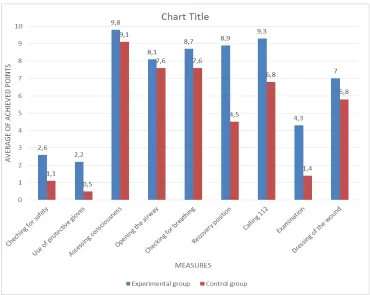
Figure 1 shows the average number of points achieved for each measure in the experimental (first-aid training included scenarios) and control (in the first-aid training scenarios were not included) group. The lowest average score was 0.5 and the highest 9.8.
points were also collected in checking for safety – students from the experimental group collected 2.6 points on average and students from the control group 1.1 points.
Fig. 1.The average number of points achieved in the experimental and control group.
4.2 The data obtained through questionnaire
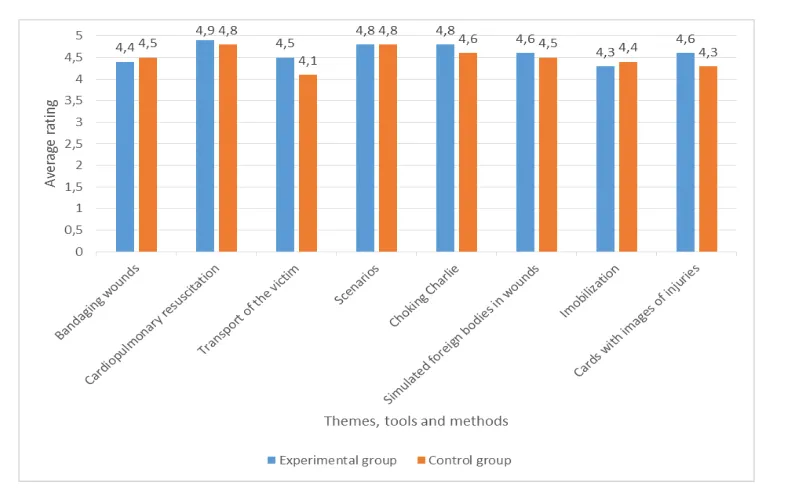
Students could rate the themes, tools and methods with minimum rating 1 and maximum 5. As can be seen from Figure 2, students have evaluated cardiopulmonary resuscitation and scenarios with the most points. The cardiopulmonary resuscitation was evaluated by the students of experimental group with an average score of 4.9 and by the students of control group with an average score of 4.8. The scenarios were evaluated with an average score of 4.8 by both groups.
To the second question (»What do you think about scenario-based training in terms of usefulness? «) students from both groups answered that they think that it is useful for their knowledge.
points were also collected in checking for safety – students from the experimental group collected 2.6 points on average and students from the control group 1.1 points.
Fig. 1.The average number of points achieved in the experimental and control group.
4.2 The data obtained through questionnaire
Students could rate the themes, tools and methods with minimum rating 1 and maximum 5. As can be seen from Figure 2, students have evaluated cardiopulmonary resuscitation and scenarios with the most points. The cardiopulmonary resuscitation was evaluated by the students of experimental group with an average score of 4.9 and by the students of control group with an average score of 4.8. The scenarios were evaluated with an average score of 4.8 by both groups.
To the second question (»What do you think about scenario-based training in terms of usefulness? «) students from both groups answered that they think that it is useful for their knowledge.
All students from the experimental groups and all students from the control group would like to take even more practice using scenarios.
Fig. 2.Average assessment of themes, tools and methods.
Students could only assess the mentioned methods and forms of work with a minimum rating of 1 and a maximum of 5.
As can be seen from Figure 3, students rated the scenarios with the most points. These were assessed with an average rating of 3.9 by students from the experimental group and 4.6 by students in the control group.
[image:5.482.57.428.392.631.2]5 Discussion and conclusion
When first aid is provided, the safety of first aid providers must be always considered. It may happen that the rescuer gets injured or ill, and then he or she cannot help. Before they come to the victim they must be convinced that they are not at risk or they must eliminate the risk [37]. As can be seen from Figure 1, students from both the experimental and the control group got a few points on average. Only a few students have checked whether it is safe to come near the victim and then properly eliminated the danger (electric cable) – 7 students from the experimental group and 4 students from the control group. Some students just said that they would check for safety before helping the victim, but they did not do it or they did not notice the electric cable and remove it. Some of the students noticed the electric cable later when they were already providing first aid. Some of them noticed the cable but did not properly remove it with a non-conductive object. The obtained data is a little bit worrying. We would like to have a greater proportion of students who would properly check for safety, as in a real situation serious injuries could have occurred. The analyses of work of Civil Protection and Red Cross first aid teams also show insufficient safetycare so it would be sensible to prepare more casualty simulations, focusing on safety precautions [38,39].
Only a few students have thought about using protective gloves (six students from the experimental group and two students from the control group). Protective gloves prevent direct contact of the rescuer with the injured person (with blood and body fluids) [40], and are very important when providing first aid – because of the rescuer's protection and the protection of injured person. The main reason for forgetting to put on protective gloves as stated by students was that they forgot about them in panic, but they would definitely use them in the real situation.
When assessing consciousness, students performed much better. Most of them gently shaked the victim, asked if they are OK, and they also called for help as it is recommended in the latest resuscitation guidelines [21].
When opening the airway and checking for breathing some of the students had some problems because they did not tilt the head back enough or were not checking the breathing for enough time. The most common cause for airway obstruction in the unconscious person are the loose throat muscles that are restricting the flow of air. The head-tilt/ chin-lift maneuver can enable the victim to breathe, therefore it is crucial that is performed correctly [40].
When putting the victim into the recovery position, the students from the experimental group got more points on average, while the students from the control group had some problems with this measure. Some of them first applied a bandage or called 112, and then placed the victim in the appropriate position, which does not correspond to the correct sequence of measures, as the injured person can stop breathing while the rescuer is calling an ambulance. Some of the students turned the victim in the opposite direction (away from themselves) or were handling the victim roughly. Some of the students placed the injured person in an adequate and very stable position, but at the end they did not tilt the victim's head back to open their airway.
The examination of the injured person was generally performed more negligently and the wound was mostly noticed by coincidence. Some of the students rinsed the wound, some cooled it and then used the Aluplast Swab, most of them applied a sterile gauze swab and attachedit with a bandage, as recommended by Ahčan [41]. Some students did not notice the wound.
5 Discussion and conclusion
When first aid is provided, the safety of first aid providers must be always considered. It may happen that the rescuer gets injured or ill, and then he or she cannot help. Before they come to the victim they must be convinced that they are not at risk or they must eliminate the risk [37]. As can be seen from Figure 1, students from both the experimental and the control group got a few points on average. Only a few students have checked whether it is safe to come near the victim and then properly eliminated the danger (electric cable) – 7 students from the experimental group and 4 students from the control group. Some students just said that they would check for safety before helping the victim, but they did not do it or they did not notice the electric cable and remove it. Some of the students noticed the electric cable later when they were already providing first aid. Some of them noticed the cable but did not properly remove it with a non-conductive object. The obtained data is a little bit worrying. We would like to have a greater proportion of students who would properly check for safety, as in a real situation serious injuries could have occurred. The analyses of work of Civil Protection and Red Cross first aid teams also show insufficient safetycare so it would be sensible to prepare more casualty simulations, focusing on safety precautions [38,39].
Only a few students have thought about using protective gloves (six students from the experimental group and two students from the control group). Protective gloves prevent direct contact of the rescuer with the injured person (with blood and body fluids) [40], and are very important when providing first aid – because of the rescuer's protection and the protection of injured person. The main reason for forgetting to put on protective gloves as stated by students was that they forgot about them in panic, but they would definitely use them in the real situation.
When assessing consciousness, students performed much better. Most of them gently shaked the victim, asked if they are OK, and they also called for help as it is recommended in the latest resuscitation guidelines [21].
When opening the airway and checking for breathing some of the students had some problems because they did not tilt the head back enough or were not checking the breathing for enough time. The most common cause for airway obstruction in the unconscious person are the loose throat muscles that are restricting the flow of air. The head-tilt/ chin-lift maneuver can enable the victim to breathe, therefore it is crucial that is performed correctly [40].
When putting the victim into the recovery position, the students from the experimental group got more points on average, while the students from the control group had some problems with this measure. Some of them first applied a bandage or called 112, and then placed the victim in the appropriate position, which does not correspond to the correct sequence of measures, as the injured person can stop breathing while the rescuer is calling an ambulance. Some of the students turned the victim in the opposite direction (away from themselves) or were handling the victim roughly. Some of the students placed the injured person in an adequate and very stable position, but at the end they did not tilt the victim's head back to open their airway.
The examination of the injured person was generally performed more negligently and the wound was mostly noticed by coincidence. Some of the students rinsed the wound, some cooled it and then used the Aluplast Swab, most of them applied a sterile gauze swab and attached it with a bandage, as recommended by Ahčan [41]. Some students did not notice the wound.
First aid, provided by students during the practical test was satisfactory, with the exception of checking for safety and using protective gloves. In first aid training a great emphasis is given to security and protection, however, according to the results of our
research, these two key aspects of providing first aid should be given an even greater emphasis or should be emphasised in some other way. For example, different scenarios could be used to highlight various hazards (fire, gas, traffic, chemicals, slippery surfaces, danger of explosions…).
As can be seen from Figure 1, students from the experimental group (in which scenarios were used during the training) showed a slightly higher level of knowledge at the practical test in comparison with the students from the control group̶ although the difference was small. The apparent difference is evident in putting the victim in the recovery position and also in examination of the victim (even though the students from both groups performed it quite superficially). We can conclude that pre-training with simulated scenarios is the reason for a better performance in measures of first aid of the students from the experimental group, but there are also some other variables that could affect the results. For example, one of them is the structure of groups. In the sample we included students from different study programmes, and at the same time different knowledge and experience with first aid, which we did not check, but it would likely make a reasonable difference in results. In addition the sample was small and therefore the results can not be generalized.
As can be seen from Figure 2, students from the experimental and control groups prefer the cardiopulmonary resuscitation and scenarios from all listed themes, tools and methods, then Choking Charlie Mannequin for training of the Heimlich abdominal thrust maneuver, and cards with images of realistic injuries. Based on the results obtained, we can conclude that students mostly like more interactive methods, as they can be more actively involved. Within scenarios and while teaching cardiopulmonary resuscitation a story or a description of events is given to students, in order to make it easier and to enable them to better experience the situation. Based on the description of the situation, students are presented with a problem which they must solve. This allows them to be actively involved in the learning process. The importance and effectiveness of this is highlighted by many researches, as it helps them to achieve better results in terms of knowledge and skills [5,7].
Based on the results of the second and third question, students think that scenario-based training is a useful method for learning and they would like this method to be used more often. Bellack [42] emphasizes that it is very important to take into account the opinions and wishes of students about the methods of teaching which they want to be used, and select the ones that are the most appropriate for them. Therefore, the data obtained is very important as it indicates that it would be reasonable to include more simulated scenarios in first aid training.
From Figure 3 it can be seen that the students from the experimental and control group prefer scenarios, then follow practical exercises on models, demonstration and, finally, conversation and explanation. At this question students had to classify the methods and forms of work (and not to evaluate them as at the first question), which is why the difference is more noticeable. The results show that, in comparison with traditional teaching methods (such as, for example, explanation), students are more interested in active methods of work, including simulated scenarios.
References
1. International Federation of Red Cross and Red Crescent Societies. International first aid and resuscitation guidelines 2016. Geneva. Accessed via: http://www.ifrc.org/Global/Publications/Health/First-Aid-2016-Guidelines_EN.pdf (2016)
2. J. Lippmann, P. Livingston, M. Craike, Health Educ J,70, 2 (2011)
3. B. A. LaVelle, J. J. McLaughlin, Simulation-based education improves patient safety in ambulatory care. In: K. Henriksen, J. B. Battles, M. A. Keyes, M. L. Grady, Advances in patient safety: new direction and alternative approaches. Rockville: Agency for Healthcare Research Quality, 225–244 (2008)
4. R. Clemow, Nurse Educ Today,27, 1 (2007) 5. K. Jakee, Int J Teach Learn High Educ,23, 1 (2011)
6. G. Norton, M. Taylor, T. Stewart et al., Australas J Educ Technol,28, 7 (2012) 7. R. S. Rosa, G. J. C. Sanches, I. C. R. Gomes, M. L. M. Silva, A. C. Santos Duarte, R.
N. S. Boery, J Nurs,11, 2 (2017)
8. F. Lateef, J Emerg Trauma Shock,3, 4 (2010)
9. B. Žvanut, S. Jurgec, I. Karnjuš, Obzor Zdr N 47, 1 (2013)
10. K. Edgecombe, P. Seaton, K. Monahan, S. Meyer, S. LePage, G. Erlam, Clinical simulation in nursing: a literature review and guidelines for practice. Wellington: Ako Aotearoa.
Accessed via: https://akoaotearoa.ac.nz/download/ng/file/group-6261/clinical-simulation-in-nursing-a-literature-review-and-guidelines-for-practice.pdf(2013) 11. E. A. Hunt, M. Fiedor- Hamilton, W. J. Eppich, Pediatr Clin N Am,55, 4 (2008) 12. C. Arthur, T. Levett-Jones, A. Kable, Nurse Educ Today,33, 11 (2013)
13. T. Valler- Jones, R. Meechan, H. Jones, Br J Nurs,20, 10 (2011) 14. K. T. Waxman, J Nurs Educ,49, 1 (2010)
15. I. Karnjuš, P. Pucer, Obzor Zdr N,46, 1 (2012) 16. A. H. Al-Elq, J Family Community Med,17, 1 (2010) 17. G. D. Perkins, Resuscitation,73, 2 (2007)
18. D. Tschannen, M. Aebersold, E. McLaughlin, J. Bowen, J. Fairchld, J Nurs Educ Pract,2, 3 (2012)
19. J. McCallum, Nurse Educ Today,27, 8 (2007)
20. J. Mikkelsen, M. Hegg Reime, A. K. Harris, Nurse Educ Today,28, 664–671 (2008) 21. P. Gradišek, M. Grošelj Grenc, A. Strdin Košir et al., Smernice za oživljanje 2015
Evropskega reanimacijskega sveta. 1. izd. Ljubljana: Slovensko združenje za urgentno medicino.
Accessed via: http://www.szum.si/media/uploads/files/ERC_2015_slo-1.pdf(2015) 22. U. Kovačič, D. Slabe, eds., Mednarodne smernice za prvo pomoč in oživljanje 2011.
Ljubljana: Rdeči križ Slovenije, 112–113 (2013)
23. J. A. Cannon-Bowers, Curr Opin Anaesthesiol,21, 6 (2008) 24. K. A. Yaeger, J. M. R. Arafeh, J Perinat Neonat Nurs,22, 2 (2008)
25. S. Erol, A. Jäger, P. Hold, K. Ott, W. Sihn, Procedia CIRP,54, 13–18 (2016) 26. S. S. Yetik, H. I. Akyuz, H. Keser, Turk Online J Distance Educ,13, 2 (2012)
27. R. Sorin, E. Errington, L. Ireland, A. Nickson, M. Caltabiano, Journal of the NUS Teaching academy,2, 4 (2012)
28. T. Zakšek, Obzor Zdr N,42, 3 (2008) 29. R. Clark, T+D,63, 1 (2009)
30. P. Moule, A. Wilford, R. Sales, L. Lockyer, Nurse Educ Today,28, 7 (2008) 31. E. P. Errington, Int J Interdiscip Soc Sci,3, 3 (2008)
References
1. International Federation of Red Cross and Red Crescent Societies. International first aid and resuscitation guidelines 2016. Geneva. Accessed via: http://www.ifrc.org/Global/Publications/Health/First-Aid-2016-Guidelines_EN.pdf (2016)
2. J. Lippmann, P. Livingston, M. Craike, Health Educ J,70, 2 (2011)
3. B. A. LaVelle, J. J. McLaughlin, Simulation-based education improves patient safety in ambulatory care. In: K. Henriksen, J. B. Battles, M. A. Keyes, M. L. Grady, Advances in patient safety: new direction and alternative approaches. Rockville: Agency for Healthcare Research Quality, 225–244 (2008)
4. R. Clemow, Nurse Educ Today,27, 1 (2007) 5. K. Jakee, Int J Teach Learn High Educ,23, 1 (2011)
6. G. Norton, M. Taylor, T. Stewart et al., Australas J Educ Technol,28, 7 (2012) 7. R. S. Rosa, G. J. C. Sanches, I. C. R. Gomes, M. L. M. Silva, A. C. Santos Duarte, R.
N. S. Boery, J Nurs,11, 2 (2017)
8. F. Lateef, J Emerg Trauma Shock,3, 4 (2010)
9. B. Žvanut, S. Jurgec, I. Karnjuš, Obzor Zdr N 47, 1 (2013)
10. K. Edgecombe, P. Seaton, K. Monahan, S. Meyer, S. LePage, G. Erlam, Clinical simulation in nursing: a literature review and guidelines for practice. Wellington: Ako Aotearoa.
Accessed via: https://akoaotearoa.ac.nz/download/ng/file/group-6261/clinical-simulation-in-nursing-a-literature-review-and-guidelines-for-practice.pdf(2013) 11. E. A. Hunt, M. Fiedor- Hamilton, W. J. Eppich, Pediatr Clin N Am,55, 4 (2008) 12. C. Arthur, T. Levett-Jones, A. Kable, Nurse Educ Today,33, 11 (2013)
13. T. Valler- Jones, R. Meechan, H. Jones, Br J Nurs,20, 10 (2011) 14. K. T. Waxman, J Nurs Educ,49, 1 (2010)
15. I. Karnjuš, P. Pucer, Obzor Zdr N,46, 1 (2012) 16. A. H. Al-Elq, J Family Community Med,17, 1 (2010) 17. G. D. Perkins, Resuscitation,73, 2 (2007)
18. D. Tschannen, M. Aebersold, E. McLaughlin, J. Bowen, J. Fairchld, J Nurs Educ Pract,2, 3 (2012)
19. J. McCallum, Nurse Educ Today,27, 8 (2007)
20. J. Mikkelsen, M. Hegg Reime, A. K. Harris, Nurse Educ Today,28, 664–671 (2008) 21. P. Gradišek, M. Grošelj Grenc, A. Strdin Košir et al., Smernice za oživljanje 2015
Evropskega reanimacijskega sveta. 1. izd. Ljubljana: Slovensko združenje za urgentno medicino.
Accessed via: http://www.szum.si/media/uploads/files/ERC_2015_slo-1.pdf(2015) 22. U. Kovačič, D. Slabe, eds., Mednarodne smernice za prvo pomoč in oživljanje 2011.
Ljubljana: Rdeči križ Slovenije, 112–113 (2013)
23. J. A. Cannon-Bowers, Curr Opin Anaesthesiol,21, 6 (2008) 24. K. A. Yaeger, J. M. R. Arafeh, J Perinat Neonat Nurs,22, 2 (2008)
25. S. Erol, A. Jäger, P. Hold, K. Ott, W. Sihn, Procedia CIRP,54, 13–18 (2016) 26. S. S. Yetik, H. I. Akyuz, H. Keser, Turk Online J Distance Educ,13, 2 (2012)
27. R. Sorin, E. Errington, L. Ireland, A. Nickson, M. Caltabiano, Journal of the NUS Teaching academy,2, 4 (2012)
28. T. Zakšek, Obzor Zdr N,42, 3 (2008) 29. R. Clark, T+D,63, 1 (2009)
30. P. Moule, A. Wilford, R. Sales, L. Lockyer, Nurse Educ Today,28, 7 (2008) 31. E. P. Errington, Int J Interdiscip Soc Sci,3, 3 (2008)
32. M. Steinbuch, Ujma, 26, 238–242 (2012)
33. D. Van Niekerk, C. Coetzee, D. Botha et al., J Homel Secur Emerg Manag, 12, 1 (2014)
34. M. A. Cantrell, Clin Simul Nurs,4, 2 (2008) 35. K. T. Dreifuerst, Nurs Educ Perspect,30, 2 (2009)
36. J. B. Moats, T. J. Chermack, L. M. Dooley, Adv Dev Hum Resour,10, 3 (2008) 37. D. Vlahovič, Pristop k poškodovancu ali nenadno obolelemu. In: Prva pomoč:
priročnik za bolničarje. Ljubljana: Rdeči križ Slovenije (2008)
38. D. Slabe, L. Kosec, D. Horvat, R. Šutanovac, Ujma, 23, 196–204 (2009) 39. D. Slabe, L. Kosec, D. Horvat, J. Melanšek, Ujma,26, 222–229 (2012) 40. D. Slabe, I. Šterbenc, Obzor Zdr N,45, 1 (2009)
41. U. G. Ahčan, Celostna obravnava opeklinskih poškodb. In: Prva pomoč: priročnik za bolničarje. Ljubljana: Rdeči križ Slovenije (2008)