THE FLORIDA STATE UNIVERSITY
COLLEGE OF ARTS AND SCIENCES
A Modular Data Pipelining Architecture (MDPA) for enabling
Universal Accessibility in P2P Grids
by
Sangmi Lee
A Dissertation submitted to the
Department of Computer Science
in partial fulfillment of the
requirements for the degree of
Doctor of Philosophy
Degree Awarded: Summer Semester, 2003
The members of the Committee approve the dissertation of Sangmi Lee defended on July, 3, 2003.
Gordon Erlebacher
Professor Directing Dissertation
Larry Dennis
Outside Committee Member
Geoffrey C. Fox Committee Member
Gregory Riccardi Committee Member
Robert A. van Engelen Committee Member
ACKNOWLEDGMENTS
I would like to thank all those that have offered me their support and encouragement while working on this thesis.
In particular I would like to acknowledge the inspiration and guidance given to me by Professor Geoffrey Fox, supervisor of my research during my graduate studies. He gave me a lot of opportunities to work on great research issues and inspired me with his brilliant ideas. As time goes by, my appreciation for him will be deeper and deeper. I would like to thank my advisor Professor Gordon Erlebacher for his support me during my Ph.D.
I strongly appreciate the support and patience of my father, Kwang-Ho, who encouraged me in every step of my graduate studies. I would like to thank my mother, Jung-Ji who has been the best listener for every new approach and idea that I discussed with her while paying a huge amount for these international calls. I’d also like to thank my brother, Sangwoo for his support during my hard time.
TABLE OF CONTENTS
List of Figures……….……….……...……….………... viii
List of Tables………...……….………..x
Abstract………..………...……… xi
Chapter 1 INTRODUCTION...1
1.1 Introduction ...3
1.2 Key concepts of Peer-to-Peer Grids and Enabling Technologies ...6
1.3 Building a Distributed Service within a Peer-to-Peer Grids Concept ...9
1.4 Motivations behind MDPA ...10
1.5 Research Objectives ...13
1.6 Author’s Contributions...14
1.7 Dissertation roadmap...15
Chapter 2 BACKGROUND...17
2.1 Classical Software Architectures for Presentation Generation in User Interactive Services...18
2.1.1 PAC-Amodeus architecture...18
2.1.2 Model-View-Controller architecture...20
2.2 Approaches to Adapt New Devices...21
2.2.1 Proxy based Architectural Approaches ...21
2.2.2 Standards for Heterogeneous Environments ...22
2.2.3 Incorporating with Transcoding Technologies ...24
2.3 Challenges posed by Web service Architecture ...26
2.4 Summary...28
Chapter 3 MODULAR DATA PIPELINING ARCHITECTURE ...29
3.1 Architecture Overview ...31
3.1.1 Data source (DAT) ...32
3.1.2 Control Logic (CTL) ...32
3.1.3 Document Transformer (DTX) ...32
3.1.4 Presentation Client (PCL) ...33
3.1.5 Minimal Client (MCL) ...33
3.2 Event Processing ...34
3.2.1 Data flow of Event Processing ...34
3.3 Architecture of a Stage ...40
3.4 Modularization and Packaging ...42
3.5 Web Service Approach to MDPA ...43
3.5.1 Dataflow in Web service ...44
3.5.2 Deployment of MDPA within Web service infrastructure...45
3.5.3 Packaging of Stages as Web service ...46
3.6 Summary...47
Chapter 4 MODELING MDPA ...49
4.1 Modeling MDPA ...50
4.1.1 Architectural Pattern of “Pipes and Filters”...51
4.1.2 Representation with PT-nets ...53
4.1.3 Definition of Modular PT-nets...55
4.2 Event Processing in MDPA...57
4.3 Definition of a Service with MDPA...59
4.3.1 Interface of MDPA...59
4.3.2 Basic Stage Managements...60
4.3.3 The MCL stage...62
4.3.4 The PCL stage ...65
4.3.5 The DTX stage ...66
4.3.6 The CTL stage...68
4.3.7 The DAT stage ...69
4.3.8 A service in MDPA ...71
4.4 Analysis of Design MDPA...72
4.5 Summary...74
Chapter 5 AGGREGATION AND COLLABORATION WITH MDPA BASED SERVICES ...75
5.1 Aggregating of Services ...77
5.2 Collaboration models and Interoperability in MDPA ...79
5.2.1 Shared Display Model...81
5.2.2 Shared Output Port Model...83
5.2.3 Shared Input Port Model ...85
5.3 Summary...86
Chapter 6 INCORPORATING CONTENT ADAPTATION STRATEGIES TO ENABLE EFFicIENT INTERACTION ...88
6.1 Adapting Content...89
6.2 Application -aware Transcoding ...90
6.2.1 Measuring Fidelity of Shared Information...92
6.2.2 Transcoding in Shared Display ...93
6.3 Summary...97
Chapter 7 DEPOYING MDPA AS WEB SERVICES: CAROUSEL WEB SERVICE ...98
7.1 The CAROUSEL Web Service ...100
7.1.1 Content servers...102
7.1.2 Event service ...103
7.1.3 Client application ...104
7.1.4 Aggregator...105
7.2 Universal Access in Carousel Web service ...105
7.3 Content Adapting in CAROUSEL Web service...107
7.3.1 Workflow of CAROUSEL Web Service...108
7.3.2 Message filtering for heterogeneous devices ...110
7.4 Network Communication issues in CAROUSEL Web service (Security, Reliability, Fault Tolerance)...111
7.5 Summary...113
Chapter 8 CONCLUSION ...115
8.1 Contributions ...116
8.2 Future works...118
8.2.1 User Interface ...118
8.2.2 Intelligent Messaging Middleware...118
8.2.3 Deployment with OGSI...119
8.2.4 Extending Adaptability to Wearable Devices ...120
BIBLIOGRAPHY ……….………...… 121
List of Figures
Figure 1.1 A Peer-to-Peer Grid... 8
Figure 1.2 Middleware Peer Groups of Services at the “edge” of the Grid... 9
Figure 2.1 Arch model ... 18
Figure 2.2 The MVC architecture... 20
Figure 2.3 WebSphere portal and transcoding technology... 25
Figure 2.4 Service Oriented Architecture of Web Services... 27
Figure 3.1 Object Processing in Distributed System ... 29
Figure 3.2 Object pipelining in MDPA... 32
Figure 3.3 Event processing in MDPA with an example of SVG ... 35
Figure 3.4 Event Filtering for Heterogeneous Customization of User Presentations... 36
Figure 3.5 Data flow of SVG example ... 37
Figure 3.6 Dataflows in Different Event types ... 39
Figure 3.7 Architecture of a Stage in MDPA with dataflow of CTL event... 41
Figure 3.8 Dataflow in Web service ... 44
Figure 3.9 Input and Output Port Defining in Web service for MDPA... 45
Figure 3.10 Various Styles of Packaging Stages with Web service infrastructure... 47
Figure 4.1Two modules Sharing Transition ... 55
Figure 4.2 Classifications of events in MDPA ... 58
Figure 4.3 Stages and Interface of MDPA... 59
Figure 4.4 Defining Interface with Fusing Transitions... 60
Figure 4.5 Possible dataflows in a stage ... 62
Figure 4.6 PTMCL : MCL stage with PT-net... 63
Figure 4.7 PTPCL : PCL stage with PT-net... 64
Figure 4.8 PTDTX : DTX stage with PT-net... 67
Figure 4.9 PTCTL : CTL stage with PT-net... 68
Figure 4.10 PTDAT : DAT stage with PT-net... 70
Figure 5.1 Collaboration in Heterogeneous Environments... 76
Figure 5.2 Aggregating Dataflow of Generating Presentation ... 78
Figure 5.4 Collaboration with Shared Output Model ... 84
Figure 5.5 Collaboration with Shared Input model ... 87
Figure 5.6 Deploying Collaboration model as Web Service ... 99
Figure 5.7. Shared Input model as Web service ... 100
Figure 5.8 Architecture of the CAROUSEL Web service... 103
Figure 6.1 Dataflow in CAROUSEL Web service to support Universal Access... 106
Figure 6.2 Workflow of Setup session in the CAROUSEL Web service... 108
Figure 6.3 Setup session and collaborative browser... 109
Figure 6.4 Sharing remote content adapting technologies... 90
Figure 6.5 400 % Zoom in Images in Bitmap and Vector graphics ... 95
Figure 6.6 Styling with CSS for Black and White PDAs ... 96
Figure 6.7 Object flow of collaborative SVG... 97
List of Tables
ABSTRACT
The enormous growth in wireless communications and miniaturized handheld devices in the last few years, have given rise to a vast range of new services for heterogeneous user environments. The concept of a Peer-to-Peer (P2P) Grid has extended traditional distributed services to accommodate diverse user devices, resources sharing environments and higher level services. In traditional multi-tier distributed services, services have generally been designed for accessing back-end resources and middleware without taking into consideration the display and networking capabilities of clients. Current developments in the design of miniature devices, their growing compute, display and communication capabilities, combined with their increasing ubiquity in day-to-day life mandate a paradigm shift in the way services are designed.
can potentially be deployed for Web-based collaborative application in P2P Grid environments. Second, MDPA provides a modular approach to this problem which can be expanded incrementally to deal with future changes in the nature of these devices. Third, although this thesis has been organized in the context of device capabilities, some of the ideas could be extended to deal with changing protocol, transport and communication standards in other network centric communication environments.
We also introduce how we deploy the software architecture for the P2P Grid represented with Web service semantics. We also present a Universally Accessible Web service architecture, CAROUSEL Web service, which is our collaborative Grid service
CHAPTER 1
INTRODUCTION
The explosive growth of the wireless network in the last few years and emergence of new devices has given rise to a vast range of new services for the heterogeneous user environment. The concept of Peer-to-Peer (P2P) Grid [Fox+02a] allows the distributed system to accommodate the diverse user devices and higher level of services. Hitherto, traditional multi-tier distributed services have generally been designed considering only back-end resources and middleware. The computing, display and networking capabilities of clients were not taken into consideration. Clients were expected to meet a set of explicit, and sometimes implicit, constraints prior to utilizing the service. The current developments in the design of miniature devices, their growing compute, display and communication capabilities, combined with their increasing ubiquity in day-to-day life mandate a paradigm shift in the way services are designed. We suggest that the nature and capabilities of these devices be factored in, into the design of services. Doing so would enable the service to cope with the ever-changing landscape of pervasive devices for P2P Grid architecture.
addressed the separation of data and user view, in addition, enabled multiple views to be rendered individually from the data and communicate each other synchronously. The enormous approaches followed such as the Presentation-Abstraction-Control (PAC) model [Coutaz+87] and Arch model [Bass+92]. Also various software architectures combined multiple conceptual models have been appeared [Dewan+95, Coutaz+97]. The paradigm of separation with data and user presentation is deployed in current software architectures designed for scientific visualizations [Brodlie+96], and also web-based applications [Shaeck+02, Arsanjani+02]. Nevertheless, existing software architectures do not adequately meet the needs of pervasive collaboration services in P2P Grid. In design of collaborative services supporting heterogeneous devices, there are various requirements should be considered. For instance, multi-functional collaborative services such as require more general software architecture to define and extend their features flexibly including asynchronous/synchronous collaboration. Also it expects to adapt heterogeneous user devices and resources. Software architectures designed for specific system such as scientific visualization is not suitable for general purpose services. Meanwhile, classical conceptual patterns are not enough to define current sophisticated distributed services which have multiple steps of data processing for user presentation, although the basic concepts of them offer good basis for structure new software architecture.
In this thesis, we propose software architecture, called the Modular Data Pipelining Architecture (MDPA), which inherits the idea of separating user presentation from data, and refines data processing as stages of the pipeline for Web-based collaborative application in P2P Grid environments. MDPA provides more extensibility and interoperability to P2P Grid. Therefore, it enables P2P Grid to support heterogeneous user devices with flexible resource accessing. MDPA supports collaboration between users with various flexibility of resource sharing.
standards based approach to building, composing, registering and discovering services [Hoscheck+02].
The impact and scope of this thesis are at three distinct levels. First, it suggests changes in the way services are designed. Second, it outlines a modular approach to this problem which can be expanded incrementally to deal with future changes in the nature of these devices. Finally, although this thesis has been organized in the context of device capabilities, some of the ideas of this thesis could be extended to deal with changing protocol, transport and communication standards with its software architectural idea.
1.1
Introduction
The portability of new miniaturized devices, together with their ability to connect conveniently to networks in different places, makes mobile and ubiquitous computing possible. Mobile computing is the capability to perform computing tasks while a user is on the move, or visiting places other than the usual environment [Coulouris+01]. Similarly, ubiquitous computing is the harnessing of many small, cheap computational devices that are present in users’ physical environments, including the home, office and elsewhere. The term ‘ubiquitous’ is intended to suggest that small computing devices will eventually become so pervasive in everyday life that they are scarcely noticed. That is, their computational behavior will be transparently and intimately tied up with their physical function. There are several traditional approaches to mobile computing, such as, mobile agents, network computers, or thin-client concept as variations of the traditional client-server model. These approaches are considered by the system developers, based on their characteristics and constraints of services.
portal service approach. However, these services have evolved to encompass richer services in real time environment.
Distributed services for mobile devices over the Internet are getting increasingly sophisticated and networked resources are innovatively utilized. The resources in distributed services include database accesses, online services, remote file services, and search and subsequent discovery of a communal resource located on another computer. Emergence of new network communication architectures has influenced resource utilization. The most significant innovative architectures are the emergence of these Peer-to-Peer technologies and Grid systems.
The Grid [Grid, GridWG, Foster+98, Globus] has made dramatic progress recently with impressive technology and several large important applications initiated in high-energy physics [PhysicsGrid, IVDGL], earth science [NEES, SCEC] and other areas [Johnston+00, Fusion]. At the same time, there have been equally impressive advances in broadly deployed Internet technology. We can cite the dramatic growth in the use of XML, the "disruptive" impact of peer-to-peer (P2P) approaches [Oram+01] that have resulted in a slew of powerful applications and the more orderly, but still widespread, adoption of a universal Web Service approach to Web-based applications [Booth+03, Christensen+01]. There are no crisp definitions of Grids and P2P Networks that allow us to unambiguously discuss their differences and similarities and what it means to integrate them. However these two concepts conjure up stereotype images that can be compared. Taking "extreme" cases, Grids are exemplified by the infrastructure used to allow seamless access to supercomputers and their datasets. P2P technology facilitates sophisticated resource sharing environments between "consenting" peers over the "edges" of the Internet, enabling ad hoc communities of low-end clients to advertise and access resources on communal computers. Each of these examples offers services but they differ in their functionality and style of implementation.
organizations. P2P networks are often used when a best effort service is needed in a dynamic poorly structured community. If one needs a particular "hot digital recording", it is not necessary to locate all possible sources; a P2P network need only search enough plausible resources to ensure that success is statistically guaranteed. On the other hand, a 3D simulation of the universe might need to be carefully scheduled and submitted in a guaranteed fashion to one of the handful of available supercomputers that can support it. There are several attractive features in the P2P model, which motivate the development of hybrid systems. Deployment of P2P systems is entirely user driven obviating the need for any dedicated management of these systems. Resource discovery and management is an integral part of P2P computing with peers exposing the resources that they are willing to share and the system (sometimes) replicates these resources based on demand. Grids might host different persistent services and they must be able to discover these services and the interfaces they support. Peers can form groups with the fluid group memberships and are thus very relevant for collaboration [Fox+02]. This is an area that has been addressed for the Grid in [Grid] and also in a seminal paper by Foster and collaborators [Foster+98] addressing broad support for communities.
science or commodity communities, information systems should support both Grid and P2P capabilities. The proposed P2P grid, which integrates the evolving ideas of computational grids, distributed objects, web services, P2P networks and message oriented middleware, comprises resources such as relatively static clients, high-end resources and a dynamic collection of multiple P2P subsystems. We investigate the architecture, comprising a distributed brokering system that will support such a hybrid environment. Services can be hosted on such a P2P grid with peer groups managed locally and arranged into a global system supported by core servers. Access to services can then be mediated either by the "broker middleware" or alternatively by P2P interactions between machines "on the edge". The relative performance of each approach (which could reflect computer/network cycles as well as the existence of firewalls) would be used in deciding on the implementation to use. P2P approaches best support local dynamic interactions; the distributed broker approach scales best globally but cannot easily manage the rich structure of transient services, which would characterize complex tasks. Such P2P Grids should seamlessly provide services and resources to users, which are also linked to each other. We can abstract such environments as a distributed system of "clients" that consist either of "users" or "resources" or proxies thereto. These clients must be linked together in a flexible fault tolerant, efficient, high performance fashion. The messaging infrastructure linking clients (both users and resources of course) would provide the backbone for the P2P grid.
Peer-to-Peer Grids allow heterogeneous user devices to share resources over the edge of the infrastructure. Dealing with heterogeneity in devices, and addressing scaling in this should be inherent in the design decisions for the P2P Grid.
1.2
Key concepts of Peer-to-Peer Grids and Enabling
Technologies
WSDL (Web Services Definition Language) [Christensen+01]. This allows “traditional approaches” like CORBA [Scallan] or Java [SUN] to be used “under-the-hood” with an XML [Bray+00] wrapper providing a uniform interface. As another key concept of P2P Grid, we consider resources accessible via the Internet. W3C defines any “object” labeled by a URI (Universal Resource Identifier) as a resource, whether an external or internal entity [Berners-Lee+98]. This includes not only macroscopic constructs like computer programs or sensors but also their detailed properties. One can consider the URI as the barcode of the Internet. There are also of course URLs (Universal Resource Locations) that indicate location. One can equate these two concepts (URI and URL). Although inadvisable in principle, it is of course common practice.
Finally, the environments of Peer-to-Peer Grids are built on top of a service model. A service is an entity that accepts one or more inputs and gives one or more results. These inputs and results are the messages that characterize the system. Within the context of WSDL [Christensen+01], the inputs and outputs of services are defined as input and output ports as components of the Web services.
Database
Database Event/
Message Brokers
Event/ Message
Brokers
Event/ Message
Brokers Peer-to-Peer
Peer-to-Peer Peer-to-Peer
Peer-to-Peer
Figure 1.1 A Peer-to-Peer Grid
There are several important technology research and development areas, upon which the above infrastructure builds namely,
• Basic system capabilities are packaged as Web Services [Booth+03]. These include security, access to computers (job submittal, status etc.) and access to various forms of databases (information services), including relational systems, LDAP [Yeong+95], and XML databases/files. Network-wide search techniques about web services or the content of web services could also be included here.
• The messaging sub-system between resources that provide addressing functionality, performance and fault-tolerance [Pallickara+03a].
• Toolkits that enable applications to be packaged as interoperable distributed services and “libraries” or more precisely components. Near-term targets include areas like image processing used in virtual observatory projects or gene searching used in bio-informatics [Globus].
• Application meta-data needed to describe all stages of the scientific endeavor.
• Higher-level and value-added system services such as network monitoring, collaboration and visualization.
• Aggregator for integrating multiple distributed services and defining the user’s display, which accepts user customization and delivers user interfaces [Jetspeed, Websphere].
Grid Middleware
Database
Database
Middl
ew
ar
e
P
eer
Gr
o
u
p
Middleware Peer Group Middleware Peer Group
Mi
d
d
le
wa
re
Pee
r Group
Grid Middleware
Grid Middleware
Grid Middleware
Figure 1.2 Middleware Peer Groups of Services at the “edge” of the Grid
1.3
Building a Distributed Service within a Peer-to-Peer Grids Concept
tasks. Figure 1.2 shows Grids control central services while “services at the edge” are grouped into less organized “middleware peer groups”. Often one associates P2P technologies with clients but in a unified model, they provide services, which are part of the middleware. As an example, one can use the JXTA search [SUN+03] to federate middle tier database systems; this dynamic federation can use either P2P or more robust Grid security mechanisms.
We can ask if this new approach to distributed system infrastructure affects key hardware and software infrastructure, and their performance requirements. First we present some general remarks. Servers tend to be highly reliable these days [Fox+02 a]. Typically, they run in controlled environments, but also their software can be proactively configured to ensure reliable operation. One expects servers to run uninterrupted for months and often one ensures that they are modern hardware configured for the job at hand. Clients on the other hand can behave quite erratically, with unexpected crashes and network disconnections, as well as sporadic connectively typical of portable devices. Transient data can be stored on clients; however permanent information repositories must beside on servers – here we talk about “logical” servers as we may implement a session entirely within a local peer group of “clients”. Robustness of servers needs to be addressed in a dynamic fashion and on a scale greater than in previous systems. Traditional techniques – replication and careful transaction processing – can probably be extended to handle servers. Realistically, clients are assumed to be both unreliable and sort of outside our control. Some clients will be “antiques” and underpowered and are likely to have many software hardware and network instabilities. In the simplest model, clients “just” act as a vehicle to render information for the user with all the action performed on “reliable” servers.
1.4
Motivations behind MDPA
mobile computing with pervasive devices has emerged as a new computing paradigm. The key enabling technologies are,
• Portable devices: Handheld devices including Personal Digital Assistants (PDAs), laptops, smart phones, pagers, and wearable devices such as JAVA ring, smart watch etc. These devices have diverse computing capabilities such as 66 MHz to 400 MHz, with displays ranging 1bit black and white to over 64K color display. The interactive capabilities include touch screen style interaction with a stylus pointer, small buttons, extensible keyboard, voice recognizing system, etc.
• Wireless and satellite network communication: Reliable wireless network communication such as wireless LAN (802.11b) or 3G network communications, has integrated portable devices integrated to the clients of distributed systems over the Internet. Meanwhile, the use of satellite communication has maximized the advantage of mobile computing; also it is joined with wireless computing and provides high quality of networking services. The current broadband wireless networking service is capable of delivering new services – streaming video, audio, gaming, backup storage, and much more. These network service providers also support various middleware services enabling their clients to access existing information systems.
The favorable effects of increasing capabilities on client devices coupled with falling prices have resulted in widespread use of the devices to access information systems. The distributed services of P2P Grid should consider supporting virtually any device, over a broad range of networks, and allow new applications to be easily built and deployed.
[Scallan], process different types of objects from various computing resources. However the current diversity of user devices requires the data processing that considers the heterogeneity of end user devices as well.
Early efforts include software architectures for user interface, such as the Seeheim model, MVC, and PAC. After these classical models, there have been various advanced approaches in field of user interface design. One of the most active approaches is scientific visualization, which maps raw data set to a graphical form for effective processing by our visual senses. The scientists are well served by a range of powerful systems, such as IRIS Explorer [Brodlie+96], AVS [Upsen+89] and IBM Data Explorer [IBM+02]. These support a visual programming paradigm of Modular Visualization Environments (MVE), which allows the users to select a set of modules to fit together in a pipeline, transforming raw data to geometry and then to images. Also collaborative capability between scientists is considered in their visualization model [Wood+95]. However, since these approaches are focused on a specific task, presenting scientific data, it is not adaptable into general purposed distributed services without modification. Meanwhile, the concept of separation user view from resources is deployed in emerging Web-based service infrastructures [Arsanjani+02, Shaeck+02]. To support various types of collaborative features, P2P Grids require software architecture refined with suitable granularity and a clear definition of process. With the current portal based infrastructure, we cannot describe sophisticated collaborative features, such as message based synchronous collaboration.
1.5
Research Objectives
There are various approaches to universal accessibility to the rich functionalities available in distributed systems. P2P Grids should consider the heterogeneity of environment very carefully. Diversity of network communication is one of the aspects that needs to be considered. The users require seamless access to services over the heterogeneous network environment. Service providers should thus consider the diversity in computing and display capabilities of entities utilizing their services. The capability of computing or displaying is extremely optimized for the characteristics of the devices. In this dissertation, we aim for a universal accessible Peer-to-Peer Grid based on a software architecture.
The goal of this dissertation is to design a generic software architecture that provides:
• Modulated data processing: The distributed services over the P2P Grids infrastructure provides various capabilities such as: accessing database systems, using a super--computing unit for computational purposes, maintaining systems remotely, collaborating with other users, and visualizing data from services etc. The data processing in these different tasks different steps of processing leading up to the task to provide service. MDPA is constructed to define generic data processing that is able to consider heterogeneous user environments and various service tasks including collaboration.
• User Interactivity: If the interprocess communication is for the communication between data processes, we consider communication between users and services. The user interactive system needs the ability to perform the user’s request. The request from the user is understood as a user event in an event-based system. To process event-based distributed services, the new architecture should be able to support communications from both sides: from users to back-end services for delivering user’s requirements, and from the back-end services to the users for showing them the results.
• Universal Accessibility: Adapting to heterogeneous user devices is one of the objectives major in MDPA. Adapting to new environments should be factored into the design of P2P Grid services. Thus, adapting process should be considered even in the design of collaborative features, and it is one of critical factors needed to decide the type of collaboration.
Eventually, the new architecture provides the environment for data processing for heterogeneous clients with diverse devices and supports distributed services including real-time collaboration. This architecture enables the Peer-to-Peer Grid to extend the concept of resources to every heterogeneous computing unit.
We also provide a prototype of this software architecture, which shows the fundamental units and deployment to collaboration models. This prototype also presents how universal accessibility is adapted to this software architecture. Moreover, the prototype will be an example of the implementation over the modern system infrastructure.
1.6
Author’s Contributions
C. Fox in 1999. Since 2000, she has focused on the universal accessibility issue while working on the Garnet message service system developed at Florida State University. Here is the summary of her contributions to this dissertation,
• Designing and modeling of the event model of the MDPA: She defined each event type and did modeling with Petri Net theory.
• Designing and modeling service extensions to MDPA: She designed and modeled the aggregation and collaboration of services using MDPA.
• Designing the architecture of the CAROUSEL Web service [Fox+02d]: As a major designer, she designed the Carousel Web service architecture.
• Implementation a prototype of the CAROUSEL Web service with the collaborative SVG browser [Lee+03a]: As a prototype, she implemented a collaborative Web service, the collaborative SVG browser for heterogeneous user devices.
• Designing and implementing the application sharing features for mobile devices within the Garnet system [Fox+02b, Fox+02c, Lee+02, Lee+03b]. The Garnet system provides application sharing methods, shared Display and shared export. She designed and implemented both these sharing features for mobile users.
• Designing and implementing the user application for GMSME (Garnet Message Service Micro Edition) [Fox+02b]: She designed and implemented features of shared application for the client with GMSME.
1.7
Dissertation roadmap
This dissertation is organized in the following manner:
In chapter 2, we present the background and discuss previous work in data processing of distributed systems. First, we present existing software architectures for processing user presentations. Then, we focus on the accommodation of heterogeneous devices and multi-user interactive systems.
utilize the Filter and Pipes pattern to structure, and Modular PT-net theory to represent, MDPA.
In chapter 5, we discuss the aggregation of services and collaborative services with MDPA. Chapter 6 focuses on incorporating content adaptation strategies in MDPA. We present content adaptation for heterogeneous devices with the demonstrative case study of the Carousel Web Service. Based on the modeling in chapter 5, we present how the services provide collaborative features to users in heterogeneous environments in chapter 7. Also, we describe how we deploy the collaboration models within the Web Service infrastructure. Finally, we present a demonstrative case study with the Web services architecture, the CAROUSEL Web Service.
CHAPTER 2
BACKGROUND
There have been several software architectures for interactive service. These are also known as user interface architectures or user interface management systems. e.g. Seeheim [Phaff+85], PAC-Amodeus [Coutaz+95], Model-View-Controller(MVC) [Goldberg+84]. Most of these architectures are based on the traditional approach of an interactive software, which separates the user interface from the application. The application part processes the task related to the functionality of the service. Meanwhile, the user interface part contains the representation of this functionality to the user(s) of the system.
The principle of separating an interactive service into application and user interface parts has advantages while trying to achieve universal accessibility. Such a scheme provides demarcation of the device dependent part and the functional part of a service. However, the types of devices that can participate in services, which were offered only for traditional desk top systems before, have increased with enhanced capabilities in miniaturized machines and advances in wireless communications. Therefore, the services cannot support the diversity of participants’ devices with the traditional user interface. Finally, there are several efforts to provide the customized services to users who access the service with CPU/bandwidth limited devices, such as supporting adapting content or mobile protocols in a proxy architecture.
traditional architectures. In section 2.3, we describe popular adapting technologies supporting the software architecture for heterogeneous environments. Finally, we introduce the Web service infrastructure briefly in section 2.4. Web Service infrastructure provides interoperability between Web-based applications with its standardized data and interface design. We use the Web service infrastructure for prototyping the MDPA architecture in this dissertation.
2.1
Classical Software Architectures for Presentation
Generation in User Interactive Services
Among the many existing user interface architectures, we discuss the PAC-Amodeus [Coutaz+95] and the MVC [Goldberg+84] architectures. One of the merits of these architectures is that these architectures can be mapped very well onto object-oriented concepts.
2.1.1
PAC-Amodeus architecture
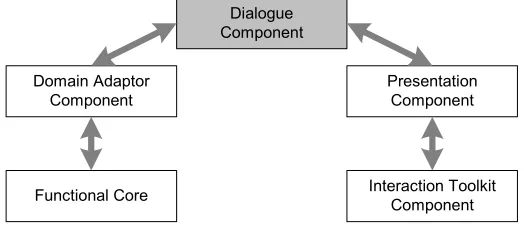
The PAC-Amodeus model [Coutaz+95] is a combination of the Arch model [Bass+98] and the Presentation-Abstraction-Control (PAC) model [Coutaz+87]. The Arch model, which refined the Seeheim model [Phaff+85], distinguishes five components of an interactive service. The structure of the Arch model is shown in Figure 2.1.
Dialogue Component
Interaction Toolkit Component Functional Core
Presentation Component Domain Adaptor
[image:30.612.186.448.573.687.2]Component
The domain-specific component encapsulates the functionality of the system and offers an abstraction of the application semantics. The interaction toolkit component encapsulates the physical interaction, such as the platform-dependent implementation of user interface widgets as well as hardware details. The presentation component provides an abstraction from the interaction toolkit component and provides platform-independence. The dialogue component contains task level sequencing and provides the mapping between domain specific objects and user interface specific objects. The domain adapter component adds domain related behavior to the functional core that is needed by the dialogue component.
There are three kinds of objects depending on the path that it is traversed. The domain object traverses through the dialogue component, domain adapter component, and functional core. The dialogue component and the presentation component exchange presentation objects (abstract, virtual objects representing aspects of interaction). The presentation component and the interaction toolkit component exchange interaction objects.
The Presentation-Abstraction-Control (PAC) model is used [Coutaz+87] for the dialogue component. PAC is a multi-agent model that structures the dialogue component as a hierarchy of interacting agents. For example, an agent can correspond to a window, a group of widgets, or a single widget.
There are three facets in each agent: an abstraction facet, a presentation facet, and a control facet. The abstraction facet contains the data or objects and the presentation facet encapsulates the presentation logic of the agent. The control facet controls the communication between abstraction and presentation and the communication between subordinate and superordinate agents.
2.1.2
Model-View-Controller architecture
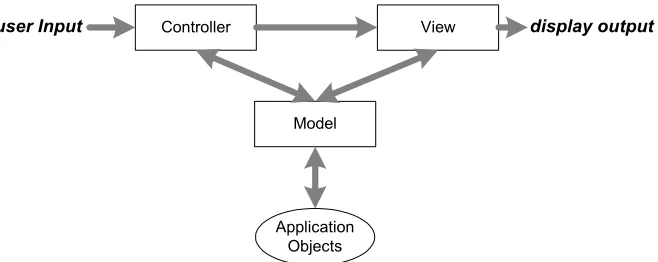
The Model-View-Controller (MVC) architecture is a well-known object-oriented model that has been applied earlier in the Smalltalk environment [Goldberg+84]. As one of three major components, the model represents the underlying information of a specific user interface element. The view displays this information in a certain way, while the controller knows how the user interactions with the view will affect the information in the model. If the model changes, it notifies its view(s) of this change. The model itself is linked to the application objects. The view and the controller are tightly coupled and they are even often combined into a single object. Note that there is a lot of coupling and interdependency in instantiations of the MVC architecture.
Application Objects Controller
Model
View
[image:32.612.156.485.320.451.2]user Input display output
Figure 2.2 The MVC architecture
Figure 2.2 depicts the MVC architecture. The MVC architecture makes multiple synchronized views on the same information possible, which is required in heterogeneous environments. Furthermore, application objects are isolated from changes in the ‘look and feel’ of the user interface. Therefore, it can be an object which is shared in a collaborative service.
2.2
Approaches to Adapt New Devices
Adaptation for data processing for heterogeneous clients has been actively investigated by many research groups. In this subsection, we explore the approaches based on the categories of, proxy based architectures, standardization of data and protocols, and transcoding technologies.
2.2.1
Proxy based Architectural Approaches
One of the most common approaches is developing a proxy-based system for new client environments. Here the client environment includes new hardware, new network communication technology, a new security method and so forth. A proxy is defined as a service representative that resides at the client’s site [Smith+99]. It provides an interface to the service and takes care of the communication protocol with that service. It also takes care of the marshalling of data, checking of the validity of calls, and any other low-level processing, thereby making distribution transparent to the client. Due to this transparency proxies are popular and have been adapted by many distributed systems.
The proxy service provides seamless access from heterogeneous network communication environments. iMobile from AT&T Wireless [Rao+01] is a proxy-based platform, which acts as a message gateway that allows mobile devices using various protocols on different access networks to relay messages to each other.
Moreover, W3C working group called CC/PP (Composite Capabilities/Preferences Profiles) [Reynolds+00] develops a structured and universal format that allows a client device to tell an origin server or proxy about its profile.
The proxy-based architecture has the advantage of being more manageable while providing an easy scheme to extend existing services for heterogeneous devices. However, a proxy may not always be the best place to perform content adaptation. The scheme may entail in efficient bandwidth utilization if a lot of contents downloaded to the proxy are later discarded due to the limited screen size or bandwidth of the receiving device. Furthermore, the content provider may prefer to perform its own transcoding service to fully control the outcome. The Apache Cocoon [Apache+99] project allows the automatic generation of HTML, PDF, and WML files through the processing of statically or dynamically generated XML files using XSL [Adler+01] and XSLT [Kay+03].
2.2.2
Standards for Heterogeneous Environments
With a profound impact of XML [Bray+00], the information over the Internet is powered with the interoperability. An important feature of this language is the separation of presentation from the content, which makes it easier to select and/or reformat the data. XML is used as an extensible syntax for metadata model designed for interoperable information systems. The markup languages derived from XML also inherit this interoperability of XML.
OASIS (formerly SGML Open, the international consortium that has guided the SGML industry since 1993) provides the guidance, process, and infrastructure necessary for e-business framework, Web Services, security, public sector etc [OASIS+03]. There are also several groups developing standards for specific areas: Multimedia Services Affiliate Forum (MSAF) [MSAF], International Digital Enterprise Alliance (IDEAlliance) [IDEAlliance], the European Telecommunications Standards Institute (ETSI) [ETSI], Text encoding initiative (TEI) [TEI], Unicode Consortium [UnicodeConsotium], and American National Standards Institute (ANSI) [ANSI], etc.
For implementers it is as well to remember that there are an awful lot of standards being developed by a very wide range of consortia and official bodies. This has meant that often standards are being developed, by many different groups, for products and services that essentially offer the same functionality.
XML is deployed for developing metadata sets. Berners-Lee defines metadata as “machine understandable information for the web” [Berners-Lee+97]. W3C has developed the Resource Description Framework (RDF) [Lassila+99] and its relative Platform for Internet Content Selection (PICS) [Chu+98]. Dublin Core Metadata Initiative (DCMI) [DCMI] develops interoperable online metadata standards for general purpose of resources. DCMI’s activities include metadata refinements and guidelines for the metadata usage. The idea of metadata to manage the resources on the Web is developed to ontology-based knowledge representation languages. The term ontology is a formal specification of the concepts and relations of some domain. Structuring resources over the Internet is approached with underlying information structure based on metadata represented with XML. The higher lever information structures make it possible for the heterogeneous devices to manage the information content from the distributed system in unified way.
Moreover, the complexity of data processing such as parsing, indexing, or searching documents can overload some of the limited CPU capability handheld devices.
2.2.3
Incorporating with Transcoding Technologies
Transcoding is the process of dynamically mutating and customizing a document based on the characteristics of the requesting device and on the user's preferences. Transcoding is used to convert image or video formats (reduction resolution or data compression). However it is also used to fit document and graphics files to the unique constraints of mobile devices and other Web-enabled products.
Web clipping technology proposed by Palm [Palm+02] initially is now the widespread solution for accessing to Web contents from miniaturized wireless devices. The web clipping architecture includes client-side applications that run on a handheld device, proxy servers for handling translation between the web clipping application format and HTML, and content servers. The client-side application is called a web clipping application. It is constructed in HTML and translated into the web clipping application format. Once this application is installed on a handheld device, content is delivered from the content provider's own web site as a subset of the HTML 3.2 standard. A number of distributed services use the transcoding technology to generate the document for their heterogeneous clients. Duke University’s Quality Aware Transcoding project [Chandra+00] and TranSqui [Maheshwari+01] from University of Massachusetts utilize the transcoding technology in their proxy server and provide accessibility to heterogeneous user devices.
Portal Filter
Portlet Fileter
Portlet
Portal
Aggregator Transcoding
[image:37.612.155.402.138.283.2]Technology
Figure 2.3 WebSphere portal and transcoding technology
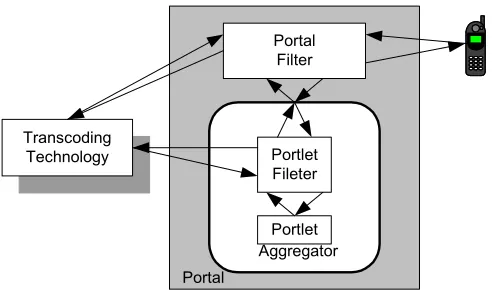
WebSphere Portal invokes transcoding technology at two different levels: the individual portlet level and the full page level as depicted in Figure 2.3. Meanwhile, WebSphere defines the portlets as the visible active components end users see within their portal pages [WebSphere].
The client device makes a request to the portal, which the Portal Filter receives. The Portal Filter calls the WebSphere Portal to receive its contents, which then calls the aggregator to aggregate the page. Then, the aggregator selects the portlets based on a combination of values. If a portlet is configured to be transcoded, and it provides a markup that the Transcoding Technology can use, then it will be selected. The portlet filter calls the portlet to receive its contents. The invoked portlet then returns its contents. The portlet filter sends the portlet’s contents to Transcoding Technology for processing, associating the portlet’s contents with a default URI unless otherwise specified. The Transcoding unit then returns the processed contents to the portlet filter. The portlet filter returns the processed contents as if it were a proper portlet returning contents normally. The aggregator, having finished aggregating the page, returns the page.
architecture as a computing unit and finally the user gets the regenerated document fitted on their environment.
2.3
Challenges posed by Web service Architecture
W3C’s Web service working group defines Web service in [Booth+03],
“A softwareapplication identified by a URI, whose interfaces and bindings are capable of being defined, described, and discovered as XML artifacts. A Web service supports direct interactions with other software agents using XML based messages exchanged via internet-based protocols”
The use of Web Services on the World Wide Web is spreading rapidly, because the need for application-to-application communication and interoperability grows. These Web Services provide a standard means of communication among different software applications, running on a variety of platforms and/or frameworks. Therefore, the Web Services enables us to deploy our software architecture efficiently with its well-defined interfaces and communication strategies in this dissertation.
Web Services is enabled based on the potential for a combination of XML [Bray+00], the Web, the SOAP [Box+00] and WSDL specifications [Christensen+01], and to-be-defined protocol stacks to address many of the problems these technologies have encountered. Compared to previous distributed object systems such as Microsoft’s COM family and the OMG CORBA standard [Scallan], Web Services provides interoperability between processes over the Web.
The Web services infrastructure places into relationship various components and technologies that comprise a Web services “stack” or completely functional implementation. Valid implementations include subsets or parts of the stack, but must at least provide the components within the basic architecture. Components and technologies that extend the basic architecture are represented within the extended architecture.
The basic architecture includes Web services technologies capable of:
• Exchanging messages
• Publishing and discovering Web service descriptions
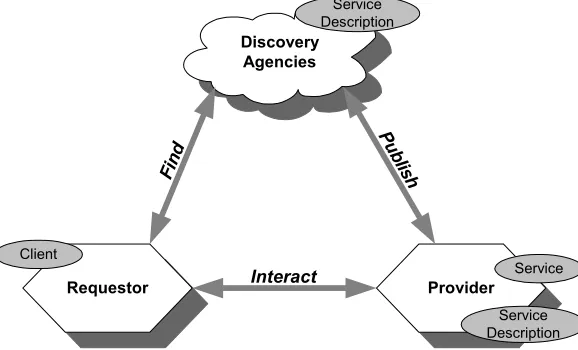
The basic Web services architecture defines an interaction between software agents as an exchange of messages between service requesters and service providers as illustrated in Figure 2.4. Requesters are software agents that request the execution of a service. Providers are software agents that provide a service. Agents can be both service requesters and providers. Providers are responsible for publishing a description of the service(s) they provide. Requesters must be able to find the description(s) of the services.
Requestor Provider
Discovery Agencies
Service Description
Find
Pu blish
Interact Service
[image:39.612.172.461.221.396.2]Service Description Client
Figure 2.4 Service Oriented Architecture of Web Services
Software agents in the basic architecture can take on one or all of the following roles:
• Service requester -- requests the execution of a Web service
• Service provider -- processes a Web service request
• Discovery agency -- agency through which a Web service description is published and made discoverable
A software agent in the Web services architecture can act in one or multiple roles, acting as requester or provider only, both requester and provider, or as requester, provider, and discovery agency. Since the service description is required to establish a binding, a service is invoked after the description is found.
service description for the web service and publishes it to a requestor or service discovery agency. The service requestor uses a find operation to retrieve the service description locally or from the discovery agency (i.e. a registry or respository) and uses the service description to bind with the service provider and invoke or interact with the web service implementation. Service provider and service requestor roles are logical constructs and a service may exhibit characteristics of both.
Requesters and providers interact using one or more message exchange patterns (MEPs) that define the sequence of one or more messages exchanged between them. A service description is hosted by a discovery service to which a provider publishes the description, and from which the requester discovers the description. The description includes data type and structure information, identifies the MEP, and contains the address of the service provider.
2.4
Summary
CHAPTER 3
MODULAR DATA PIPELINING
ARCHITECTURE
An object in a distributed service is typically in some process structured with several services as depicted in Figure 3.1. We describe the set of distributed services using data pipelines. Each stage of the pipeline is a distributed service with data flowing from one stage into another.
The modularization process is essential to simplify and enhance the adaptability of sophisticated distributed services. Compared to traditional environments, adapting to the needs of pervasive devices requires additional data processing and information. Furthermore, technologies that adapt content have matured significantly and users expect more customized services on their preferred devices.
Our aim in this chapter is to introduce our architectural approach for adapting new devices, and clients efficiently: the Modular Data Pipelining Architecture (MDPA). MDPA abstracts data processing into several stages. Each stage is designed to function independently as a module of the pipeline.
Object or Distributed
Service
Object or Distributed
Service
Object or Distributed
Service
Object or Distributed
Service
User
Presentati-on
Prior to describing the architecture, we outline the basic constraints for this architecture,
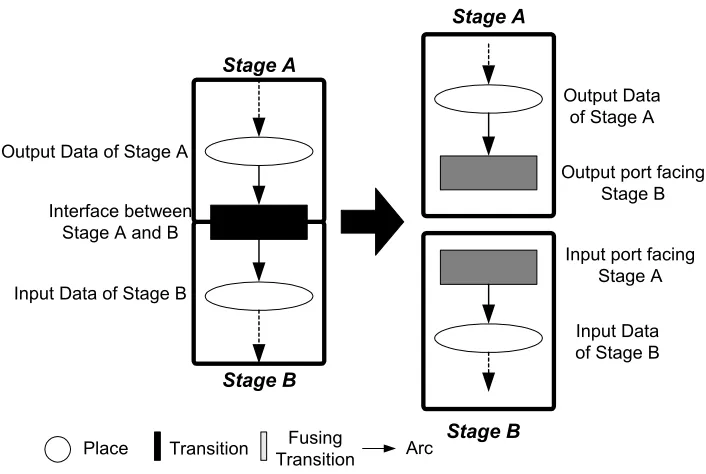
• Modularity: A service is required to be modularized based on the characteristics of each stage. To satisfy this requirement, each module must perform its task without communicating with other stages, except for processing via predefined input and output ports.
• Adaptability: An existing service should be able to adapt new types of resources, including computing units, networking constraints, user devices, and data processing technologies into its workflow with minimum modification. The adapting should be considered from first phase of design architecture as a general data processing not as an additional computing unit.
• User interactivity: The system should process user events correctly in the data processing environment designed for heterogeneous user devices.
• Flexibility: To support various types of user event processing, the software architecture must enable the service access to any stage flexibly and process user events. This feature is also needed for interoperating between different pipelines.
• Reusability: Even for a given user, we should be able to manage data in different ways. For example, if a user’s preferences change, the system should reproduce the object based on the new preference. Each stage of MDPA should keep its object instance, and avoid wasting resources on duplicating processing. Furthermore, different services should be able to utilize a stage defined in other pipeline originally.
• Interoperability: For the collaborative system, data pipelines are required to be able to share their objects. Furthermore, integrated distributed services need interoperability between local or remote applications. Our work also addresses this integration of data pipelines with efficient interoperability.
This chapter is structured as follows. Section 3.1 presents overview of MDPA with the characteristics of each stage. In section 3.2, we explain the event processing of MDPA. Section 3.3 describes the basic architecture of a stage in MDPA. In section 3.4 we discuss the design issues in MDPA. We describe the Web service approach to design the MDPA in section 3.5. Finally, in 3.6, we present summary of the chapter.
3.1
Architecture Overview
Universal user devices
real time multimedia
IBM
computation unit
DAT CTL DTX PCL MCL
Database
Generating user presentation
User event transmit
Figure 3.2 Object pipelining in MDPA
3.1.1
Data source (DAT)
MDPA processes various types of data objects from resources sitting on the edge of the P2P Grid: raw data from runtime equipment, output of a computational unit, or output from DBMS etc. The most critical functionality of the DAT stage is accessing these actual resources and passing these objects to the CTL stage.
3.1.2
Control Logic (CTL)
The major goal of CTL is generating an environment for semantic control of the data object in the DAT stage. The raw data in the DAT stage is transformed to a more accessible object type, such as a DOM tree. The user event captured from an end user is transmitted through several stages with filtering, and in the CTL stage, accesses, the original data object with the semantic meaning.
3.1.3
Document Transformer (DTX)
The DTX stage also incorporates data optimizations for limited network environments or data transformations for different network protocols. Therefore, DTX should adapt to the various technologies available locally or remotely.
3.1.4
Presentation Client (PCL)
PCL is the stage of generating an abstract presentation for each client. PCL can be described with the markup languages defining User Interface such as HTML, WML, or UIML. PCL provides a functional interface for clients, and filters the user’s event to the user interface event. One of the most important goals of PCL is integrating services. For the integrated service providing multiple features, presentation views from different data pipelines for different services are integrated in PCL stages and provide user presentations in a single user display.
3.1.5
Minimal Client (MCL)
MCL is the stage most dependent on devices and user preferences. Heterogeneity of the input mechanism is considered directly in the MCL. Therefore, each type of device should have its own MCL stage which supports its capability. To facilitate adapting new devices, the MCL stage, which must be located on user’s device, provides only minimal functionality -- such as user interface. MCL stage directly deals with user’s input and output interfaces, such as framebuffer, key inputs, voice input, etc. In MCL, user events do not have the semantic meaning of the service.
3.2
Event Processing
MDPA is an event based software architecture. The event-based user interactive system processes data when a user event occurs. The user event is processed with several steps. First, a user event is captured. Here, the user event includes a mouse click, a voice command, keyboard input, etc. The captured event traverses the MDPA data pipeline. Before being delivered, the event is adjusted by the filters defined in each stage. Finally the event is processed and a newly generated user presentation is delivered to the user after traversing the stages along the path from user to certain stage. The user presentation is also tuned in each stage with its presentation filters. Eventually, the user receives a response from the service.
3.2.1
Data flow of Event Processing
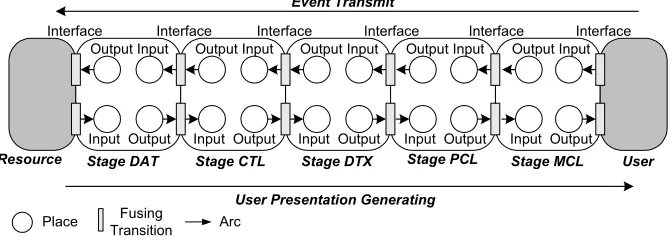
There are two directions of dataflow in MDPA,
• Event transmission: This pertains to the path taken by a user event captured in the MCL stage. This user event traverses the data pipeline until the event is processed. Each stage evaluates the user event, modifies it as necessary, and passed it to the next stage.
• Presentation Generation: This pertains to the path taken by the user presentation generated by the event processing. The user presentation is delivered to a user device. Stages that the presentation visits filter the presentation and pass the output on to next stage.
Event transmitting and presentation generating traverse in opposite directions along the data pipeline direction in their dataflow. The MCL stage is the first stage along the event transmission path, while it is the last stage for the presentation generation.
DAT CTL DTX PCL MCL
<?xml vers <!DOCTYPE <!--local DT <svg width= <desc>This
User Event Transmission
SVG document with the original size of 1200 x 2000
DOM tree of SVG document
Rendered Image with CSS for PDAs
(resolution of 160 x 160)
SVG browser
for PDAs Actual Displayon PDA
Generating Presentation View
Figure 3.3 Event processing in MDPA with an example of SVG
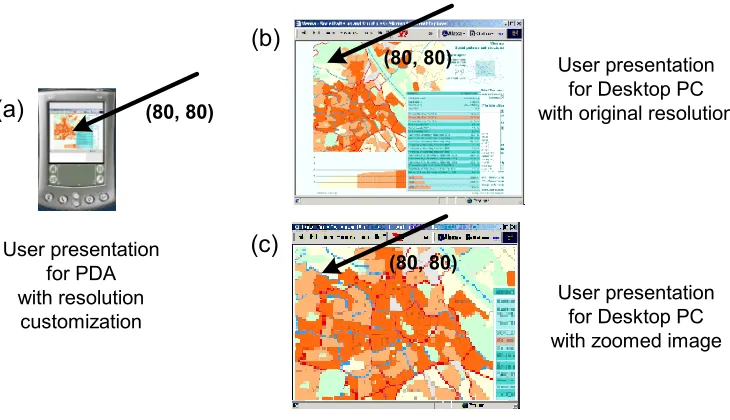
User presentation for PDA with resolution
customization
(80, 80) (80, 80)
(80, 80)
User presentation for Desktop PC with zoomed image
User presentation for Desktop PC with original resolution (a)
(b)
[image:48.612.135.500.77.287.2](c)
Figure 3.4 Event Transformation for Heterogeneous Customization of User Presentations
(a) Pointing the center of user presentation (80, 80) in the customized user presentation for the PDA
(b) Pointed user presentation for PCs with same position as (a) without filtering the event
(c) Pointed user presentation for PCs with same position as (a) without filtering event when the user zoomed the image.
Therefore, each stage should provide event filtering processing to map the event from the customized environment to the original environments. The most popular method is to keep track of history. For every pipeline, the activities are stored in a history buffer (a file). For simple processing, this strategy is very useful. In the SVG example, this can be used easily to recalculate the previous object based on the history.
this is one of the major problems of the document object modeling in collaborative and interactive information systems.
In the SVG example, pointing at the (80, 80) event should be filtered to enable processing in the PCL stage. For instance, captured event (80, 80) is captured as the stylus clicking at the position (80, 80) on the PDA screen. This event is filtered to clicking (x, y) in an image displayed via the browser in the PCL stage. The event with position (x, y) is passed to the DTX stage and the DTX stage maps (x, y) to (x’, y’) which no longer corresponds to the PDA coordinates. Finally, the event arrives in the CTL stage with the actual coordinate (x’, y’) of the original image. The CTL stage filters the event to a semantically meaningful command, such as svgTest.addelement(arrow,
x’, y’).
MCL stage PCL stage
EFMCL(e)
EFPCL(EFMCL(e))
EFDTX(EFPCL(EFMCL(e)) )
EFCTL(EFDAT(EFDTX(EFMCL(EFMCL(e))))) = eDAT
EPCTL(eDAT) PFDTX(EPCTL(eDAT)) PFPCL(PFDTX(EPCTL(eDAT))) PFMCL(PFPCL(PFDTX(EPCTL(eDAT))))
User event e
DAT stage CTL stage DTX stage
EFi : Event filtering function in Stage i
EPi : Event Processing function in Stage i
PFi : Presentation filtering function in Stage i
Figure 3.5 Data flow of SVG example
The event svgTest.addelement(arrow, x’, y’) is processed by event processing in the CTL stage, and the user presentation is generated as an output of the event processing. The output from the CTL stage is passed to the DTX stage for filtering the user presentation. Also the output of the DTX stage is delivered to the PCL stage, filtered and passed to the MCL stage. Finally, the MCL stage provides the actual user display depicted with the bitmap information. Figure 3.5 shows the data flow for the steps involved in the SVG event example.
We define the functions, event filtering, event processing, and presentation filtering for stage I, as EFi, EPi, PFi. The result of each function performing the event processing
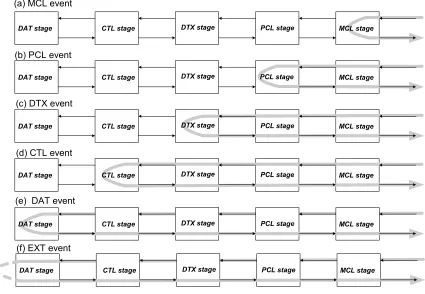
As seen in the example, this event processing does not traverse all the stages of MDPA. User events in MDPA may or may not traverse all the stages in MDPA. We classify existing events with this traversing pattern, and describe it in section 3.2.2.
3.2.2
Event Processing Patterns in MDPA
A distributed service supports various types of events. We classify the existing events based on the patterns of event processing in MDPA. The user event in MDPA is processed in three major steps: event filtering, event processing, and presentation filtering. Each stage contains every component based on the characteristics of the stage. However, not every user event requires the execution of all the components, or even traversing all the MDPA stages. As an extreme example, there is a user event processed only in the MCL stage, such as moving the mouse. The display just shows the new position of the mouse pointer. It does not perform any function other than repositioning the mouse pointer in the user’s display. This event only requires event processing in the MCL stage. If each event should traverse every stage of the MDPA, including mouse pointer repositioning events, obviously the response times for certain user events will be unnecessarily high. Nevertheless, we still need full stages of MDPA for a service. It is because a service contains various types of events which require visiting stages in different patterns.
We classify the types of user events according to the traversal pattern in the path for event and presentation: MLC event, PCL event, DTX event, CTL event, and DAT event.
PCL stage
DAT stage CTL stage DTX stage MCL stage
DAT stage CTL stage DTX stage MCL stage
PCL stage
DAT stage CTL stage MCL stage
PCL stage
DAT stage DTX stage MCL stage
PCL stage
CTL stage DTX stage MCL stage
CTL stage
DAT stage
DTX stage
PCL stage
(a) MCL event
(b) PCL event
(c) DTX event
(d) CTL event
(e) DAT event
PCL stage
CTL stage DTX stage MCL stage
DAT stage
[image:51.612.120.545.82.376.2](f) EXT event
Figure 3.6 Dataflows in Different Event types
There are some user events, which, although similar to MCL events, but actually be should classified carefully in different groups, such as clicking a button or a turning dial. In user interfaces, we click a mouse at different locations, but if the position is defined as an area specifying a “button”, we see the button area indicating a button-press or if it is dial, the dragging mouse event also acts as turning the dial. Without defining the button or dial in the PCL stage, a user cannot receive the display. We classify these events as PCL events and this type of event should traverse both the MCL and PCL stages. For instance, the event “clicking position (x, y)” is passed to PCL stage, and it is filtered to “push button A”. The event “push button A” is processed in PCL stage, and generates a new presentation depicting a button press in the relevant area. The new presentation is actually presented as bitmap information and changes the information in a framebuffer.
resolution, or changing image format. These types of events are captured in MCL and transmitted to PCL. Filtered events in MCL and PCL stages are fed into the DTX stage as an input. The DTX stage filters the event and processes the event to generate a new presentation view. The newly generated presentation is passed to the PCL stage along the “presentation generating” path and the presentation filter in PCL processes the new presentation to fit the user’s display. Finally, the MCL receives the output of user presentation from the PCL stage, and displays bitmap image data on to user’s device. CTL events pertain to those events that require access to parsed data objects located in the CTL stage. The example of a SVG event demonstrates this type of event in section 3.2.1. DAT events deal with access to resources such as loading a new document or refreshing a page. Meanwhile, the EXT event is a classification for events that require access to resources located outside the pipeline. Loading documents from a Web server, sending a query to DBMS, or accessing a remote file server are examples of EXT events. Figure 3.6 presents the patterns of dataflow for each event type. Now we describe the detailed structure of the stages in 3.3.