Features of the personality of the people
identifying
themselves
with
different
generations
Nadezhda Sivrikova 1,*, Natalya Artemyeva 2 , Nadezhda Sokolova2, Elena Moiseyeva2, Vera Borodina2 and Anton Terekhov3
1 South Ural State Humanitarian Pedagogical University, Department of Social Work, Pedagogy and
Psychology, Chelyabinsk Lenin prospect 69, Russia
2 South Ural State Humanitarian Pedagogical University, Department of Social Work, Pedagogy and
Psychology, Chelyabinsk Lenin prospect 69, Russia
3 Chelyabinsk State University, Chelyabinsk, Russia
Abstract. The issue of existence of real differences between generations is actively discussed by researchers. The discussion which is conducted in scientific community does not manage to respond to the practice request. Therefore, differences between generations need scientific studying. The purpose of this research is consisted in comparison of personal features of the Russians identifying themselves with different generations (Post-war, Soviet, Transitional and Post-Soviet). 212 people participated in a research. The generational identity of the people was decided upon the direct question of what generation they associate themselves with. The Russian-speaking version of the short questionnaire of the Big five (TIPI) was applied to studying of features of the identity of participants of a research. The obtained data confirm the idea that the representatives of the senior generations and the younger generations are more focused on collectivism values and on individualism values respectively.
1 Introduction
For many years in social sciences there was a tradition of consideration of society in terms of its vertical stratification. Researchers pay attention to class, ethnic, gender distinctions. At the same time horizontal distinctions to which differences between generational groups belong were underestimated until recently.
However the situation changed in the last decades. The attention of science and society addressed the idea of generational inequality [1, 2, 3, 4, 5]. As the reasons of such changes some researchers call the grandiose social transformations happening worldwide [6], others high degree of a resonance of the theory of generations to daily practice of people [5].
The reforms going in Russia from 90th years changed state system and form of ownership. They became a push for cardinal changes in structure of employment, quality of life, in social orientations, expectations and plans of people. The social transformations
connected with globalization processes changed a vital trajectory of many people. New social, economic and political conditions made large-scale impact on society, socialization of people. Historical transformations were reflected in cohorts structure of society. Researchers agreed that cardinal changes in cultural and historical conditions of development led to formation of several layers of the population which are given rise in different years and significantly differing on the outlook and behavior. These cohorts were called generations. The theory of generations offered new prospect for an explanation of the social and psychological phenomena and processes.
The phenomenon of the theory of generations is that in the field practice precedes science. Modern consultants and the practicing experts offer services and which decisions accounting of differences between generations is the cornerstone. And similar offers are in demand. At the same time, it is necessary to recognize that scientific research of generations is still insufficient for justification of effects of their influence on various aspects of life of the person. For example, only 20 scientific works got to attention focus in the comprehensive metaanalysis of researches of distinctions of generations in the workplace which is carried out by D.P. Costanza, etc. [7]. Che. Lyon and L. Kuron claim that the growing volume of researches of differences between generations still has generally descriptive character and does not assume creation of a theoretical basis [3]. As a result, the data obtained by different authors are separate, contradictory and difficult comparable among themselves [8].
When studying inequality of generations poorly studied is a question of the most typical lines of the identity of representatives of different generations. A question of as far as members of one cultural field can have various features of character – a part of more general question of variability of human character, its dependence on time and the place. This problem throws down a challenge to modern theories of personal development and biologically focused approaches to human character, for example, models of "big five" [9]. The model of "big five" of factors of the personality assumes that the variability in human abilities is connected with variability of five independent measurements: extraversion, agreeableness, conscientiousness, emotional stability, openness to experience [10]. It should be noted that recently new theories of personality traits development. In them the personality is considered as an open system which shows both continuity, and change of the personality throughout all life. Within this approach the dialectics between stability and variability of the personality during life their connection with the adaptation which is the main focus of development is considered[11].
By researchers it is established that upon transition from the childhood to maturity less high level of emotional stability, conscientiousness, agreeableness and higher level of an extraversionis observed [11, 12]. These traits of the personality (emotional stability, conscientiousness, agreeableness) reach the increase aged from 20 up to 40 years [11]. The cumulative continuity principle of personality proposes a steady increase in Big Five trait stability across the adult life span [13]. It should be noted that empirical data only partly confirm this principle and point that even at retirement dynamics in the traits of the personality referred to the big five is observed [11, 14]. The changes in the identity of adults found by researchers connect with influence on the identity of important vital events. At the same time, results of researches of adults showed average influence of vital events on development of personal qualities in people of a retirement age [15].
Despite amazingly small number of researches of traits of the identity of different generations, the conclusions drawn by researchers are contradictory. Some are convinced that between generations few significant distinctions are observed. Moreover, even when distinctions are observed, they are connected rather with age, than with generation [16]. Other researchers speak about traits of the personality, characteristic of representatives of different generations. Often successful generation of a post-war population explosion (baby
boomers) is characterized as selfish [9]. These data are confirmed by the tendency to grow the level of perfectionism among citizens of the USA, Canada and Great Britain found when comparing data from 1989 to 2016 [17]. Other trend is found in east countries. The senior generations in China differ in smaller degree of individualism, than younger [18].
The discrepancy of conclusions of researchers and recognition of limitation of the approach based on comparison of different age groups leave open a question of existence of differences in traits of the personality between generations.
2 Method
212 people (inhabitants of the Ural region of Russia) participated in a research. From them the 106 men and the 106 women. The age of respondents varied from 17 to 65 years. The question was asked them: what generation do you carry yourself to? The choice of respondents was limited to 5 options: to military generation (value by which were formed in the period of the Great Patriotic War); to post-war generation (which values were formed in the period of the resolution of the USSR after the Great Patriotic War); to the Soviet generation (which values were formed during an era of the "late" USSR); to transitional generation (value by which were formed during an era of reorganization, the collapse of the USSR); to Post-Soviet generation (which values were formed during an era of stabilization of a social and economic situation in Russia).
On the basis of answers of respondents all selection was divided into 4 groups (table 1), according to generation to which people carry themselves: post-war (53 persons), Soviet (53 persons), transitional (53 persons) and Post-Soviet (53 persons).
Table 1. Distribution of study participants identifying themselves with different generations by gender
Generation with which a person identifies
himself/herself Male number Female Total Post-war generation (60 and more years old) 26 27 53 Soviet generation (46-60 years old) 25 28 53 Transitional generation (33-45 years old) 27 26 53 Post-Soviet generation (and less years old) 28 25 53
Total 106 106 212
The short questionnaire of the Big five (TIPI) was applied to studying the features of the personality.
Jonckheere-Terpstra test was used for mathematical processing of results of a research.
3 Results
connected with globalization processes changed a vital trajectory of many people. New social, economic and political conditions made large-scale impact on society, socialization of people. Historical transformations were reflected in cohorts structure of society. Researchers agreed that cardinal changes in cultural and historical conditions of development led to formation of several layers of the population which are given rise in different years and significantly differing on the outlook and behavior. These cohorts were called generations. The theory of generations offered new prospect for an explanation of the social and psychological phenomena and processes.
The phenomenon of the theory of generations is that in the field practice precedes science. Modern consultants and the practicing experts offer services and which decisions accounting of differences between generations is the cornerstone. And similar offers are in demand. At the same time, it is necessary to recognize that scientific research of generations is still insufficient for justification of effects of their influence on various aspects of life of the person. For example, only 20 scientific works got to attention focus in the comprehensive metaanalysis of researches of distinctions of generations in the workplace which is carried out by D.P. Costanza, etc. [7]. Che. Lyon and L. Kuron claim that the growing volume of researches of differences between generations still has generally descriptive character and does not assume creation of a theoretical basis [3]. As a result, the data obtained by different authors are separate, contradictory and difficult comparable among themselves [8].
When studying inequality of generations poorly studied is a question of the most typical lines of the identity of representatives of different generations. A question of as far as members of one cultural field can have various features of character – a part of more general question of variability of human character, its dependence on time and the place. This problem throws down a challenge to modern theories of personal development and biologically focused approaches to human character, for example, models of "big five" [9]. The model of "big five" of factors of the personality assumes that the variability in human abilities is connected with variability of five independent measurements: extraversion, agreeableness, conscientiousness, emotional stability, openness to experience [10]. It should be noted that recently new theories of personality traits development. In them the personality is considered as an open system which shows both continuity, and change of the personality throughout all life. Within this approach the dialectics between stability and variability of the personality during life their connection with the adaptation which is the main focus of development is considered[11].
By researchers it is established that upon transition from the childhood to maturity less high level of emotional stability, conscientiousness, agreeableness and higher level of an extraversionis observed [11, 12]. These traits of the personality (emotional stability, conscientiousness, agreeableness) reach the increase aged from 20 up to 40 years [11]. The cumulative continuity principle of personality proposes a steady increase in Big Five trait stability across the adult life span [13]. It should be noted that empirical data only partly confirm this principle and point that even at retirement dynamics in the traits of the personality referred to the big five is observed [11, 14]. The changes in the identity of adults found by researchers connect with influence on the identity of important vital events. At the same time, results of researches of adults showed average influence of vital events on development of personal qualities in people of a retirement age [15].
Despite amazingly small number of researches of traits of the identity of different generations, the conclusions drawn by researchers are contradictory. Some are convinced that between generations few significant distinctions are observed. Moreover, even when distinctions are observed, they are connected rather with age, than with generation [16]. Other researchers speak about traits of the personality, characteristic of representatives of different generations. Often successful generation of a post-war population explosion (baby
boomers) is characterized as selfish [9]. These data are confirmed by the tendency to grow the level of perfectionism among citizens of the USA, Canada and Great Britain found when comparing data from 1989 to 2016 [17]. Other trend is found in east countries. The senior generations in China differ in smaller degree of individualism, than younger [18].
The discrepancy of conclusions of researchers and recognition of limitation of the approach based on comparison of different age groups leave open a question of existence of differences in traits of the personality between generations.
2 Method
212 people (inhabitants of the Ural region of Russia) participated in a research. From them the 106 men and the 106 women. The age of respondents varied from 17 to 65 years. The question was asked them: what generation do you carry yourself to? The choice of respondents was limited to 5 options: to military generation (value by which were formed in the period of the Great Patriotic War); to post-war generation (which values were formed in the period of the resolution of the USSR after the Great Patriotic War); to the Soviet generation (which values were formed during an era of the "late" USSR); to transitional generation (value by which were formed during an era of reorganization, the collapse of the USSR); to Post-Soviet generation (which values were formed during an era of stabilization of a social and economic situation in Russia).
On the basis of answers of respondents all selection was divided into 4 groups (table 1), according to generation to which people carry themselves: post-war (53 persons), Soviet (53 persons), transitional (53 persons) and Post-Soviet (53 persons).
Table 1. Distribution of study participants identifying themselves with different generations by gender
Generation with which a person identifies
himself/herself Male number Female Total Post-war generation (60 and more years old) 26 27 53 Soviet generation (46-60 years old) 25 28 53 Transitional generation (33-45 years old) 27 26 53 Post-Soviet generation (and less years old) 28 25 53
Total 106 106 212
The short questionnaire of the Big five (TIPI) was applied to studying the features of the personality.
Jonckheere-Terpstra test was used for mathematical processing of results of a research.
3 Results
Fig. 1. Extraversion level at representatives of different generations
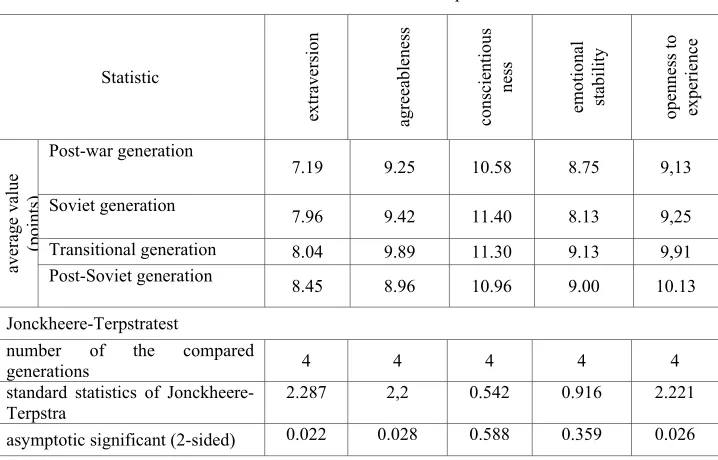
[image:4.482.60.392.83.251.2]According to the obtained data in investigated selections the trend of increase of values of level of an extraversion as trait of the personality is observed upon transition from the senior generations to younger. The most focused on others there were people identifying themselves with Post-Soviet generation, and least – with post-war generation. Differences between the compared groups are reliable at p≤0.05 (table 2).
Table 2. Statistic of Jonckheere-Terpstra test
Statistic
ex
tra
ve
rs
io
n
agree
abl
enes
s
conscien
tious
ne
ss
emotion
al
stabili
ty
open
ness to
experience
averag
e v
alue
(points)
Post-war generation
7.19 9.25 10.58 8.75 9,13 Soviet generation 7.96 9.42 11.40 8.13 9,25
Transitional generation 8.04 9.89 11.30 9.13 9,91 Post-Soviet generation 8.45 8.96 10.96 9.00 10.13
Jonckheere-Terpstratest
number of the compared
generations 4 4 4 4 4
standard statistics of
Jonckheere-Terpstra 2.287 2,2 0.542 0.916 2.221 asymptotic significant (2-sided) 0.022 0.028 0.588 0.359 0.026
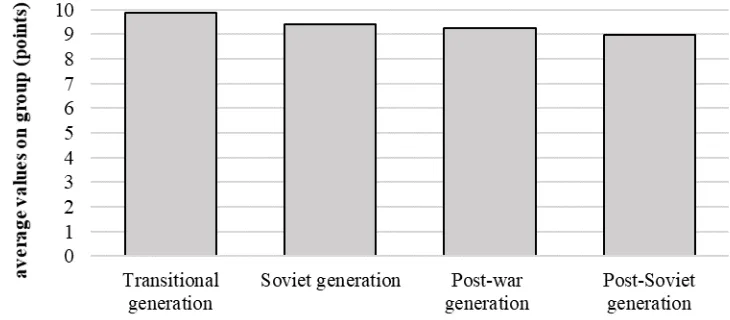
Results of comparison of the average trends reflecting agreeableness level at the participants of a research identifying themselves with different generational groups are presented in figure 2.
Fig. 2. Agreeableness level at representatives of different generations
The obtained data confirm existence of a tendency to increase in degree of agreeableness upon transition from representatives of transitional generation, to representatives of the Soviet generation, then to representatives of Post-war generation and to representatives of Post-Soviet generation (р≤0.05).
Results of comparison of the average trends reflecting conscientiousness level at the participants of a research identifying themselves with different generational groups are presented in figure 3.
Fig. 3. Conscientiousness level at representatives of different generations
According to results of mathematical data processing (table 2), the participants of a research belonging to different generations have no significant differences in conscientiousness level (p> 0.05).
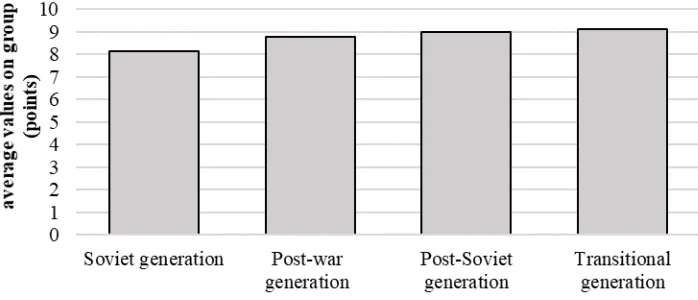
Results of comparison of the average trends reflecting the level of emotional stability (neuroticism) at the participants of a research identifying themselves with different generational groups are presented in figure 4.
[image:4.482.60.419.381.611.2]Fig. 1. Extraversion level at representatives of different generations
[image:5.482.61.426.83.243.2]According to the obtained data in investigated selections the trend of increase of values of level of an extraversion as trait of the personality is observed upon transition from the senior generations to younger. The most focused on others there were people identifying themselves with Post-Soviet generation, and least – with post-war generation. Differences between the compared groups are reliable at p≤0.05 (table 2).
Table 2. Statistic of Jonckheere-Terpstra test
Statistic
ex
tra
ve
rs
io
n
agree
abl
enes
s
conscien
tious
ne
ss
emotion
al
stabili
ty
open
ness to
experience
averag
e v
alue
(points)
Post-war generation
7.19 9.25 10.58 8.75 9,13 Soviet generation 7.96 9.42 11.40 8.13 9,25
Transitional generation 8.04 9.89 11.30 9.13 9,91 Post-Soviet generation 8.45 8.96 10.96 9.00 10.13
Jonckheere-Terpstratest
number of the compared
generations 4 4 4 4 4
standard statistics of
Jonckheere-Terpstra 2.287 2,2 0.542 0.916 2.221 asymptotic significant (2-sided) 0.022 0.028 0.588 0.359 0.026
Results of comparison of the average trends reflecting agreeableness level at the participants of a research identifying themselves with different generational groups are presented in figure 2.
Fig. 2. Agreeableness level at representatives of different generations
The obtained data confirm existence of a tendency to increase in degree of agreeableness upon transition from representatives of transitional generation, to representatives of the Soviet generation, then to representatives of Post-war generation and to representatives of Post-Soviet generation (р≤0.05).
Results of comparison of the average trends reflecting conscientiousness level at the participants of a research identifying themselves with different generational groups are presented in figure 3.
Fig. 3. Conscientiousness level at representatives of different generations
According to results of mathematical data processing (table 2), the participants of a research belonging to different generations have no significant differences in conscientiousness level (p> 0.05).
Results of comparison of the average trends reflecting the level of emotional stability (neuroticism) at the participants of a research identifying themselves with different generational groups are presented in figure 4.
[image:5.482.60.398.369.519.2]Fig. 4. Emotional stability level at representatives of different generations
According to results of mathematical data processing (table 2), the participants of a research belonging to different generations have no significant differences in neuroticism level (p> 0.05).
In figure 5 results of comparison of the average trends reflecting openness level to experience at participants of a research from the compared groups are presented.
Fig. 5. Openness to experience level at representatives of different generations
During the research the hypothesis that the trend of increase of values of openness to experience upon transition from representatives of the Soviet generation, to representatives of Post-war generation, further to representatives of Post-Soviet generation and to representatives of transitional generation is not accidental (p≤0.05) was confirmed.
4. Discussion
In general, the obtained data will be agreed with results of other researches. Earlier on the example of foreign countries it was revealed that openness to experience and an extraversional are more typical trait of the personality for representatives of younger
generations [11, 12]. Our research confirmed a conclusion that these traits are more characteristic of aged people of 17-40 years. It should be noted, however, that unlike earlier researches, we divided selection into 4 groups. It allowed to establish that the openness to the experience at the people identifying themselves with transitional generation was higher, than at the people identifying themselves with younger Post-Soviet generation. It is possible to conclude that this trait of the personality is defined not only by age, but also sociocultural conditions of development of the person. It turned out that Russians whose outlook was formed during an era of the collapse of the USSR are inclined even more than younger citizens of our country to call in question authorities, to accept and support the new ethical, social and political ideas.
Interesting results were received concerning such trait of the personality as agreeableness. It was less expressed at Post-war and Post-Soviet generations, and reached the maximum value in group of the people identifying themselves with transitional generation. They confirm the idea that representatives new (Post-Soviet generation) are more guided by individualism values. They were the most egocentric. But is the closest on this indicator to them there were representatives of post-war (most senior) generation. The aspiration to cooperation and altruism was characteristic of generations which hold position, intermediate between them. It is possible to note a pendulum trend concerning formation of selfishness as trait of the personality at representatives of different generations.
Significant differences in the level of emotional stability at the participants of a research belonging to different generations were not revealed in our research. It does not coincide with data of the researches indicating that the expressiveness of this trait of the personality is minimum in younger age groups, in comparison with the senior age groups [11].
5. Conclusion
The obtained data confirm the idea that representatives of transitional and Post-Soviet generations are more focused on collectivism values, and representatives of Post-Soviet generation – on individualism values. Results of a research specify that representatives of younger generations more in comparison with representatives of the senior generations highly appreciate such own qualities as sociability, activity, readiness for changes.
Results of a research can have important consequences, for assessment of the human capital of modern Russia. Characteristic of personal lines of representatives of different generations allows to estimate their strong and weaknesses in professional, labor and personal spheres. The analysis of personal qualities of representatives of different generations taking into account a factor of age, sex, education and the place of residence can be the prospects of further studying of a question.
It is clear that we must note limitations of the present study. First, because of the small sample size, the present study had only limited power. Second limitation concerns the fact that tight restriction of the choice when determining generational identification artificially excluded options of diffusion identity from the analysis. Need of division of selection into 4 groups, proceeding from type of generational identification, led to violations of equivalence of groups on a number of demographic signs (sex, education) that could lead to distortion of results of a research. At the same time, the conducted research expands the existing data on features of the identity of representatives of different generations in modern Russia.
Funding
[image:6.482.70.419.362.512.2]Fig. 4. Emotional stability level at representatives of different generations
According to results of mathematical data processing (table 2), the participants of a research belonging to different generations have no significant differences in neuroticism level (p> 0.05).
In figure 5 results of comparison of the average trends reflecting openness level to experience at participants of a research from the compared groups are presented.
Fig. 5. Openness to experience level at representatives of different generations
During the research the hypothesis that the trend of increase of values of openness to experience upon transition from representatives of the Soviet generation, to representatives of Post-war generation, further to representatives of Post-Soviet generation and to representatives of transitional generation is not accidental (p≤0.05) was confirmed.
4. Discussion
In general, the obtained data will be agreed with results of other researches. Earlier on the example of foreign countries it was revealed that openness to experience and an extraversional are more typical trait of the personality for representatives of younger
generations [11, 12]. Our research confirmed a conclusion that these traits are more characteristic of aged people of 17-40 years. It should be noted, however, that unlike earlier researches, we divided selection into 4 groups. It allowed to establish that the openness to the experience at the people identifying themselves with transitional generation was higher, than at the people identifying themselves with younger Post-Soviet generation. It is possible to conclude that this trait of the personality is defined not only by age, but also sociocultural conditions of development of the person. It turned out that Russians whose outlook was formed during an era of the collapse of the USSR are inclined even more than younger citizens of our country to call in question authorities, to accept and support the new ethical, social and political ideas.
Interesting results were received concerning such trait of the personality as agreeableness. It was less expressed at Post-war and Post-Soviet generations, and reached the maximum value in group of the people identifying themselves with transitional generation. They confirm the idea that representatives new (Post-Soviet generation) are more guided by individualism values. They were the most egocentric. But is the closest on this indicator to them there were representatives of post-war (most senior) generation. The aspiration to cooperation and altruism was characteristic of generations which hold position, intermediate between them. It is possible to note a pendulum trend concerning formation of selfishness as trait of the personality at representatives of different generations.
Significant differences in the level of emotional stability at the participants of a research belonging to different generations were not revealed in our research. It does not coincide with data of the researches indicating that the expressiveness of this trait of the personality is minimum in younger age groups, in comparison with the senior age groups [11].
5. Conclusion
The obtained data confirm the idea that representatives of transitional and Post-Soviet generations are more focused on collectivism values, and representatives of Post-Soviet generation – on individualism values. Results of a research specify that representatives of younger generations more in comparison with representatives of the senior generations highly appreciate such own qualities as sociability, activity, readiness for changes.
Results of a research can have important consequences, for assessment of the human capital of modern Russia. Characteristic of personal lines of representatives of different generations allows to estimate their strong and weaknesses in professional, labor and personal spheres. The analysis of personal qualities of representatives of different generations taking into account a factor of age, sex, education and the place of residence can be the prospects of further studying of a question.
It is clear that we must note limitations of the present study. First, because of the small sample size, the present study had only limited power. Second limitation concerns the fact that tight restriction of the choice when determining generational identification artificially excluded options of diffusion identity from the analysis. Need of division of selection into 4 groups, proceeding from type of generational identification, led to violations of equivalence of groups on a number of demographic signs (sex, education) that could lead to distortion of results of a research. At the same time, the conducted research expands the existing data on features of the identity of representatives of different generations in modern Russia.
Funding
References
1. V. I. Pishchik, A. V. Gavrilova, N. V. Sivrikova, Rossiyskiy psikhologicheskiy
zhurnal, 13 (3), 245-264 (2016)
2. D. P. Costanza, L. M. Finkelstein, Industrial and Organizational Psychology, 8 (3),
308-323(2015)
3. S. Lyons, L. Kuron, Journal of Organizational Behavior, 35(1),139–157(2014)
4. E. Venter, International journal of adolescence and youth, 22(4), 497-507 (2017).
5. M.J.Dam, C.Y. Noben, M. Medical teacher, 39 (11), 1195-1196 (2017)
6. N.Sivrikova, E. Moiseeva, SHS Web of Conferences, 55 (2018).
7. D. P. Costanza, J. M. Badger, R. L. Fraser, J. B. Severt, P. A. Gade, Journal of
Business and Psychology, 27, 375–394 (2012).
8. D. Cadiz, D. Truxillo, F. Fraccaroli, Industrial and Organizational Psychology, 8(3),
356-362 (2015).
9. P. Higgs, C. Dzhilleard, J. R. Jones, Sociology of the power, 3, 10-30, (2014)
10. A. Alegre, N. Perez-Escoda, E. Lopez-Cassa, Frontiers in psychology, 10 (2019)
11. B. W. Roberts, K. E. Walton, W. Viechtbauer, Psychological Bulletin, 132(1), 1-25
(2006)
12. W. Bleidorn, T. Schwaba, Personality Development Across the Lifespan. New York,
Academic Press, 20-25 (2017)
13. J. Wagner, O. Lüdtke, A. Robitzsch, Journal of Personality and Social Psychology,
116(4), 666-680 (2019).
14. T. Schwaba, W. Bleidorn, Journal of Personality and Social Psychology, 116 (4),
651-665 (2019)
15. J. J. A. Denissen, M. Luhmann, J. M. Chung, W. Bleidorn, Journal of Personality and
Social Psychology, 116(4), 612-633 (2019)
16. M. Wong, E. Gardiner, W. Lang, L. Coulon, Journal of Managerial Psychology, 23(8),
878-890 (2008)
17. T. Curran, A.P. Hill, Psychological bulletin, 145 (4), 410-429 (2019)