International Journal of Innovative Technology and Exploring Engineering (IJITEE) ISSN: 2278-3075, Volume-8 Issue-10, August 2019
Abstract: Since the PV penetration in the utility grid is increasing rapidly, there is a need of a control strategy for the purpose of energy optimization and for providing clean and green electric power to the utility grid. In this paper, a dynamic technique is proposed employing a Fractional Order PI controller tuned using Grey Wolf Optimization Technique. The strategy provides the independent control active as well as reactive power being injected into the grid. A complete investigation on performance analysis and THD levels at different solar irradiation value were conducted on MATLAB/SIMULINK software. The efficacy of the work is validated by comparing the results obtained by using Grey Wolf Optimization with permissible IEEE standards and the observations proves the power quality improvement by reducing the THD i.e. Total Harmonic Distortion levels.
Index Terms: Power Quality, FO-PI Controller, Grid Connected PV, Power Management.
I. INTRODUCTION
Depleting fossil fuels and the increasing pollution from the conventional energy sources has forced the society to shift towards the cleaner and abundantly available resources of energy in nature. Various other resources of energy are available in nature which can be utilized to generate electricity without making harm to the nature such as solar, wind, tidal geothermal, hydro etc. In a recent couple of decades, the utilization of solar energy as an option in contrast to conventional energy source has been expanded hugely. Although, the growth of solar energy utilization especially (solar photovoltaic) to generate electricity has been recorded exponentially but still, it has a long way to go as the electric power demand is expected to be doubled in next coming decade. Since there are many benefits of the solar photovoltaic systems but also there are some of the downsides of the technology such as dependence of output power on the intensity of sun oriented irradiance and the surrounding temperature which has raised the different issues in integrating it into the grid. This issues becomes larger, when the penetration level is too high which lead to various power quality problems for the grid. Also, the electrical power that is being produced is of DC nature and it requires to be changed in AC by incorporating inverters before sending out it to the grid. Here the control converters utilized in solar Photovoltaic systems to make it compatible with connecting it to the grid are the major cause of the
Revised Manuscript Received on August 10, 2019
Manoj Gupta, Department of Electrical Engineering, School of Engineering and Technology, Poornima University, Jaipur, India.
Pankaj Gakhar, Department of Electrical Engineering, School of Engineering and Technology, Poornima University, Jaipur, India.
power quality degradation up to much extent. These converters and the nonlinear loads connected to the grid through solar PV are the root cause for the power quality deterioration. The major issue of concern here are the introduction of harmonics that distorts current waveform[1]. Hence in this paper, a current control strategy for inverter which is optimised using Grey Wolf Optimization is proposed for mitigating harmonic content from the current being infused into the grid or maintaining the harmonics under the levels prescribed by IEEE standards.
II. GRID-LINKED SOLAR PV SYSTEM MODELING
A utility grid linked sun oriented PV framework is a sort of electrical framework which usually changes solar radiation into electric power and after that exchanges it furthermore in the suitable form expected. When the solar panels are coupled to the main grid, initially, the power is first given to the local load and then after satisfying the local need, the spare power is sent to the grid. Therefore PV power from the sun serves as an alternate source of electric power. The photovoltaic system, engineered within work, is tailored to transfer electric power coming from photovoltaic module to main supply grid. Initially, the yield voltage of the photovoltaic module is achieved by using a boost converter at a voltage level greater that the voltage of grid and the task for extricating the maximum possible power from the photovoltaic module is taken care by this unit. Then, an inverter is employed for converting the variable dc of the solar into ac form of power[2][3].
PV Array DC to AC
Inverter DC to DC
Converter Control Unit
MPPT
Grid
Fig. 1 Basic layout for grid linked solar PV system
A simulink model of a 100KW photovoltaic system coupled
to the main grid has been formulated in
MATLAB/SIMULINK. The Solar photovoltaic system produces the electric power from solar radiation, which is fed to grid utility, but the electric power so generated is not directly fed. It is first conditioned by using various converters and also the parameters such as current and voltage are set to some standard levels before feeding to the grid.
Power Quality Improvement in a Grid Coupled
Solar PV System using Grey Wolf Optimization
These tasks are performed by various components of the system described in the next sections.
The Solar photovoltaic system produces the electric power from solar radiation, which is fed to grid utility, but the electric power so generated is not directly fed. It is first conditioned by using various converters and also the parameters such as current and voltage are set to some standard levels before feeding to the grid. These tasks are performed by various components of the system described in the next sections.
Fig. 2 Simulink model of a grid tied SPV system.
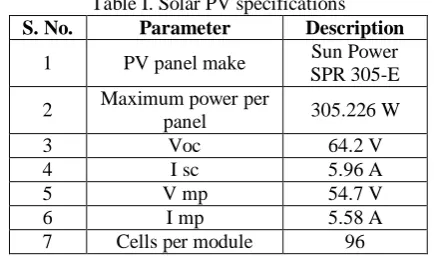
[image:2.595.60.291.180.359.2]The solar PV array has been designed to deliver maximum 100KW of Power to the grid. For the purpose, 330 solar panels have been connected (5 in series, 66 in parallel). The design consideration of the Solar photovoltaic array is mentioned below:
Table I. Solar PV specifications
S. No. Parameter Description
1 PV panel make Sun Power
SPR 305-E
2 Maximum power per
panel 305.226 W
3 Voc 64.2 V
4 I sc 5.96 A
5 V mp 54.7 V
6 I mp 5.58 A
7 Cells per module 96
The solar array current and voltage parameters are dependent on solar irradiation which is uncertain in nature throughout the day. So here MPPT plays its role. The extrication of the maximum electric power from the cluster of solar modules is done by altering of the switch. Here we have used Perturb and Observe method for MPPT.
The sporadic nature of solar radiation plays an important role for varying output voltage levels of the solar array and also due to the functioning of MPPT unit. But this varying voltage cannot be provided to the inverter. The inverter needs a constant input dc voltage for proper functioning so here boost converter is utilized that changes the variable dc output voltage to fixed dc voltage. Here, boost converter which is designed converts the varying voltage to a fix 1450 dc voltage.
Vs s
L Diode
C Vout
Fig. 3 DC-DC converter schematic diagram The values of the parameters calculated are as follows:
Table II. DC-DC converter parameters
S. No Parameter Value
1 Duty Cycle, D 0.81
2 Input voltage, VS 273.5V
3 DC Link Voltage, VOUT 1450V
4 Switching Frequency, fs 5KHz
5 CDC LINK 1580 f
6 Inductor, L 2.3mH
7 Capacitor, CPV 0.7 f
III. INVERTER CONTROL STRATEGY
In a grid coupled Solar PV system, the energy from light is transformed into electrical energy and transferred to the grid utility. In this procedure, dc is transformed into ac with the help of inverter. While transformation, the inverter control strategy is employed for ensuring the best power quality and the active as well as reactive power management. Although LCL filters are used for harmonic mitigation but due to certain limitations of the LCL filter, an inverter control strategy is used which mitigates the harmonics to decent allowable levels as per standards.
Majorly the control strategy consists of a control structure for inverter that is based on the combination of certain cascaded loops. Some of them are as follows:
Power in outermost loop and current in innermost
Voltage in outermost loop and power in innermost
DC Link voltage in outermost loop and current in innermost
Here in the mentioned combinations, last type is the most commonly used loop structure. Here the control loop pertaining to DC output of converter balances the electric power flow whereas the current control loop deals with the power quality maintenance and mitigation of harmonics present in the current so that it could be injected to grid.
A. Active/Reactive Power Controller
[image:2.595.62.283.451.580.2]International Journal of Innovative Technology and Exploring Engineering (IJITEE) ISSN: 2278-3075, Volume-8 Issue-10, August 2019
An additional approach intended for managing active and reactive power is control mode for current. In this control mode the line current is controlled with the help of an ardent strategy. One more advantage of this kind of setting of control is the fact it is guarded against over currents.
In the AC system at the PCC point, the active and reactive power may be calculated as:
(1)
(2)
Where and are voltage components in d-q frame
and also it must be noted that these components cannot be varied or controlled in a steady state. Hence, and may be used for managing the active and reactive power respectively.
PV ARRAY BOOST
CONVERTER VSC
Saturation
FILTER
Reference signal Generator Controller
abc
dq dq
abc abc
dq Vdc
Cpv
wt wt
wt
Vsa
Vsb
Vsc Qs
Ps
ia
ib
ic Vta
Vtb
Vtc
Fig. 4 Schematic diagram of inverter control strategy.
If the control system is capable of providing fast reference tracking then active and reactive power can be managed by separate reference values which are given by the following equations.
(3)
(4)
B. Inverter Control
Let us assume a steady state operation and by replacing by , we deduce that,
(5)
(6)
Where
(7)
(8)
Now here and are given by
(9)
(10)
IV. FRACTIONAL ORDER PI CONTROLLER
The fractional order PI controller was proposed in 1999 as a generalized form of PI controller the value of integer order integrator by a fractional order integrator [4][5].
The following equation demonstrated the transfer function for the FO-PI controller:
(11)
Er(t) Kp Mc(t)
Ki 1/s α
Fig. 5 Basic Fractional order PI controller
The value of is a real number between 0 to 1. The conventional PI controller is achieved by assuming =1. Hence this modification improves the accuracy and flexibility of the system. This makes the system more stable. The optimal parameters of the controllers are tuned by using Grey wolf optimization.
V. GREY WOLF OPTIMIZATION
The Grey wolf optimization algorithm mimics the assault mechanism and the leadership grading for the wolves in the mother nature[8]. The wolfs in peck may classified as alpha, beta, delta & omega which are utilised to emulate the supervision progressive system. Likewise, there are commonly three noteworthy advances which are utilized for performing streamlining, which are scan for the hunt, circling the prey and assaulting the prey [6][7].
The grey wolf comes from the Canidie family. These are viewed as top ranking carnivorous animals. These, for the most part, want to live in a pack and the size of the gathering is between 5-12 wolves. Also, it is interesting to know that they follows a very tight and strict hierarchy of social dominance. The leaders which are called alphas which may be male or female. The responsibility for the major decisions such as sleeping, time to wake, moving and especially hunting is taken by alpha. The decision of the alpha is intimated to the group. Albeit, few sorts of democratic behaviour practices have likewise been seen where an alpha wolf follows the other wolves in the group. In gatherings, the whole gathering recognizes the alpha wolf by down their tails. The alpha wolf overwhelms the pack and its requests are trailed by the gathering. The alpha wolfs are simply permitted to mate in their gathering. It is fascinating to realize that the alpha wolf isn't generally the most grounded part in the gathering however is consistently the best in the administration of the gathering. The second phase of the progression are the beta dark wolf. The beta wolves are the lesser wolves that helps the alpha wolves for settling on choices and in different exercises. The beta wolf hold the best candidature for acquiring the position of alpha wolf when an alpha wolf passes away or becomes old. The best wolf is responsible for commanding the lower level wolves and also it respects the alpha
The beta wolf goes about as a consultant for the alpha and sometimes gives criticism to the alpha wolf.. The lowest level wolf in the group are the omega wolf. The omega wolf are considered as victims in the group. These are always expected to submit in front of other dominant wolves. It has been observed that the omega wolf are not considered as important in the group but it is interesting to know that the whole group has to face internal fight and problems whenever there is a loss of omega wolf. In some cases the omega wolf also acts as a babysitter in the group. In the event that a wolf isn't an alpha, beta or delta then all things considered it is called as subordinate and called delta. These have to submit in front of alpha and beta wolves. But these dominate omega wolves. Every one of the scouts, older folks, trackers, sentinels and overseers have a place with the delta wolf classification. Scouts are utilized for dealing with the limits and the wellbeing and insurance of the gathering is taken consideration by the sentinels. The seniors who are experienced might be the alpha or beta. Trackers help the alpha and the beta wolf while chasing for the prey and giving the nourishment to gathering. Finally the overseers are required to deal with the frail and sick deceivers.
The major stages involved in the assault of prey are as follows[9]:
Chasing, pursuing & moving toward the prey
Pursuing, encompassing & harassment of the prey until it quits moving
Onslaught the prey
(12)
(13)
Here the current iteration is denoted by t and the coefficient vectors by and . The position vector of the prey is denoted by and the position vector of the wolf by
The following equations may be used for calculating vectors and :
(14)
(15)
During the iterations are going on the vector is declined from 2 to 0 and the role of arbitrary vectors is played by
in [0,1].
From the above equations it can be concluded that the position of the wolf i.e. (X,Y) can be refreshed as per current location of the prey i.e. (X*,Y*). Different position near currrent position may be considered by altering the magnitude of vetors and .
A. Tuning of FO-PI Controller using Grey Wolf Optimization
The FO-PI controller of the 100 KW plant model are optimised for least error value and the value of the Kp and Ki and are calculated by applying the GWO. After Applying the Grey Wolf Optimization, the FOPI controller gains calculated are as follows:
Table III. FOPI controller gain values after applying Grey Wolf Optimization in FO-PI controller
S.
No. Parameter
Proportional Gain, Kp
Integral Gain, Ki
Integrator Fraction,
1 Vdc 5.4458 0.2638 0.2856
2 Id 0.2761 0.4481 0.3052
3 Iq 194.1769 351.1468 0.0157
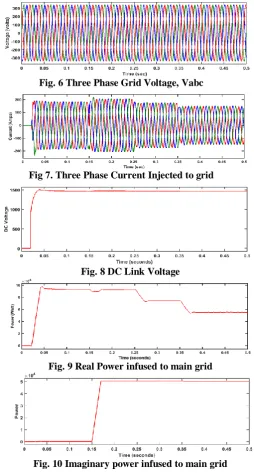
[image:4.595.306.561.247.721.2]After applying the gain value to the respective controllers the following waveforms of the different parameters were observed which are shown as follows:
Fig. 6 Three Phase Grid Voltage, Vabc
Fig 7. Three Phase Current Injected to grid
Fig. 8 DC Link Voltage
Fig. 9 Real Power infused to main grid
International Journal of Innovative Technology and Exploring Engineering (IJITEE) ISSN: 2278-3075, Volume-8 Issue-10, August 2019
VI. RESULT DISCUSSION
In the work presented, a grid coupled solar PV system having a capacity of 100KW has been designed where the inverted is fed from a DC link at 1450Vand converted to ac power further being fed to the utility grid. The grid phase to ground voltage is considered to be 340V (415V approx. line to line).
The power injection to the grid can be controlled by controlling the three parameters i.e. Dc Link voltage, D-axis current and Q-axis axis current. These three parameters are controlled using three PI controllers which are tuned in this work.
In the result, the Grid voltage is shown in fig 6. The current infused by inverter to grid is shown in fig 7.
The total simulation runs for 0.5s. At 0.025s the inverter is de-blocked and it starts injecting current in grid. The time delay of 0.025s is considered because after this instant, the DC link capacitor starts charging and maintains the dc voltage 1450V as shown in fig 8. As the DC voltage starts building, the active power being fed to grid starts increasing which is shown in fig 9 and reaches to the value of approx. 93KW at 0.045. At 0.15s the reactive power is switched from 0 to 50KW and the reactive power reaches the value at 0.16s as shown in fig 10.The dc link voltage attain maximum value at 0.04s and settles to 1450V at 0.45s
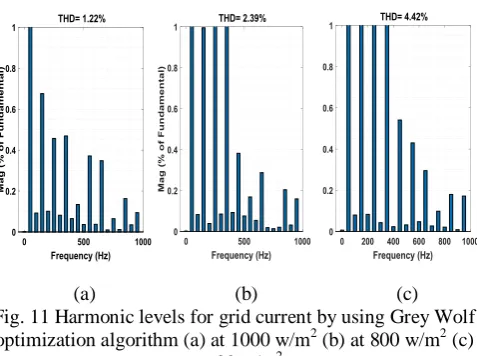
The total harmonic distortion is observed to be reduced as shown in fig 11.
[image:5.595.54.293.382.560.2](a) (b) (c) Fig. 11 Harmonic levels for grid current by using Grey Wolf optimization algorithm (a) at 1000 w/m2 (b) at 800 w/m2 (c)
at 600 w/m2
It show that the grid current being injected to the grid has a harmonic level of 4.42% at 600 w/m2 , 2.39% at 800 w/m2 , and 1.22% at 1000 w/m2 of solar irradiation. The harmonic content has been measured for different levels of solar irradiation and it has been observed that the THD of the current waveform is less than the prescribed limit for THD as per IEEE(<5%).
VI.CONCLUSION
A 100 KW grid tied system has been designed by utilizing an inverter control strategy for the purpose power quality improvement in a PV connected utility grid. The fractional order PI controller optimized using Grey Wolf Optimization used in inverter control strategy has been shown. The harmonic content has been measured for different levels of solar irradiation and it has been observed that the THD of the current waveform is less than the prescribed limit for THD as per IEEE(<5%).
REFERENCES
1. P. Gakhar and M. Gupta, "Harmonic Mitigation in a Transformer Less Grid Connected Solar PV System Using Modified LCL Filter," 2018 3rd International Conference and Workshops on Recent Advances and Innovations in Engineering (ICRAIE), Jaipur, India, 2018, pp. 1-4.
2. M. Israr and A. K. Pandey, "Modeling and control of utility grid connected solar photovoltaic array integrated system using MATLAB," 2017 International Conference on Computation of Power, Energy Information and Commuincation (ICCPEIC), Melmaruvathur, 2017, pp. 500-505.
3. Pankaj Gakhar, Manoj Gupta, “A novel control strategy for power quality improvement in grid-connected solar photovoltaic system”, Indonesian Journal of Electrical Engineering & Computer Science, Sept, 2019
4. Yu K, Liao C, Yau H., “A new.fractional-order.based intelligent maximum.power point tracking control algorithm for photovoltaic power systems”. Int J Photoenergy 2015;2015:1e8.
5. S. Buso and P. Mattavelli, Digital Control in Power Electronics: Morgan & Claypool, 2006.
6. Topaz CM , BernoffAJ , Logan S , Toolson W . A model for rolling swarms of lo- custs. Eur Phys J Special Top 2008;157:93–109 .
7. S. Mirjalili, S. M. Mirjalili, and A. Lewis, "Grey Wolf Optimizer," Advances in Engineering Software, vol. 69, pp. 46-61, 2014.
8. R. A. Swief and T. S. Abdel-Salam, "PV impact on distribution system performance following grey wolf algorithm," 2017 Nineteenth International Middle East Power Systems Conference (MEPCON), Cairo, 2017, pp. 437-444.
9. K. S. EI-Bidairi, H. Duc Nguyen, S. D. G. Jayasinghe and T. S. Mahmoud, "Multiobjective Intelligent Energy Management Optimization for Grid-Connected Microgrids," 2018 IEEE International Conference on Environment and Electrical Engineering and 2018 IEEE Industrial and Commercial Power Systems Europe (EEEIC / I&CPS Europe), Palermo, 2018, pp. 1-6.
AUTHORSPROFILE
Dr. Manoj Gupta did B.E. in Electrical Engineering, M.Tech. and Ph.D. – all from MNIT, Jaipur. He has 23 years of good experience in industry, research and academics. Currently, he is working as Pro-President at Poornima University, Jaipur. Dr. Gupta has published more than 40 research papers in various national and international journals and conferences and seminars. He is life member of Indian Society for Technical Education (ISTE), Fire & Security Association of India (FSAI), Indian Society of Heating, Refrigerating and Air Conditioning Engineers (ISHRAE) and Indian Society of Lighting Engineers (ISLE). He has received (two times) Rajasthan Energy Conservation Award from state govt. for his significant work for energy conservation in education sector. His areas of interest are Renewable energy, Power Quality and Electrical Machines & Drives.