
R E S E A R C H
Open Access
A comparative evaluation of PCR- based methods
for species- specific determination of African
animal trypanosomes in Ugandan cattle
Heba A Ahmed
1,2, Kim Picozzi
1, Susan C Welburn
1and Ewan T MacLeod
1*Abstract
Background:In recent years, PCR has been become widely applied for the detection of trypanosomes overcoming many of the constraints of parasitological and serological techniques, being highly sensitive and specific for trypanosome detection. Individual species-specific multi-copy trypanosome DNA sequences can be targeted to identify parasites. Highly conserved ribosomal RNA (rRNA) genes are also useful for comparisons between closely related species. The internal transcribed spacer regions (ITS) in particular are relatively small, show variability among related species and are flanked by highly conserved segments to which PCR primers can be designed. Individual variations in inter-species length makes the ITS region a useful marker for identification of multiple trypanosome species within a sample.
Methods:Six hundred blood samples from cattle collected in Uganda on FTA cards were screened using individual species-specific primers forTrypanosoma congolense,Trypanosoma bruceiandTrypanosoma vivaxand compared to a modified (using eluate extracted using chelex) ITS-PCR reaction.
Results:The comparative analysis showed that the species-specific primer sets showed poor agreement with the ITS primer set. Using species-specific PCR forTrypanozoon,a prevalence of 10.5% was observed as compared to 0.2% using ITS PCR (Kappa = 0.03). ForTrypanosoma congolense, the species-specific PCR reaction indicated a prevalence of 0% compared to 2.2% using ITS PCR (Kappa = 0). ForT. vivax, species-specific PCR detected prevalence of 5.7% compared to 2.8% for ITS PCR (Kappa = 0.29).
Conclusions:When selecting PCR based tools to apply to epidemiological surveys for generation of prevalence data for animal trypanosomiasis, it is recommended that species-specific primers are used, being the most sensitive diagnostic tool for screening samples to identify members ofTrypanozoon (T. b. bruceis.l). While ITS primers are useful for studying the prevalence of trypanosomes causing nagana (in this study the species-specific primers did not detect the presence ofT. congolense) there were discrepancies between both the species-specific primers and ITS for the detection ofT. vivax.
Keywords:Trypanosome, Brucei, Congolense, Vivax, Species-specific PCR, ITS PCR, Nagana
Background
Routine diagnosis of trypanosomiasis using classical para-sitological approaches shows poor sensitivity under field conditions [1]. This is in part, due to the normally very low peripheral parasitemia of naturally infected animals [2,3]. The limitations of microscopy for both human and animal
trypanosomiasis screening led to the development of a range of serological tests: such as the complement fixation test (CFT), indirect fluorescent antibody test (IFAT), card agglutination test (CATT) and enzyme linked immunosor-bant assay (ELISA). However, these methods are unable to differentiate between existing infections and previous ex-posure to infection, and may lack specificity [1,4].
In recent years, PCR has been widely applied for the detection of trypanosomes and has been shown to be highly sensitive and specific in the laboratory [5]. The use of PCR for detecting trypanosome DNA is the most reliable and accurate technique available for the specific * Correspondence:[email protected]
1
Division of Pathway Medicine and Centre for Infectious Diseases, School of Biomedical Sciences, College of Medicine and Veterinary Medicine, The University of Edinburgh, Chancellor’s Building, 49 Little France Crescent, Edinburgh, EH16 4SB, UK
Full list of author information is available at the end of the article
identification of natural animal infections for most tryp-anosome species and sub-species [6,7]. Species-specific DNA targets have been identified for the most important pathogenic trypanosome species that occur in cattle
(Trypanosoma brucei s.l., Trypanosoma congolense and
Trypanosoma vivax) and PCR based methods for their amplification developed.
For detection ofTrypanozoon(Trypanosoma brucei
bru-cei, Trypanosoma brucei gambiense, Trypanosoma brucei rhodesiense, Trypanosoma evansiand Trypanosoma equi-perdum), the most common target is the 177 bp DNA sat-ellite repeat sequence originally described by Sloof et al. [8] that exists in high copy number in the parasite genome (10,000). The TBR universal primers developed to amplify
the 177 bp sequences fromTrypanozoongenomic DNA,
were able to detect 0.1 pg of parasite DNA,i.e.the amount of DNA equated to that present in a single trypanosome [9]. Weaker bands containing the 177 bp amplicon, could be detected when the DNA content was as low as 0.01 pg (equivalent to 1/10th that of a single parasite). Clausen et al. [10] found the TBR primer set able to detect as little as one femtogram of purified DNA (which is equiva-lent to about 1% of the genome content of one parasite). In practice, in most cases the universal primers for Trypano-zoonare used to identifyT. b. bruceias a first stage in the process of identifying human infective parasites within an
animal population. To further discriminate T. b. brucei
from T. b. rhodesiense PCR reactions targeting the single copy serum-resistance-associated (SRA) gene [11] have been developed and applied [6]. To permit discrimination between samples carrying human serum resistant parasites and non human infective parasites a multiplex PCR that
simultaneously detects the SRA gene as well as the gene
for phospholipase C (GPI-PLC) was developed [12]. Both of these single copy genes are present inT. b. rhodesiense, but only GPI-PLC is present inT. b. brucei, so if a sample shows positive amplification for GPI-PLC this indicates that sufficient T. bruceis.l. genomic material is present to detect a single copy gene while the presence or absence of SRA determines whetherT. b. rhodesienseis present.
Trypanosoma congolense(savannah) is a highly patho-genic trypanosome that is the most widespread, in terms of both geographical and host range across Sub Saharan Africa [13]. Specific primers designed to detectT. congo-lense, which target a satellite sequence of 316 bp have been developed [9,14]. The sensitivity of the universal
primers to detect T. congolense savannah was 0.1 pg
of parasite DNA, again the amount of DNA in a single trypanosome and weak bands containing the amplification product could be detected when the DNA content was 0.01 pg or an estimated 1/10th that of a single parasite [9].
Trypanosoma vivax can be identified using universal primers targeting a fragment of the gene encodingT. vivax specific antigen [15,16]; this antigen was recognised by a
monoclonal antibody (Tv27) in an Ag-ELISA. The cloned gene was found to comprise a tandem repeat, with a monomeric unit length of 900 bp in the genome of all T. vivax isolates from diverse geographic locations in Africa and South America.
These species-specific primers show good sensitivity and specificity against their target species. However, to screen large numbers of samples such as are derived from naturally infected hosts to determine prevalence data, multiple PCRs need to be undertaken for each sample which is both time consuming and expensive. It would be desirable to be able to apply a single PCR reaction that could simultaneously differentiate all of the trypanosome species present within a sample, making screening of a large number of samples viable in terms of time and cost.
Ribosomal RNA (rRNA) genes are highly conserved and have been proved useful for comparisons of closely related species. Eukaryotic rRNA genes occur as tandem repeats of units separated by a non-transcribed spacer (NTS) region and internal transcribed spacer regions (ITS); the ITS regions are relatively small, show variabil-ity among related species and are flanked by highly con-served segments to which PCR primers can be designed. Individual variations in inter-species length makes the ITS region a useful marker for species differentiation in trypanosomes and this and their high copy number, of around 200 makes the (ITS) a useful target for species differentiation in trypanosomes and other species [17,18]. Njiru et al. [19] and Coxet al. [20] have developed ITS-PCR methods that generate a uniquely sized ITS-PCR product for each species of trypanosome (the inter-species length variation of the ITS region of ribosomal genes). The proto-col developed by Njiru et al. [19] is a single round PCR while Coxet al. [20] is a nested PCR designed to increase sensitivity and specificity. ITS PCR permits multiple tryp-anosome species to be detected from a single PCR reaction and reduces the cost substantially. Thumbiet al. [21] com-pared species-specific primer sets with the ITS reactions of Njiruet al. [19] and Coxet al. [20] and found no difference for the diagnosis ofTrypanozoonandT. congolensebut re-ported moreT. vivax positives using the ITS primer sets than were derived using the species-specific primers. The species specific primer set had been developed for West AfricanT. vivax isolates and this could explain the lower levels of positives generated and therefore the disagree-ment between the ITS PCR tests and species-specific PCR when applied to East African samples. In disagreement with the work of Thumbiet al. [21] a large study of do-mestic animals from Kenya [22], showed that the
species-specific primers of Moser et al. [9] were significantly
more sensitive and specific than the ITS PCR primers of Coxet al. [20].
using one punch to seed the PCR reaction can reduce the chances of a positive PCR results [23]. This is due to uneven distribution of parasite DNA on the card and that in order to increase the sensitivity of the PCR an in-creased number of punches from a card should be tested. However, this is both costly and time consuming. In order to improve the sensitivity of PCR from FTA cards,
Ahmedet al. [24] have recently shown that through the
use of an elution step simultaneously from 10 punches (each 0.2 mm) using Chelex 100® shows higher sensitivity compared to PCR of 10 punches separately. Therefore in the current work we modified the PCR designed by Cox et al. [20] to include a Chelex 100® elution stage in order to make the source material comparable.
In this study we have extensively tested a substantive number of cattle samples from Uganda to compare the application of species-specific primer sets targeting Try-panozoon [9,12],T. congolense[14] and T. vivax [14,15] with the Chelex 100® modified ITS-PCR reaction of Cox et al. [20].
Methods Sample collection
A total of 600 blood samples were available for testing that had been collected from cattle in Uganda in 2006 from baseline sampling for the Stamp out Sleeping Sick-ness campaign [25]. Samples came from the following villages, Agwea (Apac district), Abuong B, Amuko Aola, Onyakede (Lira district) and Omid (Kabermaido district). Blood (around 200μl) was collected from the ear vein and placed on an FTA®card and allowed to dry for 24 hours as described previously [3,24].
Ethical approval
At the national and district levels, the study was con-ducted with the approval of the Coordinating Office for Control of Trypanosomiasis in Uganda (COCTU) as well as the District Veterinary Officers (DVOs) in each of the study districts.
Preparation of samples
In order to allow comparison between the species-specific and the ITS-PCR of Cox et al. [20] the protocol of the latter was modified by the addition of a Chelex extraction as described by Becker et al. [26]. Ten discs (each 0.2 mm) of the FTA matrix that contain the blood sample were cut and prepared according to the manu-facturer’s instructions. In order to reduce carryover con-tamination five blank punches were taken after each sample punch. After washing and drying the discs, DNA was eluted by heating the discs for 30 minutes at 90°C in
60 μl of 5% (w/v) aqueous suspension of Chelex 100®
resin (sodium form, 50–100 dry mesh, Sigma) [26]. For
PCR, 5 μl of the eluate was added to 20 μl of the PCR
master mix as described by Ahmed et al. [24] for both
the species-specific PCRs and also the modified reaction
of Coxet al. [20]. The second round of the nested
ITS-PCR was seeded with 1μl from the first round.
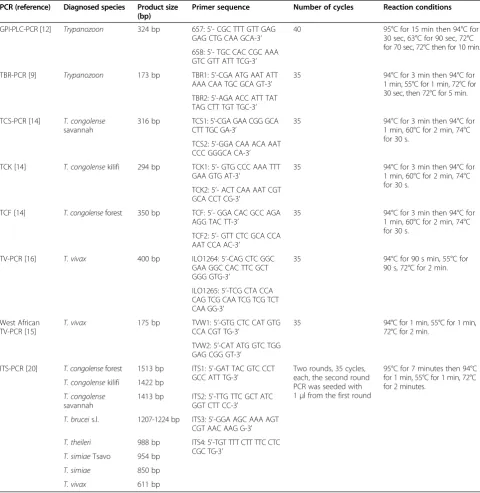
The species-specific PCR reactions used in this study
(see Table 1) detect Trypanozoon DNA (TBR-PCR [9]
and GPI-PLC-PCR [12]),T. congolenseDNA (TCS-PCR,
TCF-PCR, TCK-PCR [9,14]) and T. vivaxDNA (TV-PCR
[14,15]). The band sizes amplified by the ITS-PCR of Cox et al. [20] are shown in Table 1.
One positive control (genomic DNA) for each tryp-anosome species was used in the corresponding species specific PCR, while for ITS-PCR, a positive control of T. brucei s.l was used. Negative controls consisting of water only instead of eluate and washed blank discs were run with each PCR.
Amplification products were resolved in 1% (w/v) agarose gels along with 100 bp molecular weight Super-ladder (ABgene, Epsom, Surrey, UK). The agarose gel was prepared in 1 × TBE (89 mM Tris-Borate, 2 mM EDTA, and pH 8.3) (Sigma-Aldrich, Poole, Dorset, UK)
stained with 5μM ethidium bromide. The gels were run
in 1xTBE, 5μM ethidium bromide for at least 45 minutes at 100 volts and visualized under an ultra violet transil-luminator (Gel-Doc 2000, Bio-Rad).
When the amplification reaction gave a signal of the expected size according to the set of primers used with-out any signal in the negative control, infection was con-sidered to be confirmed.
Data analysis
Kappa values were used to determine the level of
agree-ment between the diagnostic tests [27,28]. A Fleiss’s
Kappa from rating scores using the website of Statstodo. com (http://www.statstodo.com/CohenKappa_Pgm.php) was used to compare the three PCR reactions targeting the Trypanozoon. All other Kappa tests were conducted using WinPepi (Version 3.15 [29]) with a value of above 0.75 indicating excellent agreement, 0.60-0.74 good agree-ment, 0.40-0.59 indicating fair agreement and below 0.40 indicating poor agreement [30].
Results Trypanozoon
agreed positively on one sample with TBR-PCR and GPI-PLC-PCR identifying an additional 62 and 45 samples re-spectively. Fleiss’s Kappa from rating scores showed poor agreement between the three PCR reactions (Kappa = 0.3997, 95% confidence interval = 0.3535 to 0.4459) Kappa testing showed excellent agreement between TBR-PCR and GPI-PLC-PCR (Kappa = 0.83, 95% confidence interval = 0.75 to 0.91). There was poor agreement between ITS-PCR and both TBR-ITS-PCR (Kappa = 0.03, 95% confidence
interval =−0.03 to 0.08) and GPI-PLC-PCR (Kappa = 0.04, 95% confidence interval =−0.04 to 0.11).
T. congolense
[image:4.595.57.538.100.594.2]Comparing the sensitivity (see Table 2) of the different PCR reactions in the diagnosis ofT. congolense, species-specific PCR using TCS, TCF and TCK detected 0 (0% prevalence, 95% CI = 0%-0.6%) parasitic events while ITS-PCR detected 13 (2.2% prevalence, 95% CI = 1.2%-3.7%).
Table 1 Different PCR reactions used in the current study
PCR (reference) Diagnosed species Product size (bp)
Primer sequence Number of cycles Reaction conditions
GPI-PLC-PCR [12] Trypanozoon 324 bp 657: 5’- CGC TTT GTT GAG GAG CTG CAA GCA-3’
40 95°C for 15 min then 94°C for
30 sec, 63°C for 90 sec, 72°C for 70 sec, 72°C then for 10 min. 658: 5’- TGC CAC CGC AAA
GTC GTT ATT TCG-3’
TBR-PCR [9] Trypanozoon 173 bp TBR1: 5’-CGA ATG AAT ATT AAA CAA TGC GCA GT-3’
35 94°C for 3 min then 94°C for
1 min, 55°C for 1 min, 72°C for 30 sec, then 72°C for 5 min. TBR2: 5’-AGA ACC ATT TAT
TAG CTT TGT TGC-3’
TCS-PCR [14] T. congolense
savannah
316 bp TCS1: 5’-CGA GAA CGG GCA CTT TGC GA-3’
35 94°C for 3 min then 94°C for
1 min, 60°C for 2 min, 74°C for 30 s.
TCS2: 5’-GGA CAA ACA AAT CCC GGGCA CA-3’
TCK [14] T. congolensekilifi 294 bp TCK1: 5’- GTG CCC AAA TTT GAA GTG AT-3’
35 94°C for 3 min then 94°C for
1 min, 60°C for 2 min, 74°C for 30 s.
TCK2: 5’- ACT CAA AAT CGT GCA CCT CG-3’
TCF [14] T. congolenseforest 350 bp TCF: 5’- GGA CAC GCC AGA AGG TAC TT-3’
35 94°C for 3 min then 94°C for
1 min, 60°C for 2 min, 74°C for 30 s.
TCF2: 5’- GTT CTC GCA CCA AAT CCA AC-3’
TV-PCR [16] T. vivax 400 bp ILO1264: 5’-CAG CTC GGC
GAA GGC CAC TTC GCT GGG GTG-3’
35 94°C for 90 s min, 55°C for
90 s, 72°C for 2 min.
ILO1265: 5’-TCG CTA CCA CAG TCG CAA TCG TCG TCT CAA GG-3’
West African TV-PCR [15]
T. vivax 175 bp TVW1: 5’-GTG CTC CAT GTG CCA CGT TG-3’
35 94°C for 1 min, 55°C for 1 min,
72°C for 2 min.
TVW2: 5’-CAT ATG GTC TGG GAG CGG GT-3’
ITS-PCR [20] T. congolenseforest 1513 bp ITS1: 5'-GAT TAC GTC CCT GCC ATT TG-3'
Two rounds, 35 cycles, each, the second round PCR was seeded with 1μl from the first round
95°C for 7 minutes then 94°C for 1 min, 55°C for 1 min, 72°C for 2 minutes.
T. congolensekilifi 1422 bp
T. congolense
savannah
1413 bp ITS2: 5'-TTG TTC GCT ATC GGT CTT CC-3'
T. bruceis.l. 1207-1224 bp ITS3: 5'-GGA AGC AAA AGT CGT AAC AAG G-3'
T. theileri 988 bp ITS4: 5'-TGT TTT CTT TTC CTC CGC TG-3'
T. simiaeTsavo 954 bp
T. simiae 850 bp
The species-specific reactions (TCS-PCR, TCF-PCR and TCK-PCR) and ITS-PCR did not agree positively on any samples with ITS-PCR identifying 13 positives in total. Kappa testing showed poor agreement between the species-specific reactions (TCS-PCR, TCF-PCR and TCK-PCR) and ITS-PCR (Kappa = 0, 95% confidence interval =−0.00 to 0.00).
T. vivax
Comparing the sensitivity (see Table 2) of the different PCR reactions in the diagnosis of T. vivax, specific PCR using TV detected 34 (5.7% prevalence, 95% CI = 4%-7.8%) parasitic events while ITS-PCR detected 17 (2.8% prevalence 95% CI = 1.5%-4.8%) parasitic events. TV-PCR and ITS-PCR only agreed positively on eight animals with TV-PCR and ITS-PCR identifying a further 26 and nine positives respectively. Kappa testing showed poor agree-ment between TV-PCR and ITS-PCR (Kappa = 0.29, 95% confidence interval = 0.12 to 0.45).
Other trypanosome species
In addition to these pathogenic trypanosome species,
ITS-PCR was able to identify non-pathogenicT. theileri
species. The reaction diagnosed 46 animals (7.6%) in-fected with T. theileri. A species-specific PCR reaction that targets T. theileri satellite sequence of 500 bp size
was developed by Rodrigues et al. [31] and was used in
the current study but failed to amplify T. theileriDNA
(data not shown).
Discussion
The use of ITS-PCR in diagnosis of African trypano-somes allows the identification of several trypanosome species in the same reaction. This is both a saving in time and cost, as less PCR reactions need to be car-ried out to gain an understanding of the prevalence of
trypanosomes in an area. Although FTA cards have simpli-fied the collection and transport of blood samples [3], often DNA is not spread homogenously over the matrix [23]. Al-though this can be overcome by taking several punches from each FTA card this can be time consuming and ex-pensive. Elution of DNA from the FTA card can improve the sensitivity of species-specific PCR reactions targeting trypanosomes [24]. In the current work we compared an
ITS-PCR first described by Cox et al. [20] modified
through the elution of DNA from the FTA card to species-specific PCR reactions. There was very little agreement for the three major African trypanosome species between these reactions. Although the modified ITS reaction did
not perform well forTrypanozoonit performed much
bet-ter for the detection of T. congolense when compared to
species-specific reactions.
In this study, ITS-PCR identified only one (0.2%) sam-ple to containTrypanozoonwhile the species-specific re-action diagnosed 63 parasitic events. The difference between the sensitivity of ITS-PCR and species-specific PCR reactions observed here might relate to the fre-quency of the target within the parasite genome. The
copy number of ITS target in the genome is 100–200
compared to 10,000 for TBR and the higher sensitivity of the latter reaction could be due to the increased copy number of the target DNA. However, good agreement was seen between TBR and GPI-PLC; with the latter tar-geting a single copy gene [12] it would seem doubtful that copy number alone is the reason for the lack of
agreement between TBR and ITS PCR. Cox et al. [20]
compared ITS-PCR with the same primers used in the current study and found that ITS-PCR identified 22%
(n = 245) of samples positive forTrypanozoonDNA while
TBR-PCR identified 21% (n = 245) of samples; these sam-ples were collected on FTA®cards from cattle in Uganda but PCR was conducted directly on the discs after wash-ing. However, more research by de Clare Bronsvoortet al. [22] had shown the species-specific TBR PCR reaction to be more sensitive than the Cox ITS-PCR when the PCR was seeded with washed discs. The differences between the sensitivities of the two reactions in the current study may be due to the fact that the ITS reaction was optimized to work on washed discs rather than eluted DNA.
Al-though Cox et al. [23] showed a higher sensitivity when
several punches were screened individually from the same card this is time consuming and costly. The advantage of using eluted DNA being that a greater volume of the FTA card can be sampled from a single PCR reaction [24]. In
contrast, Njiru et al. [19] reported that ITS-PCR using
[image:5.595.57.290.113.248.2]other primer sets were comparable to the species-specific reactions where ITS primers detected 84.9% (373 cattle and 185 camels were tested) of the samples positive using species-specific primers. The higher sensitivity of ITS primers compared with species-specific primers could be
Table 2 Comparison of species-specific and the modified ITS-PCR of Coxet al. [20] targeting African trypanosomes
PCR reaction ITS-PCR GPI-PLC
Positive Negative Positive Negative
TBR Positive 1 62 46 17
Negative 0 537 0 537
GPI-PLC Positive 1 45
Negative 0 554
TCS/TCF/TCK Positive 0 0
Negative 13 587
TV Positive 8 26
Negative 9 557
attributed to the sample processing method, because Njiru et al. [19] extracted DNA from blood samples with Qiagen extraction kits and 2μl of the extract was used as a tem-plate in the PCR reaction. Extraction of DNA directly from blood samples increased the sensitivity for the ITS reaction while elution of DNA from the FTA cards inhibits
the ITS PCR. However, although Thumbi et al. [21]
ex-tracted of DNA from frozen blood samples using the salt-out procedure of Sandbrook et al. [32], the specific PCR and the two ITS reactions only detected low levels of infection withTrypanozoon(1.9-3.9%).
It was difficult to differentiate between T. congolense
savannah type, T. congolense forest type and T.
congo-lensekilifi type using ITS PCR even after prolonged sep-aration time of the bands by electrophoresis. This was attributed to the band sizes of the amplified products of the three types are close to each other (1513 bp, 1422 bp and 1413 bp forT. congolense forest,T. congolensekilifi andT. congolensesavannah, respectively). For this reason, any product with a band size above 1400 bp was classified as T. congolense species. The PCR reactions specific forT. congolensesavannah,T. congolenseforest andT. con-golense kilifi were negative for all the examined samples with Kappa testing suggesting poor agreement between the two diagnostic PCR tests. Previously Cox et al. [20] had compared ITS-PCR with species-specific reactions on cat-tle blood samples collected on FTA®cards from Uganda. ITS-PCR identified six samples asT. congolensewhile only one sample was diagnosed using specific reactions for T. congolense savannah. The inability of the species-specific PCR reactions to identify theT. congolensespecies diagnosed with ITS-PCR could be explained by the exist-ence of a newT. congolensesub-species which is similar to T. congolensesavannah andT. congolenseforest in ITS tar-get, while there is no specific reaction to identify these
iso-lates at present. Isoenzyme analysis by Gashumba et al.
[33] had previously shown thatT. congolensefrom Uganda was separated from otherT. congolenseisolates suggesting
that further analysis of T. congolense from Uganda may
be required.
In the present study, universal primers targeting the
gene encoding T. vivax specific antigen were used for
the diagnosis of T. vivax species. The universal primer
set diagnosed 34T. vivaxinfections while ITS-PCR identi-fied 17 positive samples. Another set of primers targeting satellite DNA sequence were used and none of the samples were positive with these primers (data not shown). This was not unexpected since the primers targeting the satellite sequence are not present in some isolates ofT. vivax[16]. Cox et al. [20] identified nineT. vivaxinfections in cattle blood samples using the primer set amplifying the satellite sequence, while ITS-PCR identified sixT. vivaxinfections. Although Cox et al. [20] found little difference between the ITS-PCR and species-specific PCR, there were very few
positive samples making comparisons difficult. It has re-cently been suggested that the species-specific primer sets for T. vivax may not accurately assess the level of in-fection within wild animal samples from Tanzania [34]. This agrees with the current work, where ITS PCR identi-fied nine samples that were not identiidenti-fied by the species-specific primer set.
T. theileri was identified in 7.6% of samples using the modified nested ITS PCR. The prevalence obtained was similar to that obtained by Coxet al. [20] in a low Trypa-nozoonprevalence village (3%) but lower than that seen in a highTrypanozoonprevalence village (47%). As there were no positive results using the species-specific PCR reaction targetingT. theileriit was difficult to gauge the sensitivity of the modified ITS PCR in the current work.
Conclusions
The present study suggests that for estimating prevalence ofTrypanozoonwithin cattle populations, on samples that are collected on to FTA cards (that includes the zoonotic T. b. rhodesiense) species-specific primers are more suit-able in terms of sensitivity. However, as species-specific primers did not identify any T. congolenseand there were differences in the amplification ofT. vivax, the ITS reac-tions of Cox et al. [20] and other ones that are available (for example Njiruet al. [19]) might be of great value for detecting these parasites.
Competing interests
The authors declare they have no competing interests and the sponsors had no role in the study design, data collection and analysis, decision to publish, or preparation of the manuscript.
Authors’contributions
HAA carried out the study, the molecular approaches and participated in preparing the manuscript. KP and SCW designed the study supervised the molecular approaches and participated in preparing and editing the manuscript. ETM carried out the statistical analyses and participated in preparing and editing the manuscript. All authors read and approved the final version of the manuscript.
Acknowledgements
HAA would like to show a sincere gratitude to the Egyptian government represented in the public administration missions and the culture bureau in the United Kingdom for the financial and moral support that had a real impact on my research. SCW and ETM were members of COST Action BM0802, Life or Death of Protozoan Parasites. SCW and KP acknowledge support of DFID Research Into Use Programme, ICONZ, (Integrated Control of Neglected Zoonoses) an EU FP7 project and the BBSRC through CIDLID. We are also grateful to Prof Michael Thrusfield, University of Edinburgh for statistical advice.
Author details
1
Division of Pathway Medicine and Centre for Infectious Diseases, School of Biomedical Sciences, College of Medicine and Veterinary Medicine, The University of Edinburgh, Chancellor’s Building, 49 Little France Crescent, Edinburgh, EH16 4SB, UK.2Faculty of Veterinary Medicine, Zagazig University, Zagazig 44611, Egypt.
References
1. Wastling SL, Welburn SC:Diagnosis of human sleeping sickness: sense and sensitivity.Trends Parasitol2011,27:394–402.
2. Masake RA, Njuguna JT, Brown CC, Majiwa PA:The application of PCR-ELISA to the detection ofTrypanosoma bruceiandT. vivaxinfections in livestock.
Vet Parasitol2002,105:179–189.
3. Picozzi K, Tilley A, Fevre EM, Coleman PG, Magona JW, Oditt M, Eisler MC, Welburn SC:The diagnosis of trypanosome infections: applications of novel technology for reducing disease risk.Afr J Biotech2002,1:39–45. 4. Luckins AG:Detection of antibodies in trypanoasome-infected cattle by
means of microplate enzyme-linked immunosorbant assay.Trop Anim Health Prod1977,9:53–62.
5. Gibson W:Species-specific probes for the identification of the African tsetse-transmitted trypanosomes.Parasitol2009,136:1501–1507. 6. Welburn SC, Picozzi K, Fèvre EM, Coleman PG, Odiit M, Carrington M,
Maudlin I:Identification of human-infective trypanosomes in animal reservoir of sleeping sickness in Uganda by means of serum-resistance-associated (SRA) gene.Lancet2001,358:2017–2019.
7. Njiokou F, Simo G, Nkinin SW, Laveissiere C, Herder S:Infection rate of
Trypanosoma bruceis.l.,T. vivax,T. congolense“forest type”, andT. simiae
in small wild vertebrates in south Cameroon.Acta Trop2004,92:139–146. 8. Sloof P, Menke HH, Caspers MPM, Borst P:Size fractionation of
Trypanosoma bruceiDNA: localization of the 177-bp repeat satellite DNA and a variant surface glycoprotein gene in a mini-chromosomal DNA fraction.Nucl Acids Res1983,11:3889–3901.
9. Moser DR, Cook GA, Ochs DE, Bailey CP, McKane MR, Donelson JE: Detection ofTrypanosoma congolenseandTrypanosoma brucei
subspecies by DNA amplification using the polymerase chain reaction.
Parasitol1989,99:57–66.
10. Clausen PH, Wiemann A, Patzelt R, Kakaire D, Poetzsch C, Mehlitz D:Use of a PCR assay for the specific and sensitive detection ofTrypanosomaspp. in naturally infected dairy cattle in peri-urban Kampala, Uganda.Ann N Y Acad Sci1988,849:21–31.
11. Xong HV, Vanhamme L, Chamekh M, Chimfwembe CE, Van Den Abbeele J, Pays A, Van Meirvenne N, Hamers R, De Baetselier P, Pays E:A VSG expression site-associated gene confers resistance to human serum in
Trypanosoma rhodesiense.Cell1998,95:839–846.
12. Picozzi K, Carrington M, Welburn SC:A multiplex PCR that discriminates betweenTrypanosoma brucei bruceiand zoonoticT. b. rhodesiense.
Exp Parasitol2008,118:41–46.
13. Hoare CA:The Trypanosomes of Mammals: A Zoological Monograph.Oxford: Blackwell scientific publications; 1972.
14. Masiga DK, Smyth AJ, Hayes P, Bromidge TJ, Gibson WC:Sensitive detection of trypanosomes in tsetse flies by DNA amplification.Int J Parasitol1992,22:909–918.
15. Masake RA, Nantulya VM, Pelle R, Makau JM, Gathuo H, ole-MoiYoi OK:A species-specific antigen ofTrypanosoma(Duttonella)vivaxdetectable in the course of infection is encoded by a differentially expressed tandemly reiterated gene.Mol Biochem Parasitol1994,64:207–218.
16. Masake RA, Majiwa PAO, Moloo SK, Makau JM, Njuguna JT, Maina M, Kabata J, Ole-MoiYoi OK, Nantulya VM:Sensitive and specific detection of
Trypanosoma vivaxusing the polymerase chain reaction.Exp Parasitol 1997,85:193–205.
17. Desquesnes M, McLaughlin G, Zoungrana A, Davila AMR:Detection and identification ofTrypanosomaof African livestock through a single PCR based on internal transcribed spacer 1 of rDNA.Int J Parasitol2001, 31:610–614.
18. Desquesnes M, Davila AMR:Applications of PCR-based tools for detection and identification of animal trypanosomes: a review and perspectives.
Vet Parasitol2002,109:213–231.
19. Njiru ZK, Constantine CC, Guya S, Crowther J, Kiragu JM, Thompson RCA, Davila AMR:The use of ITS1 rDNA PCR in detecting pathogenic African trypanosomes.Parasitol Res2005,95:186–192.
20. Cox A, Tilley A, McOdimba F, Fyfe J, Eisler MC, Hide G, Welburn SC:A PCR based assay for detection and differentiation of African trypanosome species in blood.Exp Parasitol2005,111:24–29.
21. Thumbi SM, McOdimba FA, Mosi RO, Jung’a JO:Comparative evaluation of three PCR based diagnostic assays for the detection of pathogenic trypanosomes in cattle blood.Parasit Vectors2008,1:46.
22. de Clare Bronsvoort BM, von Wissmann B, Fèvre EM, Handel IG, Picozzi K, Welburn SC:No gold standard estimation of the sensitivity and
specificity of two molecular diagnostic protocols for Trypanosoma brucei spp. in Western Kenya.PLoS One2010,5:e8628.
23. Cox AP, Tosas O, Tilley A, Picozzi K, Coleman P, Hide G, Welburn SC: Constraints to estimating the prevalence of trypanosome infections in East African zebu cattle.Parasit Vectors2010,3:82.
24. Ahmed HA, MacLeod ET, Hide G, Welburn SC, Picozzi K:The best practice for preparation of samples from FTA®cards for diagnosis of blood borne infections using African trypanosomes as a model system.Parasit Vectors 2011,4:68.
25. Kabasa JD:Public-private partnership works to stamp out sleeping sickness in Uganda.Trends Parasitol2007,23:191–192.
26. Becker S, Franco JR, Simarro PP, Stich A, Abel PM, Steverding D:Real-time PCR for detection ofTrypanosoma bruceiin human blood samples.
Diagn Microbiol Infect Dis2004,50:193–199.
27. Cicchetti DV, Sparrow SA:Developing criteria for establishing interrater reliability of specific items: applications to assessment of adaptive behavior.Am J Ment Defic1981,86:127–37.
28. Fleiss JL, Levin B, Paik MC:Statistical Methods for Rates and Proportions. 3rd edition. Hoboken: John Wiley & Sons; 2003.
29. Abramson JH:WINPEPI updated: computer programs for epidemiologists, and their teaching potential.Epidemiol Perspect Innov2011,8:1. 30. Altman DG:Practical Statistics for Medical Research.London: Chapman and
Hall; 1991.
31. Rodrigues AC, Campaner M, Takata CSA, Dell’Porto A, Milder RV, Takeda GF, Teixeira MMG:Brazilian isolates ofTrypanosoma(Megatrypanum)theileri: diagnosis and differentiation of isolates from cattle and water buffalo based on biological characteristics and randomly amplified DNA sequences.
Vet Parasitol2003,116:185–207.
32. Sambrook J, Fritsch EF, Maniatis T:Molecular Cloning: A Laboratory Manual. 2nd edition. Cold Spring Harbor, N.Y: Cold Spring Harbor Laboratory; 1989. 33. Gashumba JK, Baker RD, Godfrey DG:Trypanosoma congolense: the
distribution of enzymic variants in east and West Africa.Parasitol1988, 96:475–486.
34. Auty H, Anderson NE, Picozzi K, Lembo T, Mubanga J, Hoare R, Fyumagwa RD, Mable B, Hamill L, Cleaveland S, Welburn SC:Trypanosome diversity in wildlife species from the Serengeti and Luangwa Valley ecosystems.
PLoS Negl Trop Dis2012,6:e1828.
doi:10.1186/1756-3305-6-316
Cite this article as:Ahmedet al.:A comparative evaluation of PCR-based methods for species- specific determination of African animal trypanosomes in Ugandan cattle.Parasites & Vectors20136:316.
Submit your next manuscript to BioMed Central and take full advantage of:
• Convenient online submission
• Thorough peer review
• No space constraints or color figure charges
• Immediate publication on acceptance
• Inclusion in PubMed, CAS, Scopus and Google Scholar
• Research which is freely available for redistribution
![Table 2 Comparison of species-specific and the modifiedITS-PCR of Cox et al. [20] targeting African trypanosomes](https://thumb-us.123doks.com/thumbv2/123dok_us/8327117.300125/5.595.57.290.113.248/table-comparison-species-specific-modifiedits-targeting-african-trypanosomes.webp)
