This is a repository copy of
Computation Offloading and Resource Allocation in Mixed
Fog/Cloud Computing Systems with Min-Max Fairness Guarantee
.
White Rose Research Online URL for this paper:
http://eprints.whiterose.ac.uk/125533/
Version: Accepted Version
Article:
Du, J., Zhao, L., Feng, J. et al. (1 more author) (2017) Computation Offloading and
Resource Allocation in Mixed Fog/Cloud Computing Systems with Min-Max Fairness
Guarantee. IEEE Transactions on Communications. ISSN 0090-6778
https://doi.org/10.1109/TCOMM.2017.2787700
[email protected] https://eprints.whiterose.ac.uk/
Reuse
Items deposited in White Rose Research Online are protected by copyright, with all rights reserved unless indicated otherwise. They may be downloaded and/or printed for private study, or other acts as permitted by national copyright laws. The publisher or other rights holders may allow further reproduction and re-use of the full text version. This is indicated by the licence information on the White Rose Research Online record for the item.
Takedown
If you consider content in White Rose Research Online to be in breach of UK law, please notify us by
Computation Offloading and Resource Allocation in
Mixed Fog/Cloud Computing Systems with
Min-Max Fairness Guarantee
Jianbo Du, Liqiang Zhao, Jie Feng, and Xiaoli Chu
Abstract—Cooperation between the fog and the cloud in mobile cloud computing environments could offer improved offloading services to smart mobile user equipment (UE) with computation intensive tasks. In this paper, we tackle the computation offload-ing problem in a mixed fog/cloud system by jointly optimizoffload-ing the offloading decisions and the allocation of computation re-source, transmit power and radio bandwidth, while guaranteeing user fairness and maximum tolerable delay. This optimization problem is formulated to minimize the maximal weighted cost of delay and energy consumption (EC) among all UEs, which is a mixed-integer non-linear programming problem. Due to the NP-hardness of the problem, we propose a low-complexity suboptimal algorithm to solve it, where the offloading decisions are obtained via semidefinite relaxation and randomization and the resource allocation is obtained using fractional programming theory and Lagrangian dual decomposition. Simulation results are presented to verify the convergence performance of our proposed algorithms and their achieved fairness among UEs, and the performance gains in terms of delay, EC and the number of beneficial UEs over existing algorithms.
Index Terms—Computation offloading, cloud computing, fog computing, resource allocation, min-max fairness.
I. INTRODUCTION
With smart mobile user equipments (UEs) gains enormous popularity, people expect to run more and more computation-intensive mobile applications [1]. Those applications usual-ly consume huge amounts of energy and demand powerful computation capacity, and have rigorous delay constraints. However, UEs are usually resource-constrained, possessing limited computation capability and battery, which makes it impractical to run sophisticated applications on them [2]. Mobile Cloud Computing (MCC) [3] has been considered as a promising way to address the above challenges by offloading those applications to powerful cloud centers. However, the delay caused by transferring data to the remote cloud server is usually unacceptable for some latency-sensitive applications.
Mobile edge computing [3] (or fog computing [4]) has been proposed as a supplement to MCC for further energy saving
*This work was supported in part by National Natural Science Founda-tion of China (61771358), Intergovernmental InternaFounda-tional CooperaFounda-tion on Science and Technology Innovation (2016YFE0122900), and the 111 Project (B08038).
J. Du, L. Zhao, J. Feng are with State Key Laboratory of ISN, Xidian University, No.2 Taibainan-lu, Xi’an, 710071, Shaanxi, China. (Email: [email protected]; [email protected]; [email protected]).
X. Chu is with Department of Electronic and Electrical Engineering, The University of Sheffield, Mappin Street, Sheffield, S1 3JD, UK. (Email: [email protected]).
and delay reduction in recent years [5]. In fog computing, ac-cess points (APs) and UEs with certain proac-cessing capabilities serve as fog nodes [4], [6], [7], and each UE is associated to a cloud clone in the fog node or cloud center, where a virtual machine (VM) executes mobile applications for the UE [8], [9]. The slight difference between Fog computing and Mobile edge computing is that Fog computing can be expanded to the core network [3], [4], however, similar to most works, we do not distinguish the two concepts in this paper.
Many works have been proposed to investigate the issues involved in computation offloading. Through the optimization of offloading decisions and the involved resource allocation, such as the allocation of transmit power, bandwidth, and computation resource, to obtain system performance gains, e.g., reduction in delay or energy consumption (EC), or an improvement in energy efficiency, etc. However, most of those previous works put their emphasis either on offloading decision making [2], [10], or resource allocation [6], without a joint consideration of both. The works in [6] and [11] focused on system-level performance improvement, without considering the performance of individual UEs, where UEs with good channel conditions (e.g., high channel gains, low interference, or both) will benefit from computation offloading, but at the cost of degraded performance of UEs under bad channel conditions, resulting in unfairness among UEs.
Different from the above approaches, in this paper, we study the joint optimization of offloading decision making, computa-tion resource allocacomputa-tion, transmit power assignment, and radio bandwidth allocation for a mixed cloud/fog computing system to minimize the system cost, i.e., a weighted sum of delay and energy consumption, with the maximum tolerable delay guaranteed. To ensure the fairness of all the UEs, we minimize the maximum cost among all the UEs. We formulate the joint optimization as a mixed integer non-linear programming (MINLP) problem and propose a suboptimal algorithm with low complexity to solve it. The main contributions of this work are summarized as follows.
• Different from [6], [12] and [13], a fairness-aware cost
minimization problem is formulated to minimize the maximum cost among all UEs.
• We devise a low complexity algorithm calledcomputation
and through semidefinite relaxation (SDR) and random-ization, offloading decisions are obtained; then by using thebisection method forcomputationresourceallocation (BCRA), we propose Algorithm 2 to optimize the com-putation resource allocation.
• We propose a fractional programming based Algorithm 3 to transform the non-convex radio resource allocation into a convex programming problem, which is solved by Lagrange dual decomposition based Algorithm 4 (which is nested in Algorithm 3) and transmit power and band-width allocation is obtained.
• We perform abundant simulation results to evaluate the convergence of the iterative algorithms 2, 3 and 4, the fairness of CORA, and the performance gain of CORA by comparing it with the existing prevalent algorithms in computation offloading.
The remainder of this paper is organized as follows. Related works are presented in Section II. Section III introduces the system model and problem formulation. Section IV presents the CORA algorithm with focus on the SDR based offload-ing decision makoffload-ing algorithm. The iterative algorithms for computation resources allocation is detailed in Section V. In Section VI, we present the bandwidth and power allocation al-gorithm. Complexity analysis of CORA algorithm is presented in Section VII. Simulation results are provided in Section VIII. Finally, the paper is concluded in Section IX.
Notation: Lower case boldface letters denote vectors, while upper case boldface letters denote matrices. For a certain matrix X, X ≽ 0 means that X is a positive semidefinite matrix, while Tr(X) and rank(X) denote the trace and the rank of X, respectively. For a vectorxor a matrix X,xT or XT represents the transpose of them. We usee
n to denote an
N ×1 unit vector with the nth entry being 1, and diag(e
n)
stands for an N×N diagonal matrix with its main diagonal elements from en.
II. RELATEDWORKS
Application offloading has been a hot topic owning to the appearance of cloud computing and fog computing. Each application can be offloaded in coarse-grained application level [6], [12], fine-grained task level [2], [13]–[16], or a percent of [17], [18], and can be offloaded to the cloud or fog, where the decision could be made in a centralized (most current works employ this manner) or decentralized manner [10], [19], for single UE or multiple UEs.
In single-UE case, task partitioning and assignment is usual-ly considered where each task should be determined whether to offload or not according to some criteria [2], [14]–[16], [20]. In [17], [18] the authors considered a special kind of data-partitioned-oriented-application and partial of the application is offloaded, together with transmit power optimization, to minimize the EC of the UE. The tradeoff between the EC for local computation and for remote communications was discussed in [20], [21].
In multi-UE scenario, the computation resources of the fog node, and communication resources between UEs and the fog
node (e.g., bandwidth, and power) are shared, which should be allocated elaborately for a better performance. The authors in [22] studied task-level offloading in a multi-UE multi-fog scenario where offloading decision (whether to offload or not) was optimized for each task of each UE. In [10] and [19], game theory was utilized to optimized offloading decisions in a multi-UE cloud computing environment. In [12], the authors intended to minimize the system EC by offloading applications into the cloud. Note that radio resources were not optimized in [10], [12], [19], [22]. The authors in [6] studied application offloading in a multi-UE multi-cell Input Multiple-Output (MIMO) system by transmit power optimization under given offloading decisions, in order to minimize the total EC of all UEs. The authors in [13] intended to maximize the weighted performance improvement in time saving and energy reduction of the system, by jointly optimizing offload-ing decisions, the allocation of local clock frequency and transmit power. A novel three-tier optimization architecture, including the UE tier, the cloudlet tier, and the cloud tier, was proposed in [19], where the authors proposed to minimize the queue-arrival-rate weighted mean task response time of each UE by offloading strategy optimization employing game theory. However, none of the aforementioned works [4], [6], [10], [12], [13], [19], [22] have jointly considered offloading decision making, computation resource allocation and uplink communication resource assignment for multi-UE mixed fog and cloud radio access networks.
Resource allocation and offloading decision making were jointly optimized in [11] so as to conserve energy while satisfying UE delay constraints. However, the EC of each UE was set as a constant for simplicity, ignoring its time varying aspect. Besides, for resource allocation, it was only mentioned as “solve the corresponding resource allocation problem”, but no detail was given. Furthermore, there was no radio channel model, and the radio resource was allocated in units of bit/s, which was oversimplified, since in actual networks, radio resource is usually in terms of resource blocks, bandwidth, and/or transmit power. Moreover, the fairness between UEs was not taken into consideration [6], [11]–[13].
III. SYSTEMMODEL ANDPROBLEMFORMULATION A. Description of the Concerned Scenario
be processed, i.e., in the UE locally, in the fog, or in the cloud, and finally, the offloading decision is delivered to the corre-sponding UE. Since the offloading requests are usually very small, we assume that no buffer is needed for queueing the computation requests, as in [9]. To enable tractable analysis, we assume that the DM decides the offloading strategy for all the UE requests that have been received at the beginning of the offloading period, i.e., the decision making delay due to request queuing and decision making is omitted [23].
UE1
UEN
Fog node Cloud server Mobile users
Fiber link
6KDUHGXSOLQN FKDQQHO
$SSOLFDWLRQ 0RELOH26 +DUGZDUH
90SRRO $SSVWRUH
'
0
[image:4.612.63.291.172.307.2]90SRRO $SSVWRUH
Fig. 1. System topology [19].
The offloading decisions of UEn are constrained by
xn+yn+zn= 1, ∀n∈ N, (1)
where xn = 1, yn = 1, zn = 1 indicate that the application
is processed by UE itself, by the fog, and by the cloud, respectively; otherwise, xn= 0, yn= 0, zn= 0. The constraint
in (1) implies that among xn, yn, and zn, one and only one
of them is 1 at any time.
Similar to the existing works [6], [9], [10], [13], [20], [22], [23], to enable tractable analysis, we consider a quasi-static scenario where all UEs and the wireless network remain stationary during an offloading period (usually within several seconds [10]). This assumption holds for many applications, e.g., natural language processing, and face recognition, where the input data size is not large so that the application offloading could be completed during a time shorter than the timescales of UE mobility and the dynamics of wireless networks. We perform the joint optimization of offloading decision and resource allocation at each new request from a UE within an offloading period independently.
For fog processing, the fog node needs to allocate the limit-ed computation resources (in CPU cycles/s) to the application of corresponding UEs. Denote the set of fog-processing UEs by N1, and N1 = |N1| is the number of UEs in N1. For remote processing in the cloud, the applications need to be transmitted from the UE to the fog node through the shared wireless links, and then forwarded by the fog node to the cloud through a wired link. Since the cloud has plenty of computation resources and the wired link between the fog node and the cloud server is of a sufficiently large capacity, the allocation of these resources will not be discussed. However, the limited radio bandwidth needs to be allocated among all the fog-processing and cloud-executing UEs for communicating with the fog node. All the fog-processing and cloud-executing UEs are referred to as remote-processing UEs, collected in the
set N2, andN2 = |N2| is the number of remote-processing UEs. Assume the total radio bandwidth isB Hz. We allocate to each remote-processing UE a portion of the total bandwidth orthogonally to avoid interference between them [24], [25].1 Denote the normalized assigned portion of bandwidth to UEn
as an, we havean∈[0,1]and ∑
n∈N2
an≤1.
The application of UE n is described by Jn =
{Dn, Appn, τnmax}, n ∈ N, where Dn denotes the size of
input data (in bits), τmax
n is the tolerable maximum latency
(in second), and Appn is the processing density (in CPU
cycles/bit), which depends on the computational complexity of the application [1], [17]. We model the size Cn of
cal-culation amount, i.e., the number of CPU cycles necessary to accomplish the application, as Cn =DnAppn [17], [18].
In the following, we assume that the Dn, Cn andAppn are
known, which can be obtained by employingprogram profilers as in [2], [13], [22]. We assume there is a clone for each UE in the fog node, so the application code ofJn with sizeCn is
backed up in the fog node [1], [20], and can be downloaded by the cloud server through a high-speed wired link [2], [6]. Therefore, only the data of Dn bits need to be transmitted
from the UE to cloud server when offloading. It should be noted thatDn, Cn, Appn andτnmaxare inherent parameters
of the application of UEn, and they will not change with where
the application is processed.
In the following we will discuss the EC and the delay caused by local processing, fog executing and cloud computing, respectively. Since the output after processing is usually small, only the uplink communication is considered hereafter for simplicity of analysis [9], [10], [13], [20].
B. Cost Under Different Scenarios 1) Local Processing: Let floc
n and plocn be the local
com-putation capability (in CPU cycles/s) and the local executing power consumption (in watt) of UEn, respectively. The delay
and EC of processing applicationJn locally are [6], [13], [16]
Tloc
n =Cn/fnloc, (2)
Eloc
n =plocn (Cn/fnloc). (3)
2) Fog Computing: For analytical tractability, we assume that the fog processing for an application starts only after all the input data has been received by the fog node. More specifically, if the applicationJn is to be processed in the fog,
UEnneeds to transmit the input dataDnto the fog through the
shared wireless links. After all the input dataDn is received,
applicationJnis executed by the fog node. Denote the channel
gain between UEn and the fog node ashn, then the achievable
transmit rate of UEn is
rn=anBlog2
( 1 +p
com
n hn
anN0B
)
, (4)
wherepcom
n is the transmit power of UEn, which is restricted
by the maximum valuepmax
n .
Denote the power consumption (in watt) of UEn in idle
state aspid
n, then the delay and EC of fog processing are given
respectively by [6]
Tf og
n =Dn/rn+Cn/fnf og, (5)
Ef og
n =pcomn (Dn/rn) +pidn(Cn/fnf og), (6)
where ff og
n (in CPU cycles/s) denotes the computation
re-sources allocated to UEn.
3) Cloud Computing: If applicationJn is offloaded to the
cloud server, then UEn first transmits the data of size Dn
through a wireless link to the fog node, which then forwards
Jn to the cloud server through a high-speed wired link. We
denote the rate of the wired link allocated to UEn as Rf cn (in
bit/s), and the cloud processing capability assigned to UEn
as fc
n (in CPU cycles/s). The delays in wired transmission
and cloud processing are given by Tf c
n =Dn/Rf cn andTnc=
Cn/fnc, respectively. The total delay and total EC of cloud
processing for UEn are given respectively by
Tcloud
n =Dn/rn+Tnf c+Tnc, (7)
Ecloud
n =pcomn (Dn/rn) +pidn(Tnf c+Tnc). (8)
According to (2)-(8), the EC and delay of UEn can be
expressed respectively as
En=Enlocxn+Enf ogyn+Encloudzn, (9)
Tn =Tnlocxn+Enf ogyn+Ecloudn zn. (10)
All the notations used are listed in Table I.
TABLE I NOTATIONDEFINITIONS
Symbol Definition
Eloc
n ,Enf og, EC for UEn in local/fog/cloud processing
Ecloud n
Tnloc,Tnf og, Delay for UEnin local/fog/
Tcloud
n cloud processing
floc
n ,fnf og, Processing ability of UEnof
fc
n local/fog/cloud processing
ploc
n ,pidn, Power of UEnin local processing/idle/transmit
pcomn
Dn,Cn, Data size/size of calculation amount/
Appn processing density ofJn
τnmax The maximum processing delay ofJn
rn Transmit rate of UEn
an Normalized allocated bandwidth to UEn
Ff og Total computation capability of the fog
Tf c
n ,Tnc Wired transmit/cloud-processing delay of UEn
Rf c
n Rate of UEn in wired link
xn,yn,zn Offloading decisions of UEn π Set of offloading decision of all UEs
N, N Set/number of UEs N1, N1 Set/number of fog processing UEs N2, N2 Set/number of remote processing UEs
L Number of runs (i.e., randomization trails)
B Total radio bandwidth between UEs and the fog
N0 Additive noisy power spectral density
C. Problem Formulation
In this section, we formulate the problem of jointly opti-mizing offloading decision making and resource allocation for a mixed fog/cloud computing system and show that it is NP-hard.
The cost of UEn is defined as the weighted sum of EC and
latency asCostn=λenEn+λtnTnwhereλen, λtn∈[0,1], n∈
N denote the weights of EC and delay for UEn, respectively.
We propose to minimize the maximum cost among all UEs while meeting the maximum delay constraints. We formu-late the joint optimization of the offloading decisions π = [x,y,z] = [x1, y1, z1, ..., xN, yN, zN], the power and
band-width assignmentpcom= [pcom
1 , ..., pcomN ]anda= [a1, ..., aN]
(for local processing UEn, we letpcomn = 0, an= 0), and the
computation resource allocation ff og = [ff og
1 , ..., f
f og
N ] (for
non-fog processing UEn, letfnf og= 0) as follows
(P1) : min
π,ff og,pcom,a maxn∈N Costn (11) s.t. (C1) :xn, yn, zn∈ {0,1}, ∀n∈ N,
(C2) : xn+yn+zn = 1, ∀n∈ N, (C3) : ∑
n∈N
ff og
n ≤Ff og,
(C4) : ff og
n ≥0, ∀n∈ N,
(C5) : 0< an≤1, ∀n∈ N, (C6) : ∑
n∈N
an ≤1,
(C7) : 0≤pcomn ≤pmaxn ,∀n∈ N, (C8) : Tn≤τnmax,∀n∈ N,
whereFf ogis the total computation capacity of the fog node; (C1)and (C2)are the constraints on the offloading decision of each UE; (C3) indicates that the allocated computation resources cannot exceed the total computation capability of the fog node;(C4)is the non-negative constraint on computation resource allocation; (C5) and (C6) are the constraints on bandwidth allocation; (C7) is the transmit power constraint of each UE; and (C8) indicates each application should be performed before a tolerable deadline. Note that (P1) minimizes the maximum cost among all UEs. Therefore, it guarantees fairness among UEs from the perspective of system cost.
Remark 1. Problem (P1) is not convex due to: 1) the min-max formulation; and 2) the binary variables π. It is a
mixed-integer non-linear programming problem, which can be generally NP-hard [26].
IV. OFFLOADINGDECISIONMAKING
A. Equivalent Transformation into a QCQP Problem
Firstly, we introduce a slack variable ζ, and let
max
n∈N Costn = ζ. By merging items containing xn, yn, zn
andyn+zn, respectively, we have
(λe
nplocn +λtn)
Cn
floc n
xn+ (λenpidn +λnt)(Tnf c+Tnc)zn
+ (λe
npidn +λtn)
Cn
fnf og
yn+ (λenpcomn +λtn)
Dn
rn
(yn+zn)
≤ζ, (12)
where (λe
nplocn +λtn)fClocn
n and (λ
e
npidn +λtn)(Tnf c +Tnc) are
constants. Letting max
n∈N{(λ
e
npidn +λtn)fCf ogn
n yn} = D
f og
n and
max
n∈N{(λ
e
npcomn +λtn)Drnn(yn+zn)}=D
com
n , we have
Cn(λenpidn +λnt)yn≤Dnf ogfnf og,
Dn(λenpcomn +λtn)(yn+zn)≤Dncomrn. (13)
Based on the above definitions,(P1)is transformed as
(P2) : min
π,ff og,pcom,a,d,ζζ (14) s.t. (C11) :xn(xn−1) = 0, yn(yn−1) = 0,
zn(zn−1) = 0, ∀n∈ N, (C2)−(C8),
(C9) :Costn≤ζ, ∀n∈ N,
(C10) :Cn(λenpidn +λtn)yn ≤Df ogn fnf og, ∀n∈ N, (C11) :Dn(λenpcomn +λtn)(yn+zn)≤Dcomn rn,
∀n∈ N,
where d = [d1,d2, ...,dN], dn =
[
Df og
n , Dcomn
]
, and the integer constraint (C1) is replaced with (C11). However, problem(P2)is still nonconvex due to the quadratic terms in
(C11). Next, we transform (P2) into an equivalent standard QCQP problem. To enable tractable analysis, the constraints with respect to resource allocation including (C5)–(C8) are not considered temporarily in offloading decision making for simplicity.
We first define the following(7N+ 1)×1vector as follows
s=[x1, y1, z1, ..., xN, yN, zN, f1f og, ..., fNf og,
D1f og, ..., D
f og
N , r1, ..., rN, Dcom1 , ..., DcomN , ζ ]T
.
Then problem(P2)is transformed into the following stan-dard QCQP problem
(P3) : min s (u0)
Ts (15)
s.t.(C1′) :sTdiag(e′p)s−(e′p)Ts= 0, p= 1, ...,3N, (C2′) : (uIn)Ts= 1,
∀n∈ N,
(C3′) : (uf og)Ts
≤Ff og, (C4′) : (ufn)Ts≥0, ∀n∈ N,
(C9′) : (ucn)Ts
≤0, ∀n∈ N,
(C10′) : sTQf ogn s+ (uf ogn )Ts≤0, ∀n∈ N,
(C11′) : sTQcomn s+ (ucomn )Ts
≤0, ∀n∈ N,
whereei ande′i are standard unit vectors with size of N×1
and(7N+ 1)×1, respectively, and
u0= [01×7N 1]T, uIn =e3′n−2+e′3n−1+e′3n,
uf og= [01×3N 11×N 01×(3N+1)]T,
uf ogn =Cn(λnepidn +λtn)e′3n−1, unf =e′3N+n,
ucomn =Dn(λenpcomn +λtn)(e′3n−1+e′3n),
ucn= (λe
nplocn +λtn)
Cn
floc n
e′3n−2+ (λe
npidn +λtn)(Tnf c+Tnc)e′3n
+e′4N+n+e6′N+n−e′7N+1,
Qf ogn =
03N×3N 03N×2N 03N×(2N+1)
02N×3N Qnf og1 02N×(2N+1)
0(2N+1)×3N 0(2N+1)×2N 0(2N+1)×(2N+1)
,
Qcomn =
05N×5N 05N×2N 05N×1
02N×5N Qcomn1 02N×1
01×5N 01×2N 01×1
,
Qcomn1 =Qf ogn1 =−12
[
0N×N diag (en) diag (en) 0N×N
]
.
However, the QCQP problem (P3) is still nonconvex and is hard to solve.
B. Semidefinite Relaxation
SDR is an efficient way to simplify QCQP problems [28]. In(P3), all the matrices are real symmetric, and all the vectors are real, satisfying the conditions for SDR. In order to apply SDR to(P3), we define
w= [s(7N+1)×1 11×1]T,
W= [wwT](7N+2)×(7N+2). (16)
Notice W is a rank one symmetric positive semidefinite matrix, then we obtain the equivalent version of (P3) as follows
(P4) : min
W Tr(M0W) (17)
s.t.(C1′′) : Tr(MpW) = 0, p= 1, ...,3N, (C2′′) : Tr(MInW) = 1, ∀n∈ N,
(C3′′) : Tr(Mf ogW)≤Ff og, (C4′′) : Tr(MfnW)≥0, ∀n∈ N,
(C9′′) : Tr(McnW)≤0, ∀n∈ N,
(C10′′) : Tr(Mf ogn W)≤0, ∀n∈ N,
(C11′′) : Tr(Mcomn W)≤0, ∀n∈ N,
(C12) : W(7N+2,7N+2) = 1,
(C13) : W≽0,
where
M0=
[
0(7N+1)×(7N+1) 12u0 1
2(u0)T 0
]
,
Man= [
0(7N+1)×(7N+1) 12uan
1 2(u
a
n)T 0
]
, a=I, f, c; ∀n,
Mf og= [
0(7N+1)×(7N+1) 12uf og
1
2(uf og)T 0
]
,
Mvn= [
Qv
n 12uvn
1
2(uvn)T 0 ]
, v=com, f og; ∀n,
Mp= [
diag(e′p) −1 2e′p
−1
2(e′p)T 0 ]
, ∀p.
In problem(P4), the only non-convex constraint is the rank constraint (C14). By dropping the rank constraint (C14), we relax problem (P4)into a positive semidefinite programming (PSD) problem as follows
(P5) : min
W Tr(M0W) (18)
s.t.(C1′′)−(C4′′),(C9′′)−(C11′′),
(C12),(C13).
Now, we have transformed the original problem (P1) into a standard convex optimization problem(P5), which could be solved in polynominal time using standard CVX tools such as SeDuMi [27].
C. Extracting Offloading Decisions
In this subsection, we extract a feasible solutiones to(P3) from the global optimal solution W∗ to (P5). We adopt the method proposed in [11], [16], to obtain the offloading decisions in the feasible solutiones.
According to the definition of W, we know that only the top left 3N ×3N submatrix of W∗, denoted as W′∗, is necessary to obtain the offloading decisions π; and all the
diagonal elements inW′∗are positive real numbers between 0 and 1. We define pr= [prl
1, pr1f, prc1, ..., prNl , pr f
N, prcN]T ,
diag(W′∗), where each entry of prindicates the probability of the corresponding entry of π being 1.
To satisfy constraint(C2), we defineΞl
n=prln(1−prnf)(1−
prc
n), Ξfn = (1−prln)prnf(1−prcn) and Ξcn = (1−prln)(1−
prf
n)prcn. Based on them, the probabilities of local, fog, and
cloud processing for UEn are given respectively as P rnl = Ξl
n/(Ξln+ Ξfn+ Ξcn),P rfn= Ξfn/(Ξln+ Ξfn+ Ξcn), andP rnc = Ξc
n/(Ξln+ Ξfn+ Ξcn).
Then the location where the application of UEn will be
executed is given by
On =
(1,0,0), local processing with prob. P rl
n,
(0,1,0), fog processing with prob. P rf
n,
(0,0,1), cloud processing with prob. P rc
n.
(19)
By randomly setting the value of the vector according to the probabilities in (19), problem (P6) is resolved and the offloading decisions xn, yn andzn of UEn can be obtained.
D. Joint Offloading Decision and Resource Allocation algo-rithm
In the above procedure for offloading decision extraction in (19), since the offloading decisions are obtained randomly according to the obtained probabilitiesP rl
n, P rfn, P rcn, we can
run the above procedure several times to obtain more accurate offloading decisions. Each run is referred to as a randomization trial and the number of randomization trails is denoted by L. After thatL i.i.d feasible offloading decisionsπl, l= 1, ..., L
are obtained. Then we perform radio and computation resource allocation under eachπl, andLsolutions including offloading
decision and resource allocation are obtained, among which the one with the minimum objective value is considered as the final solution π∗. A small value of L will be sufficient
to obtain a satisfying result [11]. The global framework of CORA is shown in Algorithm 1.
Algorithm 1 Computation Offloading Decision Making and
ResourceAllocation Algorithm (CORA)
Initialization:
1: Initialize L, N, B, N0, Ff og.
2: Initialize Dn, Appn, fnloc, pmaxn , pidn, plocn , Rf cn , fnc, τnmax
of each UE.
3: Initialize all the matrixes involved in(P5);
Iteration:
4: Solve the SDR problem(P5)adopting standard CVX tool SeDuMi to get its optimal W∗.
5: Extract the top left corner3N×3N sub-matrixW′∗from matrix W∗, and denote the values of diagonal elements inW′∗ aspr= [prl
1, prf1, pr1c, ..., prlN, pr f
N, prNc ]T.
6: forl= 1, ..., L do
7: Extract πl from prl =
[prl
1, pr
f
1, pr1c, ..., prNl , pr f
N, prcN]T
l
according to (19).
8: Perform radio and computation resource allocation un-der πl.
9: end for
10: Compare the objective value of all the L solutions, and choose the solution with the minimum objective value. 11: Output: The corresponding offloading decision π∗ and
resource allocation is considered as the final solution.
E. Dimensional Reduction of Original Problem (P1)
In lines 6-9 in the iteration of Algorithm 1, after offloading decisionπlis obtained, we need to perform resource allocation
in line 8 under given πl. For notation simplicity, we denote πl as π. Then problem (P1) reduces to the optimization of radio and computation resource allocation, which is embedded in Step 7 of Algorithm 1 as follows
(P6) : min
ff og,pcom,amaxn∈N (λ e
npcomn +λtn)
Dn
rn
(yn+zn)
+ (λenpidn +λtn)
Cn
fnf og
yn+un
whereun= (λenpnloc+λtn)fClocn
n xn+(λ
e
npidn +λtn)(Tnf c+Tnc)zn
is a constant for a given offloading decision π. According to (P6), the computation resource allocationff og and the radio resource allocation pcom,a are decoupled both in objective function and the constraints, so (P6)can be decomposed into the joint optimization of computation resource allocation and radio resource allocation, which will be detailed in the next two sections.
V. ITERATIVECOMPUTATIONRESOURCEALLOCATION
Under given radio resource allocation pcom,a, the optimal
computation resource allocation can be obtained by solving the following problem:
(P7) : min ff ognmax∈N1
(λe
npidn +λtn)
Cn
fnf og
+Bn (21)
s.t.(C3+) : ∑
n∈N1
ff og
n ≤Ff og,
(C4+) : fnf og≥0, ∀n∈ N1,
where Bn = (λenpcomn + λtn)Drnn is a constant now. Let (λe
npidn +λtn)fCf ogn
n +Bn ≤ζ1, the nonsmooth problem(P7)
is transformed into
(P8) : min
ff og,ζ1ζ1 (22)
s.t. (C3+),(C4+),
(C15) : (λe
npidn +λtn)
Cn
fnf og
+Bn≤ζ1, ∀n∈ N1.
As(λe
npidn +λtn)fCf ogn
n ≥0, thusζ1−Bn≥0, and we have 0≤ Cn(λenpidn+λtn)
ζ1−Bn ≤f
f og
n ,∀n∈ N1.
Based on the analysis above, we obtain
∑
n∈N1
Cn(λenp
id n+λ
t n)
ζ1−Bn ≤
∑
n∈N1f
f og
n ≤Ff og.
Next, we perform computation resource allocation among all the fog-executing UEs to minimize the maximum cost among them to guarantee min-max fairness. To this end, we need to allocate more computation resource to the UE with the maximum cost. Thus the cost of this UE is reduced while that of other UEs will increase. By performing this procedure iteratively, in the end, all the computation resource will be allocated and all the fog-executing UEs will be assigned the same quality of computation resource. Thus we have
∑
n∈N1
Cn(λenpidn +λtn)
ζ1−Bn
= ∑
n∈N1
ff og
n =Ff og. (23)
Then problem(P8)could be transformed into
(P9) : min
ζ1
ζ1 (24)
s.t.(C16) : ∑
n∈N1
Cn(λenpidn +λtn)
ζ1−Bn
=Ff og.
As the left side of constraint (C16) is monotonic de-creasing with ζ1, the bisection method could be employed to resolve problem (P9). The procedure of the proposed
bisection method for computation resource allocation algo-rithm (BCRA) is described in Algoalgo-rithm 2.
Algorithm 2 Bisection Method for Computation Resource
Allocation Algorithm (BCRA)
Initialization:
1: Set ζ1min = max{Bn}, ζ1max =
∑
n∈N1
(
Cn(λenp
id n+λ
t n)N1
Ff og +Bn
)
, such that ζmin
1 ≤
ζopt≤ζmax
1 .
2: Set l= 1and the maximum toleranceε >0.
Iteration:
3: while 1do
4: ζ1l = (ζ1min+ζ1max)/2. 5: if |ζmax
1 −ζ1min|≤εthen 6: ζ1opt=ζ1l
7: else
8: if ∑
n∈N1
Cnyn
ζl
1−Bn > F
f og then
9: ζ1min=ζ1l. 10: else
11: ζ1max=ζ1l. 12: end if
13: end if
14: l=l+ 1 15: end while
16: Substituting ζl
1 into (23), computation resource allocation schemeff og is obtained.
17: Output:ff og.
VI. ITERATIVERADIORESOURCEALLOCATION ALGORITHMDESIGN
When the computational resource allocationff og has been
obtained, problem(P6)reduces to the optimization of transmit power and bandwidth allocation among all remote-executing UEs inN2 as follows
(P10) : min pcom,anmax∈N
2
Dn(λenpcomn +λtn)
anBlog2(1 +
pcom
n hn
anN0B)
(25)
s.t.(C5+) : 0
≤an ≤1, ∀n∈ N2,
(C6+) : ∑
n∈N2
an≤1,
(C7+) : 0≤pcom
n ≤pmaxn ,∀n∈ N2,
(C8+) : Tnf ogyn+Tncloudzn≤τnmax,∀n∈ N2,
where the constant un = (λenpnloc+λtn)fClocn
n xn + (λ
e
npidn +
λt
n)(Tnf c+Tnc)zn in the objective function is omitted, because
it does not affect the problem solving. As the objective function is non-convex, (P10) is a non-convex optimization problem. Nevertheless, (P10) can be grouped into nonlinear fractional programming problem [29], so fractional optimiza-tion could be employed to solve it.
optimal value of (P10) as{pcom∗,a∗} andV∗, respectively, we have
V∗= min
{pcom,a}∈Fnmax∈N2
Dn(λenpcomn +λtn)
anBlog2
(
1 +pcomn hn
anN0B
)
= max
n∈N2
Dn(λenpcomn ∗+λtn)
a∗
nBlog2
(
1 + pcom∗n hn
a∗
nN0B
). (26)
Proposition 1:The optimal valueV∗is reached if and only
if
min
{pcom,a}∈Fnmax∈N2 [
Dn(λenpcomn +λtn)−V∗anBlog2
( 1+p
com
n hn
anN0B
)]
= max
n∈N2
[
Dn(λenpcomn ∗+λtn)−V∗a∗nBlog2
( 1+p
com∗
n hn
a∗
nN0B
)]
= 0. (27)
Proof: See Appendix A. 2
Proposition 1 indicates that(P10)can be solved via solving its equivalent problem (27). Nevertheless, V∗ is usually un-known in advance. To tackle the difficulty, we replaceV∗with an update parameter V [29]. The procedure is elaborated in Algorithm 3, where the optimization problem in line 4 under a given V (e.g., Vi at iterationi) is
(P11) : min pcom,anmax∈N2
[
Dn(λenpcomn +λtn)
−V anBlog2
( 1 + p
com
n hn
anN0B
)]
s.t.(C5+)−(C8+). (28)
To solve (P11), substituting equations (5) and (7) into constraint (C8+)and noting that yn +zn = 1, n ∈ N2, we obtain
anBlog2
( 1 + p
com
n hn
anN0B
)
≥τmaxDn
n −vn
, (29)
wherevn =fCf ogn
n yn+ (T
f c
n +Tnc)zn is a constant.
Similar to (12), let Dn(λnepcomn + λtn) −
V anlog2
(
1 + pcomn hn
anN0B
)
≤ζ2,(P11)is recasted as
(P12) : min pcom,a,ζ2
ζ2 (30)
s.t.(C5+),(C6+),
(C7+1) :pcomn ≥0, n∈ N2,
(C7+2) :pcom
n ≤pmaxn , n∈ N2,
(C17) :anBlog2
( 1+p
com
n hn
anN0B
)
≥τmaxDn
n −vn
, n∈N2,
(C18) :Dn(λenpcomn +λtn)−V anlog2
( 1+p
com
n hn
anN0B
)
≤ζ2, n∈ N2.
Proposition 2: Problem(P12)is jointly convex inpcom,a
Algorithm 3Iterative Power and Bandwidth Allocation Algo-rithm to solve(P10)
Initialization:
1: Set the maximum iteration number imax and precisionϵ.
2: Set the initial iteration indexi= 0and the initial optimal value Vi= 1.
Iteration:
3: while i < imax do
4: For given Vi, solve(P
11)to obtain{pcomi,ai}. 5: if
nmax∈N2
[
Dn(λenpcomn i+λtn)
−Viai
nBlog2
( 1+p
com
n ihin
ai
nN0B
)] < ϵ
then
6: {p∗,a∗}={pcomi,ai}.
7: V∗= max
n∈N2
Dn(λenp
com n
i+
λtn)
ai
nBlog2
(
1+pcomn i hin ain N0B
).
8: else
9: Set Vi+1= max
n∈N2
Dn(λenpcomn i+λtn)
ai
nBlog2
(
1+pcomn i hin ain N0B
).
10: break. 11: end if
12: end while
andζ2.
Proof:See Appendix B. 2
As problem (P12) is convex, the Slaters condition [30] is satisfied and the zero duality gap is guaranteed, thus the problem could be resolved using Lagrange dual decomposition and subgradient projection [31].
The Lagrange function of (P12) is given by (31), where β ≥ 0, ω = [ω1, ..., ωN2] ≽ 0, µ= [µ1, ..., µN2] ≽ 0, and γ= [γ1, ..., γN2]≽0 are Lagrange multipliers corresponding
to(C6+),(C7+
2),(C17), and(C18), respectively.
The Lagrange dual function is given by
D(β,ω,µ,γ) = min
pcom,a,ζ2L(p
com,a, ζ
2, β,ω,µ,γ)(32)
s.t. (C5+),(C7+1).
From (32), we minimize L(pcom,a, ζ
2, β,ω,µ,γ) for a
given set of dual variables β,ω,µ,γ to obtain the transmit
L(pcom,a, ζ2, β,ω,µ,γ)
=ζ2+β
( ∑
n∈N2
an−1 )
+∑
n∈N2
ωn(pcomn −pmaxn ) + ∑
n∈N2
µn
[ D
n
τmax
n −vn−
anBlog2
( 1 +p
com
n hn
anN0B
)]
+ ∑
n∈N2
γn [
Dn(λenpcomn +λtn)−V anBlog2
( 1 + p
com
n hn
anN0B
)
−ζ2
]
. (31)
A. Resource Allocation Update
(P13) : min pcom,a {
∑
n∈N2
ωnpcomn − ∑
n∈N2
µnanBlog2
( 1+p
com
n hn
anN0B
)
+β ∑
n∈N2
an+ ∑
n∈N2
γn [
Dn(λenpcomn +λtn)
−V anBlog2
( 1+p
com
n hn
anN0B
)]}
s.t. (C5+),(C7+1). (33)
1) Power and Bandwidth Allocation:
• Optimal Transmit Power Allocation
For a given bandwidth allocation a, the Karush-Kuhn-Tucker (KKT) conditions are satisfied. By differentiating
L(pcom,a, ζ
2, β,ω,µ,γ)with respect topcomn , n∈ N2, and let it equal 0, we obtain the optimal transmit power allocation for each UE as follows,
pcom
n ∗=
{
an [
B(µn+V γn) ln 2(ωn+γnDnλen)−
N0B hn
]}+
, n∈ N2,(34)
wherex+,max {0, x}.
• Optimal Bandwidth Assignment
After pcom∗ has been obtained, by differentiating L(pcom,a, ζ
2, β,ω,µ,γ)w.r.t. an and letting it equal 0, we
obtain
(µn+V γn)Blog2
( 1+p
com
n hn
anN0B
)µ
n+V γn
ln 2
pcom
n hnB
anN0B+pcomn hn
=β. (35)
Rearranging (35) and denoting Xn = Xn(µn, γn, β) =
1 1+pcomn hn
anN0B
as the solution to
Xn−ln 2 log2(Xn) =
βln 2 (µn+V γn)B
+ 1, (36)
it is easy to show 0 < Xn < 1. For Xn ∈ (0,1), we
have Xn −ln 2 log2(Xn) ∈ (1,+∞), which suggests that
Xn ∈ (0,1) always exists as all the dual variablesµn, γn, β
are non-negative, andXn−ln 2 log2(Xn)−(µn+βln 2V γn)B−1 = 0
decreases with Xn, and has a root in (0,1). Consequently,
a bisection search in (0,1) could be used for X∗
n, and the
bandwidth allocation a∗
n is given as
a∗n=
pcom
n hn
N0B X∗
n(µn, γn, β)
1−X∗
n(µn, γn, β)
,(0< Xn∗(µn, γn, β)<1).(37)
2) Adaptiveζ2 Selection:
(P14) : min
ζ2
ζ2 (38)
s.t.(C18+) :D
n(λenpcomn +λtn)−V anBlog2
( 1+p
com
n hn
anN0B
)
≤ζ2≤0, n∈ N2.
From (P14), the optimal solutionζ2∗ is
ζ2∗=
0, 1< ∑
n∈N2
γn
G∗n, 1> ∑
n∈N2
γn , ∀n∈ N2, (39)
whereG∗ n= max
n∈N2
[
Dn(λenpcomn +λtn)−V a∗nBlog2
(
1+pcomn ∗hn
a∗
nN0B )]
.
B. Lagrange Multipliers Update
The optimal resource allocations in (34) and (37) depend on the dual variablesβ,ω,µandγ, which can be updated by
solving the dual problem of(P12)as follows
(P15) : max
β,ω,µ,γ
D(β,ω, µ,γ) (40)
s.t. β≥0,ω≽0,µ≽0,γ≽0.
According to (31) and (32), (P15) is convex as D(β,ω,µ,γ) is a linear function w.r.t. the dual variables
β,ω,µandγ. Thus, subgradient projection could be applied
to solve(P15).
Proposition 3:The subgradients ofD(β,ω,µ,γ)are given
as
▽β= ∑
n∈N2
a∗n−1, (41)
▽ωn=pcomn ∗
−pmax
n , ∀n∈ N2, (42)
▽µn=
Dn
τmax
n −vn−
a∗nBlog2
( 1+p
com
n ∗hn
a∗
nN0B
)
,∀n∈N2,(43)
▽γn=Dn(λenpcomn ∗+λt
n)−V a∗nBlog2
( 1+p
com
n ∗hn
a∗
nN0B
)
−ζ2, ∀n∈ N2, (44)
wherepcom
n ∗, a∗n, n ∈ N2 are the optimal solutions to (37) for a given set of dual variables β,ω,µandγ.
Proof:See Appendix C. 2
using the subgradient projection method as follows:
β(t+ 1) = [β(t)−h(t)▽β(t)]+, (45)
ωn(t+ 1) = [ωn(t)−i(t)▽ωn(t)]+, ∀n∈ N2, (46) µn(t+ 1) = [µn(t)−j(t)▽µn(t)]
+
, ∀n∈ N2, (47) γn(t+ 1) = [γn(t)−k(t)▽γn(t)]+, ∀n∈ N2, (48)
wheretis iteration index;h(t), i(t), j(t)andk(t)are positive step sizes. We adopt square-summable but not summable step sizes [30], where h(t) = 1/(10−2t), i(t) = 1/(10t), j(t) = −1/(1013.8t), andk(t) = 1/(1018t). The Lagrange multipliers are updated iteratively until the terminal condition is med. The whole procedure to solve (P11) is summarized in Algorithm 4.
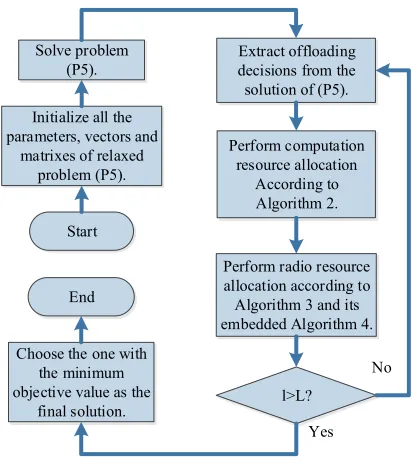
Till now, the complete solution to the primal optimization problem(P1)is obtained. For the sake of a clear understand-ing, the detailed flow diagram of CORA is shown in Fig.2.
Algorithm 4 Suboptimal Power and Bandwidth Allocation Algorithm to solve problem(P11)
Initialization:
1: Setβ,ω,µ,γ, τnmax and the precisionδ. Sett= 0.
Iteration:
2: whilet≤tmax do
3: Allocate transmit powerpcom
n (t)according to (34).
4: Perform bisection search between(0,1)for Xn(t).
5: Assign bandwidthan(t)from (37) based onXn(t).
6: Update Lagrange multipliersβ,ω,µ,γ from (45)-(48),
respectively.
7: if ∥β(t+ 1)−β(t)∥2 < δ, ∥ω(t+ 1)−ω(t)∥2 < δ,∥µ(t+ 1)−µ(t)∥2 < δ, ∥γ(t+ 1)−γ(t)∥2 < δ
then
8: a∗n=an(t),pcomn ∗=pcomn (t).
9: break. 10: else
11: t=t+ 1. 12: end if
13: end while
14: Output:a∗= [a∗n, ..., a∗N2],p
com∗= [pcom
1 ∗, ..., pcomN2
∗].
VII. COMPLEXITYANALYSIS OFCORA
The computational complexity of CORA in Algorithm 1 mainly comes from Step 4 and Step 8 in the for-loop for
L times. In Step 4 of Algorithm 1, the SDR problem could be resolved easily within a precision ε1 using the interior-point method within O(√Nlog(ε11)) iterations, where the computational complexity per iteration is O(N6), thus the complexity of Step 4 is O(N6.5log(1
ε1))[30].
In Step 8 of Algorithm 1, it contains Algorithm 2 and Algorithm 3 in fact. In Algorithm 2, the bisection method costs
O(log2
(ζmax
1 −ζ
min 1
ε ))
iterations. In Algorithm 3, computa-tional complexity mainly comes from Step 4 ( i.e., Algorithm 4) in the while loop. In Algorithm 4, the complexity mainly focuses on the bisection search in (0,1) (i.e., Step 4) in the
Start Initialize all the parameters, vectors and
matrixes of relaxed problem (P5). Solve problem
(P5).
Extract offloading decisions from the solution of (P5).
Perform computation resource allocation
According to Algorithm 2.
Perform radio resource allocation according to Algorithm 3 and its embedded Algorithm 4.
Choose the one with the minimum objective value as the
final solution. End
l>L?
[image:11.612.334.540.50.284.2]Yes No
Fig. 2. The flow chart of CORA.
while-loop, and the complexity of Step 4 in Algorithm 4 is O(log2(1δ−10)). The subgradient projection method needs
O(δ12 )
iterations to converge [30]. Therefore, the total com-plexity of the while-loop in Algorithm 4 isO(δ12log2
(
1
δ1
))
. The while-loop in Algorithm 3 needsM iterations to converge (as shown in simulations latter,M is usually no more than 2), so the complexity of Algorithm 3 isO(1
δ2log2
(
1
δ1
)
M) =
O(1
δ2log2
(
1
δ1
))
.
Thus the complexity of CORA is
O(N6.5log(1
ε1) +L
( log2(
ζmax
1 −ζ
min 1
ε ) +
1
δ2log2(
1
δ1)
))
.
VIII. SIMULATIONRESULTS
In this section, we present simulation results to first verify the convergence of the three iterative algorithms (Algorithms 2, 3 and 4), and then evaluate the performance of the proposed algorithm CORA. Simulation is performed on a Monte Carlo simulation on a Matlab-based simulator. We simulate a mixed fog/cloud computing system with one WiFi AP based fog node, a cloud server, and multiple UEs. TGn path loss model and Rician fading with 6 dB Rician factor is considered [31], [32]. Other parameters are listed in Table II. Note that each point in the following figures (except for Fig. 5) are based on the average values of 5000 runs.
Remark 2. In Table II, the “Unchanged” parameters are kept unchanged in our simulation; while the “Default” pa-rameters are set as default unless otherwise specified, because their values may change in our simulation. Note that in most of the simulations, we takeλe
n= 1andλtn = 0as the default
TABLE II SIMULATIONPARAMETERS
Parameter Value
N0 −174dBm/Hz [24]
pid
n 0.001−0.01W uniformly [20]
Unchanged B 15 MHz [25]
pmax
n 0.1 W [17]
Rnf c 1 M b/s [33]
ploc
n 0.1−0.5W uniformly [20]
L 6
N 6
Ff og 2 G cycles/s [16]
fc
n 4 G cycles/s [16]
Default floc
n 0.5−1.5G cycles/s uniformly [13]
τmax
n 4 s [18]
Dn 0.42 MB [10]
Appn 297.62cycles/bit [10]
λe
n 1
λtn 0
A. Convergence of Algorithms 2, 3 and 4
0 5 10 15
0 1 2 3 4 5 6
Number of iterations
ζ1
ζ1, Ffog=2*109
ζ1, Ffog=4*109
ζ1, Ffog=6*109
[image:12.612.331.535.60.367.2]ζ1, Ffog=8*109
Fig. 3. Convergence of the main loop of Algorithm 2.
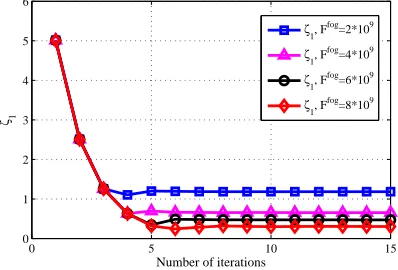
Fig. 3 plots ζ1 (As the analysis in Section V, ζ1 in fact is the maximum EC of all fog-processing UEs) versus the number of iterations to show the convergence of the main loop of Algorithm 2 for different processing capabilities of the fog server Ff og. As can be seen, ζ
1 keeps decreasing after each iteration until convergence. This is because the BCRA aims to minimize the maximum EC among all UEs in each iteration by performing computation resource allocation, thus the maximum EC can be reduced by an appropriate computation resource allocation. As shown in Fig. 3, the number of iterations is always no more than 10.
In Fig. 4, we plotViversus the number of iterations to show
the convergence evolution of the outer loop of Algorithm 3, for different number of UEsN. It is observed that it converges typically in two iterations.
In Fig. 5, we further plot the dual variablesµ= [µn], γ= [γn], n ∈ N2 versus the number of iterations to depict the convergence of the inner loop of Algorithm 3, i.e., Algorithm 4, under N= 6. Observing form Fig. 5, it can be known that UEs 1,2,4,6 are remote-processing UEs, and radio resource allocation in Algorithm 4 will be performed within them; it
2 4 6 8 10 12 14
0.5 0.6 0.7 0.8 0.9 1 1.1 1.2 1.3
Number of iterations
V
i (joule) Vi
, N=2
Vi, N=4
Vi, N=6
Vi, N=8
Fig. 4. Convergence of the outer loop of Algorithm 3.
2 4 6 8 10 1.46
1.465 1.47 1.475 1.48 1.485 1.49 1.495 1.5
x 10−4
Iteration number, t
µn
(t)
µ
1
µ2 µ4 µ6
2 4 6 8 10 1
1.02 1.04 1.06 1.08 1.1 1.12 1.14 1.16 1.18x 10
−9
Iteration number, t
γn
(t)
γ1 γ2 γ4 γ6
Fig. 5. Convergence of Algorithm 4.
can also be known that Algorithm 4 has a fast convergence rate. It should be note that Fig. 5 has to be plotted based on one random realization, because Fig. 5 plots the two dual variables,
µn andγn, n∈ N2, versus the number of iterations for each UE in set N2. As the offloading decision is independent in each run, and the UEs in setN2 will be different in different runs. Hence, the dual variablesµnandγn, n∈ N2, cannot be averaged over multiple runs.
B. Performance of CORA
1 2 3 4 5 6 7 8 9 10
0 0.2 0.4 0.6 0.8 1 1.2 1.4
Number of runs
EC (joule)
[image:12.612.73.272.313.448.2]Max energy consumption Min energy consumption Average energy consumption
Fig. 6. The maximum, minimum, and average EC among all UEs obtained by CORA vs. the number of runsL.
[image:12.612.322.535.521.663.2]runs L. As is shown, the three kinds of EC keeps dropping with the increase of L. This is because CORA is proposed aiming at minimizing the maximum EC among all UEs, and the offloading decisions are extracted from the probabilities in (19) randomly and then resource allocation is performed, so the system performance increases (i.e., the objective value decrease) with the number of the runsL. Moreover, the three kinds of system EC decrease sharply at the begin and slowly with the number of Lincreases. So a moderateLwill be the best choice to obtain better performance and without too high computational complexity, and we take L = 6as the default runs in this paper.
Next we evaluate the performance of CORA in compari-son with the following three algorithms: (i) Offloading-only algorithm [10], where only offloading decisions are optimized to minimize the weighted sum of EC and delay for each UE, while no resource allocation optimization. (ii) Resource-only algorithm [24], where Resource-only the allocation of resources (including transmit power, bandwidth and computation re-source) is optimized to minimize the power consumption of each UE, without optimizing offloading decisions. (iii) Local-only: all UEs process their applications themselves without any optimization.
2 4 6 8 10 12
0 1 2 3 4 5 6 7 8 9
Number of UEs
Max energy consumption of all UEs in system (joule)
[image:13.612.334.534.55.192.2]CORA Local−only Offloading−only [10] Resource−only [24]
Fig. 7. The max EC among all UEs vs. the number of UEsN.
In Figures 7 and 8, we present comparisons of CORA with Local-only, Offloading-only, and Resource-only, respectively, under different number of UEs N. Fig. 7 shows the com-parison on the objective value, i.e., the maximum EC among all UEs in system, which keeps increasing with the number of UEsNincreases for all algorithms. However, CORA increases the slowest, while other three algorithms grow sharper and sharper with the number of UEsN more than 8, demonstrating CORA performs good in EC reduction.
In order to show the percentage of UEs benefited from computation offloading, in Fig. 8 we show the number of beneficial UEs vs. the total number of UEs, where a beneficial UE is defined as the UE that consumes less energy than when adopting Local-only method. As there’s no any optimization in Local-only, no UE benefits in the method, so we plot Fig. 8 without plotting the bars of Local-only. As a result of the joint optimization of the offloading decision making, the allocation of computation resource, transmit power and radio
N=2 N=4 N=6 N=8 N=10 N=12 0
2 4 6 8 10
Number of UEs
Number of beneficial UEs
CORA
Offloading−only [10] Resource−only [24]
Fig. 8. The number of beneficial UEs vs. the number of UEsN.
bandwidth, CORA can always benefit the most number of UEs compared with other algorithms, which only optimize part of the optimization items.
4−queens 5−queens 6−queens 7−queens 0
50 100
Maximum EC of all UEs in system (joule)
CORA Local−only Offloading−only [10] Resource−only [24]
4−queens 5−queens 6−queens 7−queens 0
10 20 30
Different applications
Max delay of all UEs in system (second)
[image:13.612.324.534.282.420.2]CORA Local−only Offloading−only [10] Resource−only [24]
Fig. 9. The max EC and delay among all UEs vs. different applications
.
To verify the feasibility of CORA for different applications, in Fig. 9, we evaluate the performance achieved by CORA under different applications, and take max
n∈NEn and maxn∈NTn
as the objective function, respectively. The applications are the m-queens puzzle, where m = 4,5,6,7, respectively [1], [12]. The four applications possess the same size of data, i.e., Dn = 200 KB, n ∈ N, but with the different size of
processing density, where Appn = 87.8, 263, 1760, 8250,
n ∈ N, for 4-queens puzzle, 5-queens puzzle, 6-queens puzzle, and 7-queens puzzle, respectively. From the two sub-figures in Fig. 9, when m increases, the maximum EC and delay of all UEs in the system increase, which is the same for all the algorithms. However, CORA consumes the minimum energy or delay compared with other algorithms. What’s more, the second sub-figure demonstrates that our algorithm can works well when only delay is considered as the optimization objective.
The impact of local processing capabilityfloc
n on EC of the
[image:13.612.65.275.345.482.2]0.4 0.6 0.8 1 1.2 1.4 1.6 1.8 0
0.5 1 1.5
The value of f n loc
Maximum EC of all UEs in system (joule)
[image:14.612.72.272.56.192.2] [image:14.612.72.274.288.422.2]CORA Local−only Offloading−only [10] Resource−only [24]
Fig. 10. The max EC among all UEs vs.fnloc.
Fig. 10 accords with our intuition that the weaker processing capability of a UE, the more benefit could be obtained by computation offloading, and vice-versa.
2 3 4 5 6 7 8 9 10
0 2 4 6 8 10
τmax
Saved energy (joule)
CORA
Offloading−only [10] Resource−only [24]
Fig. 11. The max saved energy among all UEs vs.τnmax.
In Fig. 11 we consider the impact of the delay constraint
τmaxon the saved energy compared with Local-only method.
It can be observed that the longer the delay constraint, the more saved energy. This is because a looser delay constraint will lead to more offloaded UEs, and consequently more con-served energy, which is the same for all the three algorithms. However, CORA conserves the most energy among all the three algorithms under any τmax.
Max energy Min energy Avg energy 0
1 2 3 4 5 6 7
EC (joule)
CORA
Offloading−only [10] Resource−only [24]
Min energy 0
[image:14.612.77.270.568.703.2]0.01 0.02
Fig. 12. Fairness comparison.
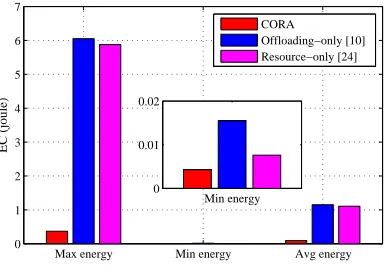
In Fig. 12, we compare the maximum, the minimum EC, and the average EC of all UEs. All parameters are set as the default values. We observe that there is a considerable difference in the maximum and minimum EC in offloading-only and resource-only schemes. However, the proposed algorithm can balance the EC among all the UEs, demonstrating CORA performs better in min-max fairness.
IX. CONCLUSIONS ANDFUTUREWORK
In this paper, we have investigated a min-max fairness based cost conservation problem in a mixed fog/cloud computing system by a joint optimization of offloading decision making and resource allocation. To address the NP-hard problem, we have proposed CORA algorithm, where SDR and random extracting are first adopted for offloading decision making. To solve the nested resource allocation problem in CORA, BCRA algorithm was proposed to solve computation resource alloca-tion among all the fog-processing UEs. Employing fracalloca-tional programming and Lagrangian dual decomposition, radio band-width and transmit power allocation was optimized among all the remote-processing UEs. Our simulation results verified the convergence of the proposed iterative algorithms, and indicated the performance gains of CORA in cost conversation and the increase in the number of beneficial UEs compared with other existing works.
Our future work are listed as follows:
• The case UEs may move dynamically in an offloading period is regarded as one of our future work.
• The long-term optimization where the offloading periods are time-coupled with each other and the wireless net-works may changes dynamically during a long period of time will be regarded as one of our future work.
• We will extend the scenario from one fog node to multiple fog nodes when interference management and load balancing will be considered in our future work.
• The queue length and delay of UEs’ requests will be considered in our future work.
APPENDIX
Appendix A. Proof of Proposition 1
Proof: We prove it from sufficiency and necessity. First, the sufficiency proof is as follows.
Assuming the optimal solution for (27) is{pcom′,a′}, and for any feasible solution{pcom,a} ∈ F, we have
max
n∈N2
[
Dn(λenpcomn +λtn)−V∗anBlog2
( 1+p
com
n hn
anN0B
)]
≥0,
max
n∈N2
[
Dn(λenpcom ′
n +λtn)−V∗an′Blog2
( 1+p
com
n ′hn
an′N0B
)] = 0.
From (49), we obtain
max
n∈N2
Dn(λenpcomn +λtn)
anBlog2
(
1 + pcomn hn
anN0B
)
≥V∗,
max
n∈N2
Dn(λenpcom
′
n +λtn)
an′Blog2
(
1 +pcomn ′hn
an′N0B
)
=V∗. (50)
Hence, {pcom′,a′} is also the optimal solution of (P8). This completes the sufficiency proof.
Proof of necessity: For any feasible solution{pcom,a} ∈ F,
from (P8), we have
max
n∈N2
Dn(λenpcomn +λtn)
anBlog2
(
1 +pcomn hn
anN0B
)
≥V∗,
max
n∈N2
Dn(λenpcomn ∗+λtn)
a∗
nBlog2
(
1 +pcom∗n hn
a∗
nN0B )
=V∗. (51)
Rearranging (51) yields
max
n∈N2
[
Dn(λenpcomn +λtn)−V∗anBlog2
( 1+p
com
n hn
anN0B
)]
≥0,
max
n∈N2
[
Dn(λenpcomn ∗+λtn)−V∗a∗nBlog2
( 1+p
com∗
n hn
a∗
nN0B
)] = 0.
(52)
Thus,{pcom∗,a∗} is also the optimal solution of (27). The necessity proof is completed.
Appendix B. Proof of Proposition 2
Proof: When f(x) is concave, then the perspective function g(x, t) = tf(x/t) is concave, too [30]. Since
anBlog2(1 +
pcom
n hn
anN0B)is the perspective function of concave
function log2(1 + pcomn hn), it preserves concavity. On the
other hand, the upper level set of concave function is convex [30], so(C17)−(C18)are convex. Moreover,(C5+)
−(C7+2) are all linear constraints. So (P12) is a convex optimization programming that minimize a convex function over a convex set.
Appendix C. Proof of Proposition 3
Proof:Observing the definition ofD(β,ω,µ,γ)of (32),
we have
D(β′,ω′,µ′,γ′)
≥ζ2+β′
( ∑
n∈N2
a∗n−1 )
+∑
n∈N2
ωn′ (pcomn ∗−pmaxn )
+∑
n∈N2
µ′n
[ D
n
τmax
n −vn−
a∗nBlog2
( 1+p
com
n ∗hn
a∗
nN0B
)]
+∑
n∈N2
γn′ [
Dn(λenpcomn ∗+λtn)−V a∗nBlog2
( 1+p
com
n ∗hn
a∗
nN0B
)
−ζ2
]
.
(53)
Rearranging (53), we have
D(β′,ω′,µ′,γ′)≥D(β,ω,µ,γ)
+(β′−β) (
∑
n∈N2
a∗n−1 )
+∑
n∈N2
(ω′n−ωn) (pcomn ∗
−pmax
n )
+ ∑
n∈N2
(µ′n−µn) [
Dn
τmax
n −vn −
a∗nBlog2
( 1 + p
com
n ∗hn
a∗
nN0B
)]
+ ∑
n∈N2
(γn′ −γn) [
Dn (
λenpcomn ∗+λtn )
−V a∗nBlog2
( 1 + p
com
n ∗hn
a∗
nN0B
)
−ζ2
]
.(54)
Note that a subgradient ζ of a convex function f(·) is defined as: if f(x) ≥ f(y) +ζT(x−y),∀x, y holds. Thus,
Proposition 3 holds.
REFERENCES
[1] J. Kwak, Y. Kim, J. Lee, et al., “DREAM: Dynamic Resource and Task Allocation for Energy Minimization in Mobile Cloud Systems,” IEEE Journal on Selected Areas in Communications, vol. 33, no. 12, pp. 2510-2523, 2015.
[2] E. Cuervo, A. Balasubramanian, D. Cho, et al., “MAUI: Making Smartphones Last Longer With Code Offload,” inProc. ACM 8th Int. Conf. Mobile Syst., Appl., Services, San Francisco, America, Jun 2010, pp. 49-62.
[3] W. Shi, J. Cao, Q. Zhang, et al., “Edge Computing: Vision and Challenges,”IEEE Internet of Things Journal, vol. 3, no. 5, pp. 637-646, 2016.
[4] R. Mahmud, and R, Buyya, “Fog Computing: A Taxonomy, Survey and Future Directions,”arXiv preprint arXiv, vol. 1611, no. 05539, 2016. [5] T. X. Tran, A. Hajisami, P. Pandey, et al., “Collaborative Mobile
Edge Computing in 5G Networks: New Paradigms, Scenarios, and Challenges,”IEEE Communications Magazine, vol. 55, no, 4, pp. 54-61, 2017.
[6] S. Sardellitti, G. Scutari, and S. Barbarossa, “Joint Optimization of Radio and Computational Resources for Multicell Mobile-Edge Computing,” IEEE Trans. Signal and Information Processing over Networks, vol. 1, no. 2, pp. 89-103, 2015.
[7] H. Viswanathan, P. Pandey, and D. Pompili, “Maestro: Orchestrating Concurrent Application Workflows in Mobile Device Clouds,” IEEE International Conference on Autonomic Computing (ICAC), pp. 257-262, 2016.
[8] M. Satyanarayanan, P. Bahl, R. Caceres, et al., “The Case for VM-Based Cloudlets in Mobile Computing,”IEEE TPervasive Comput., vol. 8, no. 4, pp. 14-23, 2009.
[9] Y. Mao, J. Zhang, and K. B. Letaief, “Dynamic Computation Offloading for Mobile-Edge Computing With Energy Harvesting Devices,” IEEE Journal on Selected Areas in Communications, vol. 34, no. 12, pp. 3590-3605, 2016.
[10] X. Chen, “Decentralized Computation Offloading Game for Mobile Cloud Computing,”IEEE Trans. Parallel Distrib. Syst., vol. 26, no. 4, pp. 974-983, Apr. 2015.
[11] M. H. Chen, M. Dong, B. Liang, et al., “Joint Offloading Decision and Resource Allocation for Mobile Cloud With Computing Access Point,” inProc. IEEE ICASSP, 2016, pp. 3516-3520.
[12] K. Liu, X. Zhang, and Z. Huang. “A Combinatorial Optimization for Energy-Efficient Mobile Cloud Offloading Over Cellular Networks,” IEEE Conference on Global Communications (GLOBECOM), pp. 1-6, 2016.
[13] X. Lyu, H. Tian, C. Sengul, et al., “Multiuser Joint Task Offloading and Resource Optimization in Proximate Clouds,” IEEE Transactions on Vehicular Technology, vol. 66, no. 4, pp. 3435-3447, 2017. [14] Y. H. Kao, B. Krishnamachari, M. R. Ra, et al., “Hermes: Latency
![Fig. 1.System topology [19].by the cloud server through a high-speed wired link [2], [6].](https://thumb-us.123doks.com/thumbv2/123dok_us/7745020.165953/4.612.63.291.172.307/fig-topology-cloud-server-high-speed-wired-link.webp)