EFFECTS OF PUBLIC PROCUREMENT PRACTICES ON PROCUREMENT PERFORMANCE OF
CONSTITUENCY DEVELOPMENT FUND PROJECTS IN KWALE COUNTY GOVERNMENT OF KENYA
1,*
Moses Mokua and
College of Human Resource Development,
COHRED, Jomo Kenyatta University of Agriculture and Technology
ARTICLE INFO ABSTRACT
The objective of the study was to determine the effect of public procurement practices on procurement performance of CDF projects in Kwale County government in Kenya. Procurement professionals always walked on a tight rope in order to implement objectives and goals. Their ability to accomplish these procurement objectives and policies indicate that procurement officials are influenced by political, legal internal and external factors. The
procedures and regulations, where contractors complain of the lack of a fair and consisted approach to tendering and accusation of favoritism and corruption. Public procurement is
mechanism, the potential which has not been fully designed in pursuit of value for money and efficiency in the use of public funds. The purpose is to support the attainment of high economic growth and ensure delivery of service. The re
participation of community in transparency and accountability in delivery of non study was based on procurement competencies, e
relationships as specific objectives. The study targeted 206 respondents from various departments and Kwale county residents. The study employed governance
and supply chain management theory. Descriptive research design was employed to formulate the best methodology to be used. A pilot study on the questionnaire was done in order to validate the questionnaire and correct any errors which may have been made. The sample size for the study was 136 derived using slovin formula. Secondary data was collected from both published and unpublished records. Data screening was done to identify any missing data and it will furt
Cronbach’s Alpha. Inferential statistics such as Pearson’s correlation and multiple regression analysis was used for further analysis. Data was analyzed using statistical packaging social sciences
version 22 to find the relationships and averages of the data in addition to tabular presentations for understandable presentation. From the finding procurement staff competencies was believed to be a vital catalyst for the ethical conduct
procurement practices which includes activities such as e
procurement practices horizon where the entire county should put more concentr
Basing on the results, it is recommended that, the county government should continue with such activities of providing adequate training and seminars to the staff to enhance their competencies. However based on the results other s
The study recommends the county government to invest more in electronic procurement transformation to reduce cost and reduce time in procurement transactions which
The study recommends that county government leaders, managers and other corporate professional players have significant role of ensuring that they formulate viable procurement strategies and practices that initi performance for the entire organizations.
Copyright © 2018, Moses Mokua and Dominic Omboto
permits unrestricted use, distribution, and reproduction
INTRODUCTION
Research Objectives
Specific Objectives
To determine the effect of procurement staff competencies on procurement performance of CDF projects in Kwale County.
ISSN: 0975-833X
Article History:
Received 19th December, 2017
Received in revised form 29th January, 2018
Accepted 12th February, 2018
Published online 30th March, 2018
Citation: Moses Mokua and Dominic Omboto, 201
fund projects in kwale county government of kenya”,
Key words:
Procurement Staff Competency, Supplier Relationships, Procurement Ethics and Electronic Procurement.
*Corresponding author: Moses Mokua,
College of Human Resource Development, Kenya.
RESEARCH ARTICLE
EFFECTS OF PUBLIC PROCUREMENT PRACTICES ON PROCUREMENT PERFORMANCE OF
CONSTITUENCY DEVELOPMENT FUND PROJECTS IN KWALE COUNTY GOVERNMENT OF KENYA
Moses Mokua and
2Dominic Omboto
College of Human Resource Development, Kenya
COHRED, Jomo Kenyatta University of Agriculture and Technology
ABSTRACT
The objective of the study was to determine the effect of public procurement practices on procurement performance of CDF projects in Kwale County government in Kenya. Procurement professionals always walked on a tight rope in order to implement objectives and goals. Their ability to accomplish these procurement objectives and policies indicate that procurement officials are influenced by political, legal internal and external factors. The tendering process can be a minefield of potential litigation without proper procedures and regulations, where contractors complain of the lack of a fair and consisted approach to tendering and accusation of favoritism and corruption. Public procurement is
mechanism, the potential which has not been fully designed in pursuit of value for money and efficiency in the use of public funds. The purpose is to support the attainment of high economic growth and ensure delivery of service. The reform strategy for economic development was not achieved without the participation of community in transparency and accountability in delivery of non
study was based on procurement competencies, e-procurement, procurement ethics and
relationships as specific objectives. The study targeted 206 respondents from various departments and Kwale county residents. The study employed governance and performance theory, corporate culture theory and supply chain management theory. Descriptive research design was employed to formulate the best methodology to be used. A pilot study on the questionnaire was done in order to validate the questionnaire correct any errors which may have been made. The sample size for the study was 136 derived using slovin formula. Secondary data was collected from both published and unpublished records. Data screening was done to identify any missing data and it will further be tested for reliability. Reliability was tested using Cronbach’s Alpha. Inferential statistics such as Pearson’s correlation and multiple regression analysis was used for further analysis. Data was analyzed using statistical packaging social sciences
version 22 to find the relationships and averages of the data in addition to tabular presentations for understandable presentation. From the finding procurement staff competencies was believed to be a vital catalyst for the ethical conduct of the entire procurement staff in the counties. E
procurement practices which includes activities such as e-ordering, e procurement practices horizon where the entire county should put more concentr
Basing on the results, it is recommended that, the county government should continue with such activities of providing adequate training and seminars to the staff to enhance their competencies. However based on the results other studies are recommended on procurement staff competencies which are viable for the research. The study recommends the county government to invest more in electronic procurement transformation to reduce cost and reduce time in procurement transactions which is big win for the counties all the county. The study recommends that county government leaders, managers and other corporate professional players have significant role of ensuring that they formulate viable procurement strategies and practices that initi performance for the entire organizations.
Moses Mokua and Dominic Omboto. This is an open access article distributed under the Creative in any medium, provided the original work is properly cited.
To determine the effect of procurement staff performance of CDF
To evaluate the effect of supplier relationships on performance of CDF projects in Kwale County.
To analyze the effect of procurement ethics on procurement performance of CDF projects in Kwale County.
To establish the effect of e
procurement performance of CDF projects in Kwale County.
International Journal of Current Research
Vol. 10, Issue, 03, pp.67333-67338, March, 2018
2018. “Effects of public procurement practices on procurement performance of constituency development , International Journal of Current Research, 10, (03), 67333-67338.
EFFECTS OF PUBLIC PROCUREMENT PRACTICES ON PROCUREMENT PERFORMANCE OF
CONSTITUENCY DEVELOPMENT FUND PROJECTS IN KWALE COUNTY GOVERNMENT OF KENYA
COHRED, Jomo Kenyatta University of Agriculture and Technology, Kenya
The objective of the study was to determine the effect of public procurement practices on procurement performance of CDF projects in Kwale County government in Kenya. Procurement professionals have always walked on a tight rope in order to implement objectives and goals. Their ability to accomplish these procurement objectives and policies indicate that procurement officials are influenced by political, legal- tendering process can be a minefield of potential litigation without proper procedures and regulations, where contractors complain of the lack of a fair and consisted approach to tendering and accusation of favoritism and corruption. Public procurement is a major development mechanism, the potential which has not been fully designed in pursuit of value for money and efficiency in the use of public funds. The purpose is to support the attainment of high economic growth and ensure form strategy for economic development was not achieved without the participation of community in transparency and accountability in delivery of non-core public service. The procurement, procurement ethics and supplier relationships as specific objectives. The study targeted 206 respondents from various departments and performance theory, corporate culture theory and supply chain management theory. Descriptive research design was employed to formulate the best methodology to be used. A pilot study on the questionnaire was done in order to validate the questionnaire correct any errors which may have been made. The sample size for the study was 136 derived using slovin formula. Secondary data was collected from both published and unpublished records. Data screening her be tested for reliability. Reliability was tested using Cronbach’s Alpha. Inferential statistics such as Pearson’s correlation and multiple regression analysis was used for further analysis. Data was analyzed using statistical packaging social sciences software (SPSS) version 22 to find the relationships and averages of the data in addition to tabular presentations for understandable presentation. From the finding procurement staff competencies was believed to be a vital of the entire procurement staff in the counties. E-procurement is one of the ordering, e-sourcing and e-payment in the procurement practices horizon where the entire county should put more concentration during formulation. Basing on the results, it is recommended that, the county government should continue with such activities of providing adequate training and seminars to the staff to enhance their competencies. However based on the tudies are recommended on procurement staff competencies which are viable for the research. The study recommends the county government to invest more in electronic procurement transformation to
is big win for the counties all the county. The study recommends that county government leaders, managers and other corporate professional players have significant role of ensuring that they formulate viable procurement strategies and practices that initiate
Creative Commons Attribution License, which
To evaluate the effect of supplier relationships on performance of CDF projects in Kwale County.
To analyze the effect of procurement ethics on procurement performance of CDF projects in Kwale
establish the effect of e-procurement on procurement performance of CDF projects in Kwale
OF CURRENT RESEARCH
Literature review
Theoretical Framework
Governance andPerformance Theory
According to Kaufman (2010), Governance is the traditions and institutions by which authority in a country is exercised for the common good. This includes the process by which those in authority are selected, monitored and replaced (the political dimension); the government’s capacity to effectively manage its resources and implement sound policies (the economic dimension); and the respect of citizens and the state for the country’s institutions.
Corporate Culture Theory
Schein (2014) adopted the functionalism view and described culture as pattern of basic assumption invented, discovered, or developed by a given group of people that learn to cope with problems of external adaptation and internal integration, that has worked well enough to be considered valid and therefore to be taught to new members as the current way to perceive, think, and feel in relation to those problems. This theory is relevant to the study as ethical practice leads to transparency and competition and how they influence procurement of goods and services in public sector. The underlying purposes and Procurement Laws and policies are to: Permit the continued development of procurement policies and practices; Provide for increased public confidence in the procedures followed in public procurement; Ensure the fair and equitable treatment of all persons who deal with the procurement system of the state; Provide increased economy in state procurement activities by fostering effective competition; and Provide safeguards for the maintenance of a procurement system of quality and integrity, State of Arkansas Procurement Act (2013).
Review of Literature Variables
Procurement Staff Competency
Capacity building is an investment in the future sustainability of the financial and governance system of a country. For better performance of the public sector, all countries need staff with the requisite knowledge, skills, behaviors and competencies to enable them to fulfil their policies and goals. Therefore, it is of utmost importance to strengthen capacity in the context of emerging economies aiming to deliver satisfactory services under financial constraints. Capacity development is the process by which individuals, organizations, Institutions and societies develop abilities to perform functions, solve problems and set and achieve objectives (Fassin, 2015).
E-Procurement
The procurement process has had many loopholes in the recent past due to the lengthy processes and lots of paperwork. The adoption of ICT application in the procurement process has reduced this through the online methods of carrying out the procurement process. The use of online forms, orders, emails, new software technologies in evaluating and making price comparisons has made this process efficient and at the same time will ensure transparency and accountability as well as reduction in errors and omissions (Caldwell and Davies, 2014). The adoption of these ICT applications has an overall impact
on the organization in that it will reduce costs within the procurement department as well as reduce errors in the procurement process thus ensuring maximum output of the organization at the lowest costs possible.
Supplier Relations
Buyer-supplier relationships in the supply chain are one of the most important elements of supply chain integration. Establishing and managing effective relationships at every link in the supply chain is becoming the prerequisite of business success. High volatility in the retail industry reflects rapid fluctuations in customer demand and unpredictable market trends. In addition, environmental diversity reveals uncertainty in the global business environment. Facing market volatility and diversity, organizations are encouraged to develop relatively flexible relationships with multiple channel partners to deal with unexpected market demands and thus reduce the dependence on the vendor (Fernadupulle, 2015). Supplier-buyer relationships have today become the backbones of economic activities in the modern world (Nagurney, 2010) and a focal point of organizational competitiveness, performance and long-term business success (Veludo et al. 2006).
According to Gadde and Hakansson (2011), the
competitiveness and profit-generating capacity of the individual firm is highly dependent on its ability to handle the supply side.
Procurement Ethics
UN Procurement Handbook (2016) indicates that there are two definitions of ethics as follows: The moral principles governing or influencing conduct and the branch of knowledge concerned with moral principles (The concise Oxford dictionary of current English). Ethics is the basis on which most of the procurement related principles, such as fairness, integrity, and transparency, are based. The handbook further states that Professional standards of ethical conduct, no matter what the organization, contain typical characteristics, including commitments to: behave honourably in all aspects of work and professional activity, conduct oneself in such a manner as to maintain trust and confidence in the integrity of the acquisition process, avoid clever practices intended to take undue advantage of others or the system and uphold the organization’s standards and policies and all relevant legislation.
RESEARCH AND METHODS
Research Design
A research design constitutes the blue print for the collection, measurement, and analysis of data. Cooper and Schindler (2015) define research design as the plan and structure of investigation conceived so as to obtain answers to research questions. The intention of research is to gather data at a particular point in time and use it to describe the nature of existing conditions. This research problem was studied using a descriptive survey design to cover four main areas of the conceptual framework.
Target Population
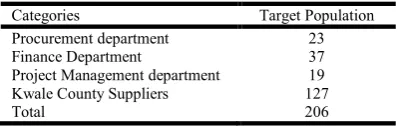
The target population comprised of respondents from procurement department, finance department, project management department and Kwale County suppliers. The target population was chosen from the departments because was easy to get data from the respondents. However, Kothari (2009) recommends that a sample size be as large as possible in order to reproduce salient characteristics of the accessible population to an acceptable level as well as to avoid sampling errors.
Table3.1 Target Population
Categories Target Population
Procurement department 23
Finance Department 37
Project Management department 19 Kwale County Suppliers 127
Total 206
Source, Kwale County, (2017)
Data Collection Instruments
The study used both primary and secondary data. Primary data was collected using self-administered questionnaires through drop and pick method.
Pilot Study
Questionnaire administration involved pre-contact with the respondents. In order to ensure content validity, the preliminary questionnaire will be pre-tested on a pilot set of respondent for comprehension, logic and relevance. Respondents in the pre- test will be drawn from county of Kwale staff and county residents, that is, 10% of the sample size as per recommendations by Mugenda and Mugenda (2013) who observe that a successful pilot study used 1% to 10% of the actual sample size and this was similar to those in the actual survey in terms of background characteristics.
Data Processing, Analysis and Presentation
Data was analyzed using quantitative techniques. Inferential statistics included analysis of Variance (ANOVA), Pearson correlation and regression analysis. Both descriptive and inferential statistics were used to analyze data. These was used to establish the association among the study variables. Preliminary associations among the study variables was assessed using correlations which was tested at 95% confidence level (level of significance, α = 0.05) and 99 percent confidence level (level of significance, α=0.01).
RESEARCH FINDINGS AND DISCUSSION
Response Rate
[image:3.595.63.262.183.246.2]The study targeted 100 respondents out of 136 respondents as this sample size produced by Slovene’s formula was sufficient. Overwhelmingly, 100 questionnaires were filled and got a 74% response. According to Mugenda and Mugenda, (2003) a response rate of 70% and above is good, reliable and representative as per Table 4.1 below.
Table 3.2 Questionnaire Response Rate
Frequency Percentage
Response 100 73.5%
Non- Respondents 36 26.5%
Total 100 100
Findings
Procurement Staff Competencies
Respondents were required to respond to set questions related to procurement staff competencies and give their opinions. The statement that there exist written policy on hiring project procurement staff based on their qualification had a mean score of 3.89 and a standard deviation of 1.171. The statement that there exist a training budget for the staff that has enhanced procurement performance had a mean score of 3.07 and a standard deviation of 1.365. The statement that the county has frequent training programs for the entire staff that greatly enhance procurement performance had a mean score of 3.80 and a standard deviation of 1.531.
Electronic Procurement
Respondents were required to respond to set questions related to e-procurement and give their opinions. The e-procurement has helped the county to save much from procurement activities. The statement that the county government has not invested much in e-tendering process that would make processes efficiency had a mean score of 4.16 and a standard deviation of 1.398. The statement that the Kwale county government is the overall best in the county when it comes to e-payment process to suppliers and contractors had a mean score of 4.33 and standard deviation of 1.407. The statement that e-procurement has reduced costs on procuring of activities had a mean score of 3.31 and a standard deviation of 1.161. The statement that the e-sourcing process has not been implemented well in the county due to resistance to change by the personnel had a mean score of 3.69 and a standard deviation of 1.376.
Procurement Ethics
Respondents were required to respond to set questions related to procurement ethics and give their opinions. The statement that the county conduct service level agreement when awarding contracts to contractors and supplier to ensure mechanism of delivery is achieved had a mean score of 3.51 and a standard deviation of 0.759. The statement that to what extent do those concerned with procurement processes in your institution subscribe and adhere to their professional codes of conduct had a mean score of 3.90 and a standard deviation of 1.403. The statement that there exists a written procurement code of ethics in the public procurement practice had a mean score of 4.07 and a standard deviation of 1.249. The statement that the county has a written down quality statement in the 4.07 and a standard deviation of 0.655.
Supplier Relationships
procurement practices for the county had a mean score of 2.94 and standard deviation of 1.656.
Correlation and Regression Analysis
Coefficient of Correlation
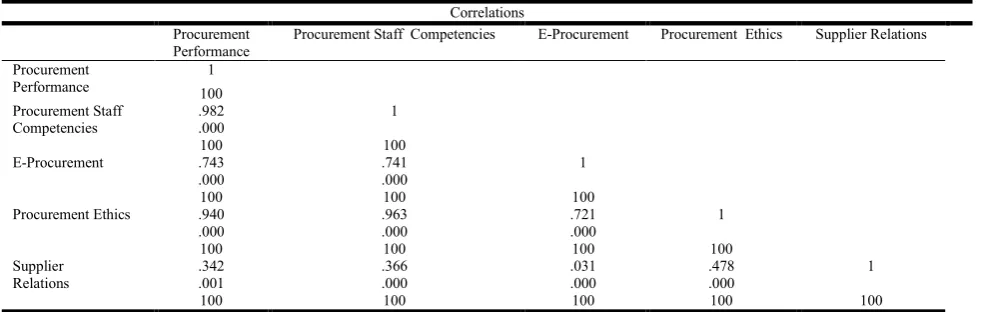
The analysis indicates the coefficient of correlation, r equal to 0.982, .743, 0.940 and 0.342 for procurement staff competencies, e-procurement, procurement ethics and supplier relations respectively.
This indicates positive relationship between the independent variable namely procurement staff competencies, e-procurement, procurement ethics and supplier relations and the dependent variable procurement performance. Robinson, (2014) notes that procurement performance is a significant factor that contributes to other variables in any given organization.
Coefficient of Determination (R2)
The model explains 96.5% of the variance (Adjusted R Square = 0.963) on procurement performance. Clearly, there are factors other than the four proposed in this model which can be used to predict procurement performance. However, this is still a good model as Cooper and Schinder, (2013) pointed out that as much as lower value R square 0.10-0.20 is acceptable in social science research. This means that 96.5% of the relationship is explained by the identified four factors namely procurement staff competence, e-procurement, procurement ethics and supplier relations. The rest 3.5% is explained by other factors in the procurement performance not studied in this research
Analysis of Variance (ANOVA)
F critical (value = 647.3) this shows that the overall model was significant. The significance is less than 0.05, thus indicating that the predictor variables (staff competency, e-procurement, procurement ethics and supplier relations) explain the variation in the dependent variable which is performance.
Multiple Regression
The findings presented shows that taking all other independent variables at zero, a unit increase in procurement staff
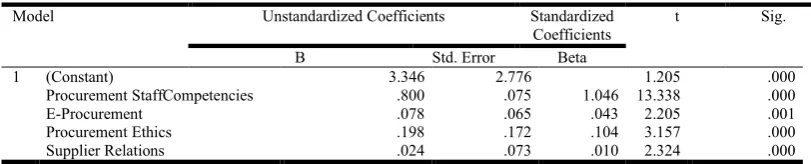
competencies will lead to a 0.800 increase in the scores of procurement staff competencies; a unit increase in e-procurement will lead to a 0.078 increase in e-procurement performance; a unit increase in procurement ethics will lead to a 0.198 increase in the scores of procurement performance; a unit increase in supplier relations will lead to a 0.024 increase in the score of procurement performance. This therefore implies that all the three variables have a positive relationship with supplier relation contributing most to the dependent variable. This therefore implies that all the four variables have a positive relationship with procurement performance with procurement staff competencies contributing most to the dependent variable. From the table we can see that the predictor variables of procurement staff competencies, e-procurement, procurement ethics and supplier relations got variable coefficients statistically significant since their p-values are less than the common alpha level of 0.05
The regression equation was
Y = 3.346 + 0.800X1 + 0.078X2 + 0.198X3+ 0.024X4
Where;
Y = the dependent variable (Procurement Performance)
[image:4.595.53.546.198.354.2] X1 = Procurement Staff Competencies
Table 3.3 Correlation of Coefficient
Correlations
Procurement
Performance
Procurement Staff Competencies E-Procurement Procurement Ethics Supplier Relations
Procurement Performance
1 100 Procurement Staff
Competencies
.982 1
.000
100 100
E-Procurement .743 .741 1
.000 .000
100 100 100
Procurement Ethics .940 .963 .721 1
.000 .000 .000
100 100 100 100
Supplier Relations
.342 .366 .031 .478 1
.001 .000 .000 .000
100 100 100 100 100
Table 3.4 Model Summary
Model R R Square Adjusted R Square
Std. Error of the Estimate
1 .982a .965 .963 1.23329
a. Predictors: (Constant), Supplier Relations, E-Procurement, Procurement Staff Competencies, Procurement Ethics
Table 3.5 ANOVAa
Model Sum of Squares df Mean Square F Sig. 1 Regression 3940.016 985.004 647.603 .000b
Residual 144.494 1.521
Total 4084.510
a. Dependent Variable: Procurement Performance
X2 = E-Procurement
X3 = Procurement Ethics
X4= Supplier Relations
Summary of findings, conclusions and recommendation
Summary of Findings: The study results revealed that CDF management in Kwale County hire procurement staff on competitive basis and those who have procurement operations experience. To maintain quality of work in the procurement department, CDF offers continuous training on e-procurement adoption systems to enhance efficiency of projects On e-procurement, the study results revealed that county governments have not invested much in e-tendering process that would make processes efficient. The study however, established that CDF in Kwale County are embracing a mixture of both electronic and manual procurement processes. The study results revealed that CDF in Kwale County have a written procurement code of ethics of public procurement and further have a written down quality statement in public procurement. There exists a well elaborated and clear procurement ethics framework that ensures all staff and other key stakeholders abide to it. The study results revealed that there is a good relationship between the suppliers and CDFs in Kwale County. Further, the suppliers are selected through a bidding process to evaluate and choose a few suppliers. There exists a written down policy on supplier assessment to enhance best selection of suppliers for the county.
Conclusion
From the research findings, the study concluded all the independent variables studied have significant effect on logistics service delivery as indicated by the strong coefficient of correlation and a p-value which is less than 0.05.The overall effect of the analyzed factors was very high as indicated by the coefficient of determination. The overall P-value of 0.00 which is less than 0.05 (5%) is an indication of relevance of the studied variables, significant at the calculated 95% level of significance. This implies that the studied independent variables namely procurement staff competencies, e-procurement, procurement ethics and supplier relations have significant on factors influencing procurement performance of CDF in Kwale County.
Recommendation
The county government should continue with such activities of providing adequate training and seminars to the staff to enhance their competencies. However based on the results other studies are recommended on procurement staff competencies which are viable for the research. The activities are significant and contribute positively by 0.078 for each unit spent on these activities. The study county government should invest more in electronic procurement transformation to reduce cost and reduce time in procurement transactions which is big
win for the counties all the county. The county government should have well elaborated and clear procurement ethics framework that ensures all staff and other key stakeholders abide to it. The ethics framework helps the entire county government staff and other players in procurement to work within the regulations and being in a position to harmonize the best values that enhances procurement performance. Procurement leaders, managers and other policy makers should establish favorable relationships with their suppliers to ensure quality services and efficient processes. By having the right tools in place and practicing consistent communication, responsibility and patience, buy-side organizations to create more effective relationships with their suppliers, propelling efficient and well-run operations.
REFERENCES
Adan, B. 2012. Overview of Procurement Reforms in Africa.”
Paper presented at the Joint World Trade
Organization/World Bank Regional Workshop on
Procurement Reforms. Retrieved from www.wto.org. Aberdeen Group. (2015). Best Practices in E- Procurement.
Boston: Massachusetts.
Achuora, J., Arasa, R. and Ochriri, G. 2012. Precursors to effectiveness of public procurement audits for Constituency Development Funds (CDF) in Kenya. European Scientific
Journal, 8, (25), 198-214
Arrowsmith, A. and Trybus, M. 2014. Public procurement the
continuing revolution, New York : Kluwer Law
International
Arrowsmith, S. 2013. Transparency in government
procurement: The objectives of regulation and the boundaries of the World Trade Organization. Journal of
World Trade, 37(2), 283-303.
Ayaga, B. 2013. Auditor General reveals that 10th parliament spent CDF cash for campaign, The Standard Newspaper, P. Ayaga, B. (2013). Auditor General reveals that 10th parliament spent CDF cash for campaign, The Standard Newspaper, P. Bolton, E.R. 2015. Survey research methods. Belmont, CA:
Wadsworth
Bagaka, O. 2012. Fiscal decentralization in Kenya: The constituency development fund and the growth of government. In Proceedings of 20th Annual Conference of the Association for Budgeting and Financial Management, Chicago. Illinois, CH: Munich Personal RePEc Archive Barasa, H. 2014. Procurement Practices Affecting Effective
Public Projects Implementation in Kenya: A Case Study of Kenya Civil Aviation Authority, European Journal of
Business and Management,39(2), 291-303.
Bartezzaghi, E., and Ronchi, S. 2005. E- sourcing in a buyer- operator- seller perspective: benefits and criticalities, Production planning and control.
Brynjolfsson, E. and Smith, M. 2012. Frictionless commerce? A comparison of internet and conventional retailers,
[image:5.595.95.501.65.147.2]Management Science, 46 (4), 563-85.
Table 3.6 Coefficient of Determination
Model Unstandardized Coefficients Standardized
Coefficients
t Sig.
B Std. Error Beta
1 (Constant) 3.346 2.776 1.205 .000
Procurement StaffCompetencies .800 .075 1.046 13.338 .000
E-Procurement .078 .065 .043 2.205 .001
Procurement Ethics .198 .172 .104 3.157 .000
Supplier Relations .024 .073 .010 2.324 .000
Burt, D.N., Petcavage, S. and Pinkerton, R. 2010. Supply
management, 8th edn., Boston: Cengage Learning,
McGraw- Hill Irwin.
Burton, R. A. 2005. Improving Integrity in Public Procurement: the Role of Transparency and Accountability. In OECD (Ed.), Fighting Corruption and Promoting Integrity in Public Procurement (pp. 23- 28). Paris, France: OECD.
Burton, T. 1988. JIT/repetitive sourcing strategies: trying the knot with your suppliers. Production and Inventory
Management Journal, 29(4), 38–41.
Chweya, L. 2014. Constituency Development Fund: A critque, University Of Nairobi
Cooper, D. and Schindler P. 2010. Business research methods. New Jersey: McGraw-Hill
Cooper, M. C., Lambert, D. M., and Pagh, J. D. 2014. Supply Chain Management: More Than a New Name for Logistics.
The International Journal of Logistics Management, 8(1),
1-14.
Daft, R.L. 2013. Organizational Theory and design (8th Edition). Concinnati, OH Southern publishers.
Dalip, N. 2014. Theory Z of supplier relationship management,
International Journal of Research and Development
organization ISSN-465-0175.
Dobler, K. 2003. World Class Supply Chain management: the key to supply chain management. Bostom: MacGrow Hill publishers.
Doyle, P. and Cannon, J. 2014. An Examination of the Nature of Trust in Buyer- Seller Relationships. Journal of
Marketing, 61(2), 35–51.
Emberson, 2014. Supply chain management. Supply chain
management journal, 32 (4 )
Ellis, A., Cutura, J., Dione, N., Gillson, I., Manuel, C. and Thongori, J. 2007. Gender and Economic Growth in Kenya: Unleashing the Power of Women. World Bank. Eyaa, M. A. 2013. Electronic procurement in supply chain
management: an information economics-based analysis of electronic markets. Journal of Supply Chain Management, 37(4), 43-49.
Grant, R.M. 2001. Resource Based View theory of competitive Advantage: implications for strategy formulation,
California management Review, USA
Gravetter, F. and Forzano, L.-A. 2010. Research Methods for
the Behavioral Sciences. California: Wadsworth Cengage
Learning.
Hannon, D. 2004. Online buying gathers steam, one buyer at a time. Purchasing, 133(16).
Harland, C. M. 1996. Supply chain management: relationships, chains and networks. British Academy of Management, 7, (2) 63-80.
Harwick, T. 1997. Optimal decision-making for the supply chain. APICS, The Performance Advantage, 7(1), 42-44. Karanja, N. and Mugo, W. 2010. Internal Factors Affecting
Procurement Process of Supplies in the Public Sector; A Survey of Kenya Government Ministries. Nairobi: Jomo Kenyatta University of Agriculture and Technology. Kaufman, 2014. Impact of JIT inventory system on OEM
suppliers. Industrial management and data systems. Krause, D, Hand field, R. T and Yler, B. 2007. The
relationships between supplier development, commitment, social capital accumulation and performance improvement.
J. Oper Manag, 25, 528–545.
Kothari, and Gang C. 2014. Research methodology: Methods and techniques,2nd edition.
Kumar, N., Scheer, L., and Steenkamp, J. 2005. The effects of perceived interdependence on dealer attitudes. Journal of
Marketing Research, 32(3), 348–356
Lysons, 2013, Procurement and Supply chain management, 8th Edition, New York: Prentice Hall publishers.
Lysons, K. and Farrington, B. 2013. Purchasing and supply
chain management, (7thed.) New Jersey: Prentice Hall.
Mac Duffie, J. and Helper, S. 1997. Creating Lean Suppliers: Diffusing Lean Production Through the Supply Chain.
California Management Review, 39(4), 118–151.
Matata, T. 2011. Economics 1nd edition, British library catalogue publishers Atlanta’s.
Mishra, A. N., Konana, P. and Barua, A. 2007. Antecedents and consequences of Internet Use in Procurement: An Empirical Investigation of U.S. Manufacturing Firms.
Information Systems, 18(1), 103-120.
Mugenda, O. M. and Mugenda, A. G. 2013. Research methods Dictionary; Nairobi: Acts Press.
Mugenda, O. and Mugenda, G. 2013. Research methods: qualitative and quantitative approaches. Nairobi: Acts Press.
Ndegwa S. N. 2012. Decentralization in Africa: A stocktaking Survey, Africa Region Working Paper Series No. 40. Washington, DC: World Bank
Neef, D. 2001. E-Procurement: from strategy to
implementation. NJ: Prentice Hall PTR.
Scannell, T., Vickery, S. and Droge, C. 2000. Upstream supply chain management and competitive performance in the automotive supply industry. Journal of Business Logistics, 21(1), 23–48.
Schapper, P. R., Malta, J. N. V. and Gilbert, D. L. 2006. An analytical framework for the management and reform of
public procurement. Journal of public procurement, 33 (4), 450-464.
Wu J. 2015. Inventory management: From warehouse to
distribution centre. Menlo park CA: Course Technology
Crisp.