
This is a repository copy of
Using the MRC Framework for Complex Interventions to
Develop Clinical Decision Support: A Case Study.
.
White Rose Research Online URL for this paper:
http://eprints.whiterose.ac.uk/115830/
Version: Accepted Version
Article:
Dowding, D, Lichtner, V orcid.org/0000-0003-3956-3743 and Closs, SJ (2017) Using the
MRC Framework for Complex Interventions to Develop Clinical Decision Support: A Case
Study. Studies in Health Technology and Informatics, 235. pp. 544-548. ISSN 0926-9630
https://doi.org/10.3233/978-1-61499-753-5-544
(c) 2017, IOS Press. This is an author produced version of a paper published in Studies in
Health Technology and Informatics . Uploaded in accordance with the publisher's
self-archiving policy.
[email protected] https://eprints.whiterose.ac.uk/
Reuse
Unless indicated otherwise, fulltext items are protected by copyright with all rights reserved. The copyright exception in section 29 of the Copyright, Designs and Patents Act 1988 allows the making of a single copy solely for the purpose of non-commercial research or private study within the limits of fair dealing. The publisher or other rights-holder may allow further reproduction and re-use of this version - refer to the White Rose Research Online record for this item. Where records identify the publisher as the copyright holder, users can verify any specific terms of use on the publisher’s website.
Takedown
If you consider content in White Rose Research Online to be in breach of UK law, please notify us by
Using the MRC Framework for Complex
Interventions to Develop Clinical Decision
Support: A case study
Dawn DOWDINGa,b1, Valentina LICHTNERc and S. José CLOSSc aColumbia University School of Nursing, USA
bVisiting Nurse Service of New York, USA cUniversity of Leeds, UK
Abstract. The Medical Research Council (MRC) framework for complex
interventions provides useful guidance to assist with the development and evaluation of health technology interventions such as decision support. In this paper we briefly summarise a project that focused on designing a decision support intervention to assist with the recognition, assessment and management of pain in patients with dementia in an acute hospital setting. We reflect on our experience of using the MRC framework to guide our study design, and highlight the importance of considering decision support interventions as complex interventions.
Keywords. Clinical decision support systems, pain measurement, pain
management, dementia
1.Introduction
The Medical Research Council (MRC) guidelines for complex interventions [1] provide guidance to researchers on the process for developing and evaluating interventions that contain several interacting components. The aim of the framework is to ensure that interventions are empirically and theoretically founded, and that considerations are given both to the effectiveness of the intervention and how it works. In this paper we report on our experiences of using the MRC framework as the basis for developing a clinical decision support intervention, focusing on the assessment and management of pain in patients with dementia in an acute care setting.
1.1.Complex Interventions
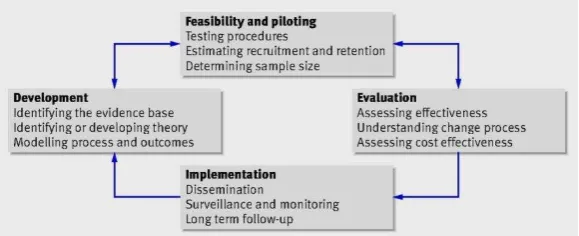
Complex interventions have ‘several dimensions of complexity’ such as variations in the number of intervention components, behaviours and degree of flexibility required to implement it, the groups it targets and the interactions between components [1]. The MRC framework (figure 1) provides guidance on how to design and evaluate such interventions in a structured way. It highlights the importance of the development
1
Dawn Dowding PhD, RN, FAAN, Columbia University School of Nursing, 617 W 168th Street, New
phase of intervention design, ensuring that there is an evidence base and theory to support the intervention, modelling both the intervention process and outcomes, before it is piloted for feasibility [1].
Figure 1. MRC framework of complex interventions
1.2.Pain in Patients with Dementia and Decision Support Interventions
Pain is a common symptom in older adults, and it is estimated that approximately 50% of people who have dementia also experience pain [2]. There is growing evidence that pain is often inadequately treated in patients with dementia [3]; patients often have difficulty with recall, interpretation, identification and responses to pain making it challenging for health care professionals to evaluate their pain experiences [4]. These difficulties are often compounded in an acute care setting, where the environment may increase a person with dementia’s sense of confusion and disorientation, and where staff may be unfamiliar with their individual pain responses [5].
Clinical decision support systems ‘provide clinicians with patient-specific
assessments or recommendations to aid clinical decision making’ [6]. They often
integrate information from a variety of sources using sophisticated technology and are implemented in a complex environment (that of a health care organisation with different layers of individual and social units collaborating together).
In this study we aimed to develop a decision support system that could assist clinicians with the complex task of identifying and treating pain in patients with dementia in an acute care setting. It focused on the first and second stages of the MRC framework; developing the intervention and exploring its feasibility.
2.Theory Development and Identifying the Evidence Base
Existing models of pain recognition, assessment and management of pain assume a linear process that could be compared to a linear judgement and decision making process (figure 2) [7], mirroring individual cognition.
Figure 2: The cognitive and clinical process for recognising, assessing and managing pain [7]
3.Methods
A systematic review of systematic reviews of pain assessment tools, and a multiple case site study with embedded units of analysis. The full methods and results of these studies have been reported elsewhere [7-9]. Here we provide a brief overview and key results, to provide context for our discussion of the utility of the MRC framework to guide the intervention development.
3.1. A Systematic Review of Systematic Reviews of Pain Assessment Tools for Patients with Dementia [8]
Systematic reviews of pain assessment tools were identified through searching databases (e.g. Medline, Embase, Cochrane) the JBI Database of Systematic Reviews and the DARE database, alongside reference chaining. Reviews were included in our
‘meta-review’ if they included pain assessment tools involving adults with
dementia/cognitive impairment and provided psychometric data on the tools evaluated. Each review was assessed for risk of bias using the AMSTAR critical appraisal tool. Data were extracted and summarised. At least two reviewers carried out each element of the review procedure (i.e. review inclusion/exclusion, assessment of methodologic quality, data extraction).
3.2.A Multiple Case Site Study Using Ethnography [7, 9]
4.Results
Ten papers reporting the results of 8 reviews were included in the meta-review. Each review summarised between 8 and 13 pain assessment tools, providing data for 28 tools in total. Overall, there were limited data on the reliability, validity and clinical utility of any of the tools evaluated in the reviews. On the basis of the evidence, we were unable to identify one specific tool that could be used as the basis for our decision support intervention.
In our case study we observed 31 patients with dementia for a total of 170 hours of observation; we interviewed 52 health care staff and 4 carers. Our analysis highlighted the difficulties patients with dementia had communicating with staff about their pain. Patients with dementia had significant issues communicating pain verbally, and their interactions with staff were often brief, and rarely with the same person.
These problems with communication affected clinicians’ abilities to reassess pain
following administration of therapy, and often affected whether a patient received medication at all. Overall the process of pain recognition, assessment and management
involved ‘putting a picture together’ of a patient’s pain, which required clinicians to
share information across individuals, and through written documentation which was often fragmented and kept in professional ‘silos’.
5.Discussion
The results of our study highlight the importance of considering theory and aspects of how an intervention may be thought to work in practice, as the first stage of intervention development. Our study used existing conceptualisations of how pain is thought to be identified, assessed and managed in clinical settings, underpinned by decision making theories. However the study results highlighted the need to refine that theory; if we had assumed that the focus of the decision tool should support a linear process focused on one clinician, we would not be reflecting the actual decision process we discovered through our ethnographic work. We have subsequently expanded the theoretical basis of our intervention to include an acknowledgement of the work of
‘sense-making’ in pain recognition, assessment and management [7] which can then
provide the basis for an intervention that may actually have more utility for clinical staff in a practice setting.
What our work has highlighted is that the MRC framework provides a good starting point for intervention development, but as often the interventions we are developing are being implemented in complex environments, that process has to be cyclical and flexible to adapt to the environment and project findings. Our study also highlighted the issues related to summarising and evaluating existing evidence; the meta-review for our study was extremely complex and did not identify one ‘best’ tool that could be used in practice. On reflection this may be a frequent issue with systematic reviews of complex interventions, that the results tend to be also complex and context dependent. The MRC framework reminds us that interventions need to be evidence based, but finding conclusive evidence may be the first challenge.
environment suggest that other conceptualisations of intervention development and evaluation may also be useful. For example realist evaluation methods, originally developed to explain how program interventions may work in one environment, but not another, may provide one way of supporting complex intervention development. This approach, where the researcher outlines and refines theories based on how individuals interact with the resources provided by an intervention (known as mechanisms) could enable a more flexible and reflexive approach both to theory development and testing in complex intervention research.
In general health informatics solutions, such as decision support interventions and other technological innovations, are rarely conceptualised in terms of their complexity. Given the complex nature of such technology, that individual users may interact with that technology in a number of ways, and the complexity of the environments where they are often introduced, we also believe that both the MRC framework and other approaches to evaluation could provide a useful framework for informatics researchers in the future.
6.Acknowledgements
The authors would like to thank the following members of the research team: Nick Allcock, Michelle Briggs, Anne Corbett, Philip Esterhuizen, Nita Gorasia, John Holmes, Claire Hulme, Kirstin James, John Keady, Andrew F Long, Liz McGinnis, John O’Dwyer, Liz Sampson, Caroline Swarbrick. This project was funded by the National Institute for Health Research HS&DR Programme (11/2000/05). The views and opinions expressed therein are those of the authors and do not necessarily reflect those of the HS&DR, NIHR, NHS or the Department of Health.
7.References
[1]Craig P, et al. (2006) Developing and evaluating complex interventions: new guidance. Medical
Research Council
[2]van Kooten J, et al. (2015) Pain in dementia: prevalence and associated factors: protocol of a
multidisciplinary study. BMC Geriatrics 15, 29
[3]Hoffman F, et al. (2014) Diagnoses indicating pain and analgesic drug prescription in patients with dementia: a comparison to age- and sex-matched controls. BMC Geriatrics 14, 20
[4] Leong IY and Nuo TH (2007) Prevalence of pain in nursing home residents with different cognitive and
communicative abilities. The Clinical Journal of Pain 23, 119-127
[5]Sampson EL, et al. (2015) Pain, agitation, and behavioural problems in people with dementia admitted to
general hospital wards: a longitudinal cohort study. Pain 156, 675-683
[6]Kawamoto K, et al. (2005) Improving clinical practice using clinical decision support systems: a
systematic review of trials to identify features critical to success. British Medical Journal 330, 765
[7]Dowding D, et al. (2016) Using sense-making theory to aid understanding of the recognition, assessment
and management of pain in patients with dementia in acute hospital settings. International Journal of Nursing Studies 53, 152-162
[8]Lichtner V, et al. (2014) Pain assessment for people with dementia: a systematic review of systematic reviews of pain assessment tools. BMC Geriatrics 14, 138
[9]Lichtner V, et al. (2016) The assessment and management of pain in patients with dementia in hospital
![Figure 2: The cognitive and clinical process for recognising, assessing and managing pain [7]](https://thumb-us.123doks.com/thumbv2/123dok_us/7744902.165925/4.595.137.460.155.310/figure-cognitive-clinical-process-recognising-assessing-managing-pain.webp)
