Rim macroarea and infrequent elsewhere (Nichols, 1992; Cysouw, 2002); head marking in the Baker or Cysouw sense is an ancient Eurasian enclave feature found only in the Himalayas and the Caucasus (Bickel and Nichols, 2003, where the term used is ‘polyagree-ment’). The distribution of head/dependent marking types, macroarea by macroarea, differs so much that no universal profile can be determined (Cysouw, 2002).
See also: Areal Linguistics; Case; Contact-Induced Con-vergence: Typology and Areality; Ergativity; Grammatical Relations and Arc-Pair Grammar; Linguistic Universals, Greenbergian; Noun Phrases; Polysynthetic Language: Central Siberian Yupik; Possession, Adnominal; Verbs; Word Order and Linearization.
Bibliography
Baker M C (1996). The polysynthesis parameter. New York: Oxford University Press.
Baker M C (2001). ‘Configurationality and polysynthesis.’ In Haspelmath M, Koenig E, Oesterreicher W & Raible W (eds.) Language typology and language universals. Berlin: Walter de Gruyter. 1433–1441.
Bauer W (1993).Maori.London/New York: Routledge. Bickel B & Nichols J (2002). ‘Autotypologizing databases
and their use in fieldwork.’ In Austin P, Dry H & Wittenburg P (eds.) International LREC workshop on resources and tools in field linguistics, Las Palmas. Nijmegen: Max Planck Institute for Psycholinguistics. Bickel B & Nichols J (2003). ‘Typological enclaves.’Paper
presented at the 5th biannual conference, Association for Linguistic Typology Cagliari, Sardinia. http://www.uni-leipzig.de/autotyp/download/index.html
Campbell L (1985). The Pipil language of El Salvador. Berlin: Mouton de Gruyter.
Cysouw M (2002). ‘Interpreting typological clusters.’ Lin-guistic Typology 6,49–93.
Dayley J P (1985). Tzutujil grammar. (UCPL 107.) Berkeley-Los Angeles: University of California Press. de Reuse W (1993).Siberian Yupik Eskimo: The language
and its contacts with Chukchi.Salt Lake City: University of Utah Press.
Dixon R M W (1988). A grammar of Boumaa Fijian. Chicago: University of Chicago Press.
Helmbrecht J (2001). ‘Head-marking vs. dependent-marking languages.’ In Haspelmath M, Koenig E, Oesterreicher W & Raible W (eds.)Language typology and language uni-versals: An international handbook. Berlin/New York: Walter de Gruyter. 1424–1432.
McLendon S (1996). ‘Sketch of Eastern Pomo, a Pomoan language.’ In Goddard I (ed.) Handbook of North American Indians 17: Languages. Washington, DC: Smithsonian Institution. 507–550.
Milewski T (1967). ‘La structure de la phrase dans les langues indigene de l’Amerique du Nord.’ In Milewski T (ed.)Etudes typologiques sur les langues indigenes de l’Amerique.Krakow: Polska Adademia Nauk. 70–101. Nichols J (1986). ‘Head-marking and dependent-marking
grammar.’Language 66,56–119.
Nichols J (1992). Linguistic diversity in space and time. Chicago: University of Chicago Press.
Nichols J (1995). ‘Diachronically stable structural features.’ In Andersen H (ed.)Historical linguistics 1993: Papers from the 11th International Conference on Historical Linguistics. Amsterdam/Philadelphia: Benjamins. 337–350.
Nichols J (2003). ‘Genetic and typological diversification of language.’ In Joseph B & Janda R (eds.)Handbook of historical linguistics.London: Blackwell. 283–310. Nichols J & Bickel B (2005). ‘Locus of marking in
posses-sive NP’s.’ In Haspelmath M, Dryer M, Gil D & Comrie B (eds.) World atlas of language structures. Oxford: Oxford University Press. 102–103.
Nichols J & Bickel B (2005). ‘Locus of marking in the clause.’ In Haspelmath M, Dryer M, Gil D & Comrie B (eds.) World atlas of language structures. Oxford: Oxford University Press. 98–101.
Nichols J & Bickel B (2005). ‘Locus of marking: Whole-language typology.’ In Haspelmath M, Dryer M, Gil D & Comrie B (eds.) World atlas of language structures. Oxford: Oxford University Press. 106–109.
Simpson J (1983). Aspects of Warlpiri morphology and syntax. Ph.D. dissertation, MIT.
Solnit D (1985).Eastern Kayah Li.Honolulu: University of Hawai’i Press.
Tesnie`re L (1985).Elements de syntaxe structurale.Paris: Klincksieck.
Head-Driven Phrase Structure Grammar
R D Levine and W D Meurers, The Ohio StateUniversity, Columbus, OH, USA
ß2006 Elsevier Ltd. All rights reserved.
The Linguistic Approach
Our discussion is primarily rooted in Pollard and Sag (1994) as the touchstone of the HPSG paradigm, based on earlier exploratory work (Pollard and Sag,
Grammar (LFG; Bresnan, 1982), a revived, empiri-cally based version of Categorial Grammar (CG, Ades and Steedman, 1982), and several other approaches all made their appearance, and HPSG has integrated ideas from each of these paradigms, in combination with insights developed in the Government and Binding (GB; Chomsky, 1981) paradigm.
Fundamentals of the Linguistic Framework
HPSG rests on two essential components: (i) an ex-plicit, highly structured representation of grammati-cal categories, encoded as typed feature structures, whose complex geometry is motivated by empirical considerations against the background of theoretical desiderata such as locality, and (ii) a set of descriptive constraints on the modeled categories expressing lin-guistic generalizations and declaratively characteriz-ing the expressions admitted as part of the natural language. The formal foundation of this architecture is discussed in a separate section below.
From a linguistic perspective, the set of descrip-tive constraints expressing the theory of an HPSG grammar consist of (a) a lexicon licensing basic words, (b) lexical rules licensing derived words, (c) immediate dominance schemata licensing constituent structure, (d) linear precedence statements constrain-ing constituent order, and (e) a set of grammatical principles expressing generalizations about linguistic objects. The clearest way to illuminate the interaction of these components is to provide a concrete example.
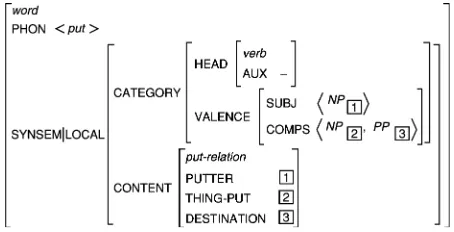
Lexical Organization Consider the verb put, for which a partial lexical entry is shown inFigure 1.
As specified by the type in the top-left corner of Figure 1, this Attribute-Value Matrix (AVM) describes objects of type word. The PHON attribute
here is simply taken to be a list of strings serving as a placeholder for an actual phonological representa-tion for HPSG, as developed by Bird and Klein (1994) and Ho¨hle (1999). The morphosyntactic information that characterizes local properties of linguistic expressions are specified under theCATEGORYfeature,
which, along with the semanticCONTENT, is identified
by theLOCALpart of theSYNSEMvalue. The subset of CATEGORY properties that are necessarily shared
be-tween mother and head daughter in a local tree are packaged together under theHEADfeature.
The VALENCE feature specifies the combinatory
potential of lexical items as lists ofsynsemobjects (as opposed to lists ofsigns). Thus, neither phonological information (specified in PHON) nor the DAUGHTERS
feature, which, as we will see, encodes constituent structure in objects of type phrase, can be selected for, incorporating the well-supported generalization that syntactic selection is independent of phonological form and is consistently local.
The specification of the valence features (SUBJand COMPS) and CONT, specifying the semantic roles
assigned by the head, make it possible to lexically associate the valents of a head with the semantic contribution of these valents to the relation it denotes. The boxed numbers indicate token-identity of the values specified. Instead of specifying such linking in each lexical entry, it can be derived from general linking principles (cf. Koenig and Davis, 2003, and references therein). The issue of lexical generaliza-tions brings us to the question how the lexicon is defined.
The basic lexicon of an HPSG theory can be de-fined by theWord Principleshown inFigure 2, where eachLexical-Entryis a description of the kind we saw inFigure 1.
Whereas this principle illustrates the basic method for expressing a lexicon as a constraint, a wide range of approaches have been developed that do not take lexical entries of type word as primitives, such as realizational approaches to morphology (cf., e.g., Erjavec, 1996; Riehemann, 1998) or word syntax approaches (cf., e.g., Krieger and Nerbonne, 1993). The HPSG architecture also readily supports lexical generalizations through principles expressing con-straints on sets of lexical elements, so-calledvertical generalizations, as well as through lexical rules expressing relations between sets of lexical elements, referred to ashorizontal generalizations(cf. Meurers, 2001; Bouma et al., 2000, and references cited therein).
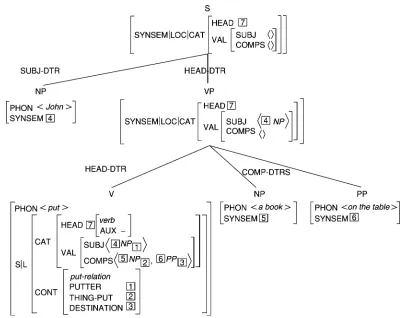
Phrasal Structures Turning to phrasal structures, consider the tree shown inFigure 3(note that S, NP, VP, etc., are just abbreviations for AVM specifica-tions; for space reasons, some attribute names are also abbreviated).
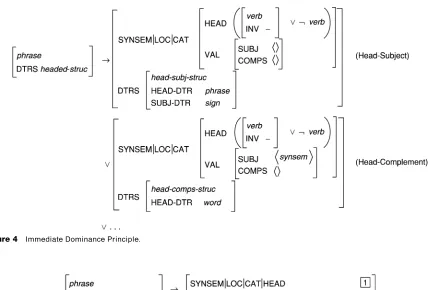
[image:2.595.64.291.596.712.2]As with all grammatical principles in HPSG, gen-eralizations over phrasal structure are expressed as constraints. Figure 4 shows the relevant parts of the Immediate Dominance (ID) Principle, which essentially encodes a version of the X-bar schema (Jackendoff, 1977).
The first disjunct of the ID Principle is the Head-Subject schema, which licenses the upper local tree of the example in Figure 3; the lower local tree is licensed by the Head–Complement schema.
In addition to the Head–Subject and the Head– Complement structure licensed by the two dis-juncts shown, Pollard and Sag (1994) assume only a small inventory of general schemata: Head–Adjunct, Head–Filler, Head–Marker, and a flat Head–Subject– Complement schema.
The subcategorization requirements specified under the VALENCE attribute in the lexical entry of
putare realized as the result of the Valence Principle, which specifies that the valence requirements of a lexical head are identified with theSYNSEMvalue of
the realized daughters, with all unrealized require-ments being handed on to the mother of the local tree. This principle essentially is the phrase-structural analogue to Categorial Grammar’s treatment of
valence satisfaction as combinatory cancellation (though, unlike CG, HPSG’s principle does not as-sume that all valence-driven combinations involve a functor combining with a single argument). In the example in Figure 3, we can see that the valence specification in the lexical entry of put requires an NP subject and two complements, an NP and a PP. In the lower tree, the two complements are realized asa book ( ) and on the table ( ). As a result of the Valence Principle, the VP mother of that local tree has an empty COMPS requirement. The SUBJ
require-ment is inherited unchanged from the lexical verb and realized as John ( ) in the higher local tree, domi-nated by the fully saturated S.
The percolation of head information along the head projection is the result of the Head-Feature Principle (HFP), shown in Figure 5. The HFP is a straightforward adaptation of the Head Feature Convention of Gazdar et al. (1985); it ensures that in any headed structure, the HEAD specifications of
a mother and its head daughter are token-identical. In our example in Figure 3, the category verb and the [AUX –] specification are shared as index
[image:3.595.92.495.394.712.2]between the lexical head put and its VP and S projections.
Capturing Dependencies
Arguably the essential test of a grammatical frame-work is its ability to capture, parsimoniously and inclusively, the ubiquitous grammatical dependencies of natural languages. Such dependencies are often grouped into two major classes:local dependencies, which hold over a limited syntactic domain and fre-quently depend on properties of a specific class of lexical items, andnonlocal dependencies, which ap-pear to hold over arbitrarily large syntactic distances and are largely independent of the lexicon. In this section, we briefly review, mostly based on Pollard and Sag (1994), how the machinery available in HPSG leads to compact solutions to the problems posed by both dependency types in English.
Local Dependencies Phenomena such as agreement, auxiliary-choice morphosyntactic dependencies, sub-ject selection, the active/passive relationship, and the so-called Raising/Equi constructions all exemplify what we refer to as local dependencies. In HPSG, these phenomena typically are all handled in terms of the selectional properties of lexical heads. We here sketch the analysis of control constructions as an illustration of this general approach.
Control Construction In line with the general HPSG strategy to reject those invisible elements for which there is no empirical evidence, in nonfinite construc-tions, the subject of the embedded verb is analyzed as not locally expressed. There is no need to assume an invisible realization of such subjects, as done in transformational grammar, since HPSG is based on richer linguistic data structures in which lexical spe-cifications, such as subcategorization requirements, are explicitly represented. The questions of what is interpreted to be the subject of the nonfinite verb and why verbs selecting nonfinite complements differ with respect to what kind of controllers can occur are thus answered through the lexical specification of the control verbs.
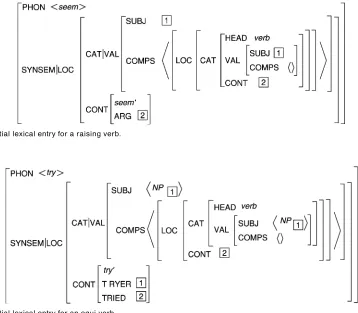
[image:4.595.80.510.404.694.2]A subject-to-subject raising verb likeseem, for ex-ample, will have the partial description in the lexicon given in Figure 6. We see that the subject valence requirement of the subject raising verb is identified with the subject of the verbal complement. Note that the subject is not assigned a semantic role by the raising verb. In order to derive the fact that such raising is permissible only if the raised argument is assigned a semantic role elsewhere in the structure, Pollard and Sag (1994: 140) specified a general metaprinciple, the Raising Principle.
Figure 4 Immediate Dominance Principle.
Based on the lexical specification in Figure 6, the properties of a raising verb fall out of the interaction with the rest of the architecture; in particular, the identification of the subject requirement of the two verbs implies that: If the embedded verb requires a nonreferential subject or permits a clausal subject, this is enforced by the raising verb realizing the subject. If the embedded verb has a subject with an idiomatic interpretation, the subject also has that interpretation when realized as an argument of a raising verb. In languages in which subjectless con-structions exist, raising verbs can embed such subject-less complements. And passivization of the nonfinite complement results in a paraphrase.
In contrast, the partial lexical specification of a subject-to-subject equi verb liketryinFigure 7 speci-fies semantic coindexing of the subject valence re-quirement of the subject control equi verb with the subject of the verbal complement. And the subject is assigned a semantic role by the subject control equi verb.
Nonlocal Dependencies Probably the strongest-seeming case for syntactic transformations was the existence of unbounded dependencies, particularly extraction phenomena. Given that certain valence
requirements appear to be satisfied by elements arbi-trarily distant from the selecting head, it is intuitively natural to suppose that they were moved there after selection. A derivational account thus seems attractive, even under the antitransformational stances evident in, e.g., Brame (1976).
The flaws in this line of thinking were made obvi-ous in Gazdar’s (1981) pioneering work on an explicit formal characterization of filler/gap linkages in a monostratal framework, which was assimilated into a feature-based account by Bear (1981) and Gazdar et al. (1985). In HPSG, the relevant feature is the set-valued SLASH, which takes as its value theLOCAL
spe-cifications of extracted elements.
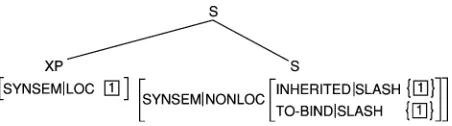
The Filler–Head schema licenses the local tree rea-lizing the filler as illustrated inFigure 8.
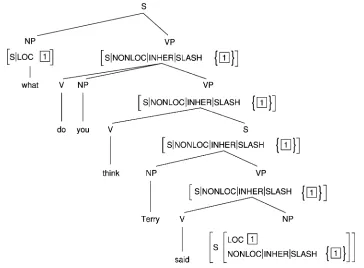
The Nonlocal Feature Principle has the effect of sharing the SLASH value of the mother with that of
some daughter until it reaches the trace, which has the lexical entry shown inFigure 9. This entry identi-fies the properties of the nonlocally realized element specified under SLASH with its own LOCAL
specifica-tion.
Taken together, the lexical entry and the general principles yield a structure for a sentence such as What do you think Robin said? as in Figure 10.
[image:5.595.113.471.406.719.2]Figure 6 Partial lexical entry for a raising verb.
Note thatpaceBaker (1978), apart from the schema realizing the filler, the sentence is licensed by the same general ID schemata also used in nonextraction examples.
Independent support for the inherently local propa-gation ofSLASHfeature specifications as the vehicle for
UDC dependencies comes from work on languages that visibly mark filler/gap pathways, as discussed at length in Zaenen (1983) and Hukari and Levine (1995). Such languages record by morpho- or phono-syntactic means the presence of each intermediate clausal step along the filler/gap pathway.
Other Dependencies In addition to the local and nonlocal dependencies, so-called middle distance dependencies arise in the context of coherence/verb-raising in the Germanic languages and of restructuring phenomena in the Romance languages – an issue we return to briefly in the next section when discuss-ing argument attraction as the lexical specification underlying an analysis of these phenomena.
Finally, another kind of dependency relation, trea-ted in considerable detail in Pollard and Sag (1992, 1994), involves the syntactic conditions that require, allow, or forbid coindexation of referring constitu-ents. These conditions, collectively referred to as the HPSG Binding Theory, are formulated in HPSG not in terms of syntactic configuration but rather in terms of an obliqueness ordering that is lexically specified as a part of the selection properties.
Strands of Research
During the past decade, a vast literature in the HPSG framework has addressed empirical and theoretical issues arising in a wide range of languages. The scale of the enterprise allows only the most cursory overview; interested readers will find many of these issues taken up in breadth and detail in Kathol and Przepio´rkowski (in press) and extensive on-line bibliographies of HPSG literature.
Beginning with the crosslinguistic breadth of coverage, a large collection of volumes has been devoted to the analysis of Romance languages (cf., e.g. Balari and Dini, 1997; Monachesi, 1999; Crysmann, 2003; Abeille´ and Godard, 2003), Slavic languages (cf., e.g. Borsley and Przepio´rkowski,
1999), German (cf., e.g. Nerbonne et al., 1994; Kiss, 1995; Kathol, 2000; Mu¨ller, 1999, 2002; Meurers, 2000; Meurers and Kiss, 2001; Holler, 2001; De Kuthy, 2002). Japanese, (cf., e.g. Iida, 1995) Welsh, (cf., e.g. Borsley and Jones, 2005), and dozens of other languages. In addition, innumerable articles in journals, conference proceeding, and collections address the relevance of HPSG analyses to an under-standing of complex phenomena in a variety of languages.
A good example of the latter is the analysis of clause union and restructuring phenomena in terms of argument attraction (Hinrichs and Nakazawa, 1994), which has had significant impact on analyses of languages as diverse as French and Korean. Simi-larly, the linearization-based approach to discontinu-ous constituency first proposed as a key to reconciling German constituent structure with the facts of word order in that language (Reape, 1996; Kathol, 2000; Mu¨ller, 1999) has been widely applied to problems of discontinuity in a variety of construction types in English, French, Portuguese Japanese, and Warlpiri. Another example is the introduction of a limited de-gree of nonlocality of selection into HPSG as a result of the work on case assignment in German reported in Meurers (2000: Chap. 10), which has proven use-ful in discussions of quite different phenomena, such astoughconstructions in various languages (cf., e.g., Levine, 2001; Amaral, 2005).
Other work addresses questions of the grammatical architecture, such as the interaction of syntax, infor-mation structure, and intonation (Engdahl and Vall-duvı´ 1994; De Kuthy, 2002; De Kuthy and Meurers, 2003), and the integration of a range of semantic architectures into HPSG, such as Underspecified DRT (Frank and Reyle, 1995), Minimal Recursion Semantics (Copestake et al., in press), Constraint Language for Lambda Structures (Egg et al., 2001), and Lexical Resource Semantics (Richter, 2004a), which support innovative analyses of long-standing natural language puzzles, such as those posed by idioms (Sailer, 2003).
[image:6.595.66.292.67.130.2]As should be expected of an active research com-munity, the HPSG paradigm also includes significant diversity and disagreement about research strategies and analyses. One such issue concerns the choice between lexical and constructional approaches. Pollard and Sag (1994) account for the complex Figure 8 The local tree realizing the filler of a nonlocal
depen-dency.
[image:6.595.319.521.67.115.2]properties of relative clauses using null functional heads; Sag (1997) instead essentially revived the treat-ment of these adjuncts in Gazdar et al. (1985) by proposing to account for their behavior in terms of constructional characteristics inherited in a complex type hierarchy from supertypes. This approach has been further explored in Ginzburg and Sag (2001) and other work that increasingly links certain quar-ters within HPSG to the program of Construction Grammar (Fillmore and Kay, 1999). There is no consensus within HPSG that this is the optimal move, however, and research that minimizes reliance on structural types continues to emphasize the head-driven, lexical aspect of HPSG (cf., e.g., Mu¨ller, 2005). In a directly related issue, two principal strands of HPSG have developed with respect to the use of types. In one strand, new types are introduced for any class of objects to be generalized over and these types are arranged in large, crossclassifying taxonomies. The other strand emphasizes minimal linguistic ontologies in that new types are introduced only if they are necessary to refer to language proper-ties that cannot otherwise be distinguished in the model (cf. Meurers, 2001; Koenig and Davis, 2003). Another source of diversity lies in the analysis of unbounded dependencies. Traceless versions of HPSG have been pursued in Pollard and Sag (1994), Boumaet al. (2001), and Ginzburg and Sag (2001), but this line of analysis is not universally accepted (cf., e.g., Levine, 2003; Mu¨ller, 2002: Chap. 6.2.5.1).
The foregoing discussion, while inevitably very in-complete, should give the reader an idea of the crea-tive ferment that has characterized HPSG over the past decade. Nor has this innovative momentum been confined to the empirical/analytic side; it has, as we discuss below, also made itself evident in the formal and computational aspects of the theory, to which we now turn.
HPSG from a Formal Perspective
A Declarative Characterization of Natural Languages
[image:7.595.114.478.67.335.2]type has which appropriate attributes with which appropriate values. Thetheoryof an HPSG grammar is a set of description language statements, often re-ferred to as the constraints. The theory essentially singles out a subset of the objects declared in the signature, namely, those that are grammatical. A linguistic object is admissible with respect to a theory if and only if it satisfies each of the descrip-tions in the theory and so does each of its substruc-tures. In the following, we take a closer look at the two components of an HPSG grammar.
Modeling the Domain What do the mathematical structures used as models for HPSG theories look like, and how are they related to the linguistic objects? Pollard and Sag (1994: 8) required the HPSG architecture to use typed feature structures (TFS) as models of linguistic objects. More precisely, they argued for modeling types (vs. tokens) of total linguistic objects (as opposed to partial information about them) and therefore assumed the models to be totally well-typed and sort-resolved feature structures. Here, totally well-typed means that (a) ‘‘what attribute labels can appear in a feature structure is determined by its sort; this fact is the reflection within the model of the fact that what attributes . . . an empirical object has depends on its ontological cat-egory’’ (Pollard and Sag, 1994: 18) and (b) ‘‘every feature that is appropriate for the sort assigned to that node is actually present’’ (Pollard and Sag, 1994: 18). Sort-resolvedness requires that every node is assigned a most specific type as value. Note thattypeandsortare often used synonymously; the same is true forattributeandfeature.
It is important to realize that these requirements are not merely technical stipulations; they are a direct consequence of the decision that feature structures should serve as total models of linguistic objects. It is not uncontroversial within the HPSG community whether total models of linguistic objects are what is needed for linguistics. Problems for such total models arise in the analysis of coordination (Pollard and Sag, 1994: 203, fn. 39; Sag, 2003) and arguments for and against total models arise from the formalization
of lexical rules and the representation of unrealized arguments (Meurers, 2001: 180–182; Pollard, 2001). At the same time, we will see in the next section that only total models support the classical negation need-ed for formulating the implicational constraints stan-dardly used to express grammatical principles in HPSG.
Expressing the Theory Having clarified how lin-guistic objects are modeled, we can turn to the ques-tion of how to express the theory and how the theory characterizes the set of well-formed linguistic objects. An HPSG theory is specified using a specific description language, sometimes written down in the form of Attribute-Value Matrices (AVM). The description language makes it possible to express that a feature structure has a certain type (e.g., noun), that the value of an attribute of a feature structure satisfies a given description (e.g., [CASE
nom-inative]), or that the values of two attribute paths are token identical. Complex descriptions are obtained by combining descriptions with the help of conjunc-tion, disjuncconjunc-tion, and negation; in the AVM notaconjunc-tion, conjunction is implicit.
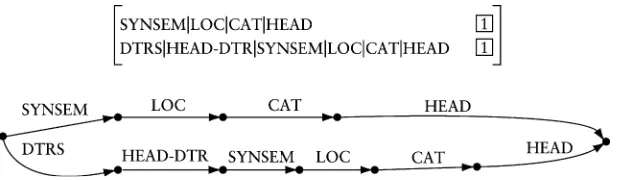
The notion of token identity means that two paths point to the same node in the feature structure model; this is illustrated inFigure 11with an AVM specifying token identity ofHEADvalues (as specified by the HFP
discussed aroundFigure 5above) and a small graph showing the relevant part of a feature structure denoted by this description.
Another identity notion sometimes referred to is type identity: Two feature structures are type identi-cal if and only if they are of the same type, the same attributes are defined on both feature structures, and the feature structures that are the values of the attributes are type identical.
[image:8.595.148.457.66.156.2]does each of its substructures. The descriptions that make up the theory are also calledconstraints, since these descriptions constrain the set of feature struc-tures that are admissible with respect to the theory compared to the domain of feature structures speci-fied by the signature. Note that the term constraint has been used for many different purposes – we use ‘constraint’ only to mean ‘description that is part of the theory.’
Formalizing the HPSG Setup
The setup of HPSG characterized in the previous section is summed up inFigure 12. The usual symbols for description language operators are used: conjunc-tion (^), disjuncconjunc-tion (_) and negaconjunc-tion (:). Type as-signment and path equality are noted as ‘’ and ‘¼’, respectively.
Several logics have been proposed to provide the formal foundations for this setup. There essentially are two families of logics dealing with this task: the Kasper–Rounds logics (Rounds and Kasper, 1986; Moshier and Rounds, 1987; Carpenter, 1992; Copes-take, 1993) and theAttribute-Valuelogics (Johnson, 1988; Smolka, 1988; King, 1989). In the following, we focus on two prominent representatives in the context of HPSG: the Kasper–Rounds logic defined in Carpenter (1992) and the Attribute-Value logic of King (1989). Figure 13 shows the setup proposed in Carpenter (1992), with ‘6¼’ as notation for path inequality.
The descriptions of Carpenter (1992) describe typed feature structures modeling partial informa-tion. Presumably there is a further level, in which the partial information is related to the linguistic objects, which is left undefined. This setup can also be seen to underlie an early model of HPSG (Pollard and Sag, 1987). Since partial information, not total linguistic objects, is modeled, Carpenter (1992) did not require the typed feature structures to be well typed or sort resolved.
The difference between the total models of lin-guistic objects assumed in HPSG since Pollard and Sag (1994) and the models of partial infor-mation of Carpenter (1992) has important con-sequences. Moshier and Rounds (1987) showed that in the setup of a Kasper–Rounds logic, full clas-sical negation as part of the description language destroys subsumption monotonicity on typed feature
structures – a property that, as Carpenter and others argued, must be upheld if feature structures are to function as models of partial information. Carpenter (1992: Chap. 15, p. 233) went one step further by stating that even for the formulation of implicational constraints with type antecedents (i.e., type negation), subsumption monotonicity cannot be achieved. The description language of Carpenter (1992) therefore contains only path-inequations, a weaker form of negation.
Turning to Attribute-Value Logics, King (1994, 1999) showed that his Speciate Reentrant Logic (SRL) can provide the setup we saw in Figure 12, i.e., the setup envisaged for HPSG in Pollard and Sag (1994). Descriptions are given a set theoretic interpretation: The interpretation of a description is a set of objects, i.e., an object satisfies a description if and only if it is in the denotation of that description. For example, the descriptionworddenotes the set of all objects of type word; and the description [CASE
nominative] denotes the set of all objects for which the partial functionCASEis defined such that the value
of that function is an object of type nominative. Conjunction, disjunction, and negation as operations on descriptions are interpreted as set intersection, set union, and set complement, respectively.
Although King’s SRL captures the basic HPSG setup, one conceptual difference is that Pollard and Sag (1994) envisaged modeling abstract linguistic objects (i.e., types) whereas SRL models concrete linguistic objects (i.e., tokens). But Pollard (1999) distanced himself from the earlier emphasis on types and adopted King’s denotation function in place of an approach based on feature structure satisfaction and admission.
King’s SRL falls short, however, in failing to pro-vide relational expressions. Richter (2000) addressed this issue by defining the Relational Speciate Re-entrant Language (RSRL), which added a bounded form of quantification and relations to the inventory of expressions. He showed in detail how this formal language can provide a direct and transparent forma-lization of the English HPSG in Pollard and Sag (1994), which turns out to require more relations than was traditionally assumed. Richter (2000, 2004a) can also be recommended as a comprehensive overview of the complex issues involved in formaliz-ing HPSG.
Processing with HPSG-Based Grammars
Motivation
There are at least three motivations for implementing and processing with HPSG-based grammars. From a linguistic perspective, such work can provide im-portant feedback on the empirical adequacy of the linguistic analyses, on the explicitness, complete-ness, and compatibility of the linguistic theories integrated in one grammar, and on the rigid and complete formalization of the linguistic architecture. From a computational perspective, grammar imple-mentation can stimulate and test the development of systems that support parsing and generation with HPSG-based grammars. Finally, from anengineering perspective, deep processing with HPSG-based gram-mars is potentially useful for applied human language technology as, e.g., illustrated by the speech-to-speech machine translation project VerbMobil.
Depending on the perspective adopted, research on HPSG-based processing has emphasized different issues; it is important to note, however, that even from an engineering perspective the value added by basing grammar writing on HPSG as a linguistic par-adigm derives from the insights provided by an active linguistic research community. The development of implementation systems that support a transparent and tractable way of implementing a grammar close to the linguistic theory thus is of particular impor-tance for HPSG-based computational work. In the same vein, a thorough documentation of grammars (cf., e.g., Meurers, 1994; Gregory, 1997; Mu¨ller, 1999), including discussions motivating the differences be-tween the linguistic theory and the implementation, is an essential component of such work.
Frameworks for HPSG-Based Processing
Since the early 1990s, a range of systems that support processing with HPSG-based grammars have been developed. Classifying these systems according to the means used for expressing grammars, one can distinguish systems that are (a) constraint-based in the sense that grammars for these systems consist of implicational statements constraining the domain di-rectly, (b) relation-based in the sense that they make use of a relational level for organizing the grammar, i.e., the relational extension of the constraint lan-guage, or (c) a combination of the two. We here focus on providing an overview of the key theoretical distinctions relevant for characterizing the different systems; a detailed system comparison can be found in Bolcet al. (1996).
Systems Directly Constraining the Domain The Typed Feature structure System (TFS; Emele and
Zajac, 1990) arguably was the first system that sup-ported a direct implementation of HPSG theories (cf., also, Matiasek, 1994). TFS grammars consist of a set of implicational statements with type antecedents. Any description can be entered as a query, and the system returns a more specific description such that the description and each of its parts satisfies each constraint in the theory.
The advantage of this approach is that the organi-zation of constraints in TFS is the same as that in the HPSG architecture: an HPSG theory is just a set of constraints, some of which happen to constrain lexi-cal objects, whereas others constrain phrasal objects, etc. The TFS system supports only implicational statements with type antecedent though, not general negation, so that principles with complex antecedents cannot be directly encoded.
In line with the credo for reversible processing architectures (cf. Van Noord, 1993; Neumann, 1998; Minnen, 2001, and references therein), proces-sing in TFS always amounts to applying constraints to whatever specification is given as the input – there is no specialized parsing or generation algorithm. This also leads us to the main disadvantage of the TFS approach: Since every linguistic constraint is treated in the same way, including type constraints on recur-sively defined data structures, TFS can run into sig-nificant control problems, which result in problems of efficiency and termination.
Systems Based on a Relational Backbone In the Comprehensive Unification Formalism (CUF; Do¨rre and Eisele, 1991; Do¨rre and Dorna, 1993), a theory is expressed using definite clauses as a relational ex-tension of the description language (cf. Jaffar and Lassez, 1987; Ho¨hfeld and Smolka, 1988). CUF thus essentially is a relational programming language like Prolog (Colmerauer, 1993), but with feature terms as arguments of the relations instead of first-order terms. Whereas CUF provides some advanced features, such as complex coroutining capabilities, related approaches have focused on providing a lean integration of typed feature structures into Prolog such as GULP (Covington, 1994) or ProFIT (Erbach, 1995b).
depends entirely on how the grammar was encoded as a logic program and which processing regime is ap-plied to it.
Compared to the computational setup exemplified by TFS, in which the constraints on the domain are expressed directly, the advantage of the relational approach is that the grammar writer determines the order of execution of goals by the way in which one encodes the grammar as a definite clause program. The definite clause encoding also allows the efficient processing techniques of logic programming to be used; e.g., clause indexing, Earley deduction, goal freezing, and specialized algorithms for parsing or generation can be encoded in this setup (cf., e.g., Erbach, 1995a, and references therein).
The disadvantage of the relational systems is that the organization and expression of a grammar are entirely different from the organization of an HPSG theory as a set of constraints. A grammar with a relational backbone in general is related to the origi-nal linguistic HPSG theory only on an intuitive level (unless the relational encoding is the result of compi-lation of a set of constraints; cf. Go¨tz and Meurers, 1995).
Phrase Structure as a Specialized Relational Backbone Probably the largest class of systems, such as ALE (Carpenter and Penn, 1994), LKB (Copestake, 1993), and Troll (Gerdemann and Go¨tz, 1996), has opted for a particular relational approach: phrase structure grammars. Phrase structure is a relation demanding a fixed number of daughters (at runtime) and having a designated argument (in HPSG typically encoded under PHON) that satisfies the
con-dition that the list of tokens covered by the mother is the concatenation of that covered by all its daughters. The key advantage of a phrase structure-based approach is that the most important recursive struc-ture, syntactic constituency, is singled out and encoded in a format that readily supports efficient algorithms for parsing. These algorithms exploit the formal properties of the phrase structure relation for efficient indexing, memoization, and other optimiza-tions, instead of relying on resolution to tackle gener-al definite clause programs. Some of the systems gener-also make it possible to combine phrase structure gram-mars with definite clause programs, so that, e.g., a phrase structure rule can refer to a general definite relation for concatenating or shuffling lists.
The phrase structure-based approach shares the general disadvantage of the relational encoding: that the organization and formulation of the grammar are different from those of the linguistic theory. Despite its somewhat confusing name, a Head-Driven Phrase Structure Grammar does not include phrase structure
rules; as we saw above, an HPSG theory is a set of constraints, one of which typically encodes a set of immediate dominance schemata licensing syntactic structure. When one recodes such immediate domi-nance schemata into phrase structure rules, the specific restrictions inherent to phrase structure men-tioned above have the effect that each immediate dominance constraint of the original linguistic theory results in a possibly very large set of phrase structure rules.
Combining Paradigms
As mentioned in the previous section, a relational backbone is advantageous for efficient processing. In contrast, implicational constraints support a more modular, underspecified encoding of grammars by making use of the elaborate structure that typed feature structures impose on the modeled domain. Several HPSG-based processing systems have thus been developed to combine the advantages of both encodings, such as the (new) ALE (Carpenter and Penn, 1994), TDL (Krieger, 1995), ConTroll (Go¨tz and Meurers, 1997), the (new) LKB (Copestake, 2002), Hdrug (van Noord and Bouma, 1997), or TRALE (Meurers et al., 2002; Penn, 2004). This development is reminiscent of the integration of the paradigms of (constraint) logic programming, functional programming, and object-oriented pro-gramming in general-purpose propro-gramming lan-guages, such as LIFE (Aı¨t-Kaci and Podelski, 1991) and OZ.
How the paradigms are combined in the HPSG implementation systems differs from system to sys-tem, reflecting the linguistic or engineering focus under which they have been developed. Let us illus-trate this with three examples:
At the other end of the spectrum, the LKB is a system emphasizing efficient processing with a phrase structure backbone and basic type constraints (Copes-take, 2002). The system supports efficient processing of large-scale grammars and is at the heart of a rich array of natural language engineering efforts (cf., e.g., Oepen et al., 2000, and several articles mentioned in the next section). In support of efficiency, the system has a lean design: The description language does not include disjunction, negation, path-inequation, or macros; the basic type constraints are not intended for recursive processing; and the system does not sup-port definite relations so that recursive processing is limited to the phrase structure component. To avoid costly computation, constraints and appropriateness conditions are not strictly enforced, in the sense that a solution returned is not guaranteed to have any specific instantiations that are well-formed.
The TRALE system attempts to cover a middle ground by combining the definite relations and efficient phrase structure backbone of the ALE system (Penn and Munteanu, 2003) with implicational con-straints with complex antecedents and enforcing some, but not all, of the inferences possible through appropriateness. In support of efficient processing, implicational constraints are applied only when the antecedent subsumes the description being processed (Penn, 2004), in contrast to ConTroll, where the interpretation of negation is classical, potentially enforcing costly exploration of many disjuncts (unless a delay statement is specified to obtain the interpretation adopted by TRALE).
Strands of Research
HPSG-based processing is an active field of research; thus, in the remainder of this section we point out some of the strands of research.
In line with the current emphasis on human lan-guage technology and applied research, a major strand of work on HPSG-based processing is advanc-ing the efficiency, robustness, and applicability of deep processing. This focus includes work on ab-stract machine compilation (cf., e.g., Wintner, 1997; Miyao et al., 2000), an efficient reimplementation of a lean, phrase structure-based system in C þþ (Call-meier, 2000), grammar compilation techniques (cf., e.g., Minnen et al., 1995; Minnen, 2001; Meurers and Minnen, 1997), and a wide range of algorithmic improvements and techniques (cf., e.g., Kiefer et al., 1999; Oepen et al., 2000; Munteanu and Penn, 2004). A related line of work relieves the HPSG-based deep processing of some of the processing burden by combining it with shallow processing techniques (cf., e.g., Frank et al., 2003) or filtering with extracted
context-free grammars (cf., e.g., Kiefer and Krieger, 2000; Torisawa et al., 2000). Some of this work is organized around the Deep Thought project (http:// www.project-deepthought.net/), which investigates such hybrid methods for the purpose of information extraction. Stochastic extensions of HPSG have been developed (Brew, 1995; Abney, 1997) and a combi-nation of statistical and linguistic insights is, e.g., explored in the Delph-IN collaboration.
Another strand of research emphasizes and explores the relation of linguistic theory and gram-mar implementation (cf., e.g. Hinrichs et al., 2004). Work in this strand includes research exploring the expressive means needed for transparent and modu-lar grammar design (cf., e.g., Meurers et al., 2003; Penn and Hoetmer, 2003; Penn, 2004), the develop-ment of a core architecture for multilingual grammar development (Bender et al., 2002), and research developing processing regimes for linearization-based HPSG (cf., e.g., Kasper et al., 1998; Daniels and Meurers, 2004; Penn and Haji-Abdolhosseini, 2003) – a paradigm providing modular and com-pact analyses for languages with relatively free word order (Mu¨ller, 2004). In the context of the MiLCA consortium (http://milca.sfs.nphil.uni-tuebingen.de/ A4/), the relation between HSPG as a linguistic for-malism, its formal foundations, and computational realization is explored from a pedagogical perspective (Richter, 2004b). This relation is also the topic of the CoGETI network.
A further strand of research concerns the integra-tion of grammar implementaintegra-tion and computa-tional semantics, as, e.g., reflected in the papers from the workshop on Semantics in Grammar Engineering included in HPSG (2004) and the HPSG Ellip project.
Finally, though we have focused on language pro-cessing from the perspective of computational linguistics, we should mention in closing that the HPSG paradigm has also been used for psycho-linguistic research on human sentence processing. HPSG-based models of human language compre-hension are, for example, explored in Semantics-Oriented Unification-based Language Processing (Konieczny, 1996), which integrates constraints from linguistic, conceptual, and discourse knowedge.
Bibliography
Abeille´ A & Godard D (2003). ‘The syntactic flexibility of adverbs: French degree adverbs.’ In HPSG (2003b). 26–46.
ACL (2003). Proceedings of the 41st Annual Meeting of the Association for Computational Linguistics. Sapporo, Japan. http://www.aclweb.org/anthology/.
ACL (2004). Proceedings of the 42nd Annual Meeting of the Association for Computational Linguistics. Barce-lona, Spain. http://www.aclweb.org/anthology/.
Ades A & Steedman M (1982). ‘On the order of words.’ Linguistics and Philosophy 5, 519–558.
Aı¨t-Kaci H & Podelski A (1991). ‘Towards a meaning of LIFE.’ In Maluszynski J & Wirsing M (eds.) Pro-gramming language implementation and logic pro-gramming: Proceedings of the 3rd International Symposium PLILP’91, Passau. Berlin, Heidelberg: Springer. 255–274.
Amaral L A (2005). The double subcategorization of tough -adjectives in Brazilian Portuguese. In Levine R D & Meurers W D (eds.) Locality of grammatical relation-ships. Columbus, OH: Department of Linguistics, The Ohio State University, No. 58 in OSU Working Papers in Linguistics. http://ling.osu.edu/publications/osu_wpl/. Baker C L (1978). Introduction to
generative-transforma-tional grammar. New York: Prentice-Hall.
Balari S & Dini L (eds.) (1997). HPSG in Romance. Stanford, CA: CSLI Publications.
Bear J (1981). Gaps as syntactic features. Master’s thesis, University of Texas at Austin.
Bender E M, Flickinger D & Oepen S (2002). ‘The grammar matrix: An open-source starter-kit for the rapid develop-ment of cross-linguistically consistent broad-coverage precision grammars.’ In Carroll J, Oostdijk N & Sutcliffe R (eds.) Proceedings of the Workshop on Grammar Engineering and Evaluation at the 19th International Conference on Computational Linguistics. Taiwan: Taipei. 8–14. http://www-csli.stanford.edu/ bender/papers/gee03. pdf.
Bird S & Klein E (1994). ‘Phonological analysis in typed feature systems.’ Computational Linguistics 20(3), 455–491.
Bolc L, Czuba K, Kups´c´ A, Marciniak M, Mykowiecka A & Przepio´rkowski A (1996). A survey of systems for implementing HPSG grammars. Technical Report 814, Warsaw, Poland: IPI PAN (Institute of Computer Science, Polish Academy of Sciences). http://www.ipipan. waw.pl/ adamp/Papers/1996-survey/.
Borsley R & Jones B M (2005). Welsh Negation and Gram-matical Theory. Bangor: University of Wales Press. Borsley R D & Przepio´rkowski A (eds.) (1999). Slavic in
Head-Driven Phrase Structure Grammar. Stanford, CA: CSLI Publications.
Bouma G, van Eynde F & Flickinger D (2000). ‘Constraint-based lexicons.’ In van Eynde F, Gibbon D & Schuurman I (eds.) Lexicon development for speech and language processing. Dordrecht: Kluwer.
Bouma G, Malouf R & Sag I A (2001). ‘Satisfying constraints on extraction and adjunction.’ Natural Lan-guage and Linguistic Theory 19(1), 1–65. ftp://csli-ftp. stanford.edu/linguistics/sag/bms-nllt.ps.
Brame M (1976). Conjectures and refutations in syntax and semantics. New York: North-Holland.
Bresnan J (ed.) (1982). The mental representation of gram-matical relations. Cambridge, MA: MIT Press.
Brew C (1995). ‘Stochastic HPSG.’ In EACL (1995), 83–89. Callmeier U (2000). ‘PET – A platform for experimentation with efficient HPSG processing techniques.’ Natural Language Engineering 6(1), 99–107.
Carpenter B (1992). The logic of typed feature structures – With applications to unification grammars, logic programs and constraint resolution. Cambridge, UK: Cambridge University Press.
Carpenter B & Penn G (1994). ALE – The attribute logic engine, user’s guide, version 2.0.1, December 1994. Technical report Computational Linguistics Program, Philosophy Department, Carnegie Mellon University. Chomsky N (1981). Lectures on government and binding.
Dordrecht: Foris.
Colmerauer A (1993). ‘The birth of Prolog.’ In The second ACM-SIGPLAN History of Programming Languages Conference. ACM SIGPLAN Notices. 37–52.
Copestake A (1993). The compleat LKB. Technical Report 316, University of Cambridge Computer Laboratory.http:// www-csli.stanford.edu/ aac/papers/compleat.ps.gz. Copestake A (2002). Implementing typed feature structure
grammars. Stanford, CA: CSLI Publications.
Copestake A, Flickinger D, Sag I & Pollard C (in press). ‘Minimal recursion semantics: An introduction.’ Research on Language and Computation.
Covington M A (1994). GULP 3.1: An extension of Prolog for Unification-Based grammar. Research Report AI-1994-06, Athens, GA: Artificial Intelligence Center, University of Georgia. http://www.ai.uga.edu/mc/ ai199406.pdf.
Crysmann B (2003). Constraint-based coanalysis. Portu-guese cliticisation and morphology–syntax interaction in HPSG. Saarbru¨cken Dissertations in Computational Linguistics and Language Technology 15. Universita¨t des Saarlandes.
Daniels M & Meurers W D (2004). ‘A grammar formalism and parser for linearization-based HPSG.’ In Proceed-ings of the 20th International Conference on Computa-tional Linguistics (COLING-04). Geneva, Switzerland, 169–175.
De Kuthy K (2002). Discontinuous NPs in German – A case study of the interaction of syntax, semantics and prag-matics. Stanford, CA: CSLI Publications.
De Kuthy K & Meurers W D (2003). ‘The secret life of focus exponents, and what it tells us about fronted verbal projections.’ In HPSG (2003b), 97–110. http://ling. osu.edu/ dm/papers/dekuthy-meurers-hpsg03.html. Do¨rre J & Dorna M (1993). ‘CUF – A formalism for
linguistic knowledge representation.’ In Do¨rre J (ed.) Computational aspects of constraint based linguistic descriptions I. DYANA-2 Deliverable R1.2.A, Universi-ta¨t Stuttgart, 1–22. http://www.illc.uva.nl/DYANA/ R1.2.A/Doerre-Dorna.pdf.
EACL (1995). Proceedings of the 7th Conference on European Chapter of the Association for Computational Linguistics. http://acl.ldc.upenn.edu/E/E95/.
Egg M, Koller A & Niehren J (2001). ‘The constraint language for lambda structures.’ Journal of Logic, Language and Information 10(4), 457–485.
Emele M & Zajac R (1990). ‘Typed unification grammars.’ In Karlgren H (ed.) Proceedings of the 13th Conference on Computational Linguistics (COLING-90). Helsinki. http://www.aclweb.org/anthology/C90-3052.
Engdahl E & Vallduvı´ E (1994). ‘Information packaging and grammar architecture: A constraint-based app-roach.’ In Engdahl E (ed.) Integrating information struc-ture into constraint-based and categorial approaches. University of Edinburgh, DYANA-2 Deliverable R1.3.B, 39–79. http://www.illc.uva.nl/DYANA/R1.3.B/Engdahl-Vallduvi.pdf.
Erbach G (1995a). Bottom-up Earley deduction for prefer-ence-driven natural language processing. Ph.D. thesis, Universita¨t des Saarlandes. http://www.coli.uni-sb.de/ erbach/pub/diss/.
Erbach G (1995b). ‘ProFIT: Prolog with features, inheri-tance, and templates.’ In EACL (1995). http://www. aclweb.org/anthology/E95-1025.
Erjavec T (1996). Unification, inheritance, and paradigms in the morphology of natural languages. Ph.D. thesis, University of Ljubljana. http://nl.ijs.si/et/Thesis/. Estival D, Lavelli A, Netter K & Pianesi F (eds.) (1997).
Proceedings of the Workshop ‘Computational Environ-ments for Grammar Development and Linguistic Engi-neering (ENVGRAM)’ held in conjunction with the 35th Annual Meeting of the ACL and 8th Conference of the EACL. Madrid: Universidad Nacional de Educacio´n a Distancia.
Fillmore C & Kay P (1999). ‘Grammatical constructions and linguistic generalizations: The what’s x doing y? construction.’ Language 75, 1–33.
Frank A & Reyle U (1995). ‘Principle based semantics for HPSG.’ In EACL (1995). http://acl.ldc.upenn.edu/E/ E95/.
Frank A, Becker M, Crysmann B, Kiefer B & Scha¨fer U (2003). ‘Integrated shallow and deep parsing: TopP meets HPSG.’ In ACL (2003). 104–111. http://www.aclweb. org/anthology/P03-1014.
Gazdar G (1981). ‘Unbounded dependencies and coordi-nate structure.’ Linguistic Inquiry 12, 155–184.
Gazdar G, Klein E, Pullum G K & Sag I A (1985). Generalized Phrase Structure Grammar. Cambridge, MA: Harvard University Press.
Gerdemann D (1995). ‘Open and closed world types in NLP systems.’ In Proceedings of the DGfS Fachtagung Computerlinguistik. Du¨sseldorf, Germany. http:// www.sfs.uni-tuebingen.de/ dg/open_world.ps.
Gerdemann D & Go¨tz T (1996). Troll manual. SFB 340, SfS, Universita¨t Tu¨bingen.
Ginzburg J & Sag I (2001). Interrogtive investigations. Stanford, CA: CSLI Publications.
Go¨tz T & Meurers W D (1995). ‘Compiling HPSG type constraints into definite clause programs.’ In Proceedings
of the 33rd Annual Meeting of the Association for Computational Linguistics (ACL-95). Cambridge, MA, 85–91. http://www.aclweb.org/anthology/P95-1012. Go¨tz T & Meurers W D (1997). ‘Interleaving universal
principles and relational constraints over typed feature logic.’ In Proceedings of the 35th Annual Meeting of the ACL and 8th Conference of the EACL. Madrid. 1–8. http://www.aclweb.org/anthology/P97-1001.
Go¨tz T & Meurers W D (1999). ‘The importance of being lazy – Using lazy evaluation to process queries to HPSG grammars.’ In Webelhuth et al. (eds.). 249–264. Gregory H (1997). A ProFIT grammar and reconstruction
procedure for ellipsis resolution. HPSG Ellip Project, SOAS, University of London. http://semantics.phil.kcl. ac.uk/ellip/papers/manual.ps.gz.
Hinrichs E W & Nakazawa T (1994). ‘Linearizing AUXs in German Verbal Complexes.’ In Nerbonne et al. (eds.). 11–37.
Hinrichs E W, Meurers W D & Wintner S (2004). ‘Linguis-tic theory and grammar implementation: Introduction to this special issue.’ Research on Language and Computa-tion 2(2), 155–163.
Ho¨hfeld M & Smolka G (1988). Definite relations over constraint languages. LILOG Technical Report 53, IBM Deutschland GmbH. http://www.ps.uni-sb.de/Papers/ paper_info.php?label ¼LR-53.
Ho¨hle T N (1999). ‘An architecture for phonology.’ In Borsley & Przepio´rkowski (eds.). 61–90.
Holler A (2001). Empirische und theoretische Aspekte der Grammatik der weiterfu¨hrenden Relativsa¨tze. Ph.D. thesis, Universita¨t Tu¨bingen.
HPSG (2003a). Proceedings of the 9th International Con-ference on Head-Driven Phrase Structure Grammar. Kim J-B & Wechsler S (eds.). Stanford, CA: CSLI Publications. http://cslipublications.stanford.edu/HPSG/3/.
HPSG (2003b). Proceedings of the 10th International Conference on Head-Driven Phrase Structure Grammar. Mu¨ller S (ed.). Stanford, CA: CSLI Publications. http:// cslipublications.stanford.edu/HPSG/4/.
HPSG (2004). Proceedings of the 11th International Conference on Head-Driven Phrase Structure Grammar. Mu¨ller S (ed.). Stanford, CA: CSLI Publications. http:// cslipublications.stanford.edu/HPSG/5/.
Hukari T E & Levine R D (1995). ‘Adjunct extraction.’ Journal of Linguistics 31,195–226.
Iida M (1995).Context and binding in Japanese.Stanford, CA: CSLI Publications.
Jackendoff R (1977). X-bar syntax: A study of phrase structure.Cambridge, MA: MIT Press.
Jaffar J & Lassez J-L (1987). ‘Constraint logic program-ming.’ In ACM (ed.) Proceedings of the 14th ACM Symposium on Principles of Programming Languages, Munich.111–119.
Johnson M (1988).Attribute-value logic and the theory of grammar.Stanford, CA: CSLI Publications.
(COLING) and the 36th Annual Meeting of the ACL. Canada: Montreal. 663–669.
Kathol A (2000). Linear syntax. Oxford: Oxford University Press. Published version of 1995 Ph.D. thesis, Ohio State University.
Kathol A & Przepio´rkowski A (in press). ‘Advanced topics in HPSG.’ In Borsley R & Bo¨rjars K (eds.) Nontransfor-mational Syntax. Oxford: Blackwell.
Kiefer B & Krieger H-U (2000). ‘A context-free approxima-tion of Head-Driven Phrase Structure Grammar.’ In Proceedings of the 6th International Workshop on Parsing Technologies (IWPT 2000). 135–146.
Kiefer B, Krieger H-U, Carroll J & Malouf R (1999). ‘A bag of useful techniques for efficient and robust parsing.’ In Proceedings of the 37th Annual Meeting of the Associa-tion for ComputaAssocia-tional Linguistics (ACL-99). College Park, MD: ACL. 473–480. http://www.aclweb.org/ anthology/P99-1061.
King P J (1989). A logical formalism for Head-driven Phrase Structure Grammar. Ph.D. thesis, University of Manchester.
King P J (1994). An expanded logical formalism for Head-driven Phrase Structure Grammar. No. 59 in Arbeitspa-piere des SFB 340, Universita¨t Tu¨bingen. http:// www.sfs.uni-tuebingen.de/sfb/reports/berichte/59/59abs. html.
King P J (1999). ‘Towards truth in Head-driven Phrase Structure Grammar.’ In Kordoni V (ed.) Tu¨bingen studies in Head-Driven Phrase Structure Grammar. No. 132 in Arbeitspapiere des SFB 340, Universita¨t Tu¨bingen, 301–352. http://www.sfs.uni-tuebingen.de/sfb/reports/ berichte/132/132abs.html.
Kiss T (1995). Infinitive Komplementation. Tu¨bingen: Max Niemeyer Verlag. Published version of 1992 Ph.D. thesis, Bergische Universita¨t – Gesamthochschule Wuppertal. Koenig J-P & Davis A (2003). ‘Semantically transparent
linking in HPSG.’ In HPSG (2003b), 222–235.
Konieczny L (1996). Human sentence processing: A semantics-oriented parsing approach. Ph.D. thesis, Universita¨t Freiburg. http://cognition.iig.uni-freiburg. de/team/members/konieczny/publ/DissLars.pdf.
Krieger H-U (1995). TDL – A type description language for constraint-based grammars. Foundations, implementa-tion, and applications. Ph.D. thesis, Universita¨t des Saarlandes.
Krieger H-U & Nerbonne J (1993). ‘Feature-based inheri-tance networks for computational lexicons.’ In Briscoe T, Copestake A & de Paiva V (eds.) Inheritance, defaults, and the lexicon. New York: Cambridge University Press. 90–136.
Levine R (2001). ‘Tough constructions and the extraclausal propagation of argument descriptions.’ In Flickinger D & Kathol A (eds.) Proceedings of the 7th International Conference on Head-Driven Phrase Structure Grammar. Stanford, CA: CSLI Publications.
Levine R (2003). ‘Adjunct valents: Cumulative scoping adverbial constructions and impossible descriptions.’ In HPSG (2003a).
Matiasek J (1994). ‘Conditional constraints in a CLP-based HPSG implementation.’ In Trost H (ed.) KONVENS ’94. Austria: Vienna. 230–239.
Meurers W D (1994). ‘On implementing an HPSG theory – Aspects of the logical architecture, the formalization, and the implementation of Head-driven Phrase Structure Grammars.’ In Hinrichs E W, Meurers W D & Nakazawa T (eds.) Partial-VP and Split-NP topicaliza-tion in German – An HPSG analysis and its imple-mentation. No. 58 in Arbeitspapiere des SFB 340, Universita¨t Tu¨bingen. 47–155. http://ling.osu.edu/ dm/ on-implementing.html.
Meurers W D (2000). Lexical generalizations in the syntax of German non-finite constructions. Universita¨t Tu¨bingen. No. 145 in Arbeitspapiere des SFB 340. (Ph.D. thesis, Universita¨t Tu¨bingen, 1999). http://w210.ub.uni-tuebingen.de/dbt/volltexte/2000/118.
Meurers W D (2001). ‘On expressing lexical gen-eralizations in HPSG.’ Nordic Journal of Linguistics 24(2), 161–217. Special issue on The Lexicon in Lin-guistic Theory. http://ling.osu.edu/ dm/papers/lexical-generalizations.html.
Meurers W D & Kiss T (eds.) (2001). Constraint-based approaches to Germanic syntax. Stanford, CA: CSLI Publications.
Meurers W D & Minnen G (1997). ‘A computational treat-ment of lexical rules in HPSG as covariation in lexical entries.’ Computational Linguistics 23(4), 543–568. http://www.aclweb.org/anthology/J97-4003.
Meurers W D, Kuthy K D & Metcalf V (2003). ‘Modularity of grammatical constraints in HPSG-based grammar implementations.’ In Siegel M, Fouvry F, Flickinger D & Bender E (eds.) Proceedings of the ESSLLI ’03 Workshop ‘Ideas and Strategies for Multilingual Gram-mar Development.’ Austria: Vienna. http://ling.osu.edu/ dm/papers/meurers-dekuthy-metcalf-03.html.
Meurers W D, Penn G & Richter F (2002). ‘A web-based instructional platform for constraint-based grammar formalisms and parsing.’ In Radev D & Brew C (eds.) Effective Tools and Methodologies for Teaching NLP and CL. 18–25. http://www.aclweb.org/anthology/ W02-0103.
Minnen G (2001). Efficient processing with constraint-logic grammars using grammar compilation. Stanford, CA: CSLI Publications.
Minnen G, Gerdemann D & Go¨tz T (1995). ‘Off-line opti-mization for Earley-style HPSG processing.’ In EACL (1995).
Miyao Y, Makino T, Torisawa K & Tsujii J-I (2000). ‘The LiLFeS abstract machine and its evaluation with the LinGO grammar.’Natural Language Engineering 6(1), 47–61.
Monachesi P (1999).A lexical approach to Italian cliticiza-tion 84.Stanford, CA: CSLI Publications.
Mu¨ller S (1999). Deutsche Syntax deklarativ. Head-driven Phrase Structure Grammar fu¨r das Deutsche. Tu¨bingen: Max Niemeyer Verlag.
Mu¨ller S (2002). Complex predicates: Verbal complexes, resultative constructions, and particle verbs in German. Stanford, CA: CSLI Publications.
Mu¨ller S (2004). ‘Continuous or discontinuous constitu-ents? A comparison between syntactic analyses for con-stituent order and their processing systems.’ In Hinrichs et al. (eds.). 209–257.
Mu¨ller S (2005). Phrasal or Lexical Constructions? Ms. Universita¨t Bremen. http://www.cl.uni-bremen.de/~ste-fan/Pub/phrasal.html
Munteanu C & Penn G (2004). ‘Optimizing typed feature structure grammar parsing through non-statistical indexing.’ In ACL (2004).
Nerbonne J, Netter K & Pollard C (eds.) (1994). German in head-driven phrase structure grammar. Stanford, CA: CSLI Publications.
Neumann G (1998). ‘Interleaving natural language parsing and generation through uniform processing.’ Artificial Intelligence 99, 121–163.
Oepen S, Flickinger D, Uszkoreit H & Tsujii J-I (2000). ‘Introduction to the special issue on efficient processing with HPSG: Methods, systems, evaluation.’ Natural Language Engineering 6(1), 1–14.
Penn G (2004). ‘Balancing clarity and efficiency in typed feature logic through delaying.’ In ACL (2004).
Penn G & Haji-Abdolhosseini M (2003). ‘Topological parsing.’ In Proceedings of the 10th Conference of the European Chapter of the Association for Computational Linguistics (EACL-03). Hungary: Budapest. http:// www.aclweb.org/anthology/E03-1039.
Penn G & Hoetmer K (2003). ‘In search of epistemic primi-tives in the English resource grammar.’ In HPSG (2003b). Penn G & Munteanu C (2003). ‘A tabulation-based parsing
method that reduces copying.’ In ACL (2003).
Pollard C (1999). ‘Strong generative capacity in HPSG.’ In Webelhuth et al. (eds.). 281–297.
Pollard C (2001). Cleaning the HPSG garage: Some problems and some proposals. Ms. Summmer School on Constraint-based Grammar. Trondheim, Norway. http:// www.ling.hf.ntnu.no/HPSG2001/summer-school/cp_ garage.ps
Pollard C & Sag I A (1987). Information-based syntax and semantics 1: Fundamentals. Stanford, CA: CSLI Publica-tions.
Pollard C & Sag I A (1992). ‘Anaphors in English and the scope of binding theory.’ Linguistic Inquiry 23(2), 261–303.
Pollard C & Sag I A (1994). Head-Driven Phrase Structure grammar. Chicago, IL: University of Chicago Press. Reape M (1996). ‘Getting things in order.’ In Bunt H & van
Horck A (eds.) Discontinuous constituency. Berlin New York: Mouton de Gruyter.
Richter F (2000). A mathematical formalism for linguistic theories with an application in Head-Driven Phrase Struc-ture Grammar. Ph.D. thesis, Universita¨t Tu¨bingen. http:// w210.ub.uni-tuebingen.de/dbt/volltexte/2004/1203/.
Richter F (2004a). Foundations of Lexical Resource Seman-tics. Habilitationsschrift, Universita¨t Tu¨bingen.
Richter F (2004b). A web-based course in grammar formal-isms and parsing. Textbook, MiLCA Project A4, SfS, Universita¨t Tu¨bingen. http://milca.sfs.uni-tuebingen.de/ A4/Course/PDF/gramandpars.pdf.
Riehemann S Z (1998). ‘Type-based derivational morphol-ogy.’ Journal of Comparative Germanic Linguistics 2, 49–77.
Rounds W C & Kasper R T (1986). ‘A complete logical calculus for record structures representing linguistic information.’ In Proceedings of the 15th Annual IEEE Symposium on Logic in Computer Science, Cambridge, MA. 38–43.
Sag I (1997). ‘English relative clause constructions.’ Journal of Linguistics 33, 431–484.
Sag I A (2003). ‘Coordination and underspecification.’ In HPSG (2003a), 267–291.
Sailer M (2003). Combinatorial semantics and idiomatic expressions in Head-Driven Phrase Structure Grammar. No. 161 in Arbeitspapiere des SFB 340. Universita¨t Tu¨bin-gen. (Ph.D. thesis, Universita¨t Tu¨bingen, 2000). http:// w210.ub.uni-tuebingen.de/dbt/volltexte/2003/916/. Smolka G (1988). A feature logic with subsorts. LILOG
Technical Report 33, IBM Deutschland GmbH. http:// www.ps.uni-sb.de/Papers/abstracts/LR-33.html.
Torisawa K, Nishida K, Miyao Y & Tsujii J (2000). ‘An HPSG parser with CFG filtering.’ Natural Language Engineering 6(1), 63–80.
Van Noord G (1993). Reversibility in natural language processing. Ph.D. thesis, University of Utrecht, Utrecht, The Netherlands. http://odur.let.rug.nl/vannoord/papers/ diss/diss.html.
van Noord G & Bouma G (1997). ‘Hdrug, a flexible and extendible development environment for natural language processing.’ In Estival et al. (eds.). 91–98. Webelhuth G, Koenig J-P & Kathol A (eds.) (1999). Lexical
and constructional aspects of linguistic explanation. Stanford, CA: CSLI Publications.
Wintner S (1997). An abstract machine for unification grammars. Ph.D. thesis, Technion, Israel Institute of Technology, Haifa, Israel. http://arxiv.org/abs/cmp-lg/ 9709013.
Zaenen A (1983). ‘On syntactic binding.’ Linguistic Inquiry 14, 469–504.
Relevant Websites
http://hpsg.stanford.edu http://ling.osu.edu/hpsg
http://www.cl.uni-bremen.de/HPSC-Bib
http://www.sfs.uni-tuebingen.de/hpsg/library.html http://verbmobil.dfki.de/
http://www.mozart-oz.org/ http://www.delph-in.net/