Blackhole Exploit Kit:
Rise & Evolution
AUTHORS:
Deepen Desai Thoufique Haq
DellSonicWALL DellSonicWALL
Executive Summary:
2
Contents
1. Introduction ... 3
2. Features of Blackhole exploit kit ... 4
3. Functionality of Blackhole exploit kits ... 7
3.1 Grapple Hook Stage ... 8
3.2 Loading Stage ... 10
3.2.1 Pseudo Random Domain Generation ... 11
3.3 Landing Stage ... 12
3.3.1 Java Exploit ... 17
3.3.2 IE MDAC Exploit ... 18
3.3.3 PDF Exploit ... 18
3.3.4 Windows Help Center Exploit ... 18
3.3.5 Flash Exploit ... 19
3.4 Payload ... 20
4. Relation with other Malware Families ... 21
4.1 Initial Delivery mechanism ... 21
4.2 Connection to other Cybercrime gangs ... 22
5. Blackhole Exploit Kit Statistics ... 24
6. Conclusion ... 26
Appendices: ... 27
Appendix (A) - Deobfuscated Blackhole Landing Page Script ... 27
Appendix (B) - Deobfuscated Script Embedded in PDF 1... 31
Appendix (C) - Deobfuscated Script Embedded in PDF 2 ... 34
Appendix (D) - ActionScript for field.swf ... 36
Appendix (E) - ActionScript for flash.swf ... 37
1. Introduction
Cybercrime exploit kits are frameworks with packaged client-side exploits and payloads created by cybercriminals to automate the process of infecting and infiltrating end user systems. These kits allow cybercriminals to easily scale their operations and evolve quickly to the changing infection vector landscape. Various exploit kits have surfaced in the last few years, but the most prevalent and popular one has been the Blackhole exploit kit. According to a report by the Internet Crime Complaint Center (IC3), this kit is the most widely purchased kit in the underground market [1].
The Blackhole exploit kit originates from Russia and sells on various underground forums. The kit was first seen in September of 2010 and has been updated regularly since then. It sells both as a licensed tool as well as a hosted solution. The kit has quarterly, semi-annual, and annual licensing options but the hosted option makes it extremely easy for a Blackhat adversary to build a new cybercrime setup without spending much time or effort. An annual license costs $1500 dollars whereas a hosted solution can run as high as $6000 dollars annually as per the advertised pricing on the underground forums (Figure 1). We will refer to the Blackhole exploit kit by the abbreviation BEK for brevity throughout the rest of this paper. BEK is a web based kit and follows a drive-by infection model through the web browser. In a typical infection scenario, an unsuspecting user is lured in to visiting the malicious link that redirects to BEK hosting site where various exploit modules are attempted silently in the background. When an exploit succeeds it leads to the silent download and execution of malware in the background. This kit is known to target various vulnerabilities in Java, Adobe Flash, Adobe Acrobat, Internet Explorer and Windows.
4
2. Features of Blackhole exploit kit
The first version of BEK was 1.0.0 which was released in September of 2010. BEK v2.0 was announced recently in September of 2012 with various new features but BEK v1.2.3 released in March of 2012 remains the most widely used version at the time of writing this paper. BEK v2.0 is described as being rewritten from scratch by Paunch (the alias used by the author of BEK) and sports various new features. Exploits are upgraded more frequently on an out of band basis aside from the major version updates. For instance, the Java exploit module being used was updated from 2012-0507 in early 2012 to CVE-2012-1723 in July of 2012 followed by usage of CVE-2012-4681 in August of 2012. The author is quick on updating the kit and the exploit payloads, as new zero-day exploits are discovered in the wild, making the BEK highly effective.
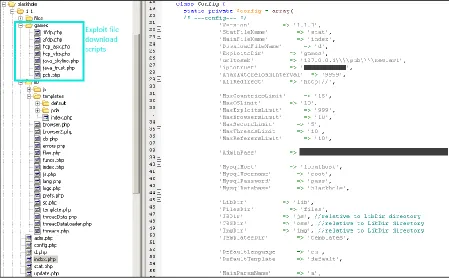
[image:4.612.82.531.397.676.2]We were able to obtain a leaked copy of BEK and inspect it (Figure 2). The server side code for the BEK kit is written in PHP and the client side code is written in JavaScript. The author of the BEK has taken precautions to protect the code through code obfuscation and also by maintaining a centralized mode of operation. The server side PHP code is obfuscated through a commercially available tool called Ion Cube PHP Encoder and the client side JavaScript is obfuscated using a custom routine.
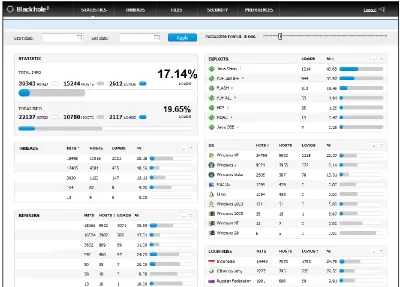
The BEK is highly configurable though a PHP admin panel [2] [3] (Figure 3) with features such as:
Password protected admin panel with support for English and Russian languages.
MySQL database backend.
Blacklisting IP Addresses (Prevents researchers from inspecting by excluding their IP ranges).
Traffic redirection with custom rules to follow pre and post exploit.
Interchangeable payload feature with Antivirus detection information for payload.
Infection statistics categorized by country, browser, operating system and exploits.
Ability to query statistics by date range.
Graphical representation of data.
Ability to enforce limits for infection execution by browser type, operating system, country and referrer (Allows them to stay under the radar).
Ability to limit infection to certain browsers or countries for a more targeted attack.
[image:5.612.124.524.347.634.2] Ability to select exploits to attempt.
6
In addition to the features listed above, BEK v2.0 claims to add multiple new features [4] to evadedetection and to prevent researchers from reverse engineering the kit:
Dynamic URL for exploits which expires after a few seconds (Prevents automated crawlers from identifying BEK and obtaining exploits and payload).
JAR and PDF exploit code is only loaded if vulnerable version of plugin is found.
Removed older exploits and bloated code.
Ability to use custom URI.
More flexible traffic redirection with ability to identify unique users.
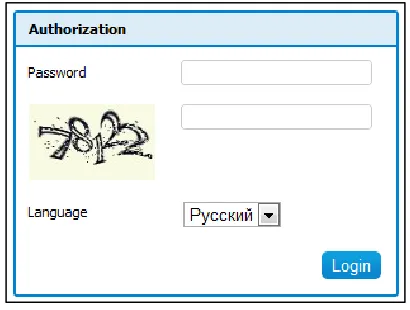
CAPTCHA for login to admin interface to prevent access to admin panel by brute force (Figure 4).
Better load distribution on admin panel and easier access to infection statistics with longer retention.
Statistics for Windows 8 and mobile devices are also collected along with statistics for software versions seen.
Ability to block traffic without referrer or with a specific referrer.
Ability to block traffic originating from TOR network.
[image:6.612.204.409.378.533.2] Ability to automatically switch domains when blacklisted.
3. Functionality of Blackhole exploit kits
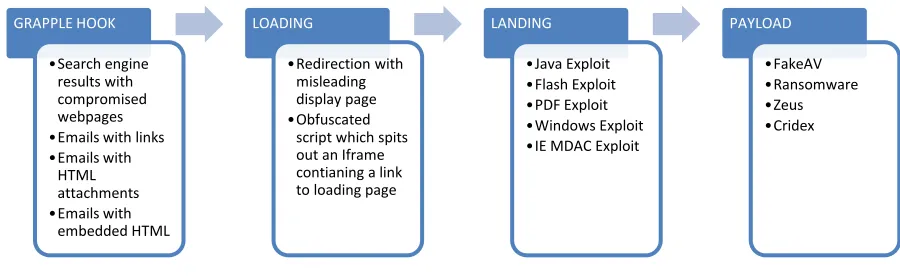
[image:7.612.80.530.179.318.2]The BEK has a modularized infection cycle. They can be classified broadly in four stages of infection which we will define as the grapple hook stage, loading stage, landing stage, and payload stage (Figure 5).
Figure 5 - Modularized infection routine of BEK
This modular infection cycle allows for easy interchangeability of various components of this kit. Once the user is led to a malicious link in the grapple hook stage and are at the loading stage, they are then redirected to a different server for the landing stage and the payload. This redirection feature, most commonly referred to as TDS (Traffic Direction System) is present in various exploit kits. BEK author goes one step further and allows for granular configuration of TDS through custom traffic redirection rules. Traffic flow of a typical infection cycle of the BEK v1.2.3 is shown in Figure 5. A distinct URI pattern is also evident from the traffic flow which will be discussed in detail as we delve in to each of these stages in detail.
Figure 6 - Traffic Flow of BEK
Updated in BEK v2.0:
In BEK v2.0 that was released recently, the URIs are dynamic and the client side exploit code is also generated dynamically. This makes it harder to identify and reverse engineer. A sample of BEK 2.0 infection cycle is shown in in Figure 7.
GRAPPLE HOOK
•Search engine results with compromised webpages •Emails with links •Emails with HTML attachments •Emails with embedded HTML LOADING •Redirection with misleading display page •Obfuscated
script which spits out an Iframe contianing a link to loading page
LANDING
•Java Exploit •Flash Exploit •PDF Exploit •Windows Exploit •IE MDAC Exploit
PAYLOAD
8
3.1 Grapple Hook Stage
[image:8.612.99.512.251.589.2]The grapple hook stage is where an unsuspecting user is lured in to clicking on a HTTP link leading to the BEK host. These links may appear in search engine results placed strategically through search engine optimization techniques or though spam emails with misleading content enticing the user to click on a link (Figure 8). The spam campaigns use varying themes and popular brand names to entice the user. We have also seen instances wherein the HTML page containing the script is sent as an attachment in the email. In this scenario when the user opens the HTML page in a browser, the infection routine kicks in.
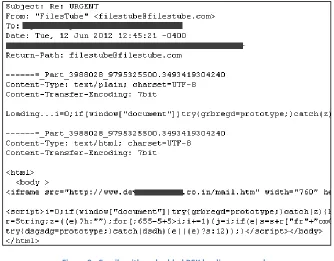
The most interesting infection vector we have seen is an email with the BEK loading page script
[image:9.612.140.474.208.469.2]embedded in the email message body (Figure 9). In this scenario, simply opening the email with an email client that renders HTML will kick start the infection process. As seen in the figure, they have employed usage of both an Iframe pointing to site hosting BEK as well as an embedded BEK exploit script in the message body. They employ this two pronged attack to improve the chances of success. If either Iframe rendering or scripting is disabled in the email client, then the other one can succeed.
10
3.2 Loading Stage
The loading stage is usually hosted on a compromised Wordpress page. This compromised page is injected with an obfuscated JavaScript code as seen in Figure 10. The long string seen in the code (variable f) contains a hidden Iframe. On execution of this code, it results in decryption of the hidden Iframe that redirects to the loading stage on a different server as seen in Figure 11.
Figure 10 - Obfuscated script in loading page
Figure 11 - Hidden Iframe containing link to landing page
Figure 12 - Misleading loading page as seen in the browser (links redacted)
3.2.1 Pseudo Random Domain Generation
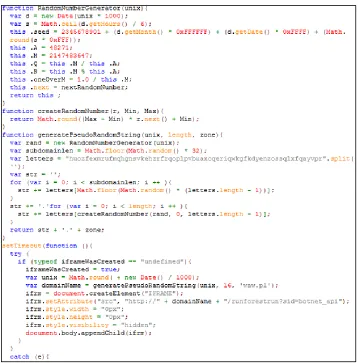
We saw a few instances of BEK using a pseudo random domain generation algorithm for TDS (Traffic direction system). The loading pages using this algorithm redirect users to a different page each time. Unlike the use of compromised Wordpress pages usually seen, these instances of BEK were found injected on servers managed using Plesk [5] [6]. Plesk is a graphical administrative control panel used to manage hosted servers. The attackers used a SQL injection vulnerability in Plesk to dump database tables storing user credentials. They then used these credentials to access and modify JavaScript files on the server. This vulnerability is documented under CVE-2012-1557.
The de-obfuscated version of the script used in these instances is shown in Figure 13. This script uses pseudo random number generators to create permutations of strings forming the domain name. It generates new domain names every twelve hours. The domains generated by this script use the following format
12
Figure 13 - Snippet of Pseudo Random Domain Generation Script
3.3 Landing Stage
The URL for the landing page in BEK v1.2.3 and before is one of the following formats:
http://{removed}/showthread.php?t={16-digit-hex} [Seen in recent instances]
http://{removed}/main.php?page={16-digit-hex} [Seen in recent instances]
http://{removed}/check.php?uid={16-digit-hex}
http://{removed}/search.php?page={16-digit-hex}
http://{removed}/index.php?tp={16-digit-hex}
The URL for the landing page in BEK v2.0 has customizable URI format.
routine (Figure 14) or at the end as seen in other instances. A BEK infection cycle flow diagram for version 1.2.3 is shown in Figure 16 and the de-obfuscated version of this script is available in Appendix (A).
Figure 14 - Snippet of obfuscated script on landing page
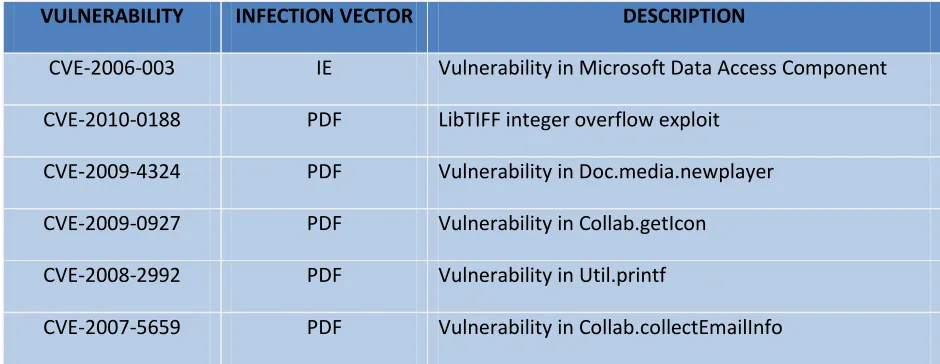
The exploits used in this stage are constantly updated as new vulnerabilities are discovered and older ones are patched. The exploits targeted by the BEK [7] that we captured over time are shown in Table 1.
VULNERABILITY INFECTION VECTOR DESCRIPTION
CVE-2012-4681 JAVA Privilege escalation vulnerability in ProtectionDomain. CVE-2012-1723 JAVA Vulnerability in the HotSpot bytecode verifier
CVE-2012-0507 JAVA Incorrect array type in AtomicReferenceArray CVE-2011-3544 JAVA Unsigned Java applet gains elevated privileges CVE-2010-0840 JAVA Improper checks when executing privileged methods CVE-2010-0842 JAVA MixerSequencer invalid array index vulnerability CVE-2011-2110 FLASH Array indexing vulnerability
14
VULNERABILITY INFECTION VECTOR DESCRIPTION
CVE-2006-003 IE Vulnerability in Microsoft Data Access Component CVE-2010-0188 PDF LibTIFF integer overflow exploit
CVE-2009-4324 PDF Vulnerability in Doc.media.newplayer CVE-2009-0927 PDF Vulnerability in Collab.getIcon CVE-2008-2992 PDF Vulnerability in Util.printf
[image:14.612.70.540.80.262.2]CVE-2007-5659 PDF Vulnerability in Collab.collectEmailInfo
Table 1 - Exploits targeted by BEK
The script on the landing page terminates by redirecting the user to a predefined location or a blank page. In earlier versions of the script we observed redirections to Google domains. Although this could be considered a good technique to mislead users and prevent them from getting suspicious, it also inadvertently provided Google with complete statistics for BEK infections and the ability to easily identify and report servers hosting BEK. The miscreants using BEK seem to have become aware of this and have stopped redirecting users to Google in recent versions of the script.
Updated in BEK v2.0:
In case of BEK v2.0, the client side exploit code is generated dynamically and does not contain all the exploit payloads unlike previous versions. In the newer version, only the exploits for identified
[image:15.612.73.558.204.362.2]vulnerable applications are loaded on the client side. The URI in the newer version for exploit as well as the malware payload is dynamically generated with random variable names (Figure 15).
Figure 15 - BEK v2.0 landing page using dymanic content
16
BLACKHOLE EXPLOIT KIT INFECTION CYCLE
SUCESS Blackhole Exploit Site Landing page
Client side Obfuscated JavaScript Client side JAR
Applet Java exploit attempt via applet. CVE-2012-4681 CVE-2012-1723 CVE-2012-0507 CVE-2011-3544 CVE-2010-0840 CVE-2010-0842
Download and execute malware payload: Cridex, Zeus, FakeAV,
Ransomware Function SP2()
MS IE (MDAC) Remote Code Execution exploit
Function SPL0 () calls Function SPL2()
CVE-2006-003 SUCCESS Browser PluginDetect &
variable initialization
Function SPL3() Checks if Adobe Reader version (A) <8.0 or (B) 8.0 or (9.0 – 9.3)
& select the PDF URL
Function SPL4() Windows Help Center URL Validation vulnerability exploit FAIL
Function SPL5() with 1000ms timeout Adobe Flash Player version check
(A) 10.0.(>)40 (B) 10.2.(<)159 (C) 10.(<)2
FAIL
Checks Escript engine & Reader version is vulnerable
& select exploit to use
CVE-2010-0188 CVE-2009-4324 CVE-2009-0927 CVE-2008-2992 CVE-2007-5659 CVE-2010-1885 SUCCESS
Refer to Figure 19 for Flash Exploit flow
CVE-2011-0611
SUCCESS
Function SPL6() if SPL5() times out Adobe Flash Player version check
(A) 10.3.181.(<=)23 (B) 10.3.(<)181 FAIL CVE-2011-0611 SUCCESS FAIL CALL Show_pdf(URL) YES FAIL SUCCESS
Function SPL7() calls end_redirect() with 8000ms
timeout. Redirects to Google or
blank page.
[image:16.612.112.519.77.670.2]Refer to Figure 19 for Flash Exploit flow
3.3.1 Java Exploit
Various java exploits have been targeted by BEK and java exploits have higher infection rates compared to other exploits. Java exploits are loaded in an applet code outside of the obfuscated exploit script on the landing page in recent instances. Java exploits were loaded by JavaScript in older instances of BEK. The JAR files targeting exploits are constantly renamed to evade detection.
[image:17.612.97.519.242.560.2]The most recent Java exploit targeted is CVE-2012-4681 and a decompiled version of this exploit is shown in in Figure 17. The exploits targets a 0 day in Java version 1.7.0_06 which was fixed with an update in Java version 1.7.0_07. This exploit was integrated to the BEK very quickly after it was discovered when it was still unpatched.
Figure 17 - Java exploit CVE-2012-4681
As seen in earlier in Figure 11, there is an applet parameter passed to the JAR file. This parameter is an obfuscated URL which when decrypted points to the malware executable. The decrypted URL for BEK v1.2.3 and prior is of the form:
18
3.3.2 IE MDAC ExploitThis is an old exploit that targets a vulnerability in Microsoft Data Access Component (MDAC) as
documented in CVE-2006-003. In spite of the vulnerability being patched years ago, we still see usage of this exploit in newer instances of BEK. The JavaScript attempting this exploit is shown in Appendix (A). When the exploit is successful it leads to download of malware from a URL which is of the form (for BEK v1.2.3 and prior):
http://{removed}/w.php?f={hex}&e=2 3.3.3 PDF Exploit
There are two PDF exploit files used in BEK. The appropriate one is selected based on the version of Adobe Acrobat Reader. The URL hosting these PDF exploits for BEK v1.2.3 and prior:
http://{removed}/data/ap1.php?f={hex} [Targets versions <8.0]
http://{removed}/data/ap2.php [Targets versions 8.0 and 9.0 – 9.3]
The PDF files contained embedded obfuscated JavaScript that attempt various exploits. These scripts are shown in Appendix (B) and Appendix (C) [8] [9]. These scripts further check Adobe Escript engine version and selects the appropriate exploit to attempt. When an exploit succeeds, it leads to the download and execution of malware from a URL of the form (for BEK v1.2.3 and prior):
http://{removed}/w.php?f={hex}&e=3 3.3.4 Windows Help Center Exploit
Windows Help Center provides access to help documents through HCP protocol (hcp://). These HCP links are susceptible to cross site scripting as the ‘svr’ parameter is not sanitized. A snippet of the exploit script attempting CVE-2010-1885 is shown below in Figure 18. This exploit is attempted via the following URL (for BEK v1.2.3 and prior):
http://{removed}/data/hhcp.php?c={hex}
Figure 18 - Snippet of HCP exploit code
When the exploit succeeds it leads to the download and execution of malware from a URL of the form (for BEK v1.2.3 and prior):
3.3.5 Flash Exploit
Flash exploits are attempted through two functions based on the version of flash installed. The first function uses field.swf and score.swf to attempt CVE-2011-0611. The second function uses flash.swf to attempt CVE-2011-2110. The flow of flash exploits is shown in Figure 19 and the exploit code is shown in Appendix (D) and Appendix (E) [10].
FLASH EXPLOIT Function SPL5(): Timeout 1000ms
Call getCN() using ExternalInterface
Adobe Flash Player version check (A) 10.0.(>)40 (B) 10.2.(<)159
(C) 10.(<)2
Function SPL6() NO
YES
Call getBlockSize()
using ExternalInterface 1024
Call getAllocSize()
using ExternalInterface 1024x1024
Call getAllocCount()
using ExternalInterface 300
CVE-2011-0611
Download & load score.swf using addChild
%u0c0c + shellcode Adobe Flash Player
version check (A) 10.3.181.(<=)23
(B) 10.3.(<)181
YES Create Flash object
flash.swf & pass paramter info={Encrypted URL}
Create Flash object
field.swf
Call hexToBin(info): Converts info in to a binary stream
XOR info with 122 & Uncompress using zlib
Get userAgent using ExternalInterface
Check if browser is IE or Firefox
Check if flash is debugger version or embedded in PDF
or process is 64 bit YES
NO
CVE-2011-2110
(Exploit payload selected
Download & execute file getFillBytes() + getShellCode()
data/score.swf
Prepare payload for heap spray using parameters
from functions calls
ERROR/EXIT
[image:19.612.111.503.178.695.2]20
3.4 Payload
The BEK v1.2.3 and prior keep track of the exploits resulting in the download of malware payload using the parameter ‘e’ in the URI and the downloaded payload using the parameter ‘f’. The parameter e and f are set to the appropriate values by the exploit script as shown in Table 2.
EXPLOIT PAYLOAD URL
[image:20.612.173.441.178.417.2]JAVA http://{removed}/w.php?f={hex}&e=0 FLASH http://{removed}/w.php?f={hex}&e=1 MDAC http://{removed}/w.php?f={hex}&e=2 PDF 1 http://{removed}/w.php?f={hex}&e=3 PDF 2 http://{removed}/w.php?f={hex}&e=4 IE MDAC http://{removed}/w.php?f={hex}&e=5 UNKNOWN http://{removed}/w.php?f={hex}&e=6 IE MSXML http://{removed}/w.php?f={hex}&e=7
Table 2 – URL format of BEK payload
The payload being downloaded from links in majority of the recently spammed BEK campaigns is the Cridex Banking Trojan. We have seen BEK leading to Zeus, Fake AV and Ransomware as well in the past. For more information on dropped malware payloads by various BEK spam campaigns, refer to the following SonicAlerts [11] [12] [13] [14] [15] [16] [17]:
https://www.mysonicwall.com/sonicalert/searchresults.aspx?ev=article&id=471 https://www.mysonicwall.com/sonicalert/searchresults.aspx?ev=article&id=460 https://www.mysonicwall.com/sonicalert/searchresults.aspx?ev=article&id=452 https://www.mysonicwall.com/sonicalert/searchresults.aspx?ev=article&id=449 https://www.mysonicwall.com/sonicalert/searchresults.aspx?ev=article&id=421 https://www.mysonicwall.com/sonicalert/searchresults.aspx?ev=article&id=414 https://www.mysonicwall.com/sonicalert/searchresults.aspx?ev=article&id=412
4. Relation with other Malware Families
In the previous section we covered in-depth analysis of the internal Blackhole Exploit Kit functionality and the infection cycle. In this section we will focus more on the initial delivery mechanism used by various malware families and the connection to related cybercrime gangs.
Blackhole Exploit kit is one of the most popular and highly successful crimeware kit for drive-by
infections of Banking Trojans, Fake AVs, Ransomwares etc. It is very popular in the Pay-Per-Install (PPI) crimeware ring because of its ability to uniquely identify the source using aforementioned TDS feature.
4.1 Initial Delivery mechanism
Blackhole Exploit kit landing page URLs are spread via following mechanisms:
SEO Techniques: Poisoning search engine results to redirect users to BEK landing page. With popular search engines like Google actively flagging the infected sites this has become less prevalent vector.
Compromised Websites: We have seen a large number of WordPress websites being exploited and injected with malicious Iframe and/or JavaScript redirecting users to BEK Landing page.
Botnet E-mail spam: We have monitored and captured millions of e-mail over past one year spammed via Botnets (Cutwail, Bredo etc) using different themes to lure the user. E-mails either have a clickable URL or HTML attachment containing redirect to compromised websites.
Miscellaneous: We have observed reports of social networking sites like Twitter being used to spam BEK URLs. We have also seen usage of BEK URLs in some targeted attacks.
22
BANKS AND FINANCIAL INSTITUTIONS SOCIALNETWORKING
SHIPPING CARRIERS
OTHER MAJOR COMPANIES
Citibank Intuit Facebook FedEX US
Airways HP
American Express NACHA LinkedIn USPS American
Airlines eBay
Bank of America ADP Craigslist DHL AT&T Amazon
Wells Fargo PAYPAL Living Social UPS Verizon Xerox
[image:22.612.69.544.82.283.2]Western Union IRS Groupon BBB
[image:22.612.74.542.350.565.2]Table 3 – Enterprise targeted by BEK Spam campaigns
Figure 20 – Blackhole Exploit Kit instances blocked.
Figure 20 above shows the number of instances of Blackhole Exlpoit Kit in the wild that were blocked by Dell SonicWALL Gateway Antivirus in the last six months.
4.2 Connection to other Cybercrime gangs
A successful Blackhole Exploit Kit run will result in a malware payload getting downloaded and executed on the victim machine as defined by the BEK hosting site controller. Fake AV and Ransomware were
0 200000 400000 600000 800000 1000000 1200000 1400000 1600000 1800000
1203 1204 1205 1206 1207 1208
among the first few malware families to adopt BEK infrastructure followed by Banking Trojans (Zeus, Cridex, etc). We have also seen reports of Blackhole Exploit kit usage in planting initial dropper malware as part of Advance Persistent Threat (APT) attacks.
Cybercriminal gangs including malware families like Cridex, Zeus, FakeAV, and Ransomware are having far greater success rates in terms of infecting target machine when using the spam campaigns involving BEK URLs as opposed to spam e-mails containing direct malware payload attachment or URL pointing to it. The main reason for the improved infection rates when using BEK URLs is that there is no user interaction needed once the URL is opened as opposed to an e-mail attachment being downloaded, unzipped, and executable file being run by the end user.
By utilizing the Blackhole Exploit Infrastructure, they are also able to ensure that the malware payloads do not get captured by various honeypots looking for traditional spammed e-mail attachments and hence avoid Antivirus detection for a longer duration. The BEK control panel also allows the operator to define a blacklist of IP addresses, hence preventing some of the known sandbox and honeypot IP addresses from accessing the server.
[image:23.612.126.487.369.657.2]Based on our analysis we were able to come up with the following Blackhole Exploit Kit driven cybercrime infrastructure (Figure 21):
24
5. Blackhole Exploit Kit Statistics
[image:24.612.143.470.204.378.2]In this section we will look at some of the interesting statistics for BEK kit based on the BEK exploit activities that we have monitored in the wild over past one year.
Figure 22 below shows the success rate of various exploit modules involved in the kit, as we can see Java exploits have been the most successful module in infecting the target machine:
Figure 22 – Blackhole Exploit Kit successful exploit modules.
We highly recommend everyone to turn off Java if you don’t need it and to keep the software updated with latest patches.
[image:24.612.142.473.486.678.2]Below is a distribution of top level domains for the domain names involved in various BEK spam campaigns and drive-by attacks (Figure 23):
Geographic distribution of the BEK landing page hosting servers involved in various BEK spam campaigns and drive-by attacks is shown in Figure 24:
Figure 24 – Blackhole Exploit Kit landing page geographic distribution.
[image:25.612.100.513.439.696.2]26
6. Conclusion
Blackhole Exploit kit is one of the most popular and successful crimeware kits we have seen over past two years. Based on our research, some of the major contributing factors towards the rise of this exploit kit in the cybercrime market are:
The modular exploit structure.
Quick periodic updates incorporating new 0-day exploit payloads.
Active support & maintenance.
Centralized mode of operation & use of commercial tools to protect source code..
Silent mode of operation in the background.
Highly customizable & scalable control server.
Antivirus evasion features.
As we discussed in this paper, some of the major malware families like Cridex, Zeus, Fake AV, and Ransomware are already leveraging BEK Infrastructure and have been very successful with it. We anticipate this kit to evolve further and stay on top with more malware families adopting this successful and proven BEK driven cybercrime business model.
With BEK v2.0 adding support for tracking Mobile Browsers, it won’t be surprising to see malware payloads targeting mobile platforms being served by BEK sites in near future.
Botnet spam remains the most active vector for BEK URL’s initial delivery mechanism, however we are anticipating more social networking media usage in future for spreading BEK URLs.
Appendices:
The exploit scripts have been reformatted and indented for readability.
Appendix (A) - Deobfuscated Blackhole Landing Page Script
Initialization & Plugin Detection
28
PDF ExploitsCVE-2009-4324 CVE-2009-0927 CVE-2008-2992 CVE-2007-5659
PDF Exploit CVE-2010-0188
Functions called by ActionScript in
field.swf
Shellcode used by field.swf for Heap Spray
30
flash.swfAppendix (B) - Deobfuscated Script Embedded in PDF 1
Shellcode used in Heap Spray
Attempts CVE-2007-5659 in Collab.collectEma
ilInfo
32
AttemptsCVE-2009-0927 in Colllab.getIcon
34
Appendix (C) - Deobfuscated Script Embedded in PDF 2
36
Appendix (D) - ActionScript for field.swf
Calls other external functions in exploit JavaScript
to prepare payload for heap
spray getCN() returns path to score.swf
Appendix (E) - ActionScript for flash.swf
info parameter is passed externally from JavaScript
and contains encrypted link to
malware
Error if userAgent XOR info parameter with
38
Error if flash isdebugger version or if process is 64
bit or if ActionScript is
embedded in Acrobat
Convert info parameter from hexadecimal to
binary string
Determine target addresses and create payload based on further
version and plugin checks. Attempts CVE-2011-2110 Array
40
References
1. http://www.ic3.gov/media/2012/120420.aspx
2. http://www.xylibox.com/2011/06/overview-of-blackhole-exploit-kit-v110.html
3. http://www.xylibox.com/2012/02/blackhole-v122.html
4. http://malware.dontneedcoffee.com/2012/09/blackhole2.0.html
5. http://blog.unmaskparasites.com/2012/06/22/runforestrun-and-pseudo-random-domains/
6. http://blog.unmaskparasites.com/2012/07/26/runforestrun-now-encrypts-legitimate-js-files/
7. http://cve.mitre.org/
8. http://www.adobe.com/content/dam/Adobe/en/devnet/acrobat/pdfs/js_api_reference.pdf
9. http://partners.adobe.com/public/developer/en/tips/lc_viewer_version.pdf
10. http://help.adobe.com/en_US/FlashPlatform/reference/actionscript/3/index.html
11. https://www.mysonicwall.com/sonicalert/searchresults.aspx?ev=article&id=471
12. https://www.mysonicwall.com/sonicalert/searchresults.aspx?ev=article&id=460
13. https://www.mysonicwall.com/sonicalert/searchresults.aspx?ev=article&id=452
14. https://www.mysonicwall.com/sonicalert/searchresults.aspx?ev=article&id=449
15. https://www.mysonicwall.com/sonicalert/searchresults.aspx?ev=article&id=421
16. https://www.mysonicwall.com/sonicalert/searchresults.aspx?ev=article&id=414